
Tag Archives: Middlesex

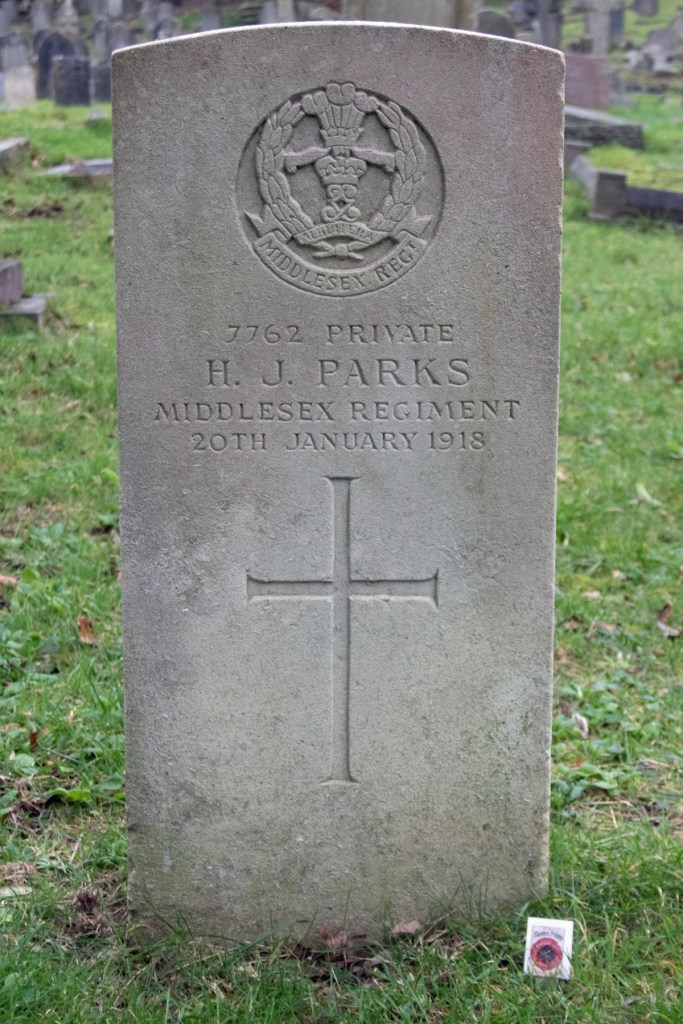
Private Hector Parks

Private Hector Parks

Hector Joseph Parks was born in the spring of 1885, the youngest of five children to William Jacob and Mary Ann Parks. William was a ship’s steward who, when Mary died in 1895, remarried, giving Hector a further two half-siblings.

With William employed at sea, Hector spent a lot of time with his paternal grandparents and, in fact, both the 1891 and 1901 censuses recorded him as living in East London with them. That later document shows that Hector had left school, and was working as a carman for a delivery company.

The next available record for Hector comes thirteen years later, when it is evident that he was among the first to volunteer for war service. He enlisted in the Middlesex Regiment and, while full details of his army career are not available, he soon found himself in the thick of things, arriving in France on 14th August 1914.

Private Parks’ battalion – the 4th – was caught up in skirmishes from the outset of war, fighting at Le Cateau, Marne, Aisne and Hooge. Over the next few years, the Middlesex Regiment found itself at The Somme and Ypres and, while it is not possible to place Hector directly in these conflicts, it seems likely that he would have been involved in a lot of them.

In January 1918, Private Parks was back on home soil, having been admitted to the Auxiliary Hospital at Ashcombe House in Weston-super-Mare, Somerset. Sadly, the cause of his return to England is lost to time, but he was to succumb, passing away on 20th January 1918, at the age of 32 years old.

Hector Joseph Parks was laid to rest in Somerset – he is buried in the Milton Road Cemetery in Weston-super-Mare.

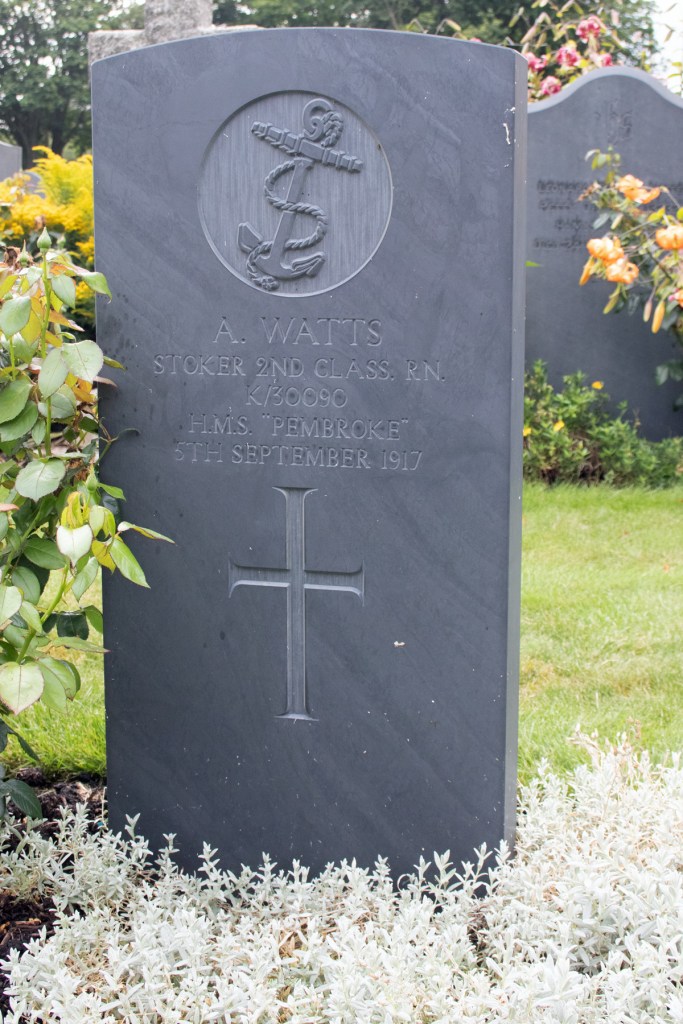
Stoker 2nd Class Alfred Watts

Stoker 2nd Class Alfred Watts

Alfred Watts was born on 16th April 1897 in Marylebone, Middlesex. His mother was called Polly, but there is little further information about his early life.

When he left school, he became a seaman, although in what capacity is not entirely evident. What can be confirmed is that, on 24th November 1915, with war raging across Europe, he decided to make this his full career, and enlisted as a Stoker 2nd Class in the Royal Navy.

Alfred’s military records show that he stood 5ft 4ins (1.63m) tall, had brown eyes, dark brown hair and a fresh complexion. He was also noted as having a birthmark on his right breast.

Alfred’s first posting was at HMS Pembroke, the Royal Naval Dockyard in Chatham, Kent. He spend four months training here, before being assigned to HMS Wallington, a depot shop that served in the Humber Estuary.

On 6th September 1916, in the column marked Discharged is one word: Run. It seems that, for whatever reason, he deserted his post, and having been rounded up nearly three weeks later, he was taken back to Chatham under police guard. He was imprisoned, and only returned to his duties on 30th October.

Stoker Watts was given another posting, on board the battleship HMS Dominion, but again absconded in June 1917, and was detained for a further three weeks, this time at HMS Victory, the dockyard in Portsmouth.

Within a month, Alfred was transferred back to Chatham. HMS Pembroke was a busy place that summer and temporary accommodation was put in place. Chatham Drill Hall was brought into service for this purpose, and Alfred found himself billeted there.

On the 3rd September 1917, the German Air Force carried out its first night air raid: Chatham was heavily bombed and the Drill Hall received a direct hit. Stoker 2nd Class Watts was among those badly injured. He was taken to hospital, but died of his wounds two days later. He was just 20 years of age.

Alfred Watts was laid to rest, alongside the other victims of the Chatham Air Raid, in the Woodlands Cemetery, Gillingham.


Ordinary Seaman George Shuttle

Ordinary Seaman George Shuttle

George James Henry Shuttle was born in Brentford, Middlesex, on 12th July 1899. His mother was Helen (or Ellen or Nellie) Shuttle, but he does not seem to have had a close connection to her and, according to the records, there was no father on the scene. Initially fostered out to Noah and Carmina Scott as a nurse child, by the time of the 1911 census, the couple had adopted him.

When he left school, George worked as a milk boy, but he seemed to know that a life of adventure awaited him. In June 1915, he joined the Royal Navy; being only 15 at the time, he was given the rank of Boy 2nd Class.

His initial posting was on board the cruiser HMS Powerful, and his training there paid off, as he quickly rose to Boy 1st Class. After a couple of months’ at HMS Victory – the Royal Naval Dockyard in Portsmouth – George was assigned to his second ship, HMS Malaya. Within weeks, the brand new battleship had cut her teeth in the Battle of Jutland, during which 65 of her crew were killed.

George spent more than eighteen months on Malaya; his time on board saw him turn eighteen, and gain the rank of Ordinary Seaman. His service records at the time show that he was 5ft 3.5ins (1.61m) tall, had brown hair, grey eyes and a fresh complexion.

By August 1917 Ordinary Seaman Shuttle had returned to shore, and was assigned to HMS Pembroke, the Royal Naval Dockyard in Chatham, Kent. The base was particularly busy when he arrived. Temporary accommodation at Chatham Drill Hall had been set up, and George found himself billeted there for the summer.

On the 3rd September 1917, the German Air Force carried out one of the first night-time air raids on England: an unprepared Chatham was heavily bombed and the Drill Hall received a direct hit. Ordinary Seaman Shuttle was badly injured and died of his wounds in hospital the following day.

George James Henry Shuttle was laid to rest, along with the other victims of the Chatham Air Raid, in the Woodlands Cemetery, Gillingham.


George’s mother, Helen, had continued with her life. A year after George was born, she had another son, Cyril, but he also seems to have been fostered out to enable her to work.

In 1903, she married musician Harry Burgiss-Brown, and the couple set up home in Richmond, Surrey. They went on to have two children, and Helen seemed focused on her new life, rather than the one she had before marrying.

Helen died in 1949, just short of her 70th birthday.