Tag Archives: myalgia

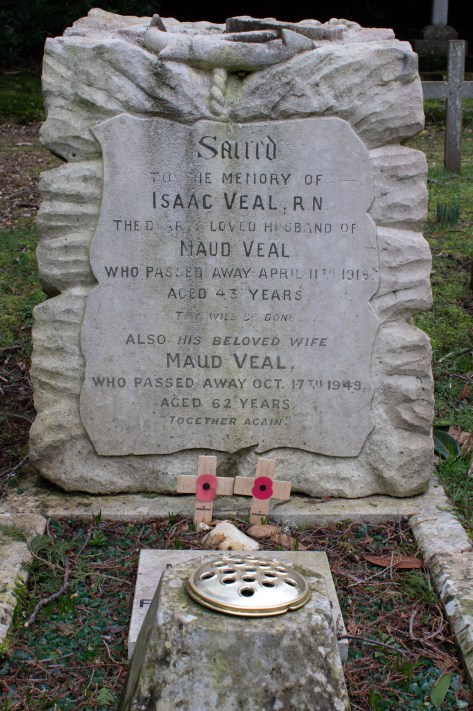
Able Seaman Isaac Veal

Able Seaman Isaac Veal

Isaac Veal was born on 18th November 1874, the seventh of eight children to Joseph and Frances Veal. When he was born, his parents were the publicans at the Waterloo Arms in Lyndhurst, Hampshire, and this is the town in which they would raise their family.

Frances died in 1890, and by the following year’s census, Joseph had stepped back from being a landlord, he was living with three of his children on a farm to the north of the town centre. Now employed as a domestic gardener, Isaac was working with him.

Isaac sought bigger and better things, however, and, on 21st December 1891, he enlisted in the Royal Navy. Intriguingly, though, he gave his date of birth as 10th July 1875. Below the age to formally sign up, he was given the rank of Boy 2nd Class, and was sent to HMS St Vincent in Devonport, Devon, for training. He remained on board for the next two years, rising to Boy 1st Class in March 1893.

On 26th August 1893, Isaac was promoted to Ordinary Seaman: this would normally mark a boy’s coming of age, but the date doesn’t match Isaac’s given date of birth, or his actual one. It is likely, therefore, that his true age had become known.

Ordinary Seaman Veal’s service documents confirm that he was 5ft 6ins (1.68m) tall, with auburn hair, brown eyes and a fair complexion. He signed up for a period of twelve years and, during that time, he would serve on a total of eleven ships. Isaac travelled the world, returning to HMS Victory, the Royal Naval Dockyard in Portsmouth, Hampshire, in between voyages.

On 11th March 1895, Isaac was promoted to the rank of Able Seaman, and his annual reviews generally marked him of very good character. From April 1901 he was assigned to the battleship HMS Revenge, and she would remain his home for more than four years. During his time assigned to her his contract came to an end and he immediately re-enlisted.

On 18th October 1909, Isaac married Ethel Maud Astridge, a caretaker’s daughter from Basingstoke, Hampshire. When they wed, Ethel – who was better known by her middle name – was working as a housemaid for a miller in North Stoneham. The couple would go on to have three children – Beatrice, Mary and Florence – and while her husband was away at sea, Ethel lived in their cottage on Queen’s Road in Lyndhurst.

Back at sea, Able Seaman Veal would continue to travel the world. During the second term of his contract with the navy, he was assigned to a further dozen ships. In August 1912, Isaac was assigned to HMS Dolphin, the shore base in Gosport, Hampshire, which was the home of the Royal Navy Submarine Service. Over the next five years he would split his time between Dolphin and HMS Maidstone. The submarine depot ship, which operated out of Harwich, Essex, would be his home for the majority of the First World War. Able Seaman Veal’s commitment to the navy was being recognised, as was his ability, which was recorded as superior in each of his annual reviews from 1911 onwards.

As the conflict entered its closing months, Isaac’s health was becoming impacted. In the spring of 1918, he was admitted to the sick quarters in Shotley – just across the river from Harwich – suffering from pernicious anaemia and rheumyalgia. The combination of conditions would prove fatal: Isaac passed away on 11th April 1918, at the age of 43 years old.

The body of Isaac Veal was taken back to Hampshire for burial. He was laid to rest in Lyndhurst Cemetery, just a few minutes’ walk from his family home. Conveyed to the cemetery in a motor ambulance van, he funeral was supported by a firing party from the local Bombing School Camp, tributes including “a token of respect from the men of the 8th and 9th Submarine Flotillas.” [Hampshire Advertiser – Saturday 20 April 1918]


After the death of her husband, Maud remained living in Myrtle Cottage, the family’s home for the rest of her life. The 1921 census recorded her as being an apartment House Keeper, while the 1939 Register noted that both she and her daughter Florence, were carrying out unpaid domestic duties.

This latter document identifies three boarders to Myrtle Cottage, including Maud’s younger sister Thirza.

Ethel Maud Veal died on 17th October 1949, at the age of 62. She was buried in the family plot in Lyndhurst Cemetery, reunited with her husband Isaac after more than 30 years.


Private Henry Ridler

Private Henry Ridler

Henry Ridler was born in Henbury, Gloucestershire, in the summer of 1862. He was the middle of three children to Abraham and Harriet Ridler. Abraham was a farm labourer who moved the family for work to the Weston area of Bath, Somerset, not long after Henry’s younger brother, John, was born.

The oldest Ridler sibling, Joseph, worked as a cabinet maker, and by the time of the 1881 census, both Henry and John were apprenticed to him. Henry married Emma Stone on Christmas Eve 1882, and the couple would go on to have seven children.

The 1891 census found Henry and the family living at 5 Comfortable Place in Bath, one of a row of terraced cottages then, but now sandwiched between the River Avon and the busy A4. Henry and Emma had four children by this point – all daughters – and the house was split between them and mother-and-daughter dressmakers Lucy and Lucy Batt.

By the time of the 1901 census, the family were growing up, and had moved literally just around the corner, to 2 Onega Terrace. Set slightly back from the main road, this terraced house had six rooms, and was better suited to the growing family. Henry was still working as a cabinet maker at this point, while his three oldest daughters – Mabel, Lilian and Maude – were all employed, as a corset fanner, a kitchen maid and a nurse girl respectively.

The next census return, taken in 1911, recorded the Ridler family still living in the same house. Henry and Emma had been married for 28 years by this point, and, while 2 Onega Terrace may have had six rooms, they would have become very cramped by this point. Six of the children – aged between 14 and 27 – were still living at home, with everyone in the household but Emma bringing in a wage of sorts.

War was closing in by this point, and, despite his advancing years, Henry was drawn to serve his King and Country. He enlisted in the Royal Army Service Corps on 20th October 1915, a date that confirms he volunteered for duty, as conscription wasn’t introduced until the following year. Henry’s service records show that he was 5ft 6ins (1.68m) tall, with greying hair and blue eyes.

Private Ridler spent two periods of time overseas. In November 1915, his unit was sent to the Eastern Mediterranean, and he served in Salonika, Greece, for seven months. While there, he was hospitalised following an injury to his right knee. He was medically evacuated to Malta, before being posted back home in Britain to convalesce in Woodcote Park Hospital, Epsom, Surrey.

By the summer of 1916, Henry was deemed fit once more, and was sent abroad again, this time to the Western Front. Details of his time there are sketchy, although he seems to have been transferred tot he Labour Corps at some point. It appears that his previous injury flared up again, and he was eventually discharged from the army on medical grounds on 30th July 1918.

At this point, Henry’s trail goes cold. He returned to Bath, but it is unclear whether or not he was able to resume working. The next confirmed documentation for Henry’s life is that of his passing. While the cause is unclear, he breathed his last on 3rd June 1921: he was 58 years of age.

Henry Ridler was laid to rest in Bath’s sweeping Locksbrook Cemetery, a short walk from the family home in Onega Terrace.


Emma remained in the family home for the next 17 years. When she passed away in 1938, she was also laid to rest in Locksbrook Cemetery, not far from her late husband.


Lance Corporal Frederick Channing

Lance Corporal Frederick Channing

Frederick Reginald Channing was born in the autumn of 1869, in Bath, Somerset. He was one of five children to carpenter Allen Channing and his dressmaker wife, Sarah. When Frederick was just a toddler, Allen moved the family south to Chard, and this is where his younger siblings were born.

When Frederick left school, he found work as a lace machine operator and, in fact, all of Allen’s children found work with their hands: Frederick worked alongside one of his brothers, while his two other brothers built on their father’s woodworking skills, one as a coachbuilder, another as a cabinet maker.

By the autumn of 1905, Frederick had moved back to Bath. This is where he met Elizabeth Scammell, a farm labourer’s daughter from Wiltshire. The 1901 census appears to record her as being a servant to a surgeon’s family in Wincanton, and this may have prompted a further move to the larger city where the couple met.

The couple married in Bath towards the end of 1905, and had a son, Frederick Jr, who was born in November the following year. Frederick Sr was doing general labouring work by this point, and the family had moved to Wedmore by the time a second boy, William, was born in 1910. Frederick and Elizabeth had a daughter, Eva, in 1911, and another, Gwendoline, in 1913, tragically, the same year that Eva died.

When war came to Europe, Frederick stepped up to play his part. He enlisted in September 1914, joining the Somerset Light Infantry as a Private. His service records confirm that he was 5ft 6ins (1.67m) tall, and weighed 154lbs (69.9kg). The document also gives his age as 35, although he was actually ten years older than that by this point.

Private Channing spent a year on home soil, during which time Elizabeth gave birth to their fifth child, Percival, who was born in May 1915. Based at a camp in Aylesbury, Buckinghamshire, he was hospitalised twice in this time, suffering from a contusion of his left shoulder.

By September 1915, Frederick was in France, and he remained on the Western Front, apart from when on leave, for the next three-and-a-half years. At some point during this time, he was promoted to the rank of Lance Corporal, and transferred across to the Royal Engineers.

Back at home, Elizabeth was doing her best to raise the family. She didn’t always do the right thing, though, and this resulted in her being taken to court.

Elizabeth Mary Rose Channing, 30… was indicted for having been delivered of a certain female child, did unlawfully by a secret disposition of the deceased child, endeavour to conceal the birth thereof at Wedmore the same day in the month of September 1916.

Mr Wethered prosecuted, and said that the prisoner was a married woman. Her husband was a soldier now on active service. He was last home on leave in April or May, 1917. Previously to that he had not been home for 18 months or two years, so the child could not have been his. Some boys found a parcel in the well, and they discovered the body of the child. The boys communicated with the police, who searched the well and found some pieces of carpet which agreed with a similar carpet in the possession of the prisoner. When arrested she confessed to the crime.

Frederick Channing, husband of the prisoner, said he was home on leave five months ago – May 27th. He went back on June 4th. Previously he had not been home for twenty months. He pleaded for the prisoner in the interests of their four children. He was very sorry for her to think she had thrown herself away like that.

His Lordship, addressing the prisoner, said that while her husband was away doing his duty for her any everybody, she was not faithful to him, and the result was the birth of the child which had been concealed and not revealed till a year afterwards. His Lordship understood that prisoner was already legitimately in a certain condition, and he did not wish her child to be born in prison. She would be sent to prison therefore for three months.

Wells Journal: Friday 26th October 1917

Elizabeth was released in February 1918, and the couple’s last child, Kathleen, was born the following month.

Frederick, meanwhile, returned to the Western Front. He remained in France through to the end of the conflict and beyond, only returning to Britain in February 1919, having fallen ill. Admitted to the North Evington War Hospital in Leicester with influenza, he remained there for two months.

In April 1919, Lance Corporal Channing was transferred to the Bath War Hospital, back in Somerset. This was presumably so that he could be closer to his family, although there is no evidence of whether he was fully reconciled with Elizabeth. His condition did not improve, however, and by this point he was also suffering from myalgia.

Frederick remained in hospital for eighteen months. As time passed, carcinoma of the liver was identified, and this, eventually, was the condition that would take his life. Lance Corporal Canning passed away on 5th September 1920. He was 49 years of age.

Sarah and the children were still living in Wedmore, by this point. Frederick Reginald Channing’s last journey was not to be that far, however. He was moved only a short distance from the hospital, and was laid to rest in the sweeping grounds of the Locksbrook Cemetery in Bath.


Sergeant Herbert Rendell

Sergeant Herbert Rendell

Herbert George Rendell was born in the summer of 1886, the oldest of six children to George and Catherine Rendell. George was a twine maker from West Coker, near Yeovil in Somerset, and it was in this village that he and Catherine raised their young family.

While he initially found work as a labourer when he left school, the lure of a better life and career proved too much for Herbert and, in June 1905, he enlisted in the Royal Engineers as a Sapper. He spent three years spent on home soil, working hard and earning a Good Conduct medal for his service. During his tour of duty, he contracted pneumonia, spending five weeks in hospital in Chatham, Kent, over Christmas 1905, but fully recovering.

In September 1908, Herbert was sent to Singapore for a three-year tour of duty with the 21st Company. His body was not accustomed to the different environment, and he was hospitalised three times for malaria and myalgia, as well as two bouts of gonorrhoea in 1908 and 1910.

In December 1911, Sapper Rendell returned home, where he served for a further three years before war broke out in the summer of 1914. Having been promoted to Lance Corporal, and after a short bout in hospital following a reaction to his cowpox vaccination, he was sent to Egypt.

Assigned to the 359th Water Company, he would have been charged with constructing and maintaining the supply pipes to and from the Front Line and for his work was soon promoted to Corporal.

In the spring of 1918, the now Sergeant Rendell was transferred to the 357th Water Company, and found himself in Palestine, where he stayed until the end of the war. He came home on leave in April 1919, and it was here that, once again, he contracted pneumonia.

Sadly, Sergeant Rendell was not to recover from the lung condition for a second time; he passed away at his parents’ home on 9th April 1919, at the age of 32 years old.

Herbert George Rendell was laid to rest in Yeovil Cemetery, not far from the village where he was born.


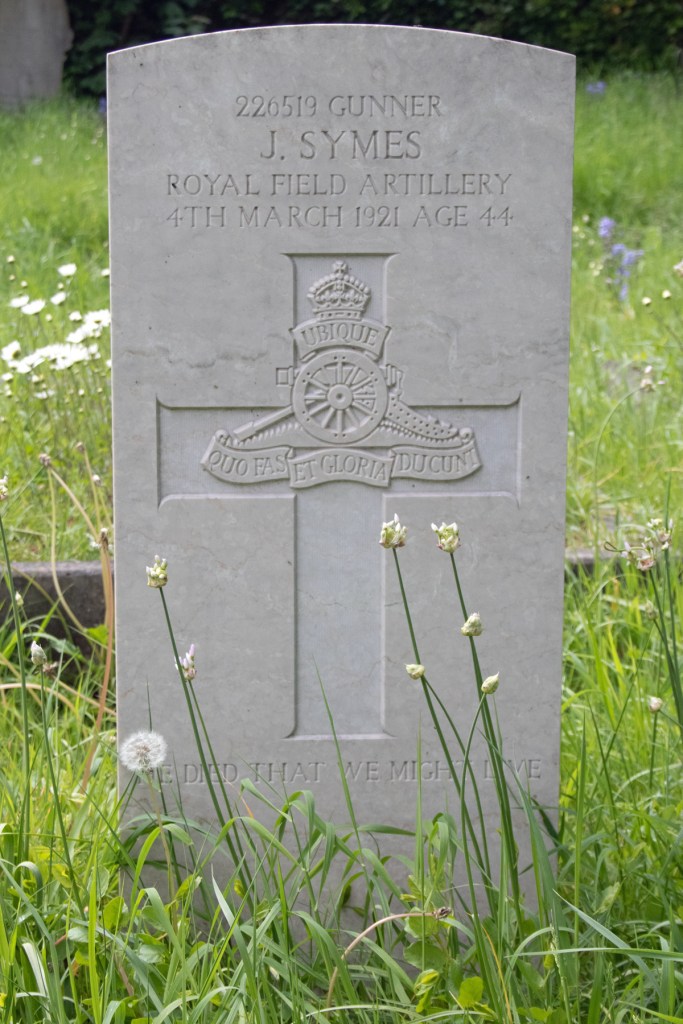
Gunner Joseph Symes

Gunner Joseph Symes

Joseph Symes was born in May 1876, and was the youngest of ten children to Joseph and Caroline Symes. Joseph Sr was a shoemaker who had been born in Shepton Mallet, Somerset, but who had moved to Bristol for work in the late 1860s.

As with some of his older siblings, Joseph Jr followed in his father’s shoemaking footsteps. He worked as a boot clicker, punching the eye holes in footwear, and cutter, taking the shaped pieces out of large leather hides.

In June 1905, he married Emily Delling, who was also from Bristol, and the couple went on to have a son, Douglas, a year later. The couple moved into a two-up-two-down terraced house in a cul-de-sac to the north east of the city centre.

War was coming to the British Isles. Full details of Joseph’s military service no longer exist; however, his gravestone confirms that he enlisted in the Royal Field Artillery.

There is no documentation to confirm whether Gunner Symes saw active service abroad; he certainly survived the war, but in February 1919 was discharged on medical grounds, suffering from myalgia. He was granted a pension, and the family soon replaced the busy city life for a quieter one down the coast in Weston-super-Mare.

Joseph’s trail goes cold for a couple of years, and he passed away on 4th March 1921, at the age of 44 years old. Sadly, there is nothing to confirm the cause of his death; it seems likely that his ongoing medical condition got the better of him.

Joseph Symes was laid to rest in the Milton Cemetery in Weston-super-Mare.


Corporal William Stevens

Corporal William Stevens

William Charles Stevens was born in Wells in 1884. The eldest child of Alfred and Susan, William was one of eleven children. Alfred worked at the local paper mill, while William became a labourer, and found work as a stonemason.

William seemed keen to improve his prospects, however; he enlisted in the army at the start of 1903, serving in the Royal Field Artillery for a period of four years, before being demobbed to the reserves.

On Christmas Day 1907, William married Minnie Bailey; the census four years later gives the young couple as living in their home city. William, by now, was labouring on the railway, and the census shows, they had had a child, who had sadly passed away.

War was looming, and Gunner Stevens was recalled to duty in August 1914. Quickly posted overseas with the 23rd Brigade, he fell ill with myalgia and was shipped home to recover towards the end of the year.

Sent back to the front in 1915, William was promoted to Corporal and transferred to the 51st (Howitzer) Brigade. Sadly, his ‘tremble’ returned and he was sent back to England in October 1915. By this point, Minnie had given birth to their second child, a little girl they called Lilian.

Corporal Stevens’ condition continued, and he was medically discharged in March 1916. No further records exist, but it seems that he finally succumbed to the condition later that year. He passed away on 2nd November 1916, aged 32 years old.

William Charles Stevens lies at peace in the cemetery of his home town, Wells in Somerset.