Tag Archives: New Zealand

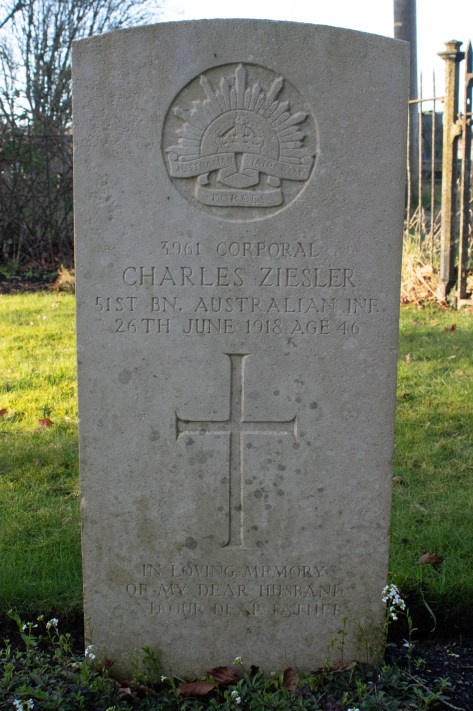
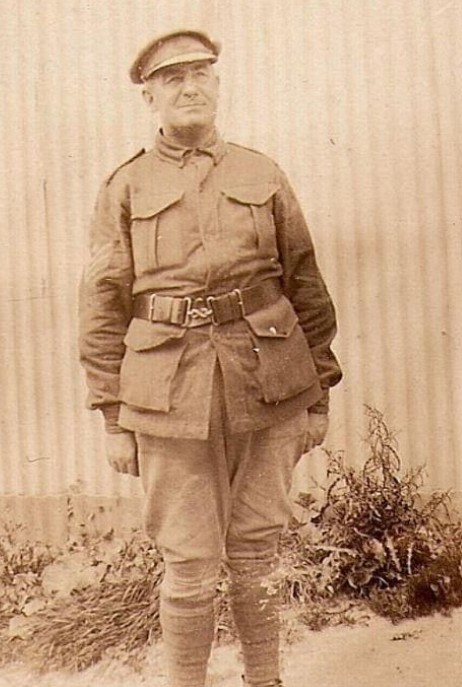
Corporal Charles Ziesler

Corporal Charles Ziesler

Charles Frederick Wilhelm Ziesler was born on 12th February 1877 in Timaru on New Zealand’s South Island. The oldest of nine children, his parents were Norwegian-born Johan Ziesler, and his New Zealand wife, Lucy.

Little information is available about Charles’ early life, but it is clear that he found work as a clerk when he finished his schooling. By the time of the 1899 electoral role, he had set up home at 258 Hereford Street in the Canterbury area of Christchurch.

Things were to change, however, and Charles emigrated to Australia. Taking up a job as a fire adjuster for an insurance company, he settled in the Subiaco suburb of Perth. In 1909 he married Martha Grimwood: the couple went on to have three children, and lived in a house at 97 Park Street.

When war broke out, despite his age, Charles stepped up to serve the Empire. He enlisted in the Australian Imperial Force on 12th November 1915, and was initially attached to the 35th Depot. His service papers show that he was 5ft 11ins (1.8m) tall and weighed 182lbs (82.6kg). He was recorded as having brown hair, blue eyes and a fair complexion.

After several weeks’ training, Private Ziesler’s unit left Australia for the battlefields of Europe. Arriving in Suez, Egypt, on 11th March 1916, he would receive further instruction there over the next couple of months. While many of the ANZAC battalions then set sail for the Dardanelles, the 35th Training Battalion, of which Charles was now a part, headed for Britain.

Private Ziesler arrived in Plymouth, Devon, on 16th June, and was marched into Rollestone Camp in Wiltshire. His preparation continued, and, in August, he was promoted to the rank of Corporal. Charles’ service records suggest that he did not serve on the Western Front, instead remaining attached to the Training Battalions based around Salisbury Plain, in Tidworth and Codford.

By the summer of 1918, Corporal Ziesler had been in Britain for two years and had been promoted to the rank of Acting Sergeant in the 51st Battalion of the Australian Infantry. In June he fell ill, and was admitted to the No 3 New Zealand General Hospital in Codford, suffering from bronchopneumonia. The condition was to prove his undoing: he passed away on 26th June 1918, at the age of 41 years old.

Thousands of miles from home, the body of Charles Frederick Wilhelm Ziesler was laid to rest in the ANZAC extension to the graveyard of St Mary’s Church, Codford, Wiltshire.


Charles’ belongings were returned to his widow: these included his clothing (a leather vest, fur vest, boots, puttees, cap, breeches, underpants and singlets) and more personal items (pipes, coins, photo albums, letters).

Martha may have taken comfort from a detailed letter she received about her late husband’s funeral. “The late Sergeant Ziesler was held in a very high esteem by all ranks in the Unit, and always proved himself a keen soldier, a true and sympathetic comrade and a friend in need and deed. His loss to the Unit is very keenly felt.”

(The CWGC records record the last full rank Charles held: as he held the role of Acting Sergeant, he is noted at the level below, Corporal.)


Corporal Charles Ziesler
(from findagrave.com)

Rifleman William McMullan

Rifleman William McMullan

William McMullan was born in Okaihau, on New Zealand’s North Island, on 10th May 1896. One of three children, his parents were James and Rose McMullan.

There is little concrete information about William’s early life. By the beginning of 1916, he was working as a bushman and volunteering for the local militia. The First World War provided an opportunity to put his skills to use, and he enlisted in the New Zealand Rifle Brigade on 15th January 1916.

Rifleman McMullan’s service records show that, at 19 years and 8 months of age, he was 6ft (1.83m) tall and weighed 12st 6lbs (79kg). A Roman Catholic, he had brown hair, blue-grey eyes and a medium-dark complexion.

William left New Zealand in May 1916, bound for Britain. The journey took ten weeks and, after disembarking in Devonport, Devon, his unit marched to Sling Camp, near Bulford, Wiltshire, arriving there on 29th July. Just a few weeks later, however, Rifleman McMullan was on the move again, and he found himself on the Western Front towards the end of September.

On 16th November 1916, while fighting at the Somme, Rifleman McMullan received a gunshot wound to his thigh. A blighty wound, it saw him medically evacuated to Britain for treatment, and he was admitted to the No. 1 New Zealand General Hospital in Brockenhurst, Hampshire. A few weeks later, he was moved to Codford, Wiltshire, for recuperation at the No. 3 NZ General Hospital.

William would spend the next few weeks in Wiltshire, but after initially being discharged from hospital, he was re-admitted on 25th January 1917. He had contracted broncho-pneumonia, and this would be the condition to which he would succumb. Private McMullan passed away on 13th February, at the age of just 20 years old.

Thousands of miles away from home, William McMullan was laid to rest in the ANZAC extension to St Mary’s Churchyard in Codford, close to the camp he had most recently called home.


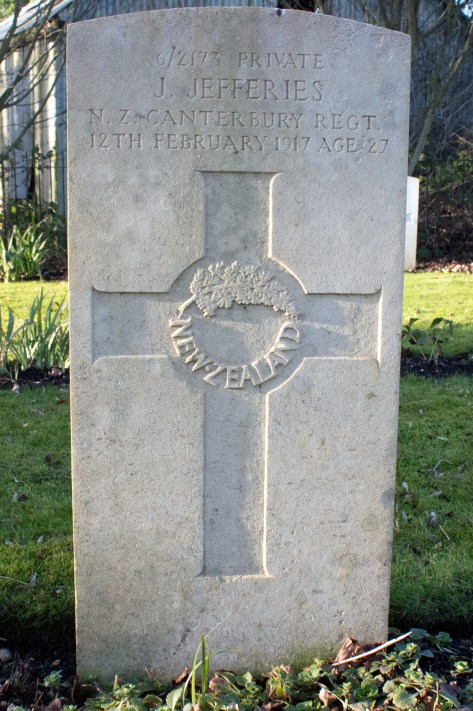
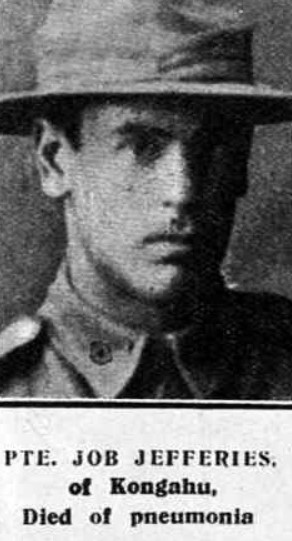
Private Job Jefferies

Private Job Jefferies

Job Jefferies was born on 12th October 1889 in the city of Timaru, on New Zealand’s South Island. The sixth of ten children, his parents were William and Ada Jefferies.

There is little information available about Job’s early life, but by the time war broke out, he had moved to Kongahu, at the northern tip of South Island. He was working as a labourer, and was employed by the Public Works Department.

Job was quick to step up and serve his country. He enlisted in the New Zealand Infantry on 12th February 1915, and was assigned to the Canterbury Regiment. His service records confirm that he was 5ft 10.75ins (1.79m) tall, and weighed 170lbs (77.1kg).

Private Jefferies left New Zealand in the summer of 1915, and his service record makes for grim reading.

On 9th August 1915, Job’s unit arrived in the Dardanelles, and he was firmly entrenched in the fighting at Gallipoli. Wounded on 5th September, he was initially treated at a casualty clearing station, before being medically evacuated first to Malta, then to Britain. He was admitted to the No. 2 Western General Hospital in Manchester, Lancashire, and would spend the next seven months there.

On 12th May 1916, Private Jefferies was on the move, leaving his base in Hornchurch, Essex, for the Western Front. He re-joined his unit on 7th July, but just nine days later was wounded at the Somme. Medically evacuated to Britain again, he spent the next couple of months being moved between hospitals. Discharged back to base in Hornchurch, Essex at the end of September, he would spend the next four months recuperating once more.

By February 1917, it would seem that Private Jefferies had been moved to Sling Camp near Bulford, Wiltshire. While there, he fell ill, and was admitted to the No. 3 New Zealand General Hospital in nearby Codford. He was suffering from pneumonia, and this time his body could take no more. Job passed away on 7th February 1917: he was 27 years of age.

Job Jefferies was laid to rest alongside his fellow soldiers in the ANZAC extension to St Mary’s Churchyard, Codford.


Private Job Jefferies
(from findagrave.co.uk)

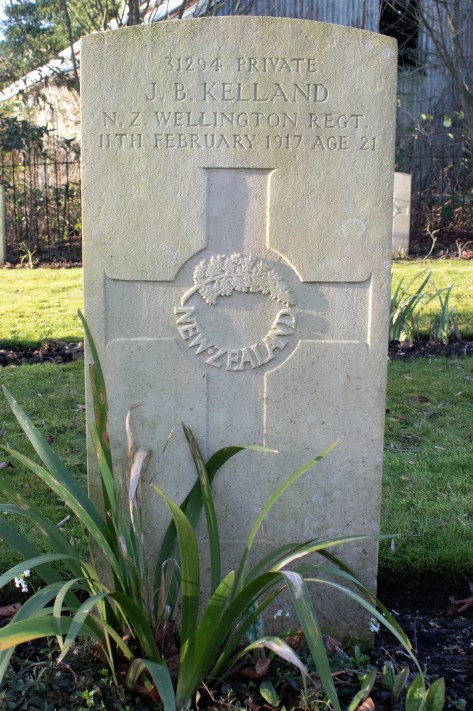
Private John Kelland

Private John Kelland

John Bodley Kelland was born on 4th June 1895 in Otakeho, on New Zealand’s North Island. The fifth of eight children, his parents were George and Mary Kelland. George died in 1902, and John’s mother married again: she and new husband Albert Bowers would have two further children.

There is little additional information available about John’s early life. He found work as a carrier when he left school, and by the time war broke out he was living in the town of Taumarunui. In his spare time, he seems to have volunteered for a local army brigade.

John formally enlisted on 24th July 1916. He joined up in Trentham, and was assigned to the New Zealand Wellington Regiment. His service records show that he was 5ft 9ins (1.75cm) tall and weighed 152lbs (68.9kg). A Roman Catholic, he had brown hair, grey eyes and a dark complexion.

Attached to B Company of the 19th Reinforcements, Private Kelland left his home country on 15th November 1916. He spent the next ten weeks on board the troop ship Tahiti, finally disembarking in Devonport, Devon, on 29th January 1917. From there his unit marched to Sling Camp near Bulford, Wiltshire, where many of the ANZAC troops were billeted.

Private Kelland’s time there was to be limited. His health had been impacted during the sea voyage, and he was admitted to the No. 3 New Zealand General Hospital in Codford, Wiltshire, on 8th February. Suffering from pneumonia, his condition worsened: he passed away on 8th February 1917, at the age of just 21 years old.

John Bodley Kelland was thousands of miles from home. He was laid to rest alongside his comrades in the newly-extended graveyard to St Mary’s Church in Codford.


Private John Kelland
(from findagrave.co.uk)

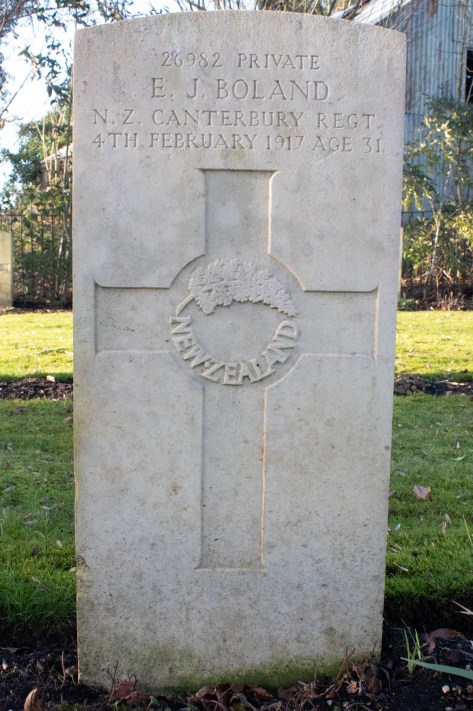
Private Edward Boland

Private Edward Boland

Edward James Boland was born on 14th August 1885 in the town of Darfield, on New Zealand’s South Island. Details of his early life are sketchy, but he was the fourth of nine children to Francis and Annie Boland.

When he finished his schooling, Edward found work as a farm labourer. In 1906, he married Ellen – or Nellie – Shea: their first child, son Raymond, was born the same year, and they would go on to have three more children by the time war was declared.

On 18th June 1916, Edward answered the call to serve the Empire. Enlisting in Trentham, he joined the New Zealand Canterbury Regiment as a Private. His service record notes that he was 5ft 8.5ins (1.74m) tall and weighed 144lbs (65.3kg). A Catholic, he had light brown hair, blue eyes and a fair complexion. A scar on his right thigh was also recorded as a distinguishing mark.

On 16th October 1916, Private Boland left from Wellington on board the steam ship Willochra. His unit – the 18th Reinforcements – arrived in Devonport, Devon, ten weeks later. They were then marched to their base at Sling Camp near Bulford, Wiltshire.

The journey from New Zealand, impacted Edward’s health. At the end of January 1917, he was admitted to the 3rd NZ General Hospital in Codford, Wiltshire, suffering from broncho-pneumonia. His condition deteriorated and would take his life. Private Boland died on 4th February 1917: he was 31 years of age.

As he was thousands of miles from his home, Edward James Boland was instead laid to rest in the newly extended graveyard attached to St Mary’s Church in Codford.


Private Edward Boland
(from findagrave.co.uk)

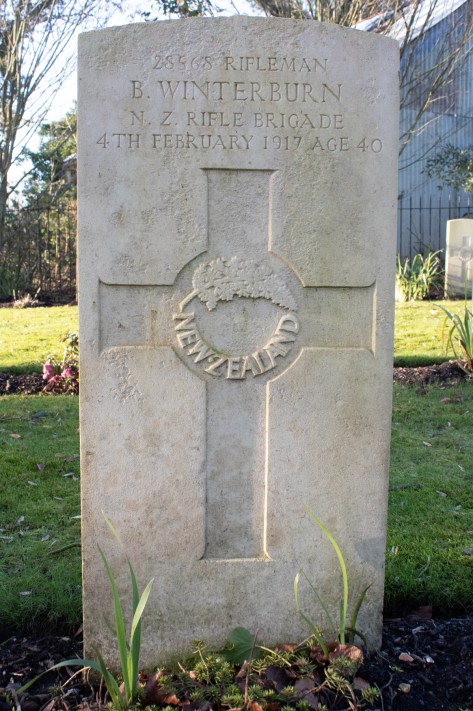
Rifleman Bertram Winterburn

Rifleman Bertram Winterburn

Bertram Winterburn was born in the city of Hutt, on New Zealand’s North Island, on 23rd April 1877. The oldest of eleven children, his parents were Arthur and Ada Winterburn. Arthur was a postmaster from South Island, and it would be here that he and Ada would raise their family.

There is little concrete information about Bertram’s life. The 1913 Post Office Directory records him as working as a labourer, and living in Otaki, a town back on North Island. He seems to have moved wherever the work took him, however, and, by the time war broke out, he was living in Hunterville, 110km (68 miles) further north.

Bertram stepped up to serve the empire when the call came. He enlisted in Trentham on 27th June 1916, and was assigned to the New Zealand Rifle Brigade.

Rifleman Winterburn left from Wellington on board the steam ship Willochra on 16th October 1916. His unit – H Company, 18th Reinforcements – would not arrive in Devonport, Devon, until 29th December. They were then marched to their base at Sling Camp near Bulford, Wiltshire.

The journey from New Zealand, would take its toll on the new recruits, with many falling ill before, or shortly after, they arrived. Bertram would not be immune from this and, at the end of January 1917, he was admitted to the 3rd NZ General Hospital in Codford, suffering from influenza. His condition worsened, developing into bronchitis, and this would take his life. Rifleman Winterburn died on 4th February 1917: he was 39 years of age.

Thousands of miles from his home, Bertram Winterburn was laid to rest in the newly extended graveyard attached to St Mary’s Church in Codford.


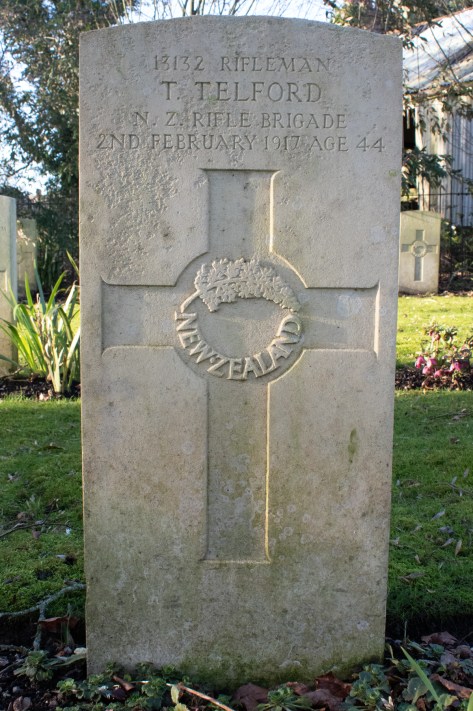
Rifleman Thomas Telford

Rifleman Thomas Telford

Thomas Telford was born in Bacchus Marsh, Victoria, Australia, on 31st July 1873. The fifth of eleven children, his parents were James and Mary Telford.

There is little additional information about Thomas’ early life. By the time war broke out, he had moved to New Zealand, and was working as a bushman, based out of Whanganui on the south coast of North Island.

Thomas enlisted on 18th January 1916, and would be assigned to the New Zealand Rifle Brigade. His service records show that, at 42 years of age, he was 5ft 5ins (1.65m) tall, and weighed 149lbs (67.6kg). A Roman Catholic, he had iron grey hair, blue eyes and fair hair.

Rifleman Telford’s unit left New Zealand in the spring of 1916. After five weeks in Egypt, he arrived on British soil on 7th August, marching from Southampton, Hampshire, to the Sling Camp in Wiltshire.

By 20th August, Thomas was in France, fighting on the front line. He was injured less than three weeks later and, after initial treatment in France, he was medically evacuated to Britain at the end of September.

Rifleman Telford spent time convalescing in a military home in Hornchurch, Essex, before being transferred to the ANZAC base in Codford, Wiltshire. That winter he contracted pneumonia, and he was admitted to the No. 3 New Zealand General Hospital on the outskirts of the village.

Sadly, the lung condition was to prove the better of Thomas. He passed away on 2nd February 1917, at the age of 43 years old.

Thousands of miles from home, Thomas Telford was laid to rest in the graveyard extension to St Mary’s Church in Codford, not far from where he had breathed his last.


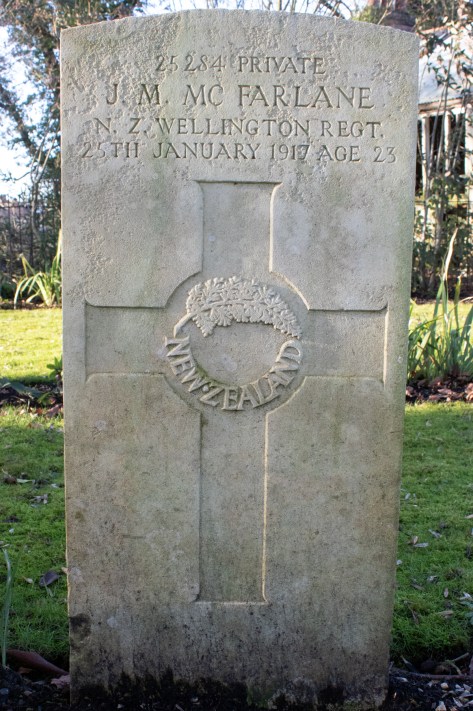
Private James McFarlane

Private James McFarlane

James Malcolm McFarlane was born in Christchurch, New Zealand, on 24th April 1893. Little is known about his early life, although his parents are recorded as Peter and Helen.

When he completed his schooling, James found work on a farm. By the time war broke out, he was employed as a shepherd for Patrick Burke of Woodgrove, in the country’s Canterbury region.

James gave up his work to join the army, enlisting on 24th March 1916. He would have cut a striking figure, standing 6ft 3.5ins (1.92m) tall, and weighing 184lbs (83.5kg). He had dark brown hair, grey eyes and a fresh complexion. His records note that he had a small scar on his right shin, from an old pellet wound.

Assigned to the New Zealand Wellington Regiment, Private McFarlane spend three months in Trentham, on the North Island, for his training. His unit boarded the SS Maunganui and left Wellington for Europe on 26th June 1916. The troop ship arrived in Devonport, Devon, in late August, and James and his colleagues were sent to their camp in Sling, near Bulford, Wiltshire, arriving after a 4-day march.

Private McFarlane would not see any enemy action. In November 1916 he was moved to the ANZAC base near Codford, Wiltshire, and he was admitted to the No 3 New Zealand General Hospital located there. Suffering from pleurisy, he would remain there for the next two months. James passed away from pneumonia on 25th January 1917: he was just 23 years of age.

James Malcolm McFarlane was buried alongside his comrades in the newly extended graveyard attached to St Mary’s Church, Codford.


Private James McFarlane
(from findagrave.com)

Rifleman Alexander Shaw

Rifleman Alexander Shaw

Alexander Richardson Shaw was born in Sandhurst, Victoria, Australia, on 10th February 1884. The second of seven children – although two of his younger siblings died when just babes-in-arms – his parents were Thomas and Elizabeth Shaw.

Little is known about Alexander’s early life. Thomas passed away in 1890, and Elizabeth was left to raise the family alone.

The next document for Alexander is his army service record, confirming that he enlisted on 27th June 1916. By this point he had moved to New Zealand and settled in Wellington. He was employed as a labourer and working for a GG Holmes.

It seems that Alexander had tried to enlist before: his records show that he had previously been turned down because of poor eyesight. At this point, however, with the war raging in Europe, and thousands of New Zealanders being called upon, he was taken on. His service records show that he was 5ft 8ins (1.72m) tall, and weighed 12st 6lbs (78.9kg). Alexander was also noted as having fair (reddish) hair, blue eyes and a fresh complexion.

Rifleman Shaw was sent to Trentham, outside Wellington, for his basic training. His time there was not without incident, however, and on 21st July he was confined to barracks for three days for failing to comply with an order.

On 16th October 1916, Rifleman Shaw’s unit – the New Zealand Rifle Brigade – set sail from Wellington on the SS Willochra for their ten-week voyage to Europe. Discipline remained tight on board and, as the ship was nearing the end of its journey, Alexander was again pulled up. His records simply state that his offence was ‘for clothing issued’, and he was stopped the sum of 3d 6d from his pay.

The Willochra arrived in Devonport, Devon, on 29th December 1916 and, while the rest of his unit was sent to their base at Sling Camp near Bulford, Wiltshire, Rifleman Shaw was admitted to the port’s military hospital. His condition is unclear, but by 10th January he was well enough to be moved to the No. 3 New Zealand General Hospital in Codford, Wiltshire.

Private Shaw was suffering from influenza, and this quickly developed into pneumonia. He passed away on 15th January 1917, just five days after being admitted. He was 32 years of age.

Thousands of miles from home, the body of Alexander Richardson Shaw was laid to rest in the peaceful graveyard extension to St Mary’s Church in Codford, not far from where he had died.


Private James McLeod

Private James McLeod

James McLeod was born on 15th April 1893 in Dunedin, New Zealand. There is little further information about his early life, although the Commonwealth War Graves Commission give his father’s name as Samuel, and his service records note his next-of-kin as his brother, George McLeod.

James was employed by A&T Watt as a French polisher. However, he gave that up on 25th January 1915, when he enlisted in the New Zealand Expeditionary Force. His service records show that he was 5ft 8.5ins (1.74m) tall, and weighed 166lbs (75.3kg). He was recorded a having fair hair, blue eyes and a fair complexion.

Private McLeod was assigned to the New Zealand Otago Regiment, and undertook his initial training on home soil. He evidently showed some promise as, on 1st May, he was promoted to Lance Corporal. Six weeks later his unit was heading for Europe, and by the summer James was in Egypt.

On 20th August 1915, Private McLeod was admitted to the New Zealand and Australian Convalescent Hospital in Mena with a gun shot wound to his finger. He remained there for three weeks, returning to his unit in time for them to leave for the Dardanelles on 7th November 1915.

What happened to James over the next couple of months is uncertain. Certainly he was on the Greek island of Moudros by 18th November and in the Dardanelles on 7th December 1915. Just 20 days later he was back in Alexandria, and he would remain there for the next few months. There is, however, nothing in his medical record to suggest that his return to Egypt was on health reasons.

On 6th April 1916, Private McLeod was on the move again, this time to France. He was wounded again on 14th July 1916, and medically evacuated to Britain for treatment. Details of this injury are not clear, but he was admitted to the 2nd London General Hospital in Chelsea, Middlesex. After a month recuperating, James was released from hospital and sent to camp in Hornchurch, Essex. At this point he was also demoted to Private, although, again, the reason is unclear: it may have been a personal choice, or the reversion may have been connected to his injuries.

In September 1916, Private McLeod was transferred to the ANZAC Camp on the outskirts of Codford, Wiltshire. That winter he contracted pleurisy, and he was admitted to the No. 3 New Zealand Hospital, which was connected to the camp, on Christmas Day. His condition worsened, and James passed away from pneumonia on 28th December 1916. He was just 23 years of age.

Thousands of miles from home, James McLeod was laid to rest alongside his fellow soldiers in the extension to the graveyard of St Mary’s Church, Codford.