
Tag Archives: paralysis

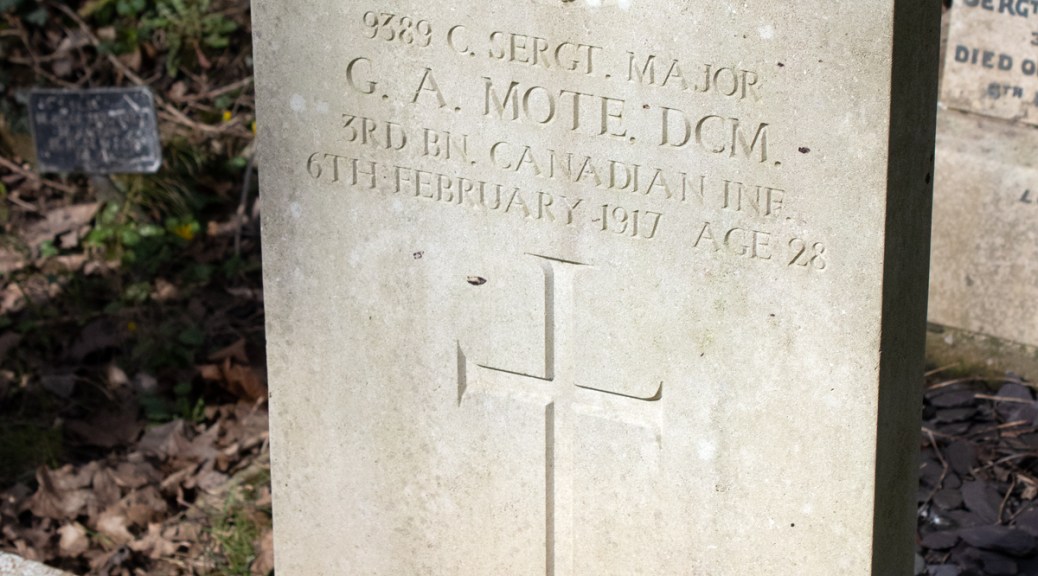
Company Sergeant Major George Mote

Company Sergeant Major George Mote

George Arthur Mote was born on the 25th August 1888 in Islington, Middlesex. The oldest of three children, his parents were Arthur and Norah Mote. The 1891 census recorded Arthur as a shoemaker’s finishing ink maker and the family had taken rooms at 45 Wyatt Road in Islington.

The next census return, taken in 1901, found that Arthur had been promoted, and was now a foreman or a leather dyer. The family had moved around the corner from the old address, and were living in rooms at 193 Blackstock Road.

At this point, George’s trail goes cold. By the autumn of 1914, he had emigrated to Canada, and was working as a corset cutter in Quebec. With war having broken out in Europe, it was here that he enlisted to serve his empire.

Goegre’s service records confirm the young man he had become. Standing 5ft 8ins (1.72m) tall, he had black hair, blue eyes and a dark complexion. A number of scars were also noted on his left forearm, the middle finger of his right hand, and on the left side of his neck.

While back in Britain, George had volunteered for the Middlesex Regiment, and this experience stood him in good stead, as he enlisted with the rank of Sergeant.

Attached to the 3rd Battalion of the Canadian Infantry, Sergeant Mote arrived in St Nazaire, France, on 11th February 1915. His unit was thrown into the deep end from the start, and George’s actions at the Second Battle of Ypres that spring won him the DCM. By the autumn, he had been promoted to Company Sergeant Major.

George continued to serve on the Western Front, but his luck was to change. On 5th June 1916, he was badly injured, receiving gunshot wounds to his right shoulder and back. Medically evacuated to Britain, he was admitted to Fort Pitt Hospital in Chatham, Kent. His medical records noted than he was paralysed, and, in October 1916, he was transferred to the Duchess of Connaught Hospital in Taplow, Berkshire.

Company Sergeant Major Mote spent the next four months admitted to the hospital, but his wounds would prove too severe to overcome. He passed away on 6th February 1917 at the age of 28 years old.

George Arthur Mote’s body was taken back to Middlesex for burial. He was laid to rest in the majestic Highgate Cemetery.

Acting Leading Seaman William Wood

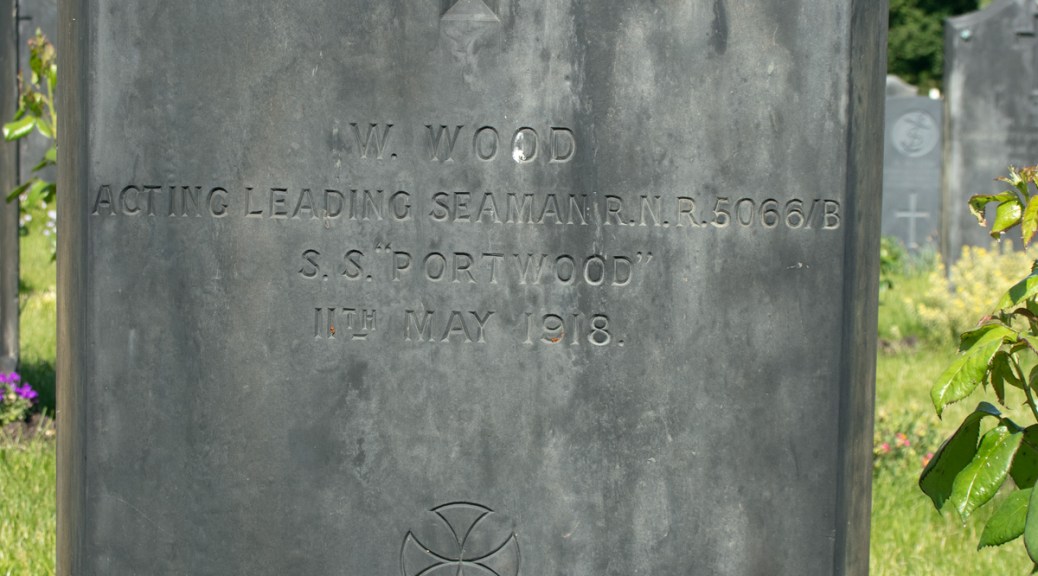
Acting Leading Seaman William Wood

The life of William Wood, who is buried in Woodlands Cemetery in Gillingham, Kent, is a challenge to piece together. His headstone confirms that he held the rank of Acting Leading Seaman in the Royal Naval Reserve, and that he was assigned to SS Portwood at the time of his death.

Full service records for William have long since disappeared, but his pension ledger index card gives his widow as Catherine Rose Wood, of Greenfield Street in Govan, Scotland. It also suggests that the couple did not have any children under full age.

The Royal Navy and Royal Marine War Graves Roll provides William’s date of birth – 28th December 1887 – and goes on to suggest that he was born in London. Sadly, his name is far too common to narrow down census records, and there are no documents relating to his and Catherine’s marriage, so any additional family connections are also lost.

Acting Leading Seaman Wood’s entry on the pension ledger confirms his died of general paralysis of the insane, and his burial in the Gillingham cemetery would suggest that he had passed away in the Royal Naval Hospital in Chatham, Kent. He died on 11th May 1918, at the age of 29 years old.

William Wood was buried in the military section of Woodlands Cemetery, Gillingham, Kent.


Ship’s Corporal Thomas Berry

Ship’s Corporal Thomas Berry

Details of the civilian life of Thomas Joseph Berry are a challenge to piece together. He is not recognisable in any census returns, and baptism records don’t tally either.

The main resource for building a picture of Thomas’ life is the service record for his time in the Royal Navy. This provides his date of birth – 6th May 1882 – and suggests that he was born in Hornsey, Middlesex. He was working as a cabinet maker when he enlisted, the document also confirming that he was 5ft 4ins (1.62m) tall, with brown hair, brown eyes and a fresh complexion.

Thomas began his naval career on 29th July 1898. Below the age to formally enlist, he was given the rank of Boy 2nd Class. Over the next eighteen months, his time was split between two training ships based in Devonport, Devon, HMS Impregnable and HMS Lion. In April 1899 he was promoted to Boy 1st Class.

In February 1900, Thomas moved to HMS Vivid, the Royal Naval Dockyard in Devonport. On 6th May he came of age, and was formally enrolled in the navy, receiving the rank of Ordinary Seaman. From this point his career took off and, over the next sixteen years, he would go on to serve on board fifteen ships, seeing the world.

At his annual reports, Thomas’ conduct was regularly identified as Very Good, and his commitment was reflected in the progress he made through the ranks. By June 1901, he had been promoted to Able Seaman Berry. The summer of 1907 saw him move up to Leading Seaman, and three years later, Thomas was a Petty Officer. In November 1911 he was made Ship’s Corporal 2nd Class, and by the following spring he had been promoted again, this time to Ship’s Corporal 1st Class.

Away from the Royal Navy, Thomas’ personal life was developing. Again there is little documentation to provide any specifics, but he married a woman called Albertine Elizabeth in the early 1910s. The couple went on to have a son, Bernard, who was born on 15th January 1913, and the family seemed to settle down in Paignton, Devon – a later record giving Albertine’s address as 3 Alma Terrace, Well Street.

When war broke out in the summer of 1914, Ship’s Corporal Berry was serving on board the protected cruiser HMS Blake. In February 1916, he was assigned to the battleship HMS Revenge which served in the English Channel.

By this point, Thomas’ health seemed to be taking a downturn. He was posted back to HMS Vivid on 7th March, but was then transferred to Devon County Asylum in Exminster, suffering from “general paralysis of the insane“. His condition worsened and he passed away on 29th April 1916: he was days away from his 34th birthday.

Thomas Joseph Berry’s body was brought back to Paignton for burial. He was laid to rest in the town’s cemetery.