Tag Archives: pleurisy

Bombardier Albert Packer

Bombardier Albert Packer

Albert Edward Farvis Packer was born in Bristol, Gloucestershire, in 1890. The middle of three children, his parents were Francis and Eliza. Francis was a grocer, and when Albert finished his schooling, he worked as his father’s assistant.

Albert went on to work as a butcher’s manager for Messers. John Lewis and Sons in Midsomer Norton. By the time of the 1911 census, he was living in Batheaston with his parents and younger sister, Elsie. When war broke out, Albert stepped up to play his part, following in his older brother’s footsteps. He enlisted in Taunton on 9th December 1915: his service records showed that he was 5ft 10.5ins (1.79m) tall.

Gunner Packer was assigned to the Royal Garrison Artillery. Initially posted to a depot in Cornwall, he was soon assigned to the 173rd Siege Battery, and found himself in France by the beginning of October 1916. Albert remained overseas for the next fourteen months and, in March 1917, was appointed Acting Bombardier.

On 12th December 1917, Albert returned home on leave and, five days later, he married his sweetheart, stationery shop assistant Dorothy Flower, in St Paul’s Church, Bath. The couple made their way to Bristol, to stay with Dorothy’s parents, but Albert fell ill. He was admitted to the 2nd Southern General Hospital in Bristol, suffering from pleurisy and double pneumonia. The condition was to prove too much for his body, and he passed away, while still admitted, on 27th December 1917. He was just 27 years of age.

Albert Edward Farvis Packer was taken back to Bath for burial. He was laid to rest in the sweeping vista of the city’s Locksbrook Cemetery.


In less than a fortnight, Dorothy had become the blushing bride and a widow. She was to go on and find happiness, however. On 20th February 1920, she married Sapper Sidney Bethell, of the Royal Engineers. Their wedding was in Jamaica, where he was based, and the couple went on to have a daughter, Phyllis, the following year.

Sidney and Dorothy eventually settled in Hertfordshire. He died in 1953, at the age of 59: Dorothy passed the next 38 years as a widow again, passing away on 26th December 1991 – almost exactly 74 year after Albert – at the age of 93.


Albert’s older brother, Francis Packer, also fought and died in the First World War. His story can be found here.
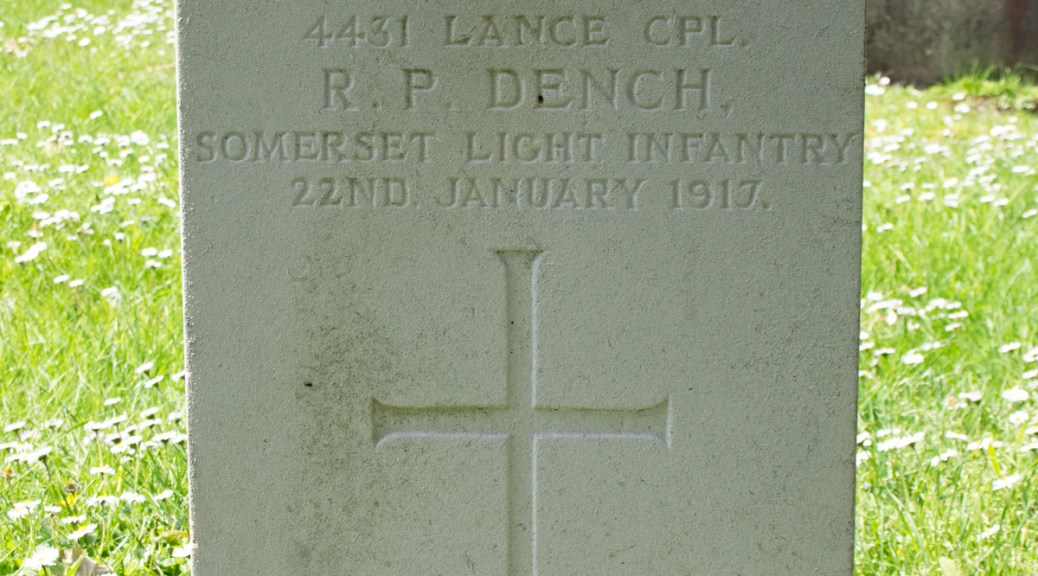
Lance Corporal Reginald Dench

Lance Corporal Reginald Dench

Reginald Percy Dench was born in the spring of 1884 in Twerton, Somerset. He was one of seven children to Henry and Jane – known as Lily – Dench. Henry was a shoe maker turned cloth dyer, but Reginald found work as a stone mason when he finished his schooling.

War came to Europe in 1914, and Reginald stepped up to play his part. His full service details are no longer available, but from what remains it is clear that he had enlisted in the Somerset Light Infantry by the summer of 1916. He was attached to the 5th Battalion, which spent of the conflict in India and Egypt, but there is nothing to confirm that Private Dench served overseas.

Reginald earned a promotion during his military career, and, by the end of 1916 was a Lance Corporal. By this point, however, he had fallen ill, contracting pleurisy. He was, by this point, back in Somerset, and it is likely that he was admitted to the Bath War Hospital. The condition was to get the better of him, and he passed away on 22nd January 1917. He was 32 years of age.

Reginald Percy Dench was laid to rest in Twerton Cemetery, a short walk from the family home in Mill Lane, and close to his two brothers, Edmund and Edward, who had died some twenty years before, while still children.


Tragedy was to strike again for the Dench family when, just six weeks after Reginald’s passing, Henry also died. He was laid in the same cemetery, not far from his sons. When Lily passed away in 1924, she was also buried in Twerton Cemetery, reunited with her family once more.


Gunner Valentine Wilkinson

Gunner Valentine Wilkinson

Valentine Burnett Wilkinson was born early in 1889 in Combe Down, Somerset. One of eight children, his parents were Harry and Eliza Wilkinson, Harry was from nearby Bath and worked as a gardener, and this is the trade into which Valentine also went when he finished school.

In the spring of 1913, Valentine married Florence Moody. She was the daughter of a stone mason and, at the time of the 1911 census, she was employed as a live-in sewing maid at Monkton Combe Junior School.

Gardening seems to have been a footstep to something bigger for Valentine, and he soon found other employment, as a police constable. He and Florence moved to Street, near Glastonbury, and this is where they were living when war broke out.

Keen to play his part, Valentine enlisted in the Royal Garrison Artillery on 11th December 1915. He was placed on reserve, possibly because of his occupation, and was not formally mobilised until the end of June 1917, just six weeks after Florence had given birth to their first and only child, Joan.

Gunner Wilkinson’s service records note that he was 5ft 11ins (1.8m) tall, and had a scar on his right wrist. He spent five months training, split between No. 3 Depot in Plymouth, Devon, 473 Siege Battery and No. 1 Reinforcing Depot in Bexhill-on-Sea, Sussex. On 3rd November 1917, however, he was sent to France, and was attached to the 234th Siege Battery.

Gunner Wilkinson’s time overseas was to be brief, however. He was caught up in a gas attack in December, and evacuated back to Britain for treatment. His health was now impacted and, during the summer of 1918, he was admitted to hospital having contracted pleurisy. After two months in hospital, Valentine was sent to the Military Convalescent Hospital in Ashton-in-Makerfield, near Wigan.

The war was in its closing stages by this point, and in November 1918 Gunner Wilkinson resumed some of his duties, albeit on home soil. His health was still suffering, and he contracted tuberculosis on the lung and throat. He was formally discharged from the army on 27th February 1919, no longer physically fit to serve.

Valentine returned home to Somerset, and it was here, on 1st April 1919, that his body finally succumbed to the lung conditions that had dogged him for nearly eighteen months. He was just 30 years of age.

Valentine Burnett Wilkinson was laid to rest in the quiet graveyard of St Michael’s Church in the parish of his childhood home, Monkton Combe.


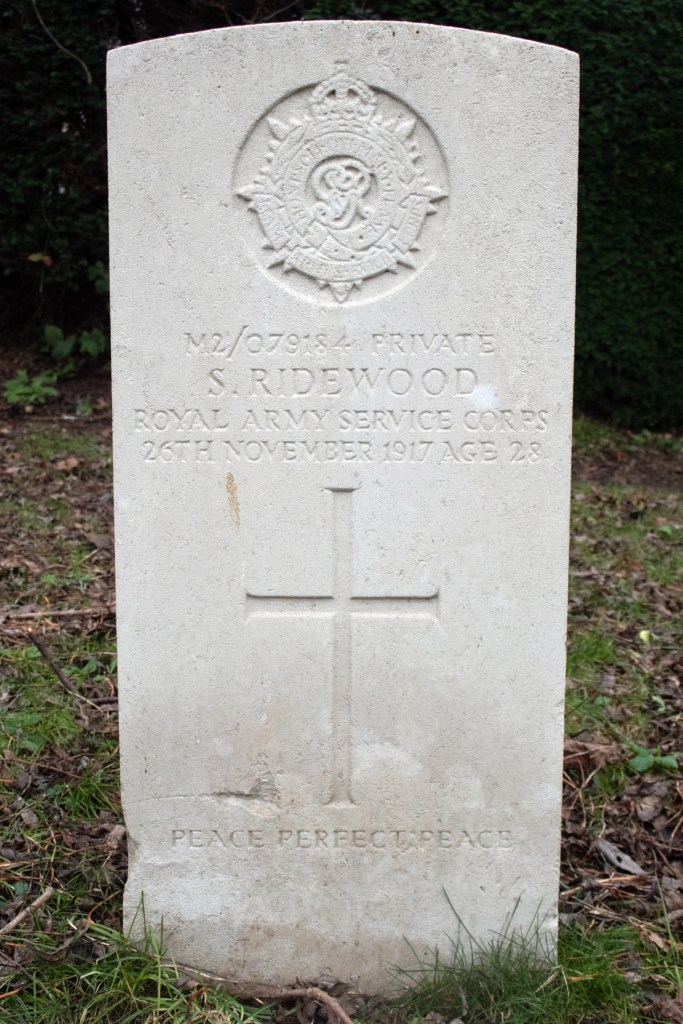
Private Sydney Ridewood

Private Sydney Ridewood

Sydney Ridewood was born in Bath, Somerset, on 31st March 1891, and was one of eleven children. His parents were labourer and sometime butcher James Ridewood and his wife Mary.

When Sydney left school, he found work as a baker, although this seems to have been as piecemeal a job as his father’s.

In January 1910, Sydney married Kathleen Scudamore. She was the daughter of a carpenter from the Twerton area of Bath and had a bit of a chequered background herself.

On 10th June 1896, Kathleen had married Edward Edwards, who was twelve years older than her seventeen years. Their marriage certificate suggested he was a clerk, although the 1901 census – which included their two children, Charles and Percy – recorded him as being a draper’s porter. Beyond that document, there is no record of Kathleen’s husband and, by the time of her marriage to Sydney, she had reverted to her maiden name.

By the time of the 1911 census Sydney and Kathleen were living in central Bath, with their nine-month old daughter, Olive, and Kathleen’s two sons. Kathleen’s widowed father, Edmund, her brother Claude and sister-in-law Nora were also in the household.

The document recorded Sydney as still employed as a journeyman baker, while his wife was a cook for the Post Office. Edmund was working as a carpenter, Claude was a sawyer, Nora a shop assistant and 14-year old Charles was a messenger boy, also for the Post Office. Six pay cheques coming in to support the extended family in the four-roomed house.

An additional member of the Ridewood family came along on 22nd October 1913, when Kathleen gave birth to a second child, Sydney Jr.

War was on the horizon by this point, and, on 20th April 1915, Sydney stepped up to play his part. He enlisted in the Royal Service Corps, and was assigned to the Mechanical Transport Corps. There is little detail about Private Ridewood’s service, although his records show that he was 5ft 3ins (1.6m) tall, with auburn hair, brown eyes and a fresh complexion.

Sydney was sent to France a month after enlisting, and his may role seems to have been that of a driver. He remained on the Western Front for a little over two years, before contracting pleurisy. He was initially treated in France, but soon returned to Britain to recuperate. The lung condition, however, was to get the better of him, and he passed away at home on 26th November 1917, weeks before he was to be medically discharged from service. He was just 28 years of age.

Sydney Ridewood was laid to rest in St James’ Cemetery, a few minutes’ walk from his family home.


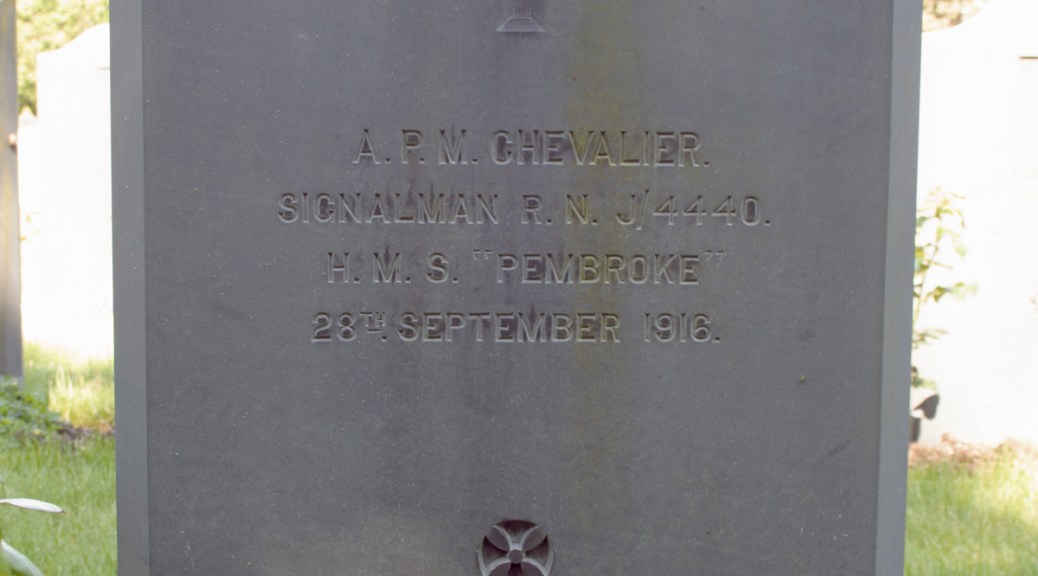
Signalman Albert Chevalier

Signalman Albert Chevalier

Albert Patrick Michael Chevalier was born in India on 16th June 1893. There is little definitive information about his early life, although his mother was called Georgina, and the family may have moved back to England when Albert was just a child.

When he left school, Albert found work as an errand boy in an office. But he wanted bigger and better things and, on 4th May 1909, aged just fifteen years old, he enlisted in the Royal Navy. Because of his age, he was given the rank of Boy 2nd Class, and for the first eighteen months, he was assigned to training bases – HMS Ganges and HMS Impregnable.

After only a few months, Albert was promoted to Boy 1st Class and, after a month at HMS Pembroke – the Royal Naval Dockyard in Chatham, Kent – he was given his first sea-going appointment on board the cruiser HMS Minerva.

Albert spent eighteen months on Minerva, during which time he came of age. He seems to have had an understanding of basic technology, as he was given the rank of Ordinary Signalman. After some more time in Chatham, Albert went to sea again, this time on board another cruiser, HMS Cressy. At the start of 1913 he was promoted again, and given the rank of full Signalman.

Signalman Chevalier went on to serve on a number of different vessels, primarily the battleship HMS Swiftsure, where he served for nearly three years, plying the waters between Britain and India. By the spring of 1916 he was back in Chatham, however, and it was here that things took a turn for the worse.

Albert was admitted to the Royal Naval Hospital in the town, suffering from pleurisy. Sadly, the condition was to get the better of him and he passed away the hospital on 28th September 1916, at the age of just 23 years of age.

Albert Patrick Michael Chevalier’s body was laid to rest in Woodlands Cemetery, Gillingham, not far from the dockyard from which he had made so many of his voyages.


Albert’s mother Georgina had not settled in England for long. The army pension record gives her as Albert’s beneficiary, but notes her address as Victoria Street, Daylesford, Victoria, Australia.


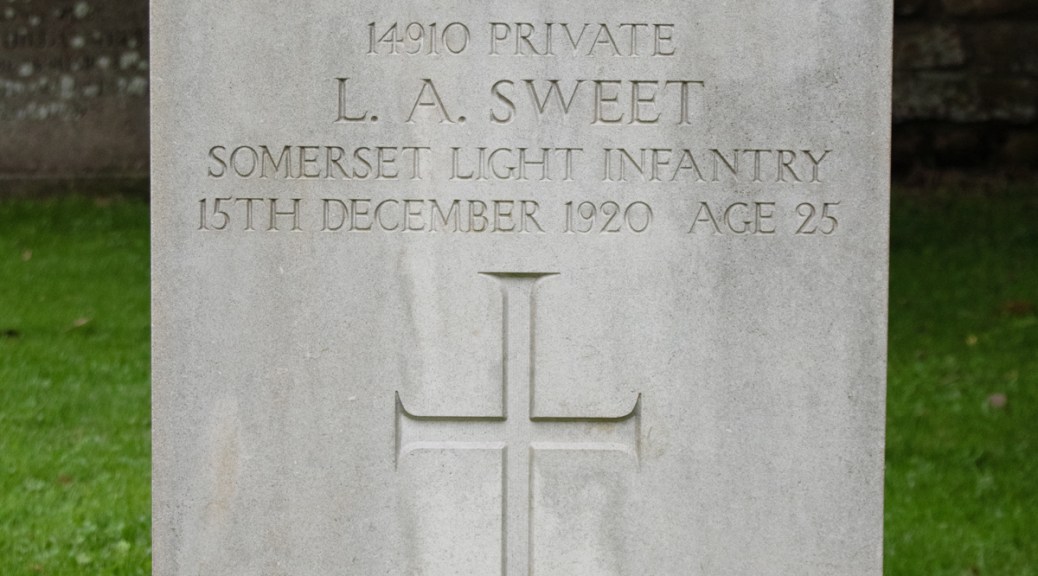
Private Lawrence Sweet

Private Lawrence Sweet

Lawrence Allen Sweet was born on 28th May 1895, one of fourteen children to Thomas and Caroline Sweet. Thomas was a farm labourer from Somerset, and the family were raised in the village of Norton-sub-Hamdon, near Yeovil.

Lawrence found work on the farm – the 1911 census shows him living with his now-widowed mother, where he was employed as an ‘improver to poultry house and building’. Three of his older brothers were also living there, and all were employed in farm work.

War was coming to Europe, and Lawrence played his part. Full details of his military service no longer remain, but those that remain confirm that he enlisted in the Somerset Light Infantry in the spring of 1915, and was assigned as a Private to the 6th (Service) Battalion of the Somerset Light Infantry.

Sent to France on 21st May, Private Sweet saw action on the Western Front. His regiment was involved in the Battles of the Somme, Arras and Ypres and he earned the Victory and British Medals and the 1915 Star for his service.

Towards the end of 1917, Lawrence contracted pleurisy; invalided home, he was ultimately discharged from the army on medical grounds the following January.

At this point, Private Sweet’s trail goes cold. The next document confirms that he passed away on 15th December 1920, at the age of 25 years old. No cause of death is evident, but is seems likely to have been connected to his previous lung condition.

Lawrence Allen Sweet was laid to rest in the graveyard of St Mary’s Church in his home village of Norton-sub-Hamdon.


Lawrence Sweet1
Lawrence Allen Sweet
(from ancestry.co.uk)

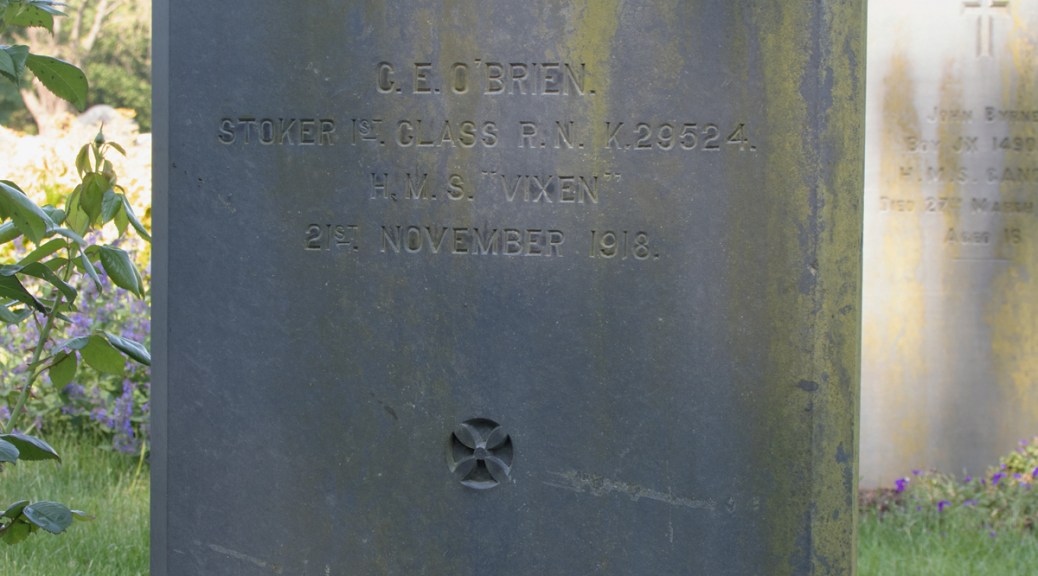
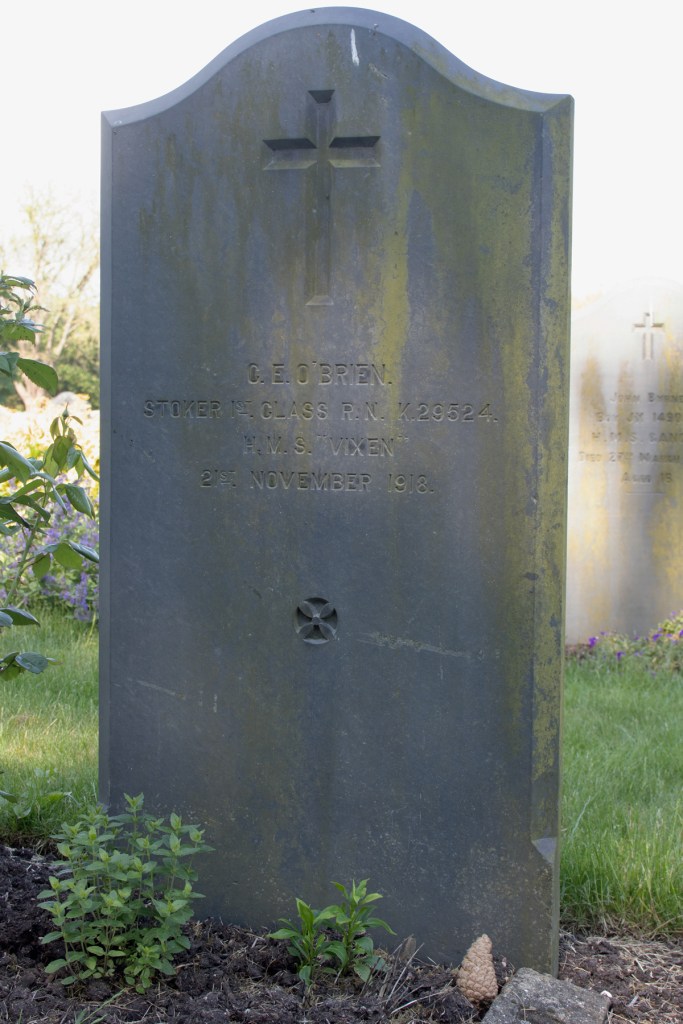
Stoker 1st Class Cornelius O’Brien

Stoker Cornelius O’Brien

Documentation on the early life of Cornelius Edward O’Brien is pretty scarce, so it is impossible to build a picture of him before the First World War. He was born in the late 1890s in Whitechapel, East London and was working as a carman when he received his enlistment papers.

Cornelius joined the Royal Navy as a stoker on 27th November 1915 and was sent to HMS Vivid II, the shore-based establishment in Devonport that served as the Stokers and Engine Room Artificers School. He trained there for a couple of months before being assigned to HMS Drake, where he spent most of 1916.

Returning to Devonport, Stoker O’Brien spent a further year on board HMS Vivid II, gaining the rank of Stoker 1st Class. By the end of 1917, however, he was back at sea, having been sent to HMS Vixen, a naval destroyer that served in the Thames Estuary, performing anti-submarine patrols and counter mining operations there.

In mid-November 1918, with the war officially over, Cornelius was admitted to the Royal Naval Hospital in Chatham, suffering from influenza, pneumonia and pleurisy. Sadly these were to prove too much of a challenge for him and he passed away on 21st November 1918.

Cornelius Edward O’Brien was laid to rest in the Woodlands Cemetery in Gillingham, not far from the Naval Dockyard in Chatham.


Private Sidney Watts

Private Sidney Watts

Sidney Gilbert Watts was born in 1892, one of five children to railway inspector Arthur Watts and his wife Laura. Initially brought up in the village of Congresbury, near Bristol, Arthur soon moved the family to nearby Taunton.

A likeable man, Arthur continued working for Great Western Railways. He also became involved in the Taunton Co-operative and Industrial Society and, for a number of years was the Chairman. Suddenly, and unexpectedly, however, on 20th January 1907, he collapsed and died from a heart attack.

Now widowed, Laura’s children rallied around her. Most of them had left school; her eldest, Reginald, was a school master, her older daughters Florrie and Mabel worked for a milliner and draper, and two lodgers moved in to help financially support her and her youngest daughter Evelyn.

By this time Sidney had followed in his father’s footsteps, and found work as a porter for GWR. He had moved to Hayle in Cornwall, where, according to the 1911 census, he was boarding with 33-year-old widow, Lizzie Richards, and sharing the house with another railway worker, Richard Crago.

Sidney seemed to be looking for something more. In February 1912, he enlisted as a Private in the Royal Army Medical Corps. He trained as a cook and, when war broke out, was sent out to France as part of the British Expeditionary Force.

In July 1915, Private Watts contracted pleurisy and was treated in a hospital in Boulogne. He was discharged for duty and assigned to a hospital ship, where he stayed for six months. While there, he contracted pneumonia and was bedridden for six weeks, his lung having collapsed.

Sidney was evacuated to England to recuperate. His health did not improve, however, and he was medically discharged from the army on 31st July 1916. A few months later, he was admitted to Cranham Lodge Sanatorium near Gloucester, but passed away on 24th September 1916. He was just 24 years old.

The body of Sidney Gilbert Watts was brought back to Taunton, and he was laid to rest in the St James Cemetery in the town.


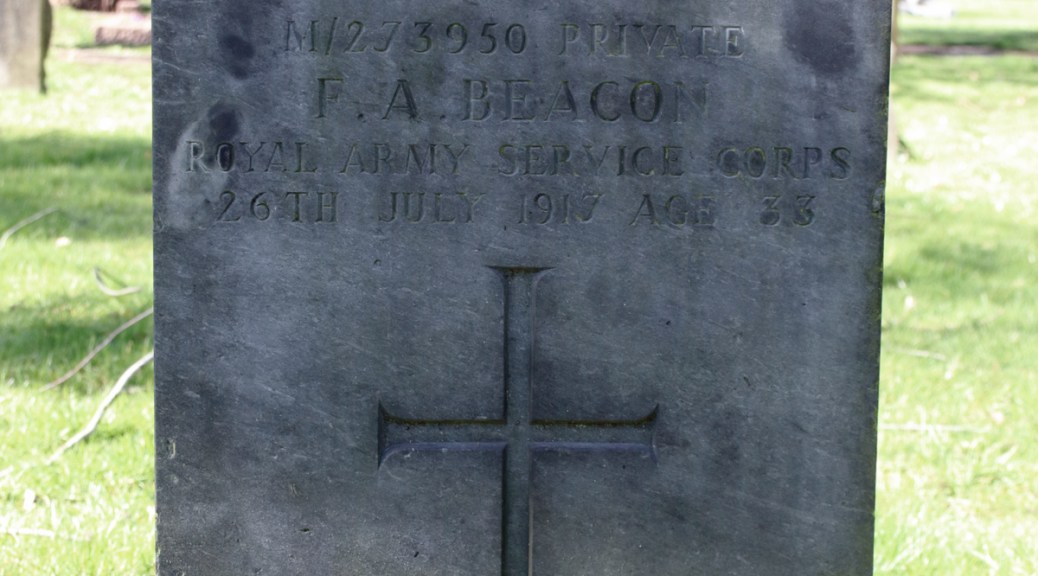
Private Frank Beacon

Private Frank Beacon

Frank Archibald Beacon was born in 27th April 1884, one of five children to William and Frances Beacon. William was a bargeman and the family lived in the village of Barrow Green near the North Kent marshes.

Tragically, William died at the age of only 36, leaving Frank without a father from the age of 2 years old. Frances found work as a charwoman, before finding love again. She married James Seager in 1895, who took in Frank and his siblings as his own.

After leaving school, Frank found work both as a builder and farm labourer and this was to stand him in good stead until the outset of war.

In January 1909, Frank married Kate Amelia Smart; she was the daughter of a victualler, and was born on Kent’s east coast, in Sandwich. The couple settled down to live in Newington, a village close to where Frank grew up, and had two children, Annie and Frank.

War was looming, and Frank enlisted. He joined the Royal Army Service Corps, working as a Private for the Mechanical Transport Company. Full details of his military service are not evident, but he was awarded the Victory and British Medals, which suggest that he service overseas at some point.

In the summer of 1917, Private Beacon fell ill, and was admitted to the Military Hospital in Boscombe. He was suffering from pleurisy and tetanus, and is was to these illnesses that he was to succumb. He passed away on 26th July 1917. He was 33 years old.

Frank Archibald Beacon was laid to rest in the Woodlands Cemetery in Gillingham, Kent, close to where he had made a new home with Kate.


Guardsman Harold Dummett

Guardsman Harold Joseph James Dummett

Harold Joseph James Dummett was born in early 1900, one of ten children – and the eldest son – of Harry and Elizabeth of Kingsdon, Somerset.

Harold joined the Coldstream Guards, although there are no records to confirm the date of his enlistment. His battalion – the 5th – remained stationed in Windsor throughout the war; it is likely, therefore, that Guardsman Dummett never saw front line service.

His pension records give his mother as his next of kin, while the Register of Soldier’s Effects also name his father.

Guardsman Dummett passed away from pleurisy and pneumonia at the Military Hospital in Purfleet on 15th February 1919. He was 19 years of age.

Harold Joseph James Dummett lies at peace in the quiet All Saints’ Churchyard in his home village of Kingsdon.


While Harold does not appear in the newspaper records, his parents do. In April 1937, the Taunton Courier reports that

Mr and Mrs Harry Dummett celebrated their golden wedding… There was a happy family gathering of all their children and two grandsons.

Taunton Courier and Weston Advertiser – 24th April 1937