Ernest Rowsell was born in the spring of 1894, in the Somerset town of South Petherton. One of nine children, his parents were John and Bessie Rowsell. Builder and wheelwright John had been married before Bessie, and Ernest had five half-siblings as well.
When Ernest left school, he found work with a blacksmith – presumably, a connection made through his father. In his spare time, he joined the West Somerset Yeomanry, building on his skills and training.
War came to Europe in 1914, and it was a natural progression for Ernest to play his part, He formally joined the regiment he had previously trained with, enlisting on 24th September 1914. Given the rank of Farrier, Ernest was sent to a camp in Minehead for training.
His service records show that he was 5ft 3ins (1.6m) tall, had good vision and was of good physical development. Something came up during the medical examination, however, which was held on 1st February 1915. Farrier Rowsell was deemed medically unfit for army service and discharged.
Ernest returned home, but, whatever the condition was, it was to swiftly get the better of him. He passed away at home on 13th February 1915, at the age of just 21 years old.
Ernest Rowsell was laid to rest in South Petherton Cemetery, a short walk from where his parents lived.
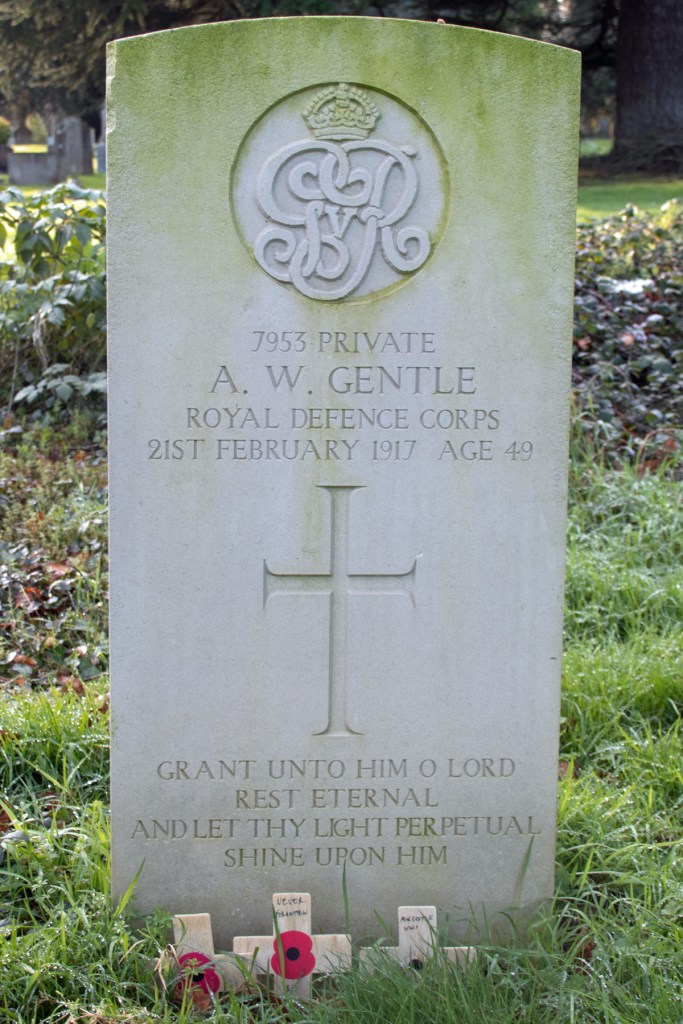
Arthur William Gentle was born in 1867 in Whitelackington, Somerset. The son of Maria Gillard, his father is not noted, although he was accepted as one of the family when Maria married Richard Gentle in 1873. The couple went on to have eleven children of their own, giving Arthur a large family of siblings.
Richard was an agricultural labourer, and this was a trade into which Arthur followed. On 23rd October 1897, Arthur married Mary Marsh, a labourer’s daughter from South Petherton. The couple tied the knot in her local church, the illiterate Arthur marking his intent with a cross.
The couple set up home just off Silver Street in South Petherton, and went on to have ten children of their own. The 1911 census recorded Arthur still employed as an agricultural labourer, his oldest son following suit, and Mary – who was also known as Polly – raising the family.
War came to Europe, and, despite his age, Arthur felt a need to play a part. While full service records are no longer available, what remains confirms that he had enlisted by the summer of 1916, and had joined the 300th Protection Company of the Royal Defence Corps.
Sadly, Private Gentle’s military career was to end in the same way as so many of his army colleagues. He contracted pneumonia during the winter of 1916, and passed away at home on 21st February 1917. He was 49 years of age.
Arthur William Gentle was laid to rest in the cemetery of his adopted home town, South Petherton.
Arthur’s brother Frank Gentle also fought in the Great War. Assigned to the 1st Battalion of the Somerset Light Infantry, he was caught up in the fighting in the Somme, and was killed on 14th July 1916. He was just 26 years of age.
Private Frank Gentle is commemorated on the Thiepval Memorial in Northern France.
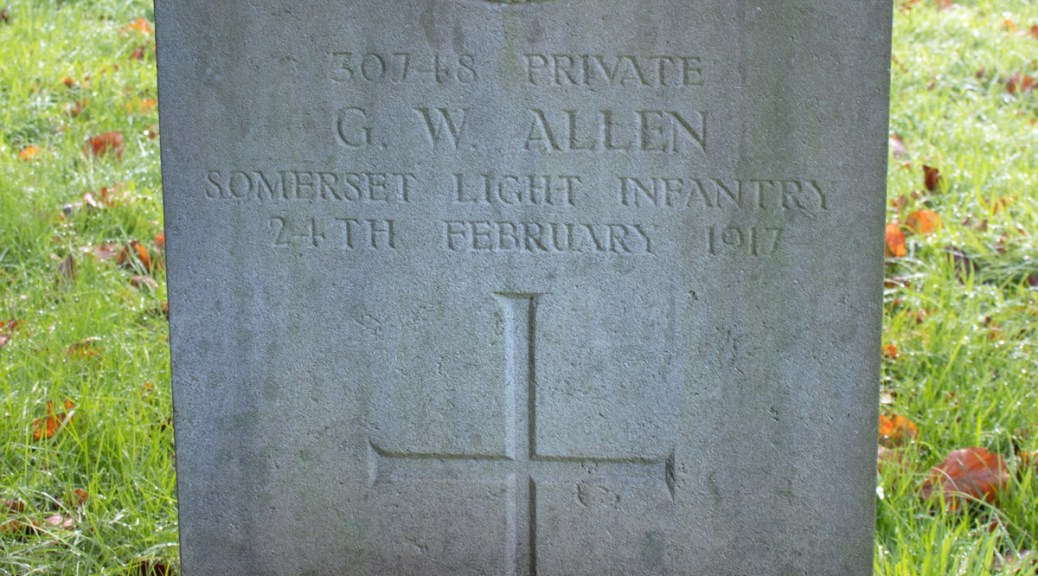
George William Allen was born in the spring of 1887, in the hamlet of Over Stratton, near South Petherton, Somerset. One of eight children, his parents were farm labourer William Allen and his wife, Martha. When he left school, George also found agricultural work and, by the time of the 1911 census, was the only one of his siblings still living with his parents.
On 12th October 1912, George married Ellen Mary Osborne, a labourer’s daughter from Norton-sub-Hamdon, and it was in her parish church – St Mary’s – that the young couple tied the knot. The couple went on to have a daughter – Dorothy – who was born the following year.
War came to Europe in 1914, and George stepped up to play his part. conscripted towards the end of 1916, he joined the 4th (Reserve) Battalion of the Somerset Light Infantry. Full details of his service are no longer available, but Private Allen appears to have contracted bronchial pneumonia not long after he was called up.
Sadly, the lung condition was to prove unassailable, and Private Allen passed away on 24th February 1917. He was just 30 years of age.
George William Allen was brought back home for burial. He was laid to rest in South Petherton Cemetery, not far from the hamlet of Yeabridge, where his widow and daughter were now living.
Joseph Henry Sibley was born on 23rd September 1897 in the hamlet of Elm, near Frome in Somerset. He was one of seven children to Joseph and Ellen Sibley. Joseph Sr worked as an iron moulder and, by the time of the 1911 census, the family had moved to South Petherton.
When he left school, Joseph Jr found work as a baker. But when he turned 18, and with war ravaging Europe, he enlisted to serve his King and his Country. On 8th December 1915, he joined the Somerset Light Infantry, and was assigned to the 6th Battalion.
Private Sibley’s service records confirm that he was 5ft 5ins (1.65m) tall and 116lbs (52.6kg) in weight. He was declared fit for the army, and was formally mobilised in June 1916.
Joseph was sent to France and by January 1917, he found himself on the Front Line. On 19th May, he was injured, receiving a gun shot wound to his hand and face. Medically evacuated to Britain for treatment and admitted to hospital.
He was for some time in Norwich Infirmary for treatment and ultimately received his discharge from the Army. He had been home only a short time and his health being very unsatisfactory, he was taken to Bristol Royal Infirmary, where an operation was performed, which, unfortunately, terminated fatally.
Western Chronicle: Friday 22nd March 1918
Private Sibley died on 16th March 1918, he was just 19 years of age.
Joseph Henry Sibley’s body was brought back to South Petherton for burial. He was laid to rest in the town’s cemetery.
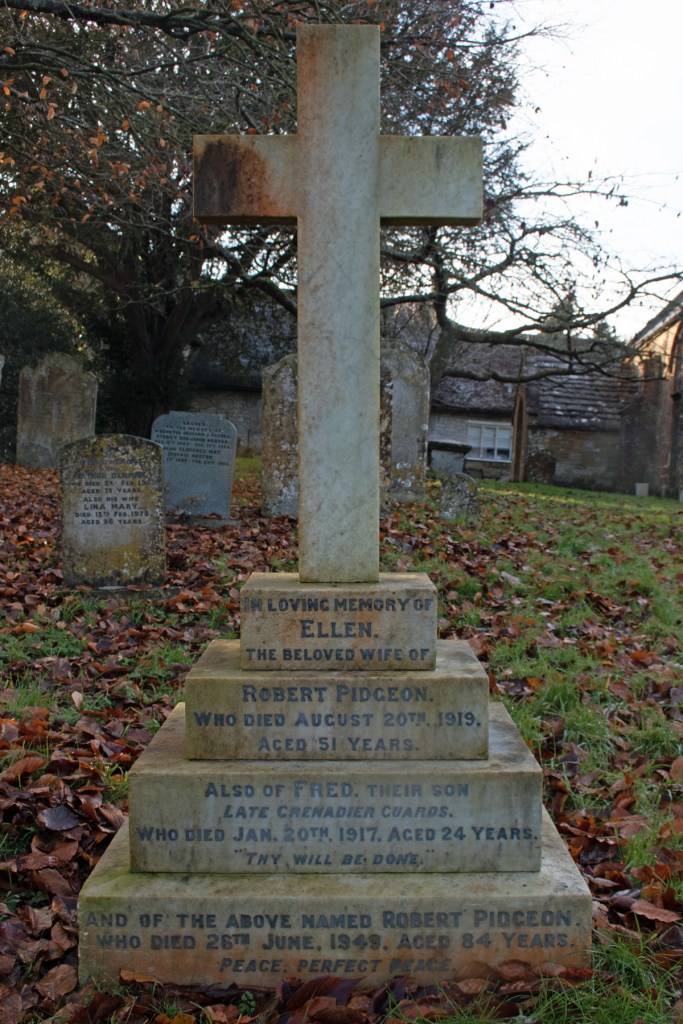
Frederick Pidgeon was born on 18th December 1892 in the Somerset village of Lopen. One of four children – and the only son – his parents were Robert and Ellen Pidgeon. Robert was a baker and, by the time of the 1911 census, only Linda – the youngest of Frederick’s siblings – was not helping in the business.
When war broke out, Frederick – who was better known as Fred – wanted to play his part. He enlisted on 7th December 1916, joining the 5th Battalion of the Grenadier Guards. As his was purely a territorial troop, Private Pidgeon was sent to the regimental barracks in Caterham, Surrey, for training.
At a time of tremendous upheaval, with men from all over the country suddenly thrust together in tightly packed barracks, it is no surprise that disease sometimes took hold. Tragically, Fred was not to be immune to this, and, on the 15th January 1917, he was admitted to the camp hospital, having contracted pneumonia.
The lung condition took a swift hold, and, tragically, Private Pidgeon was to succumb just a few days later. He breathed his last on 20th January 1917, at the age of just 24 years old. He had been in the army for just 44 days.
Fred Pidgeon was brought back to Somerset for burial. He was laid to rest in the family plot in the peaceful graveyard of All Saints’ Church, in his home village of Lopen.
Private Frederick Pidgeon
Ellen passed away in August 1919, aged just 54 years old, and was laid to rest alongside her son. Robert died some thirty years later, on 26th June 1949; he too was buried in the family plot, mother, father and son reunited once more.
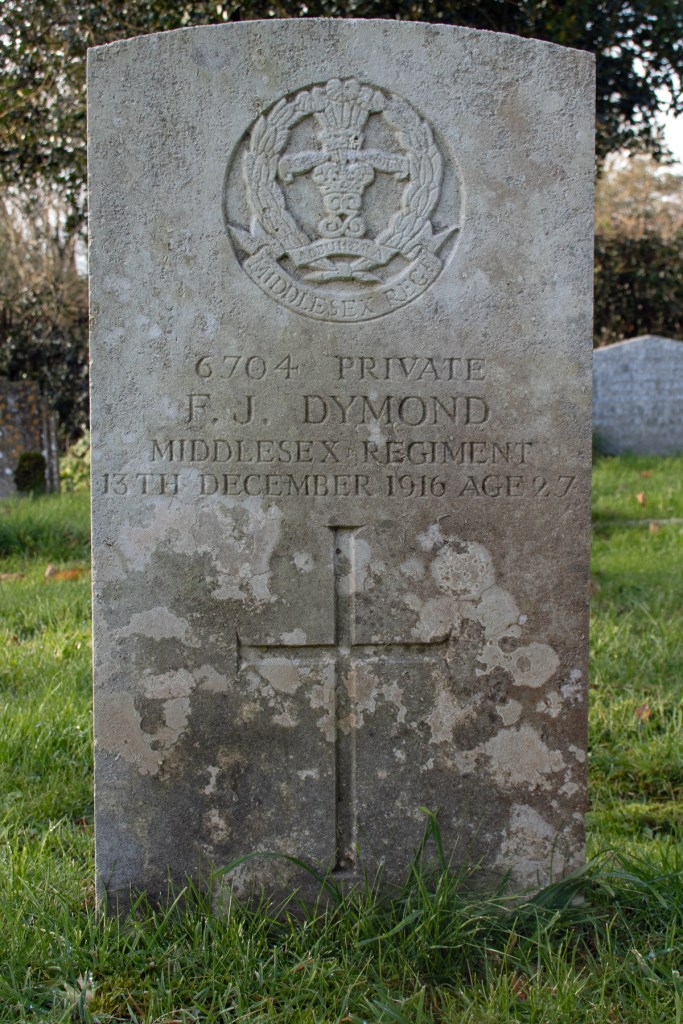
Frederick John Dymond was born in early 1888 in the Devon village of Dalwood. One of ten children, his parents were farmers Harry and Ellen Dymond. By the time of the 1911 census, the family had moved to Somerset and were running the Crock Street Farm near Ilminster.
When war came to Europe, Frederick was called upon to play his part. Full details of his military service are no longer available, but by the summer of 1916, he had joined the Middlesex Regiment.
Private Dymond was assigned to the 2nd/7th Battalion, which was a territorial force at that point in the conflict, based in Barham, Kent, midway between Dover and Canterbury.
In the autumn of 1916, Private Dymond was taken to the Military Hospital in Canterbury, although the reason for his admission is not clear. Whatever the cause, it was too much for his body to bear: he passed away while in hospital, on 13th December 1916. He was just 28 years of age.
Frederick John Dymond was brought back to Somerset for burial. He was laid to rest in the graveyard of St George’s Church in Hinton St George – presumably because his family had moved to the area.
Alan James Howland was born in the spring of 1897 in Plymouth, Devon. One of nine children, his parents were pianist and musician Harman Howland and his Irish wife, Ellen.
The Howland family moved around as, presumably, Harman followed where his work was needed. The 1901 census records them living in Devonport: ten years later they had moved to Barnstaple. Alan, by this time, had left school and was working as an errand boy.
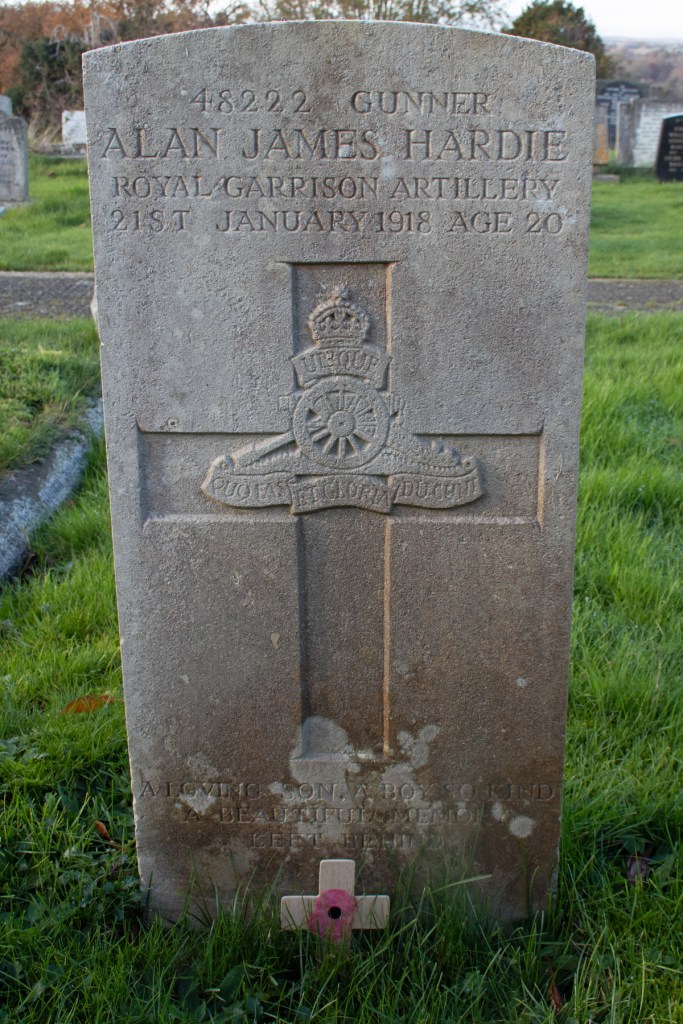
War came to Europe in 1914, and, at some point, Alan stepped up to play his part. Full details of his military service are no longer available, but from what remains it is clear that he enlisted in the Royal Garrison Artillery at some point before the summer of 1917.
Alan enlisted using his mother’s maiden name of Hardie, and was assigned to the 274th Siege Battery. His troop saw action at the Somme and Arras, and a later newspaper report confirmed that Gunner Hardie saw action overseas:
[He] had been previously wounded but was gassed and entered Leicester Hospital on November 2nd 1917.
Taunton Courier and Western Advertiser: Wednesday 30th January 1918
Gunner Hardie had been admitted to the 5th Northern General Hospital following his injury. He seemed to be improving, but developed pneumonia and the lung condition was to take his life. He passed away on 21st January 1918, at the age of just 20 years old.
Alan James Hardie/Howland was brought back to Somerset for burial. He was laid to rest in the cemetery of the town where his family now lived, Ilminster, Somerset.
Alan’s older brother, William Harman Howland, also fought in the First World War. He enlisted in the 1st Battalion of the Hertfordshire Regiment, also using his mother’s maiden name. Again, details of his service are sparse, and Private Hardie seems to have transferred to the Royal Army Service Corps at some point during his military career.
William passed away on 18th August 1918, while in Germany. The cause of his death is not clear, but he was 28 years old. He was laid to rest in the Ohlsdorfer Cemetery in Hamburg.
Herbert Henry Cleal was born on 6th November 1899, in the Somerset village of Hambridge. The tenth of twelve children, his parents were Daniel and Emily Cleal.
Daniel was a cowman on a farm, and it is likely that Herbert would have started in agricultural labouring, had war not intervened.
Full details of Herbert’s military service are not available, although it is clear that he had enlisted in the Worcestershire Regiment by the summer of 1918. By this point in the war, Private Cleal’s battalion – the 2nd/8th Battalion – was already in France, although, according to his records, it does not appear as if he saw any service overseas himself.
The only other record for Herbert is his entry in the Army Register of Soldiers’ Effects. This confirms that he passed away at Bradford War Hospital on 1st January 1919. The cause of his passing is not noted, but he had just turned 19 years of age.
Herbert Henry Cleal was brought back to Somerset for burial. He was laid to rest in the graveyard of St James-the-Less Church in his home village of Hambridge.
Frederick John Francis was born on 15th February 1893, to Henry and Mary Francis. One of nine children, the family lived in the Somerset village of Curry Rivel.
Henry was a labourer, but Frederick had his sights set on a new life and, at some point in his teens, he emigrated to Canada to work as a farmer. Details of his life in North America are scarce, but it is clear that he was in Manitoba when war broke out back in Europe.
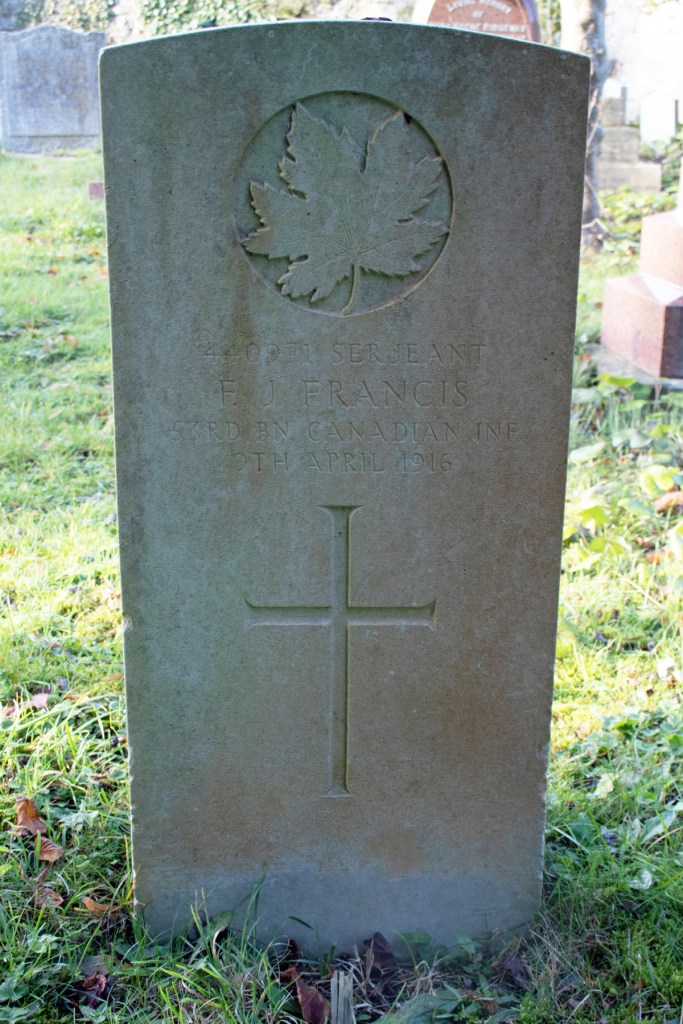
Frederick stepped up to serve his King and Country, enlisting at Camp Sewell on 5th April 1915. His service records confirm that he was 5ft 5ins (1.65m) tall, and weighed 145lbs (65.8kg). He was assigned to the 53rd Battalion of the Canadian Infantry. His service papers also note that he was promoted to the rank of Sergeant on 30th April 1915, although whether the date is correct, or whether Frederick had previous military experience is unclear.
Sergeant Francis boarded the SS Empress of Britain to make the journey back to Europe, little knowing that he was not going to see his home again. On 9th April 1916, just one day from docking in Hampshire, he passed away from quinsy, or throat abscess. He was just 23 years of age.
The body of Frederick John Francis was brought back to Somerset for burial. He was laid to rest in the graveyard of St Andrew’s Church in the village of his birth, Curry Rivel.
Frederick’s younger brother, Charles, had also made a life in Canada. He enlisted at Camp Sewell just two months after his brother, joining the same battalion.
Charles, who had the rank of Private, arrived in Europe before Frederick and, and was sent to the front line in February 1916. In June, he was involved in the fighting at Mount Sorrel, on the Ypres Salient, and it was here, on 6th June 1916, that he lost his life. He was just 21 years of age.
Charles Arthur Francis is commemorated on the Menin Gate in Ypres. His parents had to mourn the loss of two sons within two months.
Arthur Cock was born in around 1885 in Wadebridge, Cornwall. One of eleven children, he was the son of mortar mason William Cock, and his wife, Louisa.
When he left school Arthur helper his father out in the business, but when war came to Europe’s shores, he stepped up to play his part. Sadly, his service records are lost to time, and it is a challenge to piece together his time during the conflict from a confusion of other documents.
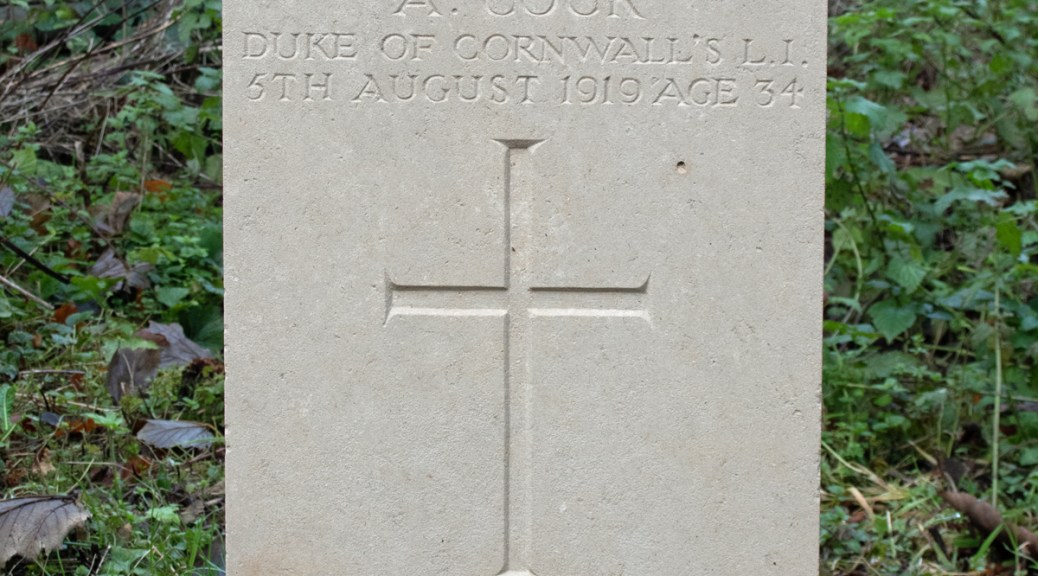
It is clear that Arthur enlisted in the Duke of Cornwall’s Light Infantry, as this is what is engraved on his headstone. However, his Medal Roll suggests that he also served in the Gloucestershire Regiment and the Labour Corps. He seems not to have fought overseas, and was awarded the Victory and British Medals for doing his duty.
Private Cock’s entry in the Army Register of Soldier’s Effects confirms that he must have enlisted before February 1919, and that he passed away at Whitchurch Hospital.
An entry in the local newspaper, reporting on his death, reads as follows:
In loving memory of Pte. Arthur Cock, son of William, and the late Louisa Cock, of Wadebridge, who died August 5th, at Whitchurch War Hospital, Cardiff.
Cornish Guardian: Friday 8th August 1919
Interestingly, the facility Arthur had been admitted to was a psychiatric hospital, but with no other confirmation as to his passing, it is only possible to assume the cause of his death. He was 34 years old when he passed away.
Arthur Cock’s body was brought back to Cornwall for burial. He was laid to rest in the peaceful, wooded graveyard of St Breoke’s Church, next to the family grave in which Louisa had been buried three years previously.
The family grave, by this time, was tragically quite full. William was able to mourn his son, wife and six of Arthur’s siblings – Mary, William, John, Fred, Charles and Ernest – who had all passed in childhood and were laid to rest there.
Arthur’s younger brother – another William – also fought in the First World War. His service records reveal a lot about his life.
Private Cock enlisted in the Australian Imperial Force on 7th September 1914. At the time he was working as a railway porter in Morphettville, now a suburb of Adelaide, Australia. His records confirm that he was 5ft 8.5ins (1.74m) tall, and weighed 158lbs (72kg). He had brown hair, brown eyes an a fresh complexion.
William left Australia for the battlefield on 20th October 1914, and soon found himself in the Eastern Mediterranean. Sadly, this was to be the end of the line for him: he was killed on the battlefields of Gallipoli on 23rd March 1915, aged just 28 year of age.
William Cock was laid to rest in the Shrapnel Valley Cemetery in Gallipoli. He is commemorated on the headstone of the family grave back in St Breock.











 Death and Service