Tag Archives: Somerset

Corporal Walter Tottle

Corporal Walter Tottle

Walter James Tottle was born in September 1892, one of fourteen children to Charles and Ellen Tottle from Somerset. Charles was a boatman, and they family lived in Salmon Parade along the riverfront in Bridgwater.

When Walter left school, he became an assistant at a market garden; by the 1911 census, he was living with his parents and eight of his siblings, whose jobs included carpentry and laundering. Walter’s younger brother Henry was listed as a ‘rink boy’, helping with skating at the local ice rink.

Walter’s life beyond this is a bit of a mystery. He enjoyed sports and, before the war had been a regular player for Bridgwater Rugby Football Club. He married a woman called Ruth, although I have been unable to track down who she was or when they couple wed.

When war came, Walter enlisted in the Somerset Light Infantry and, according to contemporary newspaper reports, Corporal Tottle had served on both the Eastern and Western Fronts. He was discharged from the army on 13th February 1919, following a severe attack of influenza, but it appeared to get the better of him. He passed away on 5th May 1919, aged just 26 years old.

Walter James Tottle lies at rest in St John’s Cemetery in his home town of Bridgwater, Somerset.


Walter’s ‘rink boy’ brother Henry also served in the First World War. He had also enrolled in the Somerset Light Infantry and, as a Corporal in the 1/5th Battalion, he was involved in some of the fierce fighting in the Middle East. He was injured, either in Gaza or Jerusalem, but sadly Henry died of his wounds on 22nd November 1917; he was buried in the War Cemetery in Jerusalem.


Private Sidney Warren

Private Sidney Warren

Sidney John Warren was born in January 1890, one of eleven children to shipwright George Warren and his wife Elizabeth. The family lived in Salmon Parade, on the riverside in Bridgwater, where George would have plied his trade. By the time of the 1911 census, Sidney had found work as a grocer’s assistant, and was living with his parents and the youngest of his brothers, Edward.

While exact details of Private Warren’s military career are not available, documents confirm that he enlisted in the Somerset Light Infantry. Assigned to the 4th Battalion, he was based in India and Mesopotamia during the conflict. No details are available of his time there, but at some point, he transferred to the Labour Corps back in Somerset.

And there Sidney’s trail goes cold. He survived the war, but passed away on 27th November 1918, suffering from pneumonia. He was just 28 years old.

Sidney John Warren lies at rest in the family grave at St John’s Cemetery in his home town of Bridgwater in Somerset.


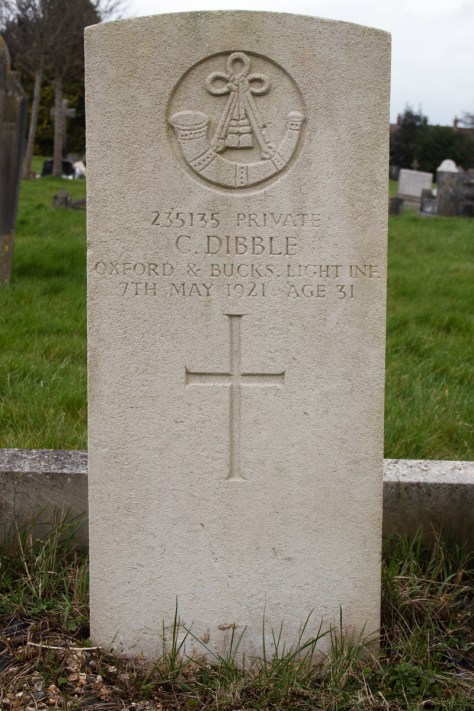
Private Charles Dibble

Private Charles Dibble

Charles Lang Dibble was born in 1890, one of nine children to Evan and Eliza Dibble from Bridgwater in Somerset. Evan was a labourer in a brickyard, and clay must have been run through the family’s veins, as Charles found employment as a kiln hand in a local tile maker when he left school.

By the 1911 census, Charles was boarding with William Rainey and his family in Bridgwater; whether there was a connection before he moved in or not, I don’t know, but the following year he married one of William’s daughters, Constance. The young couple wed on Christmas Day 1912 and went on to have one child, Charles, who was born in 1915.

Full details of Charles’ military service are not available. However, when he enlisted, he initially joined the Somerset Light Infantry, before transferring to the Devonshire Regiment and finally the Oxfordshire and Buckinghamshire Light Infantry. During his service, he was awarded the Victory and British Medals, but there is little further information about Private Dibble.

Charles survived the war, but his pension records confirm that he passed away on 7th May 1921; the cause of death was noted as exhaustion and sarcoma of the rectum. He was 31 years old.

Charles Lang Dibble lies at rest in St John’s Cemetery in his home town of Bridgwater.


Private William Woodbury

Private William Woodbury

William Alfred Woodbury was born in the Somerset village of Nether Stowey in April 1899, the oldest of four children to Alfred and Nellie Woodbury. Alfred was a farm labourer, and, by the time William was a couple of years old, he had moved the family to the town of Bridgwater to work as a carter.

After leaving school, William found work at Barham Brothers’ Brickworks in the town. When war broke out, he enlisted in the Somerset Light Infantry almost as soon as he was able to, at the beginning of 1916.

Assigned to the 6th (Service) Battalion and Private Woodbury was sent out to the Western Front in April. He would almost certainly have seen action at the Battle of Delville Wood – part of the Somme offensive – and was wounded in the shoulder and arm on 18th August 1916.

Shipped back to the UK for treatment, William was admitted to the Western General Hospital in Cardiff, but tragically died from his wounds less than a fortnight later on 30th August 1916. He was just 17 years old.

His funeral was reported in both the Shepton Mallet Journal and the Central Somerset Gazette; his father, who had been serving in France as part of the Army Veterinary Corps, managed to return home for his son’s funeral.

William Alfred Woodbury lies at rest in the St John’s Cemetery in his home town of Bridgwater.


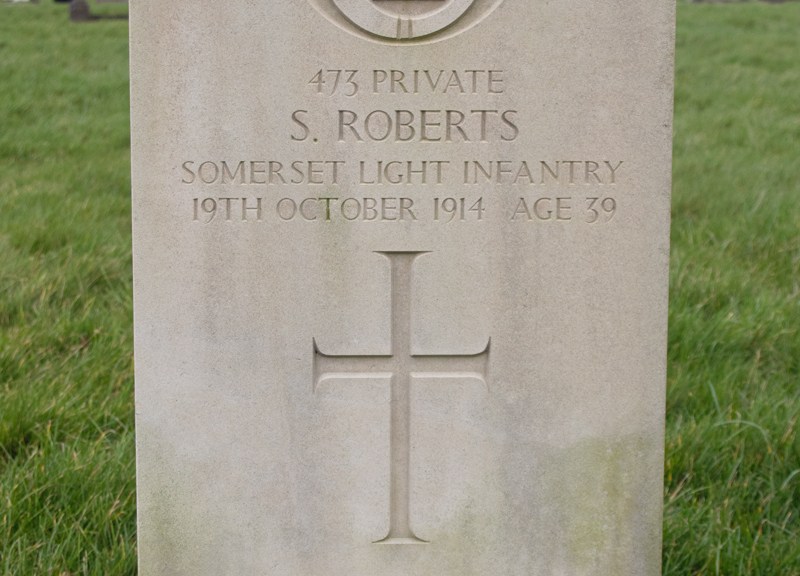
Private Samuel Roberts

Private Samuel Roberts

Samuel Roberts was born in April 1875, one of seven children to William and Harriet Roberts from Bridgwater in Somerset. William worked as a labourer in a timber yard, though sadly he died young, when Samuel was only a child.

In the spring of 1899, Samuel married Rosina (or Rose) James, and the couple went on to have six children. Samuel was supporting his family working as a wicker chair maker, a roaring trade in a part of the county where reed beds were in plentiful supply.

Samuel’s war grave suggests that he enlisted in the Somerset Light Infantry, and that this must have been early in the First World War, given that he passed away in October 1914. His pension records paint a slightly muddier picture, however. They give the cause of Private Roberts’ death as Hodgkin’s disease and mania, but suggest that:

As is has not been possible to establish that Private S Roberts actually joined for service or was paid as a soldier during the war, Mrs Roberts’ claim to [a] pension cannot be admitted.

WW1 Pension Ledger: Private Samuel Roberts

Whether Samuel ever enlisted, or whether he only told Rose that he had, or whether, through his mania, he believed that he had, will likely never be uncovered. Either way, what can be established is that he passed away on 19th October 1914, at the age of 39 years old.

He lies at rest in the St John’s Cemetery in his home town of Bridgwater.


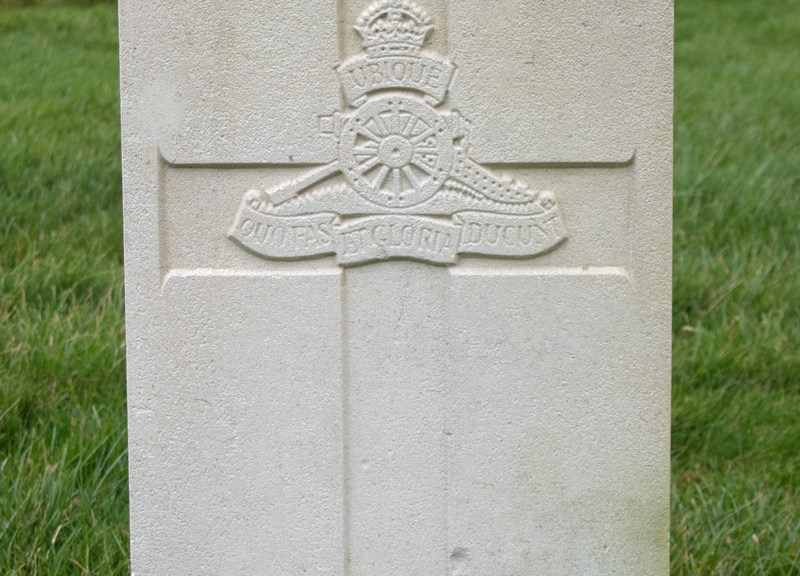
Gunner William Pearn

Gunner William Pearn

William Henry Pearn was born in January 1896, one of two children to Richard and Selina Pearn from Bridgwater in Somerset. Selina had been married previously, and had been widowed, and so William had a further four half-siblings. Richard was a lath renderer – a plasterer in today’s terms – and he was not the only one of the household to be working. According to the 1901 census, Selina was a collar maker and William ‘s two older half-brothers were a landscape gardener and a bookshop assistant.

When William left school, he went to work for a local coal yard as a porter. The next census finds him living with his mother and his older brother, Wallace, who was a labourer in a brickyard. Richard is noticeable in his absence, but Selina is having been married for 18 years.

Sadly, though, at this point William’s trail goes cold. His military records are sparse, but we know that he enlisted as a Gunner in the Royal Field Artillery, although I have been unable to identify when he enrolled. The only other information I have I have been able to locate for him are his pension records, that confirm that he passed away from pneumonia on 19th October 1918. Gunner Pearn was just 24 years old.

William Henry Pearn lies at rest in St John’s Cemetery in his home town of Bridgwater in Somerset.


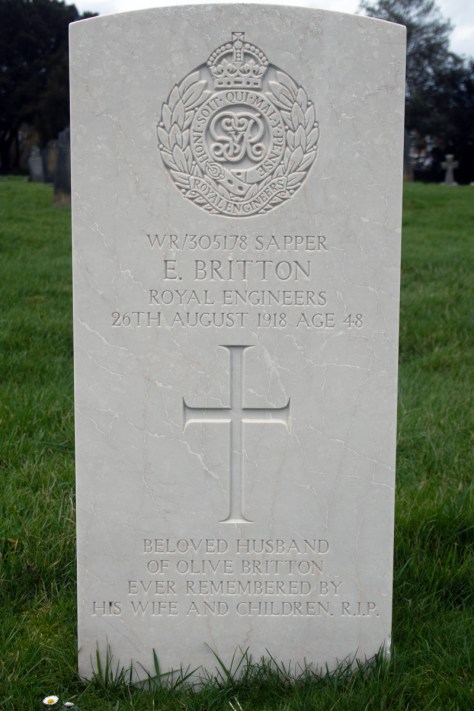
Sapper Edward Britton

Sapper Edward Britton

Edward Britton was born in Bridgwater in 1870, one of nine children to Edward and Eliza Britton. Edward Sr was a mariner, and the family lived on the main road from the town to Bath.

There is a gap in the documentation for Edward Jr; when we next meet him on the 1911 census he is married with children of his own. His wife is Ada Olive Martin, the daughter of a bricklayer from Topsham in Devon. They had eight children, six of them girls, and, according to the document, Edward was working as a ‘deal carrier’, moving wood from the ships arriving in Bridgwater to the timber yard.


A Gloucestershire deal carrier
(from gloucesterdocks.me.uk)

Sadly, Edward’s service records are also sparse. He enlisted in the Royal Engineers as a Sapper and, given his age, it is likely that this was not early in the conflict. He was involved in the Inland Water Transport division – given his father’s work as a mariner, this doesn’t come as a surprise.

The Army Register of Soldiers’ Effects provides a surprising insight into Sapper Britton. It gives the date of his death, but notes the cause as “Drowned, River Stour, Kent”.

An inquest was held on Monday by Dr Hardman at the Military Hospital, Stonar, respecting the death of Sapper Edward Britton… who was drowned through the capsizing of a boat… It appeared that Britton was ferrying Lance-Corporal Griggs to a barge which was in tow with three others when a collision occurred, the boat overturned and Britton was drowned.

[Kentish Gazette: Saturday 7th September 1918]

Sapper Britton passed away on 26th August 1918, at the age of 48.

Edward Britton lies at rest in St John’s Cemetery in his home town of Bridgwater, Somerset.


Lance Corporal Sidney Turner

Lance Corporal Sidney Turner

Sidney Joseph Turner was born in 1888, the oldest of four children to Sidney and Matilda Turner from Bridgwater in Somerset. Sidney Sr was a carter, while his son became a labourer in a local cement works. Sadly, Sidney Sr died in 1903, when Sidney Jr was 15, leaving Matilda with three other children, one of whom was only 18 months old.

Sidney Jr travelled to get work, and had moved to South Wales to work as a miner by 1909. Here he married Rose Shattock, who was born in Bristol, although within a couple of years the young couple had moved back to Somerset.

Sidney and Rose had a son, also called Sidney, although sadly he died when he was only a couple of months old. Tragically for Sidney, the records seem to suggest that Rose may have died in childbirth, or shortly after, as her passing was registered in the same quarter as her son’s birth.

By this time, Sidney was living in Bailey Street, Bridgwater, a short distance from some railway sidings. This might have driven some determination in him as, by the following year, he was listed as an engine driver. In December 1913 he married his second wife, Bessie Sharman. She was the daughter of a mariner, who had become a machinist in a shirt factory by the time of their marriage. The couple went on to have a son, also called Sidney, in April 1914.

When war broke out, Sidney enlisted in the Highland Light Infantry, initially in the 12th (Service) Battalion. They landed in France in July 1915 and were there for the remainder of the war. At some point, Lance Corporal Turner transferred to the 53rd (Young Soldier) Battalion. Very much a training brigade, it seems that Sidney’s experience of the front line may have proved useful for the upcoming recruits.

Lance Corporal Turner was demobbed on 21st March 1919; his pension record shows that, during the course of his service, he had fractured his tibia and had contracted bronchitis. The 1921 census found Sidney back in Bridgwater. He was listed as being a gas engine driver for John Board & Co., although he was, at that point, out of work. He, Bessie and Sidney Jr were living at 1 Price’s Buildings.

Sidney’s health conditions were to prove his downfall, as, within a months of the census return, he had succumbed to pulmonary tuberculosis and exhaustion. He died on 2nd July 1921, aged just 32 years old.

Sidney Joseph Turner lies at rest in St John’s Cemetery in his home town of Bridgwater, Somerset.

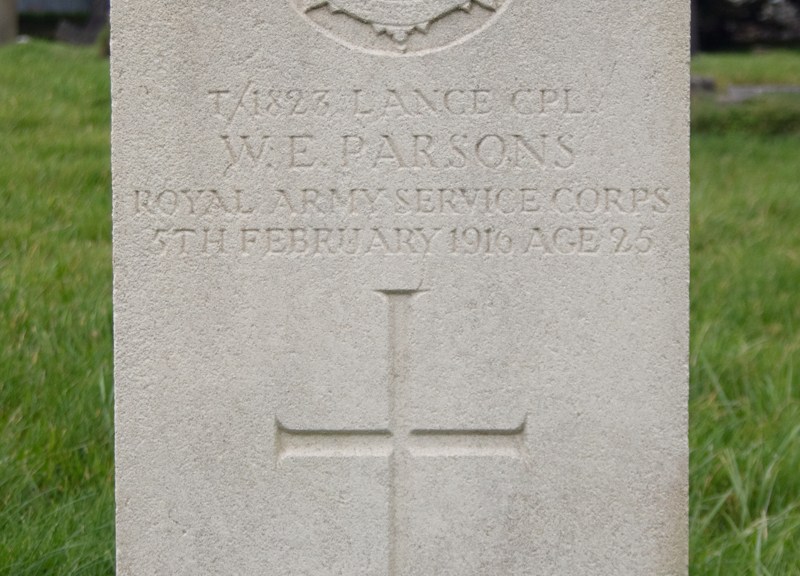
Lance Corporal William Parsons

Bridgwater (St John’s)

William Edward Parsons was born in 1890, one of six children to John and Prudence Parsons. John found work in a number of fields, working as a blacksmith, porter, dock labourer and a hobbler (towing boats along the River Parrett) in his time. Throughout this, he lived with his family in the Somerset town of Bridgwater.

William found work as a collar cutter in a local shirt factory, and went on to marry Matilda Mary Temblett on Christmas Day 1913. The young couple went on to have a son – Leslie William – who was born in February 1915. William was teetotal, and played full back for the local rugby football club, Bridgwater Albion.

Sadly, Lance Corporal Parsons’ military records are sparse; he had enlisted in the Royal Army Service Corps and was based in Fovant, to the west of Salisbury.

It was while he was on leave that William met his sad fate. On the evening of 5th February 1916, he had seen his parents and had set out to organise a football match in the town. He was walking over the town bridge, when a passer-by heard a splash. He saw a man in the water, who was crying for help, and then disappeared.

William’s body was found in the river a fortnight later close to a local brickyard. He was just 25 years old.

William Edward Parsons lies at rest in St John’s Cemetery in his home town of Bridgwater.


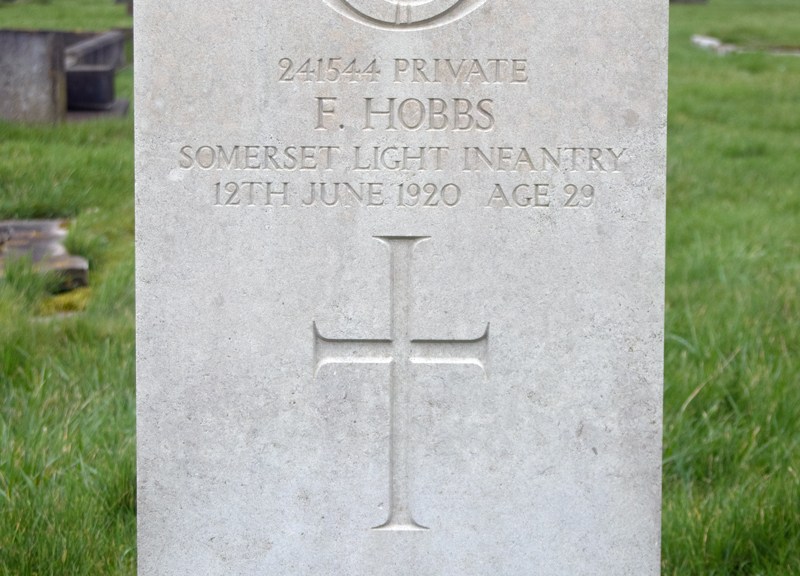
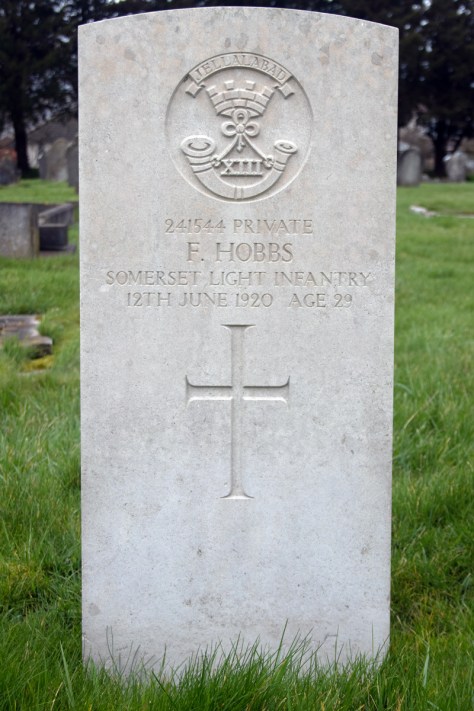
Private Fred Hobbs

Private Fred Hobbs

Occasionally I have found that some people are destined to remain hidden. No matter how much research you try and do, details stay lost, and the name on a gravestone will remain just that.

Private Fred Hobbs is one of those people.


He was born in around 1891; he enlisted in the 1st/5th Battalion of the Somerset Light Infantry. Private Hobbs’ service records are not available, but he was awarded the Victory and British Medals for his actions.

His pension record gives Mrs Ellen Louisa Hobbs as his next of kin; there is no confirmation of whether this was his mother or his wife – research has uncovered nothing to identify either.

Private Hobbs does not appear in the contemporary media – this would seem to suggest nothing out of the ordinary about his passing.

All we know for certain is that Fred Hobbs passed away on 12th June 1920, aged 29 years old. He lies at rest in St John’s Cemetery in Bridgwater, Somerset.