Tag Archives: tuberculosis

Private Percy Payne

Private Percy Payne

Percy Payne was born in the village of Kingston Seymour, between Weston-super-Mare and Yatton, Somerset. His parents were agricultural labourer Harry Payne and his wife, Elizabeth, and he had three brothers.

It seems that Percy’s parents may well have separated by 1911; Elizabeth is listed as a widow in the 1911 census, but Harry appears to be alive and well and living in South Wales.

According to the census records, Elizabeth was working as a charwoman, while three of her children were working to help support the family. Percy’s two older brothers were employed as a carter and a domestic servant, while Percy himself was working as an errand boy.

By the time war broke out, Percy has stepped up the ladder. His service records listed his trade as a groom, working in Congresbury, near Bristol. He enlisted in March 1916, at the age of 19 years and 8 months, and was assigned as a Private in the Northumberland Fusiliers. He spent most of that year training on home soil, before being shipped out to France at the end of December.

Illness seems to have dogged Private Payne; he returned to England after a couple of months, and was transferred to the Labour Corps fairly soon afterwards. By September 1917 a further transfer was made, this time to the Royal Army Medical Corps, before he was finally discharged from military service on 21st January 1918, suffering from tuberculosis.

Sadly, the lung condition was to prove fatal, and Percy passed away on 26th June 1918. He was just 21 years old.

Percy Payne lies at rest in the graveyard of St Mary’s Church in the village of Yatton, Somerset.

Sapper Herbert Ridge

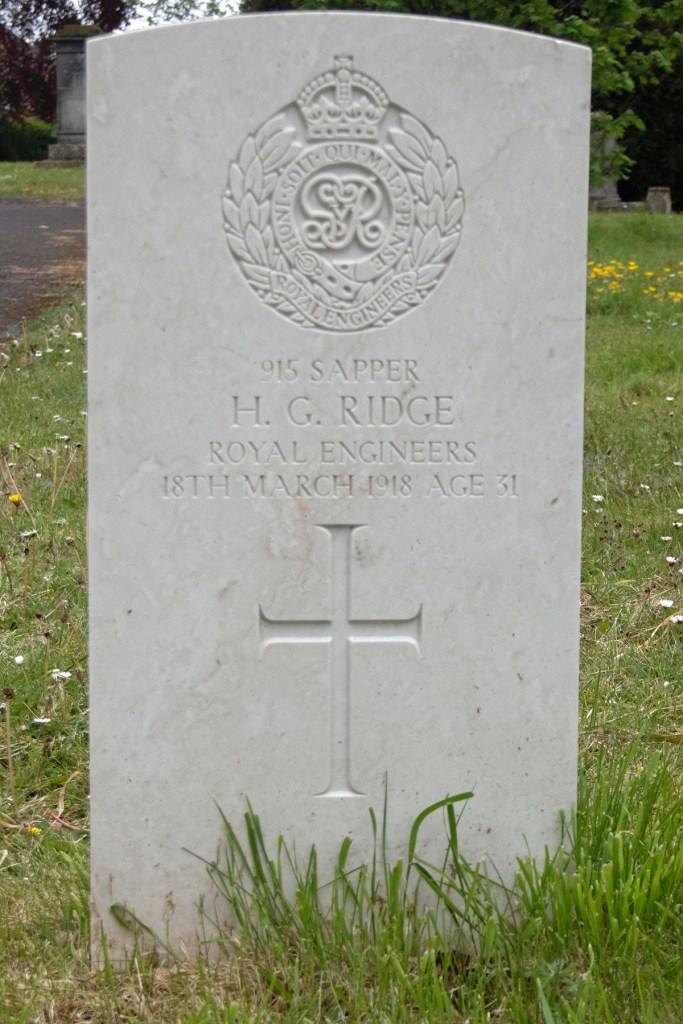
Sapper Herbert Ridge

Herbert Gladstone Ridge was born in December 1886, the youngest of three children to Alfred and Sarah. Alfred was from Lancashire and had met and married his wife in Ireland, which is where Herbert’s older siblings had been born.

Sarah had died when Herbert was only eleven years old. Alfred’s skills were as a machine engineer, and, after his wife had passed away, he brought his family down to Somerset. Initially living with his father in Taunton, Herbert had found work as a piano tuner, and moved to a boarding house in Bristol to further his trade.

War was close, however, and, in July 1915, Herbert enlisted. Joining the Welsh Field Company of the Royal Engineers as a Sapper, he was quickly posted as part of the Mediterranean Expeditionary Force. He served nearly a year in Egypt, before being sent back to England in September 1916.

By this point, Sapper Ridge was suffering from a bout of tuberculosis, and had been sent back to England for treatment. The condition refused to clear up, however, and he was eventually discharged from the army on medical grounds three months after returning home.

Details of Herbert’s life after the army are sparse. It can be assumed, however, that he remained dogged by tuberculosis, and this is what eventually killed him. He passed away on 18th March 1918, aged just 31 years old.

Herbert Gladstone Ridge lies at rest in St Mary’s Cemetery in his adopted home town of Taunton in Somerset.


Private Robert Mayers

Private Robert Mayers

Robert William Mayers – also known as Bob – was born in 1888, one of nine children to Charles and Louisa Mayers from Taunton in Somerset. Charles was a solicitor’s clerk, whose work changed direction in the 1890s, and who became a general labourer.

When Robert left school, he became a carpenter, while his older brother became a motor mechanic, and other siblings became messengers, collar machinists and housemaids.

With war on the horizon, Robert enlisted. His full service records no longer exist, but he enrolled in the Bedfordshire Regiment and joined the 3rd Garrison Battalion. While there is no evidence of Private Mayers’ time in the army, it is likely that he saw some service in India and Burma during and after the Great War.

Robert returned to England after being demobbed, but, having survived the war, was suffering from tuberculosis. Sadly, the condition was to get the better of him, and he passed away at his parents’ home on 2nd May 1921. He was 34 years old.

Robert William Mayers lies at rest in St Mary’s Cemetery in Taunton, Somerset.


Private Walter Selman

Private Walter Selman

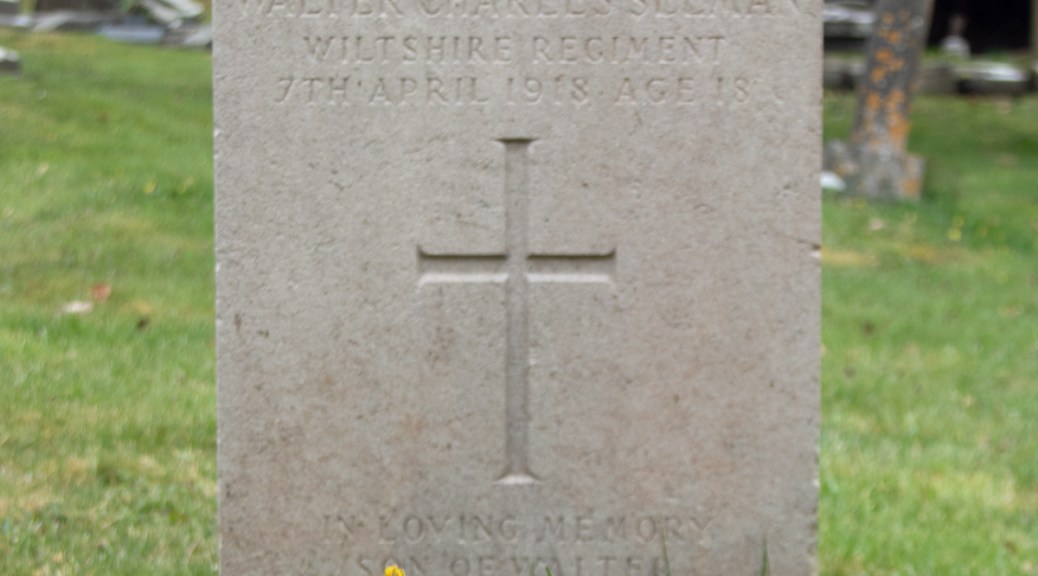
Walter Charles Selman was born on 7th June 1899, the youngest of four children to Walter and Annie Selman. Walter Sr was a gardener and, by the time of the 1911 census he had moved the family to the sleepy Somerset village of Burrington.

Sadly, there is little documentation surrounding Walter’s young life. His gravestone confirms that he enlisted in the Wiltshire Regiment; although there is no date to confirm when he enrolled, it is likely to have been in the second half of the conflict, given his age.

Private Selman was assigned to the 4th Battalion, but there is no clear confirmation of where he served. The 1/4th Battalion fought in India and Egypt; the 2/4th was also based in India but remained there for the duration. The 3/4th Battalion – the most likely to be Walter’s troop – was a reserve troop, based on home soil.

Where little is known about Private Selman’s military service, there is similarly little information about his passing. His pension records bluntly put his cause of death as ‘disease’; as with many other recruits towards the end of the war, it is likely that this was, in fact, either influenza or pneumonia.

Sadly, the mustering of the Allied armies – and the associated mixing of young men from across the country in crowded barracks – brought a real danger of disease, and lung complaints were commonplace. While there is no definite proof, it appears that Private Selman may have succumbed to one of these conditions; he passed away in a military hospital on Salisbury Plain on 7th April 1918, two months short of his 19th birthday.

Walter Charles Selman lies at rest in the graveyard of Holy Trinity Church in his home village of Burrington, Somerset.


Second Lieutenant Alfred Newington

Lieutenant Alfred Newington

Alfred John Newington was born in 1878. The oldest of four children to Alfred and Minna Newington, Alfred Sr was a hosier, and the family lived in Brighton, Sussex.

Alfred Sr passed away in 1899, and by this time, his eldest son had followed his trade, becoming a gentleman’s outfitter. By the time of the 1911 census, he was the only one of the siblings still living at home, and was supporting Minna financially and in the family business along the coast in Worthing.

As with his early life, details of Alfred’s military service are a little scarce. However, a newspaper report of his passing gives more detail.

DEATH OF LIEUTENANT NEWINGTON

We learn with regret that Lieutenant Alfred J Newington died at Nordrath [sic], Blagdon, Somerset, on Friday. He was the eldest son of the late Mr Alfred Newington and of Mrs Newington, of Somerset Villa, Richmond Road.

The death of Mr Newington Sr took place after an illness of a long duration, in July 1899, after he had been in business her for about sixteen years. He came hither from Brighton, and established himself as an outfitter at the corner of Warwick Street at the premises now occupied by Messrs. Kinch Brothers.

During his residence here, Mr AJ Newington, who assisted his father in the business, had an exciting experience in the summer of 1896. He and Mr Frederick Barnwell and a friend names Wadham went towards Lancing on a fishing expedition and the boat was capsized, and Mr Barnwell was drowned, whilst Mr Newington and Mr Wadham were in the water for an hour and a half, eventually reaching the shore in an exhausted condition.

In February 1897, Mr Newington went to South Africa, and when War broke out he became a trooper in the South Africa Light Horse. He was subsequently awarded the silver medal with six bars, bearing the names of Belmont, Laing’s Nek, the Relief of Ladysmith, Orange Free State, Tugela Heights and Cape Colony.

When he came back to England, Mr Newington returned to the business and was a member of the Somerset Yeomanry, in which he advanced to the rank of Sergeant Major. His health failed about eight years ago, and he undertook a trip to the Baltic.

During the present War, he joined the Army Service Corps, and was attached to the Indian Cavalry Division in France, and it is only within a comparatively brief period that he was on leave at Worthing. His relatives will receive the sympathy of a wide circle of friends in the loss they have now sustained.

Worthing Gazette: Wednesday 9th May 1917

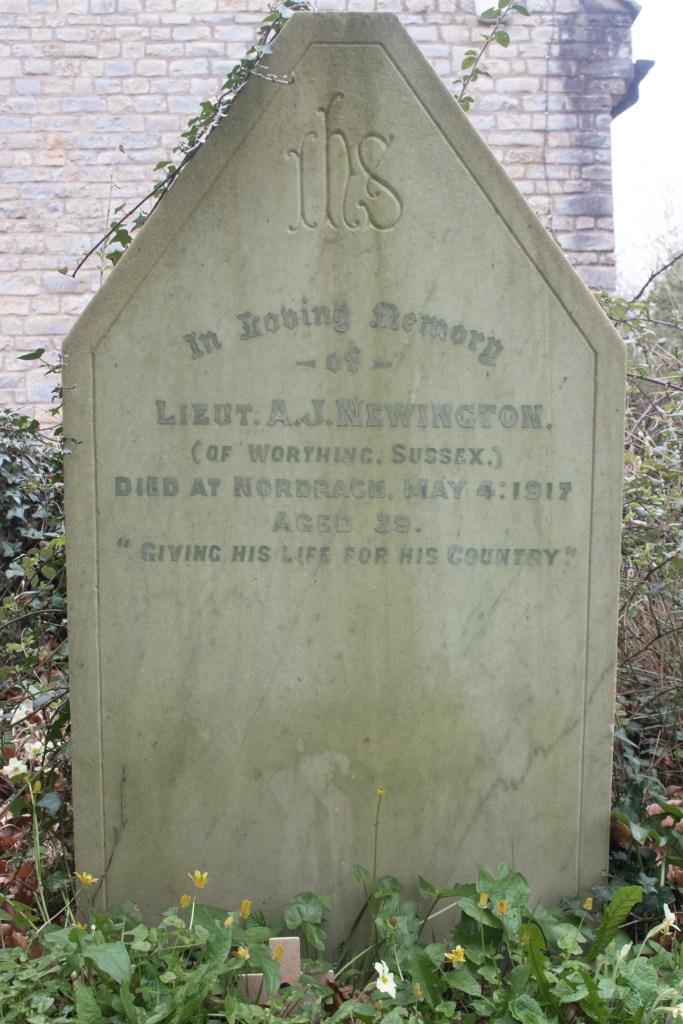
Second Lieutenant Newington had actually been admitted to the Nordrach Sanatorium near Blagdon in Somerset. This was a hospital that specialised in the treatment of tuberculosis, so it is safe to assume that this is the condition that affected him. He passed away on 4th May 1917, at the age of 39 years old.

Alfred John Newington wasn’t taken back to Worthing for burial. Instead, he lies at rest in the quiet churchyard of St Bartholomew’s in the village of Ubley, near Blagdon, in Somerset.


Musician Henry Selley

Musician Henry Selley

Henry Louis Selley was born in 1876, one of nine children to Richard and Mary Ann Selley. His father was an agricultural labourer and the family lived in Exminster, Devon.

Initially, Henry followed his father in becoming an agricultural labourer, but the military life seems to have sparked an interest. While Henry’s military records no longer exist, he is recorded as having completed 24 years’ service with the Royal Engineers at the time of his death. He would have enlisted, therefore, in around 1897, when he was about 21 years of age.

As to his duties while in the military, these can only be guessed at. He is intriguingly noted as Musician, although there is no documentation to expand on Henry’s role any further. There were many professional musicians in the army, and they performed table music, serenades, and home concerts, mainly for high-ranking officers.

Musician Selley’s role may also have to be set timing for marches, etc, although, again, this is purely speculation on my part, as there is no evidence to suggest this was the case.

Henry married a woman called Constance in 1905; she had been born in Devon, but there is no further information on her. The 1911 census records the young couple as living in a terraced house not far from the Royal Engineers Barracks, where Henry would have been based. The couple did not go on to have any children.

And there, Musician Selley’s trail goes cold. The next that he appears in any documentation is in 1921, when his army pension record confirms that he passed away. He had been admitted to the Royal Herbert Hospital in Woolwich with pulmonary tuberculosis, and succumbed to the disease on 26th May 1921. He was 45 years old.

Henry Louis Selley lies at rest in the Woodlands Cemetery in Gillingham, Kent.


Sapper Harry Paterson

Sapper Harry Paterson

Harry Bruce Paterson was born towards the end of 1893, one of two children to John and Jane Paterson. John worked at Chatham Dockyard fitting ships’ engines, and the family lived in a small terraced house close to the centre of Gillingham in Kent.

When Harry left school, he became a plumber’s apprentice, soon qualifying as a full plumber.

He married Ellen Keeler in 1906, and the couple lived a short walk away from his parents’. They went on to have four children, Lilly, Harry Jr, Mabel and Kathleen.

War was on the horizon, but Harry’s military service records are a bit sketchy.

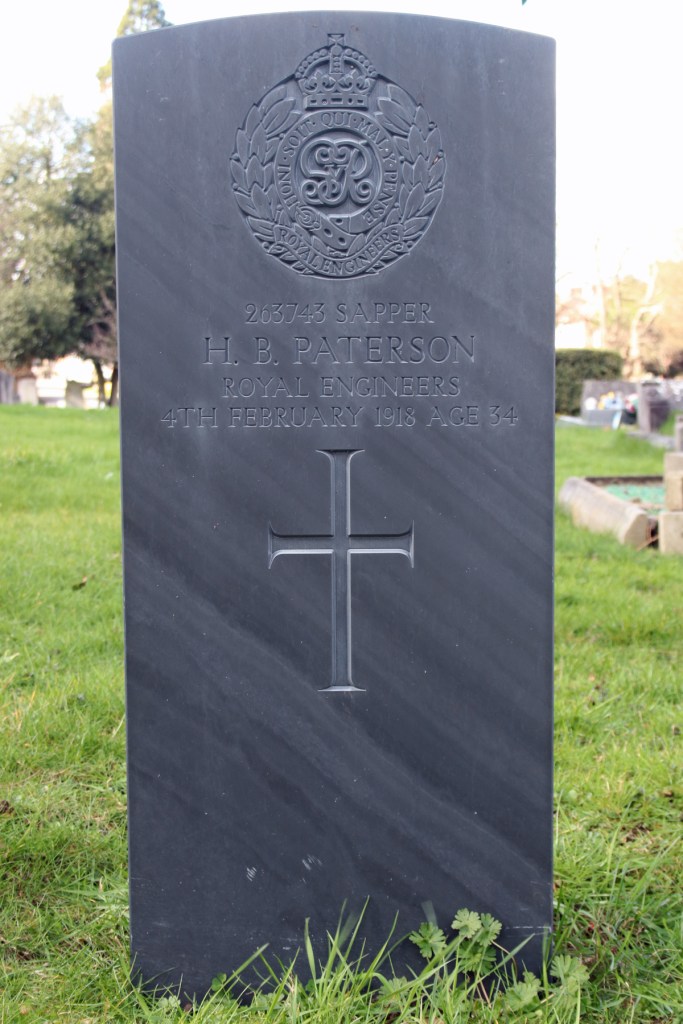
He enlisted as a Sapper in the Royal Engineers on 14th July 1915, and served in France. He attained the Victory and British Medals as well as the 1915 Star.

Sadly, Sapper Paterson’s health seems to have been impacted by his service. In January 1918 he was invalided back to England and admitted to the military hospital at the army camp in Thetford, Norfolk. Diagnosed with pulmonary tuberculosis, he quickly succumbed to the disease, and passed away on 4th February 1918. He was 34 years old.

Harry Bruce Paterson lies at rest in the Woodlands Cemetery, Gillingham, just a few minutes’ walk from both his parents and his widow and children.


Sapper Harry Paterson
(from ancestry.co.uk)

Lance Corporal Sidney Turner

Lance Corporal Sidney Turner

Sidney Joseph Turner was born in 1888, the oldest of four children to Sidney and Matilda Turner from Bridgwater in Somerset. Sidney Sr was a carter, while his son became a labourer in a local cement works. Sadly, Sidney Sr died in 1903, when Sidney Jr was 15, leaving Matilda with three other children, one of whom was only 18 months old.

Sidney Jr travelled to get work, and had moved to South Wales to work as a miner by 1909. Here he married Rose Shattock, who was born in Bristol, although within a couple of years the young couple had moved back to Somerset.

Sidney and Rose had a son, also called Sidney, although sadly he died when he was only a couple of months old. Tragically for Sidney, the records seem to suggest that Rose may have died in childbirth, or shortly after, as her passing was registered in the same quarter as her son’s birth.

By this time, Sidney was living in Bailey Street, Bridgwater, a short distance from some railway sidings. This might have driven some determination in him as, by the following year, he was listed as an engine driver. In December 1913 he married his second wife, Bessie Sharman. She was the daughter of a mariner, who had become a machinist in a shirt factory by the time of their marriage. The couple went on to have a son, also called Sidney, in April 1914.

When war broke out, Sidney enlisted in the Highland Light Infantry, initially in the 12th (Service) Battalion. They landed in France in July 1915 and were there for the remainder of the war. At some point, Lance Corporal Turner transferred to the 53rd (Young Soldier) Battalion. Very much a training brigade, it seems that Sidney’s experience of the front line may have proved useful for the upcoming recruits.

Lance Corporal Turner was demobbed on 21st March 1919; his pension record shows that, during the course of his service, he had fractured his tibia and had contracted bronchitis. The 1921 census found Sidney back in Bridgwater. He was listed as being a gas engine driver for John Board & Co., although he was, at that point, out of work. He, Bessie and Sidney Jr were living at 1 Price’s Buildings.

Sidney’s health conditions were to prove his downfall, as, within a months of the census return, he had succumbed to pulmonary tuberculosis and exhaustion. He died on 2nd July 1921, aged just 32 years old.

Sidney Joseph Turner lies at rest in St John’s Cemetery in his home town of Bridgwater, Somerset.

Engine Room Artificer George Millard

Artificer George Millard

George Edmund Millard was born in 1887, one of seven children to Edmund and Annie Millard, from Bridgwater, Somerset. Edmund was an engineer by trade, something George’s elder brother followed him into.

Sadly, little of George’s life remains documented. He enlisted in the Royal Navy, in January 1915, working as an Engine Room Artificer (or engineer). Stationed in Kent, his initial training was at HMS Pembroke II base on the Isle of Sheppey.

Artificer Millard spent nine months on HMS Dido, which formed part of the Royal Navy’s force based in Harwich. At start of 1916, he was transferred back to HMS Pembroke II. This may have been for health reasons, as he was subsequently discharged with tuberculosis in April.

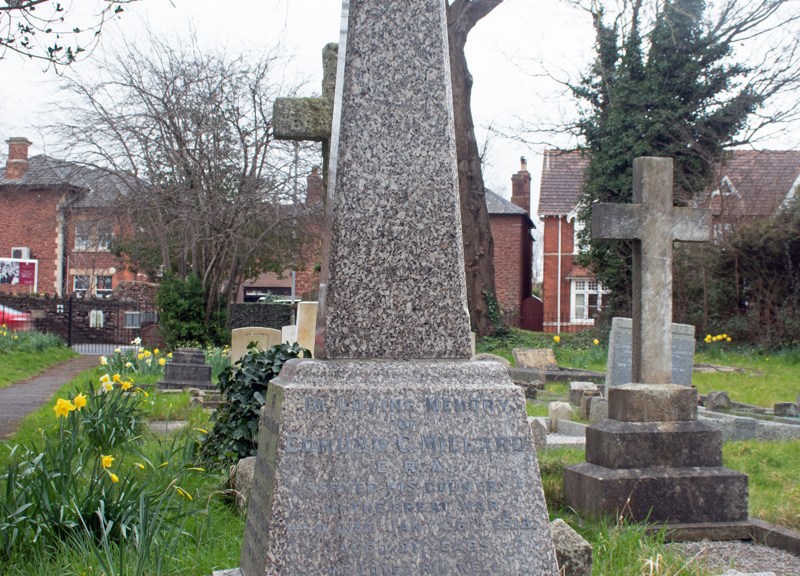
George’s records finish there, and it is likely that he succumbed to his lung condition after an 18-month fight. He died at home in Bridgwater on 26th January 1918, aged 21 years old.

George Edmund Millard lies at rest in the family grave at the Wembdon Road Cemetery in his home town of Bridgwater.


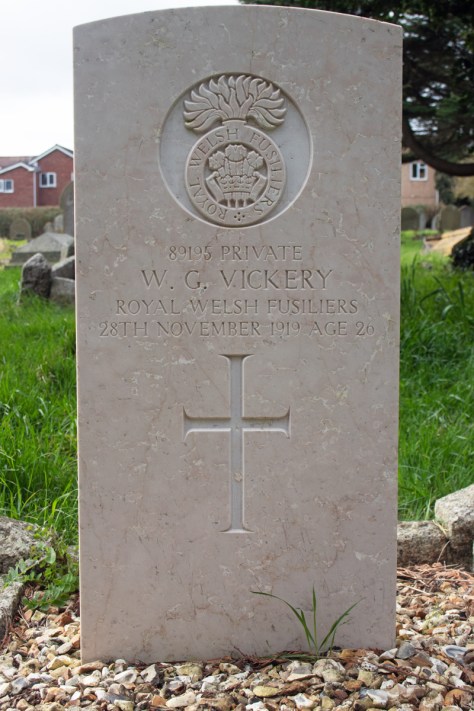
Private William Vickery

Private William Vickery

William George Vickery was born in the summer of 1894, the youngest of three children to George and Mary Vickery. George was a labourer in a brickyard, and this is work that his son followed him into once he left school.

William seems to have progressed with work as, by the time he enlisted for military service, he was recorded as a miner, working in the collieries of South Wales. Initially joining up in February 1916, is seems like his job gave him a level of protection for a couple of years at least; he was not formally mobilised by the Royal Welch Fusiliers until May 1918.

Initially serving on the home front, Private Vickery was shipped to France in September 1918, serving two months there, before returning home. William was eventually discharged from the army on medical grounds; having contracted tuberculosis while on active duty.

There is little information about William after his discharge. It seems likely that his health deteriorated, however, as he died just a year later, on 28th November 1919. He was just 26 years of age.

William George Vickery lies at rest in the Wembdon Road Cemetery in his home town of Bridgwater, Somerset.