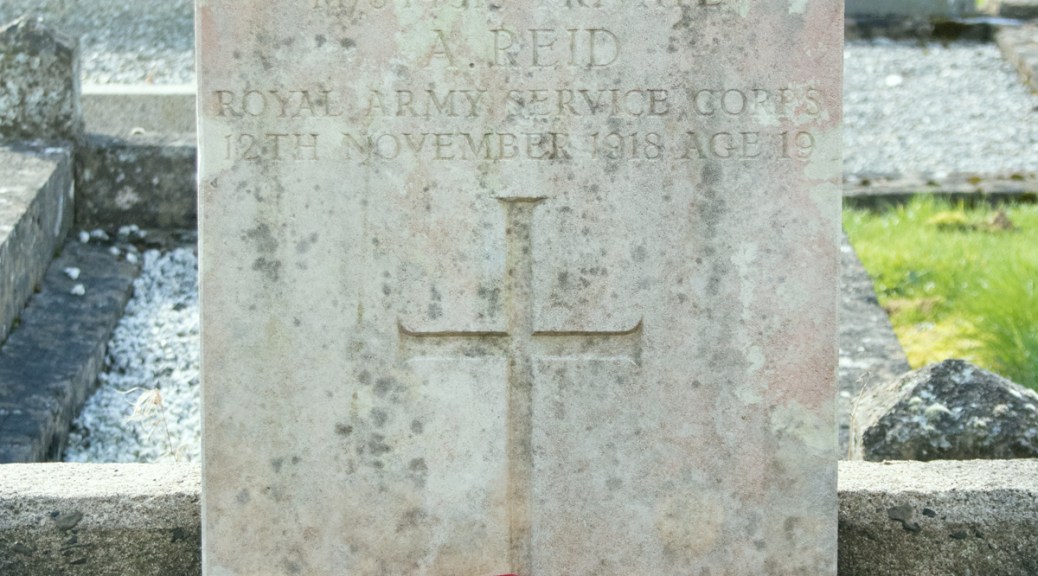
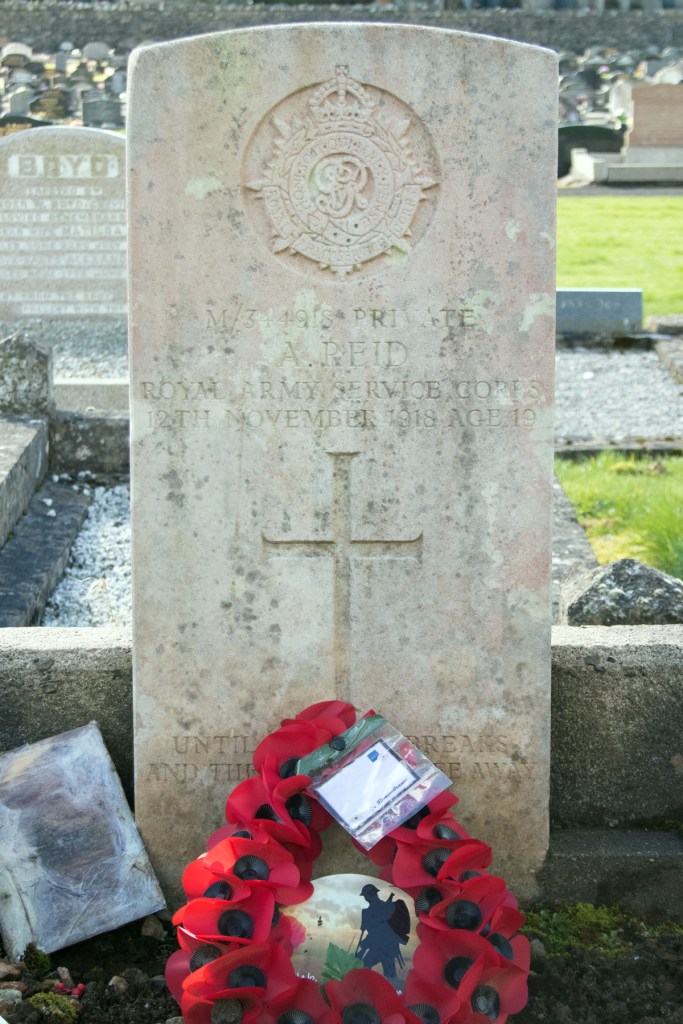
Alexander Reid was born in Ballymena, County Antrim, in the autumn of 1898. Information about his early life is a challenge to pin down, as there were a number of boys with the same name growing up in the area at the time. However, his parents were John and Margaret – or Maggie – Reid.
When Alexander finished his schooling, he found employment as a mill hand. However, when war broke out, he received the call to play his part and, on 13th October 1917, he enlisted in the Army Service Corps. His service records show that he was 5ft 7.5ins (1.71m) tall and weighed 138lbs (62.6kg). He was noted as having a tattoo of his initials on his left thumb, and that his right knee was stiff and swollen from an old injury.
Private Reid was sent to England to serve. He was attached to the Mechanical Transport Depot at Grove Park, Kent. Barracked in an old workhouse that had been taken over for army use, he remained there until the spring of 1918.
Alexander had contracted tuberculosis and was medically discharged from service because of the contagious disease. He returned home to Ballymena, but the condition worsened. He passed away at home on 12th November 1918, aged just 19 years old.
Alexander Reid was laid to rest in Ballymena New Cemetery, County Antrim, a twenty-minute walk from where his grieving family lived, in the centre of the town.
Rondaine Tristram Cary was born in Lancashire in the autumn of 1896 and was the oldest of two children to Henry and Wilhelmina. Henry was an insurance agent, and, by the time of the 1901 census, the family had moved to the parish of Linsfort in County Donegal, Ireland. This is near where Wilhelmina had been born, so it seems likely that the draw of family had been partially responsible.
The 1911 census found the Carys living a few miles down the road, in Buncrana. Rondaine was listed as being a scholar, while his younger brother, five year old John, completed the family setup. John was employed as a commission agent, and all four members of the household were listed as being Episcopalian.
When war came to Europe in 1914, Rondaine was keen to play his part. He seems to have enlisted almost at once, joining the Royal Inniskilling Fusiliers. Assigned to the 11th (Service) Battalion (Donegal and Fermanagh), Private Cary was sent to Ballymena, County Antrim, for training.
Rondaine had only been in the camp for a matter of weeks, when he contracted measles. He was admitted to a hospital in Ballymena on 17th February 1915, but his condition worsened, and his father came to visit. Private Cary passed away on 27th February 1915, aged just 18 years of age.
The Cary family seemed unable to afford the cost of bringing their son’s body back to Buncrana. Instead, the local authority paid for Rondaine Tristram Cary’s coffin and funeral at Ballymena Cemetery, while his army colleague funded his headstone.
The life Albert Bendell is one of dedication to naval service. Born in Portsmouth on 28th May 1865, his parents were Master at Arms John Bendell and his Jersey-born wife, Eliza.
The family had moved to St Martin, Jersey, by the time of the 1871 census. Given the amount of time her husband spent at sea, it would seem likely that Eliza, who had three young children to raise on her own, wanted to be close to her family.
Albert was keen to follow in his father’s footsteps and, on 6th December 1880 he enlisted in the Royal Navy. Just fifteen years old, his service records show that he was just 5ft 1.5ins (1.56m) tall, with blue eyes, light hair and a fair complexion.
Albert’s dedication to the role was obvious: starting off as Boy 2nd Class, he steadily – and rapidly – rose through the ranks. Over the next twelve years, he served on seven ships and shore bases. He was promoted to Boy 1st Class in September 1891, while serving on the training ship HMS St Vincent.
When he came of age in May 1883, he was given the rank of Ordinary Seaman: within a year he had risen to Able Seaman, and achieved the role of Leading Seaman in January 1888. Just three months later, Petty Officer Bendell was beginning a two-year service on board HMS Fearless.
In April 1893, Albert received a further promotion, and a change in direction within the Royal Navy. He was now a Gunner, a standing officer’s role, permanently attached to HMS Duke of Wellington – returning to the first ship he had been assigned to nine years earlier.
On 17th September 1900, Albert married Amelia Renouf, the daughter of a land proprietor from St Martin, Jersey. The couple wed in St Helier, Albert giving his profession as Warrant Officer. At 37, Amelia was a year older than her new husband: the couple would not go on to have any children.
Albert’s rise through the ranks continued. The 1911 census found him moored in Malta. He was Chief Gunner on HMS Egmont: the importance of his role on board highlighted by the fact that he was the 11th person out of 188 to be recorded on the document.
When war came to Europe, Albert served his King and Country proud. He was promoted to the rank of Lieutenant and, in June 1919, he was awarded the MBE “for valuable services as Officer-in-Charge, Defensively Armed Merchant Ships, Southampton.” [The Edinburgh Gazette, 1st July 1919]
This distinguished life was beginning to take its toll, however, and, on 16th March 1920, after nearly 40 years in naval service, Albert was medically stood down. Suffering from dyspepsia, he returned to Jersey, and his home, La Rosaye, in St Martin.
Albert Bendell’s health was to get the better of him. He passed away on 26th April 1920, at the age of 54 years of age. He was laid to rest in the peaceful graveyard of St Martin’s Church, Jersey.
Amelia remained on the island for the remainder of her life. She passed away on 31st August 1943, at the height of Jersey’s German occupation, at the age of 80 years old. She was laid to rest with Albert, husband and wife reunited after more than 23 years.
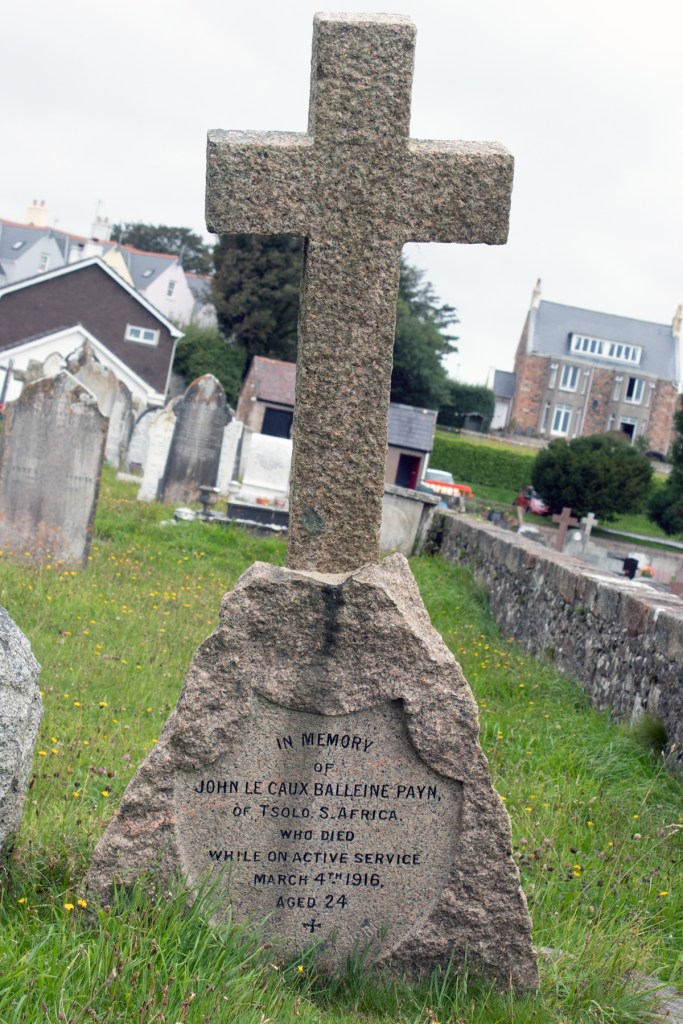
John le Caux Balleine Payn was born in South Africa in 1892. The sixth of seven children, his parents were Jersey-born Philip Payn and his wife, Mary, who came from the Eastern Cape.
There is tantalisingly little information available about John’s life. When war was declared in Europe, he answered the call from King and Empire, and enlisted in the South African Infantry. His regiment – the 1st – fought in North Africa and at the Somme, but it is not clear when and where he was based.
It is likely that Private Payn either had a base in the UK, or that he was hospitalised there following an illness or an injury. He passed away, through causes unconfirmed, on 4th March 1916. He was just 24 years of age.
It was impractical to repatriate John le Caux Balleine Payn’s body to South Africa for burial. Instead, he was laid to rest close to his father’s family, in St Martin’s, Jersey.
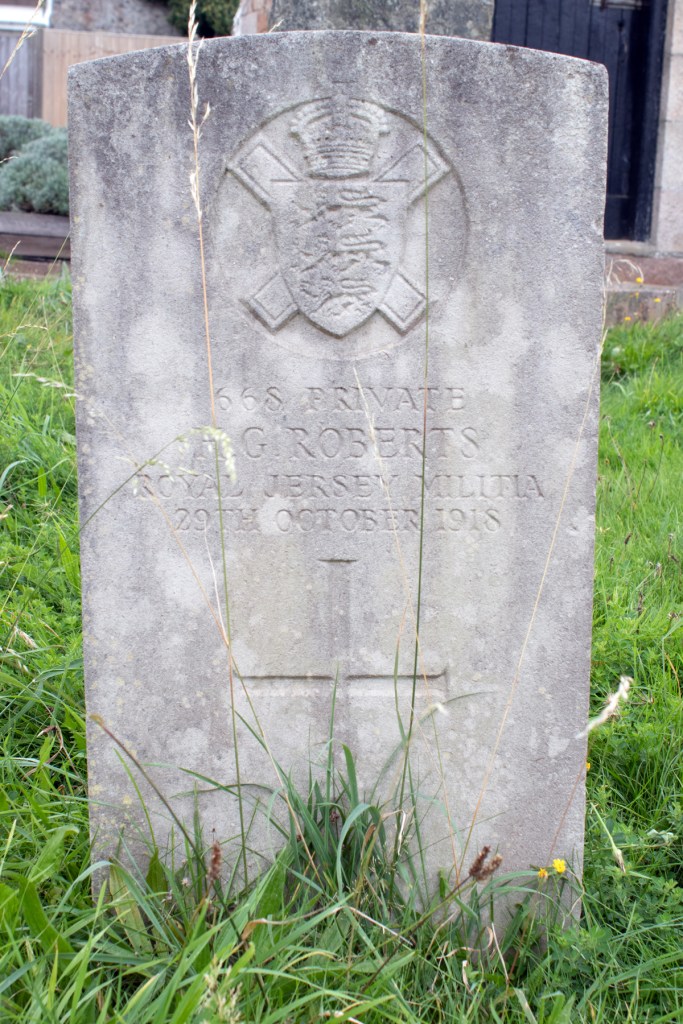
The life of Henry George Roberts is destined to remain shrouded in mystery.
His entry in the Commonwealth War Graves Commission records reads: “ROBERTS, Pte. HG, 668, Royal Jersey Garrison Bn. Channel Islands Militia. 29th Oct, 1918. In North-West corner [St Martin Churchyard]”, but there are no details of his next-of-kin.
No related military records are available for him, and, without Henry’s age an online search identifies too many results to be of any practical use.
Private Roberts lies at rest in the peaceful churchyard, his life lost in the mists of time.
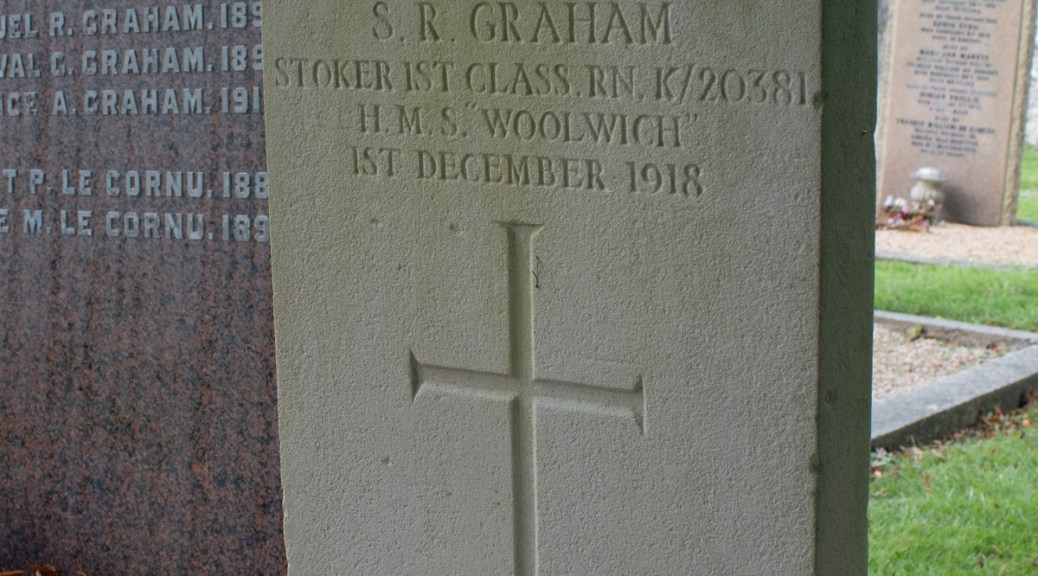
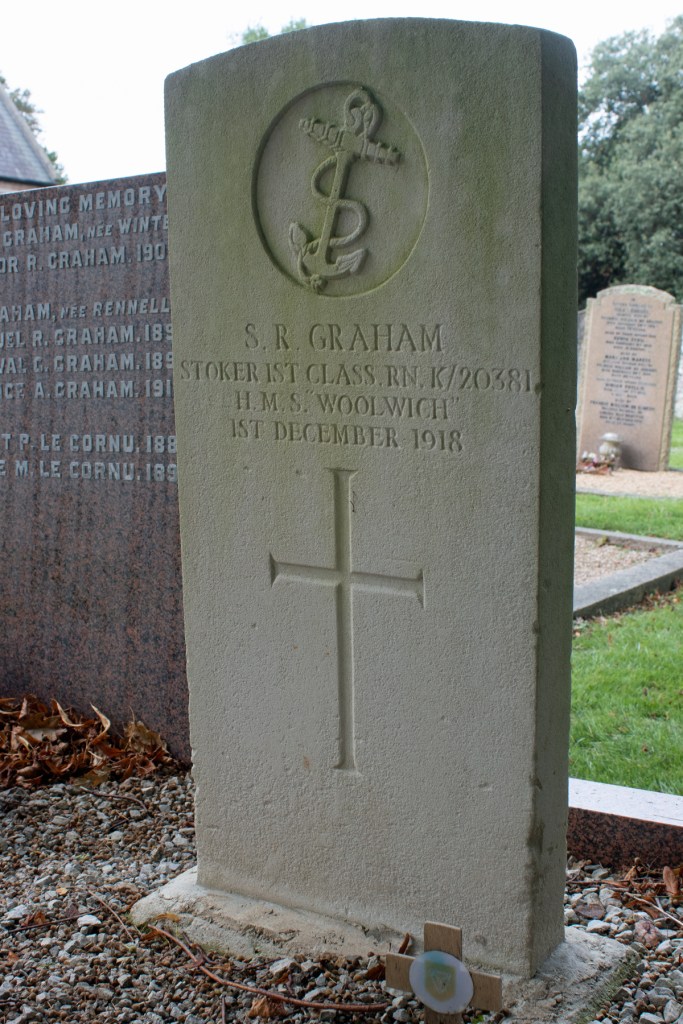
Samuel Robert Graham was born in Cork, Ireland, in 1895. He was one of six children to Samuel and Alice Graham. Samuel was a postman from Liverpool, while Alice had been born in St Helier, Jersey.
Information about Samuel Jr’s early life is scarce: the 1901 census found Alice and the children visiting her mother in Jersey, while he husband is missing from census records. The next return in 1911 recorded Samuel Sr, Alice and three of their children living in the Trinity area of Jersey, but Samuel Jr is missing.
On 9th September 1913, Samuel Jr enlisted in the Royal Navy. He had been working as a blacksmith, and sought a career at sea. His service records show that he was 5ft 5ins (1,65m) tall, with brown hair, hazel eyes and a fresh complexion.
Stoker 2nd Class Graham signed up for a period of twelve years’ service. Based at HMS Victory, the Royal Naval Dockyard in Portsmouth, Hampshire, his first formal posting was on board the cruiser HMS Bristol. He remained on board for nearly two years, and was promoted to Stoker 1st Class in the process.
During the First World War, Samuel served on two more ships and, by the end of the conflict, he was based at HMS Columbine, the naval base at Port Edgar on the Firth of Forth, Scotland. He fell ill while barracked there, and was admitted to the Royal Naval Hospital in nearby Queensferry. Whatever Stoker 1st Class Graham’s condition, it was to prove too severe: he passed away on 1st December 1918, at the age of 23 years old.
Samuel Robert Graham’s body was taken back to Jersey for burial. He was laid to rest in Trinity Churchyard, not far from where his family still lived.
Wilfred John le Breton was born in Trinity, Jersey, on 25th August 1888. The fifth of eleven children, his parents were Thomas and Mary Ann le Breton. Mary died in 1898, and the family pulled together to support each other. Thomas was a mason, and when he finished his schooling, Wilfred followed suit.
On 8th January 1916, Wilfred married Louisa Allo. The daughter of a labourer from St Lawrence, she was working as a domestic servant when the couple wed: Wilfred, by this point was employed as a plasterer.
At this point, Wilfred’s trail goes cold. War was raging across Europe, and he enlisted in the Royal Jersey Militia. Private le Breton remained stationed on the island, but his specific role is unclear.
The next document relating to Wilfred’s life is that of his passing. He died on 23rd November 1916, at the age of 28 years old. The cause of his demise is unclear.
Wilfred John le Breton was laid to rest in Trinity Churchyard, Jersey. His exact grave is unknown, but a Commonwealth War Graves Commission headstone commemorates his life.
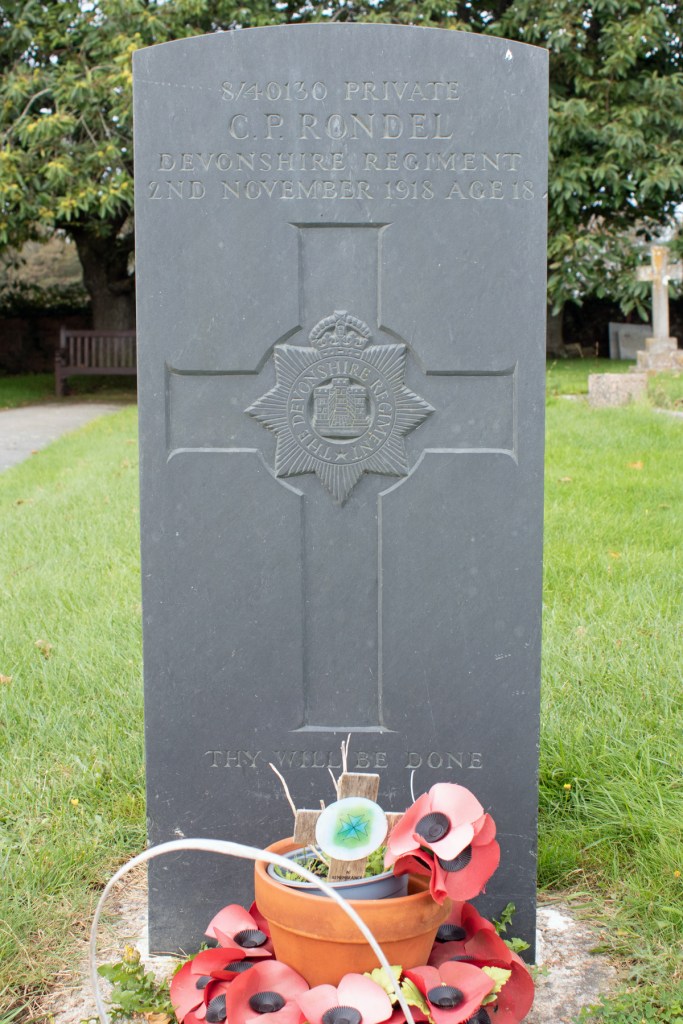
Clarence Philip Rondel was born in 1900 in St Lawrence, Jersey. One of twelve sibling, nine of whom survived childhood, his parents were John and Louisa Rondel. John was a farmer and by the time of the 1911 census, the family had moved to St John’s to take up a new post, a lot of the family pitching in to help out.
When war came to European shores, Clarence was keen to play his part. Too young to enlist when hostilities were declared, it was not until the spring of 1918 that he was able to join up. Private Rondel was assigned to the 53rd (Young Soldier) Battalion of the Devonshire Regiment.
Clarence was sent to England for training, and was based at the Rollestone Camp on Salisbury Plain, Wiltshire. The barracks were breeding grounds for illness and disease, and Private Rondel was not to be immune. He contracted pneumonia, and was admitted to the camp’s hospital. The condition got the better of him, and he passed away on 2nd November 1918: he was just 18 years of age.
The body of Clarence Philip Rondel was taken back to Jersey for burial. He was laid to rest in St John’s New Cemetery, not far from where his family still lived.
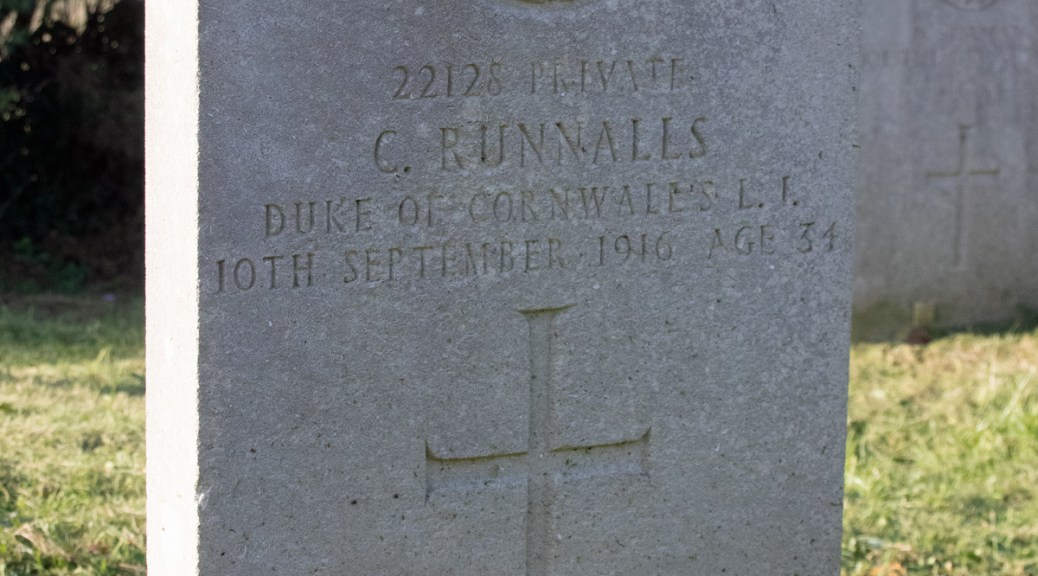
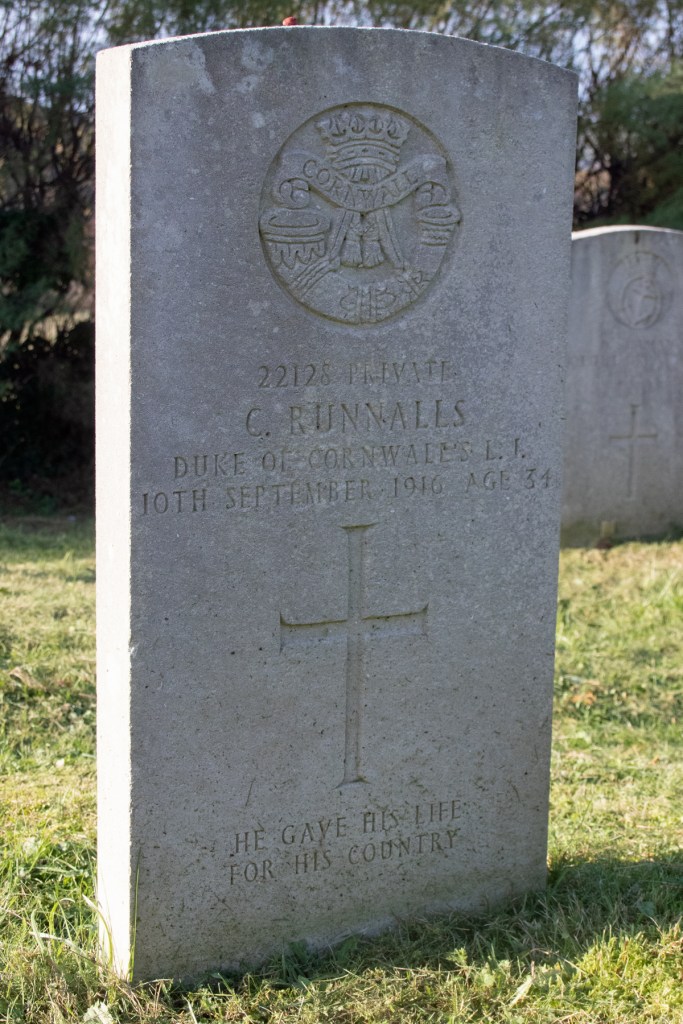
Christopher Runnalls was born in the village of Cardinham, Cornwall, in 1892. The fourth of five children, his parents were game keeper John Runnalls and his wife, Mary. Christopher – who was better known by the nickname Kitt – didn’t follow in his father’s footsteps, instead finding work as a stone mason when he finished his schooling.
Kitt moved to St Minver, near Wadebridge, for work and, in 1907, he married Susan Buse. The couple set up home in a small cottage in the village, sharing their home with Susan’s niece, Vivian.
When war was declared, Kitt stepped up to play his part. He enlisted in the Duke of Cornwall’s Light Infantry, and, as a Private, was assigned to the 10th (Service) Battalion, also known as the Cornwall Pioneers. He soon found himself on the Western Front and, in the summer of 1916, was caught up in the Somme.
Pte. Kitt Runnals [sic], of the DCLI, who was wounded in France on August 10th, and was brought to Leeds Great Northern Hospital, died at that institution on September 10th. The body was brought to St Minver and buried at [St Enodoc’s Church] on Thursday, the 14th.
[He] was one of the most respected men in the parish. He was a mason by trade. When war broke out he thought it his duty to join up. He was a member of the United Methodist Church. He leaves a widow but no family.
Newquay Express and Cornwall County Chronicle: Friday 22nd September 1916
Christopher ‘Kitt’ Runnalls was 34 years old when he passed. He lies at rest in the peaceful landscape of St Enodoc’s Church, Cornwall.
John Leslie Mably was born on 21st May 1899, the only son to Elizabeth Janie Mably. Elizabeth lived with her widowed mother and two older brothers, in the Cornish parish of St Minver.
There is scant information available for John’s short life. The 1911 census showed that he was still at school, and when war broke out, he enlisted in the Royal Engineers, although the date for this happened is unclear. Sapper Mably was assigned to the 69th Division Signal Company, but records do not confirm whether he served overseas or on home soil.
At some point later in the conflict, John was in Yorkshire, as he was admitted to the general hospital in Sheffield. Again, details are sketchy, and it is not possible to identify if he was based in the area, or medically evacuated there from overseas. Either way, it was in the hospital that he breathed his last, passing away on 15th August 1918, at the age of just 19 years old.
John Leslie Mably’s body was taken back to Cornwall for burial. He was laid to rest in the picturesque setting of St Michael’s Churchyard in the village of Rock.







 Death and Service