Tag Archives: wounded

Private Albert Cook

Private Albert Cook

Albert William Cook was born on 29th August 1887, in the Somerset village of Chaffcombe. He was the oldest of six children – of which only three survived infancy – to William and Harriet Cook. William was a thatcher by trade, and moved his young family to nearby Chard when Albert was a youngster.

When he finished school, Albert found work as a wagoner for the local coal depot, Jarman & Co. War was on the horizon, however, and, at the start of 1915, he signed up to play his part for King and Country.

Private Cook joined the Somerset Light Infantry. While full details of his service are not available, his troop – the 1st Battalion – were heavily involved in the Second Battle of Ypres in the spring of 1915. While he seemed to have survived this, he was later injured, receiving a fractured skull and becoming paralysed on one side.

Albert was admitted to the Canadian No. 2 Stationary Hospital in Le Touquet, but subsequently evacuated to England for further treatment. He was operated on in a hospital in Birmingham, but his injuries proved too severe. He passed away on 3rd September 1915, and had just turned 28 years old.

Albert William Cook’s body was brought back to Somerset for burial. He was laid to rest in Chard Cemetery, not far from his family’s home.


Private Herbert Matthews

Private Herbert Matthews

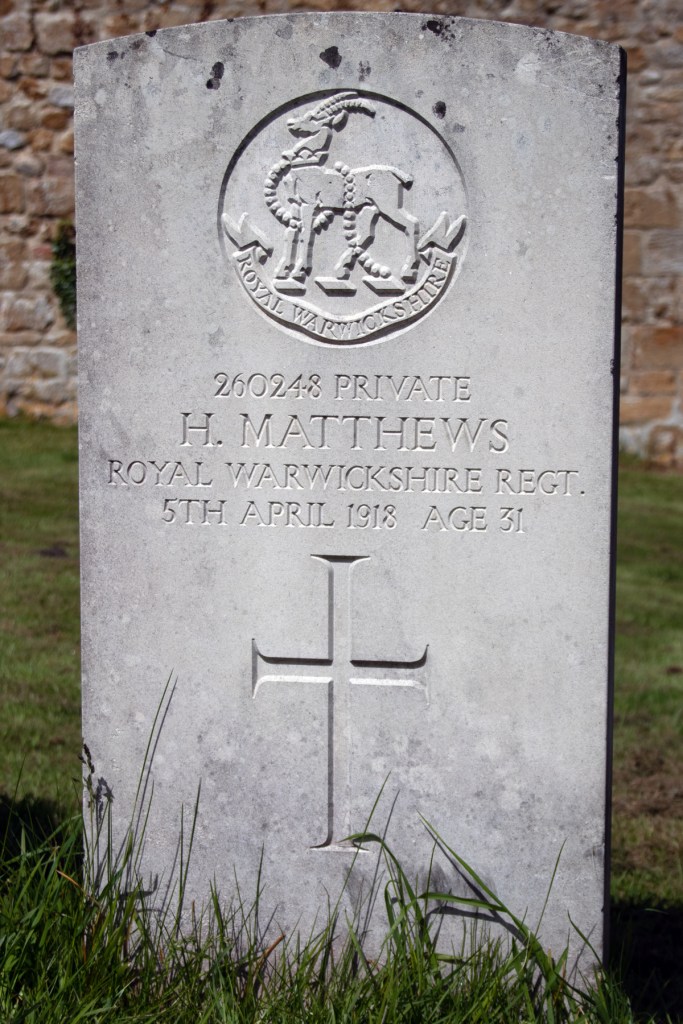
Herbert George Matthews was born in the autumn of 1886 in the Somerset village of Chillington. He was the oldest of two children to George and Elizabeth (known as Rosa) Matthews, and was baptised in the village church on Christmas Day that year.

George was a farm labourer, and this is work into which Herbert also followed. Rosa passed away in December 1910, leaving George a widow after 26 years of marriage.

War came to Europe in 1914, and Herbert signed up to play his part for King and Country. Full details of his service are not available, but he initially enlisted in the Somerset Light Infantry. He soon transferred across to the Royal Warwickshire Regiment (although the date of this is unclear) and was assigned to the 2nd/6th Battalion.

Private Matthews’ troop spent the war on the Western Front, and was involved at Fromelles, Ancre, Ypres and Cambrai. In the spring of 1918, he was caught up in the Battle of St Quentin – part of that year’s battles on the Somme. He was wounded, and medically evacuated to England, where he was admitted to the University War Hospital in Southampton.

Sadly, Private Matthews’ wounds proved too severe; he passed away from his injuries on 5th April 1918, at the age of 31 years old.

Herbert George Matthews was laid to rest in Chillington Cemetery, not far from where his mother was buried, and within walking distance of where his father still lived.


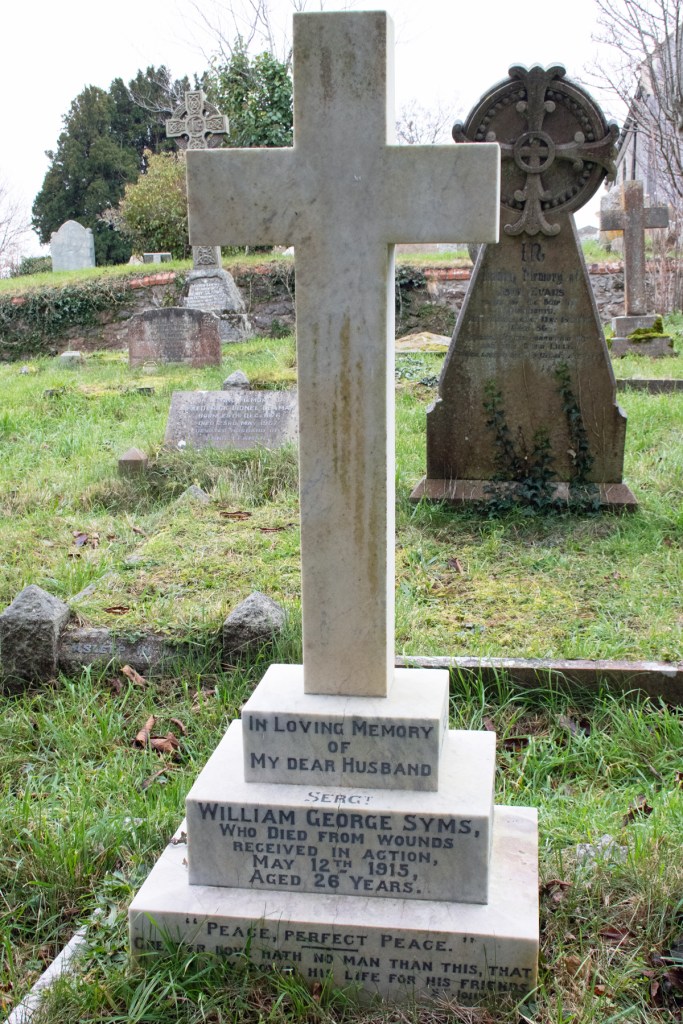
Serjeant William Syms

Serjeant William Syms

William George Syms was born in in the spring of 1889, the oldest of two children to George and Rose Symes (both spellings are recorded). George was a postman from Devon, and the family were born and raised in Highweek, Newton Abbot.

When William left school, he followed in his father’s footsteps becoming a postman in his home town. Life was not without its ups and downs, however, and the 1911 census record him as an inpatient, convalescing from an unknown illness in Exmouth.

In the summer of 1913, William married Amelia Oliver, a gardener’s daughter, who also from Highweek.

When war broke out William was eager to play his part, and enlisted in the early months of the conflict, alongside a number of his colleagues. He joined the Royal Engineers, and was assigned to the 1st (Wessex) Division Signal Company. He was sent to France on 22nd December 1914 and was involved on the Front Line from early on.

By the spring of 1915, he was fighting at Ypres, and was badly injured, fracturing both legs and suffering from the effects of being gassed. Serjeant Syms – as he was by then ranked – was medically evacuated to England for treatment. He was admitted to the Auxiliary Military Hospital in Manchester, but died of his injuries on 12th May 1915. He was just 26 years old.

William George Syms’ body was brought back to Devon for burial. He was laid to rest in the graveyard of All Saints Church in his home town of Highweek. Tragically, he was never to see his son, also called William, who had been born just two months before.


Lieutenant Frederick Liardet

Lieutenant Frederick Liardet

Frederick Charles Evelyn Liardet was born in Brighton, now a suburb of Melbourne, Australia, in 1888, and the eldest son of Wilbraham and Eleanor Liardet.

There is little further information about Frederick’s early life, but, when war broke out, he wanted to play his part for King and Country, and enlisted in the Devonshire Regiment.

He had an adventurous career… Having been twice wounded while on active service in France, he was appointed an instructor in the Balloon Section of the Royal Flying Corps.

Exeter and Plymouth Gazette: Tuesday 18th December 1917

On 23rd October 1915, Frederick married Kathleen Norah Liardet in Highweek, Newton Abbot, Devon. She was the daughter of a retired Lieutenant Colonel in the Royal Marine Light Infantry, and may have been a cousin (while their surname is unusual enough for there to be a connection, I have been unable to identify a specific connection). The couple went on to have a daughter, Barbara, who was born in 1917.

In 1916, while on a night flight with the Royal Flying Corps, the now Lieutenant Liardet was involved in an accident and badly injured. He returned to England to recover, he and Kathleen living with her family. While his health initially improved, he relapsed and passed away on 13th December 1917, aged just 29 years old.

Frederick Charles Evelyn Liardet was laid to rest in the graveyard of All Saints Church in his adopted home of Highweek, Devon.


Private Arthur King

Private Arthur King

Arthur Thomas Rendell King was born early in 1896, the oldest of six children to Thomas and Bessie King. Engine driver Thomas had been born in London, but, after marrying his wife the year before Arthur was born, he settled in Highweek near Newton Abbot, Devon.

When he left school, Arthur followed his father in working for Great Western Railways, working as a carriage cleaner at the town’s depot. War was on the horizon, however, and he enlisted in the Devonshire Regiment shortly after conflict was declared.

Private King was assigned to the 1st/5th Battalion and sailed for India in October 1914, arriving in Karachi a month later. After nearly three years, his regiment moved again, this time to Egypt, in advance of action in the Middle East.

Involved in the Battle of Nebi Samwil in November 1917, Arthur was badly wounded – and initially recorded as missing, presumed dead. However, he was found, and evacuated to England. Tragically, within hours of being admitted to a hospital on home soil on 31st January 1918, Private King died of his injuries. He had just turned 22 years of age.

Arthur Thomas Rendell King’s body was brought back to Devon for burial. He was laid to rest in the family grave in the graveyard of All Saints Church, Highweek.


Private Arthur King
(from findagrave.com)

Private Mark Ford

Private Mark Ford

Mark Ford was born early in 1881 in Wellow, near Peasedown St John in Somerset. He was the youngest of eleven children, and the son of Thomas and Ellen Ford. Thomas was a coal miner, and this was a trade that his seven sons, including Mark, went into.

The 1901 census recorded Mark as boarding in a house in Abertillery, Monmouthshire, learning his trade. Within a few years, however, he was back in Peasedown St John. In the summer of 1910, he married local woman Emily Tucker and the couple set up home in Wellow, where they went on to have four children: George, Phyllis, Hubert and Ethel.

War was coming to Europe and, while records are scarce, it’s possible to build up a picture of the service Mark undertook. He initially enlisted as a Private in the Royal Berkshire Regiment, and was assigned to the 10th (Labour) Battalion. They were sent to France in June 1916, although it is not possible to confirm if Mark went at the same time.

His battalion became the 158th and 159th Labour Companies in April 1917, and it seems that Private Ford transferred to the former and, at this point, was definitely serving in France. That summer, he was wounded in the hip and head by an exploding shell and was medically evacuated to England for treatment.

Private Ford was admitted to the Military Hospital in York, where he lay injured for some time; long enough, thankfully, for Emily to make the journey to be with him. Sadly, his wounds were to prove too much: he passed away at the hospital on 28th October 1917, at the age of 36 years old.

Mark Ford’s body was brought back to Somerset for burial He was laid to rest in the churchyard of St John the Baptist, in Peasedown St John.


Private Anthony Mountjoy

Private Anthony Mountjoy

Anthony Mountjoy was born in the Somerset village of Clutton in the spring of 1895. One of eleven children, his parents were William and Sarah. William worked as a hewer in a local coal mine, and this is a job into which Anthony and at least two of his brothers went.

War was coming to Europe and, while there is limited documentation relating to his military service, a newspaper report on his funeral sheds some light into his life.

The funeral took place at Midsomer Norton on Monday afternoon of Private Anthony Mountjoy, 2nd Royal Welch Fusiliers, who died at the Bath Pensions Hospital… at the age of 25 years. Private Mountjoy… enlisted in the army on January 22, 1916, and went to France in July 1917. He was gassed and wounded at Passchendaele in March 1918, and arriving in England was take to the Tusehill Military Hospital, Carlisle in June. He was transferred to Bristol in April, 1919, and from there to Bath Pensions Hospital in November of the same year. He never recovered from the effects of active service.

Somerset Guardian and Radstock Observer: Friday 16th July 1920

Private Anthony Mountjoy died on 7th July 1920. He was laid to rest in the family plot in the graveyard of St John the Baptist Church in Midsomer Norton.


Rifleman Frederick Partridge

Rifleman Frederick Partridge

Frederick George Partridge was born on 26th May 1890 in Kingsteignton, Devon. He was one of ten children to clay cutter George Partridge and his wife, Anna. George passed away in 1903, but Frederick left school, and also found work as a cutter, helping to pay his way at home.

When was came to Europe, Frederick was keen to play his part. He enlisted on 18th November 1915, and was assigned to the King’s Royal Rifle Corps as a Rifleman. His service records show that he stood 5ft 9ins (1.75m) tall and weighed 145lbs (66kg). He was of good physical development, but had slightly flat feet.

After his initial training, Rifleman Partridge was sent to France, arriving in April 1916. His regiment soon found itself on the front line and, that summer, was firmly ensconced at the Somme. Sadly, Frederick was not to escape injury – he received a gun shot wound to his left thigh on 2nd September.

The wound was serious enough for him to be medically evacuated back to England for treatment. He was admitted to the Royal Victoria Hospital in Netley, near Southampton, but died of his injuries on 12th September 1916. He was just 26 years of age.

Frederick George Partridge was brought back to Devon for burial. He was laid to rest in the graveyard of St Michael’s Church in Kingsteignton.


Bombardier Harold Cornall

Bombardier Harold Cornall

Harold William Cornall was born on 16th August 1890 in Kingsteignton, Devon. He was the oldest of six children to William and Elizabeth Cornall. William worked as a carter and labourer for a tannery in the town, and, when he left school, this was where Harold also went for work.

In the autumn of 1912, Harold married Hilda Potter, from nearby Newton Abbot. The couple set up home and went on to have one child, a daughter called Winifred.

War broke out and, on 29th August 1914, Harold enlisted in the Royal Field Artillery. He was assigned to the A-Battery of the 90th (Howitzer) Brigade and was given the rank of Bombardier. He soon found himself in the thick of battle, as the brigade was sent to The Somme.

Bombardier Cornall was injured in the spine by some shrapnel, and medically evacuated to England in June 1916. Sadly, his injuries led to him becoming paralysed, and he passed away at the King George’s Hospital in London on 20th August 1916. He was just 26 years of age.

Harold William Cornall’s body was brought back to Devon; he was laid to rest in the graveyard of St Michael’s Church in his home town of Kingsteignton.


Private William Warren

Private William Warren

William Norrish Warren was born in Ashburton, Devon, on 24th April 1882, one of eight children to William and Irena Warren. William Sr worked as a woodsman and a farm labourer, and agriculture was a trade into which his son also went. There is a record that he found work as a railway porter, but this seems to have been only for a short while, and he soon resigned.

In the spring of 1915, William Jr married Olive Emmett, a carter’s daughter from the town. The couple went on to have a son, Alfred, who was born the following year.

War was on the horizon, however, and William enlisted, joining the 9th Battalion of the Devonshire Regiment by October 1915. He was given the role of Private, and, while full service details are not available, he definitely spent time abroad.

Private Warren was fighting on the Front in the spring of 1916, when, on 10th March, he was badly injured. He was medically evacuated to England and admitted to the Netley Hospital near Southampton for treatment. Sadly, his internal wounds proved too severe and he passed away from his injuries on 1st April 1916. He was just 33 years old.

William Norrish Warren’s body was brought back to Ashburton for burial. He was laid to rest in the graveyard of the town’s St Andrew’s Church.