Category Archives: illness

Gunner Frederick Brooks

Gunner Frederick Brooks

Frederick Brooks was born in the spring of 1897, the ninth of eleven children to Stephen and Grace Brooks. Stephen worked as a woodsman in Bredhurst, Kent, a trade his eldest sons followed him into.

Yewtree Cottages in Bredhurst, home to the Brooks Family

Frederick’s service records show that, when he enlisted in nearby Rainham, he was working as a fence maker. He was 5ft 6ins (168cm) tall, weighed 143lbs (65kg) and had fair physical development. He joined up in September 1915 and was assigned to the 2/1 Company Kent Royal Garrison Artillery.

Gunner Brooks’ early service was on home soil as part of the Territorial Force. However, he was transferred overseas as part of the British Expeditionary Force on 10th March 1917, where he served for nearly two years.

Frederick fell ill in January 1919, and was brought back to the UK for treatment. He was admitted to the Weir Red Cross Hospital in Balham, London, with bronchial pneumonia. He succumbed to heart failure just a few days later, on 4th February 1919. He was just 21 years old.

Gunner Frederick Brooks lies at rest in a peaceful corner of the secluded graveyard of St Peter’s Church in his home village of Bredhurst.


Frederick’s life throws a couple of coincidences my way. I used to live within spitting distance of his village, Bredhurst, and, indeed, have driven past his family home countless times. I also happened to have been born in the same hospital – the Weir in Balham – where Frederick had passed away 53 years earlier.

Serjeant Nicholas Leadbetter

Serjeant Nicholas Leadbetter

Born in Lancashire in 1877, Nicholas Leadbetter was the eldest of the four children of fisherman and merchant Isaac and his wife Elizabeth. He was quick to follow in his father’s line of work and set up his own fish shop in St Anne’s-on-the-Sea (nowadays known as Lytham St Anne’s).

Nicholas married Alice Griffiths in 1900, and their first child – Isaac – was born that Christmas.

Living near the station in Lytham, the young couple took on boarders to supplement Nicholas’ work. By the time of the 1901 census they had Dionysius Howarth, a chemist’s assistant, and Edgar Charles Randolph Jones, a grocer’s assistant, staying with them.

The Leadbetters don’t appear on the 1911 census, but from later records it is evident that they moved from Lancashire to the South West, where Nicholas ran a fish, game and poultry store in Yeovil. By this time, they were a family of four, as a daughter – Alice – was born in 1906.

Nicholas moved his family across the border to Sherborne, where he continued to ply his trade as a fishmonger and poultry dealer.

War broke out and, at the age of 39, he enlisted in the fledgling Royal Air Force, serving in France for the remainder of the fighting.

Serjeant Nicholas Leadbetter was demobbed in February 1919 and returned home to his family on Valentine’s Day. A local newspaper picks up his story from there.

He was feeling unwell at the time and immediately went to bed. Double pneumonia set in, and, despite the best medical aid, he passed away on Tuesday, leaving a widow, one son, and one daughter to mourn their loss.

Western Gazette: Friday 21st February 1919.

Serjeant Leadbetter’s funeral was a fitting one:

[It] was of military character, members of the Sherborne detachment of the 1st Volunteer Battalion Dorset Regiment being present. The coffin, which was covered with the Union Jack, was borne by members of the detachment, and at the Cemetery a firing party fired three volleys over the grave, and the buglers of the Church Lads’ Brigade sounded the last post.

There were many floral tributes. Mrs Leadbetter wishes to return thanks for the many letters of sympathy received from kind friends, and which she finds it impossible to answer individually.

Western Gazette: Friday 28th February 1919.

Serjeant Nicholas Leadbetter’s records confirm he was 42 years old. He lies at peace in Sherborne Cemetery.

Private Samuel Cook

Private Samuel Cook

Samuel Cook was born in Bedfordshire, the eldest of two children to Alfred and Phoebe Cook.

Alfred was a forester, which saw the family move around the country; the 1881 census found them living in Rutland, ten years later the family was recorded in Northamptonshire and by the 1911 census, they were in Dorset.

Samuel was quick to follow in his father’s footsteps, supporting his mother and sister after Alfred died in 1906.

The war was underway when Samuel was called up. His Devonshire Regiment service records show that he enlisted on 11th December 1915. His fitness seemed to have determined the path his military career would take.

Initially Private Cook was classified as C1 (free from serious organic diseases and able to serve in garrisons at home, able to walk 5 miles, see to shoot with glasses, and hear well), but was upgraded to B2 within six months. This identified that he was free from serious organic diseases, able to stand service on lines of communication in France, or in garrisons in the tropics and able to walk 5 miles, see and hear sufficiently for ordinary purposes.

Samuel was first enrolled in 13th (Works) Battalion of the Devonshire Regiment, before being transferred to the 311th (HS) Labour Company in Plymouth.

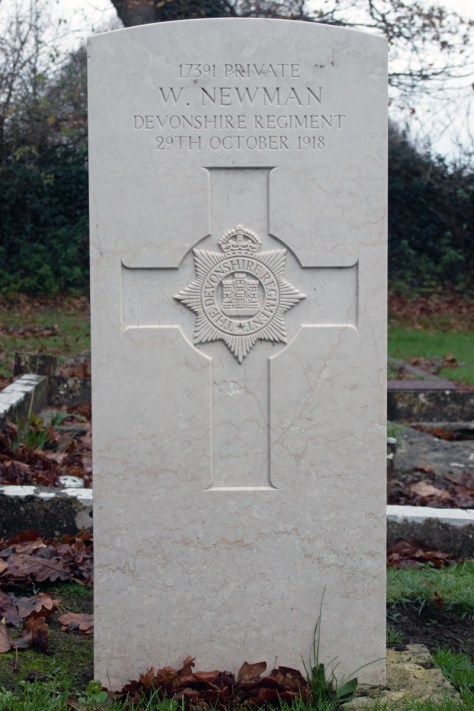
Private Cook was one of the thousands of soldiers who contracted influenza and subsequently died of pneumonia on 1st November 1918.

There seems to be some dispute over how and when Samuel fell ill. A request for a detailed medical report was sent, “as he appeared to have contracted the disease from which he died whilst on leave for the purpose of getting married”. The same request confirms that he was never admitted to hospital while in the company. (There are no records oh Samuel having married, so I am assuming that his leave may have been for wedding preparations, of normal leave.)

The report came back confirming that he has died from “pneumonia complicating influenza which was contracted whilst on service at Beaulieu”.

However and wherever it happened, the disease claimed Private Samuel Cook’s life; he lies at rest in Sherborne Cemetery, Dorset.

Lance Corporal Charles Stubbles

Charles Frederick Stubbles was born in Tottenham in 1892. One of eleven children to Richard and Mary Ann Stubbles, by the time of the 1911 census, the family were living in Edmonton. Charlie and his brother had found employment painting gas stoves, while his father was a building foreman.

Charles enlisted in the army in 1916, aged 25 years and 11 months. His service records show that he stood at 5ft 2ins, weighed in at 69lbs; his health was classified as C2 – Free from serious organic diseases, able to stand service in garrisons at home, able to walk 5 miles, see and hear sufficiently for ordinary purposes.

Joining the Labour Corps of the West Surrey Regiment, Private Stubbles initially served on the home front, before being transferred to France as part of the British Expeditionary Force in March 1917.

Charlie seems to have been a bit of a character and was pulled up a few times during his service. On 10th April, he was charged with “committing a nuisance in the barrack room”, for which he was confined to camp for eight days. On 21st August he went AWOL for nearly a day; he was docked eight days’ pay. On 28th October he appeared unshaven and dirty for the 7:15am parade; he was confined to barracks for seven days.

On 4th January 1918, Charles was admitted to a field hospital with diarrhoea; while there he was diagnosed with tuberculosis; he succumbed to this two days later, dying on 7th January 1918. He was 26 years old.

Lance Corporal Charles Stubbles is buried at the Haringhe Bandaghem Military Cemetery in Poperinge, Belgium.


Charles Frederick Stubbles was my great grandmother Lillian’s younger brother.

Private Thomas Daines

Private Thomas Daines

Born in 1871, Thomas Daines was one of fourteen children. His parents, Charles and Sarah, worked on a farm a few miles from Halstead in Essex.

After leaving school, Thomas followed in his father’s footsteps and, by the time of the 1891 census was also listed as an agricultural labourer. He married Kate Rawlinson in the spring of 1893, and they had two children – Matilda and Lewis – before relocating to South East London in around 1898.

The reason for the move was, more than like, job opportunities, and Thomas was soon working at the Royal Arsenal in Woolwich.

Settling into their new city life, Thomas and Kate had five further children: Annie, Thomas, Alfred, Charles and Beatrice. Thomas continued as a labourer, before enlisting in the army within three months of war being declared in October 1914.

Sadly, Private Daines’ service was not to be a long one. Having suffered a bout of influenza, Thomas was admitted to a Red Cross Hospital in Sherborne, Dorset. He died of pneumonia on 22nd February 2015.

Private Thomas Daines lies at peace in the Sherborne Cemetery.


As a sad aside to Thomas and Kate’s story, their eldest son, Lewis, enlisted in the 16th Battalion of the Lancashire Fusiliers. He fought on the Western Front, and was killed in action in Pozières on 26th March 1918.

The Great War had claimed both father and son.

Boy 2nd Class Sidney Stagg

Boy 2nd Class Sidney Stagg

Sidney Herbert Stagg was born in 1901. The eldest child of bootmaker Sidney Stagg and his wife Frances, Sidney Jr was too young to fight in the when war broke out.

He enlisted in the Royal Navy at the beginning of 1919, and was assigned to HMS Powerful, a training vessel based in Plymouth.

Boy Petty Officer Stagg’s time in the navy was heartbreakingly short. Within a few weeks he had contracted pneumonia and succumbed to the disease on 27th February 1919. He was just 17 years old, and had been in service for 36 days.

The Western Gazette reported on his funeral:

[He] left Sherborne just over a month ago to join the Royal Navy, a career for which he had expressed a great liking, and was attached to HMS Powerful, being made Boy PO within a fortnight of his joining that ship. A short time afterwards he contracted influenza, and pneumonia supervening, he died on Thursday at the Royal Naval Hospital, at Plymouth.

A service was held in the Congregational Church, and continued at the graveside, where three volleys were fired by a firing party of the Volunteers [the Sherborne Detachment 1st Volunteer Battalion, Dorset Regiment], and buglers sounded the last post. The Rev. W Melville Harris (uncle of the deceased) officiated, and the principal mourners were Mr Stagg (father), Miss Joyce Stagg (sister), Mr H Hounsell (uncle), and members of the business establishment.

Western Gazette: Friday 7th March 1919.

Sidney Herbert Stagg lies at peace in the cemetery in his home town of Sherborne.

Private Edward Lewsley

Private Edward Lewsley

Edward (Teddy) Lewsley was born in 1894, the ninth of twelve children to James and Charlotte Lewsley from London.

James had worked with horses, and become a cab driver at the turn of the century; Edward started as a general labourer on finishing school.

Edward’s military history is a little vague. From his gravestone, we know that he joined the Duke of Cornwall’s Light Infantry and was in the 1st Battalion. The battalion fought at the Battles of Mons, Marne and Messines.

In the spring of 1915, Edward’s battalion fought in the Second Battle of Ypres and, given the timing, it seems likely that he was involved.

Whether he was on the Western Front or stationed in the UK, Private Lewsley was admitted to the Red Cross Hospital in Sherborne, where he passed away on 30th May 1915. He was buried in the town’s cemetery.


One of Edward’s brothers also enlisted in the Light Infantry.

Daniel Lewsley first joined the East Surrey Regiment in 1909 and continued through to 1928. This included a stint as part of the British Expeditionary Force in France.

Sapper Percy Rodgers

Sapper Percy Rodgers

Percy Wright Rodgers was born in June 1888 in Pilton, Somerset. He was the fifth of eleven children to Levi and Elizabeth Rodgers.

In the 1901 census Levi was listed as a butcher and publican; ten years later, he listed himself as a butcher, slaughter man and shopkeeper.

Percy followed in his father’s footsteps – by the time of the 1911 census, he was boarding with a family in Swanage, Dorset, and worked as a butcher’s assistant.

1913 was a busy year for Percy. He married Frances Bower, they had their first child, Percy Augustus, and he emigrated to the United States (Frances and Percy Jr followed a year later).

In the 1915 New York census, Percy and his family are listed in in the town of Cortland, around 200 miles north of New York City. Percy describes himself as a meat cutter – following in his father’s footsteps – and he and his wife now have a second child, Vera, who was born in the States.

Sapper Rodgers joined the Canadian Engineers in May 1918; he was shipped abroad, back to Europe, but his service appeared short-lived. He contracted pneumonia, and was admitted to the Canadian Hospital in Eastbourne, East Sussex. He passed away on 5th November 1918, at 30 years of age.

Sapper Percy Wright Rodgers lies at rest in the churchyard of St John the Baptist in his home village of Pilton. His grave is topped with a cross dedicated by his widow, Frances.

Petty Officer Stoker Frederick Cheal

Petty Officer Stoker Frederick Cheal

Frederick James Cheal was born in Reigate, Surrey in July 1880. One of six children, his father Francis was an agricultural labourer and cowman, while his mother Ann looked after their children.

While born in the landlocked Home Counties, Frederick appeared to be drawn to a life on the open seas. He enlisted in the Royal Navy on 26th October 1897, for a period of 12 years.

Stoker Cheal served his time on a number of vessels over that time, ships with names like Hannibal, Warrior and Furious. Having completed his service, Frederick was discharged on 28th October 1910.

Frederick’s wanderlust remained, though, and it appears that his discharge was more of transfer. He immediately enrolled in the fledgling Canadian Navy for a period of five years, dividing his time between land-based instruction and service on the HMS Niobe.

War broke out, and Stoker Cheal’s service was extended beyond the initial five-year term. Again, rather than his service coming to an end, he transferred back to the Royal Navy in August 1916.

Promoted, Petty Officer Stoker Cheal was assigned to the HMS Bacchante, an armoured cruiser that served as an escort to the British convoys off the African coast.

Frederick was admitted to the Royal Naval Hospital in Chatham, Kent, in early 1919 with influenza and pneumonia. He passed away on 22nd February, aged 38.

He lies at rest in the graveyard of St Margaret’s Church in Rainham, Kent.


Here is where a mystery lies. There is no discernible link between Frederick Cheal and Rainham, other than that is where his widow lives.

A lot of Rose Anne Cheal’s life is sadly lost to time. There are no marriage records to link her to Frederick, and I have been unable to identify her maiden name or whether she was even English (the couple could easily have met during Frederick’s time in Canada).

From her later records, it is evident that she lived in Rainham, just around the corner from the church where her husband is buried. The 1939 register confirms that she was a couple of years older than Frederick; she was born on Christmas Eve 1878. The register also confirms that the couple had two children, Francis, who was born in 1914, and Kathleen, born two years later.

Some mysteries are not meant to be solved; Frederick lived a full life on the open seas, spending 22 years serving two navies. He died in the same way as many other returning soldiers and sailors, a victim of the Spanish Flu pandemic. He left a wife and two young children, a sad tale repeated countless times across the continent.

Air Mechanic Herbert Holdstock

Air Mechanic Herbert Holdstock

The year is 1897, and Edwin Holdstock has crammed a lot into his 38 years. Born in North Kent, he has travelled well, working as a grocer’s manager in south London. His first wife, Kate, gave him five beautiful children, four girls and a boy, before she died, aged only 35. Edwin married again, to Louisa, and they have already had their first child, a boy.

A new birth is on its way, though, and his third son – Herbert Frederick Victor Holdstock is born. They are living in Thornton Heath, Surrey.

The family up and move again, this time to Grimsbury, near Banbury, Oxfordshire. Edwin has new employment, as a superintendent for Kingsley Sewing Machines in the town.

Edwin appears to be an ambitious man; by the time of the 1911 census, he has moved the family from Oxfordshire back to Kent. He and Louisa have four children now and they live in Rainham, where Edwin works as a Political Agent.

Herbert was keen to make his own way in the world, however, and worked as an apprentice watchmaker and jeweller in both Rainham and nearby Sittingbourne.

He enlisted relatively late into the war; his service records show that Air Mechanic Holdstock started his Royal Air Force service on 20th June 1918. He was stationed in South London.

While there, he contracted pneumonia and was hospitalised. Within a week, Herbert had passed away. He was just 21 years old.

The local newspaper reported on his funeral:

Only so recently as November Mr EC Holsdtock of Orchard-street, Rainham, the Secretary of the Sittingbourne District War Pensions Committee, sustained a sad bereavement in the death of his wife [Louisa], who succumbed to an attack of influenza and pneumonia. Mr Holdstock has now suffered another bereavement in the death of his second son, Herbert Frederick Victor Holdstock, who died in the Royal Herbert Hospital, Woolwich… A little over eight months ago he joined the Royal Air Force, as a mechanic, as was stationed at Kidbrook, near Woolwich. Never robust, he contracted pneumonia, and after a week’s illness succumbed. He was a bright, cheery young man, and much liked.

East Kent Gazette: Saturday 1st March 1919.

Air Mechanic Herbert Holdstock lies at rest in the graveyard of St Margaret’s Church in Rainham, Kent.