John Henry Richards was born in Sutton, Surrey, on 3rd June 1896. The third of four children, his parents were John and Harriet Richards. John Sr was an engine driver and stoker, while his son found employment as a greengrocer’s assistant when he finished his schooling.
When war came to Europe, John Jr stepped up to serve his King. Full details of his military service have been lost to the annals of time, but he had certainly enlisted by the end of 1917. Initially joining the Devonshire Regiment, he subsequently transferred to the Labour Corps, and was assigned to the 385th Coy.
Private Richards seems to have been based in Kennington near Lambeth, Surrey. He married Dorothy Ford on 23rd December 1917, at which point, both bride and groom were living at 47 Hartington Road.
The family’s geographical locations become a bit confused at this point: Dorothy had been born in Bristol, Gloucestershire, but the 1911 census found her living in Ottery St Mary, Devon, with her paternal grandparents. John seems to have served some time in Devon as well, but it is unclear whether the couple met in the South West or London.
By the autumn of 1918, Private Richards’ unit was certainly in Devon: it was here that he contracted pneumonia, and he was admitted to the No. 1 Section Hospital in Devonport for treatment. This was to prove ineffectual, however, and he passed away on 2nd November 1918. He was 22 years of age.
Dorothy’s family appears to have been living in Axminster by this point, and it is certainly somewhere he would return to in later years. The town’s cemetery is where she would bury her late husband: John Henry Richards at peace again.
John Samuel Channing was born in Axminster, Devon, in 1884, the oldest of four children to John and Elizabeth. John Sr was a bricklayer’s labourer, and, when Elizabeth died in the late 1890s, he struggled to look after the whole family.
The 1901 census found John Sr and his two youngest children living with his widowed mother, while John Jr and his sister Sarah were sent to live with their maternal grandmother, widow Mary Telford. Both were of age to leave school, and both were employed: Sarah as a lace mender, John Jr as a nail brush finisher.
John Jr married a woman called Elizabeth in 1910. There is little additional information available about her, but by the time of the following year’s census, the young couple were boarding with an Eliza Banks in Silver Street, close to the centre of the town. John was employed as a toilet brush maker, adding that they were bone nailbrushes. Within the year, Elizabeth gave birth to their only child, son Leslie.
In addition to his brushwork, John had also enlisted in the local militia. He joined the Devonshire Regiment on 1st April 1908, although his service details are lost to time. Private Channing’s unit – the 4th Battalion – were based around Exeter, but, when war was declared, they moved to India. There is no evidence, however, that John went with them: promoted to the rank of Lance Corporal, it is likely that his experience was better used on the Home Front, training new recruits.
John’s wartime experience was not to be a lengthy one, however. By 1st April 1915, he had been medically discharged from service, having contracted tuberculosis. At this point, Lance Corporal Channing’s trail goes cold, but it is likely that he returned home to Elizabeth and Leslie.
The next record for John is that of his passing. He died from tuberculosis at home on 29th December 1918: he was 34 years of age.
John Samuel Channing was laid to rest in Axminster Cemetery, a short walk from where his widow and son still lived.
Eli Trenchard and his twin Reuben were born on 29th December 1889 in Axminster, Devon. Two of nine children, their parents were George and Mary Trenchard. George was a gamekeeper turned farmer, and the family were brought up at Uphay Farm on the outskirts of the town.
The whole family helped out on the farm and, by the time of the 1911 census, when the twins were 20, seven of the Trenchards – George, Mary, Eli, Reuben and three of their siblings – were all living in the farmhouse and employed in the business.
On 25th March 1913, Eli married Lily Gillingham. Born in Dorset, she was the daughter of the landlord of the Lamb Inn in Axminster, and working as a dressmaker in her own right. The couple moved to the village of Chardstock in Devon, and went on to have a daughter, Lilian, who was born later that year.
In 1915, Eli found himself brought to the Petty Sessions in Axminster, charged with “movingpigs from Dorset to Devon without the necessary license”[Western Times: Wednesday 27th October 1915]. Eli stated that he had purchased the pigs from his brother, Reuben, at Uphay Farm. Despite Reuben confirming this, it was subsequently determined that they had, in fact, been bought from a Mr Wells of Penn in Dorset. Eli have been convicted of a similar offence before, and was fined £10.
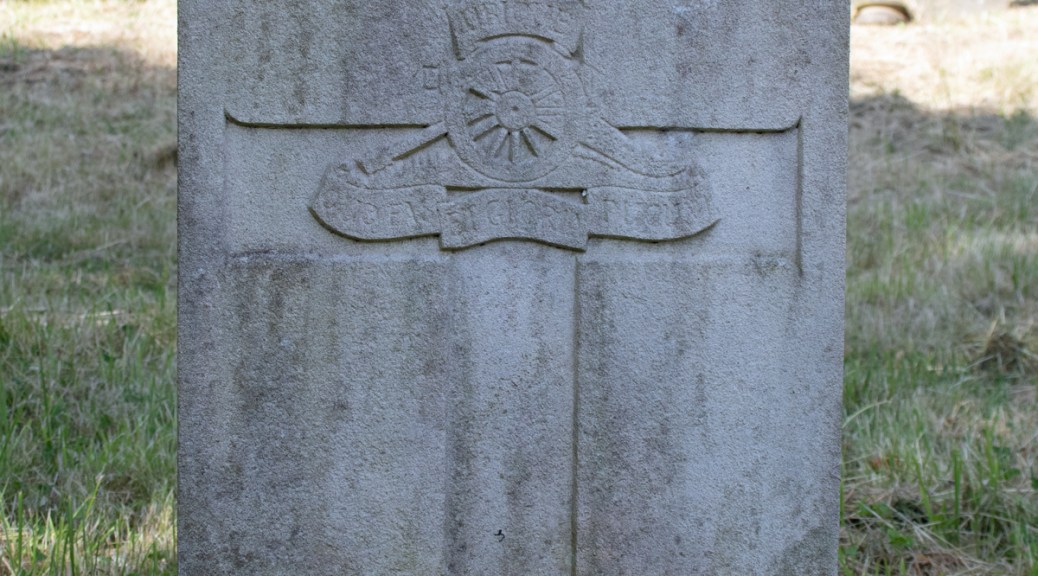
War was raging across Europe by this point, and Eli was called upon to play his part. He enlisted in the Royal Field Artillery in January 1917. Assigned to the 23rd Reserve Battery, Gunner Trenchard was sent to a camp near Sutton Veny in Wiltshire.
Eli’s time in the army was not to be a long one, however, and he was soon admitted to the camp hospital, suffering from pneumonia. The lung condition was to get the better of him, and Eli passed away on 23rd February 1917. He was 27 years of age.
The body of Eli Trenchard was taken back to Devon for burial. He was laid to rest in Axminster Cemetery, not far from where his widow and family still lived.
The Trenchard family were soon back in the court, however, with Lily bringing a lawsuit against her father-in-law, George, in December 1917. The widow said that Eli and his father had agreed her late husband’s immediate tenancy of two fields the month before Eli had been called up for to serve.
However, the month after his death, when she had gone to the fields to sow them for the coming season, the gates had been locked and her entrance barred. George responded by saying that he had agreed to pass the fields to his son, but only on the event of his own death. He subsequently sold the land to another farmer.
The judge in the case found that Lily had “failed to prove that an agreement had been made between [George] and his son”[Western Times: Thursday 6th December 1917] and found in the defendant’s favour.
Alfred Edward Wallis was born on 7th February 1876, the youngest of five children to Charles and Mary. Charles was a carpenter and joined from Bruton in Somerset, but the family were born and raised in the Walcot area of Bath.
By the time of the 1901 census, Alfred was the only one of the Wallis siblings to remain living with his parents. They were living at 14 Belgrave Crescent, to the north of the city, and, at 25 years of age, Alfred had taken on work as a printer’s compositor.
On Christmas Day 1907, Alfred married Caroline Little. She was a farmer’s daughter from Cheltenham, Gloucestershire, and, at the time of their nuptials, the young couple were living at 8 Seymour Road, the next road over from his parents.
Alfred and Caroline would go on to have three children: Harold, Winifred and Lilian. The 1911 census found that they had moved again, and were now settled in a small terrace at 22 Cork Street, in the Weston area of Bath.
War broke out across Europe in the summer of 1914, and, in on 19th December 1915, Alfred enlisted in the Army Service Corps. His records noting that he was 39 years and 10 months old, stood 5ft 5ins (1.65m) tall, and weighed 128lbs (58kg).
Private Wallis was not formally mobilised until the August 1916. Attached to the 19th Company, he was sent for duty to the Queen Mary’s Military Hospital in Whalley, Cheshire. Full details of his duties are unclear, although he would remain in the area for the next couple of years.
As the war progressed, it is likely that Alfred was exposed to the illness with which the patients were being admitted. In October 1918, he became unwell, and was admitted to hospital with a combination of influenza and pneumonia. The hospital he was sent to was the King’s Lancashire Military Convalescent Hospital in Blackpool, Lancashire, so it is likely that he had left Whalley by this point.
Private Wallis’ illness was to prove too much for his body to bear. He passed away while still admitted, on 29th October 1918. He was 42 years of age.
The body of Alfred Edward Wallis was brought back to Somerset for burial. He was laid to rest in the majestic setting of Bath’s Locksbrook Cemetery.
Charles William Comley was born on 10th May 1882 in the Somerset city of Bath. One of sixteen siblings – only seven of whom survived childhood – his parents were Charles and Mary. Charles Sr was a stonemason, and to avoid any confusions with their names, his son quickly became known by his middle name, William.
When he completed his schooling, young William found work with a baker. However he had his sights on bigger and better things, and on 1st August 1899 he enlisted in the Royal Navy. Being too young to formally enlist, he was given the rank of Boy 2nd Class, and was sent to HMS Northampton, a training ship, to start learning the skills he would later rely on.
After jut a couple of months Boy Comley was given his first assignment, on board HMS Curacoa, a cruiser which served as a training ship. He would spend the next six months on board, visiting the Atlantic coastal ports in Madeira, Las Palmas and Cape Verde. By the time William completed his time on Curacoa, he had been promoted to Boy 1st Class.
Returning to Britain, William was sent to HMS Vivid, the Royal Naval Dockyard in Devonport, Devon. He would only be based there for a matter of weeks, but during that time he turned 18, and was now of an age to be inducted into the navy proper. Now given the rank of Ordinary Seaman, his service records show that he was 5ft 3ins (1.6m) tall, with light brown hair, hazel eyes and a dark complexion. He was also noted as having a scar on the first finger of his left hand.
In June 1900, Ordinary Seaman Comley was assigned to the battleship HMS Magnificent, and from this point on, his naval career was set. Over the next sixteen years, he would serve on a total of seven ships, with HMS Vivid remaining his home base in between voyages. His service records continually note his very good character, and, from September 1903, he held the rank of Able Seaman.
When William’s initial twelve-year contract came to an end in the spring of 1912, he immediately re-enlisted. He had grown to 5ft 7.5ins (1.71cm) in height, and his records show that, while retaining his light brown hair and eyes, he now had a light complexion.
War broke out in the summer of 1914, and Able Seaman Comley was assigned to the newly launched HMS Tiger. He would remain part of the battleship’s crew for close to two years, and was involved in the Battle of Dogger Bank in January 1915.
On 3rd April 1916, William was medically disembarked in Scotland, suffering from pneumonia. He was admitted to the Royal Naval Hospital in Queensferry, but his condition turned septic. He passed away on 12th April 1916, a month short of this 34th birthday.
The body of William Charles Comley was taken back to Somerset for burial. He was laid to rest in the city’s majestic Locksbrook Cemetery.
Alfred George Hale was born in Lechlade, Gloucestershire, in the spring of 1891. The youngest of four children his parents were George and Martha. George died when Alfred was just a babe-in-arms, and by the time of that year’s census, Martha was looking after her children alone.
The next census, taken in the spring of 1901, found Martha and the family living in a house on Oak Street in Lechlade. She was taking in laundry to earn a little money, while Alfred’s older brothers, George Jr and James, were employed as house boys. This meant there were three wages coming into the Hale household, but it would still have been a daily struggle for the family.
Tragedy stuck again in 1904 when James also died. Details are unclear, but it seems that he passed away in Headington, Oxfordshire, and was laid to rest in his home town. He was just 16 years of age.
By the time of the 1911 census, Alfred was the only one of Martha’s children to still be living at home. Home was the same four-roomed house on Oak Street, Lechlade. Martha was not noted as having any employment, but her son was working as a journeyman tailor.
On 10th November 1916, Alfred married Elizabeth Smith in Highworth, Wiltshire. There is tantalisingly little information about her, although it seems likely that they met during his travels with work. The couple would go on to have a child, daughter Sylvia, the following October.
1917 proved a year of upheaval for the Hale family. Six months before Sylvia’s birth, Alfred’s sister, Martha Jr, passed away. She had been a patient in the Berrywood Asylum in Northamptonshire, for a while: although the exact dates are unclear, she is recorded as a visitor to the Green family in Reading, Berkshire, in 1911, so her admission would have been after this.
Alfred had enlisted in the Royal Flying Corps by this point. It is likely that his tailoring skills were employed by the service – whose aircraft used canvas in their make-up – , and he was given the rank of Air Mechanic 2nd Class. His service records show that, when he joined up on 28th February 1917, he was 5ft 5.5ins (1.66m) tall.
Air Mechanic Hale transferred to the Royal Air Force on its foundation in April 1918, and within a matter of weeks, he found himself overseas. He remained in France until the end of the year, and was admitted to hospital on 22nd December as a result of an unconfirmed illness. His condition warranted transfer to Britain on 2nd January 1919, and was severe enough for him to be officially discharged from duty on 12th April 1919.
The funeral took place at Locksbrook Cemetery on Wednesday of ex-Private George Hale, formally 2nd Air Mechanic, RAF, who resided at 7 Kensington Gardens, Walcot [Somerset]. Deceased, after serving three years with the Colours, was demobilised in April, 1919, but still suffered from illness, due to active service. His condition grew worse, and he was received at the Pensions Hospital, Combe Park, two days before his death… He was a native of Lechlade, Gloucestershire, but had lived in Bath for about three months.
[Bath Chronicle and Weekly Gazette: Saturday 24th January 1920]
Alfred George Hale was 29 years of age when he died on 16th January 1920. He was laid to rest in the military section of Bath’s sweeping Locksbrook Cemetery. His widow, Elizabeth, and his mother, Martha – who had now outlived her husband and three of her four children – attended the funeral.
Herbert – or Bertie – Smart was born on 9th February 1885, and was the middle of five children to John and Lucy. John worked as a gardener and the family were raised in the Kent town of Sidcup.
By the early 1900s, Bertie had moved to London, and had settled in Islington, Middlesex. He was working as a fruiterer and, on 19th May 1907, he married Lucy Purton, a policeman’s daughter from the east of the capital.
The couple set up home in Kensington, and went on to have four children: Frank, Herbert, Kathleen and Frederick. The 1911 census found the family renting three rooms in a tenement at 36 Netherwood Road. They were sharing their home with Lucy’s younger brother, Frederick.
When war broke out across Europe, Bertie was called upon to play his part. Full service details have been lost to time, but it is clear that he enlisted in the second half of 1916, and was assigned to the Northumberland Fusiliers. Attached to the 2nd/4th Battalion, it seems that he may have been sent to the South West for training.
Private Smart’s time in the army was not to be a lengthy one. He came down with cerebrospinal meningitis, and was admitted to the War Hospital in Bath, Somerset. The condition was to get the better of him: he passed away was still admitted, on 11th January 1917. He was 31 years of age.
Herbert Smart was laid to rest in the sweeping grounds of Bath’s Locksbrook Cemetery.
These were tragic times for the Smart family. Lucy’s brother died just four months after her husband, and Lucy herself passed away in February 1918. In just over a year, the four children – Frank, Herbert, Kathleen and Frederick – had become orphans.
John Adams Boura was born in the spring of 1868 in Kensington, Middlesex. The middle of three children, his parents were Julien and Esther Boura. Julien was the son of a French immigrant, who had built up two businesses as a dyer and cleaner (the first business having failed).
John followed in his father’s line of employment, and, by the time of the 1891 census, he was living with business partner Isabel Knight, at 3 St Mark’s Place in Wimbledon, Surrey. Work and pleasure were obviously mixing, though, and, on 3rd October that year, the couple married in the nearby Queen’s Road Chapel.
The newlyweds would go on to have a son, also called John, in March 1895. By the start of the new century, the family has moved out of the capital, relocating to Aldershot, Hampshire, where they set up a new business at 111 Victoria Road, in the town centre.
Within the next decade, however, the Bouras had moved back to the London suburbs, setting up home and business in Merton, Surrey. A new alliance was forged at 106 Kingston Road, with the three sharing their home with Henry and Adelaide Shelley. All four adults were involved in the business, while the now 16-year-old John Jr was employed as a dentistry improver.
Julien – who was also known by his middle name, Aimé – and Esther had moved to Maidenhead in Berkshire by this point, and in September 1910, it seems that their son visited them. An argument seems to have erupted, and John was arrested. Taken before the Maidenhead Petty Sessions, he was tried for unlawfully and maliciously damaging the glass of certain windows, exceeding he amount of £5 to wit £8 6s., the property of Aimé Boura. John was find a total of £10 for the damage.
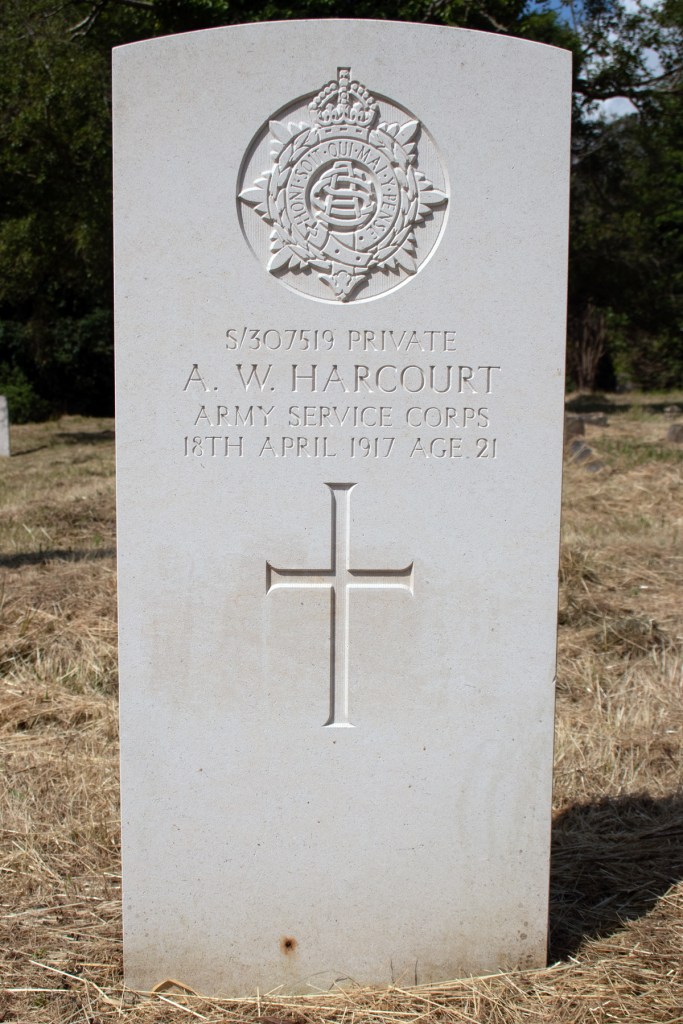
When war broke out, John stepped up to serve his country. While his service documents are long since lost, other records suggest that he had enlisted by the summer of 1916, and likely volunteered, give he was in mid-40s by this point. Private Boura was assigned to the Royal Army Service Corps, and was to be based at the Supply Depot in Bath, Somerset.
It is probable that John’s dying and cleaning background meant that he was involved in uniforms in some way, although nothing concrete remains to document his time in the army. During the early part of 1917, he fell ill, coming down with bronchitis. He was admitted to Bath War Hospital, but the condition was to get the better of him. Private Boura passed away on 9th February 1917, at the age of 48.
The body of John Adams Boura was laid to rest in Bath’s majestic Locksbrook Cemetery, not far from the hospital in which he had passed.
The early life of Henry Ernest Banks is destined to remain lost to time as there is little documentation available to corroborate details. The first concrete documentation for him is his marriage certificate, and this sheds lights onto the man he had become.
The wedding took place on 7th August 1905, and confirms that Henry was 19 years of age. His father was recorded as being James Banks who, by this point was deceased. He had been a chairmaker, and his son had followed in a similar type of work, being employed as a French polisher.
Henry’s bride was 19-year-old Blanche Hearnden, who was noted as being the daughter of deceased traveller William Hearnden. At the time of their marriage, the newlyweds were living at 13 Busby Street, Bethnal Green, London. Now long since gone, the road led directly to St Matthew’s Church, which is where their nuptials took place.
By the time of the 1911 census, Henry and Blanche were living with her mother in Whitechapel. They had had a child, son Ernest, the previous year, and the mixed household included Blanche’s three sisters and their children. Money must have been tight, but four members of the household were bringing in some money, Henry working as a French polisher, with two of his sisters-in-law working as a cigarette packer and a printer’s assistant. Blanche and her other sister were listed as housewives, while her mother, who was also called Blanche, was noted as being a charwoman.
When war broke out, Henry was called upon to play his part. Details of his military service are sketchy, but it is clear that he enlisted in the London Regiment, and was attached to the 17th (County of London) Battalion, which was also known as the Poplar and Stepney Rifles.
Rifleman Banks’ unit was sent to France on 9th March 1915. Within a matter of weeks, however, he was back in the UK, and appears to have been admitted to a hospital in Paignton, Devon.
Henry died on 2nd May 1915, and one record – his entry on the Grave Registration Form – that sheds a little light on Henry’s passing. It is noted being as a result of a strangulated hernia, although this is the only document that gives any details about his death. Henry was 28 or 29 years of age.
Henry Ernest Banks was laid to rest in Paignton Cemetery, Devon.
Sidney Harry Crabb was born in the seaside town of Lyme Regis, Dorset on 6th September 1888. One of nine children, his parents were Albert and Mary Crabb. Albert was a Trinity pilot, working on ships, and his son was destined to follow in his stead.
On 16th January 1903, Sidney enlisted in the Royal Navy. He lied about his age to be taken in, adding two years to his date of birth. That was still below the full enlistment age for the military, and he was taken on with the rank of Boy 2nd Class.
Sidney was sent to HMS Boscawen, a training ship, for his initial instruction. He remained there until mid-November 1903, by which time he had been promoted to Boy 1st Class. He then moved to the training battleship HMS Minotaur (which became HMS Boscawen II shortly afterwards), and remained on board for the next nine months.
On 7th September 1904, Sidney “came of age” (albeit he was two years younger than he had said), and was formally inducted into the Royal Navy. He was given the rank of Ordinary Seaman and, within a matter of days, was assigned to his first vessel, the tender HMS Fire Queen.
On 19th November 1904, Ordinary Seaman Crabb was reassigned, to the armoured cruiser HMS Sutlej. She was to remain his home for the next eighteen months, during which time Sidney was promoted again, to the rank of Able Seaman.
Over the next nine years, Sidney was to serve on six more vessels. On 9th December 1912, while back in Dorset, he married Lily Froom in the parish church of their home town, Lyme Regis. The couple would go on to have a son, Stanley, who was born in September 1914.
By this point, Able Seaman Crabb’s health was faltering. He was serving on board the battleship HMS Prince of Wales when war was declared, and had been promoted again, to Leading Seaman. By early October 1914, however, he was medically dismissed from service, having contracted pulmonary tuberculosis.
At this point, Sidney’s trail goes cold. He seems to have returned home, but it is unclear how much his failing health impacted on his daily life. The lung condition was ultimately to get the better of him: he passed away in Axminster, Devon, on 8th February 1917, at the age of 28 years of age.
Sidney Harry Crabb was taken the short distance back to Lyme Regis for burial. He was laid to rest in the town’s cemetery, overlooking the sea to which he and he late father had dedicated much of their lives.