Category Archives: illness

Private Robert Perham

Private Robert Perham

Robert Ivor Perham was born in the Dorset village of Purse Caundle in the autumn of 1892. The oldest of eight children – and thirteen years older than his youngest sibling – his parents were farmers Thomas and Annie Perham.

Thomas took the family where the work was: the 1901 census found them living at Manor Farm in West Chelborough, Dorset. Ten years later, they had moved north in the county, to Ryme Intrinseca. Robert was helping his father on the farm by now, his seven siblings all still being at school.

Robert saw an opportunity for farming to give him an adventure and, on 27th March 1913, he set off for Australia to work as a ranch hand. His time in the Antipodes was to be cut short, however, when, in the summer of 1914, war broke out in Europe. He made the lengthy journey back to Britain to serve his King, and was assigned to the 2nd King Edward’s Horse regiment.

Private Perham’s time in the army seemed not to have been a lengthy one. Full details of his service are lost to time, but it is likely that he arrived back in Blighty in the early weeks of 1915. He quickly fell ill – from ‘spotted fever’, or meningitis – and was admitted to the 2nd Eastern General Hospital in Brighton, Sussex. Sadly, it was a condition to which he would succumb: Robert passed away on 17th April 1915, at the age of 22 years old.

The body of Robert Ivor Perham was taken back to Dorset for burial. He was laid to rest in the peaceful graveyard of St Hippolyte’s Church in Ryme Intrinseca.


Private William Cooper

Private William Cooper

William Cooper was born in Mobberley, Cheshire, in 1894. Little information is available about his family life, but records suggest that his father was called John.

The first document that can be attributed to William is the 1911 census. This recorded him as living in Newton Hall Lane in Mobberley, with his widowed aunt and two cousins.

William’s trail goes cold again at this point, and can be picked up again when war broke out in the summer of 1914. He enlisted early on, joining the Cheshire Regiment. Attached to the 10th (Service) Battalion, his unit moved to Codford on the edge of Salisbury Plain, Wiltshire, by September.

William Cooper… was taken suddenly ill while on parade on Sunday morning at 8.30, and dropping out of the lines, was carried to the Army Medical Corps tent in the Chitterne Road, but on arrival there death had already taken place.

Lieutenant Spraight, of the Army Medical Corps, stated having examined the body of deceased, want he came to the conclusion that death was due to asphyxia and an epileptic fit.

[Devizes and Wilts Advertiser: Thursday 1st October 1914]

Private William Cooper died on 27th September 1914: he was just 20 years old when he died. It seems that his family were unable to cover the cost of the funeral: he was laid to rest in the peaceful graveyard of St Mary’s Church, Codford, his headstone being erected by his comrades in the battalion.


Lance Corporal George Fenn

Lance Corporal George Fenn

Much of George Fenn’s life is destined to be lost to time. Born in Bristol, Gloucestershire, in the summer of 1878, details of his parents are unknown. His was a common name in the late Victorian period, and census returns from the time identify at least two men born in the area around the same time.

The first document that can be directly connected to George is the 1911 census. This recorded him living at 13 Tankards Close in Clifton, where he was working as a dock labourer. His is noted as having been married to Minnie since 1902. The couple had one child, a son called William who was six years old.

When war broke out, George was quick to enlist. Full details of his service are lost, but he had certainly joined the Bedfordshire Regiment by the end of 1914. Attached to the 7th (Service) Battalion, by the start of the following year, his unit had moved to Salisbury Plain in anticipation of being sent to the Western Front.

George seems to have made his mark in the army, and he was soon promoted to the rank of Lance Corporal. In the spring of 1915, he contracted pneumonia, however, and was admitted to the military hospital in Codford, Wiltshire, close to where his unit was based.

Sadly, the condition was to prove Lance Corporal Fenn’s undoing: he passed away on 1st June 1915, at the age of 36 years of age.

George Fenn was laid to rest in the peaceful churchyard of St Mary’s, Codford, not far from where he had passed away.


George’s entry on the Army Register of Soldiers’ Effects and his Pension Ledger card shed a little more light on the family he had left behind. The first divides his belongings between his widow, Minnie, and the guardian of his child, Mrs Sarah Clarke. George’s pension ledger gives Sarah’s address as 14 Tankard’s Close, Bristol, and confirms that he was, in fact, separated from Minnie when he passed.


Private Alexander Short

Private Alexander Short

Alexander Coverdale Short was born in the Yorkshire village of Nafferton in the autumn of 1890. One of twelve children, his parents were labourer Benjamin Short and his wife, Emily.

Benjamin died in 1908, and the following year Emily remarried, to widow William Jefferson. He was a clerk for the council in neighbouring Driffield but, by the time of the 1911 census, the family had moved to Sculcoates, near Kingston-upon-Hull, where he had taken up employment at an auctioneer’s.

The 1911 census found the extended family living at 44 Hopwood Street in Hull, a seven-room property. William and Emily headed the household, sharing the house with William’s son Alfred, Alexander and four of his sisters, Alexander’s nephew, two boarders and two visitors – another of Alexander’s sisters and her son.

Alexander was employed as a bricklayer’s apprentice by this point, but at some point found alternative employment working for the North Eastern Railway Company. War was on the horizon, however, and he had enlisted in the Northumberland Fusiliers by the spring of 1915.

Private Short was attached to the 17th (Service) Battalion (North Eastern Railway Pioneers) and, by August 1915, his unit had moved to Codford, Wiltshire, on the edge of Salisbury Plain.

Knowing a trip across the English Channel was likely imminent, before he left Yorkshire, Alexander married Dora Harrison. The daughter of a butcher, she had been born and raised in Sculcoates.

Alexander’s time in the army was not to be a long one. Within a matter of months, his health began to deteriorate, and on 25th October 1915, he died of heart failure at Codford Military Hospital. He was just 24 years of age.

Finances appear to have prevented Private Short’s family from bringing their son and husband home. Instead, Alexander Coverdale Short was laid to rest in the peaceful St Mary’s Churchyard in Codford.


Private Alexander Short (from findagrave.com)

Lieutenant Colonel Cecil Stevens

Lieutenant Colonel Cecil Stevens

Cecil Robert Stevens was born in Arrah, India, on 14th March 1867. One of six children, his parents were Charles and Mary Stevens. Charles was a civil servant who had been born in the South Sea Islands, while Mary has been born in Bengal.

The family appear to have moved to the United Kingdom by the late 1870s. Census records for them are a bit sparse, but the 1881 document found Mary living in Honiton, Devon, with four of Cecil’s siblings and three servants. Cecil, meanwhile, was a boarding student at Malvern College, Worcestershire.

By 1891, Cecil had moved to St Columb in Cornwall. He was boarding at a hotel on Fore Street, and was employed as a general medical practitioner.

Charles was later rewarded for his service to the Empire, and received a knighthood. The 1901 census found him residing in Harcourt Terrace, Kensington, Middlesex, while his wife, now Dame Mary Stevens, was visiting a friend from India in Devon. Sir Charles died at home in 1909, following a bout of influenza.

Cecil, meanwhile, had been making his own way in the world. A qualified surgeon, he married Katharine Duff, a nurse from Aberdeen. They went on to have two children, son Cecil Jr and daughter Mignonette.

On 29th July 1893, Cecil joined the Indian Medical Service as a Lieutenant. Three years later, he was promoted to Captain, and in July 1905, he rose to the rank of Major. His commitment to duty is evident: he spent many years overseas, separated from his wife and young family, and in January 1913, was promoted to the rank of Lieutenant Colonel.

Cecil’s time in the Indian Medical Service was not without danger. In 1895, he was involved in the Relief of Chitral, for which he received a medal and clasp. He was caught up in the Tirah Campaign of 1897/98, and received a further two clasps for his role.

Lieutenant Colonel Stevens’ role during the First World War is lost in the mists of time. Given his role in the Indian Medical Service, it is likely that he served overseas, but he returned to Britain after the war, coming by way of Egypt.

By the autumn of 1919, he was back in Devon, at the family home on Elmsleigh Park Road in Paignton. His health was failing at this point, having come down with diabetes while in North Africa. him. Cecil passed away on 18th November 1919: he was 52 years of age.

Cecil Robert Stevens was laid to rest in the sprawling grounds of Paignton Cemetery.


Lieutenant Colonel Stevens’ will left £4123 13s 10d (around £180,000 today) to his sister-in-law, Alice Duff.

Katharine outlived her husband by only eight years. She passed away on 22nd December 1927 at the Field Officers’ Quarters in Gibraltar: she was 61 years of age.


Gunner Willie Smith

Gunner Willie Smith

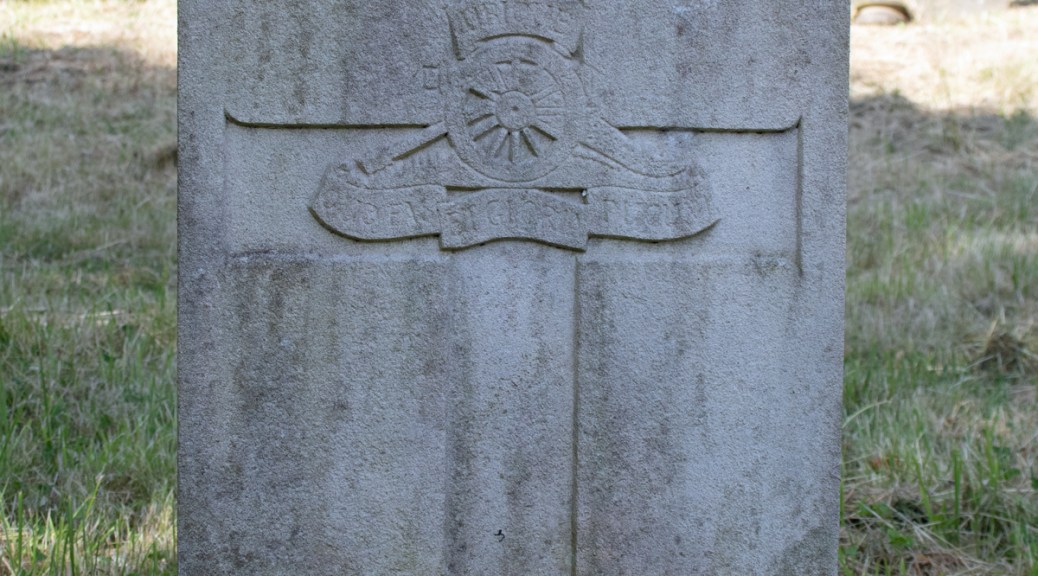
In a quiet corner of St Mary’s Churchyard, Codford, Wiltshire, is a headstone dedicated to L/17006 Gunner W Smith of the Royal Field Artillery. His pension ledger confirms that he passed on 14th January 1916 from osteomyelitis, a bone infection, contracted whilst on active service.

The document gives Gunner Smith’s first name – Willie – and that of his widow, Ada, who lived at 157 Gisburne Road, Barnoldswick, Yorkshire. Their only child, Winifred, had been born on 22nd March 1914.

The couple’s marriage certificates are not available, while the 1911 census return shows at least three Willie Smiths in the Barnoldswick area. It is not possible, therefore, to uncover more of his family’s past.

Willie Smith had enlisted in the Royal Field Artillery by the summer of 1915. He acted as a Driver in the 32nd Division Ammunition Column, although it is unclear whether or not he spent any time overseas.

Gunner Smith was based on Salisbury Plain by the winter of 1915. He was admitted to the Military Hospital near Codford with the infection he had contracted, and succumbed to is on 14th January 1916. He was laid to rest in the peaceful country churchyard, the burial records confirming he was 26 years of age.


Private James McEwan

Private James McEwan

James McEwan was born towards the end of 1879 in Bury Lancashire. He was the older of two children to James and Mary McEwan. James Sr was a foundry worker, who died in the 1890s, leaving his widow to raise their two sons.

By the time of the 1901 census, all three members of the household were earning money: Mary was employed as a cotton card room hand in a mill; James was a wringing machine fitter, while his younger brother, Peter, was a printer’s apprentice.

The next census, in 1911, found James still living at home with his mother. He was now employed as a labourer in the local railway goods yard, and his maternal aunt, Annie, was living with them, working as a rover in the local mill.

When war broke out, James stepped up to serve his country. Full details are lost to time, but it is clear that he enlisted in the Lancashire Fusiliers, and was attached to the 4th/5th Battalion. This was a service and training unit, and Private McEwan did not spend any time overseas.

In the winter of 1915, James was based on Salisbury Plain, Wiltshire. While billeted there, he contracted bronchial pneumonia, and was admitted to a camp hospital. Sadly the condition was to prove too much for his body to bear, and he succumbed to it on 26th December 1915. He was 36 years of age.

It seems that Mary was unable to afford to bring her sone back to Lancashire. He was laid to rest in the peaceful St Mary’s Churchyard, in Codford, Wiltshire, not far from where he had breathed his last.


Serjeant Cecil Whitehead

Serjeant Cecil Whitehead

Details of Cecil Whitehead’s early life as lost to time. Born in 1882, he was the son of Henry and Annie Whitehead, from Openshaw in Manchester. There are no census returns for the family, so it is not possible to discover any more of their background.

The Commonwealth War Graves Commission confirm that Cecil wed a woman called Annie Ellis. His pension ledger notes four children: John, Cecil, Annie and Catherine, who died in 1917.

When war broke out, Cecil stepped up to serve his King and Country. He enlisted in the Manchester Regiment, and was assigned to the 3rd/8th Battalion. This was a reserve unit, based on home soil, and there is no evidence that Cecil spent any time overseas.

Cecil rose to the rank of Serjeant, by the winter of 1915, Cecil was billeted near Codford in Wiltshire. It was while he was here that he fell ill, contracting pneumonia. The condition was to prove too much for his body to bear, and he passed away on 13th February 1916, at the age of 33 years old.

Annie appear to have been unable to fund bringing her husband back to Manchester for burial. Instead Cecil Whitehead was laid to rest in the quiet graveyard of St Mary’s Church in Codford.


Able Seaman William Turner

Able Seaman William Turner

Details of William Alliston Turner’s life are a challenge to track down. According to later military records, he was born on 28th February 1888 in St Helier, Jersey. While there are a couple of census returns that may be connected to him, there is nothing to definitively confirm his early life.

William enlisted in the Royal Navy on 9th January 1904. He was just shy of his 14th birthday, and so was given the rank of Boy 2nd Class. Over the next fifteen months, he was attached to the training ship HMS St Vincent, moored at Haslar in Hampshire. In August 1902, he was promoted to Boy 1st Class, and was given his first posting, on board the cruiser HMS Edgar, in May 1905.

After a short spell at HMS Victory, the Royal Naval Dockyard in Portsmouth, William was assigned to HMS Powerful, a protected cruiser, and he would spend two years on board. During this time, he came of age, and was given the rank of Ordinary Seaman. His service records at the time confirm that he was 5ft 5.5ins (1.66m) tall, with dark hair, brown eyes and a fresh complexion. He was also noted as having two tattoos – a heart on the back of his right hand, and the letter T on the back of his left.

William seemed to have taken to his life at sea with some ease. On 1st January 1907 he was promoted to the rank of Able Seaman, and over the next eight years, he served on twelve different vessels, returning to Portsmouth between each voyage.

What had become a good career for Able Seaman Turner, began to take a bit of a downturn. He spent six separate periods of time in the brig between 1908 and 1914, totalling 121 days in total. On 19th March 1915, William was medically discharged from naval service, suffering from neurasthenia, or PTSD as it is now known.

At this point, William’s trail goes cold. He returned to the Channel Islands, and passed away on 13th April 1917: he was 29 years of age.

William Alliston Turner was laid to rest in the quiet graveyard of St Lawrence Church in Jersey.


Private Philip Langlois

Private Philip Langlois

Philip John Langlois was born 21st September 1886 in St Lawrence, Jersey. One of fourteen children, he was the eldest son to carpenter Philip Langlois and his wife, Mary.

When he finished his schooling, Philip Jr was apprenticed to his father, but, by the time of the 1911 census, the Langlois family had taken on Mayfield Farm. Most of the family we included in running it.

When war came to Europe, Philip left his father’s farm and stepped up to play his part. Sadly, full details of his service are lost to time, but it is clear that he enlisted in the Royal Jersey Militia. Attached to the 1st, or West, Battalion, he served his time on the island.

The funeral took place yesterday afternoon with full military honours of Pte. Philip Langlois, of D (St Lawrence) Co… The deceased, who was 28 years of age, was very popular with his comrades, and was on duty a fortnight ago. Though suffering with a slight cold, he then seemed otherwise to be in good health. A few days ago, however, he was engaged ploughing, when he was taken ill, and returning to his father’s residence… was obliged to take to his bed. Unfortunately he never rallied, but passed away on Tuesday last.

It is very many years since a military funeral took place at St Lawrence, and this coupled with the sad circumstances surrounding the death was responsible for the large number of sympathetic spectators who lined the roads and assembled at St Lawrence Churchyard, where the internment took place.

[Jersey Evening Post: Saturday 6th February 1915]

Philip John Langlois had passed away on 2nd February 1915. His family headstone notes the other members of his family who are buried with him.


Philip’s younger brother, George, enlisted in the Hampshire Regiment, and was attached to the 1st Battalion as a Private. He was caught up in the Third Battle of Ypres and killed on 4th October 1917. George was 21 years of age, and is commemorated on the Tyne Cot Memorial.

Sadness was to strike again on 21st December 1917, when Philip’s sister, Elsie, passed away: she was 28 years old. Another sister, Florence, passed away on 3rd March 1918, aged 29. Both were laid to rest with their brother.

Philip’s parents were also interred in the family grave: Philip Sr when he died in 1936 at the age of 76; and Mary when she passed away in 1955 aged 92.