Ernest George Lewis was born in Bridgwater, Somerset, in the spring of 1895, one of fourteen children to labourer Frederick and his wife Harriett Rose. Two of his older brothers went to work for the local brickworks, but Ernest hauled coal to earn a living once he left school.
When war broke out, he was eager to do his part; he enlisted in the Somerset Light Infantry early on, serving as a Private in the 1st Battalion. His troop was to see some of the fiercest fighting in the conflict, including the Battles of Le Cateau, the Marne, the Aisne, Messines within the first six months.
Private Lewis’ troop was also involved in the Second Battle of Ypres in the spring of 1915, but it was later that year that his fate became sealed. At some point he was caught up in a German gas attack; he was evacuated home, but there is no confirmation whether he was hospitalised as a result (although it seems likely).
The gas was to damage his lungs to the extent that he would not recover. There are conflicting reports as to the cause of Private Lewis’ passing, with one source identifying the gas in France, while another put it down to pneumonia and typhoid. (It seems probable that the attack ultimately resulted in Ernest catching pneumonia, although this is not clear.)
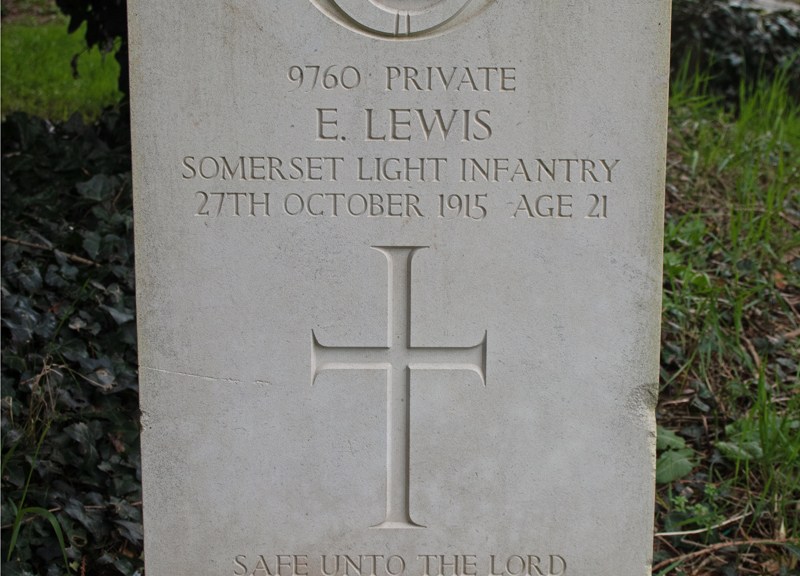
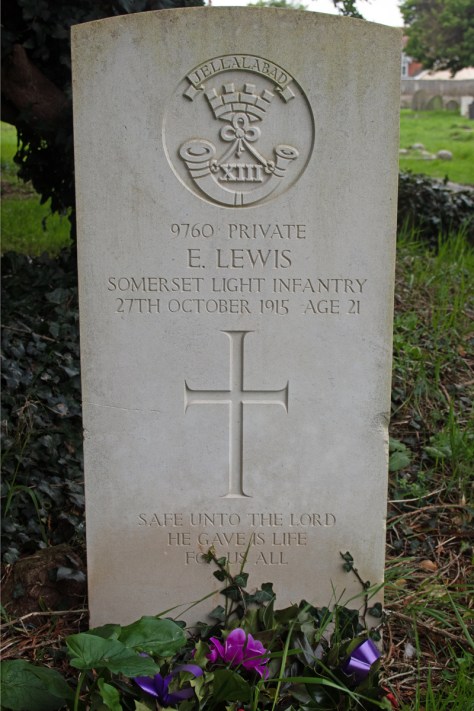
Either way, Private Lewis passed away at home on 27th October 1915. He was just 20 years old.
Ernest had eleven brothers, four of whom would have been old enough to be enlisted to fight. Ernest was the only one of the family to perish.
Ernest George Lewis lies at peace in the Wembdon Road Cemetery in his home town of Bridgwater.
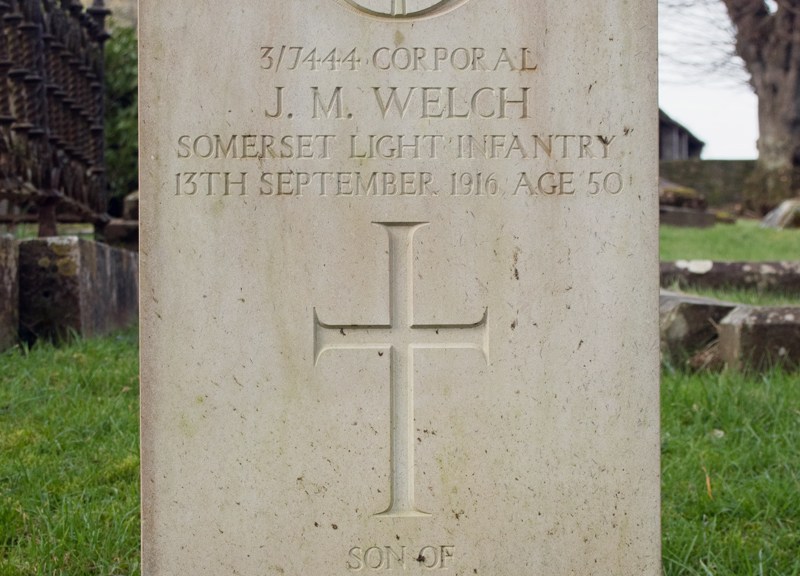
John Milton Welch was born in Yeovil on 19th February 1866, one of five children to William and Anne Welch. William was a chemist by trade, but John’s calling was elsewhere. He became a clerk, initially for a brewery, but by the time of the 1911 census, he was working for a political agency.
In that census, John can be found living with his parents – who were in their 80s by this point – and his two sisters, both school governesses. He is listed as single; although an earlier census suggests he had married a lady from the Isle of Wight called Sarah, I have found nothing to corroborate this, beyond the fact that she had wed a John M Welch, a brewery clerk from Yeovil.
War beckoned and even though he was 48 when the conflict broke out, John enlisted. Private Welch joined the Somerset Light Infantry; his service record no longer exists, but his medal record show that he arrived in France in May 1915, and was subsequently awarded the Victory and British Medals and the 1915 Star. His service obviously warranted promotion, and he was elevated to Corporal.
His troop – the 6th (Service) Battalion – was involved in several of the skirmishes of the Battle of Somme, and it is likely that Corporal Welch was injured during one of these – probably either the Battle of Delville Wood or the Battle of Flers-Courcelette. Wherever it happened, he was shipped back to England, and was treated for his injuries at the Royal Victoria Hospital in Netley, Hampshire
Sadly, Corporal Welch was not to recover; he passed away on 13th September 1916, at the age of 50.
John Milton Welch lies at rest in the graveyard of St James’ Church, in the quiet Somerset village of Milton Clevedon.
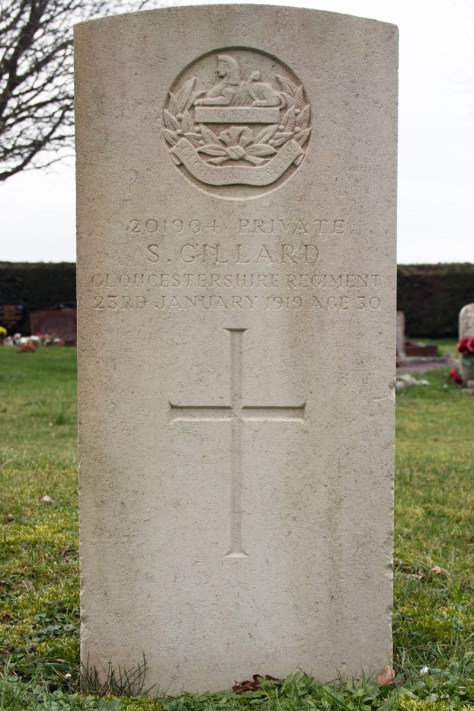
Sydney Gillard was born in October 1888, one of eight children to Charles and Lily. Charles was a stonemason, and this is the trade that Sydney and his older brother Harry also followed.
When war broke out, he enlisted in the Gloucestershire Regiment; Private Gillard’s troop, the 1/4th (City of Bristol) Battalion, were initially based in Swindon, before moving to Maldon in Essex. They were posted to France in March 1915, eventually being shipped to Italy in November 1917.
While Sydney’s military records do not confirm when he enlisted or where he served, that he saw fighting is beyond any doubt because his war pension records confirm that he died from his wounds.
Sydney Gillard passed away on 23rd January 1919, at the age of 31. He lies at rest in the cemetery of his home village of Othery, Somerset.
Leonard George Francis (who was known by is middle name) was born in October 1895. He was one of fourteen children to Jonas and Eleanor (or Ellenora) Francis, and his father worked on the railways as a plate layer or ganger.
George followed his father into manual labour, and, by the time of the 1911 census, aged 15, he was already listed as a mason.
He seems to have enlisted fairly early on in the war, and by January 1915 had joined his troop – the 2nd Wessex Field Company of the Royal Engineers – on the front line.
Sadly, Sapper Francis’ time in the army was to be brief. He was caught up in the fighting at Ypres, and he was injured at Hill 60 on 27th April. He was moved to a local hospital for treatment.
It seems that messages crossed in the communication with George’s family. They received a letter confirming that he was recovering in hospital after receiving a wound to the body, but not to worry. A day or so later his postcard confirming his arrival in France was received, but by this time he had been shipped back to England for treatment.
His parents received a telegram to confirm this, and his father and brother set out to visit him. By the time they had reached the hospital, however, he had sadly passed from a tetanus infection. In his pocket was a piece of shell; a sad souvenir of his frontline action.
Leonard George Francis died at Netley Hospital 3rd May 1915. He was just 19 years old.
He lies at rest in the cemetery of his home town, Shepton Mallet in Somerset.
Harry George King was born in Somerset in December 1894, one of nine children to John and Sarah King. John worked as a cabinet maker in Wells, and Harry followed in a similar vein to his father, becoming an upholsterer.
When war broke out, Harry – who stood at 5’3″ (1.6m) tall – enlisted in the Royal Navy as a Cook’s Mate. He trained on HMS Victory I in Portsmouth, before transferring to the HMV Vernon, a land-based ship, also in Portsmouth.
While on leave in 1917, Harry married Alice Trickey, who had also been born in Wells.
Harry’s first sea-going assignment was on the HMS Hermione, which was a guard ship off the Southampton coast. After two years on board, Cook’s Mate King was transferred to another vessel.
The HMS Glatton was a monitor vessel requisitioned by the Royal Navy from the Norwegian fleet at the outbreak of the First World War. After a lengthy refit, she was finally ready for service in the autumn of 1918, and positioned in Dover in preparation for a future offensive across the Channel.
At 6:15 on the evening of 16 September, there was a small explosion in a 6-inch magazine below decks, which then ignited the cordite stored there. Flames shot through the roof of one of the turrets and started to spread. The fire was not able to be brought under control, and there were concerns that, if the ship’s rear magazine exploded, the presence of the ammunition ship Gransha only 150 yards (140 m) away risked a massive explosion that would devastate Dover itself. The decision was taken to torpedo the Glatton, in the hope that the incoming flood water would quash the fire.
In the event, sixty men aboard the Glatton were killed outright, with another 124 men injured, of whom 19 died later of their injuries. This included Cook’s Mate King.
While the incident wasn’t reported in the media of the time, Harry’s funeral was; it gives a little more insight into the tragedy.
News reached Wells… that 1st Class Cook’s Mate Harry George King… was lying in a hospital at Dover suffering from severe burns caused through an internal explosion on the ship on which he was serving. His wife (…to whom he was married 12 months ago) and his sister at once proceeded to the hospital, where they arrived only a few minutes before he died.
The unfortunate young man had sustained shocking injuries and was conscious for only two hours on Friday. He lost all his belongings in the explosion.
Wells Journal: Friday 27th September 1918.
Harry George King was only 27 years old when he died. He lies at rest in Wells Cemetery, Somerset.
Harry’s widow, Alice, did not remarry; the couple had not had any children, and she passed away in their home town of Wells, in January 1974.
Ronald Victor Knight was born in March 1894, the youngest of two children – both sons – to John Knight, an Ironmonger from London, and his Swiss wife, Marie.
Ronald was well educated – being taught at Wells and Bedford Grammar Schools in the UK and Neuchatel in Switzerland, not far from where his mother was born. After studying at Bristol University, he went to work at Guys Hospital in London, training as a dental student.
When war broke out, he volunteered at once, being enlisted in the 8th Battalion London Regiment. Lieutenant Knight went with his regiment to France, and was involved in the Battle of Festubert and the fighting at Loos.
Returning home towards the end of 1915, Ronald married Gwendoline Dawkes, in a ceremony overseen by the Bishop of Bath & Wells.
Rather than returning to the front line, Lieutenant Knight accepted a commission to lead a section of the London Cyclist Corps, a position he held for a year or do. While in this service, Ronald and Gwendoline had their one and only child, a little girl they called Beryl.
In 1916, Ronald accepted a further move to the Royal Naval Air Service, becoming involved in flying as a Flight Lieutenant. It was while he was based at RNAS Cranwell that he was involved in the accident that led to his death.
An inquest was held into the incident, and evidence was taken.
Air Mechanic Charles Deboo [said] that the machine had been recently inspected, and that it was alright. He did not see the deceased flying, but saw the machine come down, nose first, in corkscrew fashion. He saw it at a height of 400ft. He went to the machine after it had fallen and found the officer was dead. The machine struck the ground and smashed up, but he could not say how the accident happened.
Charles Barrett, air mechanic, said he saw the accident. The deceased seemed as if he was going to turn towards the wind to land, and, as he turned, he banked, but he never righted himself. He nose-dived and spun round to the earth. He thought he lost control as he was turning, or the wind might have caught him. The machine was smashed, except for the tail.
The jury returned a verdict that deceased accidentally met his death while flying.
Retford and Workshop Herald and North Notts Advertiser: Tuesday 20th March 1917.
Flight Lieutenant Knight died in an aeroplane crash on 12th March 1917. He was 22 years old.
Ronald Victor Knight lies at rest in Wells Cemetery, Somerset.
Sadly, Ronald’s daughter, Beryl, died in the spring of 1923, when she was only 7 years old. She is buried with her father.
Gwendoline went on to marry Henri Booth in months after the death of her daughter. The couple went on to have two children, Elizabeth and William. She requested that her late husband’s war medals be given to his father, John.
Victor Charles Edelsten Bracey was born in October 1897, the only child of William and Florence Bracey. William was a physician and surgeon, practicing in Lancashire when Victor was born. The young family soon moved south, however, and by the time of the 1901 census, they were living in Wedmore, Somerset, where William had taken up as the village’s general practitioner.
Military records for Victor are not available, but his life can readily be pieced together from newspaper reports of his death and the de Ruvigny’s Roll of Honour, published after the war.
TWO PILOTS KILLED IN THE NEW FOREST
Two air fatalities have occurred within twenty-four hours of each other in the New Forest. On Saturday [22nd September 1917] Second Lieutenant Ernest Hargrave’s machine nose-dived from the height of 200ft, and crashed to earth.
Second Lieutenant Victor Bracey was flying on Sunday morning at a height of 300ft, when his machine turned and came down in a spinning nose-dive.
At the inquests verdicts of “Death by misadventure” were returned.
Western Gazette: Friday 28th September 1917
BRACEY, VICTOR CHARLES EDELSTEN, 2nd Lieut., RFC, only child of William Edelsten Bracey, LRCP [Licentiate of the Royal College of Physicians], Lieut. (Hon.) RAMC (retired), by his wife, Florence Marion, dau. of the late James Canning Gould.
[Victor was] educated St Peter’s School, Weston-super-Mare, and Blundell’s School, Tiverton, where he was a member of the OTC [Officers’ Training Corps]; passed into the Royal Military Academy in April 1915; joined the Inns of Court OTC in December 1916; was gazetted 2nd Lieut. RFC [Royal Flying Corps] 27 April 1917, obtaining his wings in July, and was killed in an aerial accident at the Beaulieu Aerodrome, Hampshire, 23 September, while testing a new machine.
A brother officer wrote that he was a gallant gentleman and a most skilful pilot.” He was a keen cricketer and footballer, and while at Blundell’s played in the First Cricket XI and the Second Football XV, and was also captain of the First Hockey XI; later played for the Royal Military Academy, Woolwich, and the RFC Rugby Football XV at Oxford.
de Ruvigny’s Roll of Honour, 1914-1919
A note on Second Lieutenant Bracey’s Roll of Honour states that he was ineligible for medals as he saw no overseas service; this seems to have been challenged by Victor’s father in 1921, but nothing confirms whether this anything was subsequently awarded.
Victor Charles Edelsten Bracey lies at rest in the churchyard of St Mary’s in Wedmore, where his father continued to practice. He died, aged just 19 years of age.
William’s prominence in the village played a big part in Victor’s legacy. A Memorial Fund was set up; this helped fund “necessitous cases for medical requirements and for conveying patients to hospitals“. The Victor Bracey Cup was also awarded into the 1940s for sporting achievement in the schools he had attended.
William Cottrell was born in April 1885, the third of twelve children to Henry and Annie Cottrell from Bampton, Devon. When William left school, he became an assistant to the village baker, but new opportunities lay ahead.
In May 1907, William married Maria Wall, the daughter of a stonemason from Wedmore in Somerset. With weeks, the young couple had embarked for a new life, boarding the Empress of Britain in Liverpool, setting sail for Canada.
Emigrating to Manitoba, William became a labourer, and he and Maria had three children – Leslie, Ronald and Kathleen.
War came, and William enlisted in the Canadian Expeditionary Force in August 1915. Shipped to England in the spring of the following year, Annie followed suit, returning to Somerset with the three children.
Private Cottrell was assigned to the 44th Battalion Canadian Infantry, setting off for France in August 1916, just weeks before his fourth child – Ruby – was born.
The battalion was involved in some of the fiercest fighting of the war, and it was during the Somme Offensive that William was shot in the left arm. Initially treated in the field, he was soon shipped back to England to recover in a military hospital in Epsom. Discharged after three months, he was returned to his battalion in early 1917.
The fierce fighting continued, and Private Cottrell was wounded again in October 1918. Further treatment back in the UK was needed, and he was admitted to the 1st Eastern General Hospital in Cambridge.
Details of the William’s injuries at the Somme are readily available, but information on his second lot of injuries is scarcer. They must have been pretty severe, however, as he was not discharged. He lost his final battle after four months, succumbing to his wounds on 9th January 1919. He was 33 years old.
William Cottrell lies at rest in the graveyard of St Mary’s Church in his widow’s home village of Wedmore, Somerset.
William’s gravestone is also a memorial to his eldest son, Leslie, who was killed during the Second World War.
Details of his military service are sketchy, but he enlisted in the Queen’s Own Royal West Kent Regiment. His battalion – the 1st – was involved in the fighting in Italy, and it was here that he lost his life. He was killed on 8th February 1944 and is buried in the Sangro River War Cemetery, in Abruzzo.
James Patch was born in 1882, the third of four children – all boys – to Albert and Jane. Albert was a farm labourer in the village of Meare, Somerset, and this is something that, once leaving school, the Patch boys also went into.
Albert passed away in 1904, so James stepped up and stayed living with his mother. By the time of the 1911 census, they were living near the Grape Vine Pub in Meare, both working as agricultural labourers, and had a John Lee boarding with them.
No firm details remain of James’ military service, although it is evident that he enlisted in the Devonshire Regiment and, from the Army Register of Soldiers’ Effects, this can be narrowed down to the 7th Infantry Works Company.
While Private Patch’s military records are sparse, his name crops up a lot in the newspapers around the time of his death, with headlines like “Mysterious Death of Meare Soldier”.
On the evening of the 25th March 1917, James was found lying across the tram tracks in Horfield, a suburb to the north of Bristol. He was in a semi-conscious state, and was taken to the nearby barracks.
An inquest was held and the story unfolded.
Witness statements confirmed that Private Patch was on a tram and had asked the conductress to let him know when they reached the barracks. The tram halted at the allotted stop, but, when nobody alighted, the driver started up again.
James apparently asked the conductress if that had been the stop for Horfield Barracks and, having confirmed that it was, and that he had wanted to get off there, she pressed the bell for the driver to pull up at the next stop. She then went up to the top deck of the tram, and it appear that James had decided he couldn’t wait for the next stop and jumped off the moving tram.
It seems that James fell from the tram and hit his head when he landed; this was when a passer-by found him.
The morning after his fall, the camp doctor identified the extent of James’ injury and he was moved from the barracks to the Royal Infirmary in Bristol. Private Patch died an hour after being admitted, having suffered an extensive fracture of the skull. He was 35 years of age.
The inquest into his death returned a verdict of “accidental death, due to a fall from a tram-car, caused by stepping from the car while in motion”.
James Patch lies at rest in the ground of the Church of the Blessed Virgin Mary and All Saints in his home village of Meare in Somerset.
Born in September 1896, John Russell was one of thirteen children to Henry and Ellen Russell. Henry worked as a turf cutter on the Somerset levels, and the family lived in the village of Meare, near Glastonbury.
By the time of the 1911 census, John, aged 15, had left school and joined his father’s business.
When war broke out, John joined up; sadly, his military records are absent, but what we do know for certain is that he enlisted in the West Somerset Yeomanry, and was based at the Stanway Camp near Colchester in Essex.
Sadly, much is written of Private Russell’s death. He was acting as a sentry at the camp on the morning of Tuesday 19th October 1915 when he was hit by a car; taken to the military hospital in Colchester, he passed away the following morning.
An inquest was held into the incident, and the following was ascertained:
Vera Coysh, aged 19, was driving near the camp with two friends and her gardener; as she was approaching the entrance, a horse-drawn military wagon ahead of her turned and she swerved to avoid it. In doing so, she hit Private Russell “and carried him some way along the ground”.
John’s injuries were significant. When admitted to hospital, he “was suffering from bruises on the back of the head and haemorrhage from the right ear and nose. His left hand and the lower part of his left arm were swollen from bruising. He was semi-conscious and restless…”
The inquest identified some discrepancies in what happened.
Witnesses in the military wagon and a second one following it all saw a turning signal being given, although not necessarily in time for Vera to slow down or stop. All of the army witnesses stated that she was driving at a quick speed, possibly as much as 35mph.
Vera and her passengers all stated that they saw no signal, saying that the wagon pulled across without indication. They also stated that they were not travelling at speed.
The inquest was a lengthy one, but the final verdict was one of accidental death, with a recommendation that signs were put up on the road to warn of the entrance to the camp.
John Russell was just 19 years old when he died. He was laid to rest in the graveyard of the Church of the Blessed Virgin Mary and All Saints in his home village of Meare, Somerset.
It’s worth also having a look into the life of the driver of that fated motor car.
Vera Murdoch Coysh was born in September 1896, the eldest child of Commander William Henry Coysh and his wife Beatrice Murdoch. The family lived in Yorkshire and, by the time of the incident, William and Beatrice had had four other children – Humphrey Cecil (who became a Commander), Geoffrey Ernest (who went on to be Sub Lieutenant), John William and Barbara Daphne.
Three months after the accident, Vera married Second Lieutenant Trevor Davidson, of the Essex Regiment, and the couple soon emigrated to Mozambique.
All was not well, however, as, by 1924, Vera has moved back to England, the couple had divorced and she had remarried, to a Douglas Stuart-Jervis. The couple went on to have two children.
Meanwhile, Vera was also making a bit of a name for herself in the literary world, writing a number of novels under the name of Jane England. While rarely seen nowadays, she wrote books with such ‘pulp fiction’ titles as Red Earth, Romantic Stranger, Flowering Harvest, Stormy Passage and Winter Jasmine.
It’s bittersweet to see that Vera made a life for herself, in the way that John Russell was sadly unable to.