In a quiet corner of the St Mary’s Cemetery in Taunton, Somerset, sit a pair of headstones.
Both are adorned with the word Portugal, and have the word Trabalhador (translated as Worker) and the phrase Corpo de Lenhadores Portugueses (or Portuguese Forestry Corps) inscribed on them.
During the Great War, vast quantities of timber were required by the Army in France. Initially imports from Canada provided most of what was needed but, as the war progressed, ships were required for other essential supplies, so imports of timber fell dramatically.
In 1916, the British government asked the country’s oldest ally, Portugal, to send workers to assist with the war effort. Soon both the Portuguese Forestry Corps and Canadian Forestry Corps had teams working all across the United Kingdom, totalling many thousands of men.
This side of the war effort was not without its casualties, and those serving were accorded Commonwealth War Graves.
There is no information readily available for Joaquim Maria Brandao. He would have come to England from Portugal at some point in 1916, but the only record of him is that of his passing.
He died on 3rd October 1918, although the cause of his death and the age at which he passed are lost to time.
Joaquim Maria Brandao lies at rest in St Mary’s Cemetery in Taunton, Somerset.
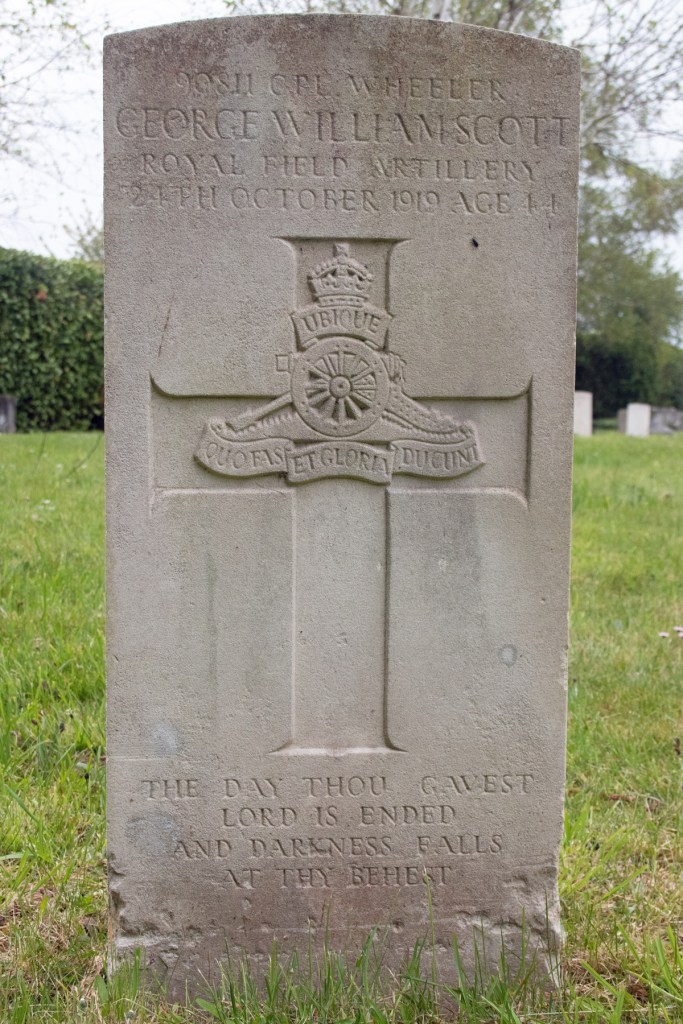
George William Scott is destined to be one of those names who is sadly lost to time. While there is information relating to him, there is not enough detail to flesh out a concrete history around him.
The facts that we do know about George are that his parents were John and Mary who, at the time that his grave was commemorated, were living in County Tyrone in Northern Ireland.
George enlisted in the Royal Field Artillery in November 1914. He was assigned to the 5th Battery of the 45th Brigade, and given the rank of Wheeler – one of the positions in a team of horses, pulling the artillery.
During his service, George was awarded the 1914 Star, as well as the Victory and British Medals. He seems to have been in a bit of trouble to begin with, however, as he was reverted down to Gunner because of misconduct. This may only have been temporary, as he ended with the rank of Corporal Wheeler.
And that is it, that is all the concrete information available for George Scott. How he died is a mystery, lost to time.
George William Scott lies at rest in St Mary’s Cemetery in Taunton, Somerset.
Ernest Frederick Hawkins was born in Street, Somerset, in 1884. He was the youngest of six children to Charles Hawkins and his wife Elizabeth. Both of Ernest’s parents were shoemakers in the Clark’s Factory in the town, and this was the trade Elizabeth continued in after her husband’s death in 1887.
Ernest’s life has some mysteries about it and there is a sense that he spent time trying to escape from something. In August 1904, he enlisted in the army, joining the Scottish Rifles (also known as the Cameronians). He did this under an assumed name, preferring to be called James Fisher.
“James” gave his next of kin as his parents, listing them as George and Annie in South Acton (even though these were not his actual parents’ names, and that his father had passed away 17 years previously).
His enlistment papers give an interesting insight into the young man. He was listed as 22 years old, 5ft 4ins (1.62m) tall, with brown eyes, black hair and a sallow complexion. His arms were adorned with a number of tattoos, including Buffalo Bill on his upper right arm and a ship surrounded by flags on his upper left.
Private Fisher served for a year on home soil, before being shipped out to India. He returned to the UK in October 1907, and transferred to the Army Reserve.
Ernest returned to Somerset, and it was here that he met Sarah Jane Manning. The couple married in a registry office in Bristol, and went on to have two children, Hubert and Iris.
War broke out, and Private Fisher was remobilised. By August 1914 he was promoted to Lance Corporal, and sent to France as part of the British Expeditionary Force. Here he became caught up in a number of the key battles of the conflict.
On 24th July 1916, during the British attacks on High Wood at the Somme, he was wounded in the right arm, and invalided back to England for treatment. Admitted to the War Hospital in Guildford, Surrey, it was confirmed that he had received a gun-shot wound to his right arm, which had resulted in a compound fracture of the humerus, radius and ulna. Sadly for Ernest, the only option was a full amputation of his right arm.
After some time to recover, Ernest was transferred to the Pavilion Military Hospital in Brighton where he was fitted for an artificial limb. He spent three months in the Brighton facility, before being moved to the Queen Mary’s Convalescent Home in Roehampton to recuperate. He was eventually discharged – from the hospital and the army – on 10th March 1917, and returned to his wife and family in Somerset.
There is little further documented information about Ernest. He and Sarah went on to have a further child – Leslie – in 1917. Sadly, where Ernest had been a toddler when his father had died, Leslie was consigned to be a babe-in-arms when Ernest passed away.
Ernest Frederick Hawkins – also known as James Fisher – died in Swindon on 2nd July 1918, at the age of 34. He lies at rest in St Mary’s Cemetery in his adopted home town of Taunton, Somerset.
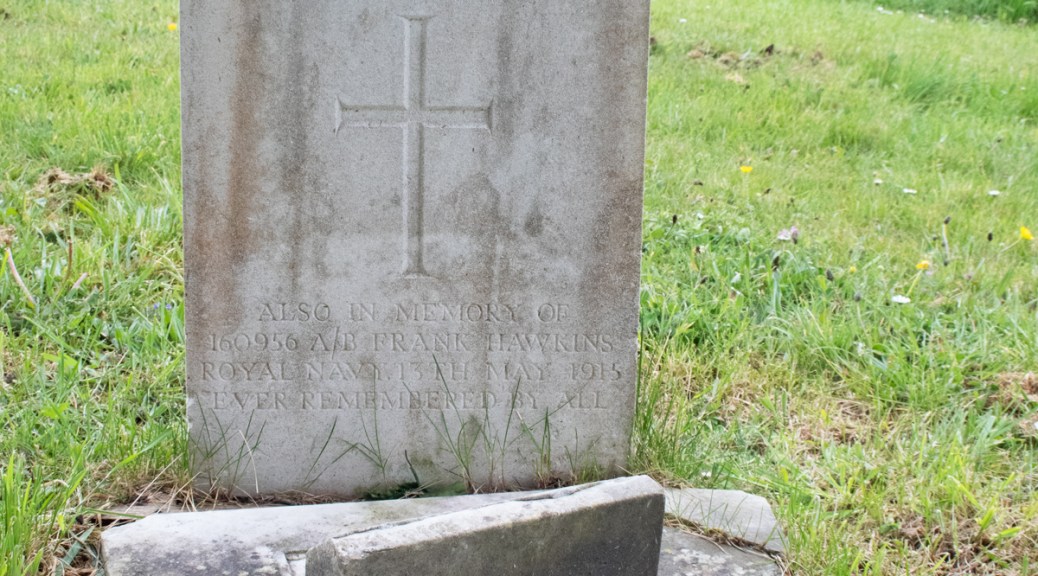
Ernest’s gravestone also commemorates his brother Frank Hawkins. Frank was nine years older than Ernest, and, like his younger brother, had decided that the military life was for him.
Frank enlisted in the Royal Navy in November 1894 and was assigned a Boy 2nd Class on HMS Impregnable – the training ship based in Chatham, Kent. Over the period of his twelve years’ service, Frank rose through the ranks to Able Seaman. When his term was up, he joined the Royal Fleet Reserve for a further five years.
When war came, Able Seaman Hawkins was immediately called back into action. He was assigned to HMS Goliath, serving off German East Africa and the Dardanelles. On the night of the 12th May 1915, the ship was guarding the water off Gallipoli, when it was struck by three Ottoman torpedoes. The resulting explosions caused the ship to sink quickly, and 570 souls – out of a total complement of 750 crew – were lost.
Able Seaman Hawkins was one of those lost, and was subsequently commemorated on his brother’s gravestone.
Arthur Webb Butler Bentley was born on 1st January 1884 to Dr Arthur Bentley and his wife Letitia. The oldest of five children, they were a well-travelled family. Dr Bentley had been born in Devon, but his and Letitia’s first two children were born in Singapore, while their second two were born in Ireland, where Letitia herself had been born.
By the time of the 1891 census, the family were living in Paddington, London, where Arthur’s father was a medical practitioner.
Arthur Jr looked set to follow in his father’s footsteps; becoming a student of medicine in Edinburgh, although it seems his life was destined to take a different route.
By 1905, his father was working at a practice in Egypt. It was around this time that his mother made the newspaper headlines.
VICTIM OF CHROLODYNE
A painful story was told at the Clerkenwell Sessions when Letitia Bentley, the wife of a doctor holding an official position in Cairo, pleaded guilty to the theft of a diamond and ruby ring from the shop of Messrs. Attenborough, Oxford Street [London]. It was stated that Mrs Bentley was addicted to the drinking of spirits and chlorodyne, and that 240 empty bottles which had contained the latter drug had been found in her rooms in Bloomsbury.
Dr Bentley said he would keep his wife under strict supervision in the future, and she was bound over.
Shetland Times: Saturday 3rd June 1905.
The ring concerned was valued at five guineas (around £700 in today’s money), and another report confirmed that her husband “supplied her with ample means” [financially].
In the 19th century, chlorodyne was readily used as a treatment for a number of medical conditions. Its principal ingredients were a mixture of laudanum (an alcoholic solution of opium), tincture of cannabis, and chloroform, it readily lived up to its claims of relieving pain and a sedative.
Letitia does not appear in any other contemporary media; sadly, however, she passed away “at sea” in June 1907, presumably on the way to or from Cairo, where Arthur Sr was still working. She was just 47 years old.
Arthur seems to have taken the decision to move away, and he emigrated to Canada, settling in Winnipeg. Leaving England behind, he left the idea of medicine with it, finding work as a lineman instead, constructing and maintaining telegraph and power lines.
Arthur’s father is the next member of the family to appear in the local newspapers. Working in Cairo during the winter and Llandrindod Wells in the summer, he travelled to Wales in April 1911. One evening he collapsed and died while in the smoking room of his hotel. The media reported that he was “formerly Colonial Surgeon to the Straits Civil Service, Singapore” and that “he was going to deliver a lecture at Owen’s College [now the Victoria College of Manchester] on tropical diseases, upon which he was an expert.“
Arthur Jr was now 27, and had lost both of his parents. War was on the horizon, though, and he seemed keen to become involved. He enlisted in December 1915, joining the Canadian Expeditionary Force. His sign-up papers gave him as just short of 32 years old, standing at 5ft 8ins (1.72m) tall, with a fair complexion, blue eyes and brown hair. The document also recorded his next of kin as his brother, William, who was living near Cairo.
Arthur arrived in England on 25th September 1916; during his time in the army he remained on English soil, primarily at a signal base in Seaford. Transferred to a reserve battalion in January 1917, he was eventually discharged seven months later.
His records suggest that his services were no longer required, but t is likely that Arthur’s discharge was his transfer to the Yorkshire Regiment, complete with a commission.
The now Second Lieutenant Bentley was assigned to the 3rd Special Reserve Battalion but never saw action in Europe. The troop’s main duties were to train men for service overseas and to provide coastal defences. While there is no confirmation of exactly where Arthur was based, there were units in and around Hartlepool, County Durham.
Sadly, there is little further information about Arthur. By the end of the war, he was living in Taunton, Somerset, where his younger sister Eileen had settled. Second Lieutenant Bentley survived the war, but passed away not long afterwards, on 2nd December 1918. There is no cause given for his death. He was just 35 years old.
Arthur Webb Butler Bentley lies at rest in St Mary’s Cemetery in Taunton, Somerset.
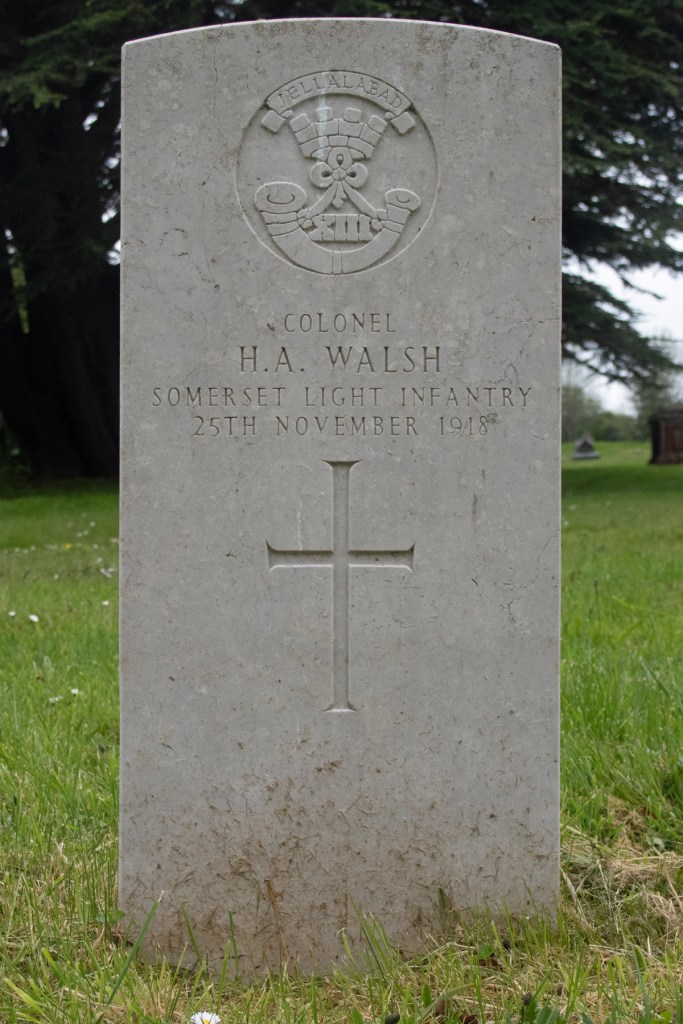
Henry Alfred Walsh was born near Taunton, Somerset, in September 1853, the eldest of five children to Theobald and Isabel Walsh. Theobald was a magistrate with some military connections, and it was military service that Henry went into.
While full details aren’t readily available, the 1881 census finds him living in Devon, with his employment simply as “military”. Presumably, he had enrolled in the Somerset Light Infantry, the regiment he had a lifelong commitment to.
By the early 1880s, Henry had married Ann Sparrow. The couple went on to have three children – Theobald, Gwladys and Archibald.
The 1891 finds Henry and his family in the Somerset Light Infantry Barracks at Farnborough. Henry was a Sergeant Major by this time, and was assigned to the 1st Battalion. Also living in the same accommodation – and presumably helping Ann with the running of the household – were a governess and cook.
The census also highlights the transient nature of army life. Henry, as mentioned before, was born in Taunton, while Ann came from Plymouth in Devon. Theobald was born in Taunton, while Gwladys and her younger brother were both born in Devon. Military service brought a sense of stability, but not necessarily geographically.
Henry eventually took a step back from the army; by the time of the 1911 census, he was living back in Bishop’s Hull, the village of his birth in Somerset, and listed as a retired colonel. When war broke out, however, he volunteered his services again, and was appointed the officer commanding the No. 8 District in Exeter.
While Henry came out of retirement to serve his country again, his two sons had also forged their own military careers. Theobald also joined the Somerset Light Infantry, also achieving the rank of Colonel. Archibald joined the Royal Horse Artillery; his story can be found by clicking here.
When Henry passed away in 1918, local newspapers were unanimous in their praise of the long-serving officer, outlining both his military service and his charitable work.
Colonel Walsh had had a distinguished military career, dating from 1870, when he joined the old Somerset Militia at Taunton. [He] was created a CB in 1905, and held the medal and clasp for Zululand, and the medal and two clasps and the Khedive’s Bronze Star for his services in Egypt.
He was a JP for Somerset and a member of the Army and Navy Club. [He] threw himself wholeheartedly into the work of the Boy Scout organisation.
The greatest work in which Colonel Walsh had been identified during the war, however, was undoubtedly that of feeding the Somerset prisoners of war in Germany, and his name will ever be linked in grateful memory with that of his honoured wife for having raised and maintained a fund capable of bearing the strain of over £3,000 expenditure per month to save the Somerset men in Germany from starvation.
Well Journal: Friday 29th November 1918
Ironically, for all this exultation, there is no immediate record of the cause of Henry’s death; given his age – he was 65 when he passed – it seems likely that he died following an illness.
Colonel Henry Alfred Walsh lies at rest in St Mary’s Cemetery in Taunton, Somerset. He is buried next to his son, Archibald.
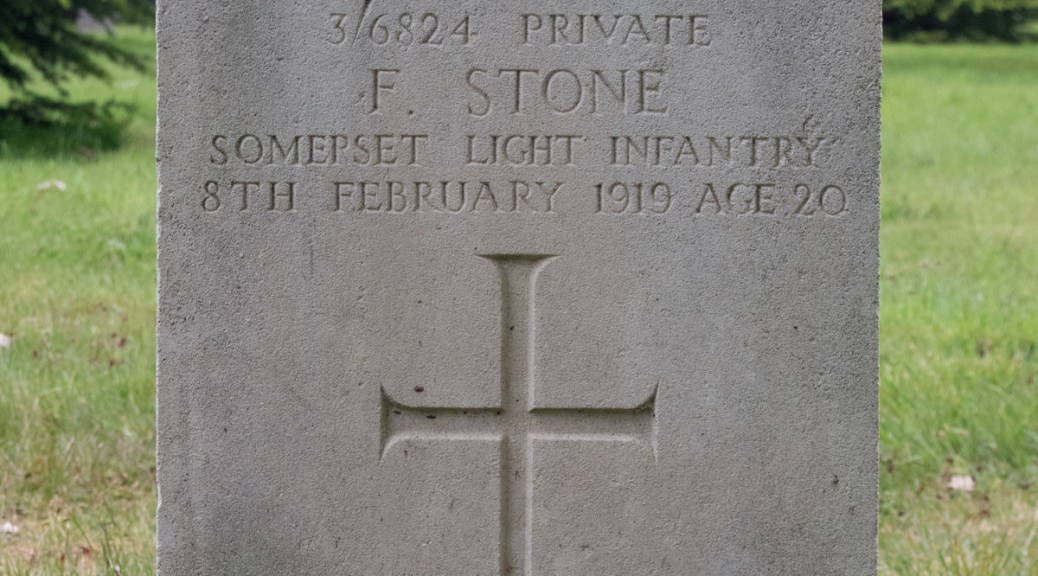
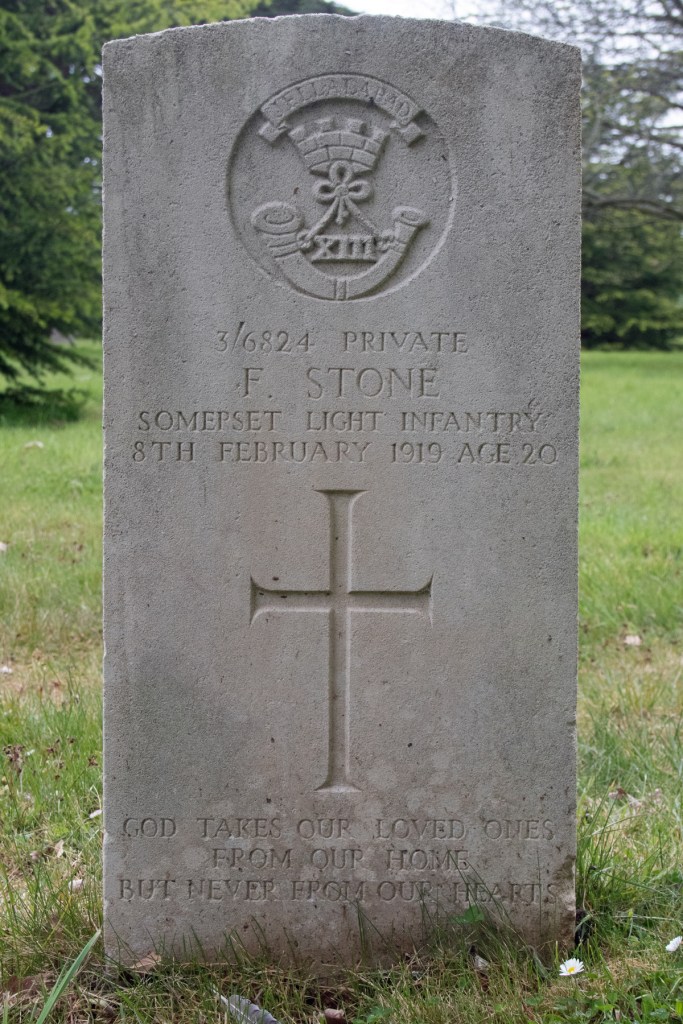
Francis Jesse Stone – known as Frank – was born in 1899, one of five children to William and Sarah Stone. William was a general handyman – his census records record him variously as a labourer, carpenter and carman (or carter) – and the family lived in the village of Bishop’s Hull, on the outskirts of Taunton, Somerset.
Given when he was born, documentation for Frank’s early life is limited to the 1901 and 1911 censuses. We are restricted, therefore, to the information provided by the medal rolls.
Frank was under age when he joined up. He enlisted in the Somerset Light Infantry on 27th December 1914, when he could only have been 15 years old. He was assigned to the Depot Battalion, and was shipped to France the following year.
Sadly, there is little other information about Private Stone. He survived the war and returned to England, but passed away on 8th February 1919. No cause of death is evident, but it seems likely to have been one of the lung conditions running rampant across the country at the time, probably influenza, tuberculosis or pneumonia. When he died, Frank was just 20 years old.
Frank Jesse Stone lies at rest in St Mary’s Cemetery in his home town of Taunton, Somerset.
Frederick Henry Virgin was born in 1888, the second eldest of ten children. His parents were carter Thomas Virgin and his wife, Ellen, and the family lived in Taunton, Somerset.
Frederick craved adventure and this came in the form of military service. In August 1906, he enlisted in the Royal Field Artillery, and was assigned as a driver. Initially serving at home, he was shipped to India for four years, returning to England in December 1912.
Driver Virgin met and married Alice Shattock in April 1914, but had been shipped off to France within months, when war broke out. He served overseas for eighteen months, before transferring back to England again. By this point he was suffering with sciatica, and this is what saw him assigned lighter duties in the Reserve Brigade on the home front.
Alice fell pregnant, and the couple had a little boy in February 1917; sadly, his life was brief, and he passed away at the age of just two days. One can only imagine the impact this had on his parents.
Frederick’s health issues continued to be a problem, and he was medically discharged from the army later that year. While the sciatica was not solely attributed to his military service, his discharge report confirmed that his time in the army contributed to the issue. Driver Virgin’s time with the Royal Field Artillery came to an end in December 1917.
Sadly, it is at this point that Frederick’s trail goes cold. His records confirm that he passed away nearly a year later, on 26th November 1918, but there is no record as to the cause of his death. He was 30 years of age.
Frederick Henry Virgin lies at rest in St Mary’s Cemetery in his home town of Taunton, Somerset.
Arthur Ernest Taylor was born at the end of 1892, the middle of three children to James and Sarah. James was a baker, and the family lived in Bruton, a small town in the west of Somerset.
Only one of James’ three sons followed him into the baking business; this was his youngest, Reginald. The oldest of the three brothers, Oatley, found employment in Wales as a miner. Arthur, on the other hand, stayed in Bruton, but found work as a cycle repairer when he left school.
In December 1913, Arthur married Gertrude James, the daughter of a local carpenter; the young couple went on to have a son, Gerald, the following year.
Sadly, little information about of Arthur’s military career survives. He enlisted in the Machine Gun Corps, although there is nothing to confirm exactly when he enrolled.
The next time Private Taylor appears in the records is a notice in the Western Gazette on 28th March 1919. The newspaper reports that he passed away in the Military Hospital in Grantham, Lincolnshire. Further documentation shows that he passed away on 13th March 1919, at the age of 27 years old. Sadly, there is no confirmation of the cause of his passing.
Arthur Ernest Taylor was brought back to Somerset, and his body lies at rest in the graveyard of St Mary’s Church in his home town of Bruton.
Thomas James Clark was born in Worcester at the beginning of 1853, the oldest of two children to James Clark and his wife Sarah. James was an engine smith and gas fitter, and moved the family with his work, initially to London, then on to the Kent coast.
Documentation relating to Thomas’ early life is difficult to track down; the 1871 census has him listed as a gas fitter like his father, but it is likely that he enlisted in the army fairly shortly after this date.
In 1875, he married a woman called Emily Ann. There life was to take on a grand new adventure as their first child, a boy named after his father, was born in Bombay, India, later that year.
It seems likely that it was Thomas’ military service that took the young family overseas. This was to be the case for at least a decade, as Emily gave birth to four further children in India. James, their fifth child, was born in Bombay in 1884. Their sixth, and last child, Ellen, was born in Gillingham, Kent, ten years later.
Given that the standard time for military service was twelve years, it is possible that Thomas served all of that time overseas, returning to England in around 1887.
Back home in Kent, Thomas is given the commission of Quartermaster in November 1897. By this point, he has been in the Royal Engineers for just under 21 years. He and his family are living in central Gillingham, within easy walking distance of the Royal Engineers Barracks and School of Engineering.
The 1901 census also lists Thomas as Quartermaster for the regiment, while three of his sons are by this time working in the Naval Dockyard as shipwrights and engine fitters.
Ten years later and the family are still living in the same house. By now, and aged 57, Thomas is recorded as a Retired Captain and Quartermaster for the Royal Engineers. He and Emily have been married 36 years, and their three youngest children (now aged 29, 26 and 17) are still living with them.
War was looming by now, although, age 61 when it broke out, it is unlikely that Retired Quartermaster Clark would have been involved in any front line activity. While no military records survive for Thomas, it seems possible that he may have been recalled for a training or administrative role at the barracks nearby.
Any re-commission would not have lasted for long, however, as Quartermaster Clark passed away at home on 10th September 1916. He was 63 years old.
Thomas James Clark lies at peace in the Woodlands Cemetery in Gillingham, Kent.
Thomas’ widow, Emily, passed away just two years after her husband. She was also laid to rest in the Woodlands Cemetery.
Thomas left his estate in the hands of his youngest son, James, who was still living at his parents’ home when they passed away.
Richard Edmundson Taylor was born in 1895, one of nine children to Frederick and Emma Taylor. Frederick was from Portsmouth, Emma from Blackburn, but the couple had settled their family in Kent, where Frederick worked as an engineer and pattern maker at the Naval Dockyard in Chatham.
When he left school, Richard took work as an apprentice photographer – his older sister Mildred worked as a re-toucher in the same studio. The 1911 census reveals that his eldest sister, Alice, was working as a governess; the family of eleven were living in a small terraced house in Seaview Road, Gillingham – a road that, ironically, had no view of the nearby River Medway or Thames Estuary.
At this point, Richard’s trail goes cold. He enlisted in the Royal West Surrey Regiment – also known as the Queen’s – but there is no documentation to confirm when this was.
Private Taylor’s battalion, the 2/4th, would go on to fight at Gallipoli, but he would not have been involved, and, more than likely, did not see any overseas service. The prefix to his service number (T/2711) may well have indicated he was in training when he passed away, although, again, there is no physical evidence to confirm this.
Nor is there any indication of the cause of Private Taylor’s death. His name does not appear on any contemporary newspaper reports, so it is unlikely that it was due to any misadventure; more probably, he passed away from one of the many communicable diseases that became common in the training camps of the 1910s.
Whatever the cause, Private Taylor died at home on 4th February 1915. He was just 19 years old.
Richard Edmundson Taylor lies at rest in the Woodlands Cemetery in his home town of Gillingham, Kent.