Category Archives: Cornwall

Corporal Thomas Teague

Corporal Thomas Teague

Thomas Teague was born in the spring of 1884 in the Cornish town of Tintagel. He was one of ten children to quarryman and road labourer John Teague and his wife, Ellen. When he first left school, Thomas found work as a farm labourer. By the time of the 1911 census, he was still living in the family home, but had found more skilled work as a stone mason.

Much of the rest of Thomas’ life remains a mystery. John passed away in September 1914, and it is clear that, with war now raging across Europe, Thomas stepped up to play his part. He enlisted in the Royal Dublin Fusiliers, and was assigned to the 7th Battalion. The regiment served in Gallipoli, Salonika and Egypt, although it is not possible to identify where Private Teague served.

At some point, potentially because of health reasons, Thomas was transferred to the 655 Home Service Coy of the Labour Corps. Again, exact details of his service are unclear, but he had been promoted to the rank of Corporal, and appears to have been based in Curragh Camp, not far from Kildare, Southern Ireland.

The only other confirmed record relating to Corporal Teague is that of his passing. He died of heart disease in the camp, on the 2nd October 1917. He was 33 years of age.

Thomas Teague’s body was brought back to Cornwall for burial. He was laid to rest in the peaceful graveyard of St Materiana’s Church, overlooking his home village of Tintagel.


Thomas was buried in the family plot, alongside his father. When his mother, Ellen, passed away in 1930, she was reunited with her husband and son.


Private James Toms

Private James Toms

James Toms was born in Tintagel, Cornwall, early in 1886, and was the youngest of seven children to Lavinia Toms. Lavinia’s husband, quarry worker John Toms had passed away a few years before, and she had moved her young family in with her mother, Mary Emmett, by the time James was born.

James found work in the local slate quarry when he left school and, by the time of the 1911 census, he was living with his mother and two of his siblings in the town.

When war came to Europe, James stepped forward to play his part. While his service records are no longer available, other documents confirm that he enlisted in the Duke of Cornwall’s Light Infantry, and was on the Western Front by October 1915.

At some point, Private Toms transferred to the Royal Defence Corps: as this regiment was not created until March 1916, his move could obviously not have been before this point in the conflict. He was based back on home soil, and, by the end of the war, he was serving in Oxfordshire.

In the closing weeks of the war, Private Toms was admitted to the 3rd Southern General Hospital in Oxford, having contracted pneumonia. The condition was to get the better of him and, he passed away on 6th November 1918. He was 33 years of age.

Brought back to Cornwall for burial, James Toms was laid to rest in the quiet and picturesque graveyard of St Materiana’s Church. His epitaph reads: Home at last thy labour done, safe and blest the victory won.


Lieutenant Arthur Wellacott

Lieutenant Arthur Wellacott

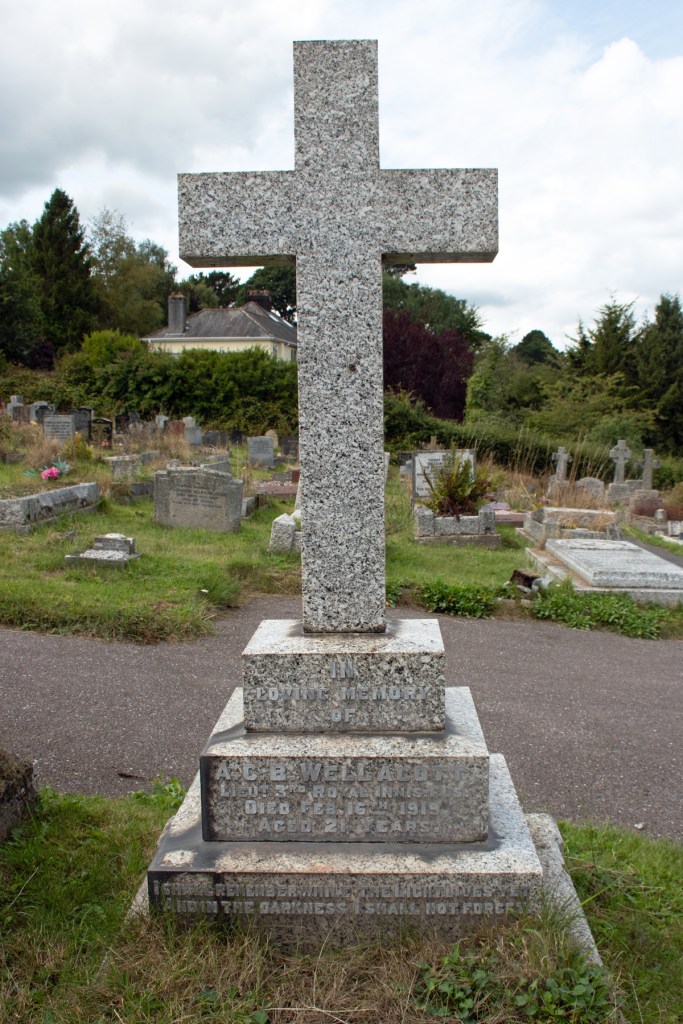
Arthur Cecil Baber Wellacott was born the summer of 1897, in the village of Bradworthy, North Devon. Ond of seven children, his parents were William and Ada Wellacott. William was the parish vicar and with his status came additional support for the family.

The 1901 census saw the vicarage employ three members of staff, and William was hosting two students as well as his and Ada’s own children. Ten years later, with Arthur and his younger brother William, boarding at a school in Bude, Cornwall, the Wellacott retinue remained in place.

On leaving boarding school, Arthur studied at Kelly College in Tavistock and, at around the same time his father took up a new post in Totnes. When Arthur left the college, he joined the 7th (Cyclist) Battalion of the Devonshire Regiment. He was subsequently given a commission in th 3rd Battalion of the Royal Inniskilling Fusiliers, and was based in Londonderry.

At Easter 1916, Lieutenant Wellacott took part in quelling the rebellion in Dublin, and was subsequently sent to France. In the battle for Contalmaison his platoon was gassed and buried, and Arthur was badly injured. Suffering from shell shock, the experience had a lasting impact on him “and from that time his health had given cause for anxiety…” [Western Morning News: Tuesday 18th February 1919]

Lieutenant Wellacott returned to England and he was billeted near Leeds. During the winter of 1918/1919, he contracted pneumonia, and was admitted to the Drax Hospital. Sadly, the condition was to prove too much for his already damaged lungs and he died on 16th February 1919. He was just 21 years of age.

Arthur Cecil Baber Wellacott was brought back to Devon for burial. He was laid to rest in the cemetery in Totnes, Devon.


Deck Hand Philemon Richards

Deck Hand Philemon Richards

Philemon Witheridge Richards was born on 9th July 1891 in Porthleven, Cornwall. He was one of at least seven children to George and Ann Richards. George was a sailor, as were he two oldest sons and, by the late 1890s, the family had made the move to Penarth in Glamorganshire.

When he left school, Philemon followed his father and older brothers into sailing. By the time he turned eighteen, George had passed away and Philemon wanted bigger and better things. On 16th July 1909, he enlisted in the Royal Garrison Artillery. His service records show that he stood 5ft 9.5ins (1.76m) tall, had good vision and was of good fitness.

Gunner Richards was posted to No. 6 Company and remained part of the territorial force. On 1st July 1911, after twenty months’ service, he was, at his own request, discharged from the army.

The trail goes cold for a while, and Philemon seems to have returned to a life at sea. This changed, however, when war broke out and, in October 1915, he was drafted into the Royal Naval Reserve as a Deck Hand.

Philemon’s time in service seems to have been shore-based however. After an initial posting to HMS Vivid, the Royal Naval Dockyard in Devonport, he moved to HMS Victory, which was the name given to the dockyard in Portsmouth, Hampshire. He moved on again in the autumn of 1916, by which point he was based at HMS Pembroke, the Royal Navy’s shore-base in Chatham, Kent.

It was here that Deck Hand Richards fell ill. It is unclear what the condition was, but he was admitted to the Military Hospital in Chatham on 20th October 1916. His illness worsened, and he passed away there on 2nd November. He was just 25 years of age.

Philemon Witheridge Richards was brought back to Glamorganshire for burial. He lies at rest in the graveyard of St Augustine’s Church in Penarth.


Philemon’s gravestone is also dedicated to his brother, Thomas Witheridge Richards. Eighteen years Philemon’s senior, Thomas had been a sailor, and, while no records remain, it seems likely that he may also have been called into service during the First World War. He died at home on 4th July 1918, at the age of 45 years old. He was laid to rest in the same plot as his younger brother.


Boy Sidney Buttle

Boy Sidney Buttle

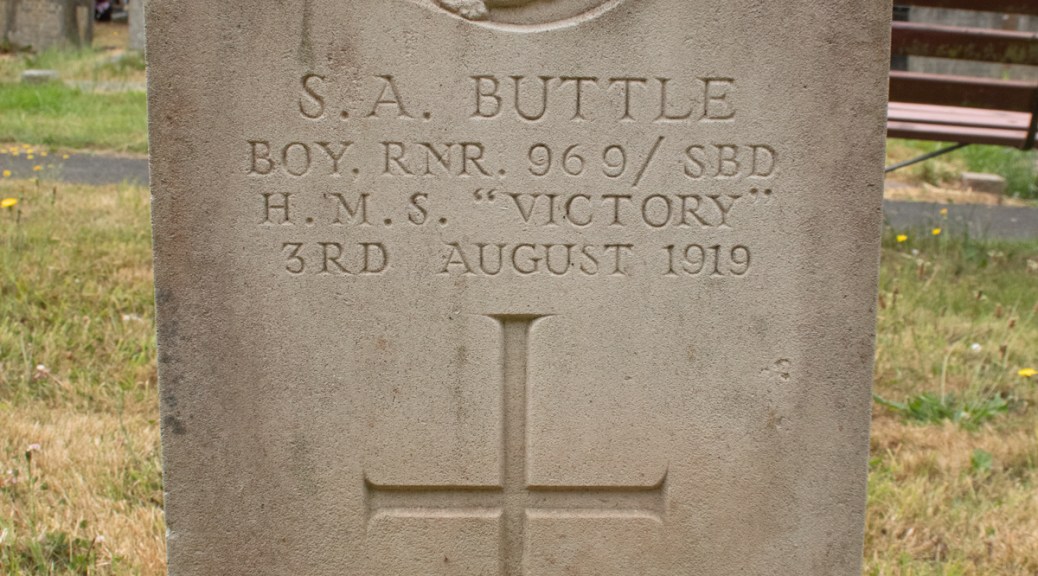
Sidney Alfred Buttle was born on 7th November 1900, one of eight children to Walter and Alice Buttle. Walter was a brickyard labourer from the Somerset hamlet of Churchstanton, but it was in nearby Wellington that he and weaver Alice raised their young family.

Sidney was just 13 years old when war broke out, but he was a young man who appeared keen to play his part. On 31st July 1917, he enlisted in the Royal Naval Reserve, a regiment that suggests that, even at his young age, he had some experience of working with boats.

His service records show that Sidney was just 5ft 2.5ins (1.59m) tall, had a fresh complexion with hazel eyes. Given the rank of Boy, he was initially posted to Falmouth, Cornwall, where he spent nine months training. After this, he spent a further six months on short postings as a deck hand, before being sent to HMS Victory, the Royal Naval Dockyard in Portsmouth, Hampshire.

Boy Buttle was, by this point, suffering from neurasthenia, a nerve disorder, and it was this condition that led to his eventual discharge from naval service in December 1918.

Sidney returned home, but seems to have been weakened by the condition. He passed away at home on 3rd August 1919, at the tender age of just eighteen years of age. He was laid to rest in Wellington Cemetery, not far from where his family still lived.


Private George Knight

Private George Knight

George Albert Knight was born in Dover, Kent, on 27th September 1888, the second of seven children to Thomas and Frances Knight. Thomas was a railway porter from Hampshire, and the family lived in a small terraced house a few minutes’ walk from his workplace, Dover Priory Station.

By the turn of the century, the family had moved to Faversham: Thomas was working a signalman, and two of George’s brothers also worked for the railway – one as a clerk, the other as a number taker. George, meanwhile, was working as a butcher.

In the summer of 1916, George married Alice Smith, who was working as a domestic servant for an government inspector in Willesborough, Kent. George was still working as a butcher at this point, and continued to do so up until the spring of 1918, when he was eventually called up.

Private Knight enlisted in March 1918, joining the Royal Naval Air Service shortly before it merged with the Royal Flying Corps to become the fledgling Royal Air Force. He was based in Cornwall, and his role included mechanic work.

On the evening of 21st September 1918, George collapsed and, despite being rushed to hospital in Truro, he passed away the following morning. It appears that he had not been unwell before, and his death came as a shock. He was just short of his 30th birthday.

George Albert Knight was brought back to Kent for burial. He was laid to rest in Faversham Borough Cemetery, not far from where his widow and family were living.


Wireless Operator Edward Phillips

Wireless Operator Edward Phillips

Edward James Phillips was born on 22nd January 1900 in Bedminster, Bristol, and was the oldest of two children to Ernest and Emily Phillips. Ernest was a bit of a jack-of-all-trades; the 1901 census recorded him as being a shopkeeper of glass and china, while by 1911 he was working as an architect’s clerk.

By this point, the family had moved to Chard, Somerset, and had set up home in a small, terraced house near the centre of the town. Storm clouds were gathering over Europe, and, while he was too young to enlist at the start of the war, it is clear that Edward wanted to play his part.

While details of his service are unclear, Edward joined the Merchant Navy. By the summer of 1918 he was on board the SS Polesley, working as a Wireless Operator. A newspaper report expanded on what became of him:

On the 21st September the SS Polesley was torpedoed off the Cornish coast by a German submarine and sunk. Later two bodies wearing life belts of the SS Polesley were washed ashore at Penreath, Cornwall. One of the bodies was identified as that of the mate of the ill fated vessel; the other was not recognised and was buried as unknown, both the gallant seamen being interred in one grave.

On learning that the bodies had been washed ashore form the torpedoed vessel, Mr EE Phillips… forwarded a photograph of his son, Edward James Phillips, who was wireless operator on the vessel, to the police at Penreath, and the undertaker and the person who recovered the bodies were able to identify the unknown remains as Wireless Operator Phillips.

Since then their sworn statements have been forwarded to the Home Office, with the result that the remains have been exhumed, and on Wednesday Mr EE Phillips, the father, went to Penreath and received the remains of his gallant son and brought them to Chard, where they will be interred.

Taunton Courier and Western Advertiser: Wednesday 29th January 1919

Edward James Phillips, who was just 18 years old when he died, was laid to rest in the family plot in Chard Cemetery.


Private William Fuller

Private William Fuller

William Charles Fuller was born on 31st January 1876 in Newton Abbot, Devon. He was the older of two children to Francis and Mary Fuller. Francis was a nurseryman, and gardening was a trade that both William and his brother followed him in.

Mary died in 1895 and Francis married a second time the following year, to a Mary Rogers. In July 1905, William married Ellen Bland, the daughter of the landlord of the Swan Inn in nearby Highweek. The couple went on to have a son, William, who was born the following year. William Sr continued his nursery trade through until the outbreak of war, while volunteering for the local defence corps.

When war came to Europe, William stood up to play his part. Full details of his service are not readily available, but it is clear that he had enlisted in the 13th (Works) Battalion of the Devonshire Regiment by the summer of 1916.

Private Fuller was based on home soil, serving in both Devon and Cornwall. However, he was billeted on Salisbury Plain by the start of 1917, and it was here that he fell ill. Having contracted influenza, William was admitted to the Fargo Hospital in Larkhill, Wiltshire; this was where he passed away on 25th January 1917. He was days short of his 42nd birthday.

William Charles Fuller’s body was brought back to Devon for burial. He was laid to rest in the family plot in the graveyard of St Mary’s Church in Wolborough, near Newton Abbot.


Gunner Frederick Webber

Gunner Frederick Webber

Frederick James Webber was born on 6th July 1889, and was one of nine children to Charles and Mary Webber. Charles was a machinist and wheel turner from Wolborough, near Newton Abbot in Devon, and it was in the village that Frederick and his siblings were born and raised.

The year 1902 was to prove tragic for the Webber family as Mary and two of Frederick’s siblings – Charles, who was 16, and Olive, who was 11 – all died. While there is nothing to confirm causes of death, or whether the three were related, there was a smallpox outbreak in Devon at the time, so it seems likely that the family were drawn into the tragedy.

Charles remarried three years later, to local widow Mary Harper; the couple would go on to have two children of their own. Frederick, by this point, seemed keen to make his own way in the world, and found work on the railways. The 1911 census records him as lodging with the Batten family in Penzance, Cornwall, where he was earning a living as a carriage cleaner.

On 4th September 1915, Frederick married Hannah Mary Annear (née Williams). She was nine years older than him, and was a widow with three children. The couple set up home in Redruth, Cornwall, and may have married as, with war raging across Europe, Frederick was on the verge of being called up.

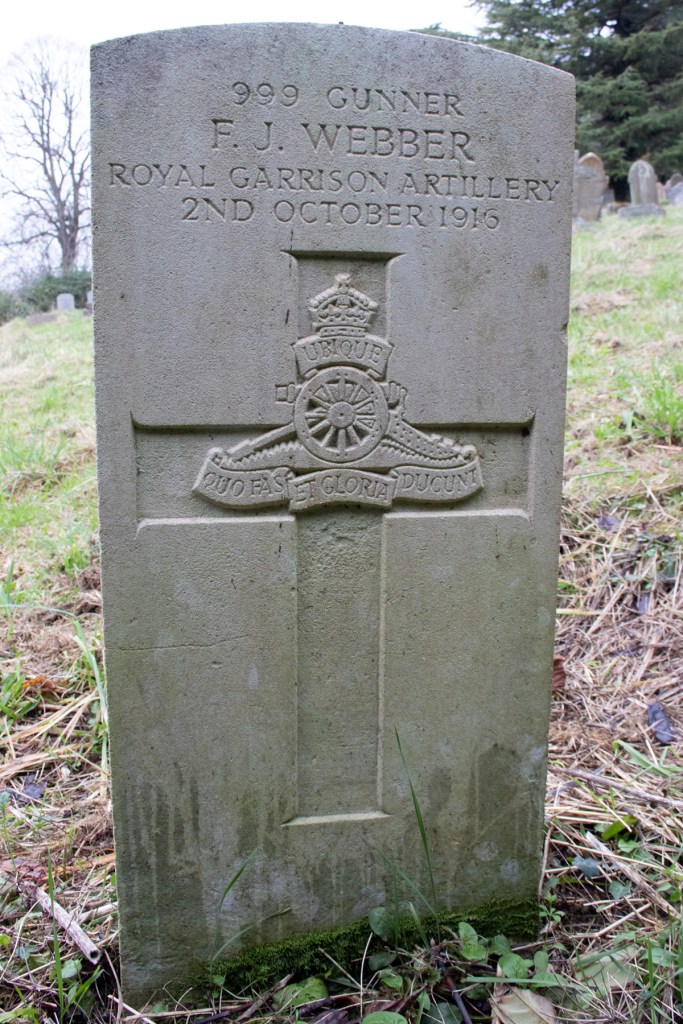
Full details of Frederick’s military service are not available, but it is clear that he joined the Royal Garrison Artillery at some point in early 1916. Assigned to his adopted home county of Cornwall, he nevertheless needed training, and, for this, he was sent to the B Battery of the 1st Anti-Aircraft Brigade in the North East.

It was while here, that Gunner Webber contracted endocarditis. He was admitted to the Jeffery Hall Hospital in Sunderland, but the condition got the better of him, and he passed away on 2nd October 1916, aged just 26 years old.

Frederick James Webber was brought back to Devon for burial. He was laid to rest in graveyard of St Mary’s Church in Wolborough, where his father and family still lived.


Private Everett Ferriday

Private Everett Ferriday

Everett Ferriday was born in February 1899 in the Cornish town of Camborne. The second of four children, his parents were Methodist minister Jonah Ferriday and his wife, Elizabeth. Jonah’s calling took the family around the country, and, by the time of the 1911 census, they had settled in Frome, Somerset.

When Everett left school, he found employment at a motorcycle works in Bristol, and left home to move to the city. War was coming to Europe, however, and things were soon to change.

Everett got the call to join up in January 1917, just shy of his eighteenth birthday. His enlistment papers give his height as 5ft 11ins (1.8m) tall, and confirm that he weighed in at 126lbs (57.2kg). They also confirmed that he had found new employment as an insurance agent.

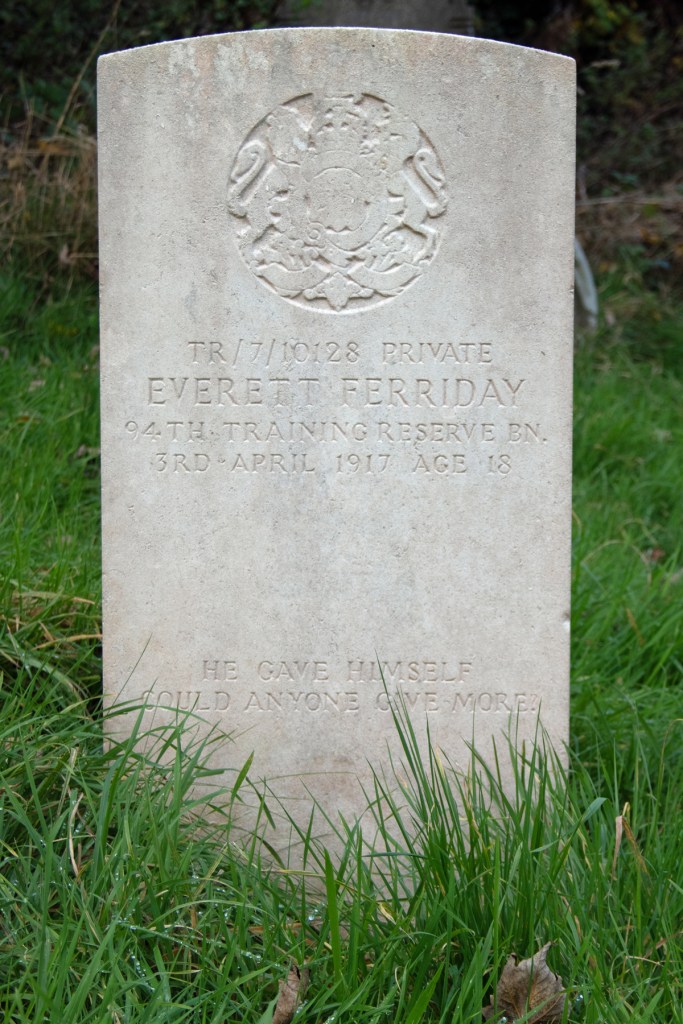
Private Ferriday was assigned to the 94th Training Reserve Battalion and sent to the army camp at Chiseldon, near Swindon at the beginning of March. Tragically, within a matter of weeks, he was admitted to the camp hospital with bronchial pneumonia. Sadly, this was too much for his body to take; he died at the hospital on 3rd April 1917, at just eighteen years old.

Everett Ferriday’s body was brought back to Frome; he was laid to rest in the Vallis Road Cemetery in the town.


Everett was not the only Somerset soldier to succumb to pneumonia at Chiseldon Camp that spring. Private Charles Oborne, died from the same condition a few weeks before him. Private Ivan Day, of the 93rd Training Battalion, passed away in the same hospital on the same day as Everett, also from pneumonia.

You can read their stories by following the links above.