Category Archives: Gloucestershire

Gunner Stanley Parry

Gunner Stanley Parry

Stanley William Parry was born in the spring of 1890 in St George’s on the outskirts of Bristol, Gloucestershire. One of four children to Herbert and Susannah Parry, Stanley was a twin to brother Roland. Herbert was a commercial clerk for a chemical manufacturer, and this afforded the Parry boys a level of education, with both Roland and Stanley attended the Colston Endowed School in Bristol.

Tragically, Susannah had died when Stanley and Roland were just 3 years old: their younger brother, Wilfred, had died the year before, when just a babe-in-arms. By the time of the 1911 census, Herbert had moved the family to Portishead. He was still working as a clerk, while both of the twins were employed as insurance clerks. Their older brother, Edwin, was also a clerk, in the docks at Bristol, and Herbert had employed a live-in housekeeper, Mary Govier, to look after him and his sons.

When war came to Europe, both Stanley and Roland enlisted. The two of them joined the Royal Field Artillery as Gunners. While full service records are not available, Stanley was assigned to the 40th Trench Mortar Battery, while Roland became attached to A Battery of the 240th Brigade.

Stanley was serving in France in the summer of 1916, when he became ill.

The funeral took place on Saturday afternoon, at Portishead Cemetery, of Gunner Stanley Wm Parry, who… died at Mile End Hospital, London, on September 19th. The deceased, who was 27 years of age, was always somewhat delicate in health, but was anxious to serve his King and country, and joined the [Royal Field Artillery]. He was brought to London from France on the previous Saturday suffering from enteritis, and although he lived until his father reached him, he died shortly after. He was the third son of Mr HC Parry… whose two other sons are also serving, one in France and the other in Egypt.

Bristol Times and Mirror: Monday 25th September 1916

Gunner Stanley William Parry was laid to rest in Portishead Cemetery, just a short distance from the family home.


Gunner Stanley Parry
(from findagrave.com)

Roland continued to serve his country in France, but tragedy was to strike the family once more.

Mr HC Parry… has received the sad intelligence that his son, Rowland G Parry [sic], of the [Royal Field Artillery], was killed in action on the 17th September. A letter from deceased’s officer stated that Gunner Parry was returning to the battery when a shell burst on the track, killing deceased instantaneously, death being absolutely painless. The letter further states that Gunner Parry had been a very valuable member of the battery, and will be missed by them all. Gunner Parry was the second of Mr Parry’s three sons to lay down his life in the great fight, a twin brother having died in a military hospital in London last year. The other son, the eldest, is serving in Palestine.

Bristol Times and Mirror: Saturday 29th September 1917

Roland George Parry was 28 years of age when he died. He was laid to rest in the Vlamertinghe New Military Semetery, in Ypres.
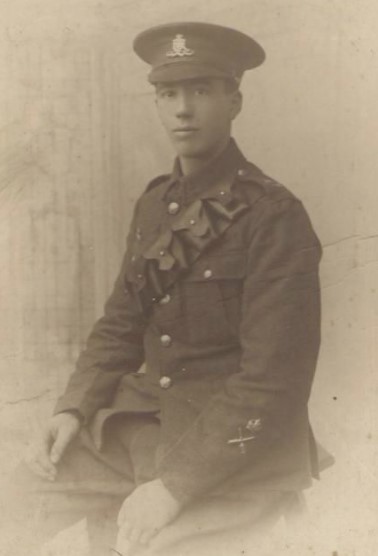
Gunner Roland Parry
(from findgrave.com)

Herbert Parry passed away in the summer of 1920, at the age of 62. He had outlived three of his sons, as well as being a widower for 27 years. He was laid to rest in Portishead Cemetery with his son Stanley.

Edwin Parry, Stanley and Roland’s older brother, had returned from the First World War by the summer of 1919. He resumed his work as a clerk at the docks in Bristol, and married schoolteacher Annie Homewood in August 1919. They went on to have three children, Barbara, Gwladys and Roland. Edwin died in September 1959, at the age of 71 years old.


Private Edward Davies

Private E Davies

In a quiet corner of Portishead Cemetery, Somerset, is the grave of Private EG Davies. His headstone confirms that he was in the Duke of Cornwall’s Light Infantry, give the date of his death – 23rd March 1919 – and his age when he passed – 40 years old. The Commonwealth War Graves Commission website confirms that Private Davies transferred to the Labour Corps, but only a couple of documents remain from his time in the army.

The soldier’s pension records confirm that his full name was Edward George Davies, and that, at the time of his death, he was living with his ‘unofficial wife’, Minnie Louisa Holbrook. The records also give the cause of death: influenza and septic bronchitis.

Minnie Louisa Fido was born in the spring of 1874 in Bedminster, Bristol, one of thirteen children to farmworker David Fido and his wife, Sarah. She married Arthur Holbrook on 28th April 1895, and had Gertrude four months later.

The Somerset School Register from 1906 notes that Gertrude Fido joined the Church of England School in Weston-in-Gordano on 12th February. It gives her mother’s name as Minnie Fido, but doesn’t give a father’s name. It seems that Gertrude left the school in November 1914, as she had found work.

A search of the 1911 census records shows Edward and Minnie (whose surname is now given as Davies), living in George Street, Portishead. Edward is listed as a wagoner on a farm, and that he was born in Gloucestershire. Minnie is noted as a charwoman from Nailsea, Somerset. Making up the household is Gertrude, noted as being Edward’s stepdaughter, and who was working as a domestic servant.

Edward’s history is more of a challenge to piece together. His name is too common to be able to single him out on census records, and, while the 1911 census suggests he and Minnie had been married for eight years, there is no marriage record to shed any further light on his family. (This is not surprising, given that his army pension documents suggest Minnie was his unofficial wife.)

Most of Edward’s life, therefore, is destined to remain lost to time. Minnie did not marry, or co-habit, again, and she passed away on Christmas Day 1949, at the age of 75 years old. Gertrude looks to have married a man called Bessant. The 1939 England and Wales Register recorded her living in the Portishead area, and working as a supervisor in a boot factory. She was living with her maternal uncle, Herbert Fido, but was noted as being the head of the household. She died early in 1967 in Weston-super-Mare.


Private James Savory

Private James Savory

James Henry Savory was born in Gloucester in the spring of 1872. An only child, his parents were Frederick and Sophia Savory. Frederick was innkeeper of the town’s Bell Inn, but things seemed to go wrong for the family as time passed.

Both Frederick and James disappear from the 1891 census return, while Sophia is recorded as being an inmate in the Bristol City Workhouse. She was still there ten years later, although whether she had been there for the full decade is unclear.

James, by this point, had found employment as a travelling labourer. By the autumn of 1891, he had met Edith Morgan, a butcher’s daughter from Bristol. The couple married on 16th May 1892, four days before Edith gave birth to their first child, a daughter they called Eleanor. The couple set up home in Bedminster, James finding work as a foreman at the local marble works. He and Edith went on to have four children in all.

James was drawn to piecemeal work: by the time of the 1911 census, the family had moved to Portishead, Somerset, and he was employed as an ironmonger. His son, James Jr, was apprenticed in the same line of work, and the family had a relative, 71-year-old printer William Badger, boarding with them to bring in a little extra money.

What war came to Europe, James stepped up to play his part. Full records are not available for him, but he certainly enlisted in the army. Based on his age – he was 42 years old when the conflict began – it seems likely that he either volunteered for service, or that he was called up later in the war.

Private Savory was attached to the 19th Battalion of the Hampshire Regiment. Whether he service on home soil or overseas is unclear, but he survived through to the end of the war, and had returned home by the start of 1919.

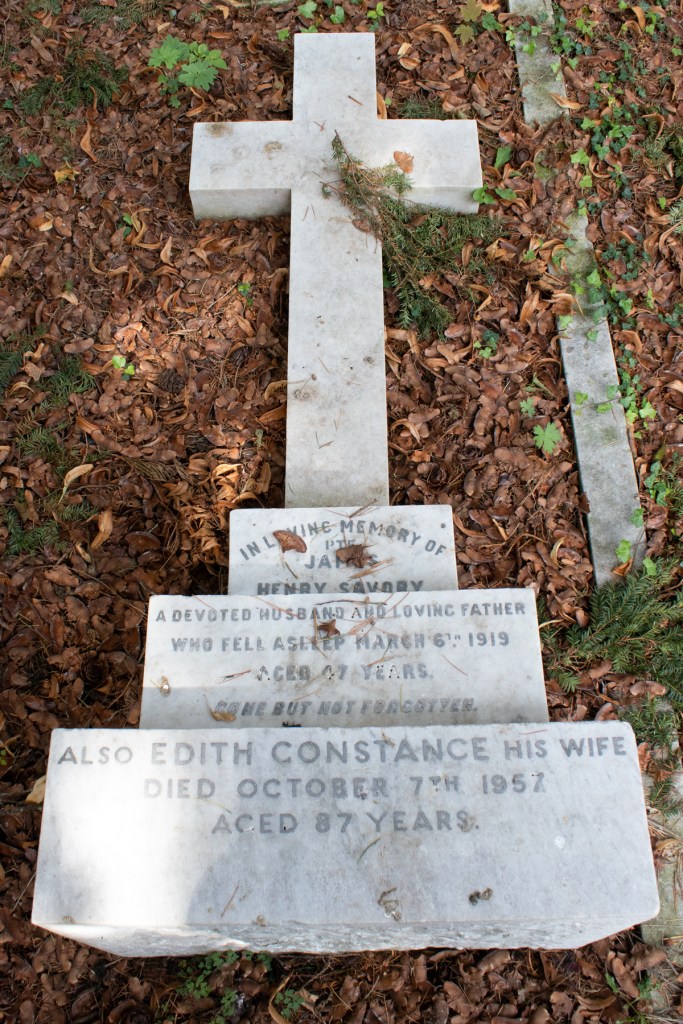
James Henry Savory died on 6th March 1919: he was 46 years of age. He was laid to rest in Portishead Cemetery, not far from where his widow still lived. Edith lived on until October 1957: she was laid to rest with her late husband, reunited after nearly forty years.


Private Godfrey Beames

Private Godfrey Beames

Godfrey George Beames was born in the spring of 1891, in Henbury, Gloucestershire. One of eleven children, his parents were Thomas and Minnie Beames. Thomas was in the navy, which meant that Minnie was left to her own devices a lot of the time. While her husband came home often enough for them to build a large family, the 1891 and 1901 censuses record Minnie and the children living with her farm labourer brother-in-law, George Watkins.

The 1911 census gives the same information for Minnie and the children – living with George in Redwick, Gloucestershire. Minnie is, however, noted as a widow, although this seems to be out of convenience, as the now naval pensioner Thomas was living with his wife of eight years, Louisa, in Arundel, West Sussex.

Godfrey, now 21 years old, was working as a farm labourer. In the autumn of 1913, he married a woman called Lily Ball, although little information about her remains today. War was coming to Europe, and things were to change for the young couple.

Godfrey stepped up to play his part. While his full service records no longer exist, what remains paints a picture of his time in the army. He had enlisted by the spring of 1917, joining the Royal Engineers. At some point, however, he moved to the Worcestershire Regiment, and was assigned to the 10th (Service) Battalion.

While it’s not possible to determine exactly where Private Beames fought, he was definitely caught up in the fighting on the Western Front and, by October 1917, was entrenched at Passchendaele. It was here that he was wounded, and he was medically evacuated to Britain for treatment.

Private Beames was admitted to the General Hospital in Nottingham, but his injuries were to prove too severe. He died on 15th November 1917, at the age of just 26 years old.

Godfrey George Beames’ body was brought back to Somerset for burial. He was laid to rest in the graveyard of Ss Mary and Peter’s Church in Winford, where Lily was now living.


Private Godfrey Beames
(from ancestry.co.uk)

Sapper Abraham Scott

Sapper Abraham Scott

Abraham James Scott was born in Bathford, Somerset, in the spring of 1893. He was one of fourteen children to Abraham and Lucy Scott, and became known as James, to avoid any confusion with his father. Abraham was a shepherd, who travelled where work took him: both he and Lucy were from Wiltshire, but had moved to Somerset by the end of the 1880s. When James was just a babe-in-arms, the family had relocated to Gloucestershire, but by the time of the 1901 census, they were back in Wiltshire once more.

Abraham Sr died in 1910, at the age of just 41 years old. The following year’s census found the now widowed Lucy living in North Wraxhall, Wiltshire, with eight of her children. Abraham Jr is absent, and, indeed, does not appear on any of the 1911 censuses.

Lucy needed options and, on Christmas Day 1912, she married carter William Amblin in the village church. Abraham was, by this time, living in Bath and working as a carter.

When war came to Europe, Abraham felt the need to step up and play his part and, on 15th December 1915, he enlisted in the army. His service records show that he was 5ft 5ins (1.65m) tall and weighed 132lbs (59.9kg). He had a vaccination mark on his left arm which, according to the document’s section on ‘distinctive marks’, has a tendency to rupture.

Private Scott was mobilised in March 1916, and was assigned to the 1st/5th Gloucestershire Regiment. He soon found himself on the Western Front, and, having transferred to the 1st/4th Battalion, served at the Somme.

Abraham was in for a chequered time in Northern France. On 26th August 1916, he was injured when he received a gunshot wound to his scalp. He was admitted to the 1st Canadian General Hospital in Etaples, the moved to Rouen to recuperate. Private Scott rejoined his unit on 21st October 1916.

Just weeks later, however, Abraham was back in a hospital in Rouen, having fractured his ankle. After a couple of weeks in the 1st Australian General Hospital, the injury was deemed severe enough for him to be evacuated back to Britain for recuperation, and he was posted to Ballyvonare Camp in County Cork. Abraham returned to his unit in France in September 1917, nine months after his ankle injury.

On 1st March 1918, Abraham transferred to the Royal Engineers where, as a Sapper, he was attached to the Depot in Rouen. He remained there for more than a year, during which time he was admitted to hospital once more, this time with trench fever. Little additional information is available about this spell in hospital, other than that Lucy had written to the regiment thanking them for informing her of her son’s illness, and confirming a new address for her.

Sapper Scott’s health continued to suffer, however. In May 1919, he was admitted to a camp hospital, suffering from appendicitis. He was operated on, and medically evacuated to Britain for further treatment and recuperation. Abraham was admitted to the Bath War Hospital on 25th July 1919, and remained there for four months.

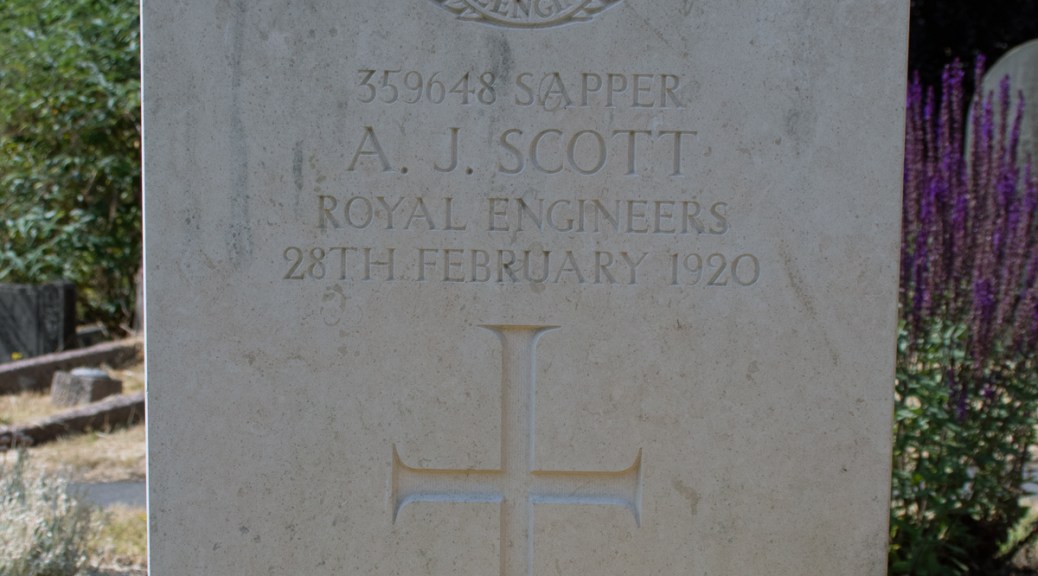
Abraham’s health seemed to improve, albeit slowly, and he was moved to the Pension’s Hospital in Bath on 27th November. The head wound, broken ankle and bout of trench fever appear to have taken their toll on his body which, by this point, seems to have been too weak to recover. On 28th February 1920, two months after being transferred to the Pension’s Hospital, he passed away there from a combination of appendicitis and pelvic cellulitis. He was just 26 years of age.

Abraham James Scott’s body did not have to travel far after this point. He was laid to rest in the sprawling Locksbrook Cemetery in his adopted home city of Bath.


Private James Pyatt

Private James Pyatt

James Douglas John Pyatt was born in the spring of 1881 in Tranmere, Cheshire. The older of two children, his parents were Somerset-born John and Clara Pyatt. John was a coal merchant, and, by the time of the 1901 census, the family had moved back south, settling in the Clifton area of Bristol.

According to that census record, the family were living at 33 Pembroke Road, which Clara ran as a boarding house. James, by this point, was employed as a butcher, while his younger brother, Hubert, was a grocer. At the time the census was taken, the family had two boarders: Emmeline Blake, who was a music teacher, and Archibald Archer, a dentist.

Happiness is Bristol was destined to be short-lived. John died in 1902, aged just 49 years old. The same year, Hubert emigrated to Canada, settling in Brandon, Manitoba. Clara and James both followed the following year, setting up home in the same town.

Clara died in December 1908, but not before seeing both of her sons marry, James to Edith Gillam in June 1907, and Hubert to Lilian Pearce twelve months later.

James was working as a shipping clerk for a brewery by this point, and he and Edith were living on Park Street, to the east of the city. This was an ideal spot for their young family – John, born in 1908, Sidney, born in 1912, and Dennis, born in 1914 – as it overlooked a park and had space around it. Hubert lived down the road with his own family, so the brothers still had each other close by.

When war came to Europe, James felt compelled to play his part for King and Empire. He enlisted in the Canadian Expeditionary Force on 7th July 1915. Private Pyatt’s service records confirm that he was 33 years of age, and stood 5ft 10ins tall. He was noted as having brown hair, brown eyes and an average complexion.

James arrived back in England on 25th March 1916. Once there, he was attached to the 44th Battalion of the Canadian Infantry and by August that year, he was stationed on the Western Front. That autumn, however, he was dogged by illness and was admitted to field hospitals four times, suffering from diarrhoea, myalgia twice, and laryngitis.

By the start of 1917, however, Private Pyatt was back to full fitness. Details of his service over the next couple of years are unclear, although he remained on the Front Line. In December 1918, James was back in England on leave, and had returned to Somerset, possibly to see friends or relatives.

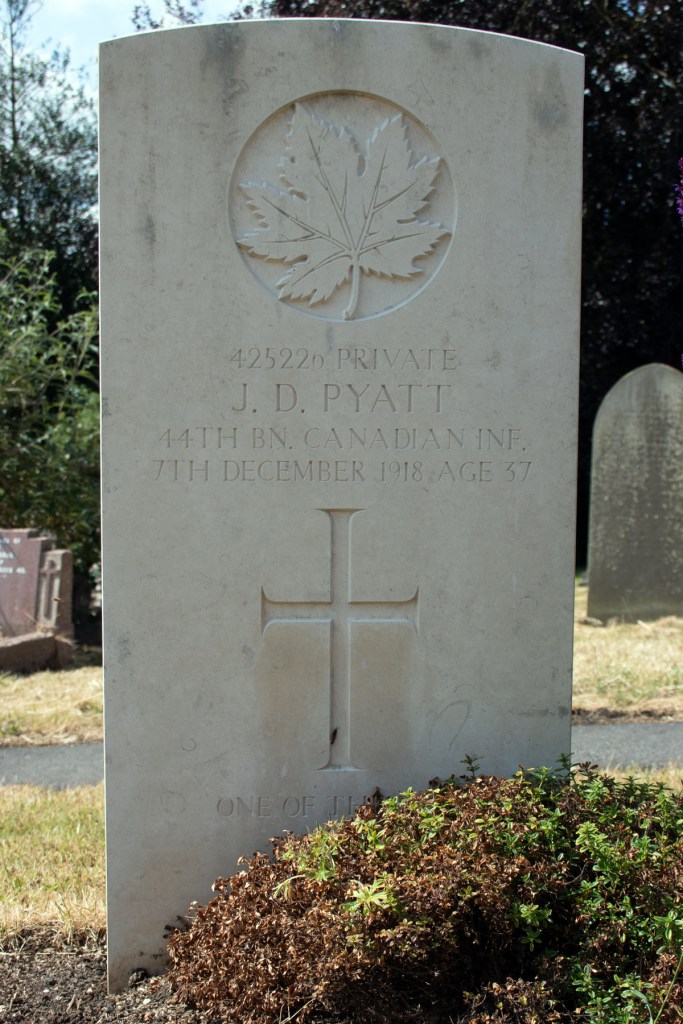
While here, James contracted influenza, and was admitted to the Bath War Hospital. The condition was to get the better of him, however, and he died on 7th December 1918, days after going in. He was 37 years of age.

With his surviving immediate family all in Canada, James Douglas John Pyatt was laid to rest in Locksbrook Cemetery, Bath, not far from the hospital in which he had passed away.


Sapper Frank Gilbert

Sapper Frank Gilbert

On Monday the body of a man was found.. neat Newton Bridge, commonly known as the “Skew” Bridge, having been killed by a passing train… The deceased was Frank Gilbert…

The inquest was held at the Globe Inn, Newton… by the Coroner for North Somerset (Dr S Craddock), who sat without a jury.

The first witness… said the previous morning he was walking along the railway when he saw the body of a man lying on the down side. The head was separated from the body…

PC Cornish said he found four cards in the pockets of the deceased’s coat. Two were National Insurance cards, and there was an unemployment book, the last payment being dated 15-8-21.

Written on the blotting paper of the book was the following:

“It is quite dark. You still take you neck oil, and my children outside waiting. Marry the man who gave you the watch. Don’t forget to have an extra one (Guinness) over my parting. It would be murder if I ever lived with you again.”

The man’s name, “Frank Gilbert, 44 Jubilee Road, Aberdare,” was on some of the cards. Deceased was wearing a discharged soldier’s badge.

Sarah Kate Gilbert, wife of the deceased, who lives at Bristol, said she had not known her husband’s address at Aberdare. They had been living apart since he went into the Army in 1915. She had, however, met him since that date.

Witness added that she saw him on Sunday night, and went on to say that she took out a summons for a maintenance order against him last February at Gloucester. He was then working as a carpenter in Cheltenham.

The Coroner: ‘Have you ever heard him threaten to commit suicide?’

‘Yes, sir.’ She added that he did so on Sunday night when she was with him at the bottom of Park Lane, Bath. “He was always threatening me when we lived together,” she stated, and also said she had a separation order in Bath in 1913. She had a letter from him on Saturday morning in which he said that when she got the letter he would be gone. In the letter was enclosed the ticket for his suit-case, and the key.

[The letter read] “I would never dream of making a home for you as you are worth only the Gloucester man. You have ruined my life, and you will be able to sleep with… for always now. I shall be gone.”

Witness said there was no reason for him to have made any such statements, as she had had nothing to do with any man except him. He was always using threats. When she left him on Sunday night she told him to try and get on and pull himself together.

The Coroner recorded a verdict that deceased committed suicide by placing himself in front of a passing train on the Midland Railway.

Somerset Guardian and Radstock Observer: Friday 2nd September 1921

Little additional concrete information is available for Frank Gilbert’s life. No marriage certificate remains for his wedding to Sarah, nor is there any evidence for the couple in the 1911 census.

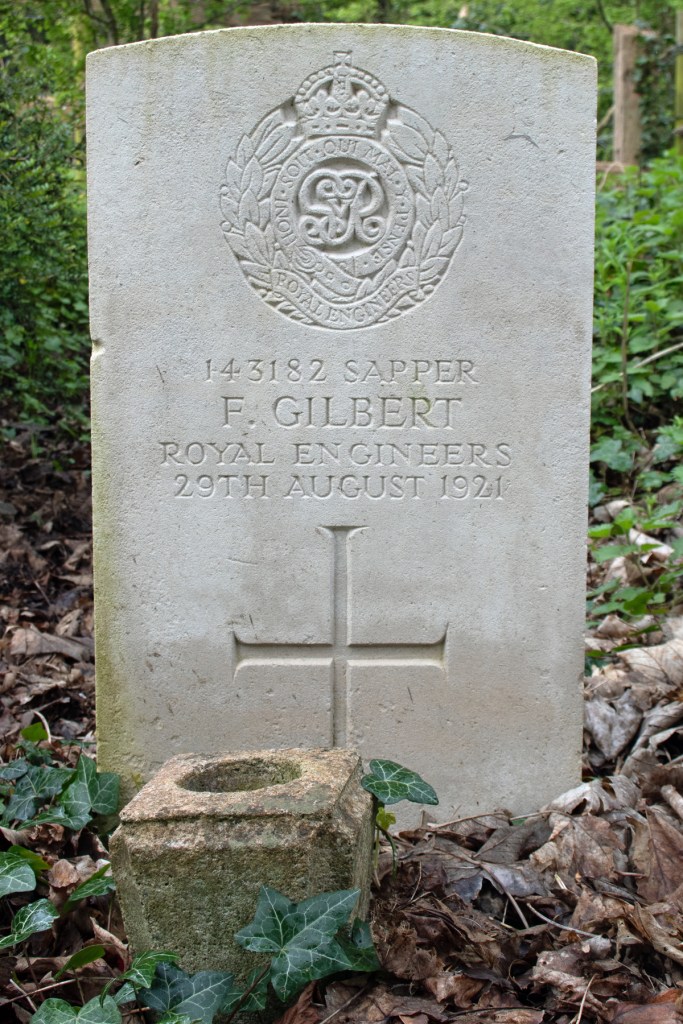
Frank’s service records no longer exist in their entirety, although his pension record give hints as to his service. He enlisted in the Royal Engineers as a Sapper on 20th November 1915, although he never saw any action overseas. He was medically discharged because of rheumatism on 11th November 1917. The document confirm he was born in 1883, and lived in Cheltenham after his discharge.

An additional newspaper report of the inquest confirmed that Sarah had two children, and that they lived with her parents in Bath. When asked by the Coroner if she intended to bury her husband’s remains, she replied that “she had no money to do it with.” [Bath Chronicle and Weekly Gazette: Saturday 3rd September 1921]

And so Frank Gilbert was laid to rest in the quiet graveyard of Holy Trinity Church in Newton St Loe, near Bath in Somerset. He was around 38 years of age when he took his life.


Serjeant Major Frederick Pearce

Serjeant Major Frederick Pearce

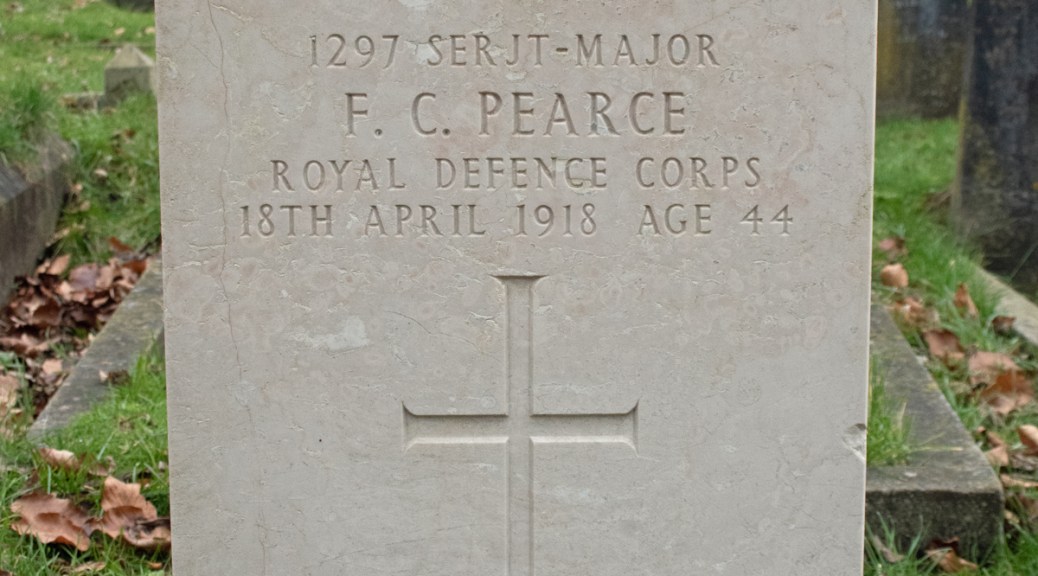
Frederick Charles Pearce was born in the spring of 1873 in the Gloucestershire town of Thornbury. The youngest of six children, his parents were Thomas and Elizabeth Pearce. Thomas was an agricultural labourer and, when he finished school, Frederick found work as a ‘rural messenger’.

This was only a step towards the career that Frederick sought, however, and on 12th July 1892, he enlisted in the Gloucestershire Regiment a a Private. His service records show that he was 5ft 5ins (1.65m) tall and weighed 128lbs (58kg). He was noted as having a fresh complexion, blue eyes and brown hair.

Private Pearce spent twelve years in the army, serving in Malta, Egypt, India and Ceylon (Sri Lanka). He had two stints in South Africa, including the 1899-1900 campaign, during which he was wounded in his chest in the battle at Farquhar’s Farm.

By the time he was discharged on 11th July 1904, he had risen through the ranks to Sergeant, his service records noting that his conduct had been “very good” (in capitals and underlined).

Thomas had died in 1896, and Frederick’s widowed brother William moved back in with his mother to help support her. Frederick also returned to Gloucestershire and, on 30th March 1905, he married Mary Rugman in the parish church in Olveston. The couple may have been childhood sweethearts, as the Pearces and Rugmans were Thornbury neighbours.

The marriage certificate noted Frederick as a groom, and it is likely that he was able to turn his hand to any role after his army career. The couple had a son Leslie, who was born in 1909, and, with the new responsibility of fatherhood, Frederick sought a more permanent career.

The 1911 census found the family living in Somerset, where Frederick was employed as a gardener at the Kingswood Reformatory School. This was a boarding school on an estate to the north of Bath, set in 57 acres of grounds, and again it seems likely that his military career stood him in good stead for such a prestigious role.

When war came to Europe, Frederick felt the pull of his military career once more. While his age did not compel it, on 20th November 1914, he re-enlisted in the Gloucester Regiment. He was enlisted with his previous rank, but within a year has been promoted to Acting Colour Sergeant.

In the spring of 1916, the Royal Defence Corps was formed, and, given his experience and age, Frederick was transferred across to the new regiment. Colour Sergeant Pearce was based in London and, over the next eighteen months served in four troops: 109, 149 and 150 Protection Companies and the 10th City of London Volunteers’ Regiment.

Frederick’s age and the demands of his role were beginning to take their toll by this point, and by the end of 1917, he had developed nephritis, or inflamed kidneys. The condition was severe enough to warrant his discharge from service, and the now Sergeant Major Pearce’s military career came to an end on 17th January 1918.

Frederick returned home to Bath, to the bosom of his family. He and Mary three children by this point, Violet and Freddie being two younger siblings to Leslie. Tragically for the Pearces, however, the family life was not to to last for long: Frederick’s condition was to get the better of him just three months later. He passed away on 18th April 1918, at the age of 44 years old.

Frederick Charles Pearce was laid to rest in St James’ Cemetery in Bath; a man of duty resting at last.


Tragedy was to strike again for poor Mary, when just six months later her youngest child, Freddie, also passed away. Details of his death are vague, but he was buried with his father, the two Fredericks reunited too soon.


Private Henry Wheeler

Private Henry Wheeler

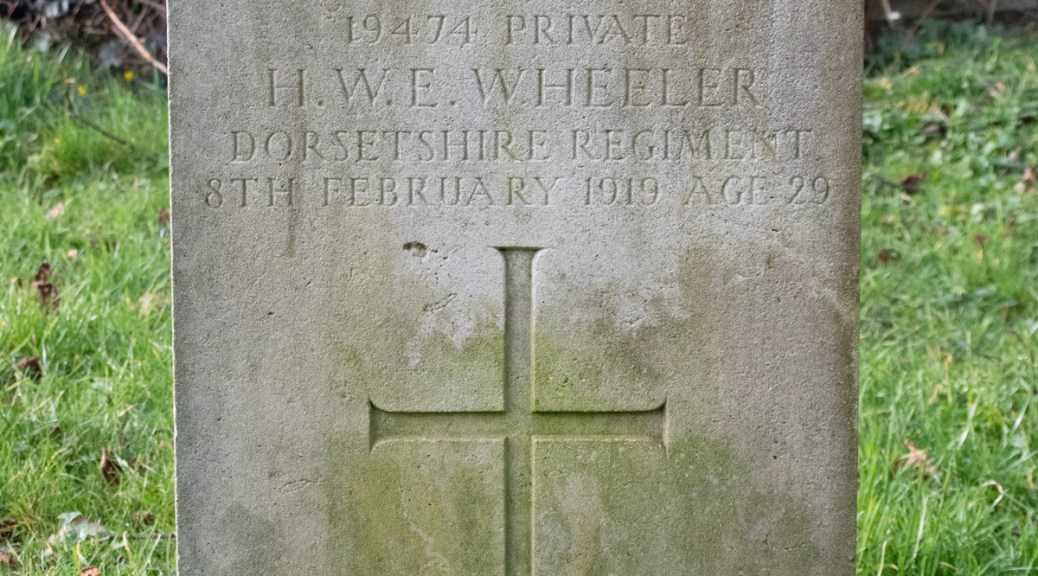
Henry William Edward Wheeler was born in early 1890, the fifth of thirteen children – and the oldest son – to Henry and Anne Wheeler. Henry Sr was a labourer from Witham Friary in Somerset, and this is where the family were born and raised.

When he left school, young Henry – who became known as Harry to avoid confusion with his father – found work as a postman. When war broke out, however, he enlisted as a Private in the Somerset Light Infantry. Full details of his military service are unclear, but his marriage certificate confirms that he was a soldier by the spring of 1915.

Harry’s wedding was to a woman called Mabel Hulbert, who was working as a domestic servant in Wotton-under-Edge, Gloucestershire. It was in the village’s church that the couple exchanged vows, and within a matter of weeks, Private Wheeler was sent to France.

Harry’s troop – the 1st Battalion – was involved in some of the fiercest fighting of the war, and it is likely that he was involved at The Somme in July 1916. At some point, though, he moved across to the 5th (Service) Battalion of the Dorsetshire Regiment, who had moved to France, having been fighting at Gallipoli. The specifics of Private Wheeler’s time in the army are, however, destined to be lost to time.

Private Wheeler’s trail can be picked up again after the end of the war, presumably when he had returned to Britain prior to being demobbed. Sadly, however, he was admitted to a military hospital in Wilton, Wiltshire, suffering from ‘disease’. He passed away on 8th February 1919, at the age of 29 years old.

The body of Henry William Edward Wheeler was brought back to Somerset for burial. He was laid to rest in the quiet graveyard of St Mary’s Church in his home village of Witham Friary.


Henry’s younger brother, John, also served in the First World War. He enlisted in the 8th (Service) Battalion of the Somerset Light Infantry, and arrived in France on 4th October 1915, just a couple of months after his older brother.

John was killed in fighting on 11th October 1917 – possibly as part of the opening salvos of the Battle of Passchendaele – and was just 20 years old. He was laid to rest in the Outtersteene Communal Cemetery in northern France.


Private John Maguire

Private John Maguire

John Maguire was born in Dublin, Ireland, in 1874. There is scant information about his life, and his name is too common to be able to narrow down details of his family.

The only documentation that links to his life is that of his army service. He was working as a labourer when he enlisted in the Royal Army Medical Corps on 27th April 1918. His service records confirm he was 5ft 7ins (1.7m) tall, with blue eyes, grey hair and a sallow complexion. Interestingly, he reported that he did not have any next-of-kin.

Private Maguire seemed to serve on home soil, and was primarily based in Lancashire. It was while here in the January of 1919 that he fell ill with nephritis – kidney disease – and was admitted to the hospital on Adelaide Street, Blackpool.

His condition was such that it led to John’s discharge from military service on medical grounds. On 23rd February he was moved to the 2nd Southern General Hospital in Bristol, and two days later he left army life. John was transferred to the War Hospital in Bath a couple of weeks later, and it was here that he passed away on 16th April 1919. He was 45 years of age.

An addition to John’s initial service records noted that a next-of-kin had been confirmed, and so Mary Prestige, who was living in Bedminster, to the south of Bristol, was informer of her friend’s death.

Respecting the Irishman’s religion, John Maguire was laid to rest in the Roman Catholic Cemetery in Bath, the city in which he died.


John’s friend, Mary Prestige, is also destined to remain a mystery. There are no records of her at the address John’s service records provide – Pipe Cottage, North Street, Bedminster.

There are two census records for Somerset for a Mary Prestige: 1901 records a Durham-born 18 year old Mary working as one of a number of laundry maids at the Marlborough Hill House of Refuge in Bristol.

The 1911 census records the same Mary Prestige visiting a William and Amelia Hockerday in Yatton, Somerset. It is impossible to confirm, however, whether this is the woman John notified the army as his next of kin.