Herbert Lee was born in the Herefordshire village of Dilwyn on 16th August 1896. The sixth of eight children, he was one of five sons to Charles and Frances Lee. Charles was a waggoner on a local farm and, when he finished his schooling, his son found work as a farm hand there.
When war broke out, Herbert was quick to step up and play his part. He enlisted in the Royal Navy on 14th October 1914, taking on the role of Stoker 2nd Class. His service papers show that he was 5ft 4.5ins (1.64m) tall, with brown hair, blue eyes and a fresh complexion.
Stoker Lee was sent to the Royal Naval Dockyard in Chatham, Kent – also known as HMS Pembroke – for his training. Over the next five years, he seems to have been mainly shore-based, transferring between units in Chatham and at HMS Victory, the navy dockyard in Portsmouth, Hampshire. In August 1915, he was promoted to Stoker 1st Class, and his records note a very good character with a superior ability.
Herbert survived the war and, by the start of 1919, he was back in Chatham. He had fallen ill by this point, and, having contracted the highly contagious tuberculosis, he was medically discharged from navy service on 19th March 1919.
Herbert Lee battled his condition bravely, but would ultimately succumb to it. He passed away on 8th October 1920, at the age of 24 years old. He was laid to rest in the tranquil surrounds of St Mary’s Churchyard in his home village of Dilwyn.
Walter James Ricketts was born in the summer of 1893, the fifth of ten children to James and Elizabeth (and, tragically, the first to survive childhood). James was a farm labourer from the Herefordshire village of Dilwyn, and this is where the family were born and raised.
When he completed his schooling, Walter found work as a groom. The 1911 census recorded him as living at the Moorhampton Hotel, seven miles (11km) to the south west of his home. His employer, Edith Pearman, is recorded as a hotel keeper and farrier, and he was one of two live-in staff.
Walter married Lucy Godwin in the spring of 1918. The oldest daughter of a clerk, she had been born in Lugwardine, near Hereford. By the time the couple married, Walter had enlisted in the army, and was serving in the Royal Field Artillery.
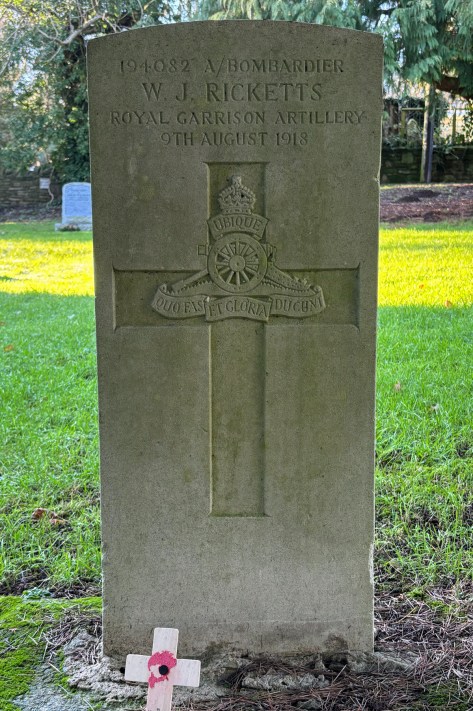
Full details of Gunner Ricketts’ service have been lost, but it is clear that he made the move to the Royal Garrison Artillery at some point. By the summer of 1918, the newly promoted Acting Bombardier was attached to the 57th Company, and based at a gun station in Dulwich, Surrey.
The only other record for Walter is his Pension Ledger card. This confirms that he died on 9th August 1918, following accidental contact with an electric current. There is no further information about the incident, but he was 25 years of age when he died.
The body of Walter James Ricketts was taken back to Herefordshire for burial. He was laid to rest in the tranquil setting of St Mary’s Churchyard in his home village, Dilwyn.
William Reginald Karslake was born in the spring of 1867 in the Surrey village of Westcott. The oldest of three children, his parents were William and Annie Karslake. William Sr was the vicar of the village’s Holy Trinity Church, and the family had a retinue of five servants to look after the household.
By the time of the 1891 census, the Karslakes had moved to Eastbourne in East Sussex. Their house, on the corner of Carlisle and Granville Roads, was a grand affair, and, while William Jr’s siblings, Henry and Mary, were 22 and 19 years old, there was still a live-in retinue of four staff to support them. William Jr is absent from this record, and he may well have been studying in Oxford at the time.
In the autumn of 1896, William Jr married Laura McKenzie. She was an admiral’s daughter who had been born in Glasgow, but their couple exchanged vows in Faringdon, Berkshire. The 1911 census found the family living in the 19-room Moorend Court in the Herefordshire village of Mathon. The couple had two children – Sam and Bridget – by this point and had a governess, parlourmaid, two housemaids, a kitchen maid and a cook to keep them in the right lifestyle.
The census recorded William’s employment as ‘formerly resident land agent’, which suggests he may have spent time overseas before marrying. His father had passed away by this point, and his brother Henry had taken up holy orders.
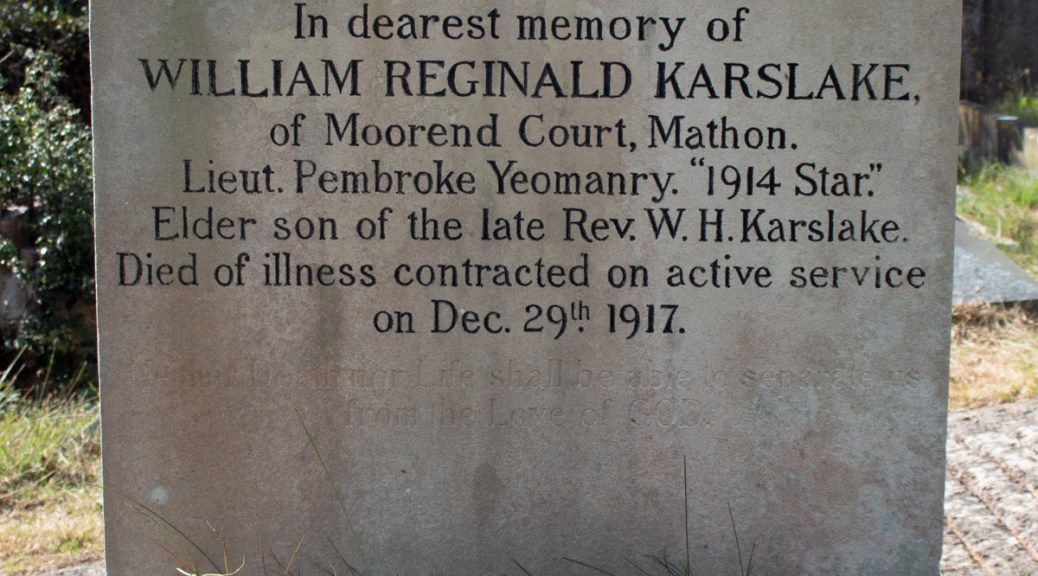
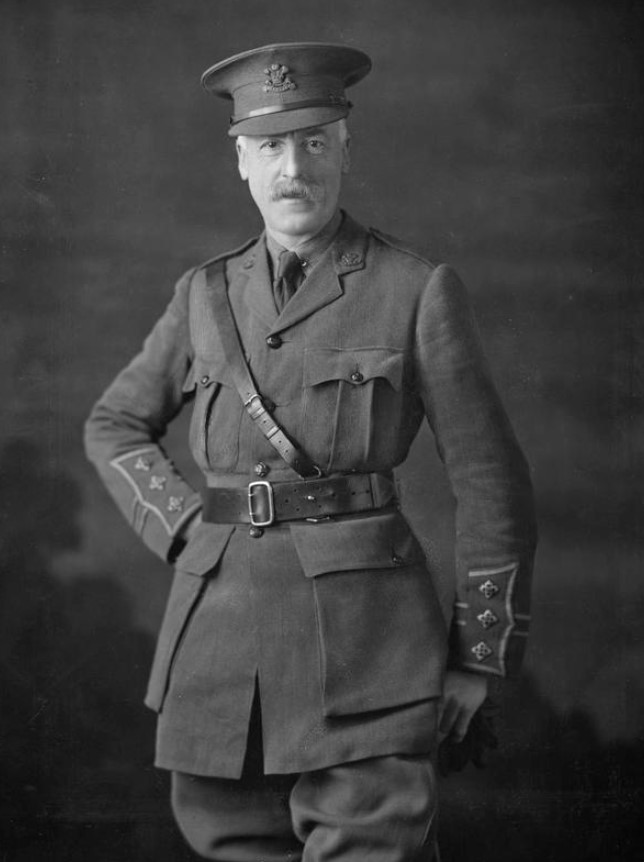
When war was declared, William was quick to volunteer his services. Initially acting as a driver for the British Red Cross, he found himself in France within weeks of the conflict starting. By January 1915, Lieutenant Karslake was moved to the Balkans, and at this point seems to have transferred to the Pembroke Yeomanry.
Little additional information is available to William. He passed away following an illness on 29th December 1917: he was 50 years of age.
It would seem that William Reginald Karslake was either hospitalised in Devon, or that there are additional family connections in the area. He was laid to rest in Paignton Cemetery, far from his substantial Herefordshire home.
James Frederick Hain was born on 5th November 1881 in the village of Holmer in Herefordshire. He was one of seven children to James and Catherine Hain, and was more commonly known as Fred. On James Jr’s birth certificate, his father was listed as a manure agent, although by the time of the 1891 census, the family had moved to London, where James Sr was now running a coffee house.
When he left school, James Jr started work as a French polisher, but he had a taste for adventure and joined the army. He served in South Africa during the Boer War campaign of 1899-1900, attaining the Cape Colony, Orange Free State and Transvaal Clasps.
In 1900 James returned home, finding work as a French polisher. The military life was in his blood by now, though, and in September, he re-enlisted. Initially joining the Royal Berkshire Regiment, he was soon transferred over to the Royal Engineers as a Sapper.
James had signed up for a period of eight years and, as part of his role as a wireman (maintaining and fitting telegraph cables), he was stationed abroad. On one particular trip, when his battalion was travelling from Plymouth to Limerick early in 1908, he was injured. According to the accident report: “owing to bad weather on boat between Fishguard and Waterford he was thrown violently forward, striking his head against a girder.” Treated in Limerick, “the disability is of a slight nature, and in all probability will not interfere with his future efficiency as a soldier.”
Sapper Hain’s time with the service was nearly up, and he was put on reserve status in November 1908. By 1911, he was working as a linesman, and boarding in a house in Hayle, Cornwall.
War was on the horizon by now, and on 5th August 1914, James was called back into service. He saw action on the Western Front, adding the Victory and British Medals and the 1915 Star to his count. In October 1915, he was treated for shell shock, and evacuated back to England.
At the beginning of 1917, Lance Corporal Hain was transferred back to the Army Reserve, suffering from neuritis. His health was to suffer for the rest of his life.
In September 1917, having settled in Cornwall, James married Beatrice Opie, an innkeeper’s daughter from the village of Wendron, Cornwall. The couple would go on to have a son, who they called Frederick, two years later.
Discharged from the Army, James put his engineering experience to good use, joining the General Post Office to work with telegraphs.
By this time, James’ medical condition had been formally diagnosed as General Paralysis of the Insane. A degenerative disease, similar to Alzheimer’s disease, it was associated with brisk reflexes and tremors (usually most obvious of the lips, tongue, and outstretched hands) and characterised by failing memory and general deterioration.
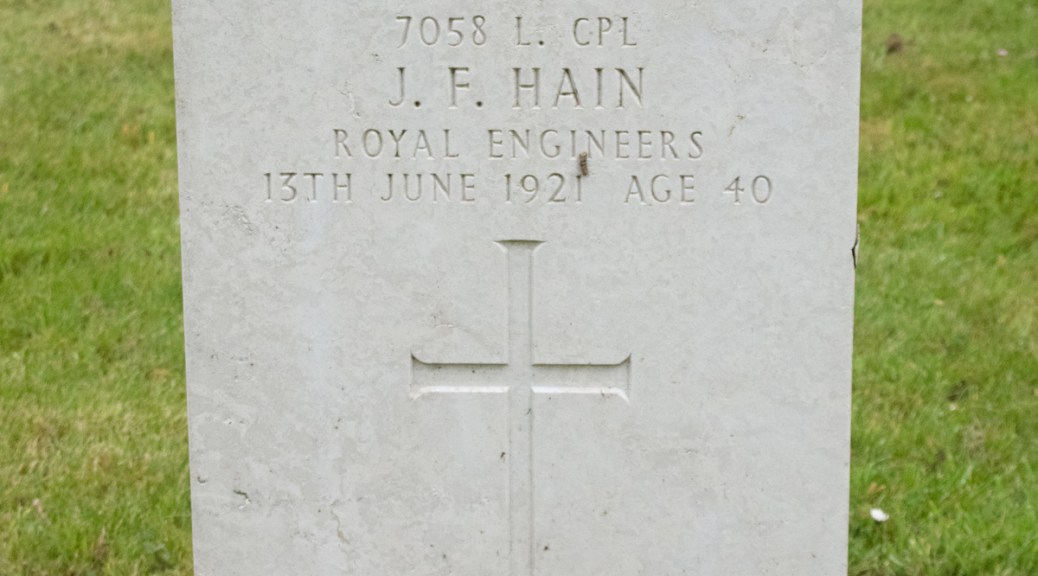
By August 1920, James was admitted to the Somerset and Bath Asylum in Cotford, because of his worsening condition. He was not to come out again, and passed away ten months later, on 13th June 1921. He was just 39 years old.
James Frederick Hain was buried in the St James’ Cemetery in Taunton, Somerset.





 Death and Service