Category Archives: Somerset

Private George Watts

Private George Watts

George Watts was born in the autumn of 1892, one of ten children to James and Caroline. The family were raised in Ottery St Mary, Devon, but by the time of the 1911 census, they had moved to Williton, Somerset, where James was running the Railway Hotel. At this point George is noted as being a grocer’s assistant.

Little further information is available for George. He courted a Withycombe farm labourer’s daughter called Ellen Gould, and the couple had a son together in 1917, but there is no evidence that the couple got married.

When war broke out, George stepped up to play his part. He listed in the Somerset Light Infantry and, while his service record has been lost to time, other evidence confirms that he had joined the 2nd/5th Battalion long before the conflict finished. Private Watts’ troop spent the conflict in India, although there is no evidence that he left Britain’s shores.

The next record for George shows that he was admitted to a military hospital in Devonport, Devon, suffering from nephritis, a form of kidney disease. Sadly, he was to succumb to the condition, and passed away on 22nd November 1919, at the age of 27 years old.

George Watts was taken back to Somerset for burial. He was laid to rest in the peaceful graveyard of St Decuman’s Church in Watchet, not far from where his family still lived.

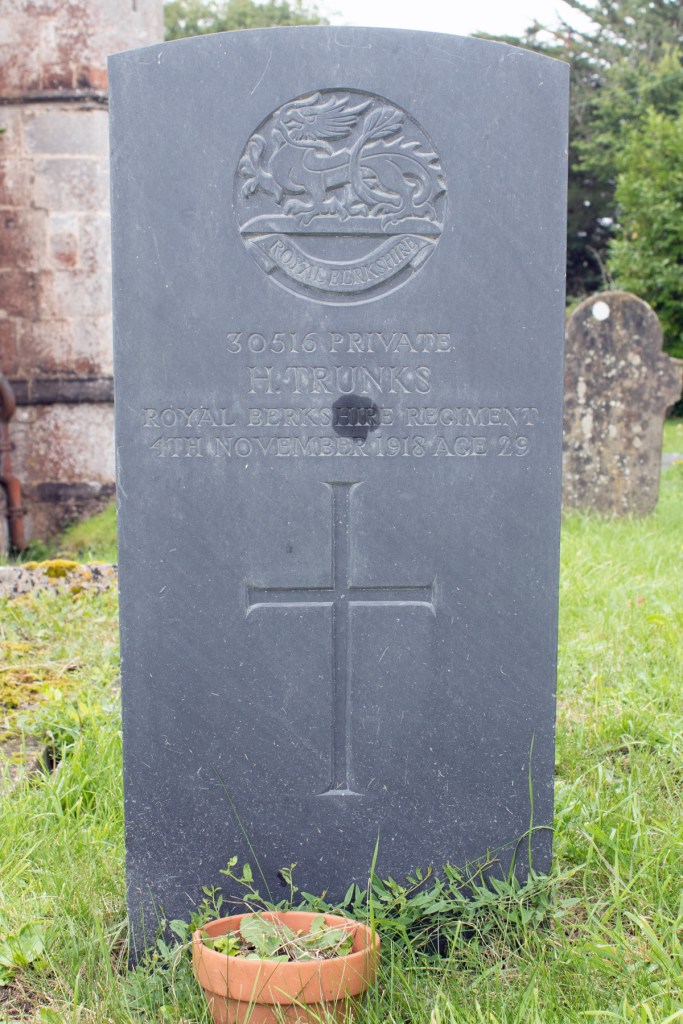
Private Herbert Trunks

Private Herbert Trunks

Herbert Henry Trunks was born in Williton, near Watchet, Somerset, in the spring of 1888. One of fourteen children, his parents were George and Rosa. George was a labourer in a timber yard, but when Herbert left school, he found work as a labourer in a paper mill.

On 10th June 1911, Herbert married Lily Sully at St Decuman’s Church in Watchet. Four years Herbert’s senior, she was a labourer’s daughter: the couple went on to have three children: Lilian, Henry and Dorothy.

Herbert was called up to serve his country on 5th June 1916. Assigned to the Royal Berkshire Regiment, his service records confirm that he was 5ft 9ins (1.75m) tall, and weighed 135lbs (61.2kg). He soon found himself in France, leaving for the continent on 20th September 1916.

Attached to the 13th Labour Battalion, Private Trunks spent the next 15 months overseas, returning to Britain in February 1918 for medical treatment. He was suffering from albuminuria, a side effect of kidney disease, and was hospitalised for a couple of months.

When he had recovered, Private Trunks was transferred to the 397th Home Service Company. He was based on the Isle of Wight, but his health had been impacted, and he came down with pneumonia. He was admitted to Parkhurst Military Hospital on the island on 28th October 1918, but died there just a week later, on 4th November. He was 30 years of age.

Herbert Henry Trunks was taken back to Somerset for burial. He was laid to rest in the peaceful graveyard of St Decuman’s Church, where he had been married just seven years before.


Lieutenant John Davey

Lieutenant John Davey

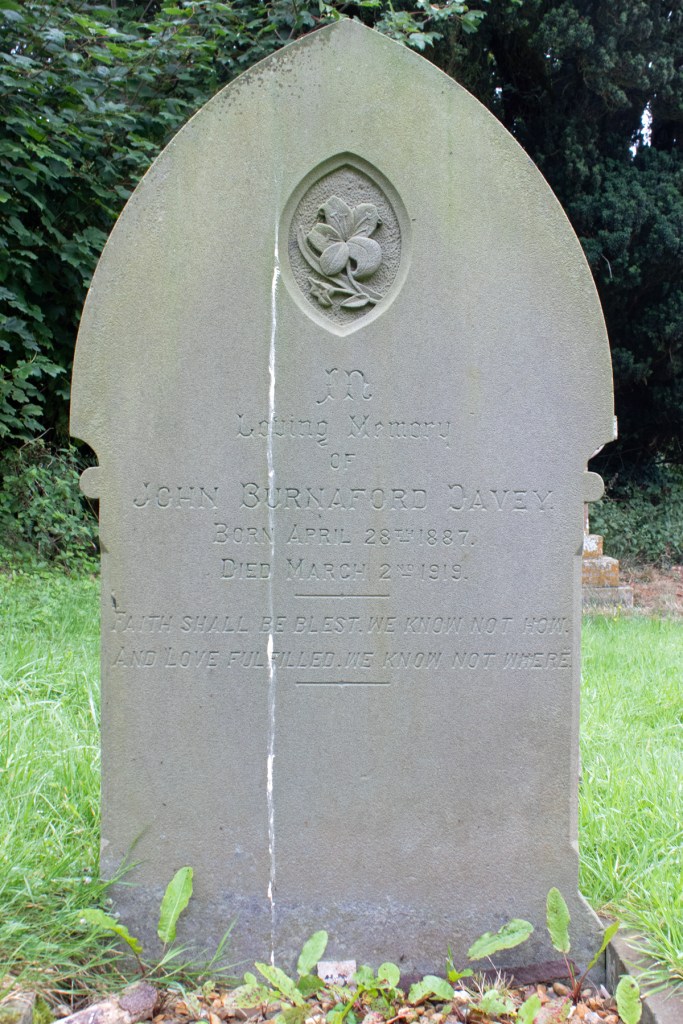
John Burnaford Davey was born on 28th April 1887 in Cannington, Somerset. The youngest of nine children, his parents were farmers Thomas and Emma Davey. Emma died in 1899, and the next census, two years later, found John and two of his siblings living with their father at Beere Manor Farm on the outskirts of the village.

John’s trail goes cold at this point, and it seems that he may have emigrated to South Africa. When war broke out, he enlisted in the Natal Light Horse, and was awarded the 1915 Star in Pretoria for his involvement in fighting in Africa. Private Davey’s troop later moved to England, and it was here that he transferred to the Royal Field Artillery.

The move, in September 1915, included a promotion to Second Lieutenant. Within a couple of years his dedication meant that he advanced to the rank of Lieutenant. By this point, John was based in London, and it was here, on 16th July 1917, that he married Katherine Trayler, a tanner’s daughter from Bridgwater, who had gone on to become a teacher of gymnastics. The couple went on to have a daughter, Jean, who was born in November 1918.

Illness caught up with John and, with the Armistice signed, he was invalided out of service on 8th February 1919. The family were now living in Bridgwater, and this is where John returned. His time back with family was to be tragically short, however, as he passed away just weeks after leaving the army, on 2nd March 1919. He was 31 years of age.

John Burnaford Davey was laid to rest in the peaceful graveyard of St Mary’s Church in Holford, Somerset.


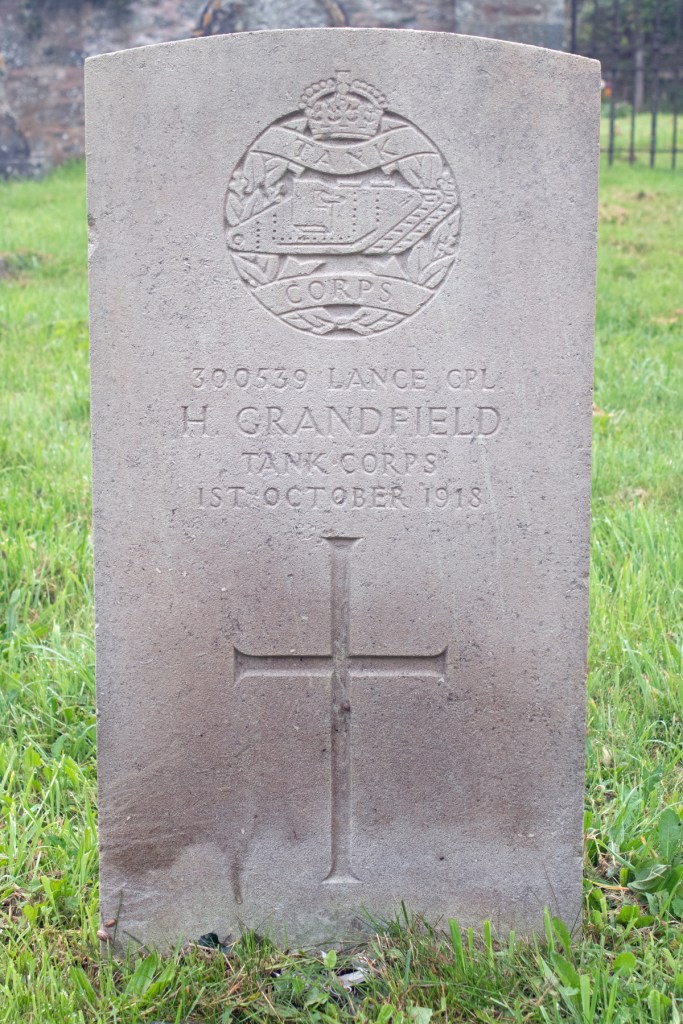
Lance Corporal Henry Grandfield

Lance Corporal Henry Grandfield

Henry Grandfield was born in the spring of 1887, the third of six children to William and Martha Grandfield. William was a bootmaker from the Somerset village of Over Stowey, and it was here that he and Martha raised their family.

Henry found work as a labourer on a local estate when he finished his schooling. When war came to Europe, however, he stepped up to play his part.

Service records for Henry are pretty scarce. He appears to have enlisted in the Royal Field Artillery, but then transferred across to the Tank Corps. Separate research appears to suggest that Lance Corporal Grandfield served in the Eastern Mediterranean, but fell ill.

Suffering from rheumatism he returned to Britain for medical support. Based at Bovington Camp in Dorset, Henry was later admitted to a hospital near Wareham, having contracted pneumonia. This latter condition was to prove too much for his body to bear: he passed away on 1st October 1918, at the age of 31 years old.

The body of Henry Grandfield was taken back to Somerset for burial. He was laid to rest in Over Stowey Cemetery, not far from where his family still lived.

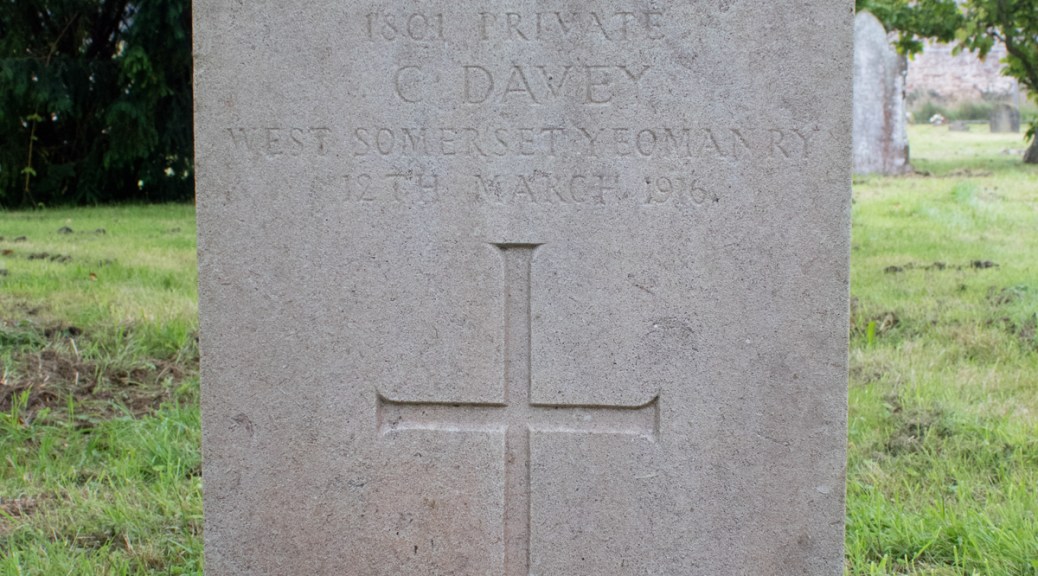
Private Charles Davey

Private Charles Davey

Charles Davey was born in Nether Stowey, Somerset, in the autumn of 1893. The second of six children, his parents were publican-turned-labourer Charles Davey and his wife, Mercy. The 1911 census found the family living in a four-roomed house, with Charles Sr and Jr and the younger Davey son, Walter, all employed in farm work.

When war came to Europe, Charles was called upon to play his part for King and Country. Sadly his service records have been lost to time, but it is clear that, by September 1915, he had enlisted in the West Somerset Yeomanry. Attached to the 3rd/1st Battalion, Private Davey would have been employed on home service. He was billeted at the Aliwal Barracks at Tidworth, Wiltshire.

The only other record relating to Private Davey is his entry in the Army Register of Soldiers’ Effects. This confirms that he passed away in Taunton, on 12th March 1916. The cause of his death is not recorded, but he just was 22 years of age.

The body of Charles Davey was taken back to Somerset for burial. He was laid to rest in the peaceful graveyard of St Mary’s Church in Nether Stowey.


Private Edward Browning

Private Edward Browning

Edward John Browning was born in the autumn of 1897 in the Somerset village of Over Stowey. The youngest of five children, his parents were blacksmith-turned-farmer John Browning and his wife, Alice.

By the time of the 1911 census, the family had moved to nearby Colepool Farm in Stogursey. Edward’s older brothers were all supporting their father on the farm, while, at 13 years of age, he was still to complete his schooling.

Details of Edward’s military life are scarce. When war broke out he enlisted, and joined the 3rd (Reserve) Battalion of the Somerset Light Infantry. His troop served on home soil, moving to Derry/Londonderry, Northern Ireland, by November 1917, and Belfast by the following spring.

Private Browning survived the conflict but had fallen ill by the summer of 1919. He was admitted to the Purdysburn Military Hospital in Belfast. He was suffering from cerebrospinal meningitis, and this was to claim his young life. He passed away there on 9th July 1919, at the age of just 21 years old.

The body of Edward John Browning was brought back to Somerset for burial. He was laid to rest in the peaceful graveyard of St Andrew’s Church in Stogursey.


Private Arthur Dudley

Private Arthur Dudley

Arthur Samuel Dudley was born in the spring of 1895, and was the second of six children to Arthur and Alberta Dudley. Arthur Sr was an fitter for an engineering works in Birmingham, and it was in the Kings Norton area of the West Midlands where he and Alberta raised their family.

When he finished his schooling, Arthur found work as a grocer’s assistant, but factory work offered better financial prospects, and by the time war was declared in 1914, he was working as a tube drawer for the company that employed his father.

The conflict brought further opportunity for a career and an adventure, and this was not something Arthur was able to let pass by. He enlisted on 3rd September 1914, but intriguingly did so in Bodmin, Cornwall, some 200 miles to the south of his home, and there seems to be no direct connection between the Dudleys and this part of the country.

Arthur joined the Duke of Cornwall’s Light Infantry and was assigned to the 6th (Service) Battalion. His medical report – which was completed back in Birmingham towards the end of September – showed that he was 5ft 6.75ins (1.69m) tall and weighed 120lbs (54.4kg). He had brown hair, green eyes and a fair complexion.

On 18th January 1915, Private Dudley transferred to the Army Cyclist Corps, and was attached to the 19th Divisional Cyclist Company. Based in Somerset, he soon found himself barracked near Burnham-on-Sea. It was here, just two weeks later, that Arthur became ill. On 30th January 1915 he was sent to the Volunteer Aid Detachment Hospital in the town, in a diabetic coma, and passed away same evening. He was just 19 years of age.

Unable to afford the cost of bringing their son’s body back to the West Midlands, Arthur Sr and Alberta instead made their way to Somerset for the funeral. Arthur Samuel Dudley was laid to rest in the peaceful Burnham Cemetery, not far from where he had breathed his last.

About 700 of his comrades followed the coffin… Mrs Duncan Tucker and Mrs T Holt, representing the staff of the Red Cross Hospital, were also present.

Shepton Mallet Journal: Friday 5th February 1915

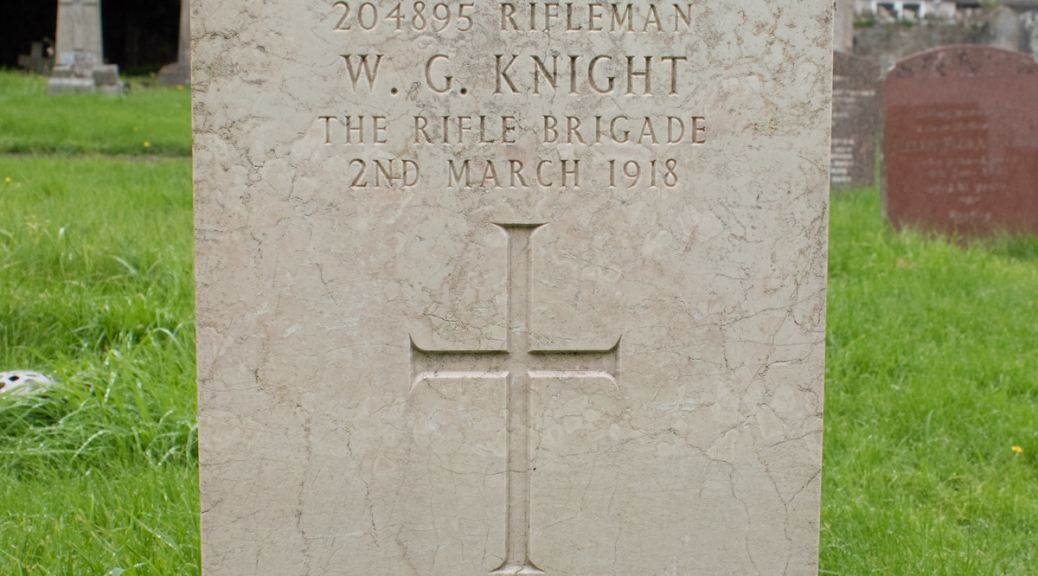
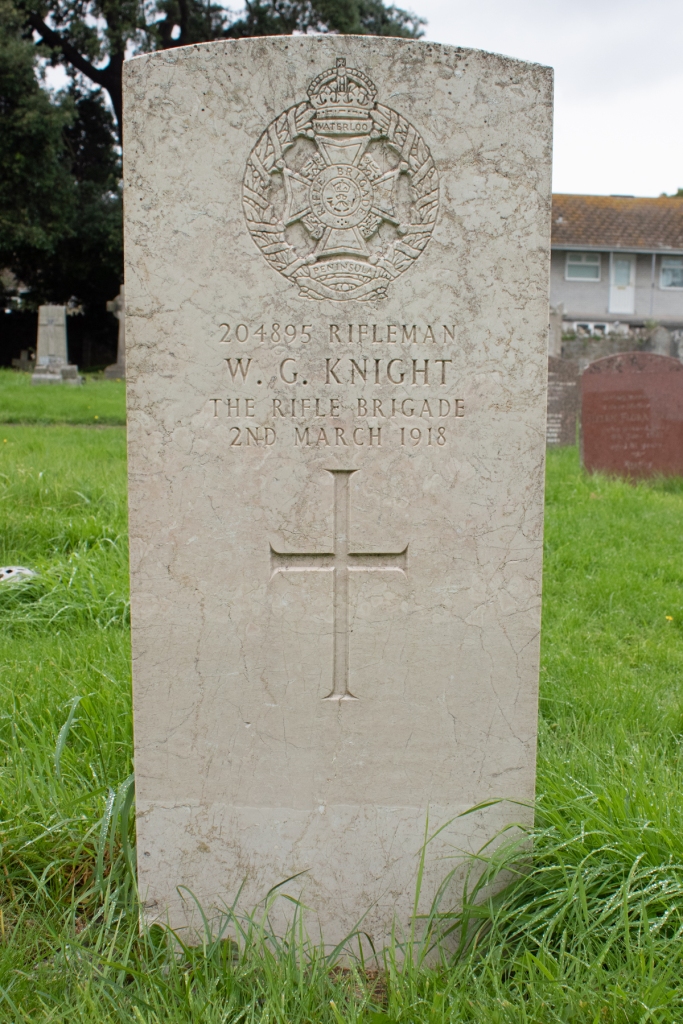
Rifleman Walter Knight

Rifleman Walter Knight

Walter George Knight was born on 27th December 1887 and was the older of two children to George and Mary. George was a gardener from London, Mary had been born in Devon, but it was in Weston-super-Mare, Somerset that they settled down to raise their family.

On 11th October 1910, Walter married Rosa Burford at St Saviour’s Church. While listed as a spinster, Rosa had two children by this point – Phyllis and Lionel. A later document records Walter as their stepfather, but their full parentage is unclear.

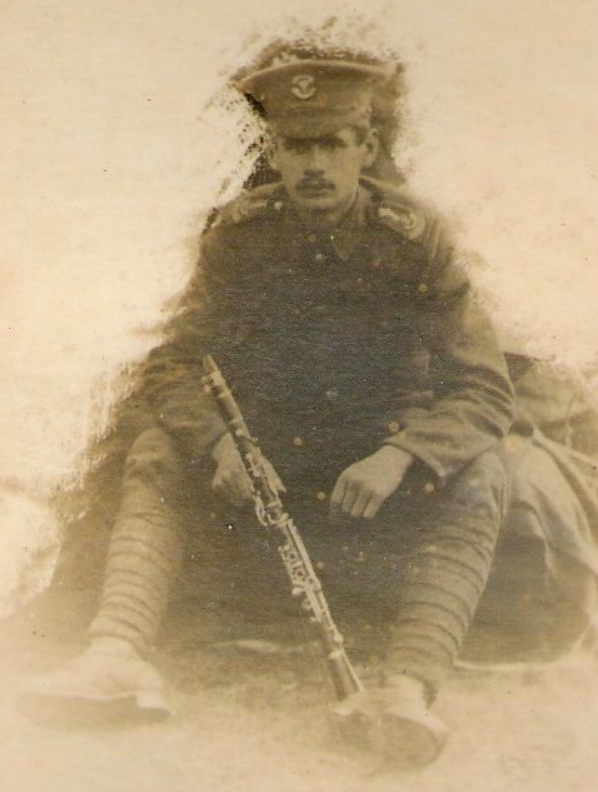
The marriage certificate notes Walter’s trade as a musician, but the following year’s census shows a more reputable trade, as he had taken to working as an insurance agent. He and Rosa had set up home in Cranleigh Road, Bridgwater, by this point, in a small terraced house they shared with the two children and Rosa’s widowed father, William.

By the summer of 1914, war was brewing over European shores, and Walter was quick to step up and support his country. He enlisted in the army on 14th October, joining the Somerset Light Infantry. He spent a year with the regiment, before transferring to the 22nd Wessex & Welsh Battalion of the Rifle Brigade.

By January 1916, Rifleman Knight found himself sailing for the Eastern Mediterranean, spending the next year in Egypt and Salonika. It was while he was overseas, in the spring of 1917, that he became ill and, having contracted tuberculosis, he returned to the UK.

Walter’s condition meant he was no longer fit for the army: he was formally discharged from the Rifle Brigade on 16th April 1917, having served for two-and-a-half years. He was admitted to the Cheddon Road Sanatorium in Taunton, the aim being to help manage his condition.

Rosa and the children had moved from Bridgwater by this point, settling in a small house in Ravensworth Terrace, Burnham-on-Sea. It is likely that Walter came here to visit the family during good spells in his health. The lung condition was to get the better of him eventually, however, and he passed away on 2nd March 1918, at the age of 30 years old.

Walter George Knight was laid to rest in the peaceful Burnham Cemetery, a short walk from where his grieving family lived.


Rifleman Walter Knight
(from findagrave.com)

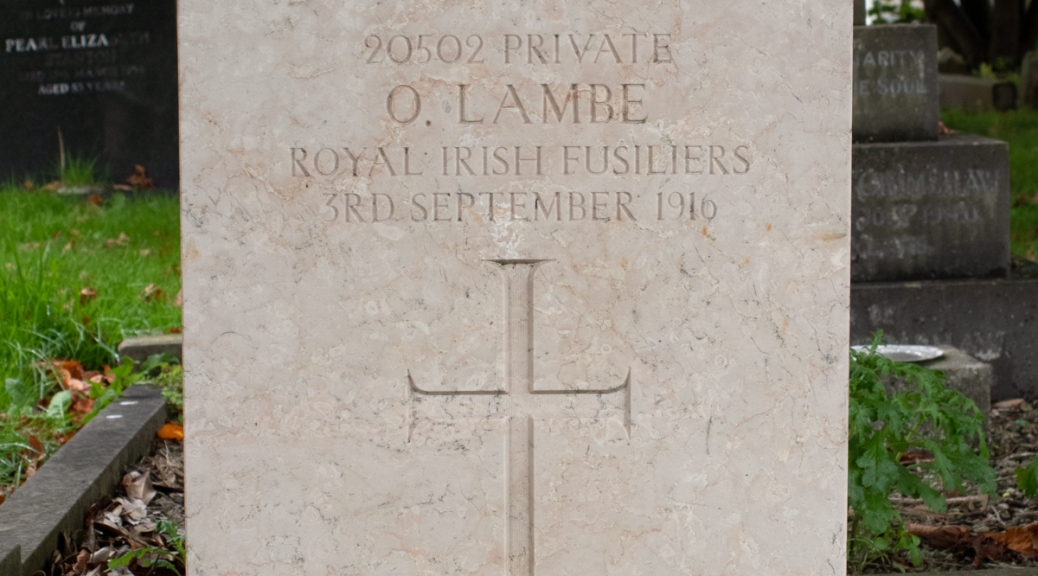
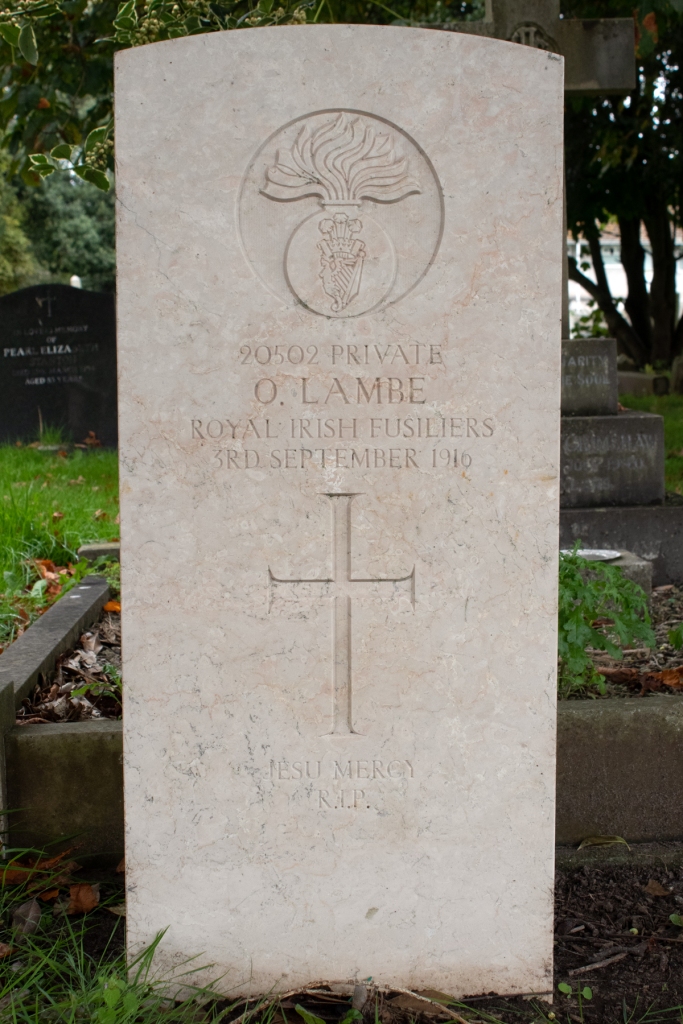
Private Owen Lambe

Private Owen Lambe

Owen Lambe was born in Drogheda, Co. Louth, Ireland, in November 1873. There is little information about his early life, but later documentation confirms that he was the son of John and Ellen Lambe, and that he had three brothers and one sister.

When Owen finished his schooling, he found work as a baker. He was also volunteering as a soldier in the 6th Battalion of the Royal Irish Rifles at the time, however, and this sparked a career move for him. On 7th May 1890, he formally enlisted: his medical report shows that he was 5ft 4ins (1.63m) tall, and weighed 128lbs (58kg). He was noted as having brown hair, grey eyes and a dark complexion.

Over the twelve years of his contract, Private Lambe saw a fair bit of the world. After eighteen months on home soil, he was sent to Malta, where he remained until November 1894. His battalion was then moved to India, where they remained for more than three years.

With seven years’ service under his belt, Owen returned to Britain. Put on reserve status, he was recalled to active duty in October 1899, as hostilities broke out in South Africa. He served in the Second Boer War for nearly three years, until, in July 1902, he returned home once more. By this point, he had completed his contract, and formally stepped down from the army on 31st August.

Owen’s trail goes cold at this point, and it is only possible to pick up details from later documents relating to his death. These confirm that he had re-enlisted by the spring of 1916, and that he joined the 8th (Service) Battalion of the Royal Irish Fusiliers. Based on his previous army experience, Private Lambe would have been sent to the Western Front fairly readily, and his battalion was certainly involved in the fighting at the Battle of the Somme.

It was here, on the front line, that Owen was injured. Again, details are sketchy, but he received gun shot wounds severe enough for him to me medically evacuated to Britain for treatment. He was taken to Somerset and admitted to the Volunteer Aid Detachment Hospital in Burnham-on-Sea for treatment. Private Lambe’s wounds were to prove too severe, however: he passed away from his injuries on 3rd September 1916, at the age of 42 years old.

Owen Lambe was laid to rest in the Roman Catholic section of Burnham Cemetery. His headstone was paid for by the local Catholic church.


Sapper Oliver Banwell

Sapper Oliver Banwell

Oliver Banwell was born in Burnham-on-Sea, Somerset, in 1882. One of nine children, his parents were mason William Banwell and his wife Jane. When he completed his schooling, Oliver followed his father into manual work and, by the time of the 1901 census, he was employed as a bricklayer.

In 1910, Oliver married Mary Ann Burrows, a carter’s daughter from Axbridge: the couple settled down in lodgings on Oxford Street, near the centre of Burnham-on-Sea, and went on to have three children: Stanley, Primrose and Violet.

When war came to Europe, Oliver stepped up to serve his King and Country. He gave up his new employment as a groom and enlisted on 13th September 1915, joining the Royal Engineers as a Sapper. His service records give some idea of the man he had become. He was 5ft 8.5ins (1.74m) tall, weighing 141lbs (64kg), and was noted to be of good physical development, although he had slight varicose veins in both legs.

Sapper Banwell found himself in France by the end of April 1916. He spent six months overseas, before being posted back to Britain. Initially attached to the 82nd Training Reserve Battalion at the Royal Engineers Barracks in Chatham, Kent, by July 1917, he had moved again, to the 39th Fortress Company, in Sheerness.

In July 1918, Oliver was back in France again, where he was to remain until after the Armistice. By this point his health was beginning to fail and, on his return to Britain in December 1918, a medical examination deemed him no longer fit for army service. He was formally discharged from the Royal Engineers on 30th January 1919, suffering from cancer of the rectum.

Oliver returned to Burnham-on-Sea, and spent the next ten months with his family. His battle with cancer finally proved too much: he passed away on 4th December 1919, at the age of 37 years old.

Oliver Banwell was laid to rest in the family plot in Burnham Cemetery. Mary Ann was buried alongside him when she passed away in 1965, husband and wife reunited after 46 years.


Sapper Oliver Banwell