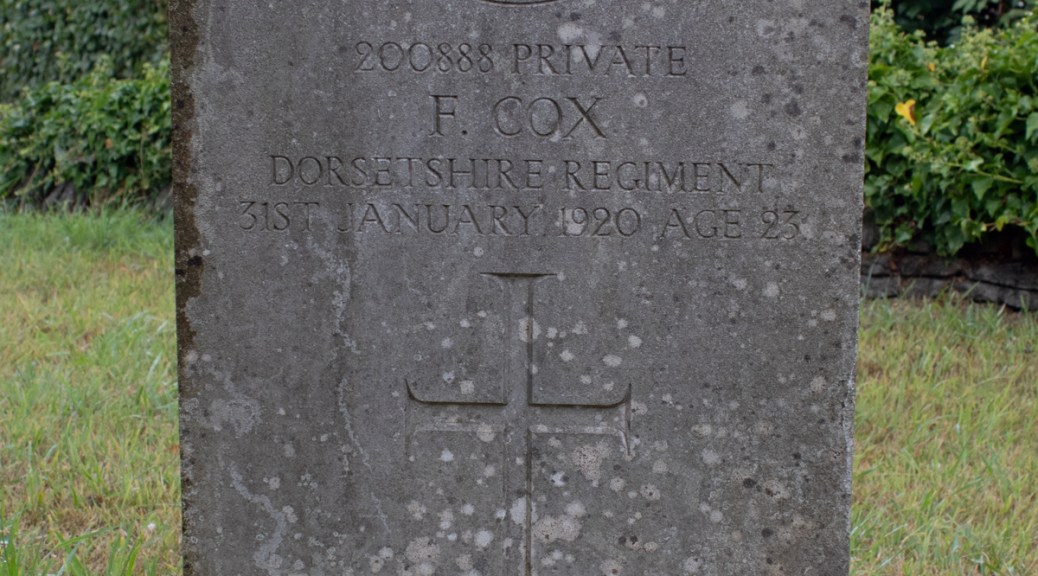
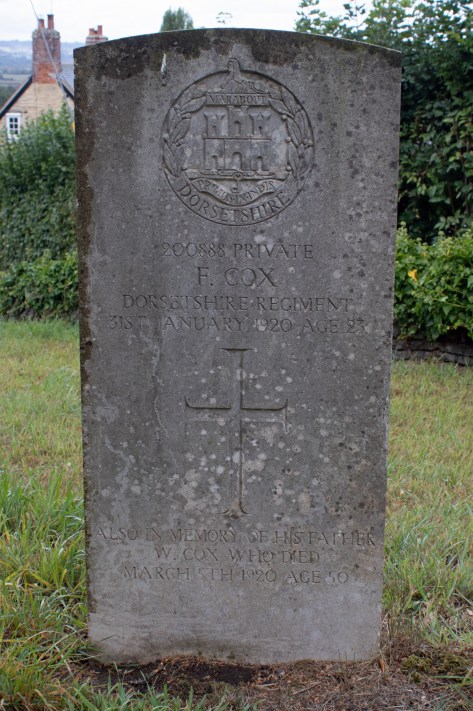
Frederick Charles Cox was born in the Dorset village of Kington Magna in the spring of 1897. One of seven children, his parents were agricultural labourer William Cox and his wife, Kate.
When Frederick completed his schooling, he also found work as a farm labourer. However, when war broke out, he was keen to play his part, possibly having seen his older brother, William Jr, also join up.
Unlike his sibling, Frederick enlisted in the Dorsetshire Regiment. His service papers have been lost to time, but it is clear that he took the role of Private, and that he was assigned to the 1st/4th Battalion. His unit began the war in India, but had moved to Basra in February 1916, remaining in Mesopotamia for the remainder of the conflict.
Private Cox survived the war, and had returned home by the end of 1919. His time in the army would impact his health, however, and during the winter of 1919/20, he came down with malaria, a condition which would prove fatal. Frederick passed away in hospital in Shaftesbury, on 31st January 1920: he was 23 years of age.
The body of Frederick Charles Cox was taken back to Kington Magna for burial. He was laid to rest in All Saints’ Churchyard, close to his brother, who had died a few years before.
Kate had lost two adult sons in a matter of years, and her tragedy was not to end. William Sr passed away less than five weeks after Frederick. He was buried close to his sons.
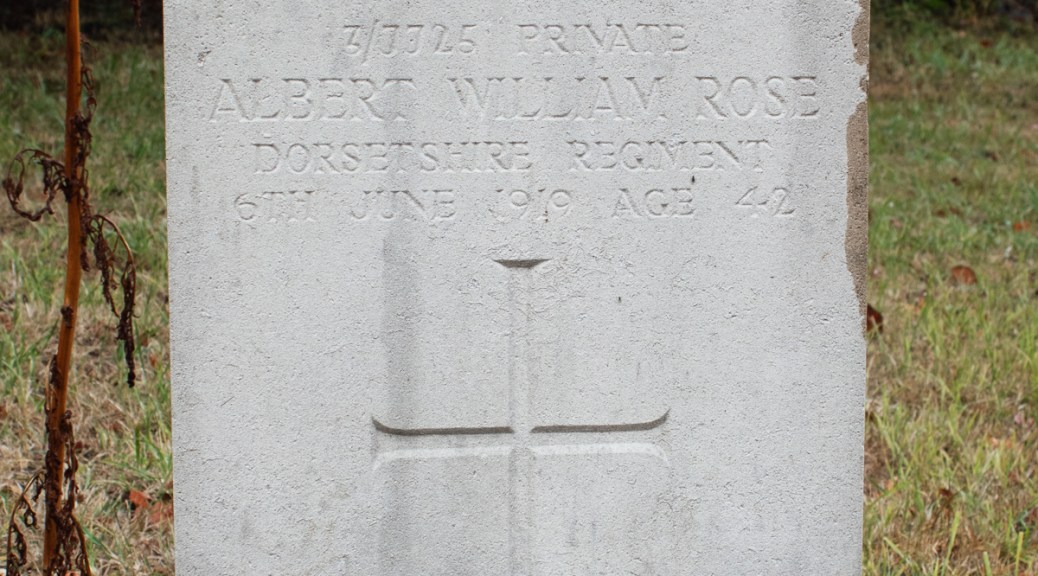
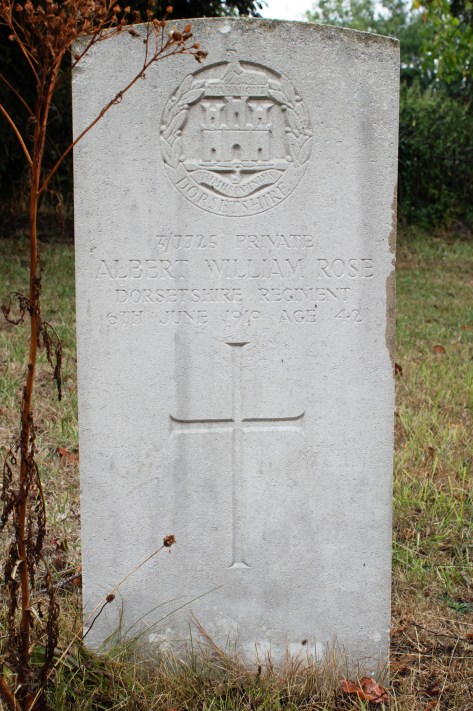
Albert William Rose – who was better known by his middle name – was born in the spring of 1876. One of eight children, his parents were Thomas and Amelia Rose. Thomas was a farm labourer from Sturminster Newton, Dorset, and this is the village in which the Rose family were born and raised.
William followed in his father’s footsteps, and was a farm labourer by the time he turned 14. The 1881, 1891 and 1911 census records all show him living with his parents: in 1901 he was a boarder with the Brown family at The Stables in Bryanstone, Dorset. He was employed as a stable keeper, one of eleven live-in employees at the stud.
Alongside his farm work, William was also an active volunteer in the local militia. When war broke out in the summer of 1914, he was quick to enlist, joining the 3rd Battalion of the Dorsetshire Regiment. His service papers show that he was 5ft 7ins (1.7m) tall and weighed 160lbs (72.6kg). He is recorded as having brown hair and grey eyes.
During the next four months, Private Rose undertook training on home soil. In December 1914, his unit was moved to France, and he would remain on the Western Front through to the Armistice and beyond. His time overseas was not without incident, and his age and health would be against him.
Over the next four years, William would he hospitalised at least a dozen times, for rheumatism, myalgia, a recurring heart condition and, in May 1915, from the effects of a gas attack and subsequent issues with catarrh. In December 1918, he returned to Britain with atherosclerosis, a clogging of the arteries, and was medically discharged from service the following month.
At this point, William’s trail goes cold. It is likely that he returned home, as , when he passed away, his death was registered in Sturminster.
Albert William Rose passed away on 6th June 1919: he was 43 years old. His body was laid to rest in Sturminster Newton Cemetery, not far from his family home.
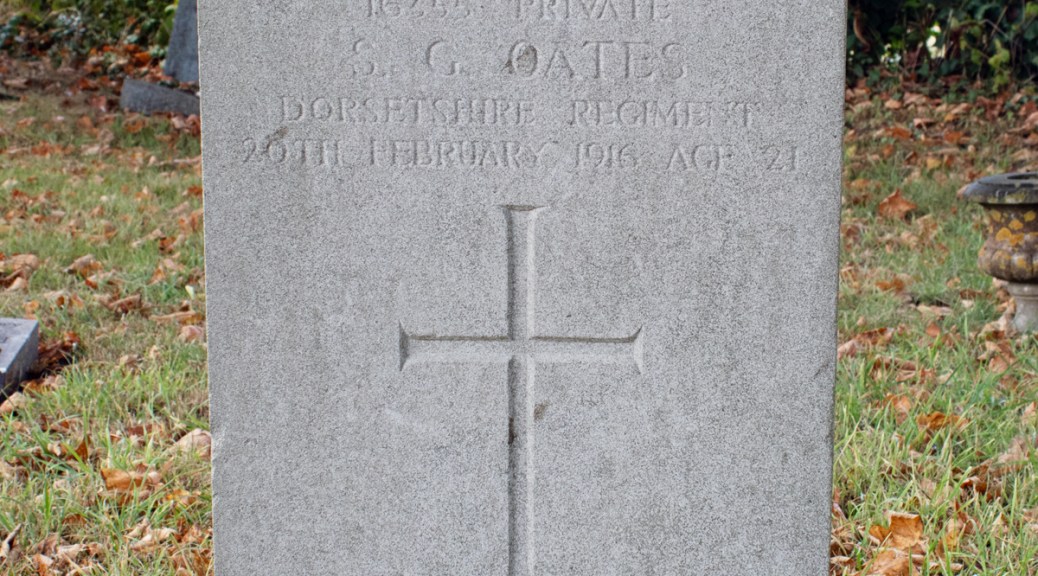
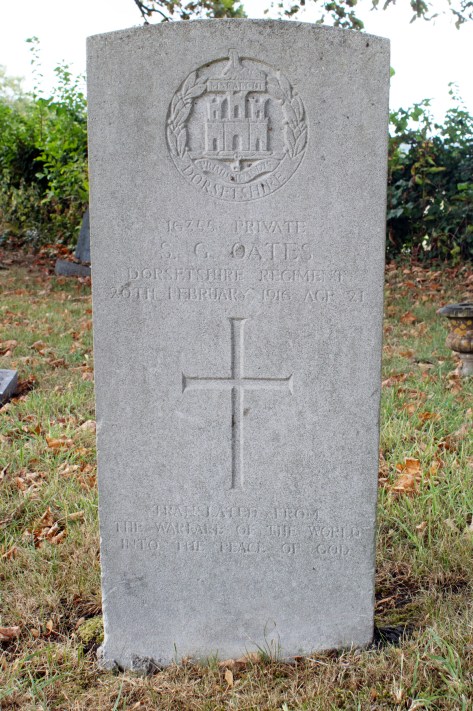
Sidney George Oates was born in the spring of 1895, and was the oldest of three children – all boys – to John and Eliza Oates. John was a general labourer from Parkstone, Dorset, but it was in the village of Odcombe in Somerset that the family were born and raised.
Eliza died in 1899, and John was left to raise three young children on his own. He re-married, to a Lucy Moores, but the a split of the family followed the wedding. Sidney’s younger brothers stayed with their father and his new wife, while Sidney himself was looked after by his maternal grandparents. Job and Elizabeth Green lived in Buckhorn Weston, a village to the west of Gillingham, Dorset.
When he finished his schooling, Sidney was apprenticed to a carpenter. War was on the horizon, however, and he soon stepped up to play his part. As with many others, his service papers have been lost to time, but it is clear that he had enlisted in the Dorsetshire Regiment no earlier than August 1915.
Private Oates was assigned to the 7th (Reserve) Battalion and sent to a training camp near Wool, Dorset. While there, however, he caught pneumonia, and was admitted to a military hospital in the village. The condition was to prove fatal: he passed away on 20th February 1916, aged just 21 years old.
The body of Sidney George Oates was taken back to Buckhorn Weston for burial. He was laid to rest in the village’s cemetery.
Sidney’s younger brother Edward also served in the First World War. A Pioneer in the Royal Engineers, he was killed in action in northern France on 12th April 1917. He was buried in Mory Abbey Military Cemetery to the north of Bapaume.
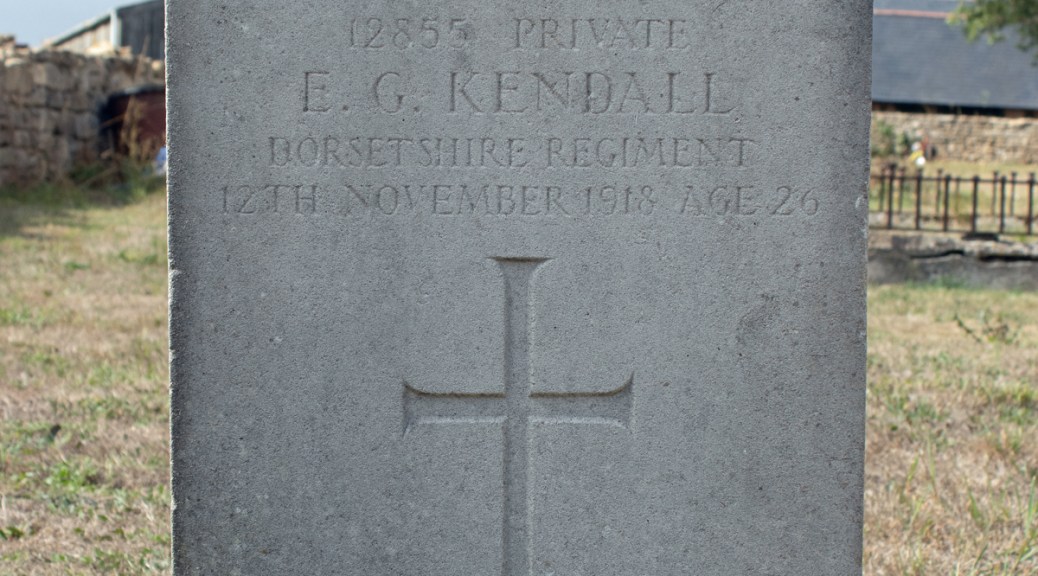
Ernest George Kendall was born in December 1891 and was the fourth of five children to Charles and Mary Kendall. Charles was a farm labourer from Dorset, and the family were living at Shearstock Farm in the town of Gillingham when Ernest was born.
By the time of the 1911 census, Ernest had found work as a farm labourer, alongside his father. When war broke out, however, Ernest felt the need to serve his country.
Full details of Private Kendall’s military service have been lost to time, but he had enlisted in the Dorsetshire Regiment by the autumn of 1915, and was assigned to the 5th (Service) Battalion. His unit left Britain on 15th October, and headed for the Eastern Mediterranean and Gallipoli.
Over the next few months, Ernest was caught up in fierce fighting. He was evacuated to the Greek island of Mudros in December 1915, and spent the winter in Egypt. By the summer of 1916, his unit had moved to France, and fought at the Somme.
At some point, Private Kendall returned to Britain, and transferred to the Labour Corps. The move was likely to be due to an illness or injury, although there is no documentation to confirm this either way. Attached to the 477th Agricultural Company, he seems likely to have been based in Wiltshire. Ernest was admitted to the Military Hospital in Fovant for reasons unknown, and passed away there on 12th November 1918, a day after the Armistice was signed: he was 24 years of age.
The body of Ernest George Kendall was taken back to Dorset for burial. By this point his family had moved to East Stour, and he was laid to rest in the village’s Christ Church graveyard.
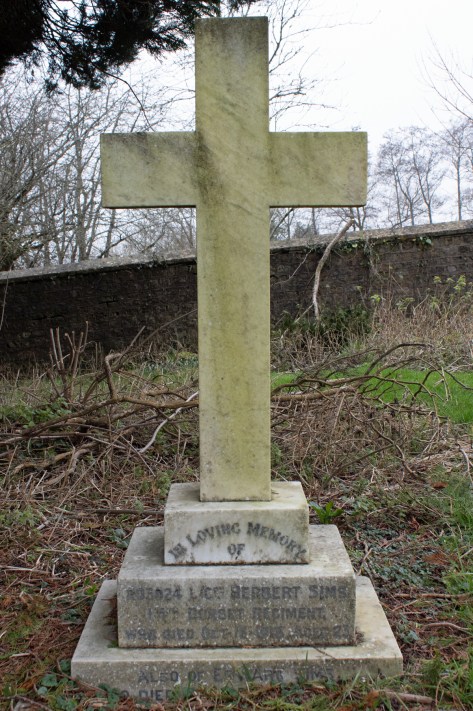
Herbert Rowland Sims was born in Warminster, Wiltshire, on 27th May 1895. One of nine children, he was the youngest son to Edward and Mary Sims. Edward was a railway signalman, and the family lived on Imber Road, to the north east of the town centre.
When Herbert finished his schooling, he found employment as a tailor’s apprentice. When war broke out, however, he was keen to play his part. His service records no longer exist, but a later newspaper report fills in some of the details.
The death took place on Wednesday in last week at the Tewkesbury Red Cross hospital of Lance-Cpl. Herbert Rowland Sims… [He] went to India on the outbreak of war with the Wilts Regiment, and subsequently volunteered for service in Mesopotamia, being transferred to the Dorsets. He contracted typhoid, and after being in hospital in Egypt he was invalided home. He was about to receive his discharge, but was again laid low by an attack of pneumonia which, after the illness contracted in Mesopotamia, proved fatal.
A memorial service was held in Tewkesbury Abbey on Saturday, the body being escorted by wounded comrades from the hospital. From the Abbey the coffin was taken to the railway station to be sent to Warminster, and on Monday the internment took place in the Minster churchyard with military honours.
[Wiltshire Times and Trowbridge Advertiser: Saturday 26th October 1918]
Herbert Rowland Sims was just 23 years of age when he died on 16th October 1918. He was laid to rest in St Denys’ Churchyard in his home town of Warminster.
Nicholas John Paice was born in the spring of 1867, the second of five children to John and Olive Paice. John was a railway policeman from Aldermaston in Berkshire, but his oldest son, Nicholas, was born in Poole, Dorset where Olive came from.
The Paice family seemed to move to wherever John’s work took him. The 1871 census found them living back in the Berkshire village of Shrivenham, while a decade later they were to be found in Longfleet, to the north of Poole. By this point, John was employed as a groom, and Olive a laundress.
When he completed his schooling, Nicholas found work as a butcher. He had also enlisted in the local militia, joining the 3rd Dorset Regiment. The army life seemed to suit him and, on 12th July 1886, he enlisted in the Rifle Brigade. His service records show that he was 5ft 7ins (1.7m) tall and weighed 148lbs (67.1kg). At 19 years and three months old, he was noted as having a fresh complexion, grey eyes and brown hair. The papers show that he had a scar on his left eyebrow, and tattoos on his forearms and the middle finger of his left hand.
Joining up for a period of twelve years, Private Paice would spend nearly seven of those in India and Burma. His time in the army was not without incident, however. Just three weeks after enlisting he deserted, and remained at loose for nearly a month. When he was captured, he was imprisoned for desertion for four weeks, his term of service extended to reflect the time he was AWOL.
In August 1896, having been back on home soil for just over two years, Nicholas was arrested again. Convicted of ‘begging’, he was confined for a week, before being released back to duty.
On 16th September 1898, Nicholas completed his contract, and was formally discharged from the army.
The next few years are a mystery for Nicholas. He had married Maria Andrews in 1896, and the couple would go on to have eight children, of which five would survive childhood. By the time of the 1911 census – the next document where we can pick him up – Nicholas and the family were living in two rooms at 2 New Corn Street, Bath, Somerset. Nicholas was working as a cattle drover, along with Maria, the household included her daughter Annie, and granddaughter Lily, and John and Maria’s son, Earnest.
When war came to Europe, Nicholas stepped up to play his part. He enlisted in the Somerset Light Infantry on 26th October 1915 but, with his age against him, he was transferred to the 263rd Coy. of the Royal Defence Corps the following April.
It seems that Private Paice’s health was also being impacted and he spend a month in the Red Cross Hospital in Portishead, having contracted influenza. Released to duty on 16th May 1916, just a month later he was re-admitted for three weeks, this time suffering from bronchial catarrh. On 10th September he was admitted to the hospital for a third time. This time it was identified that he had come down with pulmonary tuberculosis, and on 12th October 1916, he was formally discharged on medical grounds.
It is unclear what happened to Nicholas next. His service records suggest that he wasn’t immediately discharged from the Portishead hospital, and it seems likely that he would have returned home to Bath at some point. The next record for him is that of his passing, from tuberculosis, on 20th December 1919. He was 52 years of age.
Nicholas John Paice was laid to rest in the sweeping Locksbrook Cemetery in his adopted home town of Bath, Somerset.
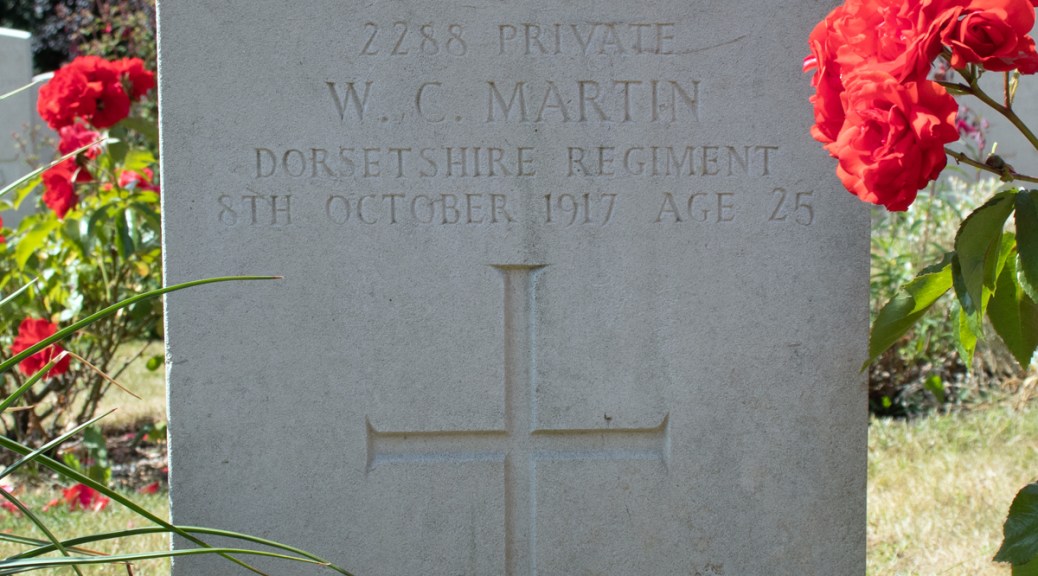
Willie Cyril Martin was born in December 1891 in the Dorset village of Almer. The son of Elizabeth Martin, his mother would go on to marry Edward Holloway nine years later, although it is unclear whether he was Willie’s father.
When he finished his schooling, Willie found work as a kitchen porter, and this led him to the Dorset coast. The 1911 census found him boarding with 35 others at Pryory Mansions in Bournemouth.
When war broke out, Willie stepped up to play his part. He enlisted on 9th October 1914, joining the Dorsetshire Regiment. Assigned to the 4th Battalion, his unit was soon sent to India, moving to the Middle East over the following years.
By the autumn of 1916, Private Martin was back in Dorset. On 7th November he married Edith Williams at St Clement’s Church in Bournemouth. She was the 26-year old daughter of a gas fitter, and the couple’s marriage certificate sheds some light on Willie’s background as well. It gave his father’s name as Richard Martin (deceased), who was a butler, although there is no other information to substantiate this, and Elizabeth had passed away some years before, so could not back up or refute the suggestion.
Private Martin returned to duty after his wedding. At some point he transferred to the Labour Corps, and was attached to 644 Company. His re-assignment may have been down to medical issues – he had contracted malaria while serving overseas – and by the autumn of 1917, he was sent to hospital because of his deteriorating health.
Willie was admitted to Bath War Hospital in Somerset, suffering from a bout of malaria. The condition was to get the better of him, and he passed away on 8th October 1917, from a haemorrhage on his lungs. He was 25 years of age.
Willie Cyril Martin was laid to rest in the military section of Bath’s sweeping Locksbrook Cemetery, not far from the hospital in which he passed away.
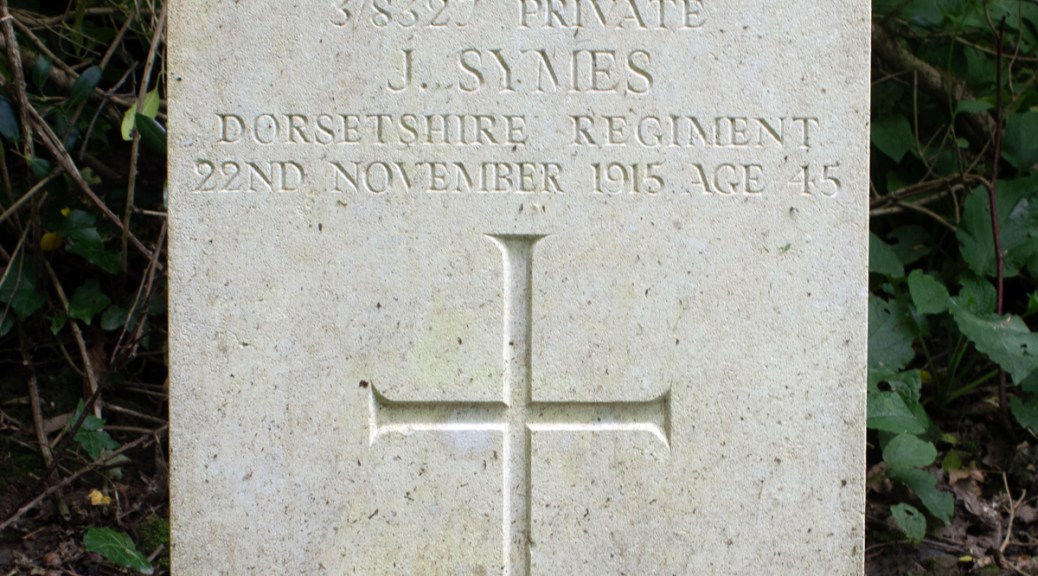
Joseph Symes was born in the spring of 1871, and was the oldest of four children to William and Sarah. William was a farm labourer from Stoke Abbot in Dorset, and it was here that the family were born and raised. They set up home with Sarah’s parents, and were recorded as living with them in the 1871 census, and with Sarah’s widowed mother in the 1881 record.
William had died by the time the 1891 census return was taken, and Sarah took up work as a mill hand. The document found her living in the village of Netherbury, a few miles to the south east of Stoke Abbott, with her three younger children, William, Alice and Mary Ann. Joseph was noticeable by his absence, but later documents confirm that he had enlisted in the Dorsetshire Regiment by this point, and was likely serving overseas.
Joseph had returned to England by the turn of the century, setting up home back in Netherbury. On 24th September 1910, he married Sarah Jane Dunsbury in Beaminster parish church. The daughter of a blacksmith, she was 13 years Joseph’s senior – 52 years old to his 39. The couple lived in Netherbury, where he was working as a mason’s labourer.
When war broke out, Joseph stepped up to play his part once more. He re-enlisted in the Dorsetshire Regiment on 1st September 1914, and was attached to the 6th Battalion. His service records confirm that he was 5ft 5.5ins (1.66m) tall and weighed 182lbs (82.6kg).
Private Symes remained on home soil during his time in the army. He switched to the 3rd (Reserve) Battalion in March 1915, which was based in and around Weymouth. In the autumn of 1915, he was admitted to the Sidney Hall Military Hospital in the town, suffering from bronchial pneumonia. The lung condition was to prove his undoing, and he passed away on 22nd November 1915, while still admitted. He was 44 years of age.
Joseph Symes was taken back to Netherbury for burial. He was laid to rest in the graveyard of St Mary’s Church in the village.
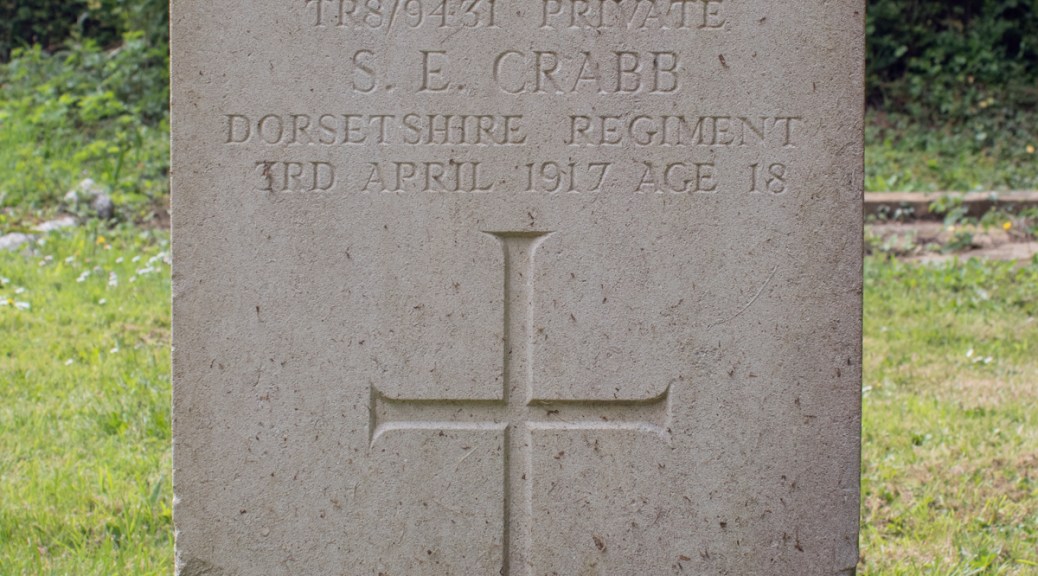
Sidney Edgar Crabb was born in the autumn of 1898 in the Dorset village of Chedington. One of ten children, his parents were shepherd-turned-farm labourer John Crabb and his wife, Mary.
Little information is available about young Sidney’s life. He was still at school when the 1911 census was taken, and was too young to enlist when war was declared in the summer of 1914. He enlisted in the Dorsetshire Regiment no earlier than October 1916, and was sent to Warminster for training.
The only other record for Private Crabb confirms his passing. He died from bronchial pneumonia while in hospital near his army camp in Warminster, Wiltshire, on 3rd April 1917. He was just 18 years of age.
Sidney Edgar Crabb’s body was taken back to Dorset for burial. He was laid to rest in the graveyard of St Mary’s Church, in his home village of Halstock. While only five of his siblings survived childhood, Sidney was the only one to pass away as a result of the conflict.
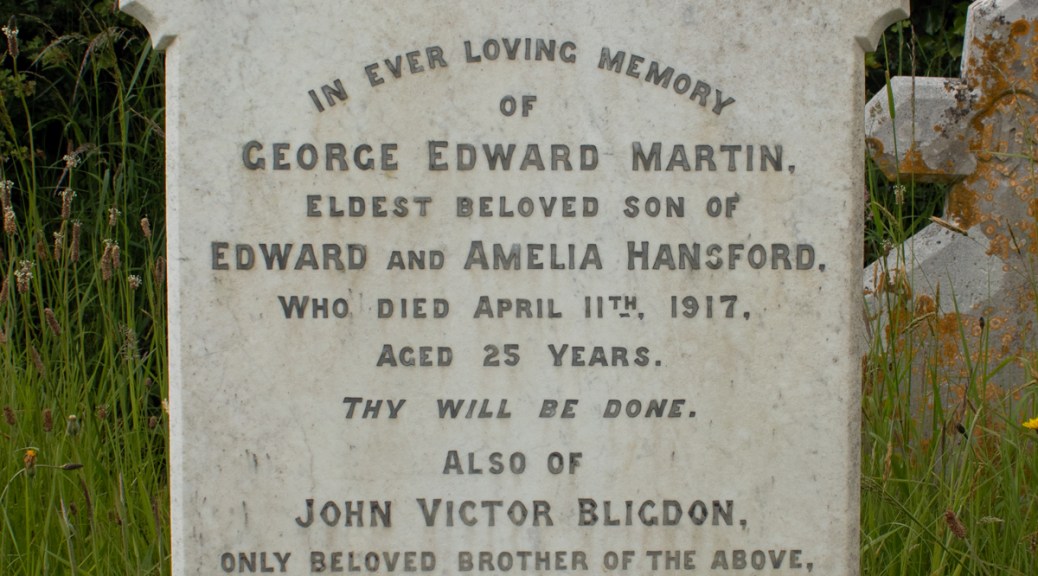
George Edward Martin Hansford was born on 25th March 1892, the second of five children – and the eldest son – to Edward and Amelia Hansford. Edward was a farmer from Netherbury in Dorset, and this is where the family were born and raised.
By the time of the 1911 census, Lower Ford Farm had become a family affair, with George and his older sister, Susannah both supporting their father in running things. War was on the horizon, however, and things were to change.
George was called upon to serve his country on 15th February 1916. He joined the Dorsetshire Regiment, and was assigned to the 2nd Battalion. He wasn’t formally mobilised until 19th January 1917, but his medical identified an underlying health condition.
Private Hansford had suffered a bout tuberculosis in 1914, and this left to his medical report confirming that his health was impacted to the point that he was medically unfit to serve in the army. Unfortunately, while awaiting the results of the report, George, who was back at home had a recurrence of the condition, and succumbed to it. He passed away on 11th April 1917, at the age of just 25 years old.
George Edward Martin Hansford was laid to rest in the graveyard of Holy Trinity Church in Salwayash, a few miles from the family home in Netherbury.








 Death and Service