Category Archives: Kings Royal Rifle Corps

Rifleman Reginald Murdin

Rifleman Reginald Murdin

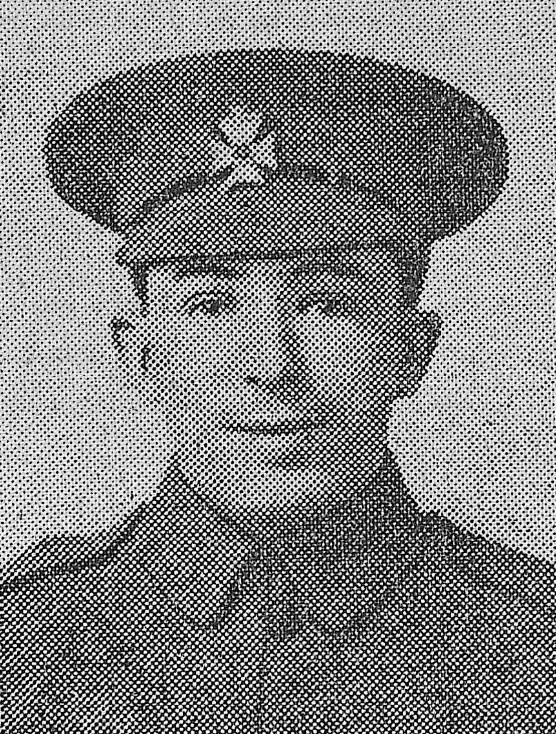
Reginald John Murdin’s early life is one of contradictions. Born in 1899, his parents were George White and Lily Murdin, and he is recorded with both surnames in documents from the time. George was a iron ore labourer from Northamptonshire, and is was in Woodford, near Kettering, that the family were raised.

When he finished his schooling, Reginald followed George into iron ore and, by the time war broke out he was in the employ of the Islip Iron Company Ltd. Keen to play his part, Reginald enlisted in the King’s Royal Rifle Corps on 29th January 1916.

While it’s not possible to fully identify Rifleman Murdin’s service, he was certainly caught up on the Western Front by the autumn of 1918. It was here that he was injured by “a shell which burst about two yards from him, wounding him severely in the thigh.” [Midland Mail: Friday 15th November 1918]

Reginald was medically evacuated to Britain for treatment, and was admitted to the Bath War Hospital in Somerset. Sadly, his wounds were to prove to severe, and he passed away on 2nd November 1918: he was just 19 years of age.

Reginald John Murdin was laid to rest in the sweeping grounds of Bath’s Locksbrook Cemetery.


Rifleman Reginald Murdin
(from britishnewspaperarchive.co.uk)

Lieutenant Vincent Mellor

Lieutenant Vincent Mellor

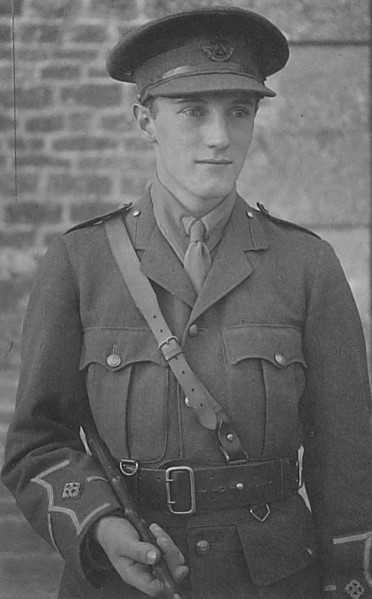
Vincent Charles Serocold Mellor was born in Chelsea, Middlesex, in the spring of 1897. The younger of two children, his parents were Chief Solicitor to the Treasury – and later Sir – John Paget Mellor and his Australian-born wife, Mabel. The 1901 census recorded the family living on Chelsea Embankment, with four servants: a cook, a nurse and two housemaids.

For someone with a relatively high standing in Edwardian England, there is surprisingly little documentation relating to Vincent – who was known as Vin. His name does not appear in the 1911 census, although nor does his family.

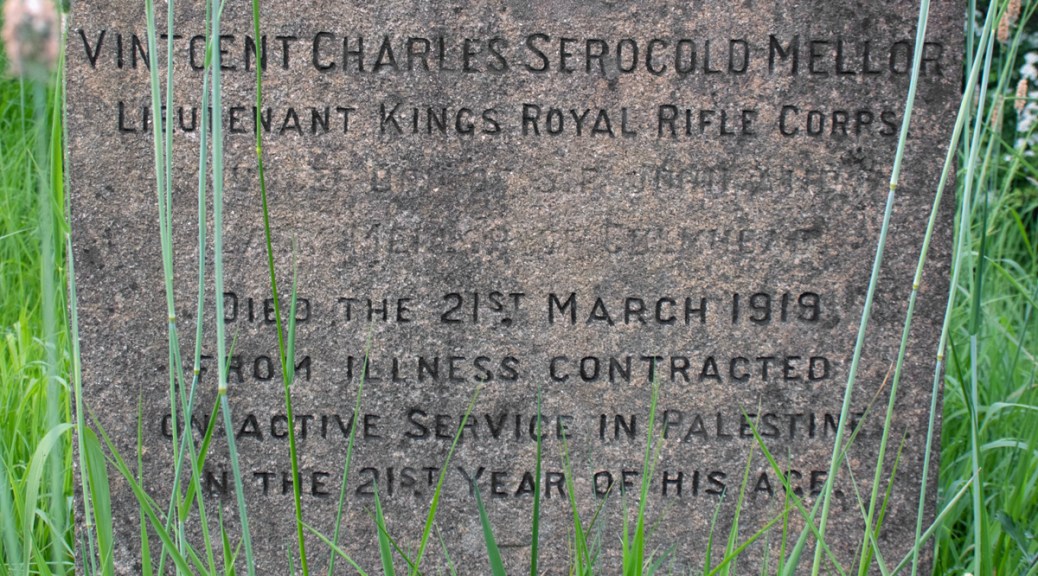
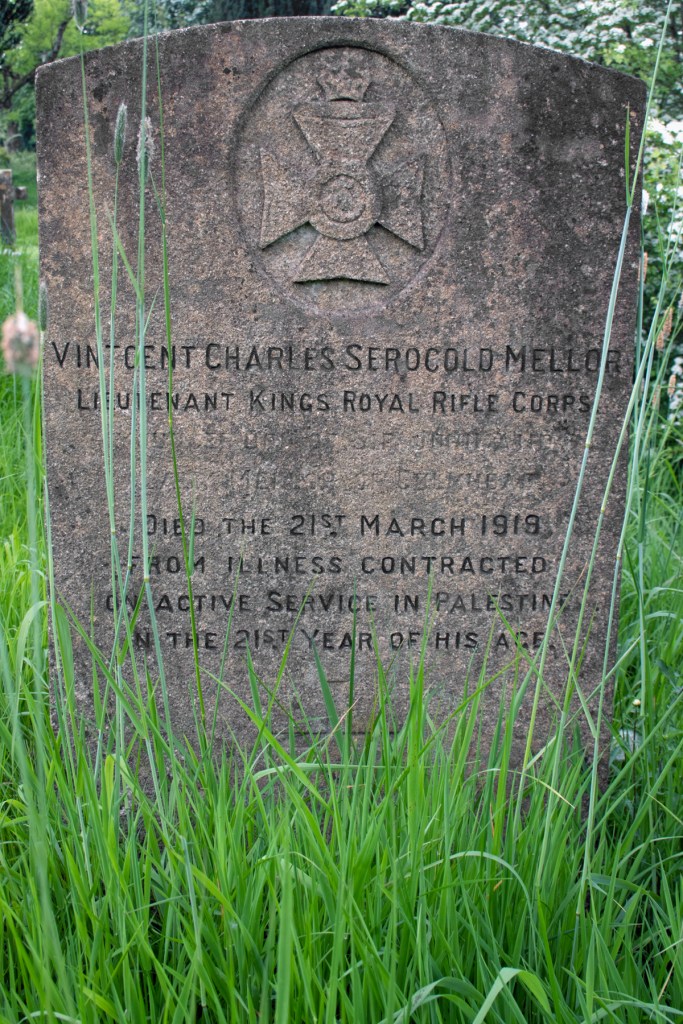
At some point, Vincent was given a commission in the King’s Royal Rifle Corps, but his service records are lost to time, which makes it impossible to find any specific information about his military career. Lieutenant Mellor’s headstone confirms that he served in Palestine, and that he fell ill while in the Middle East.

Vincent returned to Britain for treatment, and was admitted to the Red Cross Hospital for Officers in Portland Place, London. Whatever his condition, he was to succumb to it: he passed away on 21st March 1919, aged just 20 years of age.

Vincent Charles Serocold Mellor was brought back to Somerset for burial. He was laid to rest in the peaceful graveyard of St Paul’s Church in Churchstanton, close to the family’s country home, and the same church in which he had been baptised two decades before.


Lieutenant Vincent Mellor
(from findagrave.com)

Lieutenant Edward Bending

Lieutenant Edward Bending

Edward Owen Bending was born early in 1891, one of seven children to Edward Bending, who was from Bath, Somerset, and Emma, who came from Castle Cary.

Edward Sr worked on the railways, and the family moved across the county with his work: the 1891 census recorded them living in Edington, while he worked as a signalman in nearby Ashcott; ten years later, the family had moved to Bridgwater with his job. The 1911 census return recorded the Bendings as living in Station House, Wellow, with Edward now employed as the station master.

Edward Jr, who was sometimes known by his middle name to avoid confusion with his father, was also employed at the station, where he was working as a clerk. War was coming to Europe, however, and he stepped up to play his part for King and Country.

Edward enlisted in the King’s Royal Rifle Corps as a Rifleman, and was attached to the 60th Rifles. Full details of his military service are lost to time, but a contemporary newspaper report notes that he served both in the Balkans and in France. During his time in the army, he was promoted to the rank of Lieutenant, but contracted an illness, and was invalided out of service.

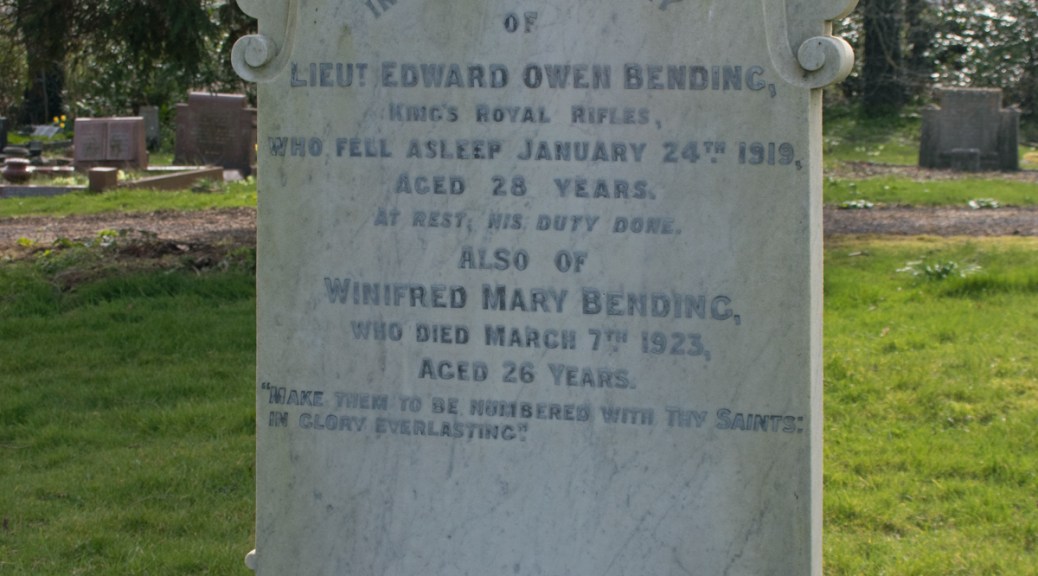
Whatever his illness, it was to get the better of him: Lieutenant Bending passed away at home on 24th January 1919. He was just 28 years of age.

Edward Owen Bending was laid to rest in the peaceful Wellow Cemetery, overlooking the village where his family still lived.


Edward’s was a family plot. When his younger sister Winifred died just three years later, she was buried with him. When his mother, Emma, passed away in 1924, she was laid to rest in a neighbouring plot.


Edward Bending Sr lived on until 1938. The newspaper report of his funeral, gives an insight into the family man he was:

A native of Combe Down, where his father carried on business as a tailor, Mr Bending spent all his working days in the employ of the Somerset and Dorset Railway. For a time he worked as a reliefman, and later was appointed stationmaster at Cole, being transferred in 1907 to Wellow, where he took part in all the village activities.

In 1920 he was transferred to Stallbridge, Dorset, but after about four years there had to relinquish work just before reaching retiring age, owing to an attach of rheumatoid arthritis. Since then he had been unable to get about and he stayed with his eldest daughter at Reading for a time.

For the past seven years he had stayed at the residence of his younger daughter at Burnham-on-Sea. Unfortunately the malady affected his sight, and for eight years he had been blind, yet throughout his last years his cheerful disposition never failed him, and he was his old self to the last, being keenly interested in his wireless, which brought him such happiness.

His wife died in 1924, and his younger son, Lieut. Edward Owen Bending, King’s Royal Rifle Corps, lost his life in the war; his name is to be found on the War Memorial at St Julian’s Church.

Mr Bending’s elder son, Hubert Alan Bending, is head master of St Julian’s school, Shoscombe. He is also survived by two of his four daughters.

Somerset Guardian and Radstock Observer: Friday 24th June 1938

While Wellow Station was a bustling place, it is highly likely that Edward Jr would have known Leonard Luke, one of the porters at the time Edward Sr was station master. Leonard also went off to war, and his story can be found here.


Second Lieutenant Cedric Pepper

Second Lieutenant Cedric Pepper

Cedric William Pepper was born in 1895 in South Kirkby, Yorkshire. He was the middle of three children to William and Harriette Pepper. William was a colliery owner from Leeds, and the family lived in some comfort in Rawdon Hill in Wharfdale. The 1901 census records show that they employed a governess, cook, two housemaids, a kitchen maid and a page.

By the time of the next census, in 1911, the Pepper family had moved to Shipton in Oxfordshire, where they lived in the 27-room Shipton Court. Cedric, by this time, was still studying, having been taught at Winchester College, where he lasted only a year, Tonbridge School, and then Worcester College in Oxford.

When war broke out, he had taken time away from his studies, and was working on a ranch in Rhodesia (present-day Zimbabwe). He returned to Britain at the start of the conflict and enlisted in the King’s Royal Rifle Corps. Assigned to the 2nd Battalion, Private Pepper arrived in France in November 1914, and was wounded in his thigh the summer of 1915.

Private Pepper returned to Britain to recuperate and, when he had recovered, he was given a commission in the 3rd Battalion of the Somerset Light Infantry. It was while he was training in Oxfordshire that the now Second Lieutenant Pepper met his end.

The evidence at the inquest… suggested that the death from a bullet wound… was accidental.

Second-Lieutenant William Eric Warburton… stated that early last week Lieutenant Pepper told him he was in some difficulty with a woman, but he did not explain it. Lieutenant Warburton did not think that this caused him to take his life. In his opinion Lieutenant Pepper knew nothing of the working of an automatic pistol he possessed.

The medical evidence was that a bullet entered the centre of the forehead. The doctor said that if the wound was self-inflicted it was quite possible that it was accidental.

The jury returned a verdict of Death from a bullet from an automatic pistol, but that there was no evidence to show how the wound was inflicted.

Central Somerset Gazette: Friday 29th October 1915

Second Lieutenant Pepper died from the bullet wound on 21st October 1915. He was just 20 years of age.

Pepper Family Memorial

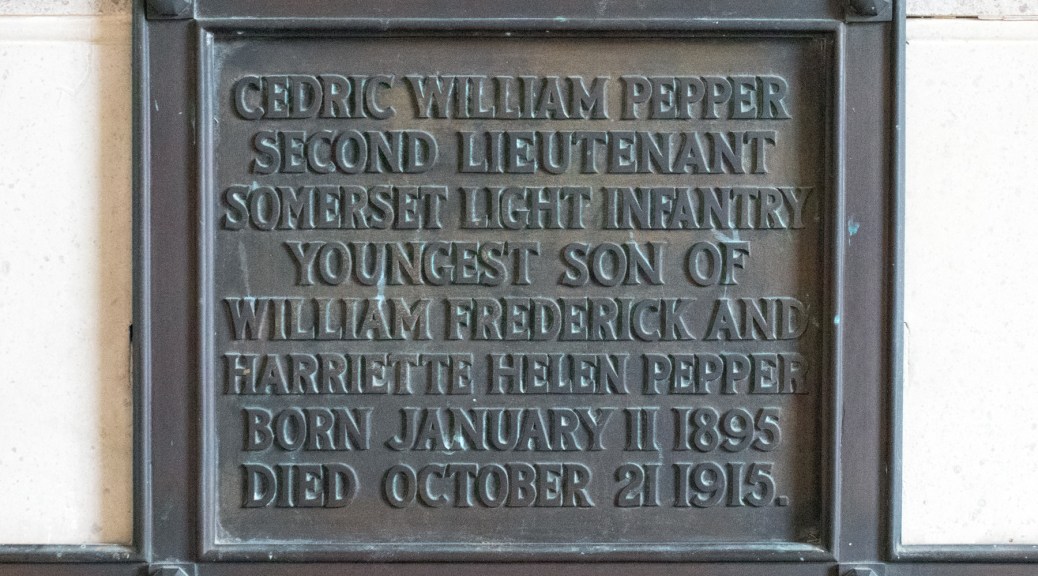
Cedric William Pepper’s family were, by this time, living in Redlynch House, near Bruton, Somerset. He was cremated, and his ashes immured in the wall of St Peter’s Church in the hamlet.


Second Lieutenant Cedric Pepper
(from findagrave.com)

In researching Cedric’s life, there is a definite sense of a young man desperately looking to please his father. A successful Yorkshire colliery owner, he may have expected more from his oldest son, a drop out from Winchester College, possibly sent to Southern Africa to find himself. While an immediate return to Britain to serve his country would have been commonplace, the suggestion of difficulty with a woman and the subsequent accident with his gun just adds to the sense of a need for Cedric to not disappoint his father.


Second Lieutenant Cyril Croft

Second Lieutenant Cyril Croft

Cyril Talbot Burney Croft was born on 28th January 1891 in Streetsville, Ontario, Canada. He was the only child of Dorset clergyman Otho Croft and his Canadian-born wife, Lucy.

Otho brought his young family back to England when Cyril was a boy. The 1901 census found him and Lucy living in South Cadbury, Somerset, where he had taken the role of the local rector. Their young son, meanwhile, was boarding at a school in St Leonard’s in East Sussex.

Education was key to Cyril’s development. He was sent to King’s College in Taunton and St Boniface College in Warminster, and enlisted in the Officer’s Training Corps for three years.

During this time, he and Lucy had travelled back to Canada, and there was an obvious draw for the young man as, in 1913, he made a move to Quebec, becoming the Assistant to the Commissioner of Harbour Works in the city.

When war broke out, Cyril was quick to step up and play his part. Joining the Canadian Expeditionary Force on 23rd September 1914, his service records show that he was 6ft 1in (1.85m) tall, with black hair, grey eyes and a dark complexion.

Cyril was initially assigned to the 12th Battalion of the Canadian Infantry, where he held the rank of Lance Corporal. On arriving in England, however, he took his leave of the Canadian force, and accepted a role in the King’s Royal Rifles. Within a few months, he transferred again, gaining the rank of Second Lieutenant in the 8th (Service) Battalion of the Somerset Light Infantry.

Details of Cyril’s actual service are vague, however, as his British Army service records are no longer available. It appears that he did not serve any time overseas, as his battalion was raised in Taunton, Somerset, and did not move to France until the end of 1915.

Second Lieutenant Croft had made a further transfer by this point, joining the Royal Flying Corps in the summer. He gained his wings on 27th October 1915 at a Military School in Birmingham.

On 8th December 1915, he was a passenger in an aircraft being piloted by a Lieutenant McDonald at Castle Bromwich.

The weather was “bumpy” but not bad… They went towards Birmingham, and then made a turn to the left. [McDonald] noticed that the engine was missing fire when he was at a height of 1,500ft [460m], and decided to land. He turned off the petrol, but did not switch off the electric ignition. He made a right-hand turn, so as to reduce the height, the machine then being at a normal angle, when, owing to the wind, the aeroplane banked. To put the machine back again he put the control lever over to the left, but finding that the machine did not answer to the control, he put on the right rudder, and Lieutenant C Black, of the Royal Flying Corps, who had instructions to watch the aeroplane, stated that shortly after eleven o’clock in the morning it ascended to a height of 1,500ft. Shortly afterwards he saw the machine coming down: it made a short spiral, then a complete circle, and while turning to make another at a height of 500ft [150m], fell straight to the ground, nose downwards. The aeroplane was in proper working order, and the witness was of the opinion that the accident was due to wind disturbances.

De Ruvigny’s Roll of Honour

Croft and McDonald were both killed. Cyril was just 24 years of age. His Colonel wrote to Otho and Lucy, noting that Cyril “did so well that it makes one feel the loss all the more of such a promising young officer. He is, indeed, a great loss to our country, especially in these times.” Cyril’s Major noted “he had a most charming, lovable character, and was thoroughly popular with all his brother officers. He was exceedingly keen at his work, and in him the service has lost a most promising and capable officer.”

Cyril Talbot Burney Croft was brought back to Somerset for burial. He was laid to rest in the graveyard of his father’s church: St Thomas a Becket’s in South Cadbury.


Second Lieutenant Cyril Croft
(from ancestry.co.uk)

Rifleman Frederick Avards

Rifleman Frederick Avards

Frederick John Avards was born in Lamberhurst, Kent, in the summer of 1891. The oldest of three children, his parents were Frederick and Lucy Avards. Frederick Sr was a licenced publican and went on to run the Beckingford Arms in Tovil, near Maidstone.

Frederick Jr helped his father with the business, but when war came to Europe, he stepped up to play his part. He enlisted on 1st January 1915, joining the 7th (Service) Battalion of the King’s Royal Rifle Corps.

Rifleman Avards was sent to France on 19th May 1915 and very quickly found himself in the thick of things. Based on the Western Front, his regiment was involved in a number of skirmishes during the Battle of the Somme.

Last week [Rifleman Avards’] parents received a telegram stating that he was lying at the Royal Victoria Hospital, Netley, dangerously wounded. They at once proceeded to Netley but only to find that he had passed away.. Meanwhile his lieutenant, knowing he had been hit and thinking he had been killed on the battlefield, had written a feeling letter to the parents, saying his gallantly he had done his duty and that he had died a true rifleman’s death in the hour of victory, and worthily upheld the name of his regiment.

Kent Messenger & Gravesend Telegraph: Saturday 9th September 1916

Rifleman John Avards had passed away from his injuries on 3rd August 1916: he was just 24 years of age. His body was brought back to Kent for burial and he was laid to rest in the graveyard of St Peter & St Paul’s Church in Aylesford, Kent, not far from the Lower Bell public house, which his parents were then running.


Rifleman Frederick Avards
(from britishnewspaperarchive.co.uk)

While buried in the churchyard, the location of Frederick’s grave is not known. Instead, he is commemorated on a joint headstone in the First World War section of the graveyard.


Rifleman Bert Burridge

Rifleman Bert Burridge

Bert Burridge was born in the spring of 1893, one of nine children to Charles and Elizabeth. Charles was a journeyman shoemaker from Crediton in Devon, and this is where Bert was born. By the time of the 1901 census, however, the family had moved south to Newton Abbot.

When Bert left school, he found work as a carriage cleaner for the railways; he soon moved out, and boarded with a family in Kingsbridge, in the south of the county.

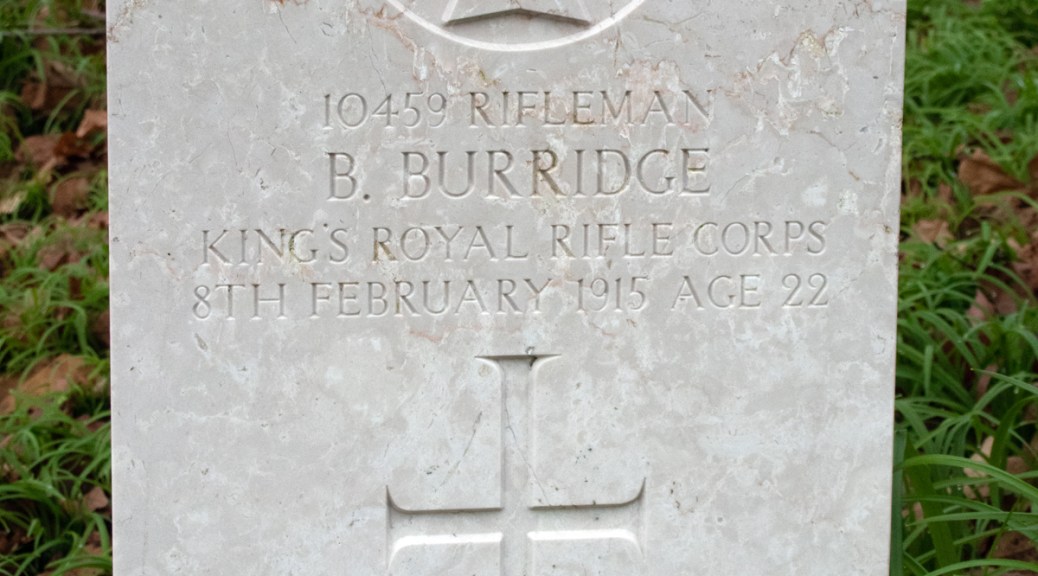
War was coming to England’s shores, however, and Bert was keen to play his part. He enlisted in the 4th Battalion of the King’s Royal Rifle Corps as a Rifleman on 16th January 1912. His service records show that he stood 5ft 4ins (1.63m) tall, and weighed 121lbs (55kg). He had a fresh complexion, grey eyes, dark brown hair, and a tattoo on right wrist of two crossed hands.

When war broke out, Rifleman Burridge was sent to France and was caught up in the fighting early on. After three months at the front, during the winter of 1914, he contracted frostbite, and was medically evacuated back to England. He was admitted to the 2nd Eastern General Hospital in Brighton, but died of injuries on 9th February 1915. He was just 22 years of age.

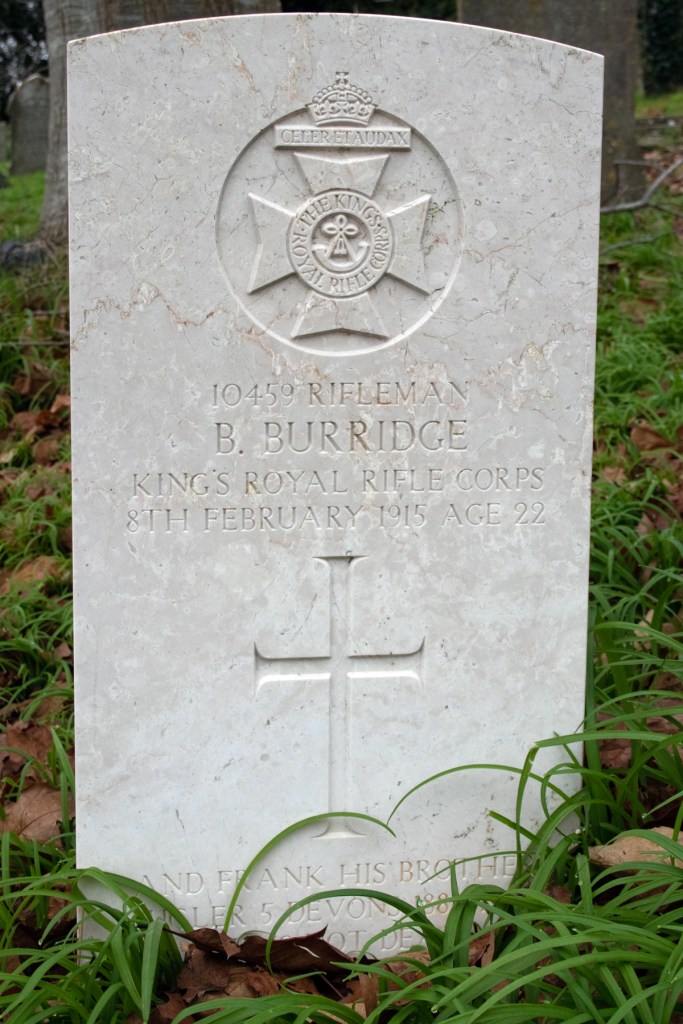
Bert Burridge’s body was brought back to Devon for burial. He was laid to rest in the graveyard of St Mary’s Church in Wolborough, on the outskirts of Newton Abbot.


Bert’s headstone also includes a commemoration to his older brother, Frank. Seven years older than Bert, he had enlisted in the Devonshire Regiment as a Bugler when quite young. He passed away in the autumn of 1906, aged just 20, but further details are unclear.


Rifleman Frederick Partridge

Rifleman Frederick Partridge

Frederick George Partridge was born on 26th May 1890 in Kingsteignton, Devon. He was one of ten children to clay cutter George Partridge and his wife, Anna. George passed away in 1903, but Frederick left school, and also found work as a cutter, helping to pay his way at home.

When was came to Europe, Frederick was keen to play his part. He enlisted on 18th November 1915, and was assigned to the King’s Royal Rifle Corps as a Rifleman. His service records show that he stood 5ft 9ins (1.75m) tall and weighed 145lbs (66kg). He was of good physical development, but had slightly flat feet.

After his initial training, Rifleman Partridge was sent to France, arriving in April 1916. His regiment soon found itself on the front line and, that summer, was firmly ensconced at the Somme. Sadly, Frederick was not to escape injury – he received a gun shot wound to his left thigh on 2nd September.

The wound was serious enough for him to be medically evacuated back to England for treatment. He was admitted to the Royal Victoria Hospital in Netley, near Southampton, but died of his injuries on 12th September 1916. He was just 26 years of age.

Frederick George Partridge was brought back to Devon for burial. He was laid to rest in the graveyard of St Michael’s Church in Kingsteignton.


Corporal Norman Allard

Corporal Norman Allard

Norman Stanley Allard was born on 3rd December 1892 in the village of Corsley, Wiltshire, halfway between Frome and Warminster. The younger of two children, his parents were Benjamin and Mercy Allard. Benjamin was a farmer who passed away when his son was only 14 years old. Mercy, who was born in Frome, moved the family back to her home town and Norman found work as a clerk at a printing firm in the area.

War came to Europe and, in December 1915, Norman was called up. There is little specific information about his military service, although his records show that he was 5ft 9ins (1.75m) tall and had varicocele – enlarged veins in his scrotum – listed as Distinctive Marks.

Initially assigned to the King’s Royal Rifles, Private Allard spent the first year of his service on home soil. He was eventually dispatched to France in March 1917, serving there for a year. On 22nd March 1918, he was wounded in a gas attack, and medically evacuated back to England.

He was called back into service, and assigned to the 9th Battalion of the Northamptonshire Regiment. He remained on home soil, working as part of the Labour Corps in Cley-next-the-Sea in Norfolk. Sadly, however, it seems that his injuries were to prove too much, and the now Corporal Allard was discharged from military service after just three months.

At this point, Norman’s trail goes cold. He returned home, and passed away there on 13th March 1919. He was just 26 years of age.

Norman Stanley Allard was laid to rest in the graveyard of Holy Trinity Church. This became a family grave, and his mother and sister were also buried there when they passed in 1924 and 1940.


Lance Corporal Henry Preece

Lance Corporal Henry Preece

Henry Thomas Preece was born in the summer of 1884, one of seven children to agricultural labourer Tom Preece and his wife, Sarah. Thomas had been born in the Somerset village of Nunney, and it was here that he raised his family.

When Henry left school, he chose not to follow in his father’s agricultural footsteps. By the time of the 1911 census, he was recorded as a baker and, as such, would have been at the heart of village life in Nunney.

Henry married local woman Ellen Stone in 1909, who was a dressmaker with her own account. The couple would go on to have four children between 1909 and 1916.

With war looming, Henry felt the need to play his part. He joined the King’s Royal Rifle Corps in January 1916 and, after training, was sent to France a couple of months later.

He was wounded on July 25th, when out with a wiring party erecting barbed wire obstacles. He received a gun-shot wound in the abdomen, which also injured the spinal cord and his back. He was first taken to the South African Hospital at the base, and after being there for several days he was removed to England and take to the Netley Hospital where he died…

Somerset Standard: Friday 8th September 1916

Lance Corporal Preece died on 3rd September 1916, at the age of 32 years old. His body was brought back to Nunney, where he was laid to rest in the family grave at All Saints’ Church.


Lance Corporal Henry Preece
(from britishnewspaperarchive.com)