Norman Howell Owen was born in the spring of 1888, and was the third of four children – all boys – to John and Elizabeth. John was a surgeon from Pembroke Dock, Pembrokeshire, but the family were raised in Fishguard, where his practice was based.
Norman was an educated young man and, in 1906, attended the Sir Isaac Pitman & Son Phonetic Institute in Bath Somerset. He was studying shorthand, passing an examination in the subject after just three months. He passed an entrance exam for the National and Provincial Bank the following year, and, by the time of the 1911 census, he was working in the Fishguard branch and living back with his parents.
When war came to Europe, Norman was called upon to play his part. Full details of his service have been lost to time, but what remains paints an interesting picture of his time in the army. He appears to have enlisted in the King’s Liverpool Regiment as a Private, before transferring to the Labour Corps, then the Army Ordnance Corps.
By 1918 the Pembrokeshire Voters List noted Norman and two of his brothers as absentee voters – serving in the army, so not at home. Norman is recorded as being a Captain in the Army Service Corps, having received a commission on 8th February 1915. His older brother John is recorded as being a Captain in the Royal Army Medical Corps, while his younger brother, Lionel, was a Captain in the Royal Field Artillery.
The mystery of Norman continued: he survived the conflict, but by February 1919 had been admitted to the Broadway Military Hospital in Sheerness, Kent. He passed away on 1st March, the cause of his passing not readily available. Captain Owen was 31 years of age.
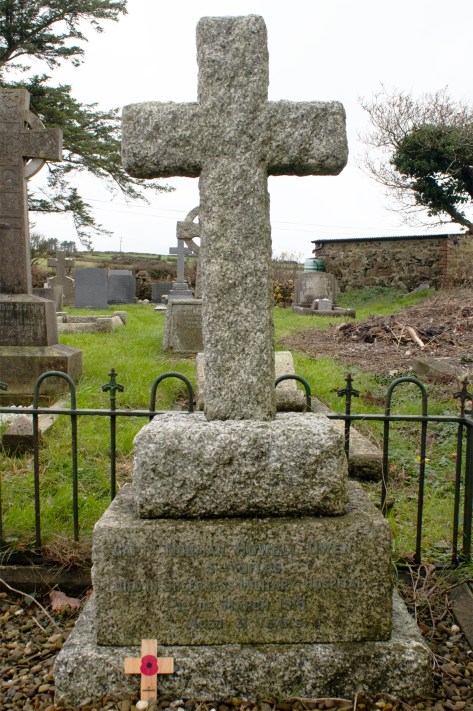
The body of Norman Howell Owen was taken back to Pembrokeshire for burial. He was laid to rest in Fishguard Church Cemetery.
Norman died intestate: his family went through probate, and his effects – totalling £1003 8s 10d (approximately £67,000 today) were left to his father.
Alfred Ribbans was born in Belvedere, Kent, in the summer of 1889. The sixth of nine children, his parents were Arthur and Sarah Ribbans. William was an iron turner from Ipswich, Suffolk, while his wife had been born in Jersey, Channel Islands. It is unclear how the couple met, but by the 1891 census the family were at No. 8 Coastguard Cottages in Erith.
When he finished his schooling, Alfred followed in his father’s stead, finding employment as a fitter and turner. By the autumn of 1908, he found an opportunity to turn this work into a career, and enlisted in the Royal Army Ordnance Corps. His service records show that, at 19 years of age, he was 5ft 7ins (1.71m) tall, and weighed 132lbs (59.9kg). He had a fair complexion with brown hair and brown eyes. He was also noted as having a scar on his left eyebrow, another on the right side of his upper lip, and two noticeable moles: one on the left side of his navel and the other on the right side of his neck.
Private Ribbans’ initial term of service was for three years. He served on home soil, and when his contract came to an end on 27th October 1911, he was stood down to reserve status. When war broke out he was mobilised again, and by 14th August 1914, he found himself in France. It is unclear exactly where he served, but his time overseas was not to be a lengthy one.
By April 1915 Alfred was back on home soil, suffering from tuberculosis. The contagious nature of the condition meant he was no longer suited to the crowded barracks and billets of the Western Front, and so Private Ribbans was medically discharged from the army.
Alfred returned home to Kent, and, when he recovered, to his job as a fitter. On 3rd July 1916 he married dressmaker Armenia Tuckerman in the parish church in Erith. At the time, the couple were living at 9 Stanmore Road, but soon moved to Totnes in Devon, presumably to help with Alfred’s now-failing health.
The following January, Armenia gave birth to a daughter, Armenia Joy, but the young family’s happiness was to be short-lived: Alfred succumbed to his lung condition on 20th March 1917. He was 27 years of age.
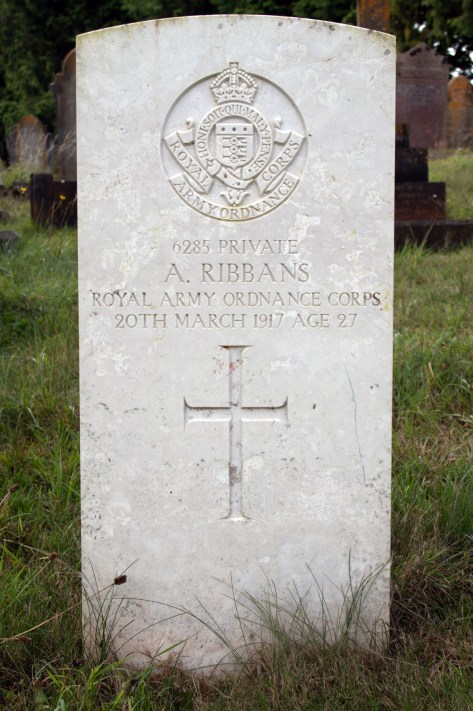
Alfred Ribbans was laid to rest in Paignton Cemetery, Devon.
Frank Harry Tom Perryman was born in Axminster, Devon, on 16th October 1889. The third of six children – and the only boy – his parents were Barnabas and Emily. Barnabas was a carpenter and joiner, and the family lived in the centre of the town: first next door to the Red Lion Inn on Lyme Street, then around the corner on South Street.
By the time of the 1911 census, an opportunity had arisen to take Frank away from Devon. The document records him as one of four servants (in addition to a maid, butler and cook) for Eumenia Hime and her law student son, Stanley. Eumenia’s husband, Edward, was a merchant in Brazil, and their son had been born in Rio de Janeiro. Ste Georgian Croyland House on Cornwall Gardens in South Kensington, was the family’s London residence, and this is where young Frank was employed.
When war came to Europe, Frank was called upon to play his part. Sadly, his service records have been lost to time, but it is evident that he enlisted in the Royal Army Ordnance Corps. Private Perryman’s Medal Roll suggests that he served on home soil, and certainly by the end of the war – presumably while waiting to be demobbed – he was based in Cheshire.
In November 1919, Frank was admitted to the War Hospital in Warrington. Details are unclear, but it is likely that he had contracted one of the many lung conditions prevalent at the time. He passed away while still admitted on 19th November: he had not long turned 30 years of age.
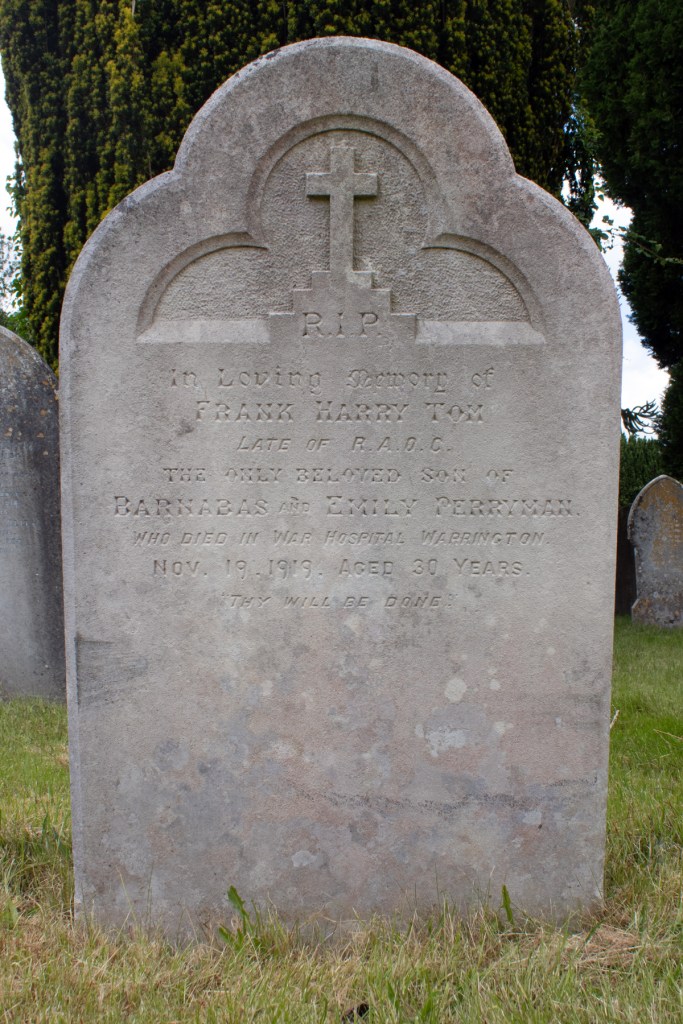
The body of Frank Harry Tom Perryman was taken back to Devon for burial. He was laid to rest in Axminster Cemetery, on the outskirts of the town that had been his childhood home.
Walter Soper Mitchell was born in the summer of 1878 in Newton Abbot, Devon. The fourth of nine children, his parents were Frederick and Mary. Frederick was a house painter and handyman, and records seem to suggest that he took the family to where the work was. The 1881 census found the family living in Chelsea, West London, and it seems that they stayed in London until 1890.
By the time of the 1891 census, the Mitchells were back in Devon, living at 10 Orchard Terrace in Paignton. Frederick was now working as a plumber, while Walter’s older siblings – brothers Frederick Jr, William and Alfred – were variously employed as a sailor, a painter and a plumber.
Walter, who was 12 years old by this point, was nearing the end of his schooling. When he left, he followed the family trade, and as soon employed as a house painter. The 1901 census found him as the oldest sibling still to be living with Frederick and Mary, although his circumstances were about to change.
In September 1903, Walter married Emily Jeffery. She was a couple of years younger than her new spouse, but, sadly, there is little information about her parents. The 1891 census found her living with her grandparents, while the 1901 return noted her boarding with her aunt and uncle.
Walter and Emily went on to have three children. By the time of the 1911 census, the family were living at 25 Norton Terrace in Paignton, Walter being employed as a house painter by this point.
War came to Europe in the summer of 1914, and Walter was called upon to play his part. Full details of his military service have been lost in the mists of time, but from what remains it is clear that he enlisted in the Royal Army Ordnance Corps at some point after July 1915. He was attached to the 67th Coy., but it is unclear whether he saw any action overseas.
Private Mitchell’s time in the army was not to be a lengthy one. He seems to have been based in Essex, and a later record confirms that he contracted bronchitis and anaemia. This would prove to be his undoing: he passed away in Colchester on 17th February 1916, aged 36 years old.
The body of Walter Soper Mitchell was brought back to Devon for burial. He was laid to rest in what would become the family plot in the sweeping Paignton Cemetery.
Robert Cogle Gillo was born in December 1880 in Bridgwater, Somerset. He was the only child to Jane and Robert Gillo who, in the 1881 census was listed as a wholesale photographer, employing four male and four female assistants.
The following census, a decade later, found the family living in Walcot, Bath, where Robert Sr was listed as living on his own means. The household also included Jane’s sister, Elizabeth, and a certified nurse, Jane Moreton.
When he left school, Robert Jr found work as an auctioneer’s clerk. By the time of the 1901 census, both of his parents had passed away, and he was boarding at Hanover House, Hanover Street in Bath. The document, however, throws up an anomaly, however, in that the house’s three other occupants are listed as Edna and Majorie White, who are identified as Robert’s daughters, and Lily Holvey, who was a servant. Whether the head of the household was not there at the time of the census return is not known, but given that ages of Edna and Marjorie were 9 and 5, to Robert’s 20, it is extremely unlikely that they were actually his children.
By the following summer Robert had taken up employment as an auctioneer in Dorset. On 4th June 1902 he married Kathleen Seward, an agent’s daughter from Bath. The couple would go on to have two children, Molly, in 1904, and Robert in 1911.
By the time Robert’s son was born, the family were living back in Bath. He was, by now, listed as living on his own means in his own right, and the family occupied a seven room house in a quiet cul-de-sac within spitting distance of the city’s Alexandra Park.
When war came to Europe, Robert stepped up to play his part. He had enlisted in the Army Ordnance Corps by the autumn of 1915, and was stationed in Didcot, Oxfordshire. When he wrote to Kathleen, he complained of not being able to sleep in the barracks, and this insomnia led to him suffering from headaches.
Sent home on sick leave in March 1916, he was quite depressed and worried, his short term memory was affected, and he had to write even the simplest tasks down, including remembering to shave. He was seen by his doctor, who had written to his commanding officer, suggesting that an extension to this leave was be beneficial. Whether this was granted or not is unknown, but after a short period back in camp, Private Gillo returned to Bath on 17th April.
Kathleen had gone out at about 5pm the following day and when she returned home just after 7pm, she was told that Robert had just left. This was not unusual, as far as she was concerned, because he often went out for a walk in the evening. Sadly, she was not to see him alive again.
Terrible Railway Fatality
On Wednesday morning last week [18th April] the much-mutilated dead body of Mr R Gillo… was picked up on the Great Western Railway at Bathampton… He was home on leave from Didcot. Deceased suffered from neurasthenia, and was depressed at times.
Central Somerset Gazette: Friday 28th April 1916
Robert had walked the five miles east to Bathford and, made his way to the railway track over the river in the village. He got onto the tracks as the express train from Paddington was coming through at around 10:30 that evening, and never stood a chance.
The the following morning the alert was raised by a signalman at Bathampton and the gruesome discover was made of parts of Robert’s body over the half-a-mile from Bathford Bridge. His glasses were found on the bridge itself and a note to Kathleen was found in his pocket. Blood was subsequently found on the front of the railway engine, although the driver was oblivious to anything out of the ordinary having happened the previous night.
An inquest found that Private Gillo had committed suicide while in a state of temporary insanity. He was just 35 years of age.
Robert Cogle Gillo was laid to rest in St James’ Cemetery in Bath, a short walk from the family home.
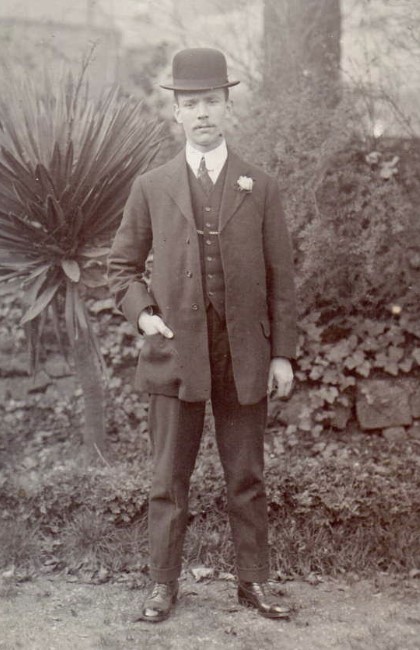
Private Robert Gillo (from ancestry.co.uk)
Robert’s headstone notes the burial of Adelaide Julia Seward, Kathleen’s mother, who died in March 1936.
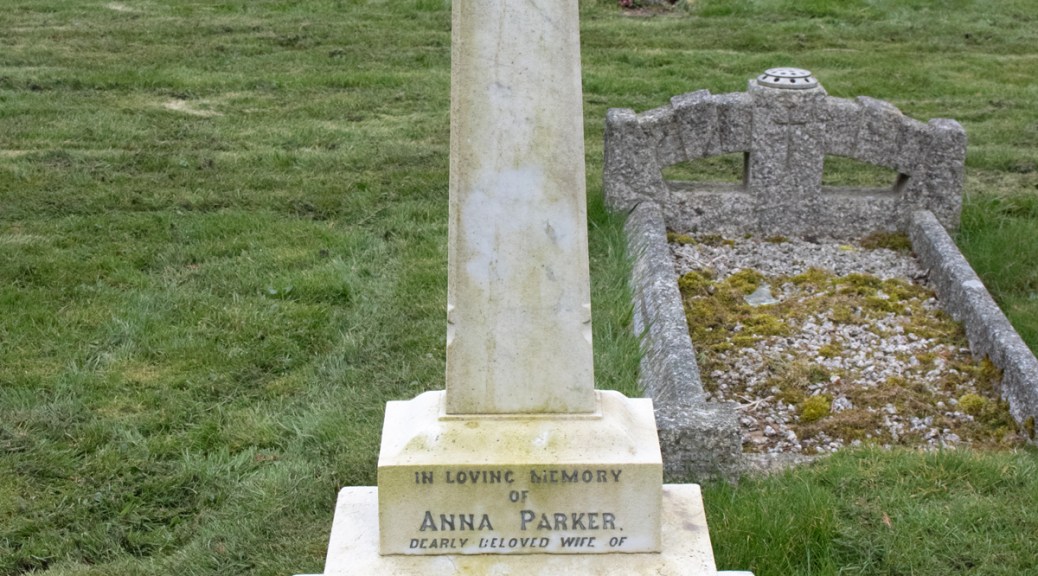
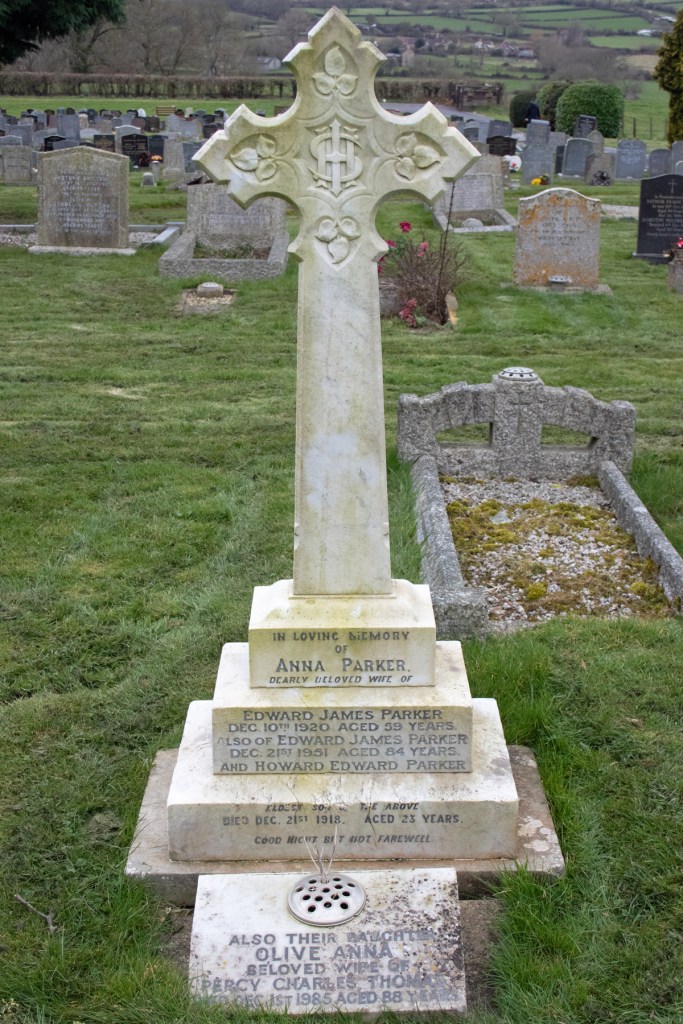
Howard Edward Parker was born in the summer of 1895 and was one of six children to Edward and Anna Parker. Edward was a tailor from Castle Cary, Somerset, and it was in his home town that he raised his young family. When he left school, Edward worked as his father’s clerk.
War was on the way, however, and Edward was keen to play his part. Unfortunately, details of his military service are limited, but from what little remains, it’s possible to piece some bits together.
Edward joined the Army Ordnance Corps at some point before June 1918. During his time in the army, he rose to the rank of Serjeant, but it is unclear whether he served on home soil or abroad.
The only other certain information is Serjeant Parker died in Southampton on 21st December 1918; the cause of his passing is unclear, and there is nothing in contemporary newspapers to suggest anything out of the ordinary. He was just 23 years of age.
Howard Edward Parker’s body was brought back to Somerset for burial. He was laid to rest in the family grave in Castle Cary Cemetery.
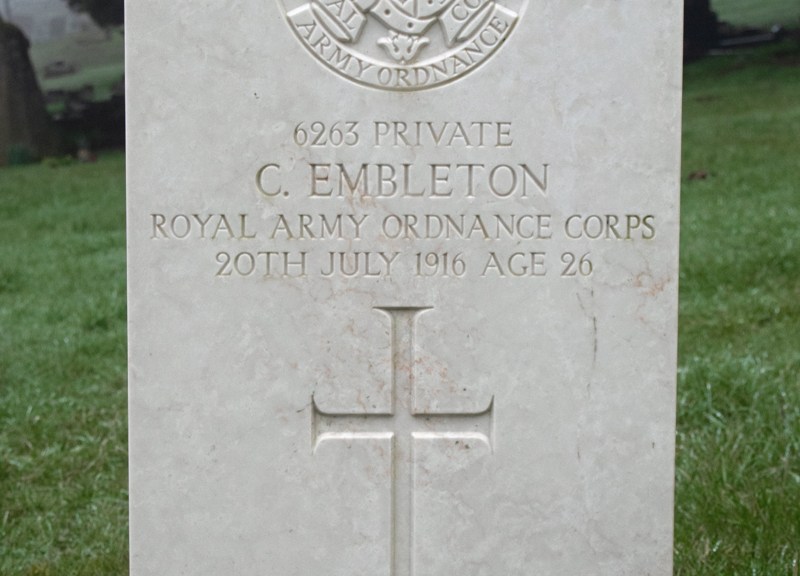
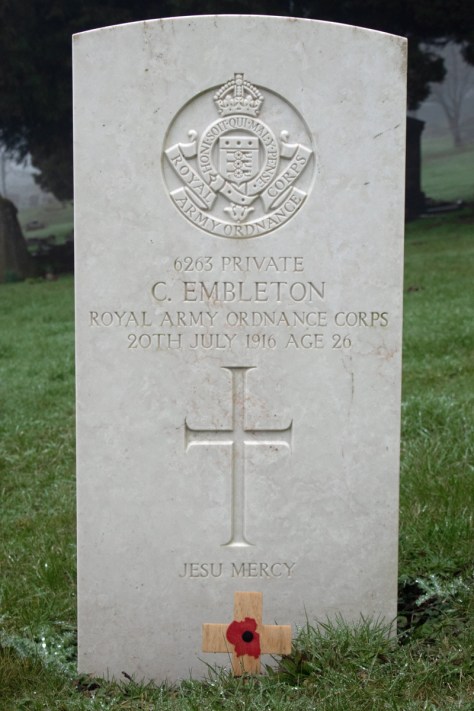
Charles Embleton was born in Alexandria, Egypt, in 1891. One of five children, his father John was a captain in the army, and his wife, Sarah was based wherever he was.
Military service was obviously in Charles’ blood. He joined up in 1908, and was assigned to the Army Ordnance Corps. After three years’ service, he was moved back to the Reserves.
Charles had met Mary Cooper, a baker’s daughter, from Farnham. They married in September 1911, and, two months later, Mary gave birth to their daughter, Florence. Her baptism records show that, by this time, Charles was working as a registry clerk for his former Corps.
When war broke out, Private Embleton was remobilised and by 14th August 1914, he was in France. His service abroad was brief, however. Within a fortnight he had been shipped back to England and there he stayed until he was medically discharged in March 1915.
While no cause for his dismissal is evident from his service records, his war pension document confirms that, when he passed away, it was from tuberculosis, contracted while on active service. It is reasonable to assume, therefore, what his lung condition was the cause for his initial discharge.
It seems that Charles and his family had relocated to the south west of England when his service was completed. It was here that he died – on 20th July 1916 – at the age of just 25 years old.
Charles Embleton lies at peace in Shepton Mallet Cemetery in Somerset.







 Death and Service