Category Archives: Royal Garrison Artillery

Gunner Victor Evans

Gunner Victor Evans

Victor George Evans was born in the autumn of 1882, one of eleven children to George and Charlotte Evans. George was a woodsman from Aldworth in Berkshire, and it was here that he and Charlotte raised their growing family.

There is little concrete information about Victor’s early life. While his family were living on Bethesda Street in Basildon, Berkshire, at the time of the 1901 census, Victor is noticeable by his absence.

On 29th January 1910, Victor married Edith Rains in Kensington, Middlesex. She appears to have been a dressmaker’s apprentice, and had been born in Moulton, Lincolnshire. The next year’s census recorded Victor employed as a butler for the Clutton family. His boss, Ralph Clutton, was a lawyer, and the family resided at 5 Vicarage Gate, not far from Kensington Palace. This time, however, it is Edith who is missing from the census record and, given that she had given birth to their one and only child, Phyllis, the year before, it is likely that she was recuperating elsewhere, possibly with the support of her family.

When war broke out, Victor was called upon to serve his country. On 22nd December 1916, he enlisted, joining the Royal Garrison Artillery as a Gunner. His service records show that 34 years of age and stood 5ft 7.5ins (1.71m) tall.

Victor was recorded as being a messenger, and he and Edith were living with his older sister, Rachel, at 17 Adeney Road in Hammersmith, Middlesex. The document suggests, however, that Phyllis was in the care of Edith’s parents in Lincolnshire, possible to enable both her and Victor to work.

Gunner Evans was assigned to the 270th Siege Battery, and he was soon sent to France. While based near Rouen in April 1918, he was badly injured through a number of shrapnel wounds, and medically evacuated to Britain for treatment. Admitted to a hospital in Paignton, Devon, there was little that could be done, other than being made comfortable. Victor succumbed to his wounds on 28th April 1918: he was 35 years of age.

It is likely that Edith would not have been able to afford for her husband to be brought back to Middlesex for burial. Instead, Victor George Evans was laid to rest in the ground of Paignton Cemetery.

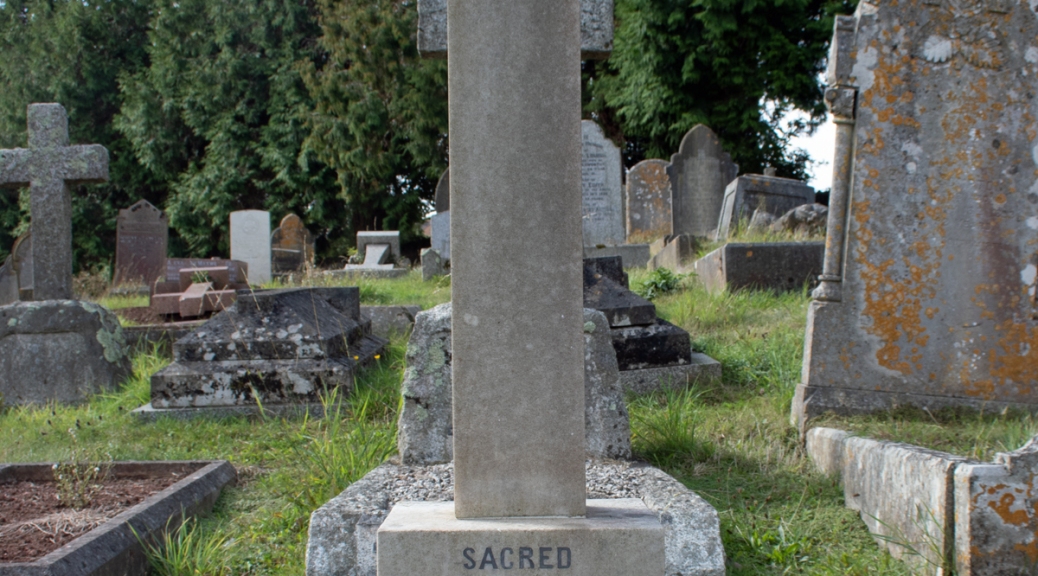
Gunner Simeon Powell

Gunner Simeon Powell

Simeon James Powell was born on 18th October 1882 in Wootton Fitzpaine, Dorset. The oldest of three children, his parents were Francis and Elizabeth Powell. Elizabeth died when Simeon was just 7 years of age, and his father remarried, and went on to have five children with his new wife, Annie.

Francis was a farmer, and Simeon found employment as an estate labourer. The 1911 census found the family living on Dodpin Farm in Monkton Wyld, a village to the north of Lyme Regis: Francis, Annie, Simeon and his three younger siblings.

On 12th June 1913, Simeon married Mary Hodder. There is little information about her, but it seems the couple set up home on the outskirts of Charmouth, Dorset. Mary was six years older than her new husband, and they didn’t go on to have any children.

War was declared in the summer of 1914, and by the following autumn, Simeon had signed up to play his part. His service records confirm that he was 5ft 11ins (1.8m) tall and weighed 188lbs (85.2kg).

Gunner Powell joined the Royal Garrison Artillery, and was formally mobilised on 31st May 1916. By November he was sent to Malta, returning to Britain in September 1917. His new posting was in Sheerness, Kent, and he would remain there for the next nine months.

In May 1918, Simeon fell ill. He had caught influenza, and when this developed into bronchitis, he was admitted to the local war hospital. His health began to deteriorate, and, on 10th June 1918, Gunner Powell passed away from a combination of bronchitis and haemoptysis. He was 35 years of age.

The body of Simeon James Powell was taken back to Devon for burial. He was laid to rest in the graveyard of St John the Baptist Church in Hawkchurch, near the family home just across the border in Dorset.


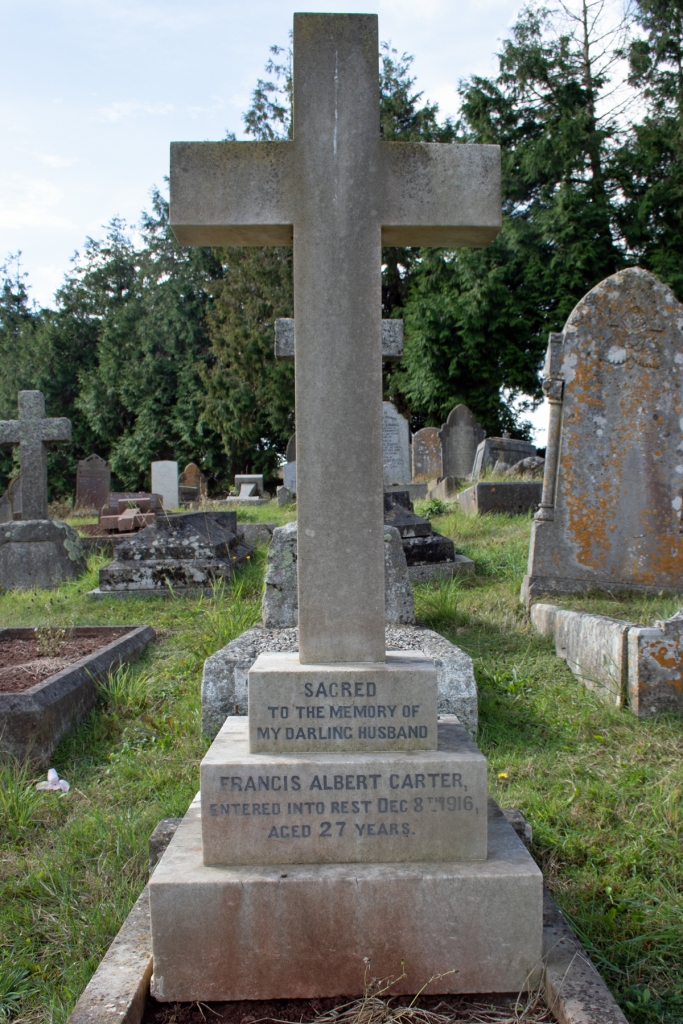
Gunner Francis Carter

Gunner Francis Carter

An inquest was held at Plymouth on Monday on Francis Albert Carter, 27, [Royal Garrison Artillery], late of 45 Lang-road, Paignton, auctioneer and valuer. Deceased was visiting his wife, who was staying with friends at St Hilary-terrace, St Jude’s, Plymouth, on the 8th inst., and died suddenly. Dr Ward said death was due to valvular disease of the heart. Deceased had only been in the artillery about three weeks. Deceased… was formerly in business with his brother as a house and estate agent…

[Western Times: Friday 15th December 1916]

Tracing the details of Francis Albert Carter’s life is a bit of a challenge, although the 1911 census records him living at 11 Shirburn Terrace, Torquay, Devon. At 21 years of age, he is noted as having been born in Lezayre, on the Isle of Man. He was living with his mother – the widow Sarah Carter, who was living on independent means – and his brother, 14-year-old Louis, who had been born in Halifax, Yorkshire. Francis was employed as a house agent, while Louis seems to have been his apprentice.

The previous census had recorded the family of three living in Torquay, and confirms that Sarah had been widowed by the time her youngest was four years old.

There is no information about Francis’ marriage, nor any indications as to who his wife might have been.

With regard to his time in the army, it is clear that he enlisted in the Royal Garrison Artillery as a Gunner in November 1916, and was on a break from his training when he visited his wife and her friends on the day he died.

There is little more detail available for Francis Albert Carter. He was laid to rest in Paignton’s sweeping cemetery, not far from where his mother and brother were still living.


Gunner Herbert Cudlipp

Gunner Herbert Cudlipp

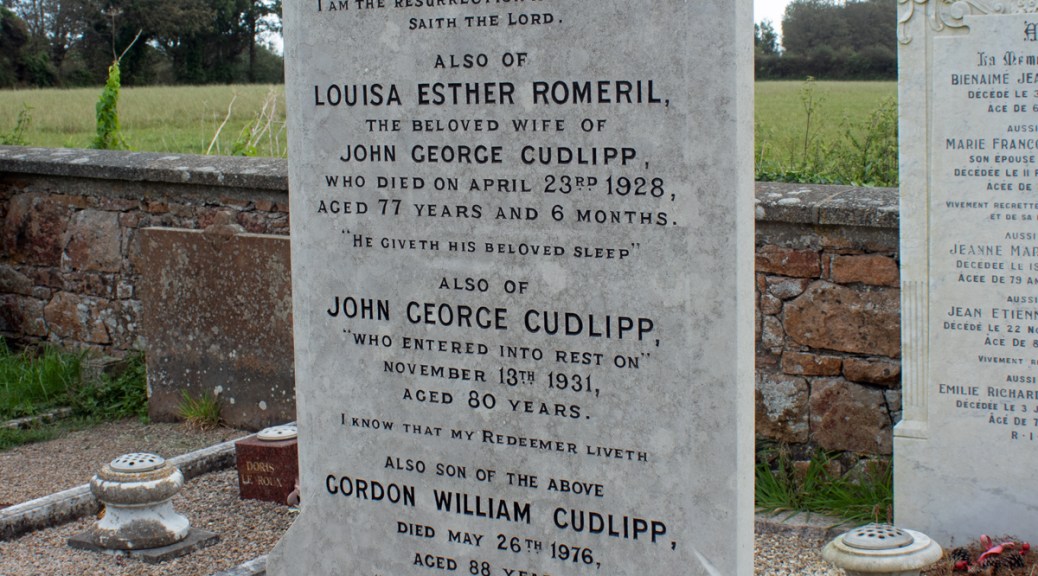
Herbert Henry Cudlipp was born in St Peters, Jersey, in around 1891. He was one of ten children to farmers John and Louisa Cudlipp. The family had moved to Mont à L’Abbé, on the outskirts of St Helier, by the time of the 1911 census, at which point the whole family were involved in the farm in one way or another.

Little information is available about Herbert’s military life. He enlisted in the Royal Garrison Artillery at some point during the war, and was attached to the 38th Siege Battery. The unit was based in Egypt from December 1915, and later moved to France. However, records are unclear as to when and where Gunner Cudlipp served.

Details of Herbert Henry Cudlipp’s later life are also lost to time. Herbert survived the war, but died on 4th June 1919, at the age of 28 years old. He was laid to rest in the family plot in Macpela Cemetery, St John’s, Jersey.


Gunner Herbert Cudlipp
(from ancestry.co.uk)

Gunner Richard Dale

Gunner Richard Dale

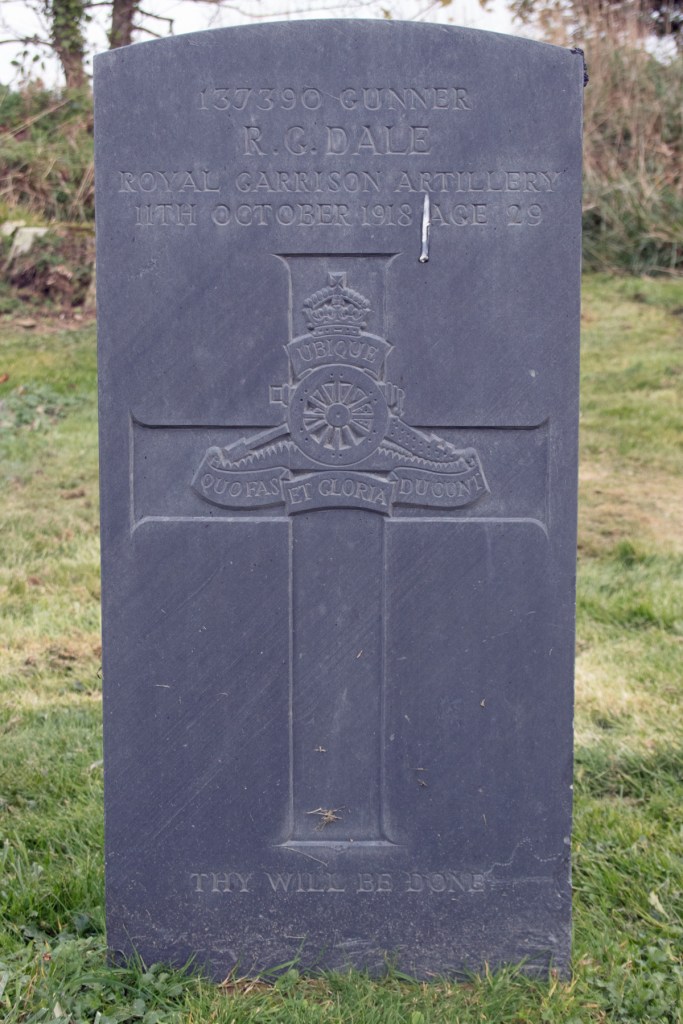
Richard George Dale was born Padstow, Cornwall, in the summer of 1889, the oldest child to Alice Dale. She married Frederick Bryant in March 1894, but and went on to have two children – Frederick and Albert – but, by the time of the 1901 census, her husband has passed away. The document gives Richard’s surname as Bryant, but there is no real indication that he was Frederick’s son.

Alice had been living with her greengrocer parents, but the 1901 census in a small cottage off Lanadwell Street, a couple of door away from them. As a widow at 31 years old, she is noted as being on parochial relief.

Details of Richard’s later life are a challenge to track down. Absent from the 1911 census, it was around that time that he married Agnes MacKintosh. While she was born in Edinburgh, the wedding took place in St Columb, Cornwall.

When war broke out, Richard was working as a farmer. He enlisted the day after hostilities were declared, and joined the Royal Garrison Artillery. Gunner Dale was, according to the records, 5ft 3ins (1.6m) tall, with medium colour hair, blue eyes and a fresh complexion. He had a scar between his eyebrows.

Gunner Dale served for nearly four years, all the time being based on home soil. He suffered from epilepsy, however, and this is what led to his eventual discharged from armed service in March 1918.

Richard returned home, but his health was compromised. He passed away on 11th October 1918, from a combination of influenza and pneumonia. He was 29 years of age.

Richard George Dale was laid to rest in Padstow Cemetery, in sight of his younger brother Albert, who had passed away eleven years before.


Lance Serjeant John Chapman

Lance Serjeant John Chapman

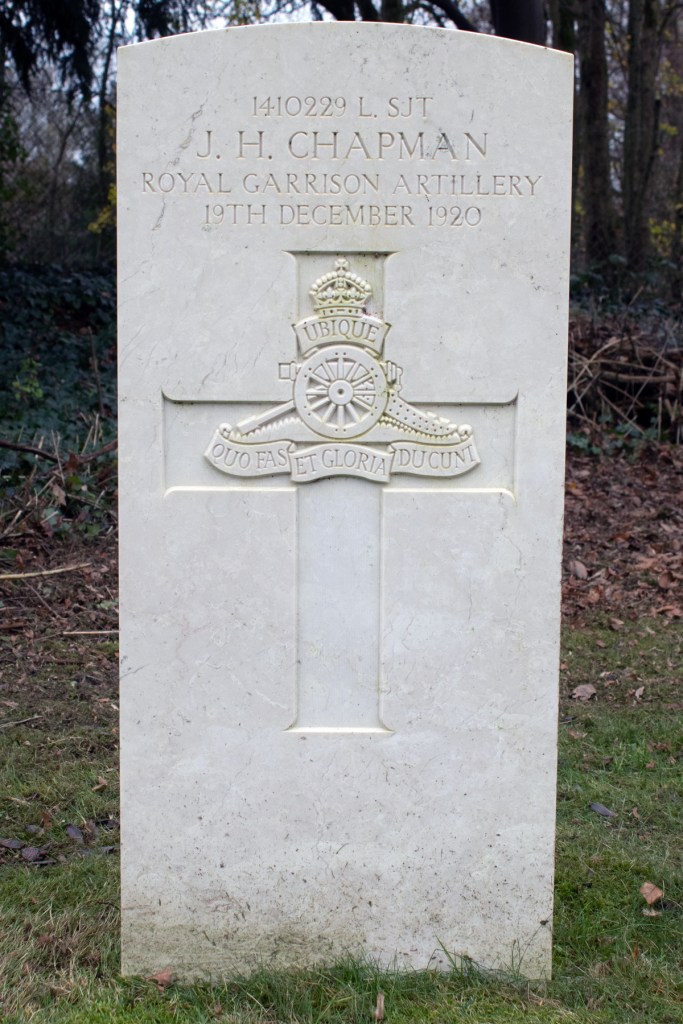
There is little concrete information available on the life of John Henry Chapman. His headstone, in Amesbury Cemetery, Wiltshire, confirms that he was a Lance Serjeant in the Royal Garrison Artillery, and that he died on 19th December 1920.

John’s pension ledger gives his widow’s name, Caroline, date of birth, 25th August 1900, and her address, High Street, New Romney, Kent. It also gives a cause of death for John, who passed away from pneumonia.

The record for Lance Serjeant Chapman’s headstone gives his next of kin as Mrs C Chapman, c/o Mrs Savage, which would suggest that that was Caroline’s maiden name. The Civil Registration Marriage Index records the union of a John H Chapman to someone with the surname of Savage in the summer of 1920: the wedding took place in Richmond, Yorkshire, although there does not appear to be any direct connection between the Lance Serjeant, Caroline and the town.

There are no further clear documents relating to John Henry Chapman. He lies at rest in the peaceful anonymity of Amesbury Cemetery.


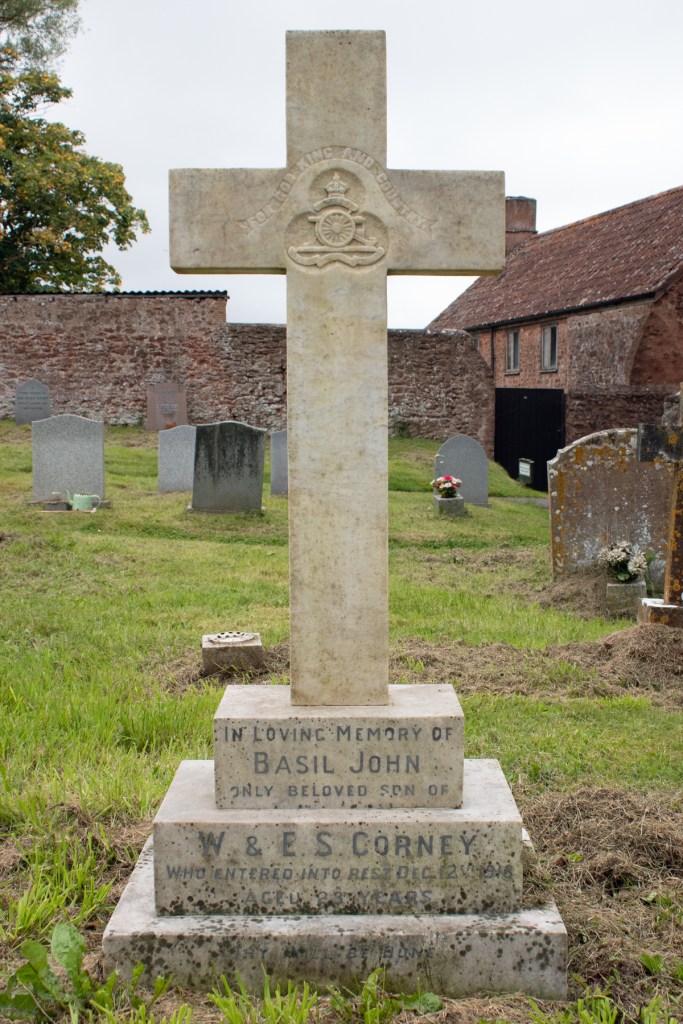
Gunner Basil Corney

Gunner Basil Corney

Basil John Corney was born in Berrynarbor, Devon, in the summer of 1895. The fourth of five children, his parents were William and Elizabeth. William’s work as a farm bailiff, took the family across the area: by 1901, they had moved to Shapwick in Somerset, and the next census record, in 1911, found the family living in Stogumber, where William had taken up management of the White Horse Hotel. Basil, meanwhile, was employed as a butcher’s assistant in the village.

When war came to Europe, Basil stepped up to serve his King and Country. He enlisted on 10th December 1915 and, from this point, preferred to go by his middle name, rather than his first. He asked to be assigned to the Royal Army Service Corps, but by the time he was mobilised in April 1916, he was attached to the Royal Garrison Artillery. Gunner Corney’s service records show that he was 20 years and 8 months old, stood 5ft 10ins (1.77m) tall and weighed 155lbs (70.3kg).

Basil was assigned to the 143rd Siege Battery and, by August 1916, he was sent to France. His time in Europe was to be brief, however, as, on 1st October, he was shot and wounded by shell fire in his right knee while fighting at the Somme. Invalided to Britain for treatment, he eventually seemed to recover, and was transferred to the regiment’s No.2 Depot.

In April 1918, Gunner Corney was admitted to hospital in Edmonton, Middlesex, as his injury was causing some issues again. An examination identified that his kneecap had all but disintegrated, and this led to his eventual dismissal from armed service on medical grounds. He left the Royal Garrison Artillery on 14th November 1918 and was awarded the Silver Badge, noting the reason for him not being in the army.

Basil returned to Somerset, but his time back with his family was to be brief. He passed away at home on 12th December 1918: he was 23 years of age.

The body of Basil John Corney was laid to rest in the peaceful graveyard of St Mary’s Church in Stogumber, across the road from, and within sight of, where his family still lived and worked at the White Horse Hotel.


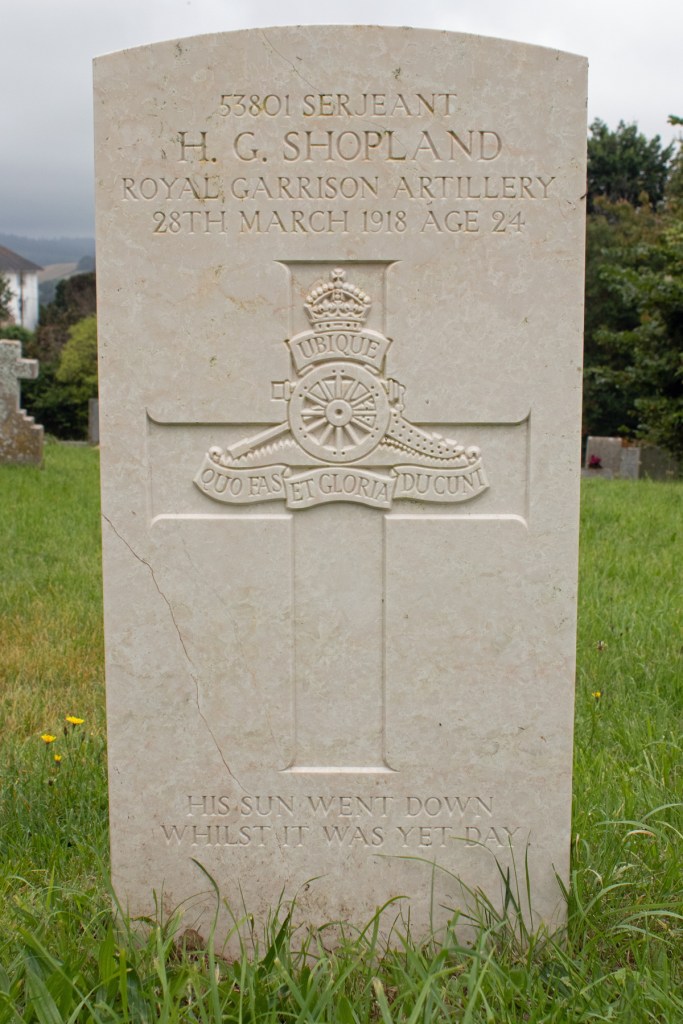
Serjeant Harold Shopland

Serjeant Harold Shopland

Harold George Shopland was born in the spring of 1893, the youngest of nine children to George and Mary Shopland. George was a joiner and platelayer for Great Western Railways: he died when Harold was just seven years old, which left Mary to raise the family alone. She did this with the support of the community and Harold’s older siblings.

By the time of the 1911 census, Harold, who was now 17 years of age, was the only one of her children to still be living at home: he was a stone mason’s carter, while Mary was getting by as the housekeeper for the local Wesleyan chapel.

When war broke out, Harold stepped up to play his part. Possibly keen to follow in his oldest brother’s footsteps – Private Walter Shopland had died at Bloemfontein in 1901 – he enlisted on 23rd November 1914. Harold joined the Royal Garrison Artillery as a Private, his service records confirming that he was 5ft 10ins (1.77m) tall, and weighed 165lbs (74.8kg).

Harold spent more than two years on home soil, before being sent to France in July 1917, with a promotion to Serjeant. He remained overseas, but fell ill with tuberculosis that winter, and was medically repatriated the following January. He was admitted to the Queen Mary’s Military Hospital in Whalley, Lancashire, and remained there for the next couple of months.

Harold’s condition meant that he was no longer fit for military duty, and was dismissed from service on 8th March 1918. He remained in hospital, however and his condition worsened. He passed away on 28th March 1918, at the age of 24 years old.

Mary brought Harold George Shopland’s body back to Somerset for burial. He was laid to rest in the peaceful setting of St Andrew’s Churchyard in Old Cleeve, not far from his father’s grave.


Gunner Lot Evans

Gunner Lot Evans

Lot Evans was born in Street, Somerset, on 30th October 1895. The second of two children, his parents were George and Elizabeth Evans. Lot’s mother had four children from a previous marriage and, by the time of the 1901 census, the family had set up home in the coastal village of Brean. George was employed as a farm labourer there, as were Lot’s older half-brothers.

When Lot completed his schooling, he also found work as a farm labourer. The next census return, in 1911, recorded the family of four still living in Brean. George had eased up on the manual work – he was 67 by this point – and was employed as a domestic gardener. Lot’s older brother Ben was a bricklayer’s labourer, so there were three wages – albeit probably meagre ones – coming in to support the household.

When war came to European shores, both Lot and Ben stepped up to play their part. Lot enlisted on 10th November 1915, but was not actually mobilised until January 1918. He joined the Royal Garrison Artillery as a Gunner, and was assigned to the 4th Siege Battery.

On 28th March 1918, Lot married his sweetheart, Hester Puddy. Theirs was to be a brief honeymoon, as he was sent to France just three days later.

Gunner Evans remained overseas until the end of the year, returning home on 5th February 1919 in advance of being demobbed.

He was very ill with influenza. He went to bed and we had the Doctor. It developed into pneumonia and he died last night [13th February 1919].

Letter from Private Ben Evans to the Royal Garrison Artillery

Gunner Evans was just 23 years old when he died. The letter sent by his brother – who was also at home and waiting to be demobbed from the Wiltshire Regiment – explained that Hester was living with their family and his question to the regiment concerned how to claim his brother’s pension.

Lot Evans was laid to rest in the graveyard of St Bridget’s Church in Brean. Now surrounded by caravan parks and holidaymakers, at the time, this would have been a place of sanctuary bordering the Somerset coastline.


Gunner John Edmonds

Gunner John Edmonds

John Edmonds was born on 12th November 1871 in Bath, Somerset. The oldest of five children, his parents were market gardener Albert Edmonds and his wife, Ellen.

When he finished his schooling, John found work as a miner. He sought a more adventurous career, however, and, on 8th November 1894 he enlisted in the army. Assigned to the Royal Artillery, Gunner Edmonds’ service records noted that he was 5ft 8ins (1.73m) tall and weighed 149lbs (67.6kg). He had brown hair, grey eyes and a sallow complexion, with a couple of marks above and below his left eye.

Gunner Edmonds was assigned to the 4th Mountain Battery and spent most of the next year training on home soil. On 17th September 1895, however, he was transferred to the 5th Mountain Battery, and shipped off to India, where he was to spend the next nearly nineteen years. During his time on the Asian sub continent, John was awarded the India Medal, with clasps for the Punjab Frontier and Tirah (both 1897-98). He was also awarded the Delhi Durbar Medal in 1911.

When war came to Europe in August 1914, John was recalled to British shores. He was not to remain on home soil for long, however as, on 9th December he was sent to France as part of the Royal Garrison Artillery. He spent just over a year on the Western Front before his troop was dispatched to Salonika, Greece, in December 1915.

Gunner Edmonds was to remain in the Eastern Mediterranean for a little over three years. During this time he had a short period in hospital, having contracted malaria, but saw the war out in Greece, returning home in March 1919. John was formally stood down from military service on 25th April 1919, having completed 24 years 169 days in the army.

Returning to Bath, John’s health had started to suffer. He had developed cancer, and passed away from the condition on 4th October 1919. He was 47 years of age.

John Edmonds’ body was laid to rest in the military section of Bath’s Locksbrook Cemetery.