Category Archives: Royal Marines

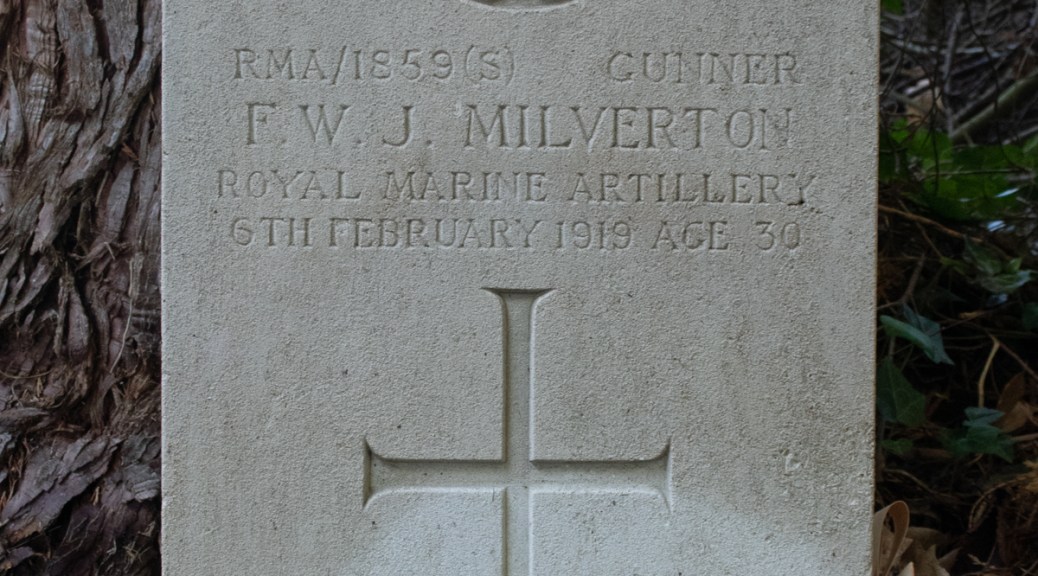
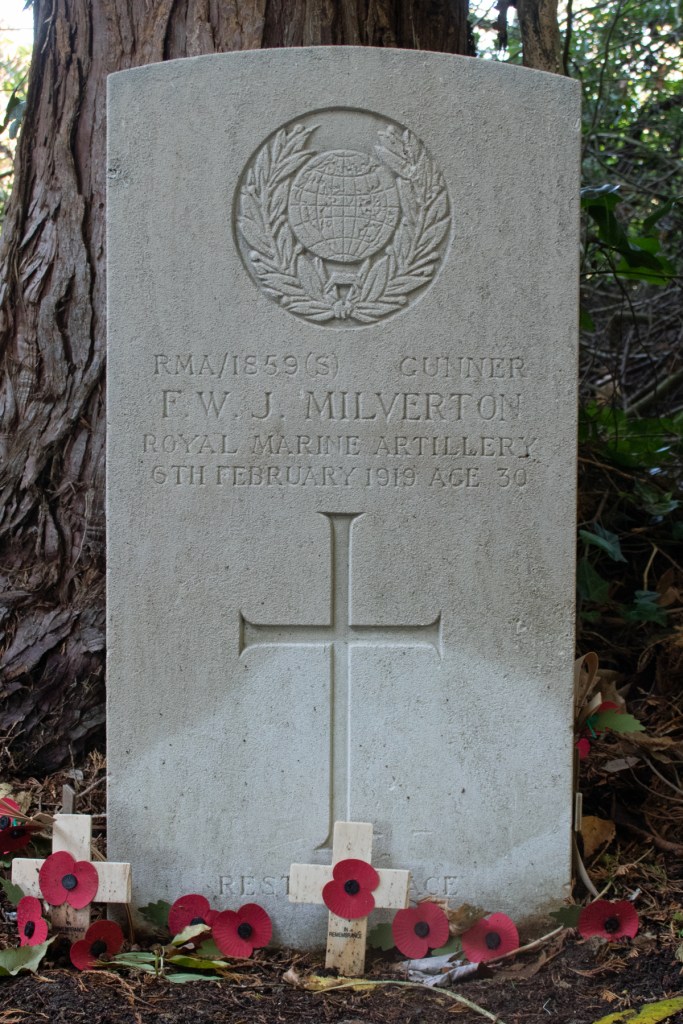
Gunner Frederick Milverton

Gunner Frederick Milverton

Frederick Walter John Milverton was born on 26th June 1888 in the Somerset village of Rimpton. One of seven children, his parents were farm workers George and Mary Milverton.

When he left school, it was natural for Frederick to follow in his father’s footsteps. The 1901 census recorded him as working as a farm lad in Leigh, Dorset, while in 1911 he was back at the family home, where he was formally employed as a rabbit trapper.

George passed away in 1913 and, with war fast approaching, Frederick remained at home, to help support his mother. But he eventually received his enlistment notice and, on 28th February 1916, he joined the Royal Marine Artillery.

Private Milverton’s service records show that he was 5ft 8ins (1.73m) tall, with dark brown hair, blue eyes and a fresh complexion. After five months’ initial training, Frederick was awarded the rank of Gunner 2nd Class, and assigned to the cruiser HMS Euryalus.

For the next couple of years Gunner Milverton remained on board Euryalus, serving in the Mediterranean, the Middle East, India and Hong Kong. He transferred to HMS Lavatera in March 1918, and saw out the remainder of the war on board.

In January 1919 Gunner Milverton returned to home soil, and was assigned to the Royal Marine Artillery Headquarters in Eastney, Hampshire. It was here, however, that he fell ill, and was admitted to the Royal Naval Haslar Hospital with bronchial pneumonia. Tragically the condition was to get the better of him: Frederick passed away on 6th February 1919, at the age of 30 years old.

Frederick Walter John Milverton’s body was brought back to Somerset for burial. He was laid to rest in the quiet graveyard of St Mary’s Church in his home village of Rimpton.


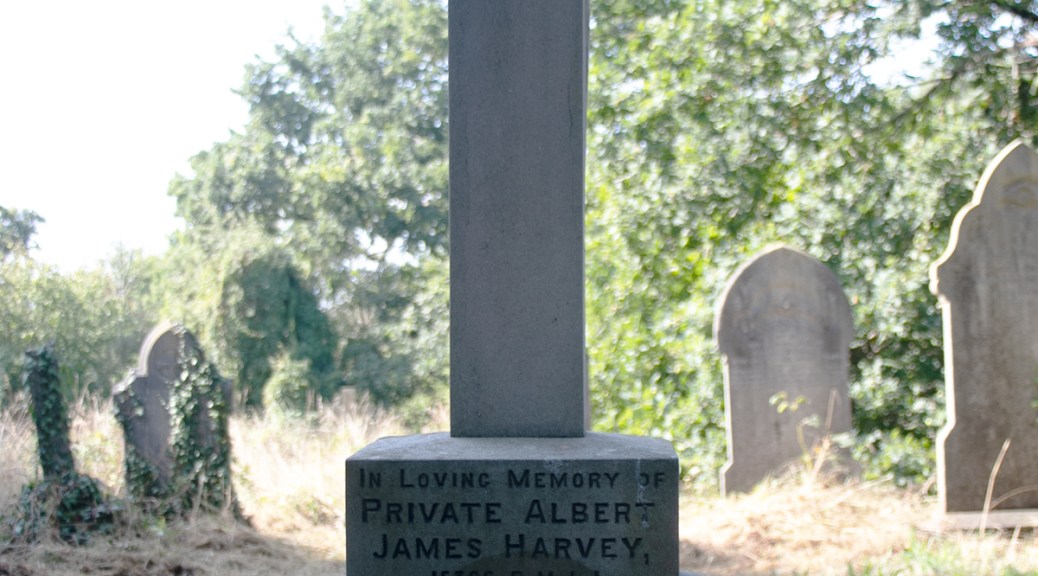
Private Albert Harvey

Private Albert Harvey

Albert James Harvey was born on 23rd May 1894 in the Gloucestershire village of Warmley. One of eleven children, his parents were James and Alice Harvey. James was a bootmaker, and most of Albert’s siblings followed him into shoemaking, but Albert bucked the trend, and found work with a baker when he left school.

He wanted bigger and better things, however, and so, on 26th April 1911, he enlisted in the Royal Marine Light Infantry. His service records record that Private Harvey was 5ft 5.5ins (1.66m) tall, with blue eyes, auburn hair and a fresh complexion. It also suggests that he added a year to his age, to ensure that he was accepted for duty.

After initially enlisting in Deal, Kent, Albert was sent to Plymouth, Devon, where he served for most of 1912. On 18th November that year, he was assigned to the dreadnought battleship HMS Conqueror, on which he was to serve for the nearly five years.

It was during his time on board Conqueror that Albert married Ethel Brewer. The daughter of a pressman, the couple exchanged vows at St Barnabas Church in their shared home village, Warmley.

Private Harvey remained serving throughout the war and, in April 1918, he was involved in the Zeebrugge Raid. This was an attempt by the Royal Navy to block the Belgian port by sinking obsolete ships in the canal entrance. During the operation, more than 200 men were killed and over 300 – including Albert – were wounded.

Private Harvey was medically evacuated to England for treatment, but his injuries were to prove too severe. He passed away in a hospital in Plymouth on 28th June 1918. He was just 24 years old.

Albert James Harvey was brought back to Gloucestershire for burial. He was laid to rest in the graveyard of St Barnabas’ Church, where he has been both baptised and married.


Private William Jackson

Private William Jackson

Little concrete documentation remains about the life of William Henry Jackson. He was born in Bedford, Bedfordshire, on 6th February 1872, although it is not possible to identify who his parents were.

He married a woman called Edith in 1903, and the couple settled in her home town of Beeston, Nottinghamshire. By the time of the 1911 census, he was recorded working as an electrician’s labourer at the local telephone works, while Edith, who was five years his senior, earned extra money as a blouse finisher.

Information about William’s wartime efforts are also limited. He enlisted in the Royal Marine Light Infantry, and was assigned to the Chatham Division. He was given the rank of Private and based at the Royal Naval Dockyard in the Kent town.

The only other information available for Private Jackson is that he died on 16th September 1916, having contracted a combination of pneumonia and tuberculosis. He was 44 years of age.

William Henry Jackson was laid to rest in Woodlands Cemetery, Gillingham, not far from the dockyard in which he had served. His headstone gives the initial H, rather than W, although no documents suggest he went by any name other than William.


Gunner Arthur Young

Gunner Arthur Young

Arthur William Young was born on 11th July 1900, in the Gloucestershire village of Charfield. His parents, James and Eliza, were both born in the area, and this is where they raised their nine children.

James worked as a bone turner and sawyer, working the material for things like buttons. This was a family trade, and something that Arthur followed his father and older siblings into when he finished school.

By this point, storm clouds were brewing over Europe. Arthur was too young to enlist when war first broke out, but when his older brother Francis died in Northern France in December 1917, this seemed to have driven him to play his part as well.

Arthur enlisted in the Royal Marine Artillery on 1st July 1918, a couple of weeks before his eighteenth birthday. Assigned the rank of Private, his records show that he was 5ft 9ins (1.65m) tall, had blue eyes, brown hair and a fresh complexion. It was also noted that he had a scar on his right wrist and another on his forehead.

After nine months’ service, Arthur was promoted to Gunner and, by the autumn of 1919, he was assigned to the dreadnought HMS Queen Elizabeth.

On 1st December 1920, while moored in Portland Harbour, Dorset, a concert was held on HMS Warspite. Gunner Young attended, but on the trip back to his own ship, the boat he was on collided with another, and he and three others were knocked overboard and drowned. He was just 20 years of age.

Arthur William Young was brought back to Gloucestershire for burial. He was laid to rest in the family plot in the Congregational Chapelyard in his home village of Charfield.


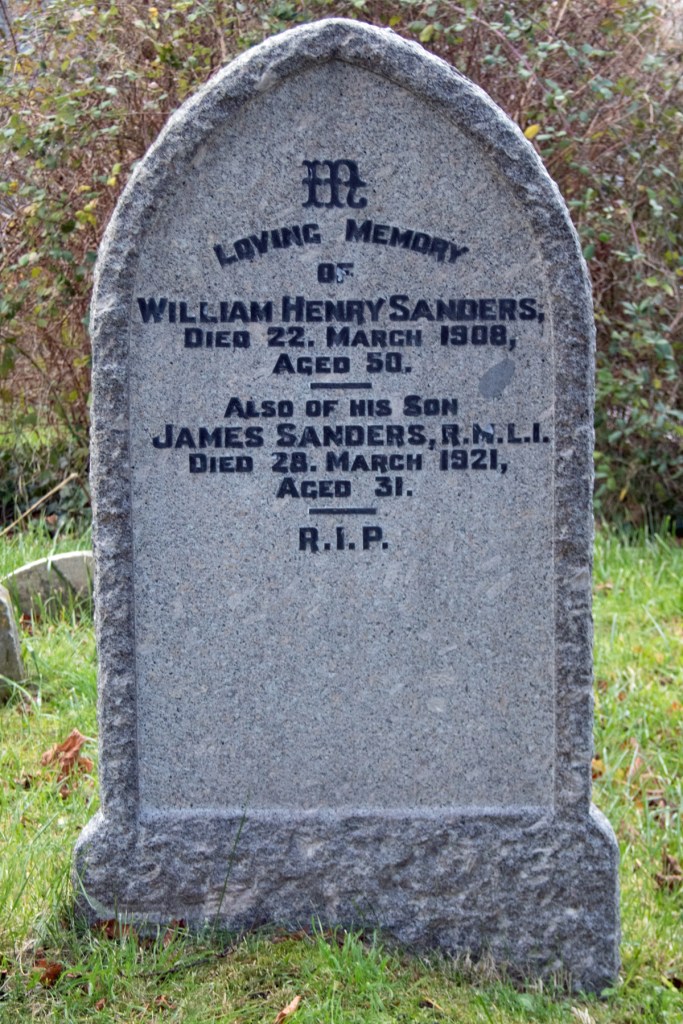
Private James Sanders

Private James Sanders

James Sanders was born on 17th April 1889. One of nine children, his parents were William and Emily Sanders. William worked for a clay company in his home town of Kingsteignton, Devon. He had various roles, including caretaker, inspector and messenger.

William’s son, however, was after bigger things in life and, on 17th July 1907, he enlisted in the Royal Marine Light Infantry. James’ service records show that he was 5ft 6ins (1.67m) tall, had light brown hair, grey eyes and a fresh complexion.

Based out of Plymouth, Private Sanders signed up for an initial period of twelve years. During this time, and throughout the war, he served on six vessels, including 30 months on HMS Argyll (where he was based for the 1911 census) and more than five years on HMS Colossus.

In April 1919, Private Saunders returned to land. When his initial contract was up, he re-enlisted, this time remaining at the Naval Dockyard in Plymouth.

James’ trail goes a little cold for the next couple of years, although he continued in his role with the Royal Marine Light Infantry. On the night of the 28th March 1921, however, he encountered some trouble. The local newspaper reported on the subsequent inquest.

Kingsteignton Man’s Mysterious Death

At an enquiry held at Teignmouth on Saturday afternoon into the circumstances attending the death of Private James Sanders, RMLI… who was found drowned in the river Teign on Friday, it was stated that deceased and seven other Kingsteignton men on Monday visited Teignmouth to attend a football match, at which Sanders acted as touch-judge.

After the match they went to a public house, where deceased had three or four pints of beer and some spirits, which made him unsteady.

They left to catch a bus, but at Station Road deceased turned back. One of his companions followed him, but could not persuade him to return, so he left deceased on his own to travel back home.

The man considered Sanders was in a condition to look after himself. An open verdict was returned.

Wester Times: Friday 8th April 1921

Private James Sanders died on 28th March 1921, aged 31 years old. He was laid to rest with his father, William, who had died in 1908, in the graveyard of St Michael’s Church in Kingsteignton.


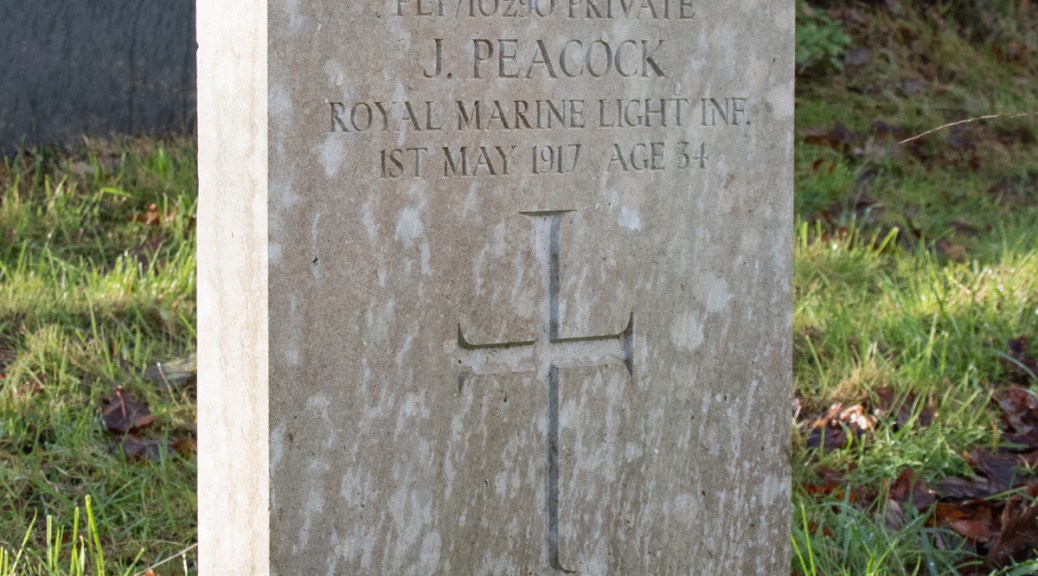
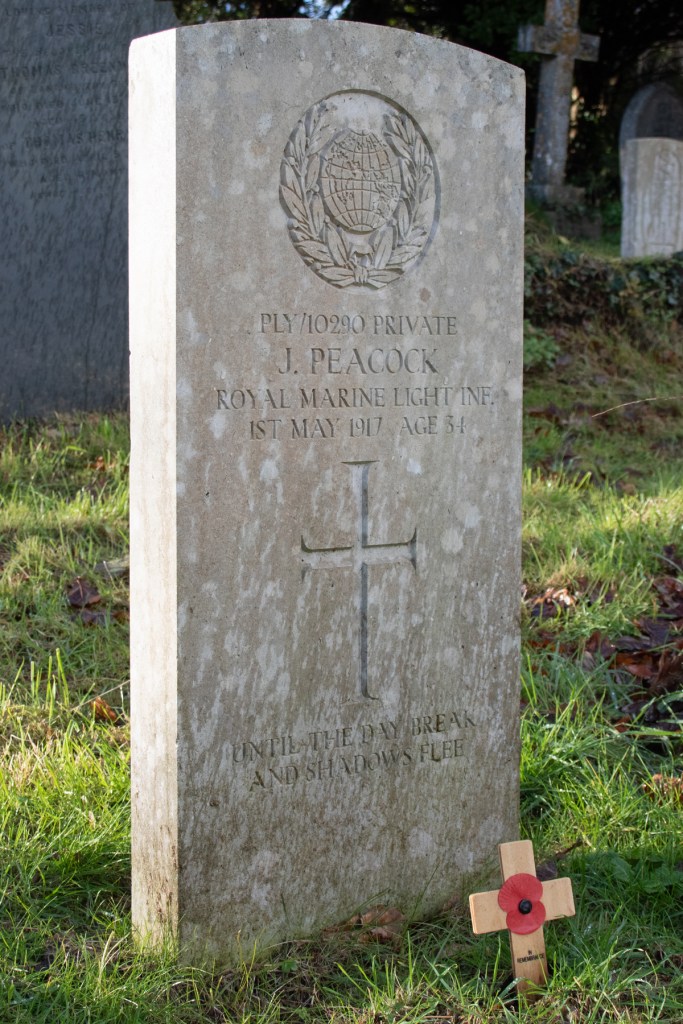
Private John Peacock

Private John Peacock

John Peacock was born in Ashburton, Devon, in 1883. Details of his life are a little sketchy, but his parents were John and Mary Ann Peacock, and he was one of at least thee children. John Sr was an agricultural labourer, but his son wanted bigger and better things.

By the time of the 1911 census, John Jr had enlisted as a Private in the Royal Marine Light Infantry. No military records exist to confirm when he joined up or where he served. The census recorded him as being a patient in the Royal Naval Hospital in East Stonehouse although, again, there is no record of why he had been admitted.

The story of Private Peacock’s health seems to remain a thread through his life. The next document evident is his Pension Ledger Card. This confirms that he died on 31st May 1917, from what was described as general paralysis, often insane. He was 34 years of age.

John Peacock was laid to rest in the graveyard of St Andrew’s Church in his home village of Ashburton, Devon.


Private Frederick Down

Private Frederick Down

Frederick Francis Down is one of those servicemen whose life is destined to remain lost to time. Born in Chudleigh, Devon, most of the information available about his life comes from one document – his naval service record.

The document gives his date of birth as 15th November 1897 and confirms that he enlisted on 23rd November 1914. Frederick was 5ft 2ins (1.57m) tall, had a fresh complexion, brown eyes and dark brown hair.

Frederick signed up as a Private in the Royal Marine Light Infantry, and, at the time of joining up, had been working as a butcher’s boy, living in Fore Street in the village of his birth.

Private Down served at the regiment’s depot in Deal, Kent. But he was only there for a short time: he was invalided out of the service – for reasons unrecorded – on 9th June 1915.

At this point, Frederick Francis Down’s trail goes cold once again. His gravestone confirms that he died on 11th April 1916, at the age of just 18 years old. He was laid to rest in Chudleigh Cemetery.


Sergeant John Foxworthy

Sergeant Joh Foxworthy

John James Foxworthy was born in the South Devon village of East Allington in 1867. He was the middle of five children to carpenter Roger Foxworthy and his wife Ann.

When he left school, John found work on a local farm, but he had bigger plans and, in July 1887, he enlisted in the Royal Marine Light Infantry. His service records show that he stood 5ft 8ins (1.73m) tall, had dark brown hair, brown eyes and a fresh complexion.

John had a varied military career that lasted for more than two decades. During this time, he served on nine ships, and was based at HMS Vivid – the Royal Naval Dockyard in Plymouth – for significant periods of time. He began as a Private, but rose through the ranks to Corporal (in 1894) and Sergeant (in 1900). He was wounded in April 1899, when he was shot in the leg, but recovered from this and continued his career.

In 1895, John married Maria Woodley, the daughter of a railway labourer from Totnes. The couple went on to have four children, Minnie, Gladys, Alice and William.

In 1908, Sergeant Foxworthy left the Royal Marine Light Infantry after 21 years’ service. By now the family home was in Prospect Terrace, Newton Abbot, just a short walk from the town centre. The 1911 census records him as being a Royal Marine pensioner and caretaker of the Miniature Rifle Club.

When war broke out, John was called back into duty and, by September 1914, he found himself in a Royal Marine Depot in Belgium. His service overseas was fairly short, and he had returned to England by the spring. He was working as a recruiting sergeant in Northampton on 30th March 1915, when he suddenly collapsed and died. He was 47 years of age.

John James Foxworthy’s body was brought back to Devon; he lies at rest in the family grave in Newton Abbot Cemetery.


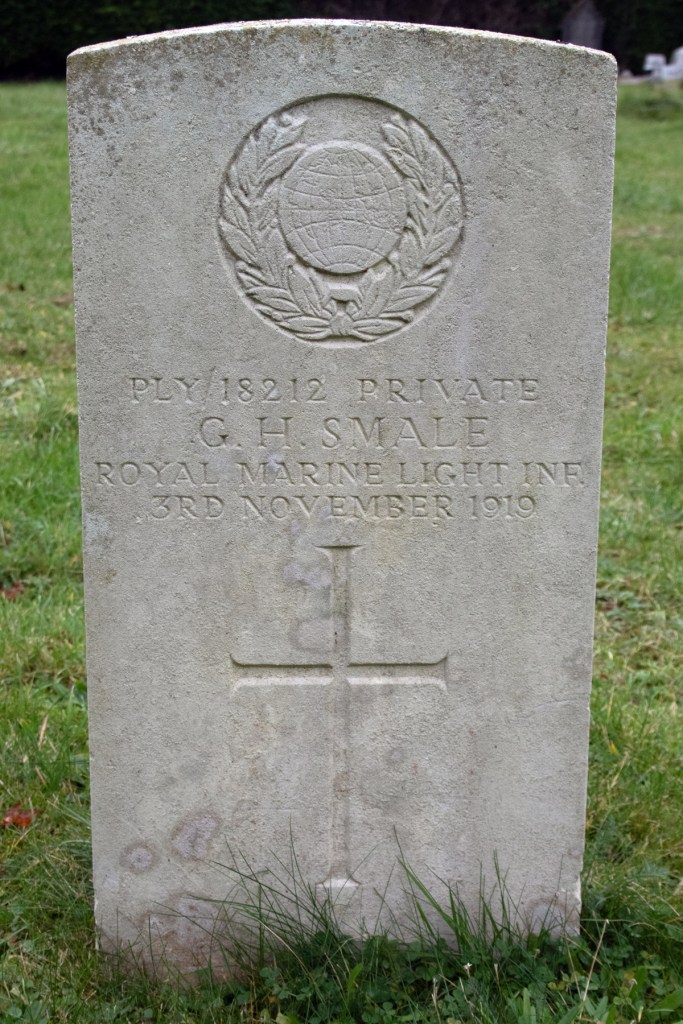
Private George Smale

Private George Smale

George Henry Smale was born in 1899 and was the oldest of four children to George and Alice Smale. George Sr was born in Tavistock, Devon, and worked as a labourer in a tannery. The family were raised in Newton Abbot, which is where George Jr was born.

Sadly, little is documented on young George’s life. He would have been 15 years old when war broke out, but at some point during the conflict, he enlisted in the Royal Marine Light Infantry. Private Smale was based at the Stonehouse Barracks in Plymouth, but no other information about his service is available.

George’s trail goes completely cold at this point, and there is nothing to confirm how or when he left the army, or how he died. All that can be confirmed is that he passed away on 3rd November 1919, and that he was just 20 years old at the time.

George Henry Smale was laid to rest in Newton Abbot Cemetery.


Private John Lodge

Private John Lodge

John Thomas Inskip Lodge was born in Shefford, Bedfordshire, on 31st January 1899, one of seven children to John and Florence Lodge (née Inskip). When his son was young, John Sr worked as a bead lace manufacturer, but by the time of the 1911 census, he had become the manager of a steam laundry.

Florence, by this time, had passed away, and in November 1911, John Sr married again, to Florence Yarnell. The couple would go on to have four children, John Jr’s half-siblings.

By this time, war was on the horizon, and John was eager to leave his laundry job and volunteer. He joined the Royal Marine Light Infantry on 4th September 1915, giving his date of birth as three years earlier in order to ensure he was accepted. His service record shows that he stood 5ft 4ins (1.62m) tall, had a fresh complexion, brown eyes and brown hair.

As a Private, John served with the Chatham Division of the regiment; he would have seen action in some of the key battles of the war, including at Gallipoli in 1915/16 and later on the Western Front. It was while he was fighting in France in September 1916 that he was injured, and he was medically evacuated back to England for treatment.

Private Lodge recovered, and served on in Chatham, Kent, where he was billeted at the naval barracks in the town. At the start of June 1917, he had some leave owing, and so visited his parents back in Bedfordshire. When he returned to Kent, he fell ill and was admitted to the Naval Hospital in the town. Sadly, John was not to recover; he passed away on 23rd June 1917, aged just 18 years old.

John Thomas Inskip Lodge was laid to rest in the Woodlands Cemetery in Gillingham, not far from the Chatham barracks at which he was based.