Category Archives: Somerset Light Infantry

Second Lieutenant Wallis Rochfort-Davies

Second Lieutenant Wallis Rochfort-Davies

Wallis Rowland Henry Rochfort-Davies was born August 1895, the youngest of two children to Reverend Charles Rochfort-Davies and his wife, Ethel. Charles was, for some time, the vicar at St Leonard’s Church in Shipham, Somerset, and both Wallis and his older sister Agnes, were both at school until at least their late teens.

Details of Wallis’ military service are scant. He enlisted in the Somerset Light Infantry, and was assigned to the 3rd (Reserve) Battalion, which was based initially in Taunton and then Devonport, near Plymouth.

Sadly, the next information available for Wallis relates to his death. A contemporary local newspaper initially.

It is reported that Sec.-Lieut. Wallis Rowland Henry Rochfort-Davies, 3rd (Reserve) Batt. Somerset LI, died on March 8th. He was the only son of Rev. CH Rochfort-Davies, of Shipham Rectory, Weston-super-Mare. Aged 20, he obtained his commission in Somerset LI in August 1914.

Western Morning News: Thursday 16 March 1916

No details of the cause of Wallis’ death were announced, but a post mortem and inquest were held, and the findings came out later that month.

At the Coroner’s Court yesterday afternoon, Mr AE Baker resumed the inquiry into the circumstances surrounding the death of Wallis Roland [sic] Henry Rochfort-Davies, aged 20, a Second Lieutenant in the Somerset Light Infantry. The inquest was opened on the 9th when evidence was given to the effect that deceased was found dead at the Royal Hotel on March 8. The adjournment was rendered necessary in order that the contents of the stomach might be analysed.

Mr Russell, the City Analyst, gave evidence as to the examination of the contents of the stomach. This showed the presence of morphia.

Dr PW White said he was called to the Royal Hotel about 3:30 in the afternoon of March 8. He found the deceased lying in bed, life being extinct. Death had take place probably 8 or 9 hours previously. There were no external marks of violence. The post mortem examination showed some congestion of the internal organs, but nothing to account for death. He had no hesitation in saying that the cause of death was morphia poisoning, probably hypodermically administered.

Charles Greenslade, a plain clothes officer, said he was called to the Royal Hotel on Wednesday 8 March about 4:30pm. Witness made an examination of the room. He found on the dressing table a case containing two small bottles: one was filled with morphia tablets and the other empty. There was also a blue bottle found, which contained a lotion. Needles and a hypodermic syringe were also found…

Reginald Francis Cheese, a friend of the deceased, said he had shown him some drugs on two occasions. He identified a case of drugs produced as having been shown him by the deceased.

The jury returned a verdict of “Death from an overdose of morphia, self-administered”. The expressed sympathy with the father of the deceased and desired to severely censure the witness Cheese.

The Coroner spoke of the increased habit of drug taking among officers, and of the amount of drugs which the case that had been produced contained. Deceased, he said, could not have purchased from any chemist such a quantity of drugs, and it must have got into his hands through the medium of a friend. It was a grossly wicked act that such a large quantity of drugs was ever allowed to get into the hands of this unfortunate young man.

Western Daily Press: Friday 31st March 1916

Wallis Rowland Henry Rochfort-Davies was just 20 years old when he died. He was laid to rest in the Milton Cemetery in Weston-super-Mare, in his home county of Somerset.


Private Henry Cowles

Private Henry Cowles

In a quiet corner of a cemetery in Somerset stands a gravestone to Private HJ Cowles. It confirms that he passed away on 26th April 1920, and that he was in the Bedfordshire Regiment during the First World War.

Little additional information on HJ Cowles is available. One document, the Medal Roll Index Card, confirms his first name as Henry, and that he had initially joined the Somerset Light Infantry. He was awarded the British Medal for his war service.

Cowles is a fairly common name in the Somerset area, and, without any additional information – date of birth, familial connections – it is impossible to narrow down the name on the gravestone to a specific Henry Cowles from the area or beyond.

There is also nothing in any contemporary newspapers to suggest that Private Cowles’ passing was anything out of the ordinary.

Sadly, therefore, he remains a name lost to history. Henry J Cowles, whoever he was, and however he died, lies at rest in the Milton Cemetery in Weston-super-Mare, Somerset.


Private Edward Sams

Private Edwards Sams

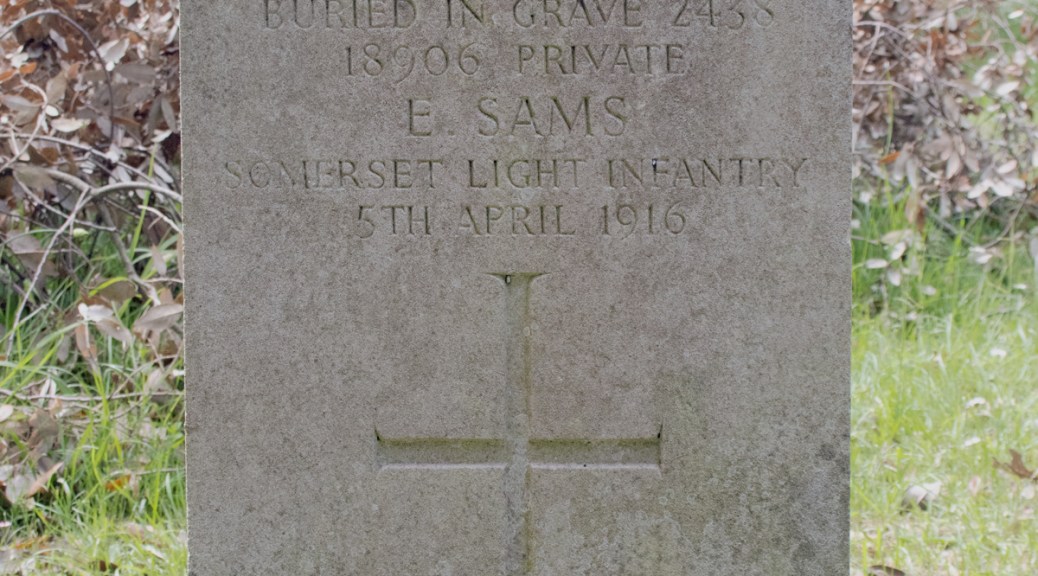
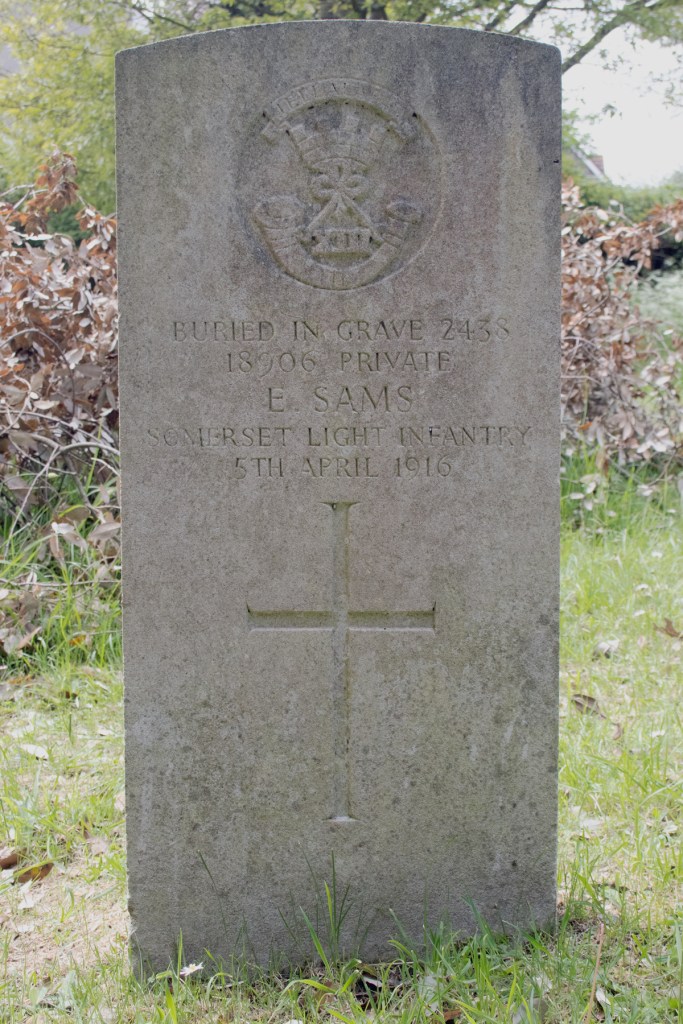
In a corner of the Milton Cemetery in Weston-super-Mare, Somerset, stands the gravestone of Edward Sams. It gives little information away, other than the fact that he passed away on 5th April 1916, and that he served as a Private in the Somerset Light Infantry.

There is no documentation – military or otherwise – that can be concretely connected to Private Sams. None of the available documents for Edward Sams include the service number on his gravestone, and there is nothing to provide a definite date of birth or familial connections.

Sams was not an uncommon Somerset name at the start of the twentieth century, and there are a number men by that name called Edward in the area at the time. Again, however, the information is lacking that allows us to directly connect any of these names with the gravestone in the Weston-super-Mare cemetery.

There is nothing in any contemporary newspapers to suggest that Private Sams’ passing was anything out of the ordinary.

Sadly, therefore, he remains a name lost to history. Edward Sams, whoever he was, and however he died, lies at rest in a Somerset cemetery.


Major Stanley Payne

Major Stanley Payne

Stanley James Payne was born towards the end of 1882, one of eleven children to Stephen and Elizabeth Payne. Stephen was a leather salesman from Essex, who had moved his family to Weston-super-Mare in Somerset in around 1880.

Stanley seems to have been drawn in to a military life from an early age. In January 1900, he enlisted as a Private in the Somerset Light Infantry, and the 1901 census listed him as living at the Raglan Barracks in Devonport, near Plymouth.

Military service took Private Payne to India, where he served for six years. His success and ambition were clear; in 1906 he was promoted to first to Corporal and then to Sergeant. By 1911 – and now back in England – as a Lance Sergeant, Stanley was working as a military clerk at the Royal Horse Artillery Barracks in Dorchester, although he was still attached to the Somerset Light Infantry.

Stanley’s ambition and sense of adventure continued; by July 1912 he had made the transfer over to the newly-formed Royal Flying Corps, as a Sergeant.

It was while he was based in Dorchester that he met Winifred Bell. She was the daughter of a local council worker, and the couple married in the town in September 1912. Stanley and Winifred went on to have a daughter, Doris, who was born in July 1914.

War had arrived in Europe, and on 7th October, the now Warrant Officer Payne was shipped to France. During his nine months on the Western Front, he was mentioned in despatches and received the Croix de Guerre for his gallantry. The local newspaper also reported that he:

…had also the honour of being presented to the King on the occasion of His Majesty’s last visit to the front, and at a home station had also been presented to Queen Mary.

Western Daily Press: Saturday 8th March 1919

Returning to England on 1st June 1915, he was again promoted to Lieutenant and Quartermaster, although here his military records dry up. By this time, he had been in the armed forces for more than fifteen years, but his military records seem to confirm this as the last day of his service.

The next record for Stanley confirms his passing. Admitted to the Central Air Force Hospital in Hampstead with a combination of influenza and pneumonia, he died on 3rd March 1919. He was just 36 years of age.

Brought back to Weston-super-Mare, where his now widowed father was still living, Stanley James Payne was laid to rest in the Milton Cemetery in his home town.


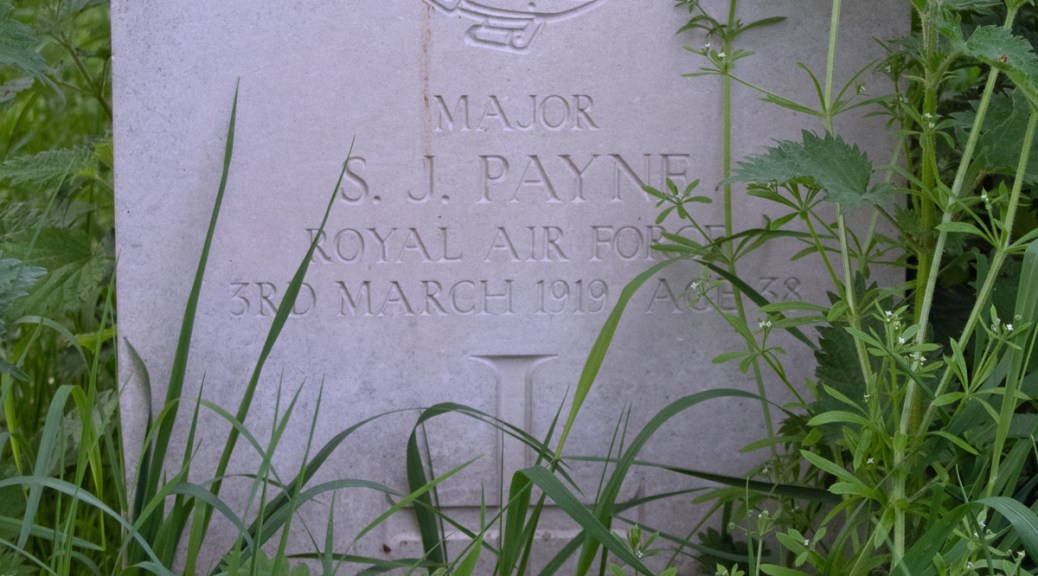
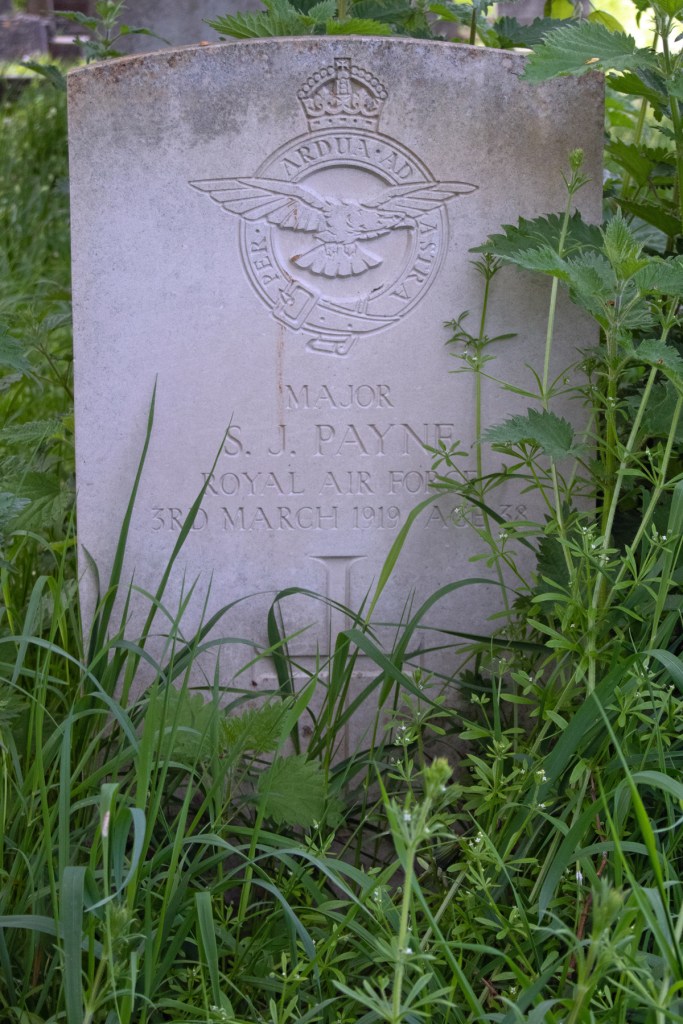
Stanley’s gravestone gives his rank as Major. While there is no documented evidence of any additional promotions after June 1915, the rank is the equivalent of Quartermaster in the Army Reserve. It seems likely, therefore, that the end date of his military service marked the start of his time in the reserves.


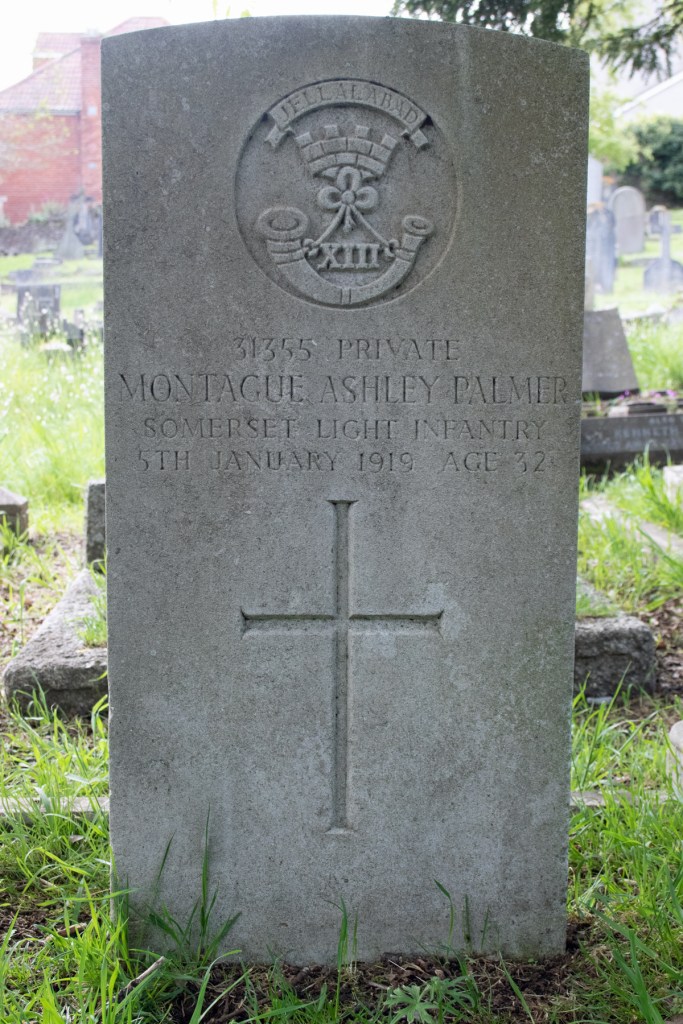
Private Montague Palmer

Private Montague Palmer

Montague Ashley Palmer was born in Weston-super-Mare, Somerset, in 1886, one of five children to Alfred and Martha. Montague’s father was a postman in the town for 25 years, retiring through ill health in February 1898. Sadly, Alfred’s retirement was not to last long, and he passed away that July aged 48, when his son was just 12 years old.

When he left school, Montague found work as a bus conductor and was now the oldest of Martha’s children to still be living at home. He was obviously an ambitious and inventive young man; by the time of the 1911 census, he had started work for the Ordnance Survey, and had moved to Didcot in Berkshire where he was boarding with Frances Battison, a suiter and greengrocer.

At this point, details of Montague’s life become a little hazier. At some point, he married a woman called Matilda, who either came from, or would go on to live in, Helston, Cornwall.

With war on the horizon, Montague enlisted – documented dates for this, again, are missing. He joined the 12th Battalion of the Somerset Light Infantry, which initially served in Egypt, before transferring to France in May 1918.

Where and for how long Private Palmer served is not clear, although he was definitely caught up in the fighting, and injured, towards the end of the war. Details of his wounds are not clear, but they were enough for him to be repatriated to England, and he was admitted to the Royal Hospital in Salford.

Private Palmer’s injuries appear to have been too severe for him to survive; he passed away in hospital on 5th January 1919. He was just 32 years old.

Montague Ashley Palmer’s body was brought back to Somerset, and he was laid to rest in the Milton Cemetery in Weston-super-Mare.


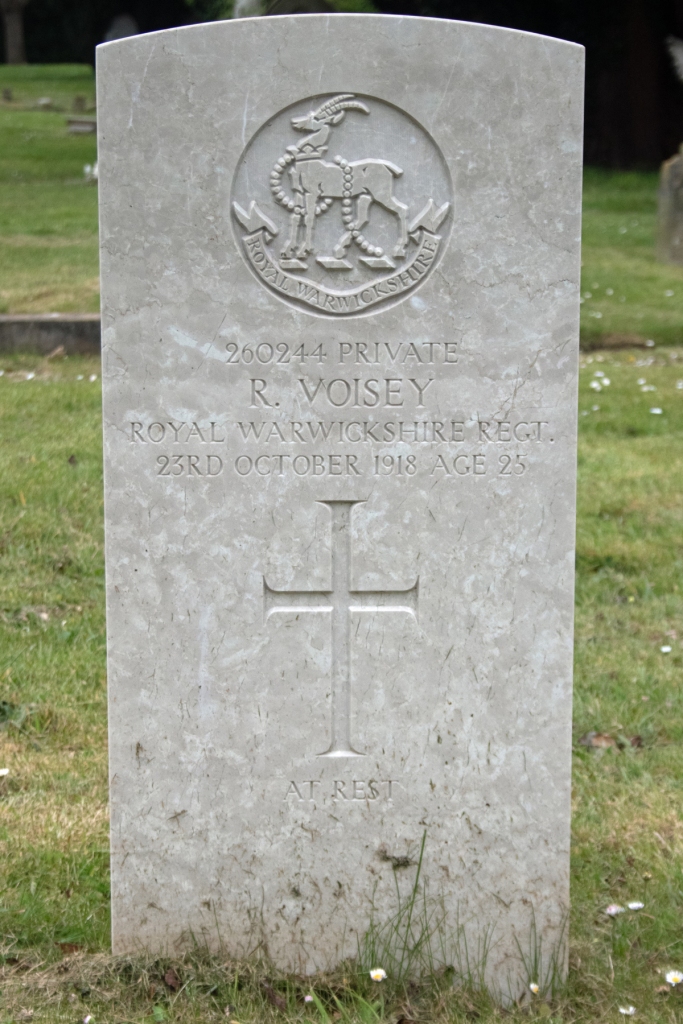
Private Robert Voisey

Private Robert Voisey

Robert Voisey was born towards the end of 1891, one of six children to Richard and Sophia. Richard was a tailor and, while both he and Sophia had been born in Cullompton, Devon, by the time Robert was born, they had moved to the Somerset town of Taunton.

When he left school, Robert followed his father’s trade and, by the time of the 1911 census, he was living with his parents and two of his sisters in a terraced house not far from the town’s station.

With the outbreak of the Great War, Robert was keen to do his bit. While full details of his military service are not available, it seems that he initially enlisted in the Somerset Light Infantry, but was subsequently transferred to the Royal Warwickshire Regiment. Joining the 6th Battalion as a Private, he saw action on the Western Front, and was wounded in April 1918.

Evacuated to England for treatment, Private Voisey was admitted to the 5th Northern General Hospital in Leicester. He seemed to be recovering well from his injuries, but then contracted influenza.

Sadly, this developed into pneumonia and Private Voisey subsequently died on 23rd October 1918, at the tender age of 25 years old.

Robert Voisey’s body was brought back to Somerset and he was laid to rest in the St James’ Cemetery in the town.


Robert’s funeral was written up in the local newspaper, and the report sheds more of a light on the Edwardian attitude towards some medical and mental health conditions than it does on the actual service.

The very fact of [Robert] ever having been a soldier, considering the great disability he was afflicted with through an incurable impediment in his speech, testifies abundantly to his high and noble interpretation of duty and patriotism.

Had he insisted he could at any time have evaded military service, but so eager was he to serve his country that it was not until he had actually been four times rejected as “physically unfit for military service” was he eventually accepted.

To the writer o this brief notice, who was his friend and fellow shop-mate for a long while, but who was at the time doing duty at Castle Green Recruiting Office, he often time used to express his indignation at not being accepted, and on the last occasion he spoke to the writer, it was to emphatically declare himself “as fit to be a soldier as anyone who had yet left Taunton.”

He dreaded the thought of being considered a shirker, and his opinion of many who have, even up till now, successfully evaded service, though far more physically fit than he was, was contemptuous to the bitterest extreme.

He was a true Britisher, a faithful friend and shop-mate, and a courageous soldier of whom no fitter epitaph could be written than “he gave himself in defence of home, country and liberty.”

Taunton Courier and Western Advertiser: Wednesday 6th November 1918

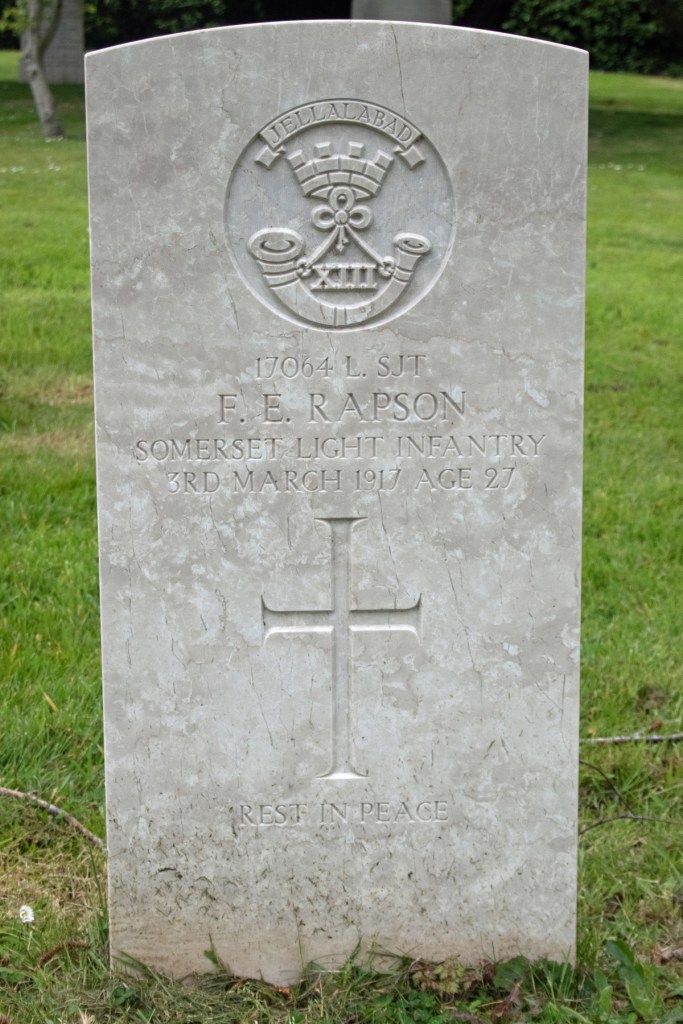
Lance Serjeant Frederick Rapson

Lance Serjeant Frederick Rapson

Frederick Ernest Rapson was born in the spring of 1888, one of nine children to Francis and Susan Rapson. Francis was a Serjeant in the 18th Hussars, and the family lived in Dulverton, a village on the edge of Exmoor.

Francis had served in the armed forces for 26 years, but passed away after a short illness in February 1891. According to a local friend and supporter, he had been in charge of the local yeomanry in Dulverton for a number of years and had been ‘in the prime and flower of life’. [West Somerset Free Press: Saturday 28th February 1891]

Susan was left widowed with nine children, the eldest of whom was only 13 years old. Frederick was only three at the time, and had lost his father at a very early age.

In 1895, Susan married a Frederick Howard, who was a painter and carpenter. The family moved to Taunton in Somerset, and Frederick and Susan went on to have three children of their own.

On 6th February 1910, Frederick Rapson married Lucy Knight; by this time, he was working as a compositor for the local newspaper. The couple set up home in the middle of Taunton, and went on to have three children, Francis, Frederick and Ronald.

War was coming, and, while Frederick did not actively seek military service in the same way as his father had done, it was not something he was able to avoid. While his full military records are not available, it’s clear that he enlisted in the Somerset Light Infantry at some point early on in the conflict.

Private Rapson was assigned to the 1st Battalion, who were based on the Western Front for the duration of the conflict. During his time there, he was awarded the Victory and British Medals, but not the 1915 Star, so that would narrow down his enlisting to some point in 1916.

While he was promoted to the role of Lance Serjeant, his service was to be a short one. At the start of 1917, he contracted pneumonia and was admitted to hospital. Sadly, the condition was to get the better of him, and he passed away on 3rd March 1917. He was just 27 years of age.

Frederick Ernest Rapson was buried in a quiet corner of St James’ Cemetery in Taunton, Somerset.


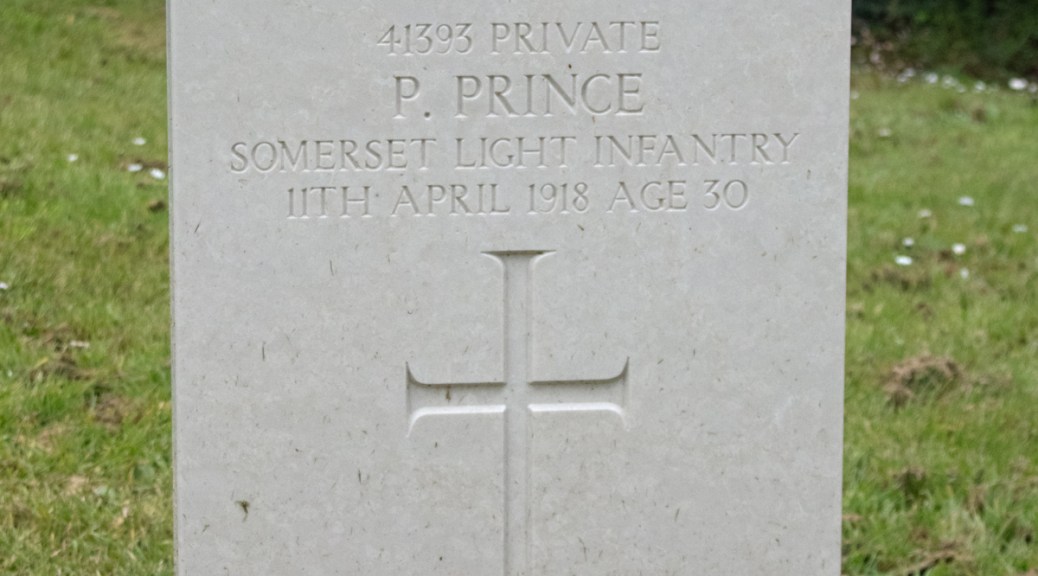
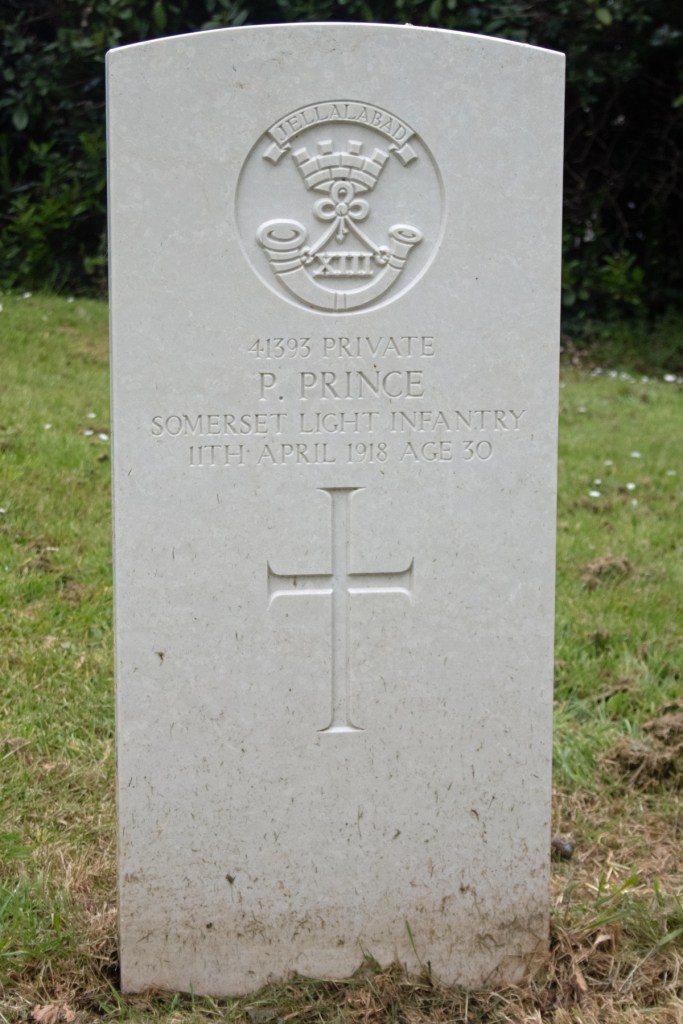
Private Percy Prince

Private Percy Prince

Percy Prince was born in 1890, one of seven children to John and Eliza Prince. John was an agricultural labourer and coal merchant, and brought his family up on the Somerset/Wiltshire border, near Bruton.

Percy followed in his father’s line of work when he left school, eventually moving to Frome. He met and married a woman called Florence Stickler in July 1909, setting up home in Water Lane, to the south of the town centre.

War was soon beckoning, and Percy enlisted in the Somerset Light Infantry as a Private. Sadly, his service records are lost to time, and so details of him time in the army are not available. What we do know is that he was assigned to one of the depots, although which one is not clear.

Sadly, that is about the limit of information available about Private Prince. He died on 11th April 1918, at the Military Hospital in Taunton. There is nothing to confirm a cause of death, but he just was 28 years old.

Percy Prince was buried in St James’ Cemetery in Taunton.


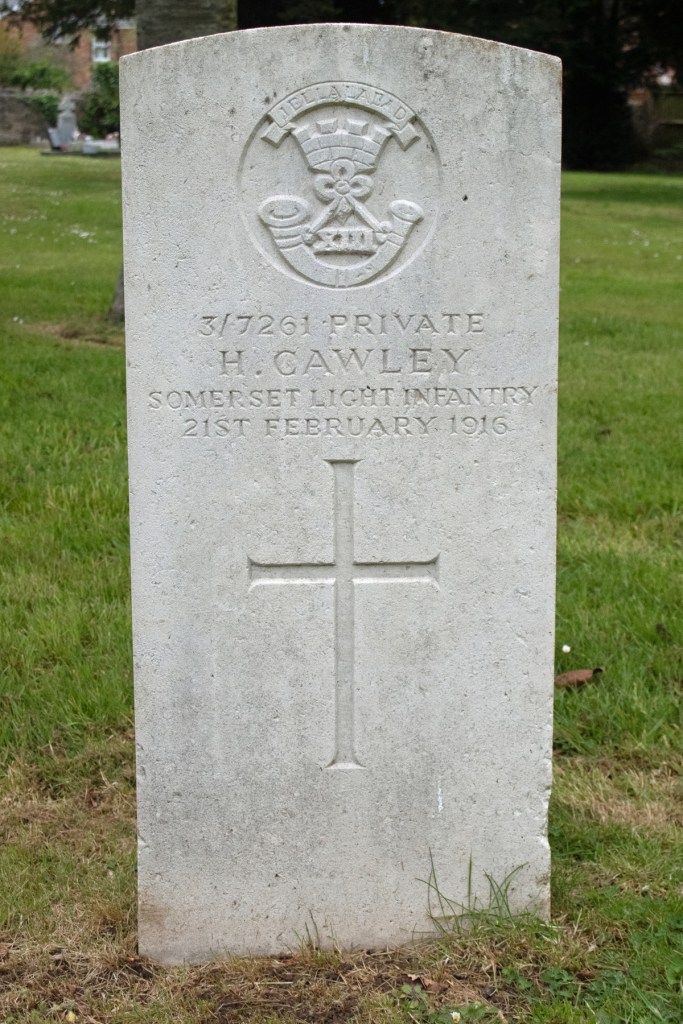
Private Henry Cawley

Private Henry Cawley

Henry Cawley was born in September 1871, one of eight children to John and Ann Cawley. John worked as a blacksmith in the village of Corfe, near Taunton, Somerset, but when Henry left school, he found work as a butcher’s assistant in Bristol.

Henry disappears from the radar for a while. John died in 1884, but the next information available for his son comes in the form of his war medals. This confirms that he enlisted in the Somerset Light Infantry in the summer of 1915, and that he was assigned to the depots as a Private. He was awarded the Victory and British Medals, as well as the 1915 Star, but then fell ill early in 1916.

Private Cawley was medically evacuated back to England, and was admitted to a sanatorium in Taunton. Sadly, whatever illness he contracted, he succumbed to, and he passed away on 21st February 1916, at the age of 45 years old.

Henry Cawley was laid to rest in St James’ Cemetery in Taunton.


Henry’s war pension was given to his mother, Ann. After her husband’s death, she continued to live in Corfe and, based on the available information, lived into her 80s.


Lance Corporal Joscelin Currey

Lance Corporal Joscelin Currey

Joscelin William Currey was born in the summer of 1897, one of six children to Job Arthur Currey and his wife, Eliza Jane. Job was a shoesmith, and brought his young family up in his home town of Taunton, Somerset.

When Joscelin left school, he worked as an errand boy, before becoming an apprentice with local foundry of Messrs. Rudman, Lancey and Co. But with war on the horizon, things were about to change.

Along with his older brothers, Joscelin enlisted in the army, joining the 3/5th Reserve Battalion of the Somerset Light Infantry in August 1914. Initially based on Salisbury Plain, he was soon transferred to Bath, and attained the position of Lance Corporal.

It was in Bath that he fell ill, and was admitted to hospital with cerebrospinal meningitis. Sadly, Joscelin was to succumb to this condition, and he passed away on 28th June 1915. He was just 18 years of age.

Joscelin William Currey was laid to rest in the St James Cemetery of his home town of Taunton.


Joceslin Currey
(from britishnewspaperarchives.com)

The newspaper report of Lance Corporal Currey’s funeral confirmed that one of his brothers was a prisoner of war in Germany, while another was in the Royal Field Artillery. Joscelin was the only one of the three to die during the conflict.


Joscelin’s name is spelt variously as Jocelyn and Joslin across the documents relating to him, and his surname is also spelt Curry. For the purposes of this post, I have chosen to use the spelling cited on the Commonwealth War Graves Commission records.