Alfred Daymond was born on 9th July 1891, in Porlock, Somerset. The second youngest of seven children, his parents were wall mason Albert Daymond and his wife, Maria. By the time of the 1901 census, Albert’s work had moved the family to the sleepy village of Luccombe.
When Alfred finished his schooling, he followed his father into wall building. This was the career he was still following when, in 1914, war broke out.
Alfred was quick to play his part for King and Country. He enlisted on 4th November 1914, joining the Somerset Light Infantry. Private Daymond’s service records show that he was 5ft 10ins (1.78m) tall, with good vision and a fair physical development.
Initially serving as part of a territorial force, Alfred remained on home soil until September 1916. At this point he was transferred over to the Duke of Cornwall’s Light Infantry, and became attached to the 7th (Service) Battalion. Details of his time in the army are sketchy, but his troop certainly fought at the Somme in 1916, and at Ypres the following year.
In May 1917, Alfred returned to British shores. His health appears to have been suffering, although it is not clear from what ailment. On 8th February 1918, Private Daymond was discharged from army service as being no longer physically fit.
Alfred’s trail goes cold at this point. It is likely that he returned home to Luccombe, and this is where he passed away, on 11th November 1918, Armistice Day. He was 27 years of age.
Alfred Daymond was laid to rest in the family plot of St Mary’s Church, Luccombe. He was interred alongside his younger brother, Albert.
Alfred’s younger brother, Albert, also enlisted for war service. Read his story here.
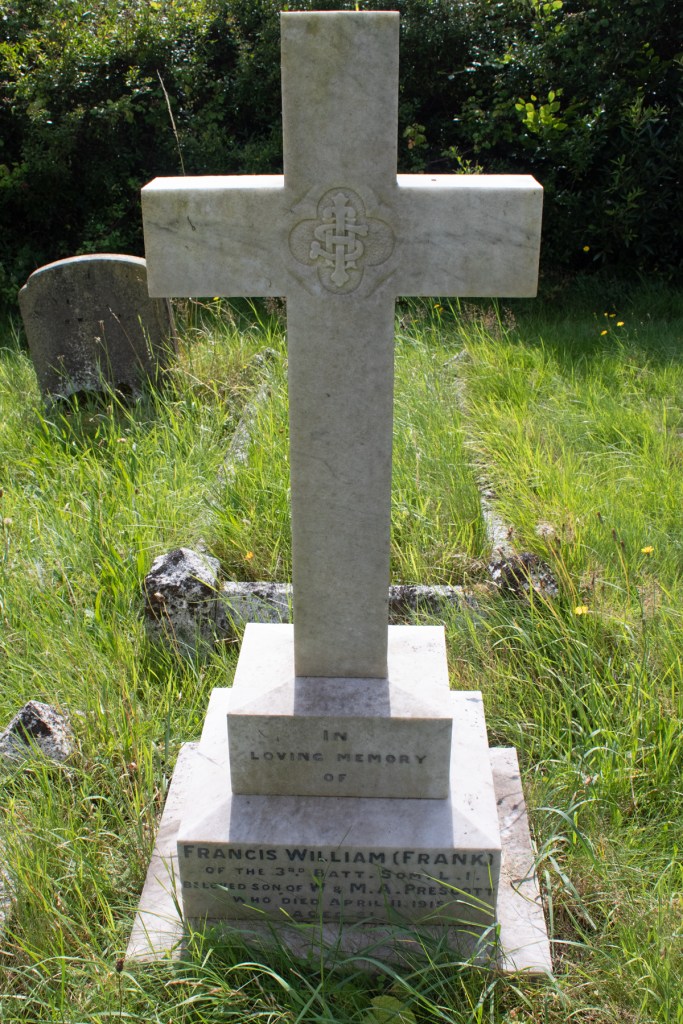
Francis William Prescott – better known as Frank – was born on 17th March 1894, and was one of four children to William and Mary. William was an agricultural labourer from Somerset, and, by the time of the 1901 census, the family had settled in the village of Luccombe, in the western outreaches of the county.
Frank went to school in Allerford, before spending a year at Luccombe’s Church of England school – from 13th May 1907 to 29th May 1908. Now aged 14 years old, he was considered old enough to be earning his keep. He found work as a farm boy on a farm on the outskirts of the village, but with storm clouds brewing across the Channel, he was keen to play his part.
Little information is available about Frank’s military service, but it is clear that he enlisted in the first weeks of the war, as imperial fervour gripped the country. He enlisted in the Somerset Light Infantry and, as a Private, was assigned to the 3rd (Reserve) Battalion. Contemporary documents do not confirm either way, but as this particular troop was based at Devonport, Devon, for most of the war, it is unlikely that Private Prescott saw any action overseas.
Indeed, he was in barracks on 11th April 1915, when he passed away. Again, the cause is lost to time, but he was just 21 years of age when he died.
Francis ‘Frank’ William Prescott was taken back to Somerset for burial. He was laid to rest in Luccombe Church Cemetery, not far from where his family still lived.
Frank’s younger brother, Harold, also enlisted in the war. He joined the Royal Engineers as a Private and, unlike his brother, he did go to the Western Front.
Harold was caught up in the fighting, and received a gunshot wound to his arm. He recovered, but the injury dogged him. He was formally discharged on 14th May 1919, and found work as a lorry driver. Harold married Kathleen Peck in December 1929: the couple’s only child, Edward, was born just over a year later.
Harold spent his life in Somerset. He died in Exmoor in the spring of 1968, at the age of 71 years old.
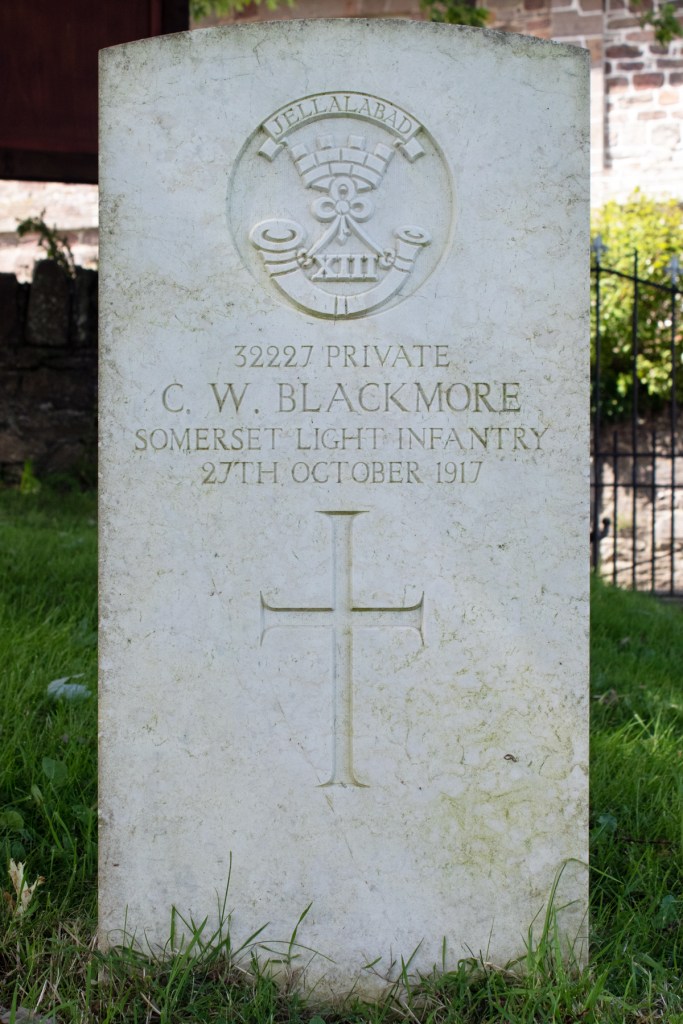
Charles William Blackmore was born in Brompton Regis (or Kingsbrompton), Somerset, on 19th August 1896. He was the twelfth of thirteen children to journeyman carpenter Joshua Blackmore and his wife, Margaret. Charles attended the nearby Upton Primary School until Christmas 1909 at which point he started working with his father.
When war erupted across Europe, however, he stepped up to play his part. He enlisted as a Private in the Somerset Light Infantry on 14th January 1916. Little remains of his service documents, but his medical report confirms that he was 5ft 9ins (1.75m) tall, with light brown hair and grey eyes. Interestingly, the document also gives his date of birth as 14th February 1897, six months later than his school intake record.
The documents that remain for Private Blackmore’s time in the army, do not specify exactly where he served, but his battalion – the 1st – were heavily involved in the Battle of the Somme in 1916, and at Arras the following year.
It was during that summer that Charles fell ill, contracting tuberculosis. He was medically evacuated to Britain for treatment, and admitted to the Toxteth Park Auxiliary Military Hospital in Liverpool. The former workhouse was to be where Charles breathed his last: he died on 27th October 1917, at the age of 21 years old.
The body of Charles William Blackmore was brought back to Somerset for burial. He was laid to rest in the peaceful and picturesque graveyard of the Church of the Blessed Virgin Mary in his home village, Brompton Regis.
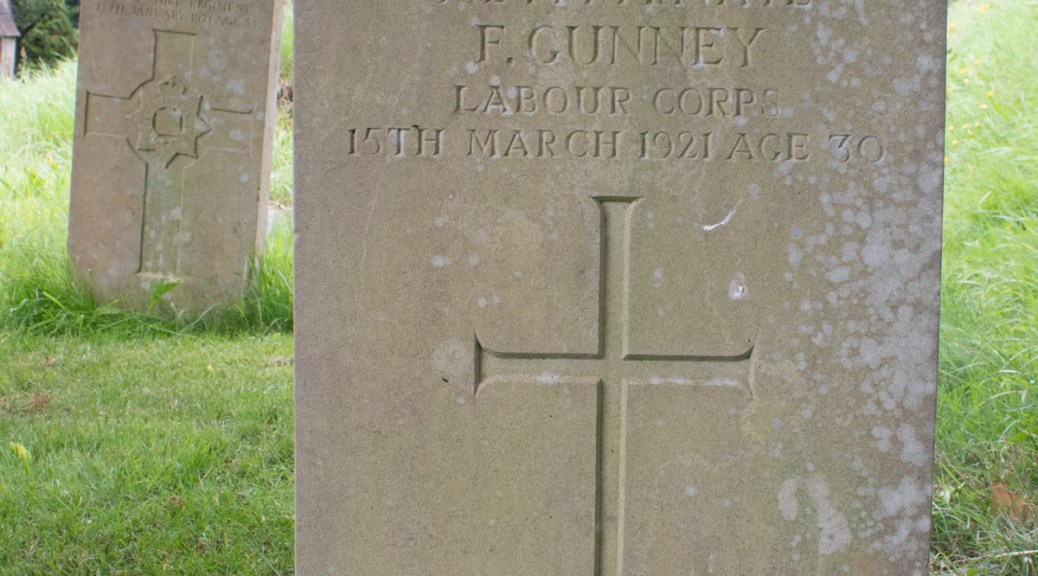
Frank Gunney was born in Brushford, Somerset, in the spring of 1890. The youngest of four children, with two sisters and a brother, his parents were William and Mary. William was a groom-turned-gardener, but when Frank left school, he found other employment: by the time of the 1911 census, he was recorded as being a tailor.
Frank’s older brother, James, followed his father’s trade, becoming a groom when he finished his schooling. His work took him to South Wales, where he met and married Emma Lewis. The couple went on to have two children: Hilda and Kenneth. When war came to Europe, James enlisted, joining the Royal Army Service Corps as a Private.
Frank followed his brother into the army, enlisting in the Somerset Light Infantry on 11th December 1915. This must have proved a tragic time for his mother, Mary, as, just ten days later, William died “after a long and painful illness.” [Western Times: Friday 24th December 1915]
Frank’s service records give little away about the man he had become, but do note that he was 5ft 5ins (1.65m) tall. He was re-assigned to the 1st/21st Battalion of the London Regiment, and was sent to France in June 1916.
Private Gunney’s service papers suggest that he was injured on 9th September 1916, having received a gun shot wound to the head. He appears to have been treated on site, and there seems to be no notable break in his time on the front line.
James was killed in action on 7th April 1917: he was 33 years of age, and was laid to rest in the Warlincourt Halte British Cemetery in Saulty. Mary had lost a husband and a son within eighteen months, and James had left a widow and two children.
In March 1917, Private Frank Gunney had transferred to the Labour Corps, and aside from a six-month period on home soil, would remain in France until September 1919. He then returned to Britain, and was demobbed a month later.
Frank returned to Somerset, but his trail then goes cold. Two documents give an idea as to what happened next, however. The first is a newspaper report about his burial:
The funeral took place in All Saints’ Churchyard, Dulverton… of Mr F Gunney, only don of Mrs Gunney… who died on Tuesday last. Deceased served three years in France, and has been in failing health practically ever since demobilisation, although the end came rather suddenly.
Western Times: Tuesday 22nd March 1921
His army Pension Ledger Card, confirms that he had been discharged from the army because of a ‘septic wound to his left thumb’, which was due to his military service. It appears that this had festered over the ensuing years: Frank Gunney passed away on 15th March 1921, aged 30 years of age.
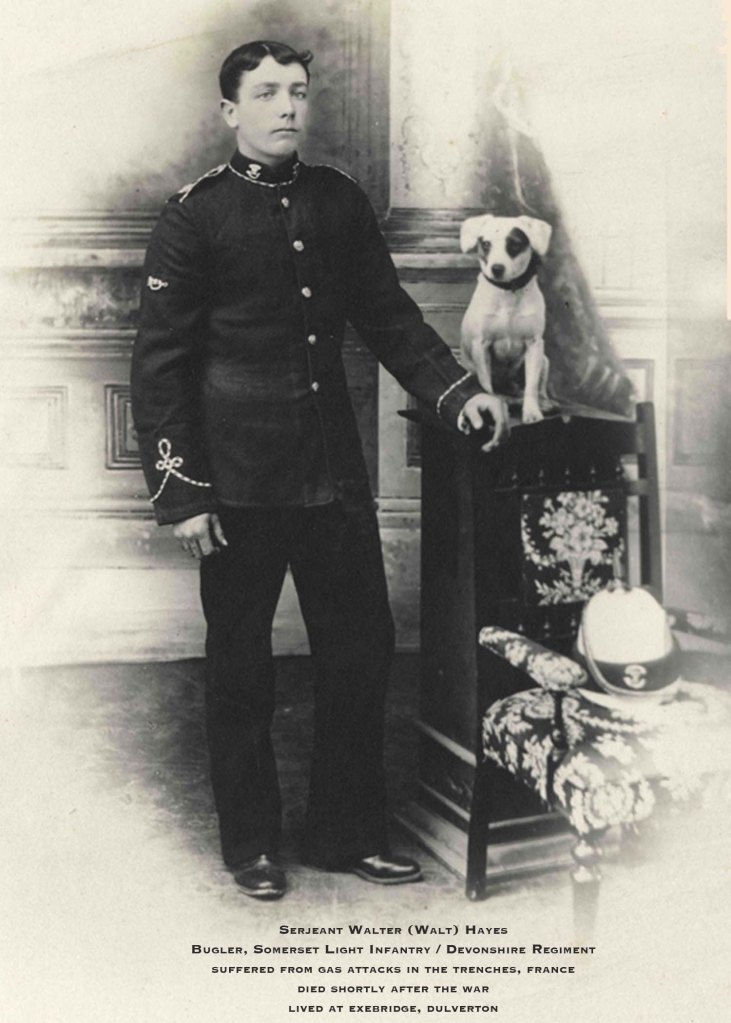
Walter Hayes was born in Somerset in 1883. The oldest of seven children, his parents were William and Mary Hayes. William was an agricultural labourer, and the family lived and worked at Houndhill, to the south east of Stogumber.
Walter also fell into farm work and, in the spring of 1914, he married Emily Mary Tarr. The wedding took place in Tiverton, Devon, but the couple did not stay there for long as, just weeks after their wedding day, Emily gave birth to a daughter, Edith, over the Somerset border in Dulverton.
Storm clouds were brewing over European shores, and Walter was called upon to play his part. His service records are also sparse, but they confirm that he initially joined the Somerset Light Infantry, before moving across to the Devonshire Regiment.
Walter had either been in the army earlier in his life, or he worked his way up during the war, and at some point he reached the rank of Serjeant. He saw fighting overseas and, according to later documentation, was caught up in a gas attack. This was to have an impact on his health and he was discharged from army service sooner than he might otherwise have done. Officially stood down in March 1919, he returned home to his wife and family.
Emily and Walter had a second child, William, later that year, and the family were finally able to settle into a routine. Walter’s health, however, was severely impacted and, on 12th January 1921, he passed away from bronchitis. The lung condition was found to be directly attributable to his war service, and that gas attack, Walter was 38 years of age.
Walter Hayes was laid to rest in the quiet graveyard of All Saints’ Church in Dulverton.
Emily was pregnant when her husband died: she gave birth to their third child, a son she named Walter, just a few months later. She did not re-marry, and, according to the 1939 Register, she was boarding in a house in Dulverton and carrying out unpaid domestic duties.
Emily lived on until the autumn of 1973, passing away in Taunton at the age of 85.
Serjeant Walter Hayes (courtesy of Trevor Hayes)
The early life of Walter Hayes was a challenge to piece together, as his was not an uncommon name in the area at the time. My thanks go to his great nephew, Trevor Hayes, for his help in pulling together the story and for the image of his great uncle.
Thomas Fear was born in around 1872 in East Pennard, Somerset. The youngest of six children, his parents were Thomas and Harriet Fear. Thomas Sr was a general labourer, who had moved his family to Bath, where work was more plentiful, by the time of the 1881 census.
When Thomas Jr finished his schooling, he sought bigger and better things. He enlisted in the Devonshire Regiment, and while his service records no longer exist, other documents confirm that he fought in the Second Boer War in South Africa at the turn of the century.
On 5th August 1893, Thomas had married Bath-born Sarah Hughes, who was the daughter of a printer’s machinist. The couple went on to have three children: Albert, Nora and Rose. By the time of the 1911 census, the family were living in a four-roomed apartment near the centre of Bath. Thomas was employed as a stoker for a gas company, Albert was working as a tailor’s errand boy, and Nora had found employment at a lace factory.
When war broke out, Thomas felt the calling to serve his country once more. He enlisted on 1st September 1914, just weeks after conflict had broken out, joining the Somerset Light Infantry. His service records confirm that he was 5ft 5ins (1,65m) tall and weighed 136lbs (61.7kg). He was noted as having brown hair, blue eyes and a fair complexion.
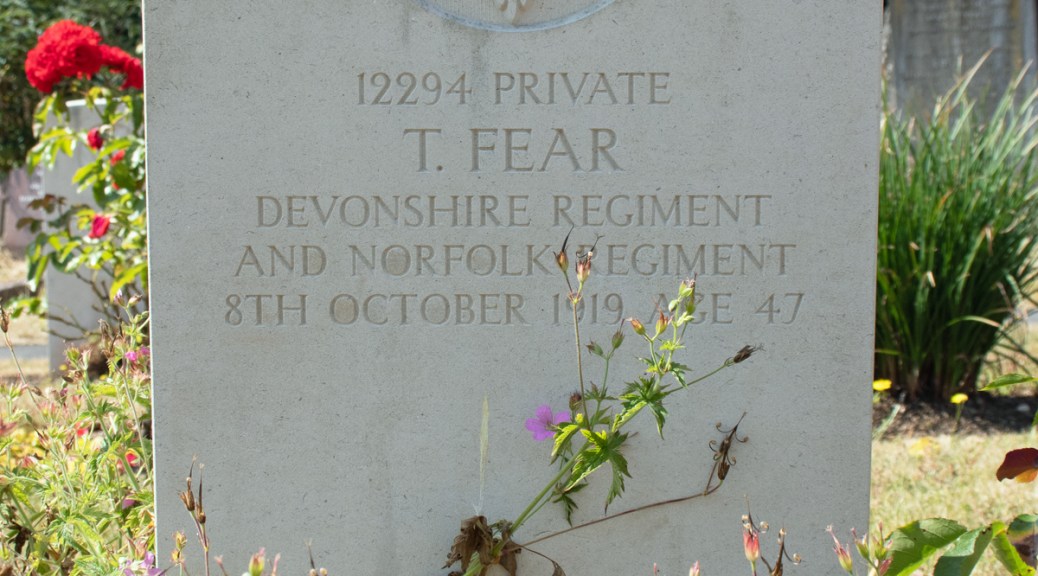
Private Fear was transferred to his old regiment – the Devonshire – at the end of September, remaining on home soil until September 1915. At this point, his troop was sent to France, but he was not to remain on the Western Front for long. In November, his troop was sent to the Eastern Mediterranean, and for the next year, Thomas was based in Salonika.
While in Greece, Thomas contracted malaria, and this was to continue to affect his health in the months and years to come. By Christmas 1916, he had been sent back to Britain, and the following September, he was medically discharged from the army as he was no longer physically fit to continue.
At this point, Thomas’ trail goes cold. At the end of December 1917, “after much suffering patiently borne” [Bath Chronicle and Weekly Gazette: Saturday 5th January 1918], Sarah passed away, aged just 44 years of age. All of the children were of age by this point, and it can only be assumed that Rose, at least, was still residing in the family home.
The funeral took place at Locksbrook on Monday of the late Private Fear, whose death occurred at the [Bath] War Hospital. Private Fear, whose age was 45 [sic], was an old soldier, and had seen service in the South African and the late European Wars. In the latter he served with the 2nd/4th Battalion of the Norfolk Regiment, from which he was discharged in May, 1916. As an army pensioner, he was sent to the War Hospital by the Ministry of Pensions, but, unfortunately, his case proved fatal.
Bath Chronicle and Weekly Gazette: Saturday 18th October 1919
Thomas was actually 47 at the time of his passing, and it seems likely that he died of the condition that had resulted in his medical discharge from the army, malaria.
Thomas Fear was laid to rest in the military section of Locksbrook Cemetery, Bath, not far from where Sarah had also been buried.
Tauntonians will learn with deep regret of the death of Private W Haines, of the No. 5 Supernumerary Company, 4th Battalion Somerset Light Infantry, which took place at the Portishead Red Cross Hospital, at the age of 64. The funeral took place at the Portishead Cemetery on Friday of last week, the deceased being buried with full military honours… The late Private Haines… came up with the last Company of the National Reserves, about 14 months ago… and during that time did his duty to the satisfaction of the office commanding and all other officers concerned. Corporal Jarman, who is a well-known Tauntonian of the same Company writes: “Private Haines was a fine old soldier, doing his duty in a manner with would be a credit to any youngster, and his death came as a surprise to all of us. There are still with us half-a-dozen of the old ‘sixties’, and I hope when some of these conscientious objectors see this they will alter their mind, and do their little bit for their King and country like he did.”
Taunton Courier and Western Advertiser: Wednesday 29th March 1916
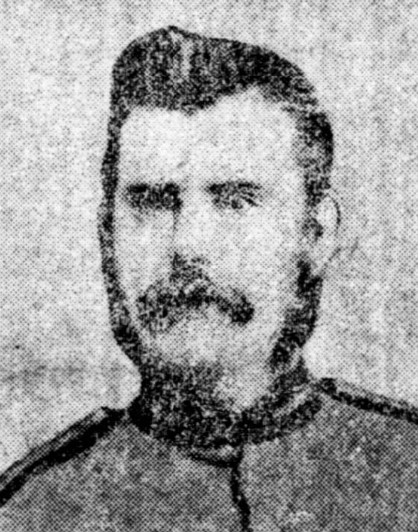
William Haines was born in the spring of 1850 in Hinton St George, Somerset. The younger of two children, his parents were William and Sophia Haines. William Sr died when his son was a teenager, leaving Sophia to raise the family. She found work as a nurse to bring in some income and, by the time of the 1871 census, the family were living together, William Jr working as a stonemason and his older sister earned money through glovemaking.
On 23rd December 1871, William married Jane Shuter, a sawyer’s daughter from Stoke-sub-Hamdon. The couple set up home in South Petherton, and had a son called William Jr the following year. The family remained together through the next three census returns, William Sr continuing as a mason, while his son found work as a plumber. By 1911 they family had moved again, this time to Taunton, where Jane was now working as a dealer in wardrobes.
When war broke out, William Sr stepped up to play his part, as the report suggests. He enlisted at the start of 1915, volunteering his services, despite having reached 64 years of age. Assigned to the 4th Battalion of the Somerset Light Infantry, and attached to the 5th Supernumerary Company – a territorial reserve force – Private Haines he remained in Somerset.
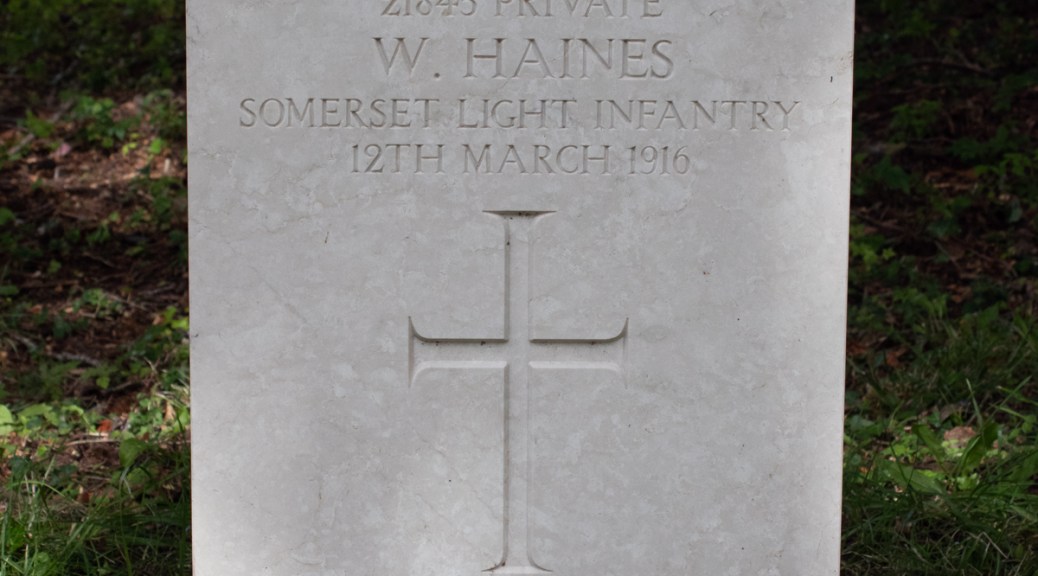
William suffered a heart attack on 12th March 1916. He was rushed to the Red Cross Hospital in Portishead, but passed away soon after being admitted. He was 66 years of age (the newspaper report giving the incorrect age).
William Haines did not travel far to be laid to rest. He was buried in Portishead Cemetery, on the southern outskirts of the town.
Private William Haines (from britishnewspaperarchive.co.uk)
Arthur Chard was born in the spring of 1893, one of eight children to Isaac and Eliza Chard. Isaac was a labourer at the colour works in Winford, Somerset, and this is where the family were born and raised.
When Arthur finished his schooling, he found work as a farm labourer and, by the time of the 1911 census, he was living with his maternal uncle and family in the village, where he was employed as a farm lad.
As war came to Europe, Arthur stepped up to serve his country. He enlisted on 16th November 1915, joining the Somerset Light Infantry. His service records show that he was 5ft 3ins (1.6m) tall and weighed 113lbs (51.3kg).
Private Chard was formally mobilised in January 1916, and was sent to France in September, having completed his training. By May of 1917, he seems to have been back in Britain, and was transferred to the Labour Corps. There appears to have been some health issue behind this, as, on 11th August he was admitted to Henham Hall Auxiliary Hospital in Suffolk, suffering from ‘debility’. Having been moved to another hospital after a couple of weeks, he was finally discharged back to his unit on 20th September 1917.
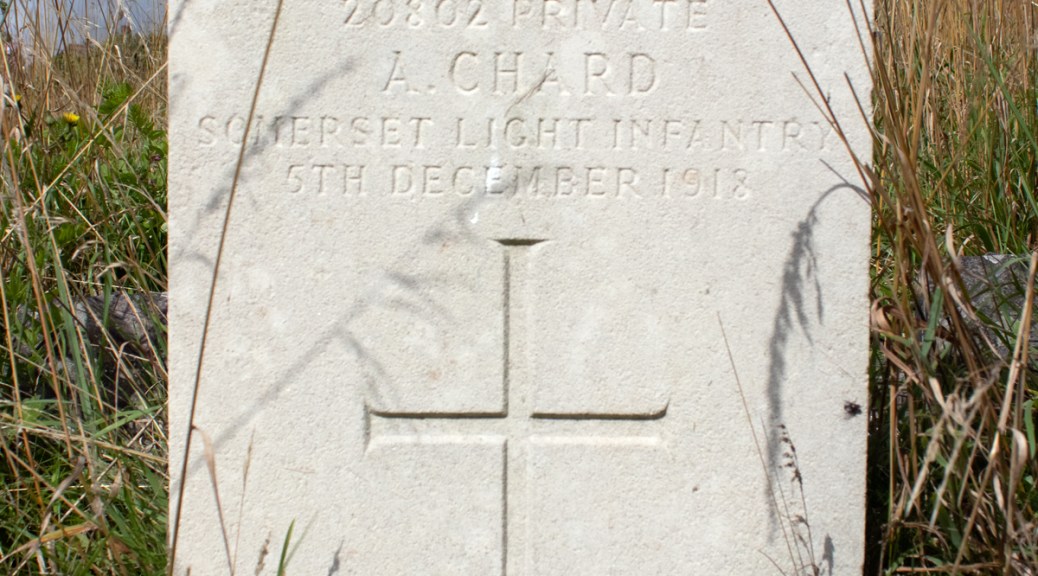
Arthur joined the 626 Agricultural Company, which was based in Taunton. By July 1918, he had moved to another of the Somerset troops, 593 Agricultural Company. His health was still suffering, however, and he was soon admitted to Taunton Military Hospital. Private Chard passed away from nephritis on 5th December 1918. He was 25 years of age.
Arthur Chard’s body was taken back to Winford for burial. He was laid to rest in the village’s parish church, St Mary & St Peter’s.
Frederick Reginald Channing was born in the autumn of 1869, in Bath, Somerset. He was one of five children to carpenter Allen Channing and his dressmaker wife, Sarah. When Frederick was just a toddler, Allen moved the family south to Chard, and this is where his younger siblings were born.
When Frederick left school, he found work as a lace machine operator and, in fact, all of Allen’s children found work with their hands: Frederick worked alongside one of his brothers, while his two other brothers built on their father’s woodworking skills, one as a coachbuilder, another as a cabinet maker.
By the autumn of 1905, Frederick had moved back to Bath. This is where he met Elizabeth Scammell, a farm labourer’s daughter from Wiltshire. The 1901 census appears to record her as being a servant to a surgeon’s family in Wincanton, and this may have prompted a further move to the larger city where the couple met.
The couple married in Bath towards the end of 1905, and had a son, Frederick Jr, who was born in November the following year. Frederick Sr was doing general labouring work by this point, and the family had moved to Wedmore by the time a second boy, William, was born in 1910. Frederick and Elizabeth had a daughter, Eva, in 1911, and another, Gwendoline, in 1913, tragically, the same year that Eva died.
When war came to Europe, Frederick stepped up to play his part. He enlisted in September 1914, joining the Somerset Light Infantry as a Private. His service records confirm that he was 5ft 6ins (1.67m) tall, and weighed 154lbs (69.9kg). The document also gives his age as 35, although he was actually ten years older than that by this point.
Private Channing spent a year on home soil, during which time Elizabeth gave birth to their fifth child, Percival, who was born in May 1915. Based at a camp in Aylesbury, Buckinghamshire, he was hospitalised twice in this time, suffering from a contusion of his left shoulder.
By September 1915, Frederick was in France, and he remained on the Western Front, apart from when on leave, for the next three-and-a-half years. At some point during this time, he was promoted to the rank of Lance Corporal, and transferred across to the Royal Engineers.
Back at home, Elizabeth was doing her best to raise the family. She didn’t always do the right thing, though, and this resulted in her being taken to court.
Elizabeth Mary Rose Channing, 30… was indicted for having been delivered of a certain female child, did unlawfully by a secret disposition of the deceased child, endeavour to conceal the birth thereof at Wedmore the same day in the month of September 1916.
Mr Wethered prosecuted, and said that the prisoner was a married woman. Her husband was a soldier now on active service. He was last home on leave in April or May, 1917. Previously to that he had not been home for 18 months or two years, so the child could not have been his. Some boys found a parcel in the well, and they discovered the body of the child. The boys communicated with the police, who searched the well and found some pieces of carpet which agreed with a similar carpet in the possession of the prisoner. When arrested she confessed to the crime.
Frederick Channing, husband of the prisoner, said he was home on leave five months ago – May 27th. He went back on June 4th. Previously he had not been home for twenty months. He pleaded for the prisoner in the interests of their four children. He was very sorry for her to think she had thrown herself away like that.
His Lordship, addressing the prisoner, said that while her husband was away doing his duty for her any everybody, she was not faithful to him, and the result was the birth of the child which had been concealed and not revealed till a year afterwards. His Lordship understood that prisoner was already legitimately in a certain condition, and he did not wish her child to be born in prison. She would be sent to prison therefore for three months.
Wells Journal: Friday 26th October 1917
Elizabeth was released in February 1918, and the couple’s last child, Kathleen, was born the following month.
Frederick, meanwhile, returned to the Western Front. He remained in France through to the end of the conflict and beyond, only returning to Britain in February 1919, having fallen ill. Admitted to the North Evington War Hospital in Leicester with influenza, he remained there for two months.
In April 1919, Lance Corporal Channing was transferred to the Bath War Hospital, back in Somerset. This was presumably so that he could be closer to his family, although there is no evidence of whether he was fully reconciled with Elizabeth. His condition did not improve, however, and by this point he was also suffering from myalgia.
Frederick remained in hospital for eighteen months. As time passed, carcinoma of the liver was identified, and this, eventually, was the condition that would take his life. Lance Corporal Canning passed away on 5th September 1920. He was 49 years of age.
Sarah and the children were still living in Wedmore, by this point. Frederick Reginald Channing’s last journey was not to be that far, however. He was moved only a short distance from the hospital, and was laid to rest in the sweeping grounds of the Locksbrook Cemetery in Bath.
Andrew Michael Fox was born on 25th May 1871, the oldest of six children, to Michael and Eliza Fox. Michael was a Private in the 40th Regiment of Foot, and was based in Curragh Camp, Kildare, Ireland, when Andrew was born.
The family travelled where Michael’s work took him: Andrew’s oldest siblings were born in Uttar Pradesh, India, and the family were in England by the time of the 1881 census.
Given Michael’s military connections, it is no surprise that Andrew followed him into the army. He enlisted in August 1884, joining the South Lancashire Regiment. His service records give his age as 14 – he was, in fact, just 13 years old – and note his height as 4ft 9ins (1.44cm) and his weight as 73lbs (32.7kg). Andrew was recorded as having hazel eyes, brown hair and a fair complexion: his religion was also confirmed as Roman Catholic.
Andrew’s service records have become damaged over time, and a lot of his details are illegible. Because of his age when he enlisted, he was initially given the rank of Boy. In July 1887, he was formally mobilised, with the rank of Private. He remained on home soil for the next ten years, with the 1891 census listing him as being barracked in Fort Regent, Jersey.
It was in the Channel Islands that Andrew met Kathleen Dooling. The couple married on 7th January 1892, and went on to have ten children. Over the next couple of years, Andrew progressed through the ranks, achieving Lance Corporal in September 1892, Corporal in June 1894 and Lance Serjeant in August 1897.
In 1899, the Second Boer War led to the newly-promoted Serjeant Fox being posted overseas. He remained in South Africa for six months, while the conflict raged on. Andrew returned to Britain in April 1900, and was officially stood down from the army on 31st December that year, as he was deemed no longer fit for military service.
The 1901 census found Andrew and Kathleen still living in family barracks in Aldershot with their three eldest children, Andrew Margaret and Edith. Andrew was recorded as being an officer’s valet, likely now in a civilian role. The family remained in Aldershot until 1910, with five more of their children being born there.
Another change came at that point, however, as the following year’s census found the family living in Brighton Street, Warrington, Lancashire. Andrew was, by this point, working as a salesman for the Singer Sewing Machine Company, and the family were cramped into a four-roomed end-of-terrace house.
War came to Europe in the summer of 1914, and Andrew stepped up to play his part once more. Again, full details have been lost to time, but he took up the rank of Serjeant once more, and was attached to the Somerset Light Infantry. This necessitated another relocation for the family, and they moved to Cannington, near Taunton, Somerset.
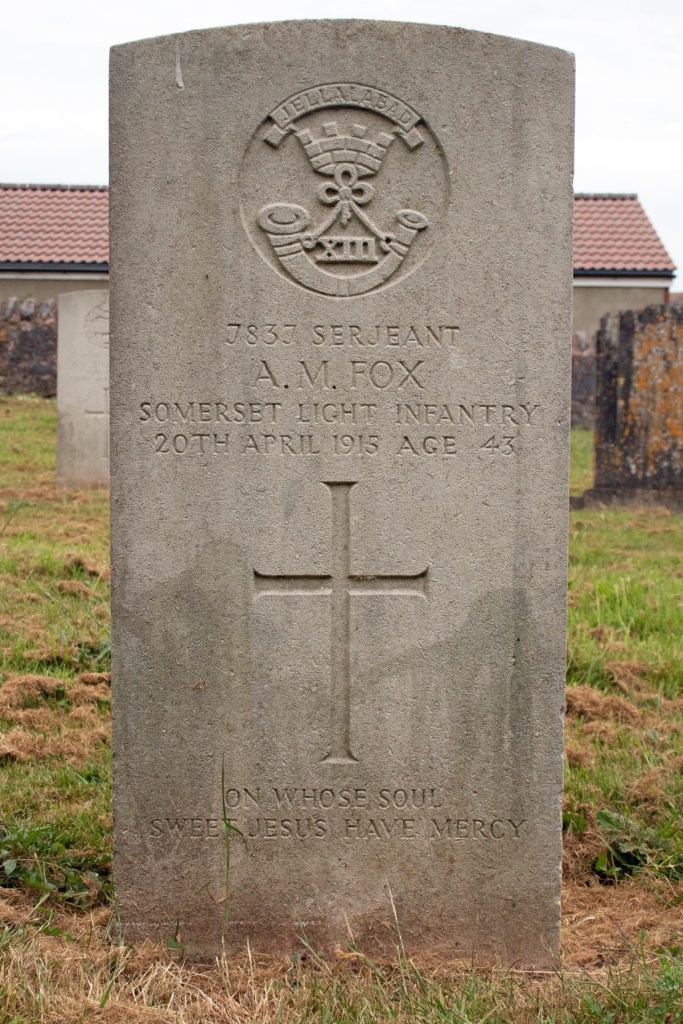
Serjeant Fox was assigned to the 7th (Service) Battalion, but was not to remain in his role for long. He contracted phthisis, or tuberculosis, and passed away from the condition on 20th April 1915, just weeks before his regiment departed for the Western Front. He was 43 years of age.
Andrew Michael Fox was laid to rest in the peaceful Cannington Cemetery, not far from the family home.
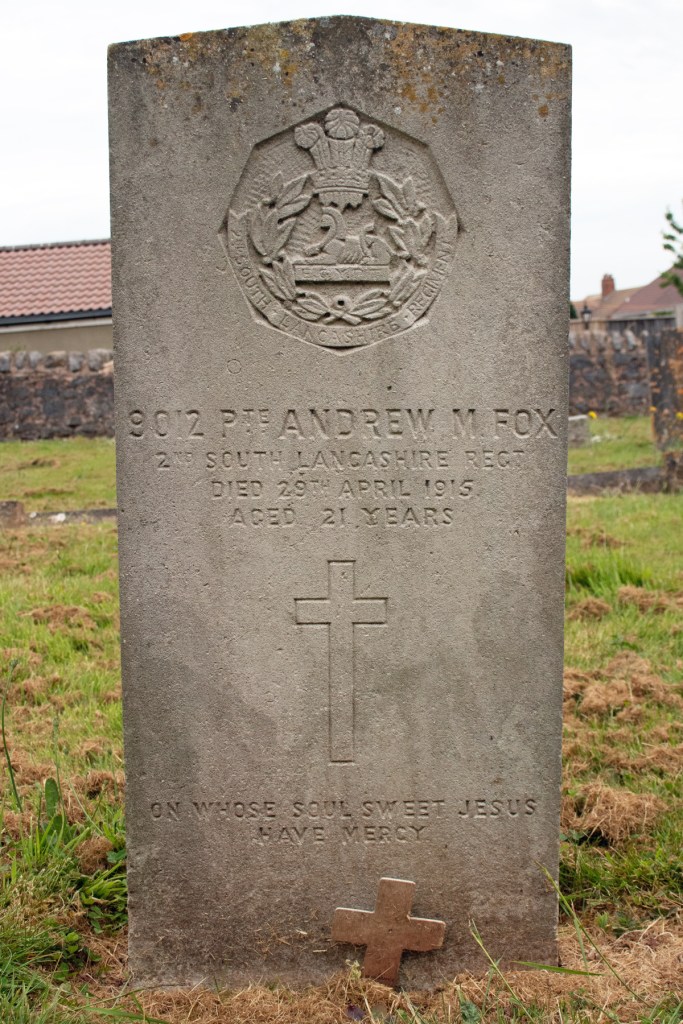
Private Andrew M Fox
In the plot next to Serjeant Andrew Fox is another, similar headstone. Not quite having the same form as the Commonwealth War Grave Commission headstone that Serjeant Fox has, this is dedicated to a Private Andrew M Fox, of the 2nd South Lancashire Regiment.
Andrew Moyse Fox was the eldest son of Andrew and Kathleen. Born on 31st March 1894 in Ireland, he wanted to follow his father and grandfather into the army.
Andrew Jr enlisted in the South Lancashire Regiment in August 1908. His service records confirmed that he was just 14 years of age, standing 5ft (1.52m) tall, and weighing 5st 2lbs (32.7kg). He was noted as having dark brown hair, hazel eyes and a fresh complexion, and that he has a scar on his right buttock.
As is the case with his father, there is limited information about Andrew Jr’s army career. He spent just under six years serving with the regiment, and was formally mobilised when he came of age in 1912. On 27th March 1914, however, Private Fox was discharged from the army on medical grounds, for reasons unclear. The next record available for him is that of his passing, just nine days after his father. He was 21 years of age.
Andrew Fox Jr was laid to rest next to his father in Cannington Cemetery. The heartbreak for Kathleen, to have lost husband and oldest boy within two weeks, must have been indescribable. While her son’s headstone is similar in design to her husband’s, he was not subsequently entitled to an official Commonwealth War Grave, as he had left the army before the outbreak of war: the Commission’s qualification dates (4th August 1914 to 31st August 1921).










 Death and Service