Category Archives: Tank Corps

Serjeant Herbert Newman

Serjeant Herbert Newman

Herbert James Newman was born at the start of 1891, the fourth of five children – all sons – to Charles and Mary Newman. Charles was a general labourer, and the family lived on Well Head, to the north of Mere, Wiltshire.

Charles died when Herbert was just a boy, and Mary was left to raise the family on her own. By the time of the 1901 census, the family had moved to a cottage on Old Hollow, and she had taken work as a charwoman. Herbert’s older brother, Theodore and William, had also taken jobs to help with money.

In 1911, her boys had all grown up and were moving on, and Mary found more secure employment as a live-in servant to 80-year-old Anna Collard, a single woman who was living on her own means.

Herbert, meanwhile, had left Wiltshire for the capital, and was working as a compositor. He was boarding with widow Mary Ann Day and her two children, all living relatively comfortably at 41 St Thomas’ Road in Finsbury Park, Middlesex. Amongst the other lodgers were Jeweller John Tipping, conductor Wilfred Mustill and cycle mechanic Lester Rule.

When war came to Europe, Herbert stepped up to play his part. Full details of his military service have been lost to time, but it is clear that he had enlisted by December 1917. Initially joining the Tank Corps, It seems likely that Private Newman had seen service overseas, although there is nothing to confirm this either way.

As the conflict drew into its closing months, the now promoted Serjeant Newman seems to have been based in Dorset. In the spring of 1918, he fell ill, and was admitted to the Military Hospital in Wareham. The cause of his illness is unclear, but it would prove fatal: he passed away on 18th May 1918, at the age of 27 years old.

The body of Herbert James Newman was taken back to Wiltshire for burial. He was laid to rest in Mere Cemetery, on the outskirts of the town he had called home.


Interestingly, Serjeant Newman’s Pension Ledger Index Card gives his beneficiary as his mother, Mary. The British Register of Soldiers’ Effects, however, suggests his next-of-kin was his widow, Lucy, although there appears to be no record of Herbert having married.

Lance Corporal Henry Grandfield

Lance Corporal Henry Grandfield

Henry Grandfield was born in the spring of 1887, the third of six children to William and Martha Grandfield. William was a bootmaker from the Somerset village of Over Stowey, and it was here that he and Martha raised their family.

Henry found work as a labourer on a local estate when he finished his schooling. When war came to Europe, however, he stepped up to play his part.

Service records for Henry are pretty scarce. He appears to have enlisted in the Royal Field Artillery, but then transferred across to the Tank Corps. Separate research appears to suggest that Lance Corporal Grandfield served in the Eastern Mediterranean, but fell ill.

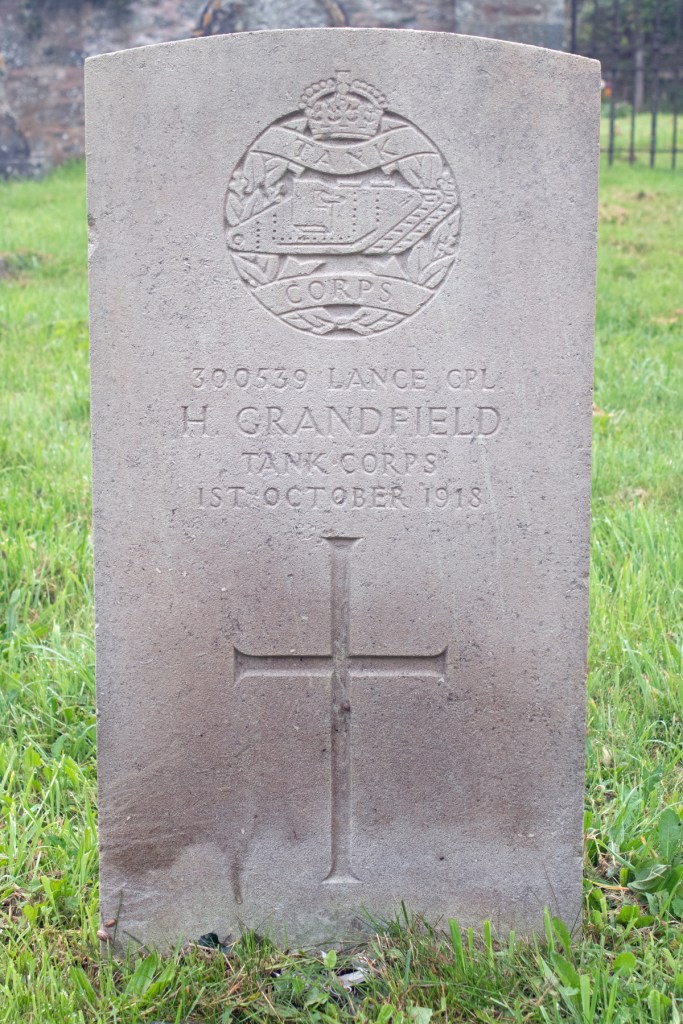
Suffering from rheumatism he returned to Britain for medical support. Based at Bovington Camp in Dorset, Henry was later admitted to a hospital near Wareham, having contracted pneumonia. This latter condition was to prove too much for his body to bear: he passed away on 1st October 1918, at the age of 31 years old.

The body of Henry Grandfield was taken back to Somerset for burial. He was laid to rest in Over Stowey Cemetery, not far from where his family still lived.


Private Maurice Chapman

Private Maurice Chapman

Maurice Chapman was born in the summer of 1883 in Newington, Surrey (now in the London borough of Southwark. The younger of two children, his parents were Charles and Jessie Chapman. Charles was a horse collar maker and, by the time Jessie passed away in 1899, Maurice was following in his father’s footsteps.

Maurice sought a bigger career, however, and, on 6th April 1899, he enlisted in the Royal Artillery. His service records show that he was 5ft 6ins (1.68m) tall, and that he weighed 118lbs (53.5kg). In the section relating to any distinguishing marks, it was noted that his eyebrows met, he had a scar on his forehead and two tattoos, one on each forearm.

Maurice’s military career was not to be a lengthy one. He was recorded as being absent without leave on 18th May, and docked 6 days’ pay. Admitted to a hospital in Woolwich on 26th May, he spent a week there, suffering from scabies. On 27th July, Maurice was formally discharged from the army, when it was discovered that he had lied about his age: on his enlistment papers, he stated he was 18 years 7 months old (he was, in fact, just sixteen.

Returning to the family home, Maurice took up his father’s trade once more. Charles remarried in 1905, to a woman called Rosa. The 1911 census found the two living in two rooms in a house in Kennington Lane, but of his children, there is no sign. Maurice does not appear on any of the 1911 census records. It is also not possible to track down his older sister Charlotte either, there are a number of Charlotte Chapmans in the that year’s records, and it is also unclear whether she had married by this point.

Maurice only reappears on 1st March 1916, when he stepped up to serve his King and his Country. Initially signing up for the Labour Corps, he wasn’t formally mobilised for eighteen months. Maurice gave his profession as a barman, but also noted that he had served for two years in the 2nd Battalion of the Dragoon Guards, before being discharged in 1904, although there is no other record to corroborate this.

Private Chapman’s service records provide some, but not a lot of, information. There is no record of him spending time overseas, but he spent ten months with the Labour Corps, before transferring to the Tank Corps on 30th August 1918. Over the next year-and-a-half, he moved between a couple of the regiment’s depots and their reserve unit, and remained on active service long after the Armistice was signed.

Maurice remained on active service with the Tank Corps until November 1920, when he was medically discharged. He had been unwell for a while by this point, and a combination of diabetes and a perineal fistula meant that he was no longer physically fit enough to serve.

It is likely that Maurice was in the War Hospital in Bath, Somerset, when he was discharged, as this is where he passed away, on 22nd December 1920. He was 37 years of age.

Maurice Chapman did not travel far to his final resting place. He was buried in the grounds of the Locksbrook Cemetery in Bath, Somerset.


Private Anthony Gardner

Private Anthony Gardner

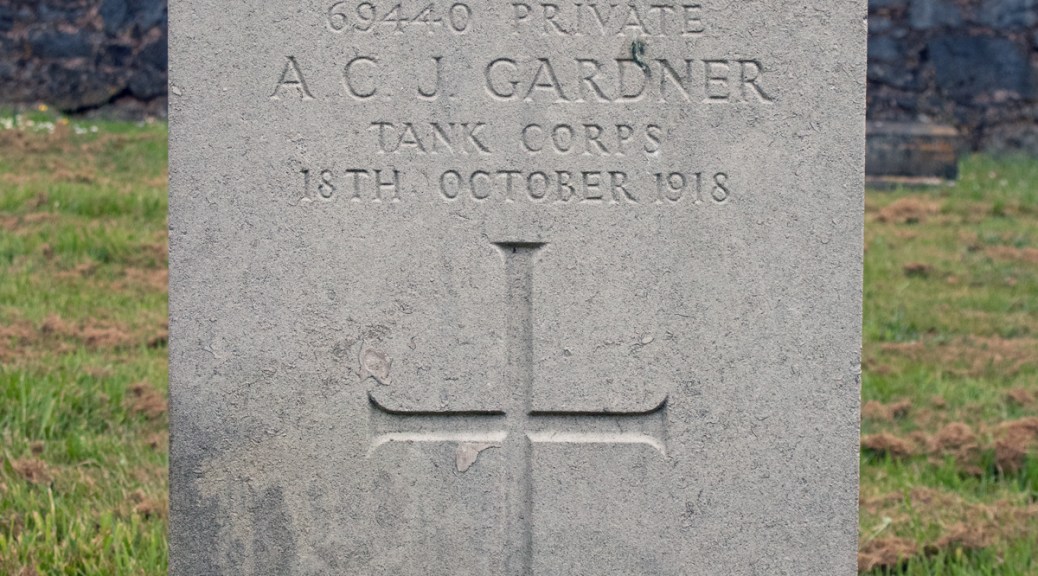
In a quiet spot in Cannington Cemetery, Somerset, is the burial plot for Anthony Charles James Gardner. His headstone confirms that he was a Private in the Tank Corps, and that he died on 18th October 1918.

Private Gardner’s service number provides only one army document: the British Army Register of Soldiers’ Effects. Sadly, this sheds little more light onto his life, confirming only that he died in the Military Hospital in Wool, the village connected to Bovington Camp in Dorset. No next of kin is evident.

Another record suggests that he may have served in the Somerset Light Infantry before transferring to the Tank Corps, but no records remain to confirm this stage of his military career.

There are no census birth or baptism records for an Anthony Gardner. While there are numerous Somerset documents connected to Charles and James Gardners, without any confirmation of his age, or whether he actually came from the county, it is impossible to identify ones relating to the soldier buried in Cannington.

Parish details confirm that Anthony worked at the Blue Anchor Inn in Cannington. The 1911 census recorded him as working there under Charles and Ann West. It confirms that Anthony was 24 years of age, and was born in Gloucester. Tantalising though this fact is, there are no earlier documents to confirm his upbringing in Gloucestershire.

There are no reports in contemporary newspapers about Anthony’s passing or his funeral, so no light can be shed down that route either.

The life of Alfred Charles James Gardner, therefore, is destined to remain lost in the mists of time. His story hidden in the cemetery in Cannington, Somerset.


My thanks to Tina at Cannington Parish Council for her help in uncovering a little of Anthony’s life.


Lieutenant Hugh Punchard

Lieutenant Hugh Punchard

Hugh Punchard was born in February 1895, the oldest of three children to William and Jane Punchard. William was a civil engineer from London, and Hugh was born in Surbiton.

The 1901 census recorded the family living in the 14-room house, Pope’s Garden, in Twickenham. Along with the family, there were four members of staff – a governess, housemaid, cook and a nurse. By the time of the next census, sixteen-year-old Hugh was away at school, boarding with more than 400 others at Haileybury College in Hertfordshire.

War was coming to Europe by this point, and Hugh was keen to play his part. He enlisted in the Royal Navy on 20th October 1914 and, while he was only there for a short period, his records shed some light onto the man he had become. He enlisted as a mechanic, and was noted as being 6ft 4ins (1.93m) tall, with dark brown hair, grey eyes and a fair complexion.

Hugh remained in the Royal Navy for only a month, and, while full details of his service are no longer available, it would seem that it was at this point that he transferred to the Royal Garrison Artillery. He appears to have performed his duties well, and achieved the rank of Lieutenant. He also made another transfer, when he was attached to the Tank Corps.

Lieutenant Punchard was based in Dorset by the last year of the war, and it was while he was serving there that he became unwell. He contracted pneumonia, and was admitted to Wareham Military Hospital. Sadly, the condition was to take his life, and he passed away on 31st October 1918, at the age of just 23 years old.

Hugh Punchard’s paternal grandparents lived in Devon, and, as William had passed away two years earlier, the decision was to lay him to rest in Totnes Cemetery.


Hugh’s will left his estate to his mother, Jane. When he passed, she became the beneficiary of his effects, totally some £3,600 7s 6d (around £250,000 in today’s money).

Jane stayed living in Twickenham: when she passed away on 29th July 1937, she was brought to Devon for burial, and was laid to rest with her son.


A number of documents relating to Hugh give his name as R Hugh Punchard. Sadly, I have not been able to unearth details of what his official first name might have been.


Private William Jennings

Private William Jennings

William Gladstone Jennings was born in Kent, in the summer of 1898, the only child of James and Emma Jennings. James was a marine engineer in the Naval Dockyard in Chatham, and it was here that the family lived.

Sadly, due to his age, and the lack of military service documentation, there is little written about William’s life. He was still at school by the time of the 1911 census, and the next records available confirm that he enlisted in the army. The date for this is not available, but it would have been by May 1917 at the latest and he seems to have enlisted with the surname Hickson, which was possibly his mother’s maiden name.

Private Jennings transferred to the Tank Corps when it was formed in July 1917. What his specific role was is lost to time, but it appears that his time in the regiment was short. The next available document is the Army Register of Soldiers’ Effects; this confirms that William passed away on 30th October 1917, in the Military Hospital in Woolwich.

There is no confirmation of the cause of his death, but Private Jennings was just 19 years old.

William Gladstone Jennings was brought back to his home town for burial, and he lies at rest in the Woodlands Cemetery in Gillingham.