Category Archives: Lance Corporal

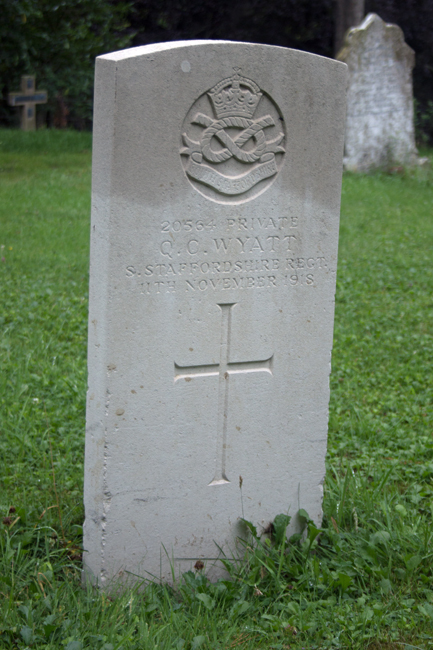
Private Quinton Wyatt

Private Quinton Wyatt

Quinton Charles Wyatt was born in the Gloucestershire town of Northleach in 1893 to William and Elizabeth. His mother died when he was a toddler, leaving William to look after Quinton and his older sister Agnes.

By the time war was declared, Quinton was working as a farm labourer and waggoner in the Gloucestershire village of Hampnett.

Quinton enlisted in the 8th Battalion of the South Staffordshire Regiment on 22nd November 1915. Appointed Lance Corporal just two months later, he was posted to France in March 1916.

Neglect of duty in June meant that Lance Corporal Wyatt was demoted to Private four months later. His battalion was caught up in a German gas attack in the autumn of 1917, and he was injured; ultimately, he was medically discharged from the Army on Boxing Day 1917.

Quinton Charles Wyatt finally succumbed to his injuries on 11th November 1918 – Armistice Day. He was 25 years old.

He is buried in St Mary’s churchyard in the village of Charlton Mackrell in Somerset.

Lance Corporal William Warne

Lance Corporal William Warne

William Henry Warne was born in Walworth, South London, in March 1892. His father is not named, but his mother was Ellen Warne (or Gould), who was “living on her own means”. He had two older siblings, Fred – whose surname is listed as Gould – and Gertie Warne.

By the time of the 1911 census, William was a law clerk in West Coker, near Yeovil in Somerset. The record shows him living with his mother and sharing her surname – which was now listed as Gould. Again, Ellen’s occupation was “private means”.

William’s full military service records are not available, but various sources produce a little information.

Private William Warne had enlisted in the Dorset (Queen’s Own) Yeomanry by April 1915, as this is when he was dispatched to Egypt. August 1915 saw his battalion shipped to Gallipoli; William survived this horrendous battle and returned to Egypt by the end of that year. As a result, he earned the 1915 Star medal.

When the Dorset Yeomanry was retitled, Private Warne became part of the Corps of Hussars. After Egypt, the battalion moved to Palestine, where they saw out the war. He was appointed Lance Corporal at some point during this time.

The exact details of his passing are lost to time; he passed away on 9th October 1918 at the British Red Cross Hospital in Netley, and his records suggest that he died of wounds. He was 26 years old.

Lance Corporal Warne’s life was an intriguing one from start to finish.

The Army Register of Soldiers’ Effects is a document that shows how much was paid out to the relatives of soldiers who have passed away in service; in the research I have carried out over the last few months, this amount has generally ranged between £2 and £8, rarely reaching double figures.

William’s mother and sister, however, received a significant amount. The initial payment was £31 13s 8d, and this was followed by a second figure of £19 10s. There may be various reasons for this – the campaigns William fought in, the prestigious regiment, the appointment to Lance Corporal – but again this is another mystery that will remain such.

Lance Corporal William Warne lies at rest in Sherborne Cemetery.

Lance Corporal William Larkin

Lance Corporal William Larkin

William Larkin was born in 1863, the eldest son of Alfred and Frances Larkin from Cranbrook in Kent.

He disappears off the radar for a few censuses – there are too many variations on his surname to identify exactly where he was on the 1881 and 1891 documents.

From later documents, however, we can identify that he married Eliza in around 1886; the couple had no children. By the 1901 censes the couple were living to the north of Maidstone; ten years later, they were running the Fox & Goose pub in Weavering, Kent.

Private Larkin’s military service is also lacking in documentation, but some information can be pieced together.

Originally enlisting in the Royal West Kent Regiment, he (was) transferred over to the Royal Defence Corps, and served on home soil.

On Sunday 2nd April 1916, Lance Corporal Larkin was on guard at a gunpowder factory in Faversham, Kent. As the Ministry of Munitions reported at the time:

During the weekend a serious fire broke out in a powder factory in Kent, which led to a series of explosions in the works.

The fire, which was purely accidental, was discovered at midday and the last of the explosions took place shortly after two in the afternoon.

The approximate number of casualties is 200.

Thanet Advertiser: Saturday 8th April 1916.

William was not killed during the Faversham Explosion, but Boxley Parish Council (who covered the Weavering area) carried out research on the names on the village war memorial. According to that research, William “developed cancer after the ‘Faversham Powder Works’ explosion”. He died two months later, on 8th July 1916. He was 53 years of age.

Lance Corporal William Larkin lies at rest in the graveyard of St Mary & All Saints Church in Boxley, Kent.


More details of the Faversham Explosion, along with the servicemen who died there, can be found here.

Lance Corporal Charles Stubbles

Charles Frederick Stubbles was born in Tottenham in 1892. One of eleven children to Richard and Mary Ann Stubbles, by the time of the 1911 census, the family were living in Edmonton. Charlie and his brother had found employment painting gas stoves, while his father was a building foreman.

Charles enlisted in the army in 1916, aged 25 years and 11 months. His service records show that he stood at 5ft 2ins, weighed in at 69lbs; his health was classified as C2 – Free from serious organic diseases, able to stand service in garrisons at home, able to walk 5 miles, see and hear sufficiently for ordinary purposes.

Joining the Labour Corps of the West Surrey Regiment, Private Stubbles initially served on the home front, before being transferred to France as part of the British Expeditionary Force in March 1917.

Charlie seems to have been a bit of a character and was pulled up a few times during his service. On 10th April, he was charged with “committing a nuisance in the barrack room”, for which he was confined to camp for eight days. On 21st August he went AWOL for nearly a day; he was docked eight days’ pay. On 28th October he appeared unshaven and dirty for the 7:15am parade; he was confined to barracks for seven days.

On 4th January 1918, Charles was admitted to a field hospital with diarrhoea; while there he was diagnosed with tuberculosis; he succumbed to this two days later, dying on 7th January 1918. He was 26 years old.

Lance Corporal Charles Stubbles is buried at the Haringhe Bandaghem Military Cemetery in Poperinge, Belgium.


Charles Frederick Stubbles was my great great uncle.