Category Archives: Private

Private Francis Millard

Private Francis Millard

The early life of Francis Albert Millard is lost to time. He was born in 1894 in Bath, Somerset. His gravestone notes that he was the adopted son of AE and H Evans, though there are no census records confirming the three as a family. His military records specifically note that he has “no relations alive only one brother who is younger than myself nor have I any guardians”.

Interestingly, when Private Millard passed, Mrs Harriet Evans, who was noted as a foster mother, applied for his personal effects. Two days later, and Albert Francis Millard, who was claiming to be Francis’ father, also put in an application.

Francis was working as a seaman when he formally enlisted. He had previously been a volunteer in the Durham Light Infantry, and was readily accepted in the regiment’s 2nd Battalion. He joined up in November 1911, his service records noting that he was 5ft 3ins (1.6m) tall, 104lbs (47.2kg) in weight, with a fresh complexion, blue eyes and light brown hair. He was also noted as having a tattoo of the figure of a woman on his right forearm and a scar on his left buttock.

Over the next couple of years Private Millard was reprimanded a couple of times for small misdemeanours – being absent from bread rations on 15th September 1912, and being absent from the company officer’s lecture on 22nd February 1913. During this time he had been promoted to Lance Corporal, but the reprimand he received demoted him to Private once more. Overall, however, his service appears to have been a positive one and, when war was declared, he soon found himself on the Western Front.

[Priavte Millard] was present at the retreat from Mons. He took part in the advance over the Marne and the Aisne, and [had] been engaged in the battles around Ypres. In the early part of August [1915] a charge was ordered, and in this he took part. The late Captain RH Legard… to whom Millard was servant, fell. Millard ran to his assistance, and was wounded in two places…

Bath Chronicle and Weekly Gazette: Saturday 21st August 1915

Francis received gun shot wounds to his thigh and across his spinal column. He was medically evacuated to Britain for urgent treatment. Admitted to the King George Hospital in South London, his admission notes make for stark reading:

Patient very collapsed. Sunken eyes, some delirium. Small circular wound on right shoulder behind level 1st Dorsal spine 2″ from middle line; wound on inner side of left thigh, with suppuration and cellulitis. Can move both arms but very poor power. Patient continued to go downhill rapidly after admission despite stimulation (brandy, [strychnine], saline).

A telegram was sent to Harriet and she took the first train to London. She arrived on the evening of Tuesday 17th August, and remained by Francis’ bedside until he passed away the following morning. He was just 21 years of age.

The shattered body of Francis Albert Millard was brought back to Somerset for burial. He was laid to rest in the city’s St James Cemetery.


Private Alfred Stoyle

Private Alfred Stoyle

Details of Alfred Lawrence Stoyle’s life a challenging to piece together. Most of the information comes from his service records, but even that is limited.

The Somerset Light Infantry records suggest that Private Alfred Stoyle was born in March 1890 in Widcombe, Bath. Physically, he was 5ft 8ins (1.73m) tall, and weighed 109lbs (49.4kg). He had blue eyes, brown hair, a tattoo of crossed flags on his right forearm and a scar above his right eye.

According to the document, Alfred’s parents were Alfred and Ellen Stoyle, and he had been working as a mason’s labourer before he enlisted on 13th February 1909. Early records for the Stoyles are hard to come by, The 1891 census found Alfred and Ellen living in Walcot, Somerset, with their eight children. They have a son, Alfred, although he is noted as being 19 at the time, which does not match the service records for the Alfred who enlisted. They have another son, Albert, who was born in 1886, and it seems that he may have used the name Alfred when enlisting (indeed, those service records note not only Alfred’s parents, but his older siblings Nellie, Ada, Henry and Alfred).

The next census, in 1901, recorded Alfred Sr as being a pauper in the Bath Union Workhouse. He was also listed there in the 1911 census, while that document recorded Ellen living in two rooms in the centre of Bath with Albert/Alfred and her youngest son, William.

Alfred Jr was recorded as being a general painter. By this time, he had enlisted in the Somerset Light Infantry, and was on reserve status, allowing his daily life to continue. He undertook annual training, and, when war broke out in August 1914, he was formally mobilised.

Private Stoyle was sent to France the following month, and ended up spending four months there. In January 1915 he returned home, and there appears to have been a medical reason for doing so. Within a matter of months, he was discharged from the army as he was no longer physically fit. The service records do not give a reason for his dismissal.

At this point, Alfred’s trail goes cold. He seems to have returned home to Somerset, and passed away on 21st August 1915. Based on his service records, he was just 25 years old, although his true age is debatable.

Alfred Lawrence Stoyle was laid to rest in St James’ Cemetery Bath.


Serjeant John Carthew

Serjeant John Carthew

John Wallace Carthew was born in Warminster, Wiltshire, in the spring of 1892. The second youngest of seven children – three of whom did not survive childhood – his parents were miller James Carthew and his tailoress wife, Sarah.

John was destined to make a path for himself. By the time of the 1911 census, he was boarding with the Southon family in Aldershot, and working as a chauffeur.

On 22nd March 1914, John married Caroline Hamilton, a parlour maid for Captain Charles Woodroffe and his family in Aldershot. The couple set up home in Queensgate Mews, London, and having had a daughter, Cecilia, who was born that February.

When war came to Europe, John was quick to enlist. He joined up on the 21st December 1914, and was assigned to the Mechanical Transport section of the Royal Army Service Corps. His service records note that he was 6ft 1in (1.85m) tall, with a scar on his right eyebrow.

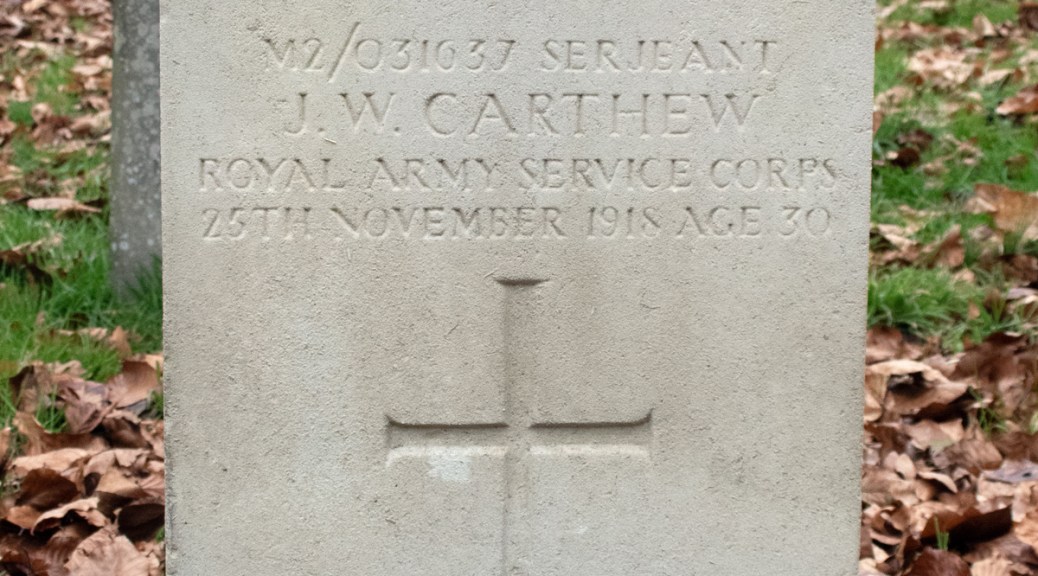
Private Carthew rose through the ranks, becoming a Corporal in 1916, and a Serjeant in 1918. During this time he acted almost exclusively as chauffeur to General Sir William Robertson. His duties were mainly based on home soil, but he did spend a year in France, while Robertson was Chief of the General Staff there.

As the war came to a close, Serjeant Carthew fell ill. Based in a camp in Aldershot, he contracted influenza, and this developed into pneumonia. This was to take his life, and he passed away at the town’s Connaught Hospital on 25th November 1918. He was just 26 years of age.

Caroline was living in Bath, Somerset by this point, and this is where the body of her husband was brought for burial. John Wallace Carthew was laid to rest in St James’ Cemetery, in the family plot where his father, who had died in 1911, was also buried.


Private Charles Oborne

Private Charles Oborne

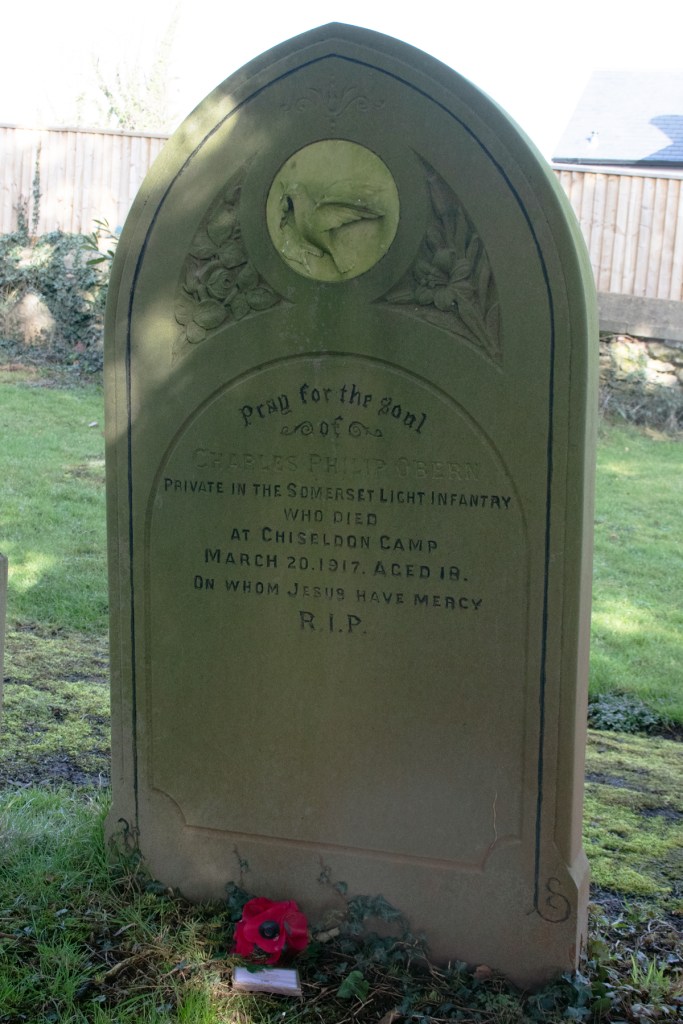
Charles Philip Oborne was born in Mosterton, Dorset, early in 1899. He was the middle of three children to Charles Oborne. Charles Sr had been married before, to a woman called Martha, and the couple had a son, Joseph. Martha died in the mid-1890s and Charles remarried, to a woman called Elizabeth. They went on to have two children, of which Charles Jr – better known as Charley to avoid confusion with his father – was the older.

There is little documentation for the Oborne family. Charles Sr was a farm labourer, and the family moved from Dorset to Stratton-on-the-Fosse, near Shepton Mallet in the early 1900s. At the time of the 1911 census, Charley was a student, and there is no direct evidence of what he went on to do when he finished his schooling.

Nor are there many documents relating to his military service. Private Oborne joined the Training Reserve, and was assigned to the 94th Battalion. The troop had formed from the 16th (Reserve) Battalion of the Gloucestershire Regiment, and was based in Chiseldon, to the south of Swindon in Wiltshire. There is nothing to confirm when he enlisted, but given his age, and when he passed, it is likely to have been during the winter of 1916/17.

What is clear is that while Private Oborne was training, he contracted pneumonia, and, on 20th March 1917, he passed away from the condition. He was just 18 years of age.

The body of Charles Philip Oborne – Charley to his friends and family – was brought back to Somerset for burial. He was laid to rest in the graveyard of St Benedict’s Roman Catholic Churchyard in the village of Downside, a mile to the north of Shepton Mallet, and not far from Stratton-on-the-Fosse, where his family were still living.


Charles was not alone in succumbing to pneumonia at Chiseldon Camp that spring. Two Somerset soldiers from battalions based there, Private Everett Ferriday, and Private Ivan Day, passed away in the same hospital just days after Charles.

You can read their stories by following the links above.

Private Edgar Cox

Private Edgar Cox

Edgar Albert Cox was born in Wanstrow, Somerset, in the spring of 1897. The youngest of five children, his parents were railway packer Herbert Cox and his wife, Orpha.

When he left school, Edgar found employment as a live-in farm hand in Upton Noble, a mile from where his parents lived. When war came to Europe, however, he felt a pull to serve, and enlisted in the Somerset Light Infantry.

Full details of Private Cox’s military service are lost to time, but he was assigned to the 8th (Service) Battalion, and arrived in France towards the end of July 1915. He certainly saw action at the Somme, where his troop was involved in the battles of Bazentin Ridge, Flers-Courcelette and Morval.

It was in the battle of le Transloy, however, that Edgar was injured. His wounds were severe enough for him to be medically evacuated to Britain for treatment, and he was admitted to the 1st Southern General Hospital in King’s Norton, Birmingham. Sadly his wounds were too much for his body to bear: he passed away on 9th October 1916, at the age of just 19 years old.

The body of Edgar Albert Cox was brought back to Somerset for burial. He was laid to rest in the quiet graveyard of St Mary’s Church in his home village of Wanstrow.


Private Henry Wheeler

Private Henry Wheeler

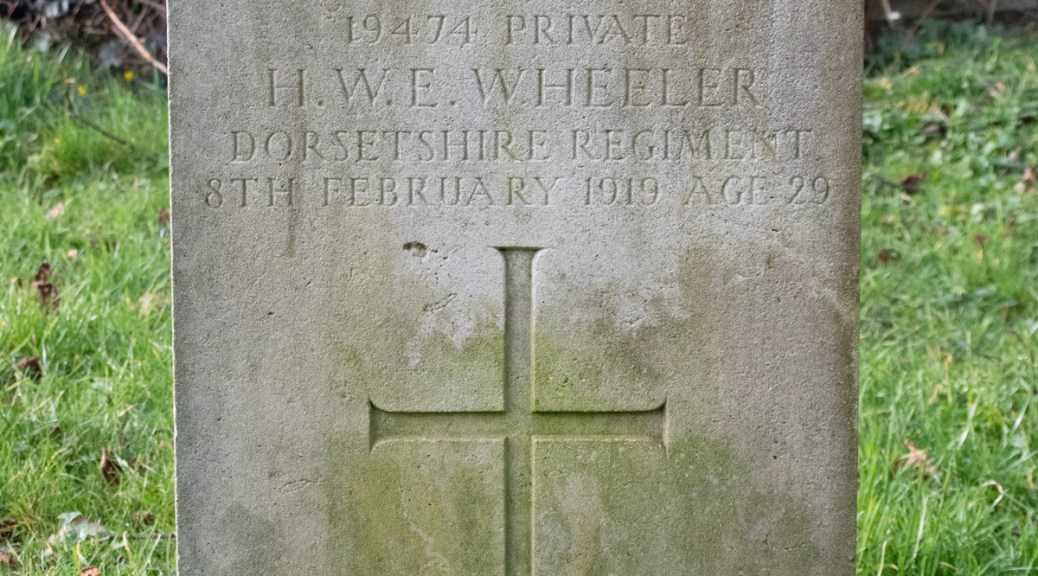
Henry William Edward Wheeler was born in early 1890, the fifth of thirteen children – and the oldest son – to Henry and Anne Wheeler. Henry Sr was a labourer from Witham Friary in Somerset, and this is where the family were born and raised.

When he left school, young Henry – who became known as Harry to avoid confusion with his father – found work as a postman. When war broke out, however, he enlisted as a Private in the Somerset Light Infantry. Full details of his military service are unclear, but his marriage certificate confirms that he was a soldier by the spring of 1915.

Harry’s wedding was to a woman called Mabel Hulbert, who was working as a domestic servant in Wotton-under-Edge, Gloucestershire. It was in the village’s church that the couple exchanged vows, and within a matter of weeks, Private Wheeler was sent to France.

Harry’s troop – the 1st Battalion – was involved in some of the fiercest fighting of the war, and it is likely that he was involved at The Somme in July 1916. At some point, though, he moved across to the 5th (Service) Battalion of the Dorsetshire Regiment, who had moved to France, having been fighting at Gallipoli. The specifics of Private Wheeler’s time in the army are, however, destined to be lost to time.

Private Wheeler’s trail can be picked up again after the end of the war, presumably when he had returned to Britain prior to being demobbed. Sadly, however, he was admitted to a military hospital in Wilton, Wiltshire, suffering from ‘disease’. He passed away on 8th February 1919, at the age of 29 years old.

The body of Henry William Edward Wheeler was brought back to Somerset for burial. He was laid to rest in the quiet graveyard of St Mary’s Church in his home village of Witham Friary.


Henry’s younger brother, John, also served in the First World War. He enlisted in the 8th (Service) Battalion of the Somerset Light Infantry, and arrived in France on 4th October 1915, just a couple of months after his older brother.

John was killed in fighting on 11th October 1917 – possibly as part of the opening salvos of the Battle of Passchendaele – and was just 20 years old. He was laid to rest in the Outtersteene Communal Cemetery in northern France.


Second Lieutenant Cedric Pepper

Second Lieutenant Cedric Pepper

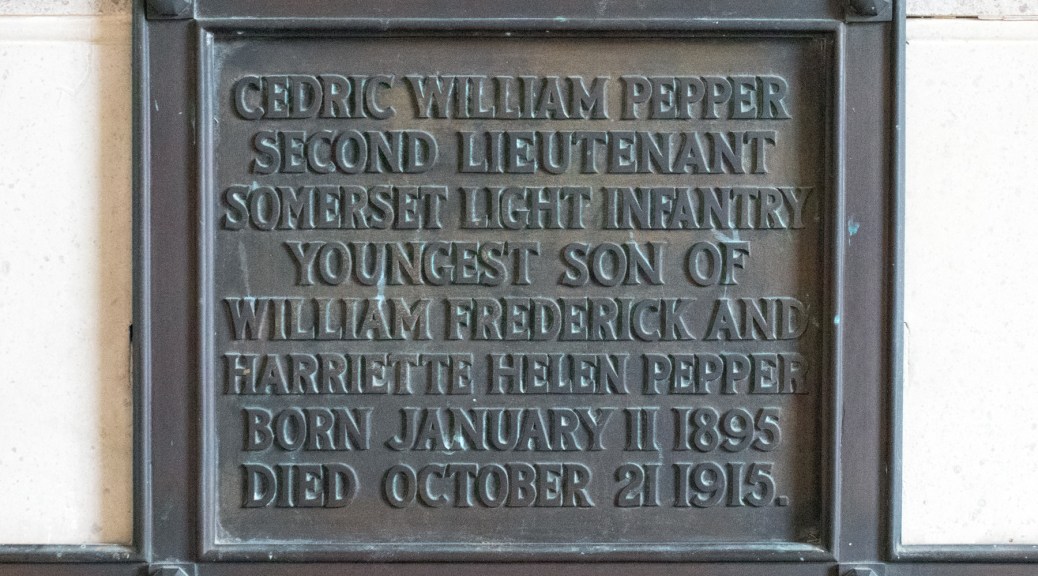
Cedric William Pepper was born in 1895 in South Kirkby, Yorkshire. He was the middle of three children to William and Harriette Pepper. William was a colliery owner from Leeds, and the family lived in some comfort in Rawdon Hill in Wharfdale. The 1901 census records show that they employed a governess, cook, two housemaids, a kitchen maid and a page.

By the time of the next census, in 1911, the Pepper family had moved to Shipton in Oxfordshire, where they lived in the 27-room Shipton Court. Cedric, by this time, was still studying, having been taught at Winchester College, where he lasted only a year, Tonbridge School, and then Worcester College in Oxford.

When war broke out, he had taken time away from his studies, and was working on a ranch in Rhodesia (present-day Zimbabwe). He returned to Britain at the start of the conflict and enlisted in the King’s Royal Rifle Corps. Assigned to the 2nd Battalion, Private Pepper arrived in France in November 1914, and was wounded in his thigh the summer of 1915.

Private Pepper returned to Britain to recuperate and, when he had recovered, he was given a commission in the 3rd Battalion of the Somerset Light Infantry. It was while he was training in Oxfordshire that the now Second Lieutenant Pepper met his end.

The evidence at the inquest… suggested that the death from a bullet wound… was accidental.

Second-Lieutenant William Eric Warburton… stated that early last week Lieutenant Pepper told him he was in some difficulty with a woman, but he did not explain it. Lieutenant Warburton did not think that this caused him to take his life. In his opinion Lieutenant Pepper knew nothing of the working of an automatic pistol he possessed.

The medical evidence was that a bullet entered the centre of the forehead. The doctor said that if the wound was self-inflicted it was quite possible that it was accidental.

The jury returned a verdict of Death from a bullet from an automatic pistol, but that there was no evidence to show how the wound was inflicted.

Central Somerset Gazette: Friday 29th October 1915

Second Lieutenant Pepper died from the bullet wound on 21st October 1915. He was just 20 years of age.

Pepper Family Memorial

Cedric William Pepper’s family were, by this time, living in Redlynch House, near Bruton, Somerset. He was cremated, and his ashes immured in the wall of St Peter’s Church in the hamlet.


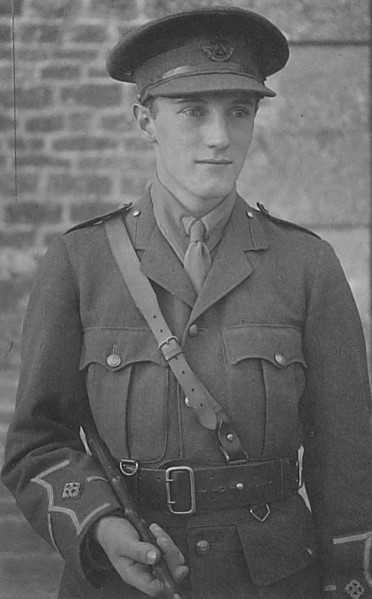
Second Lieutenant Cedric Pepper
(from findagrave.com)

In researching Cedric’s life, there is a definite sense of a young man desperately looking to please his father. A successful Yorkshire colliery owner, he may have expected more from his oldest son, a drop out from Winchester College, possibly sent to Southern Africa to find himself. While an immediate return to Britain to serve his country would have been commonplace, the suggestion of difficulty with a woman and the subsequent accident with his gun just adds to the sense of a need for Cedric to not disappoint his father.


Private Frederick Coward

Private Frederick Coward

Frederick John Coward was born in the Somerset village of Cucklington, in September 1900. The youngest of eight children, his parents were farm labourer Frank Coward and his wife, Agnes.

It is likely that Frederick followed in his father’s footsteps when he left school, labouring on a farm. He was only thirteen when war broke out in the summer of 1914, and over the next few years, he probably watched with envy as his older peers – and older brothers – went off to serve their King and Country.

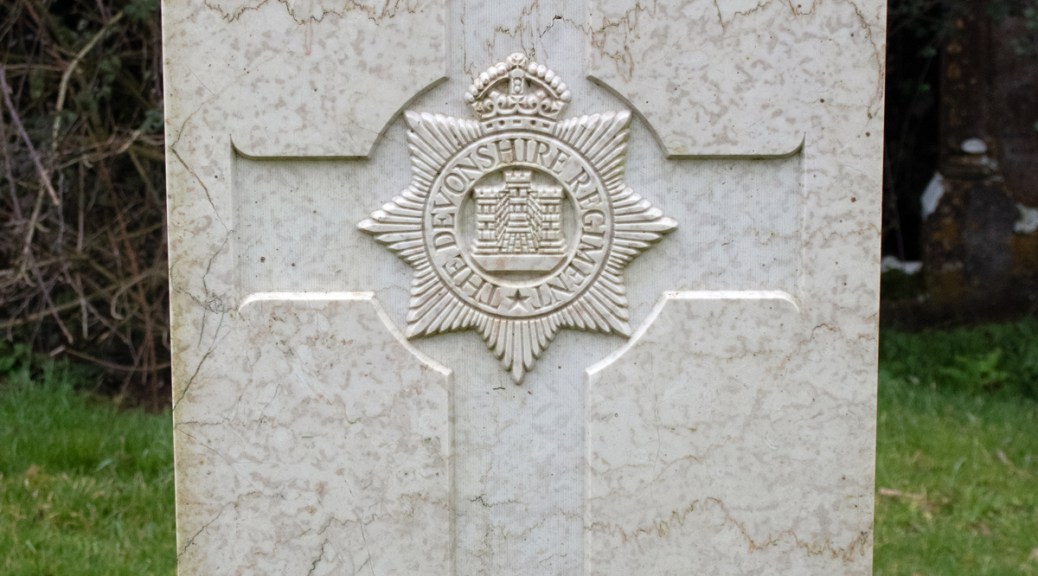
While full details are no longer available, Frederick probably enlisted as soon as he turned eighteen. He joined the Devonshire Regiment as a Private and was attached to the 53rd (Young Soldier) Battalion. He was sent off to Wiltshire and billeted at the Rollestone Camp, to the north of Stonehenge.

Army and naval barracks were crowded places, and brought together boys and men from all over the country in a way that had never happened before. The cramped nature of the billets meant that disease would run rampant and, once it took hold, it could prove fatal. Sadly, young Frederick was not to be immune from this: he was admitted to the camp hospital, and passed away from ‘disease’ on 6th October 1918. He was just 18 years of age.

The body of Frederick John Coward was brought back to Somerset for burial. He was laid to rest in the picturesque graveyard of St Lawrence’s Church in his home village of Cucklington.


The loss of her youngest boy seems to have proved too much for Agnes to bear. She died the following spring, at the age of 55 years old.


Private Harry Lawrence

Private Harry Lawrence

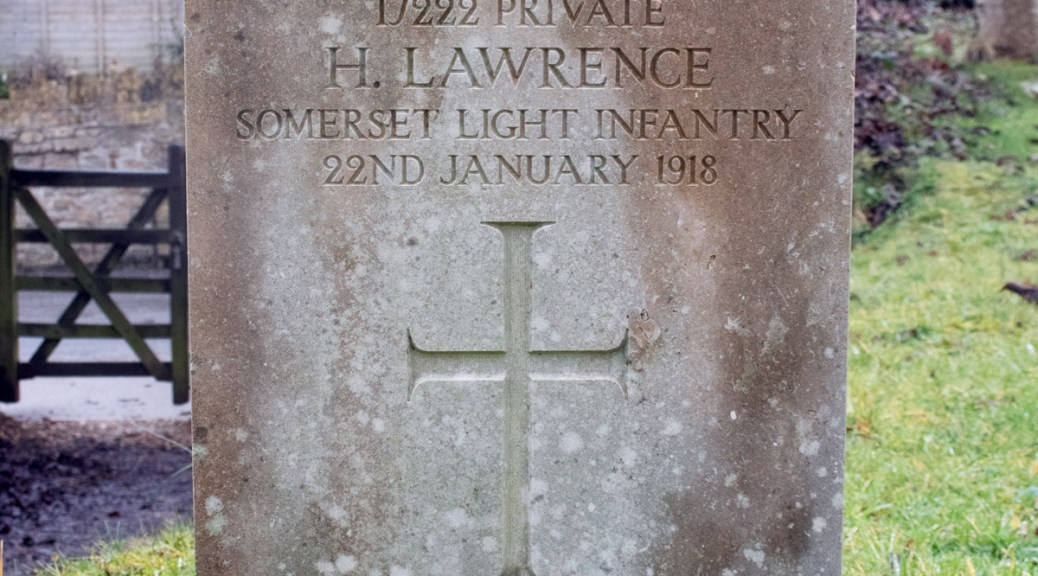
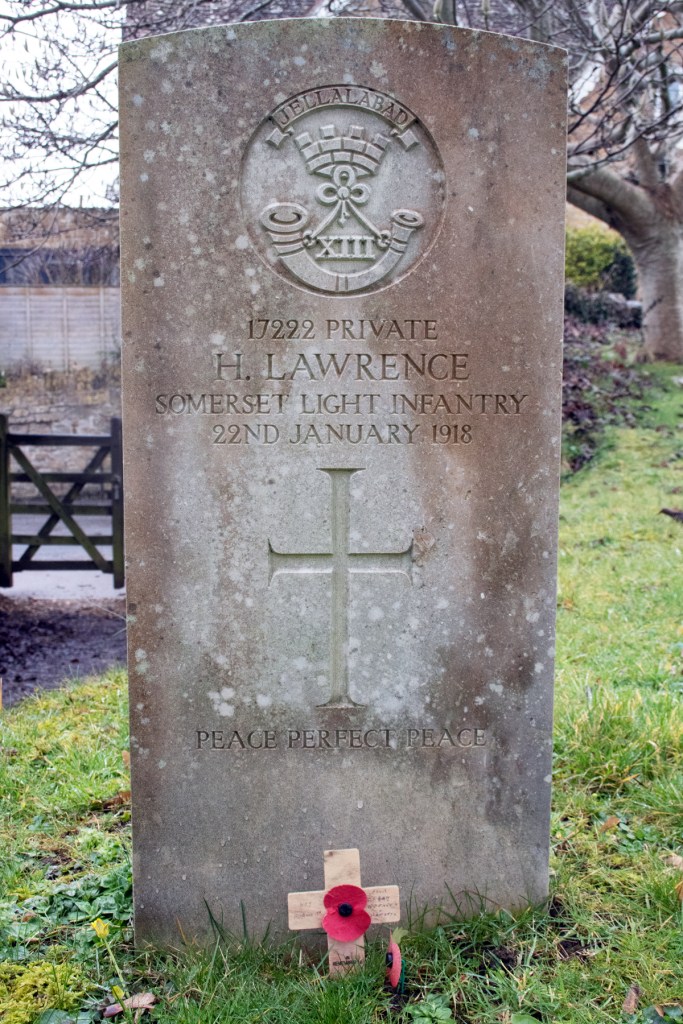
Harry Lawrence was born on 21st March 1895 in the Somerset village of Merriott, and was one of seven children to Samuel and Rose Lawrence. Samuel was a farm labourer, and, when he left school, this is work that Harry also took up.

When war was declared, Harry stepped forward to play his part. He had enlisted in the Somerset Light Infantry by the summer of 1917 and, while his full service records are no longer available, he definitely spent time on the Front Line in France.

Private Lawrence’s troop – the 6th (Service) Battalion – was involved in some of the fiercest fighting of the war, at the Somme, Arras and Ypres. At some point he was injured, and medically evacuated back to Britain for treatment.

He had been under medical treatment for some time in St George’s Hospital, London. Unfavourable symptoms, resulting from concussion of the brain, set in, which terminated fatally, and death this added one more name to the already long list of the Roll of Honour of [Merriott].

Western Chronicle: Friday 8th February 1918

Harry Lawrence died in St George’s Hospital on 22nd January 1918. He was just 22 years of age. His body was brought back to Somerset for burial, and was laid to rest in the quiet graveyard of All Saints’ Church in his home village.


Private Arthur French

Private Arthur French

Arthur John French was born on 3rd September 1889 in the Somerset village of Merriott. He was the youngest of three children to John and Annie French. John was a miller and baker in the village, and Arthur’s older brother Edward helped his father with the business. Arthur, however, followed a different path and, with Annie passing away in 1903, he had moved to London for work.

The 1911 census recorded Arthur boarding with his maternal aunt and uncle, who were both schoolteachers. He had found employment as a clerk in the head office of the National Telephone Company and shared the large terraced house with the couple, their son Alfred and their servant, Esther.

When war was declared, Arthur was in the first wave of those enlisting. He joined the Oxford & Bucks Light Infantry and, as a Private, was assigned to the 2nd/4th Battalion. Initially sent to Northampton for training, his troop soon came south again and, by April 1915, was based just outside Chelmsford, Essex.

Tightly-packed barracks, housing men from across the country soon became hotbeds for illness and disease, and Private French was not to be immune. He contracted meningitis, and was admitted to the 3rd London General Hospital in Wandsworth for treatment. Sadly he was to succumb to the condition, and he breathed his last on 16th April 1915, at the age of just 25 years old.

Arthur John French’s body was brought back to Somerset for burial. He was laid to rest in the graveyard of All Saints’ Church in his home village, Merriott.