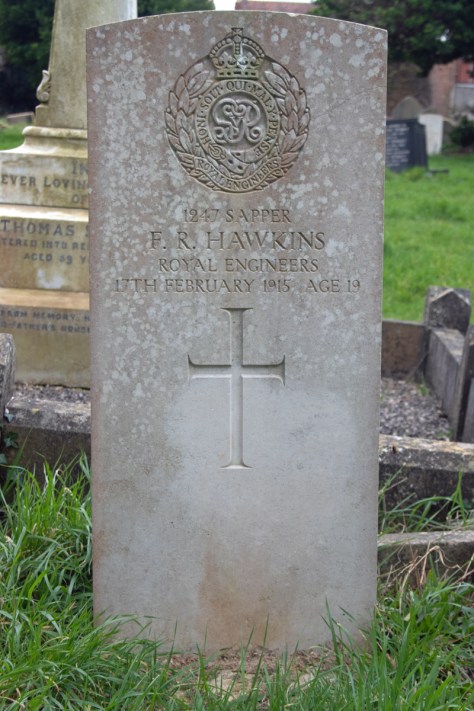
Francis Ralph Hawkins was born in Somerset in March 1895 and was one of twelve children to Charles and Jane Hawkins. Charles was a police sergeant and the family lived in Bishop’s Lydeard, a village to the west of Taunton.
By the time of the 1911 census, Charles had retired from police work, and was operating as a licenced victualler in nearby Bridgwater. While Jane was supporting her husband running the business, Francis was apprenticed to a local clothier.
When war broke out, Francis was quick to enlist – he joined the Royal Engineers, and was appointed a Sapper. He wasn’t with the company for that long, however, as by February he had been admitted to the Red Cross Hospital in Christchurch, Dorset, with a fever.
Sadly, he was not to recover; Sapper Hawkins passed away from spinal meningitis on 17th February 1915. He was just 19 years of age.
Francis Ralph Hawkins lies at rest in the Wembdon Road Cemetery, Bridgwater.
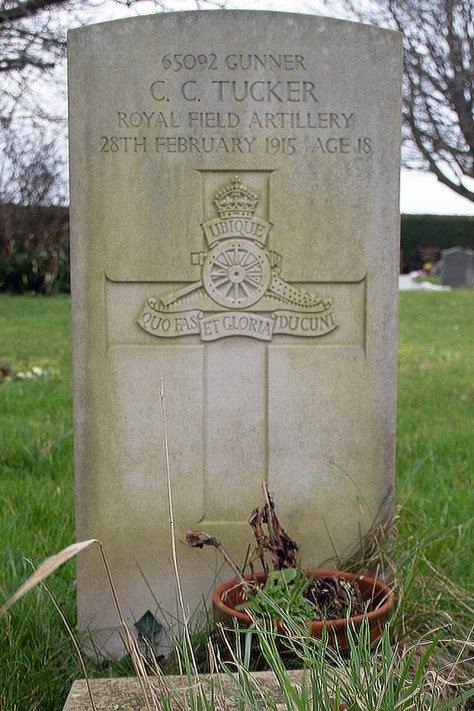
Clifford Charles Tucker was born in 1896, one of five children to John and Ellen Tucker. John was a shoemaker in the Somerset village of Othery, while Clifford became a farm labourer when he left school.
There is little documented of Clifford’s life, and what I have been able to identify about his military career has come from a newspaper article.
Much regret is felt in Othery at the new of the death of Clifford Tucker, one of the young fellows who volunteered for the service of their King and Country. Deceased, who was only 18 years of age… enlisted in the Royal Artillery about six weeks ago and was stationed at Brighton.
He was taken ill with pneumonia and died, his father arriving in time to see him before he breathed his last.
Taunton Courier and Western Advertiser: Wednesday 17th March 1915.
Gunner Tucker passed away on 28th February 1915, aged just 18 years old.
He lies at rest in the cemetery of his home village of Othery.
Leonard George Francis (who was known by is middle name) was born in October 1895. He was one of fourteen children to Jonas and Eleanor (or Ellenora) Francis, and his father worked on the railways as a plate layer or ganger.
George followed his father into manual labour, and, by the time of the 1911 census, aged 15, he was already listed as a mason.
He seems to have enlisted fairly early on in the war, and by January 1915 had joined his troop – the 2nd Wessex Field Company of the Royal Engineers – on the front line.
Sadly, Sapper Francis’ time in the army was to be brief. He was caught up in the fighting at Ypres, and he was injured at Hill 60 on 27th April. He was moved to a local hospital for treatment.
It seems that messages crossed in the communication with George’s family. They received a letter confirming that he was recovering in hospital after receiving a wound to the body, but not to worry. A day or so later his postcard confirming his arrival in France was received, but by this time he had been shipped back to England for treatment.
His parents received a telegram to confirm this, and his father and brother set out to visit him. By the time they had reached the hospital, however, he had sadly passed from a tetanus infection. In his pocket was a piece of shell; a sad souvenir of his frontline action.
Leonard George Francis died at Netley Hospital 3rd May 1915. He was just 19 years old.
He lies at rest in the cemetery of his home town, Shepton Mallet in Somerset.
Francis George Smith was born in Glasgow in 1890. Records are scattered, but some of the pieces pull together to give an outline of his life.
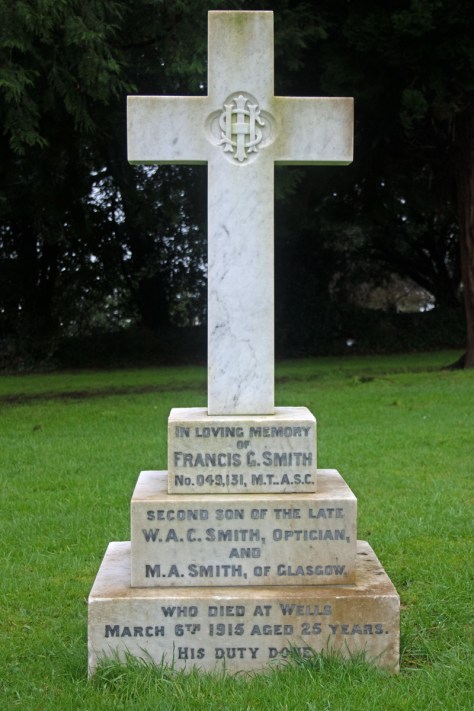
The son of William and Mary Smith, Francis was the fourth of six children. His tombstone confirms that William had worked as an optician, but passed away when Francis was a young man.
Francis was an electrical engineer, and had assisted Mary in her business in Glasgow before signing up.
Private Smith enlisted early on in the war, “on February 24th of this year [1915], when he left his native city for London, where he joined the motor transport section of the Army Service Corps” [Wells Journal, Friday 12th March 1915].
Billeted in Wells, he had been assigned to the 133 Mechanical Transport Company. Within weeks of moving there, however, it seems that Francis fell ill. Sadly, his was a life cut too short, and he passed away from pneumonia on 6th March 1915, aged just 25 years old.
Francis George Smith lies at rest in the cemetery in Wells.
William James Waterhouse was born in 1875, the eldest of seven children to Richard and Elizabeth Waterhouse. The family lived in Cumberland, where Richard initially worked a grocer before becoming a music teacher.
William followed his father into food retail, working initially as a butcher’s boy in Barrow-in-Furness, before moving 400 miles to the south coast and settling in Eastbourne. Travel was definitely on William’s mind, however, as, by the 1911 census, he was a butcher’s manager at a hotel in Leicester.
William’s service records are limited; he was 39 when war broke out, and enlisted in the Eastern Mounted Brigade, before transferring Army Service Corps. During his time, he was promoted to Serjeant, and according to a newspaper report of his funeral “was most popular among the men.” [Wells Journal: Friday 9th July 1915]
It seems that, as part of his service, Serjeant Waterhouse had been assisting with haymaking in the Wells area, and it was after this that he fell ill. He developed pneumonia, and passed away on 30th June 1915. He 40 years old.
William James Waterhouse lies at rest in the cemetery of his adopted home town of Wells, in Somerset.
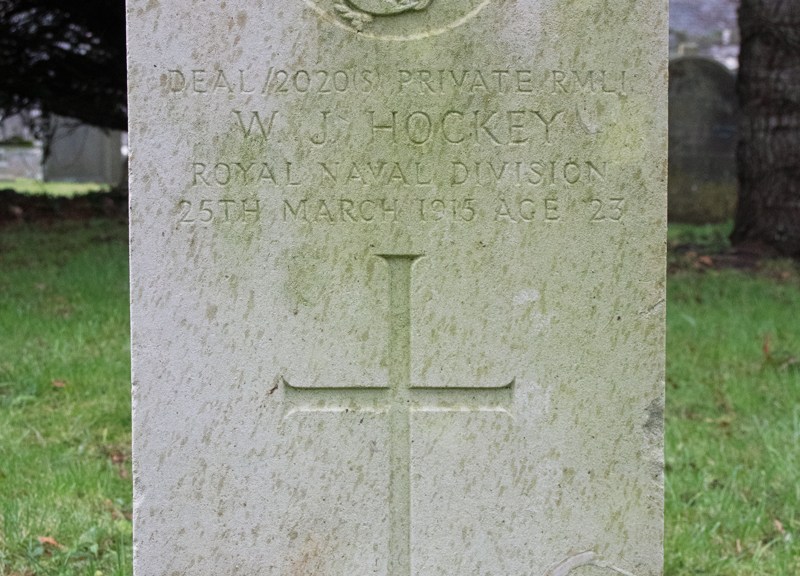
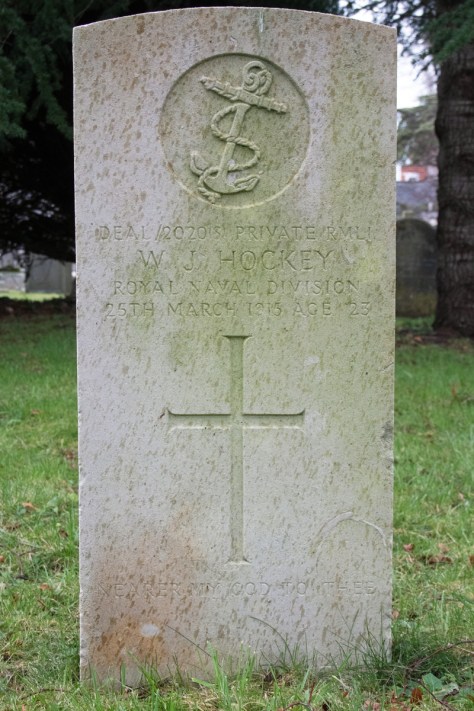
Wilfred James Hockey was born in September 1892, the sixth of nine children to William and Mary. William was the village butcher, but Wilfred followed his older brother Oliver into the gardening business.
Military records for Wilfred are difficult to locate, but it appears that there is a reason for this.
He enlisted in February 1915, joining the Royal Marine Light Infantry. His initial service took him to Crystal Palace in South London – then a naval training base.
Returning home on leave on 12th March, Private Hockey fell ill on his first evening at home. Quickly diagnosed with ‘spotted fever’ (or meningitis), he sadly passed away on 25th March. He was just 23 years of age.
Wilfred Hockey lies at rest in the graveyard of St Matthew’s Church in his home village of Wookey, in Somerset.
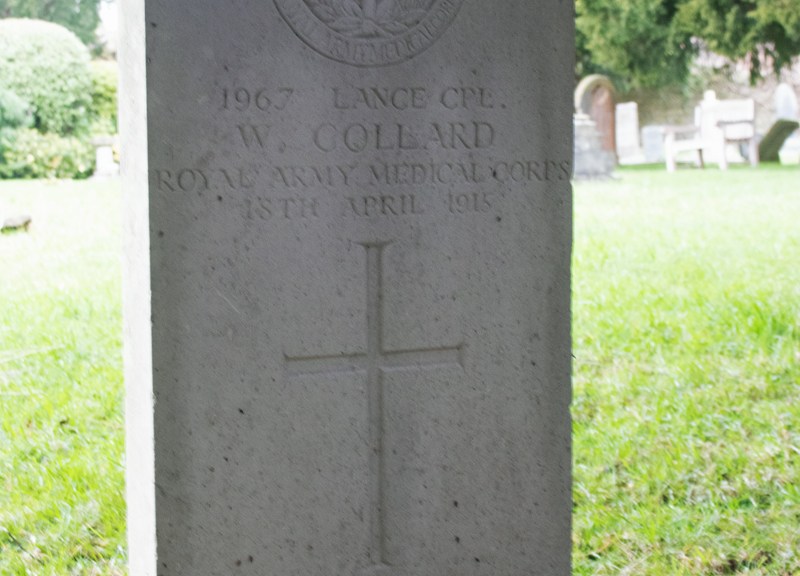
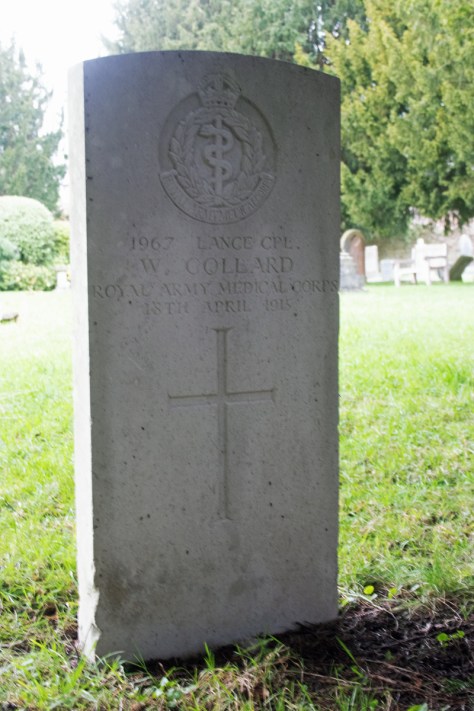
William Collard was born in August 1891, the youngest of two children to William and Agnes Collard from Wedmore in Somerset. William Sr was a carter for a local miller and his son followed him into labouring when he left school.
William’s life seems to have been a tragic one. His mother died in 1910, while his sister Mabel passed a year later.
William married Eva Heal, a woman from the same village, in April 1914. The couple didn’t go on to have any children.
There is limited information relating to William’s military service. What is apparent is that he enlisted in the Royal Army Medical Corps, presumably at some point after the start of the Great War.
Private Collard’s battalion, the 3rd South Midlands, were based in Essex and were shipped to France in March 1915. There is, however, no evidence that William went with his troop. His training must have gone well, however, and he was promoted to Lance Corporal.
Details of his death are vague; William’s gravestone confirms he passed on 18th April 1915; the cause of his death was not reported. He was 23 years of age.
A brief notice in a local newspaper gives a little more information:
Mr W Collard [Senior], of Wedmore, one of the patients at the Country Sanatorium, received last week the news of the death of his soldier son. The funeral took place on Thursday at Wedmore in the same grave as the mother and only other member of the family, a sister of the deceased.
Shepton Mallet Journal: Friday 30th April 1915
William Collard lies at rest in the churchyard of St Mary’s Church in his home village of Wedmore, Somerset.
William is remembered in on a plaque in Bristol Cathedral; this commemorates the fourteen members of the 3rd South Midland Field Ambulance who fell during the war.
Comment should also be made of William’s father. In the space of four and a half years, he had lost his wife and both his children. He was already in a sanatorium when his son died. He too passed away, in December 1924, at the age of 58.
William’s widow, Eva, never remarried. She went on to live the age of 96, and passed away in Poole, on the Dorset coast.
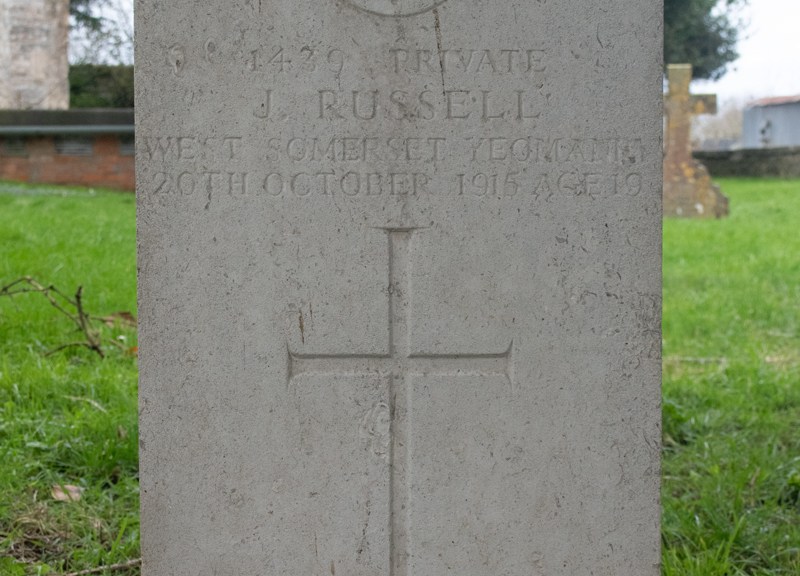
Born in September 1896, John Russell was one of thirteen children to Henry and Ellen Russell. Henry worked as a turf cutter on the Somerset levels, and the family lived in the village of Meare, near Glastonbury.
By the time of the 1911 census, John, aged 15, had left school and joined his father’s business.
When war broke out, John joined up; sadly, his military records are absent, but what we do know for certain is that he enlisted in the West Somerset Yeomanry, and was based at the Stanway Camp near Colchester in Essex.
Sadly, much is written of Private Russell’s death. He was acting as a sentry at the camp on the morning of Tuesday 19th October 1915 when he was hit by a car; taken to the military hospital in Colchester, he passed away the following morning.
An inquest was held into the incident, and the following was ascertained:
Vera Coysh, aged 19, was driving near the camp with two friends and her gardener; as she was approaching the entrance, a horse-drawn military wagon ahead of her turned and she swerved to avoid it. In doing so, she hit Private Russell “and carried him some way along the ground”.
John’s injuries were significant. When admitted to hospital, he “was suffering from bruises on the back of the head and haemorrhage from the right ear and nose. His left hand and the lower part of his left arm were swollen from bruising. He was semi-conscious and restless…”
The inquest identified some discrepancies in what happened.
Witnesses in the military wagon and a second one following it all saw a turning signal being given, although not necessarily in time for Vera to slow down or stop. All of the army witnesses stated that she was driving at a quick speed, possibly as much as 35mph.
Vera and her passengers all stated that they saw no signal, saying that the wagon pulled across without indication. They also stated that they were not travelling at speed.
The inquest was a lengthy one, but the final verdict was one of accidental death, with a recommendation that signs were put up on the road to warn of the entrance to the camp.
John Russell was just 19 years old when he died. He was laid to rest in the graveyard of the Church of the Blessed Virgin Mary and All Saints in his home village of Meare, Somerset.
It’s worth also having a look into the life of the driver of that fated motor car.
Vera Murdoch Coysh was born in September 1896, the eldest child of Commander William Henry Coysh and his wife Beatrice Murdoch. The family lived in Yorkshire and, by the time of the incident, William and Beatrice had had four other children – Humphrey Cecil (who became a Commander), Geoffrey Ernest (who went on to be Sub Lieutenant), John William and Barbara Daphne.
Three months after the accident, Vera married Second Lieutenant Trevor Davidson, of the Essex Regiment, and the couple soon emigrated to Mozambique.
All was not well, however, as, by 1924, Vera has moved back to England, the couple had divorced and she had remarried, to a Douglas Stuart-Jervis. The couple went on to have two children.
Meanwhile, Vera was also making a bit of a name for herself in the literary world, writing a number of novels under the name of Jane England. While rarely seen nowadays, she wrote books with such ‘pulp fiction’ titles as Red Earth, Romantic Stranger, Flowering Harvest, Stormy Passage and Winter Jasmine.
It’s bittersweet to see that Vera made a life for herself, in the way that John Russell was sadly unable to.
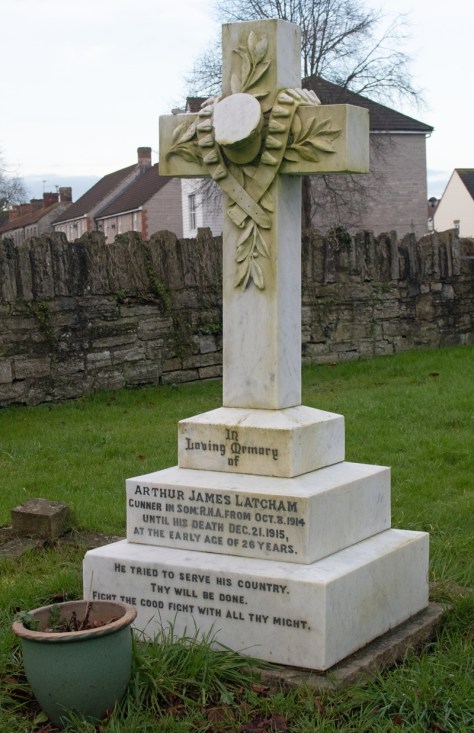
Arthur James Latcham was born in 1889, the oldest of five children – all boys – to Walter and Matilda Latcham. The family lived in Street, Somerset, where Walter worked as a carpenter in the Clark’s shoe factory.
Initially following his father into shoemaking, Arthur was quick to enlist when war broke out. Details of Gunner Latcham’s military service is scarce, but documents confirm that he joined the Somerset Royal Horse Artillery on 8th October 1914. He did not see active service abroad, but had been stationed on the east coast for his training.
While little remains of his service records, contemporary media of the day includes a lot of information about both his passing and his subsequent funeral.
On Sunday, December 5th, having a few hours’ leave, he visited his parents at Street, and while at home complained that he was feeling unwell. On the following Wednesday, December 8th (which, by a coincidence, was his twenty-sixth birthday) Mr and Mrs Latcham received a post-card from him from Taunton [where the Somerset RHA was based] stating that he was very ill. They immediately engaged a motor car, and went to Taunton, where they found him in an extremely weak state, and on the point of collapse, he having had to walk to a hospital nearly a mile away three times a day for his medicine. Having obtained the captain’s permission, they brought him home in the motor car, and at once put him under the care of Dr MacVicker. He was then found to be suffering from pneumonia and congestion of the lungs… In spite of the greatest care, and best of nursing, however, he gradually grew worse, and never rallied.
Central Somerset Gazette: Friday 24th December 1915.
The following week’s newspaper included nearly a whole column on Gunner Latcham’s funeral, including two tributes, one from his captain and another from the local MP.
I am writing to tell you how very sorry all the officers of this battery are at your loss. Your son was the first member of the Somerset RHA to give his life for his country, and although he did not have the satisfaction of being killed in action, the honour is the same. I’m afraid the last few months he was in this battery were not very happy ones for him, owing to his trouble with his finger; but he bore the trouble and pain well. I had him with me for more than a year, so I can fully appreciate what a good fellow he was and how great your loss is.
Captain M Clowes (Central Somerset Gazette: Friday 31st December 1915)
I am very sorry indeed to learn of the sad loss you have suffered through the death of your son. I know that he was a fine fellow, an example of what an Englishman should be, and respected by all who knew him. I am sure you must feel proud to know that he has done all that a man can do, and has died serving his country.
Ernest Jardine MP (Central Somerset Gazette: Friday 31st December 1915)
Arthur James Latcham lies at rest in the graveyard of Holy Trinity Church in his home town of Street.
Arthur was the third son Walter and Matilda had lost. Their second-born, Herbert, passed when a little over a year old. Their third son, William, died a year before Arthur, when he was just 15 years old.
William Joseph Dawbin was born on 23rd April 1888, in Yeovil, Somerset. He was the oldest of three children to William and Julianna Dawbin, a farming family.
In 1897, when William Jr was 9 years old, the family emigrated to New Zealand, settling in the town of Feilding, 100miles (150km) north of Wellington.
William enlisted in 1905, joining the Wellington Mounted Rifles for a five-year term of service, and being promoted to the rank of Corporal. He re-enlisted on 14th August 1914, and the troop departed New Zealand for Europe a month later.
Trooper Dawbin arrived in Alexandria, Egypt on 3rd December, from where they travelled to Cairo for training. Initially planning on becoming involved in the defence of the Suez Canal, on 14th April 1915, William and his battalion landed in Gallipoli, to support the invasion there.
History knows that the fighting in this battle was some of the fiercest of the Great War. History also tells us that this campaign resulted in huge losses for the Anzac troops, including the Wellington Mounted Rifles. Sadly, Trooper Dawbin was not to escape injury.
On 27th May 1915, he received a gunshot wound to the back, fracturing his spine. He was evacuated by hospital ship back to Egypt, and, suffering from paralysis, was shipped back to England ten days later.
Trooper Dawbin was admitted to the Netley Hospital in Southampton, but his wounds appeared too severe; he died there on 22nd August 1915. He was 27 years old.
William Joseph Dawbin lies at peace in the quiet churchyard of St Andrew’s, in the village of Compton Dundon, Somerset, not far from extended family in Butleigh.










 Death and Service