Tag Archives: 1919

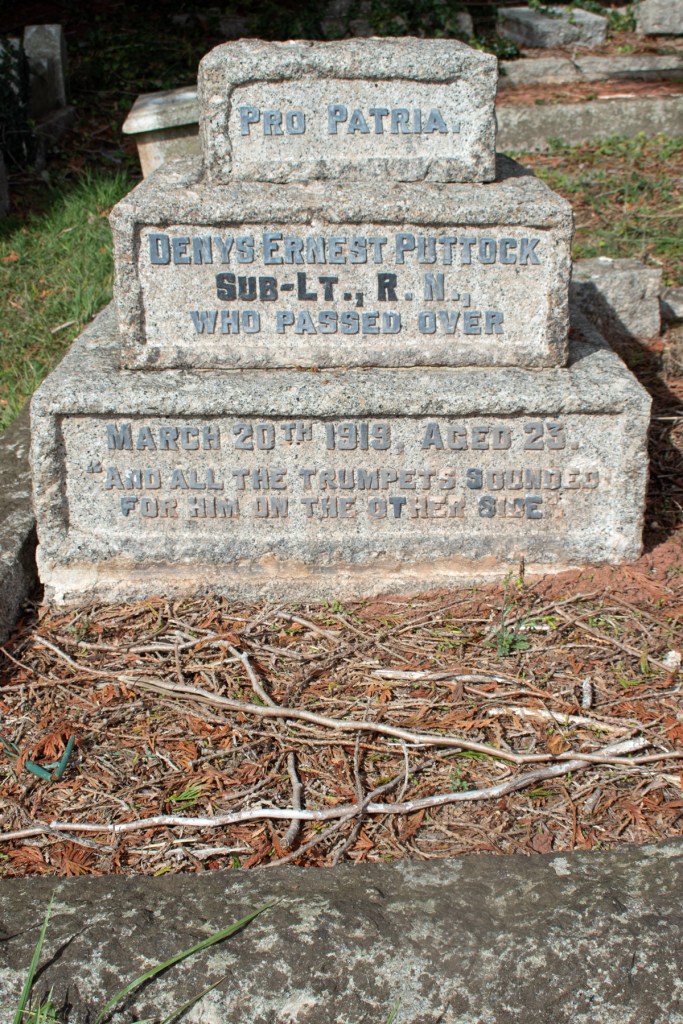
Sub-Lieutenant Denys Puttock

Sub-Lieutenant Denys Puttock

Denys Ernest Puttock was born on 14th September 1895 in the Devon village of Halwill. The middle of three children, his parents were Edward and Alice Puttock. Edward was a vicar of the village’s St Peter & St James’ Church, but died tragically early:

The Red. E Puttock, Rector of Hallwill died on Wednesday, after a brief illness… Mr Puttock had been in charge… for six and a half years. He was much beloved by those among whom he labourer and universally respected. His devotion to the due performance of all his sacred duties was unceasing and his visitations among the poor and afflicted were much appreciated by the whole parish. He was fond of all manly sports, and under his captaincy the Cricket Club at Halwill attained considerable success. Up to the day of his death he could hardly believe that he was ill, and up to the last it was hoped that his wonderful constitution might have carried him through the illness. About a fortnight since he contracted a chill. He would not be deterred from carrying out his duties, and against the advice of his friends, he persisted in taking every service at the church long after he was fit for it. On Sunday, the 24th January, although then in a high fever, he took both the morning and evening services at Halwill Church unassisted, and also the Sunday School in the afternoon. Pneumonia set in at the end of last week, and on Tuesday evening, the 2nd February, the action of the heart failed. He leaves a widow and three young children to mourn their loss.

[Exeter and Plymouth Gazette: Friday 5th February 1897]

After Edward’s death, Alice moved the children to Okehampton. The 1901 census found the family living at 4 Brondage Park, Alice by this time living off her own means. She felt that learning was important, and Denys was sent to Twyford School and St Edmund’s School in Canterbury, Kent. From here he took up a career in the Royal Navy, enlisting in September 1913.

He served in the Highflyer as a Cadet, and was Midshipman in HMS Conqueror, and later Sub-Lieutenant in the destroyers Patriot and Valorous. Long exposure to the rough weather in the North Sea during the winters of 1916 and 1917 brought on tuberculosis, which incapacitated him for further war service. He was invalided our of the Navy and spent many months in a Sanitorium.

[Exeter and Plymouth Gazette: Friday 4th April 1919]

Denys Ernest Puttock’s health was failing him, and he passed away on 20th March 1919, while still admitted. He was 23 years of age. The report of his funeral included comments from those who knew him:

His Headmaster writes: “He has not lived in vain, for he has exercised the power of unconscious influence on all those around him. He knew the secret of happiness – purity of soul and unselfishness of heart.” His Commanding Officer has written: “He was a zealous and capable young officer. Possessed of great charm of manner, he was popular with both officers and men.”

[Exeter and Plymouth Gazette: Friday 4th April 1919]

Alice, having moved to Paignton by this point, laid her son to rest in the town’s cemetery. When she passed away in 1932, she was buried alongside him.

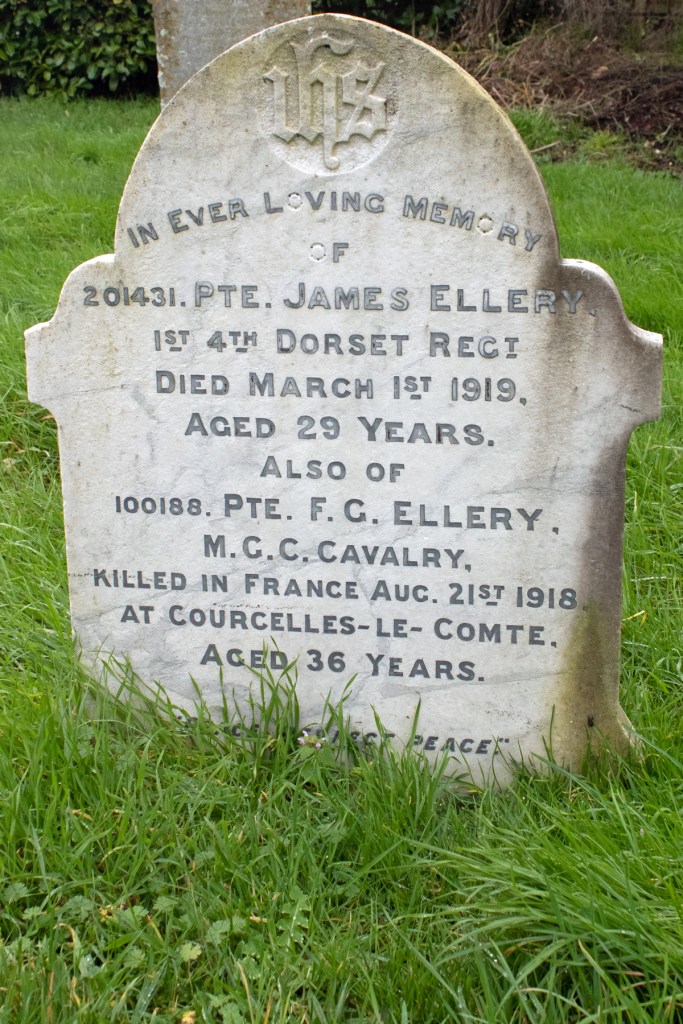
Private James Ellery

Private James Ellery

James Ellery was born in the autumn of 1889, and was the middle of seven children. His parents – Frederick and Mary – were born in Dorset, and the family were raised in the hamlet of Lillington. Frederick was a farm labourer, but James found his way into building work when he finished his schooling.

When war came to Europe, James stepped up to play his part. Full details of his military service have been lost to time, but it is clear that he had enlisted in the Dorsetshire Regiment and was attached to the 1st/4th Battalion.

Private Ellery’s unit served in India and Mesopotamia during the conflict, but it is unclear whether James saw any action overseas. Certainly by early 1919 he was back in Britain, as he was hospitalised in Sherborne following a bout of influenza. This developed into pneumonia, and he was admitted to the town’s Yeatman Hospital.

James’ immune system had become weakened during the conflict, and the pneumonia turned septic. It proved to be fatal, and James passed away on 1st March 1919. He was 29 years of age.

James Ellery’s body was taken back to Lillington for burial. He was laid to rest in the peaceful graveyard of St Martin’s Church.


James was not the first of the Ellery siblings to die during the Great War. His eldest brother, Frederick, had enlisted in the 2nd Battalion of the Machine Gun Corps Cavalry. He was killed in action on 21st August 1918, leaving behind a widow and three children. He was 36 years of age and is commemorated on the Vis-en-Artois British Memorial in Haucourt. France.


Private Alexander Cain

Private Alexander Cain

Alexander Bertram Cain was born on 31st July 1885 in Ormskirk, Lancashire. He was the ninth of eleven children to concert promoter Robert Cain and his wife, Sarah.

By 1901, Robert and Sarah had moved the family to Jersey, setting up home in St Saviour’s. Robert was noted as living off his own means, but Alexander, who would have been 15 by this point, is noticeable by his absence and, in fact, does not appear on that year’s census return.

Robert died in 1909, and on 26th January 1911, Alexander married a woman called Hilda Bedford. They settled down in St Helier, and went on to have two children, daughters Yvonne and Elizabeth. The census taken three months after the couple’s wedding recorded Alexander as living on his own means, so money appeared not to be an issue for the young family.

When war came to Europe, Alexander was called upon to play his part. On 12th March 1917, he enlisted in the Royal Jersey Militia, and was attached to the regiment’s Garrison Battalion, stationed on the island. His service records confirm that he was 5ft 7ins (1.7m) tall, and that he had a scar on his left cheek. The document also suggests that he had spent time in the Gloucestershire Regiment, but no further information about this is available.

Private Cain spent the next two years in the army. Towards the end of this time, however, his health appears to have been impacted, to the point that, on 6th May 1919, he was medically discharged from the Royal Jersey Militia.

Whatever his condition, it was to prove fatal. Alexander passed away at home on 31st May 1919: he was 33 years of age.

Alexander Bertram Cain was laid to rest in the family plot in La Croix Cemetery in Grouville, Jersey, Hilda left widowed and with two children – Elizabeth just four months old – to raise.


Private John Turner

Private John Turner

John Francis Turner was born on 24th March 1899 in the St Ouen region of the Channel Island of Jersey. He was the only surviving child of Francis and Eugenie Turner, his older brother, Francis Jr, having passed away before John was born.

Francis was a farm labourer, but when John finished his schooling, he found work as a carpenter. When war broke out across Europe, he was conscripted to play his part and, on 31st March 1917, he enlisted in the army.

Private Turner was noted as being 5ft 5ins (1.65m) tall and weighing 115lbs (52kg). His medical records show that his vision was defective, but not so bad as to exclude him from service, but he was also found to have flat feet.

John was assigned to the Royal Army Medical Corps, and was sent to Blackpool, Lancashire, where he was attached to the local depot. He spent the next two years in the army, although his time was not without incident.

In December 1917, he was confined to barracks for five days for overstaying his pass by more than eight hours. This seems to have been Private Turner’s only misdemeanour, however, and there is nothing to suggest anything other than good service.

John’s time in the army does not seem to have been limited to home soil, and, in the spring of 1919, he was attached to one of the Russian convoys ferrying aid and supplies overseas. On his return, however, he fell ill, and on 2nd February, he was admitted to hospital in Edinburgh, suffering from pleurisy.

Private Turner was to remain in hospital for the next few months. He slowly recovered, but then contracted meningitis, and, with his body already weakened by illness, this was to prove his undoing. He passed away on 23rd June 1919, aged just 20 years of age.

John Francis Turner’s body was taken back to Jersey for burial. He was laid to rest in the peaceful churchyard of St Ouen’s.


Sergeant Francis Godfray

Sergeant Francis Godfray

Francis George Godfray was born in Jersey, Channel Islands, on 10th April 1895. One of fifteen children, his parents were Philippe and Alice Godfray. Philippe was a quarryman-turned-agricultural labourer and, by the time of the 1911 census, Francis had also gone into farm work.

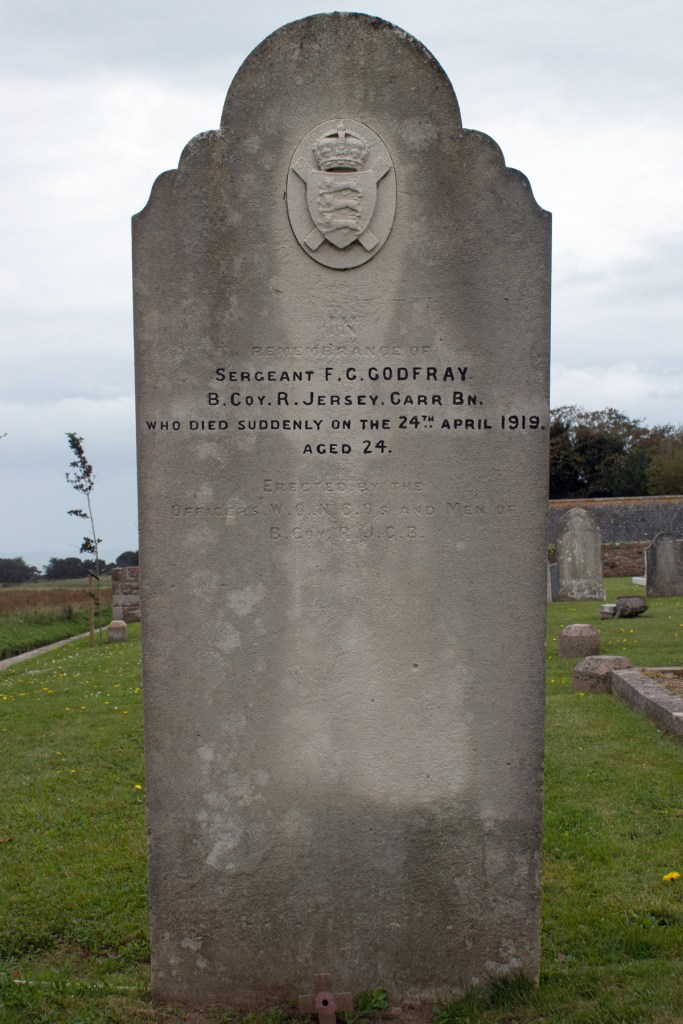
War was closing on on Europe’s shores, and Francis stepped up to play his part. Full details of his service have been lost to time, but it is clear that he had enlisted in the Royal Jersey Militia by 1918. Attached to B Company of the regiment’s Garrison Battalion, by the end of the conflict he had been promoted to the rank of Sergeant.

Sergeant Godfray survived the conflict and had returned home by the spring of 1919. On 24th April, he collapsed and died suddenly, his death later confirmed as heart failure. Francis was just 24 years of age.

Francis George Godfray was laid to rest in the peaceful St Ouen’s Churchyard in Jersey.


Private Philip Mauger

Private Philip Mauger

Philip Mauger was born in 1893 in the St Peter’s area of Jersey, Channel Islands. He was the oldest of six children to Albert and Jane Mauger. Albert was a labourer, alternating between road-building and farm work, depending on the time of year. When he finished his schooling, however, Philip fund work as a wheelwright’s assistant.

On 10th February 1917, Philip married Florence Dimmick, a shoemaker’s daughter from St Ouen. Their marriage certificate confirms Philip was a farmer by this point, and it seems likely that the young couple tied the knot ahead of his conscription the army.

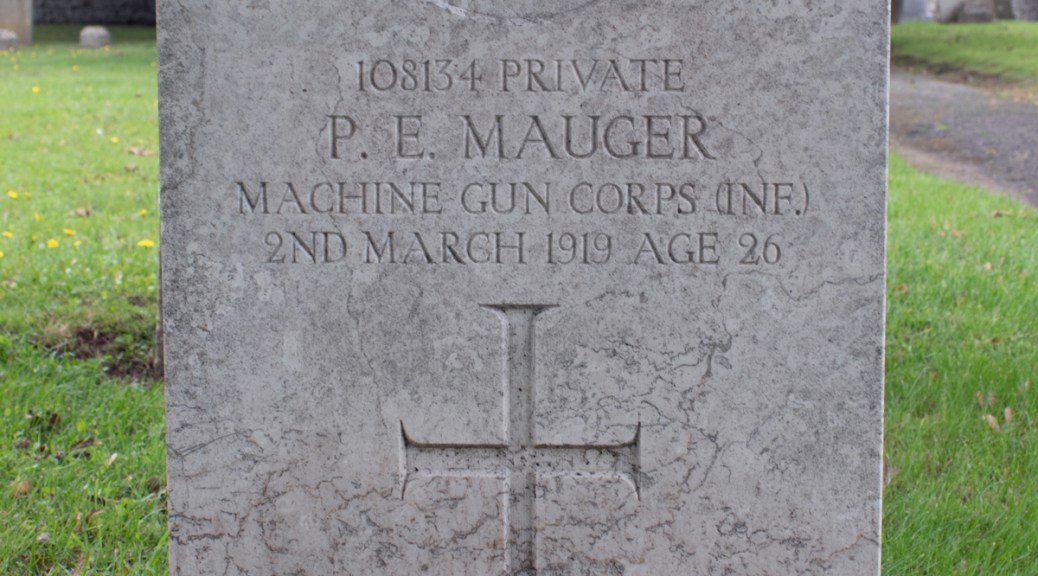
Full details of his military service are lost to time, but it is clear that Philip enlisted in the Machine Gun Corps. Private Mauger survived the conflict, but here his trail fades. All that can be confirmed is that he passed away on 2nd March 1919, at the age of 26 years old. He was laid to rest in St Ouen’s Churchyard.


After her husband’s passing, Florence did not remarry. The couple had not had children, and it appears that she reverted to her maiden name. Husband and wife were reunited, however, when Florence passed away in 1937, and she was buried alongside Philip.


Lieutenant Colonel Cecil Stevens

Lieutenant Colonel Cecil Stevens

Cecil Robert Stevens was born in Arrah, India, on 14th March 1867. One of six children, his parents were Charles and Mary Stevens. Charles was a civil servant who had been born in the South Sea Islands, while Mary has been born in Bengal.

The family appear to have moved to the United Kingdom by the late 1870s. Census records for them are a bit sparse, but the 1881 document found Mary living in Honiton, Devon, with four of Cecil’s siblings and three servants. Cecil, meanwhile, was a boarding student at Malvern College, Worcestershire.

By 1891, Cecil had moved to St Columb in Cornwall. He was boarding at a hotel on Fore Street, and was employed as a general medical practitioner.

Charles was later rewarded for his service to the Empire, and received a knighthood. The 1901 census found him residing in Harcourt Terrace, Kensington, Middlesex, while his wife, now Dame Mary Stevens, was visiting a friend from India in Devon. Sir Charles died at home in 1909, following a bout of influenza.

Cecil, meanwhile, had been making his own way in the world. A qualified surgeon, he married Katharine Duff, a nurse from Aberdeen. They went on to have two children, son Cecil Jr and daughter Mignonette.

On 29th July 1893, Cecil joined the Indian Medical Service as a Lieutenant. Three years later, he was promoted to Captain, and in July 1905, he rose to the rank of Major. His commitment to duty is evident: he spent many years overseas, separated from his wife and young family, and in January 1913, was promoted to the rank of Lieutenant Colonel.

Cecil’s time in the Indian Medical Service was not without danger. In 1895, he was involved in the Relief of Chitral, for which he received a medal and clasp. He was caught up in the Tirah Campaign of 1897/98, and received a further two clasps for his role.

Lieutenant Colonel Stevens’ role during the First World War is lost in the mists of time. Given his role in the Indian Medical Service, it is likely that he served overseas, but he returned to Britain after the war, coming by way of Egypt.

By the autumn of 1919, he was back in Devon, at the family home on Elmsleigh Park Road in Paignton. His health was failing at this point, having come down with diabetes while in North Africa. him. Cecil passed away on 18th November 1919: he was 52 years of age.

Cecil Robert Stevens was laid to rest in the sprawling grounds of Paignton Cemetery.


Lieutenant Colonel Stevens’ will left £4123 13s 10d (around £180,000 today) to his sister-in-law, Alice Duff.

Katharine outlived her husband by only eight years. She passed away on 22nd December 1927 at the Field Officers’ Quarters in Gibraltar: she was 61 years of age.


Gunner Herbert Cudlipp

Gunner Herbert Cudlipp

Herbert Henry Cudlipp was born in St Peters, Jersey, in around 1891. He was one of ten children to farmers John and Louisa Cudlipp. The family had moved to Mont à L’Abbé, on the outskirts of St Helier, by the time of the 1911 census, at which point the whole family were involved in the farm in one way or another.

Little information is available about Herbert’s military life. He enlisted in the Royal Garrison Artillery at some point during the war, and was attached to the 38th Siege Battery. The unit was based in Egypt from December 1915, and later moved to France. However, records are unclear as to when and where Gunner Cudlipp served.

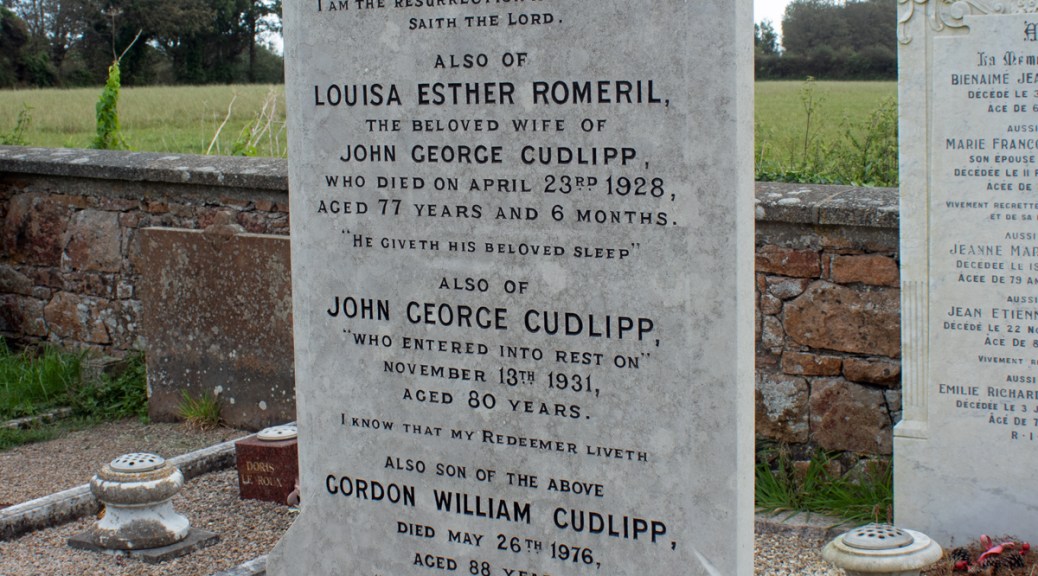
Details of Herbert Henry Cudlipp’s later life are also lost to time. Herbert survived the war, but died on 4th June 1919, at the age of 28 years old. He was laid to rest in the family plot in Macpela Cemetery, St John’s, Jersey.


Gunner Herbert Cudlipp
(from ancestry.co.uk)

Private Percy Wall

Private Percy Wall

Percy James Wall was born in the Somerset village of Kilmersden in the summer of 1880. The fifth of ten children, his parents were called Robert and Amelia. Robert was a cashier for a local colliery, but it seems that Percy did not follow into his father’s line of work.

The 1901 census found Percy working as a draper’s assistant for Jolly & Son’s in Bath. He was one of 27 boarders at the company’s lodgings on Milsom Street in the city centre. By 1911, he was still working for the same company, but as a draper’s clerk, and had moved to some new lodgings just to the north in Lansdown Road.

When war broke out, Percy stepped up to play his part. He enlisted in the Gloucestershire Regiment, although his full service records are no longer available. Private Wall was attached to the 1st/4th Battalion, and, by the autumn of 1916, he found himself caught up in fighting at the Ancre, part of the Battles of the Somme.

Percy was badly wounded, and evacuated to Britain for treatment. Full details are unclear, but his injuries were enough for him to medically discharged from the army. He was awarded the Silver War Badge – proof of his genuine discharge – but at this point his trail goes cold.

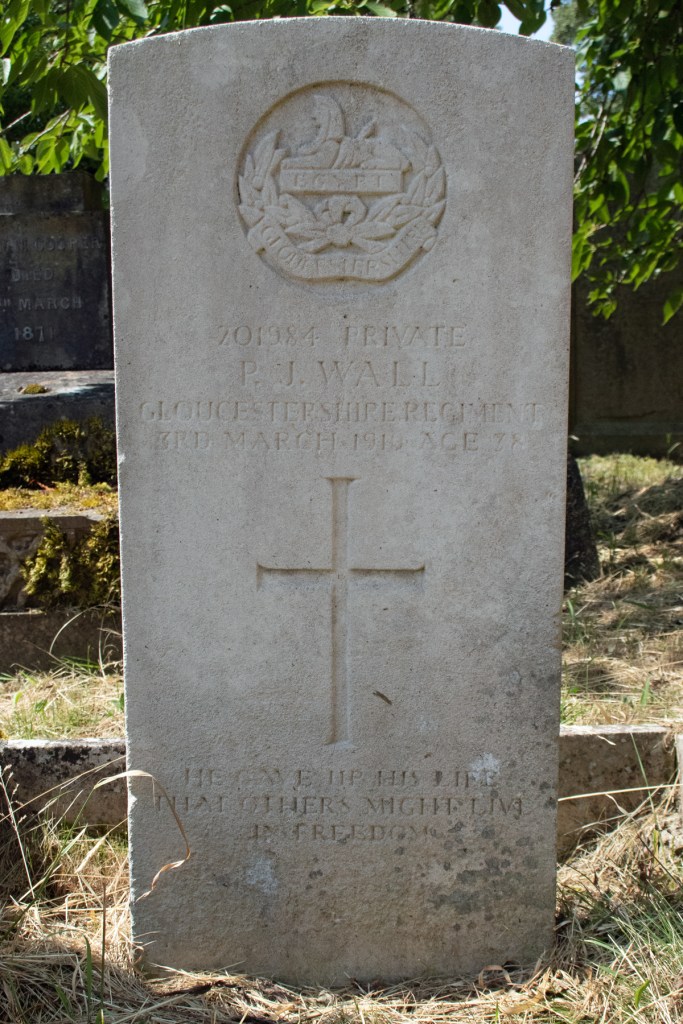
Percy struggled on with his injuries for a further two years. Hhe may have remained in hospital since his original injuries, but there are no records to corroborate this either way. At the start of 1919, he had been admitted to the Bath War Hospital, his family having also moved to the city by this point. He finally succumbed to his wounds, passing away on 3rd March 1919: he was 38 years of age.

Percy James Wall was laid to rest in the sprawling Locksbrook Cemetery, Bath, his pain finally eased.


Private Richard White

Private Richard White

Richard Ezra Baron White was born in the autumn of 1886 in the Cornish village of St Minver. The third of four children, his parents were Joseph and Zillah White. Joseph was a ship’s carpenter by trade, and Richard served an apprenticeship as a woodworker. By the time of the 1911 census, however, the Whites were working as farmers on the outskirts of the village.

When war was declared, Richard stepped up to serve King and Empire. It is unclear when he enlisted, but he joined the Gloucestershire Regiment, and was attached to the 3rd (Reserve) Battalion. Private White was based in Kent during the conflict, his unit being attached to the Thames and Medway Garrison.

Richard survived the conflict, but the winter of 1918/19 was to prove his undoing. He contracted pneumonia, and was admitted to the military hospital in Aylesford. The condition was to get the better of him: he passed away on 20th February 1919, at the age of 33 years.

The body of Richard Ezra Baron White was taken back to Cornwall for burial. He was laid to rest in the peaceful graveyard of St Menefreda’s Church in his home village, St Minver.