Tag Archives: 1919

Lieutenant Colonel Cecil Stevens

Lieutenant Colonel Cecil Stevens

Cecil Robert Stevens was born in Arrah, India, on 14th March 1867. One of six children, his parents were Charles and Mary Stevens. Charles was a civil servant who had been born in the South Sea Islands, while Mary has been born in Bengal.

The family appear to have moved to the United Kingdom by the late 1870s. Census records for them are a bit sparse, but the 1881 document found Mary living in Honiton, Devon, with four of Cecil’s siblings and three servants. Cecil, meanwhile, was a boarding student at Malvern College, Worcestershire.

By 1891, Cecil had moved to St Columb in Cornwall. He was boarding at a hotel on Fore Street, and was employed as a general medical practitioner.

Charles was later rewarded for his service to the Empire, and received a knighthood. The 1901 census found him residing in Harcourt Terrace, Kensington, Middlesex, while his wife, now Dame Mary Stevens, was visiting a friend from India in Devon. Sir Charles died at home in 1909, following a bout of influenza.

Cecil, meanwhile, had been making his own way in the world. A qualified surgeon, he married Katharine Duff, a nurse from Aberdeen. They went on to have two children, son Cecil Jr and daughter Mignonette.

On 29th July 1893, Cecil joined the Indian Medical Service as a Lieutenant. Three years later, he was promoted to Captain, and in July 1905, he rose to the rank of Major. His commitment to duty is evident: he spent many years overseas, separated from his wife and young family, and in January 1913, was promoted to the rank of Lieutenant Colonel.

Cecil’s time in the Indian Medical Service was not without danger. In 1895, he was involved in the Relief of Chitral, for which he received a medal and clasp. He was caught up in the Tirah Campaign of 1897/98, and received a further two clasps for his role.

Lieutenant Colonel Stevens’ role during the First World War is lost in the mists of time. Given his role in the Indian Medical Service, it is likely that he served overseas, but he returned to Britain after the war, coming by way of Egypt.

By the autumn of 1919, he was back in Devon, at the family home on Elmsleigh Park Road in Paignton. His health was failing at this point, having come down with diabetes while in North Africa. him. Cecil passed away on 18th November 1919: he was 52 years of age.

Cecil Robert Stevens was laid to rest in the sprawling grounds of Paignton Cemetery.


Lieutenant Colonel Stevens’ will left £4123 13s 10d (around £180,000 today) to his sister-in-law, Alice Duff.

Katharine outlived her husband by only eight years. She passed away on 22nd December 1927 at the Field Officers’ Quarters in Gibraltar: she was 61 years of age.


Gunner Herbert Cudlipp

Gunner Herbert Cudlipp

Herbert Henry Cudlipp was born in St Peters, Jersey, in around 1891. He was one of ten children to farmers John and Louisa Cudlipp. The family had moved to Mont à L’Abbé, on the outskirts of St Helier, by the time of the 1911 census, at which point the whole family were involved in the farm in one way or another.

Little information is available about Herbert’s military life. He enlisted in the Royal Garrison Artillery at some point during the war, and was attached to the 38th Siege Battery. The unit was based in Egypt from December 1915, and later moved to France. However, records are unclear as to when and where Gunner Cudlipp served.

Details of Herbert Henry Cudlipp’s later life are also lost to time. Herbert survived the war, but died on 4th June 1919, at the age of 28 years old. He was laid to rest in the family plot in Macpela Cemetery, St John’s, Jersey.


Gunner Herbert Cudlipp
(from ancestry.co.uk)

Private Percy Wall

Private Percy Wall

Percy James Wall was born in the Somerset village of Kilmersden in the summer of 1880. The fifth of ten children, his parents were called Robert and Amelia. Robert was a cashier for a local colliery, but it seems that Percy did not follow into his father’s line of work.

The 1901 census found Percy working as a draper’s assistant for Jolly & Son’s in Bath. He was one of 27 boarders at the company’s lodgings on Milsom Street in the city centre. By 1911, he was still working for the same company, but as a draper’s clerk, and had moved to some new lodgings just to the north in Lansdown Road.

When war broke out, Percy stepped up to play his part. He enlisted in the Gloucestershire Regiment, although his full service records are no longer available. Private Wall was attached to the 1st/4th Battalion, and, by the autumn of 1916, he found himself caught up in fighting at the Ancre, part of the Battles of the Somme.

Percy was badly wounded, and evacuated to Britain for treatment. Full details are unclear, but his injuries were enough for him to medically discharged from the army. He was awarded the Silver War Badge – proof of his genuine discharge – but at this point his trail goes cold.

Percy struggled on with his injuries for a further two years. Hhe may have remained in hospital since his original injuries, but there are no records to corroborate this either way. At the start of 1919, he had been admitted to the Bath War Hospital, his family having also moved to the city by this point. He finally succumbed to his wounds, passing away on 3rd March 1919: he was 38 years of age.

Percy James Wall was laid to rest in the sprawling Locksbrook Cemetery, Bath, his pain finally eased.


Private Richard White

Private Richard White

Richard Ezra Baron White was born in the autumn of 1886 in the Cornish village of St Minver. The third of four children, his parents were Joseph and Zillah White. Joseph was a ship’s carpenter by trade, and Richard served an apprenticeship as a woodworker. By the time of the 1911 census, however, the Whites were working as farmers on the outskirts of the village.

When war was declared, Richard stepped up to serve King and Empire. It is unclear when he enlisted, but he joined the Gloucestershire Regiment, and was attached to the 3rd (Reserve) Battalion. Private White was based in Kent during the conflict, his unit being attached to the Thames and Medway Garrison.

Richard survived the conflict, but the winter of 1918/19 was to prove his undoing. He contracted pneumonia, and was admitted to the military hospital in Aylesford. The condition was to get the better of him: he passed away on 20th February 1919, at the age of 33 years.

The body of Richard Ezra Baron White was taken back to Cornwall for burial. He was laid to rest in the peaceful graveyard of St Menefreda’s Church in his home village, St Minver.


Corporal Frederick Chamberlain

Corporal Frederick Chamberlain

Frederick Chamberlain was born in the summer of 1896, the youngest of six children to John and Susan Chamberlain. John was a gardener from Dulverton in Somerset, but it was in Abbots Leigh, near Bristol, that the family were born and raised.

When he finished his schooling, Frederick found work in service and, by the time war broke out, he was employed as a footman. War presented a new adventure, however, and he was quick to step up and serve his country. He enlisted on 1st September 1914, just a few weeks after hostilities were announced, and was assigned to the 1/4th (City of Bristol) Battalion of the Gloucestershire Regiment.

Private Chamberlain’s service records are pretty sparse, but his unit was sent to France in May 1915, and he was to spend the next thirteen months on the Western Front. He seemed to have performed his duty well, however, and during that time was promoted to Corporal. Frederick returned to Britain in the summer of 1916, for what seemed to be health reasons. He was discharged from the army on medical grounds in November, suffering from phthisis, or tuberculosis.

At this point, the trail goes cold. He returned to Somerset, but his health deteriorated. Frederick passed away at home on 18th July 1919: he was just 22 years of age.

Frederick Chamberlain was laid to rest in the family plot in Holy Trinity Churchyard, Abbots Leigh. His funeral was presided over by Reverend Walter Brinkley, who had performed his baptism two decades earlier.


Private Harry Gannett

Private Henry Gannett

Harry Udall Gannett was born in the autumn of 1900, the second of four children to Charles and Clara. Charles was an agricultural labourer from Somerset, and it was here that the family were raised.

The 1901 census found Clara living with her brothers and two children in the village of Fivehead, while Charles was living and working just a few miles away in North Curry.

Charles passed away in 1906, aged just 48, leaving his widow to raise their now four children. The next census, in 1911, found Harry living in North Curry with his aunt and uncle, Francis and Emily Lee. Francis was noted as being a thatcher and hurdle maker. Harry’s mother was living elsewhere in the village with his three siblings. She was working as a farm labourer, while her brother, Russell, was also living there, helping support the family through his work, also as a hurdle maker.

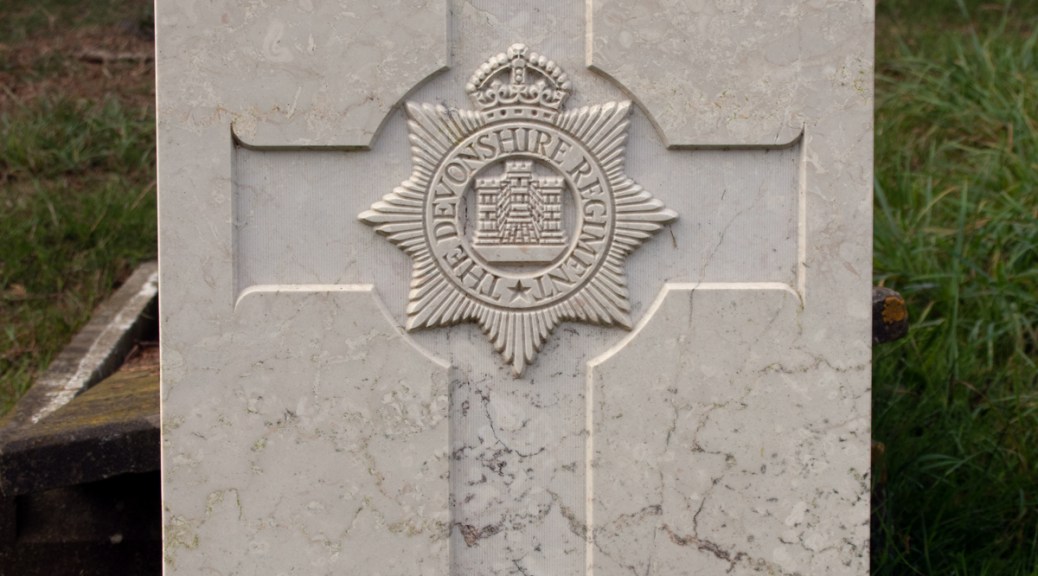
Harry was keen to play his part when war broke out. His age initially prevented him from doing so, but he had enlisted by the late summer of 1918, joining the 53rd (Young Soldier) Battalion of the Devonshire Regiment. His service records are no longer available, but his unit was based at Rollestone Camp in Wiltshire, and this is likely where he was sent to be trained.

Little further information is available for Private Gannett. He contracted influenza while billeted in the cramped army barracks and died on 13th January 1919. He was just 18 years of age.

Harry Udall Gannett was brought back to Somerset for burial. He was laid to rest in the peaceful graveyard of St Peter & St Paul’s Church in North Curry. His headstone reads “our dear nephew”, and it is likely that is was paid for by Francis and Emily Lee, the relatives who had taken him in after his father’s death.


Private Robert Carroll

Private Robert Carroll

Robert Carroll was born on 15th October 1874 in Ballymena, Co. Antrim. He was one of three children to Henry and Mary Ann Carroll.

There is little additional information about his early life, but, on 6th April 1896, he married a woman called Martha Keenan. Robert was a plasterer at the time of his wedding, and the couple went on to have four children. Tragically, the youngest, Robert Jr, was just five months old when he passed: even worse, Martha was to die just weeks later, in June 1908.

With three children to raise, the grieving Robert married again, wedding Sarah O’Hara in October 1909. They were to have a son together, another boy they called Robert, the following year.

When war came to European shores, Robert stepped up to play his part. He enlisted in the Royal Irish Regiment and was assigned to the 1st Battalion. By September 1915, Private Carroll was sailing for the Eastern Mediterranean, where he was to remain for more than a year.

Little further information is available for Robert’s life. He was discharged from the army on 27th April 1917. As his service records no longer remain, it is not possible to determine why he left the army, but is likely to be as a result of illness or injury.

Robert returned to Northern Ireland, and his trail goes cold. All that can be confirmed is that he passed away at home on 7th August 1919, at the age of 44 years of age.

Robert Carroll was laid to rest in Crebilly Cemetery, on the hills outside Ballymena.


Sapper John Dyer

Sapper John Dyer

John Phippen Dyer was born in the spring of 1896, and was the oldest of four children. His parents, John and Fanny Dyer, were from Somerset and it was in the town of Highbridge that they raised their family.

John Sr worked as a coach body maker for the railways, and his eldest boy joined him as an apprentice when he finished his schooling. When war broke out, however, John Jr was keen to be seen to be playing his part.

John Jr enlisted in Taunton on 15th November 1915, joining the Wessex Division of the Royal Engineers. His service records confirm that he was 5ft 7.5ins (1.71m) tall and of god physical development. He was sent off to Essex for training, but came down with influenza the following January.

Sapper Dyer was admitted to hospital in Great Bentley, spending a fortnight there. He was released back to his unit, but his health continued to suffer. He had had bouts of rheumatism going back to 1911, and, by the spring of 1916, this had recurred, and was recorded as possible rheumatic appendicitis.

John’s condition led to him being declared permanently unfit for was service: he was discharged from the army on 30th March 1916, having served for just four-and-a-half months.

John Jr returned to Somerset, but at this point his trail goes cold. The next record for him is that of his passing, on 26th May 1919. He was just 23 years of age.

John Phippen Dyer was lair to rest in the cemetery of his home town, Highbridge, Somerset.


Private John Hookway

Private John Hookway

The early life of John Hookway seems destined to be lost to time. He was born in 1876 or 1877 in Lancashire, and the only surviving 1881 census featuring that name would suggest his parents were James, who was a shoeing smith, and Leah Hookway.

The next census on which John appears is in 1911. This confirms that John had married a widow called Rose Ash the year before. They were living in Huntspill, Somerset, with Rose’s three children – daughters Rose, Violet and Lily – and her sister, Emily. John was employed as an ‘improver in grocery trade’, while Violet, who was 17 years old, was noted as being a ‘servant on the Isle of Wight’. Violet’s sister, Rose, the census recorded, was ‘feebleminded’, while Emily was identified as an ‘imbecile’.

When war broke out, John stepped up to enlist. His age may have excluded him from any compulsion to join up – he was nearly 40 years old when he signed his attestation papers in December 1915. This may suggest that he had served in the army before, hence the absence from the 1891 and 1901 census records.

Private Hookway’s service records noted that he was a grocer, and that he had been born in Devon, although this is at odds with other, earlier, documents. He was 5ft 4ins (1.64m) tall and weighed 137lbs (62.1kg). He was assigned to the Somerset Light Infantry, and he joined the 13th (Home Service) Battalion. As the name suggests, John saw no action overseas, and his time appears to have been split between Somerset and Suffolk.

John’s time in the army was not without issue. In September 1916, he was admitted to a local Volunteer Aid Detachment Hospital with appendicitis, which saw him laid up for more than six weeks. In November 1918, the war having come to an end, Private Hookway was sent to the 2nd Southern General Hospital in Bristol, Gloucestershire, with an aneurysm of the abdominal aorta. This was, understandably, severe enough for him to be discharged from the army, and he was formally stood down on 12th March 1919.

John returned home to be with his family. The next record for him is that of his passing, on 4th June 1919. He was around 43 years of age.

John Hookway was laid to rest in Highbridge Cemetery, Somerset. Rose, who had now been widowed twice in ten years, never remarried. She was laid to rest near her second husband when she passed in 1946.


Leading Stoker Leonard Gulliford

Leading Stoker Leonard Gulliford

Leonard Henry Gulliford was born on 26th January 1895 in the village of Cothelstone, near Bishops Lydeard, Somerset. One of eleven children, he was the son of farm labourer William Gulliford and his wife, Jane.

When he completed his schooling, Leonard also found employment on the farm. However, it seemed he wanted bigger and better things and, on 7th April 1913, he enlisted in the Royal Navy as a Stoker 2nd Class. His service records show that he was 5ft 4.5ins (1.64m) tall, with fair hair, blue eyes and a fresh complexion.

Stoker Gulliford spent the first six months of his naval career at HMS Vivid, the Royal Naval Dockyard in Devonport, Devon. This was to be the base to which he would return in between voyages. His records show unusual activity for his time, as he was assigned to just one ship – the battle cruiser HMS New Zealand – during his six years’ service. Leonard spent five years on board, from September 1913 to February 1919, with just one month based back in Devonport during this time.

Leonard rose through the ranks over the years, receiving a promotion to Stoker 1st Class in April 1914, Acting Leading Stoker in July 1918 and Leading Stoker in July 1919, by which point he was, once again, based at HMS Vivid.

In November 1919, Leonard was attached to the sloop HMS Silvio, based in the River Tamar. A party of the crew, Leading Stoker Gulliford included, left the ship without leave, taking a boat to shore.

The bodies of the seven men who were missing from two warships in the Tamar Estuary were recovered this morning, and a mystery has thus been cleared up.

The men left two ships, HMS Swindon and HMS Silvio, on Sunday evening, and it is believed visited Saltash, a riverside town. Later an upturned boat and two naval caps were found…

The bodies were found close together on the mudflats in shallow water in Tamar Creek, on the eastern side of the River Tavy, near the Tavy railway bridge.

Daily News (London): Friday 5th December 1919

A subsequent inquest into the sailors’ deaths determined that, after their time in Saltash, they took their boat, which, at just 13.5ft (4.1m) long, proved too small for seven man, back to their ships. The wind and choppy waters proved too much, and the boat capsized, throwing all of them into the water to their doom. A verdict of accidental death was recorded.

The body of 25-year-old Leonard Henry Gulliford was taken back to Somerset for burial. He was laid to rest in the graveyard of St Mary’s Church in Bishops Lydeard.