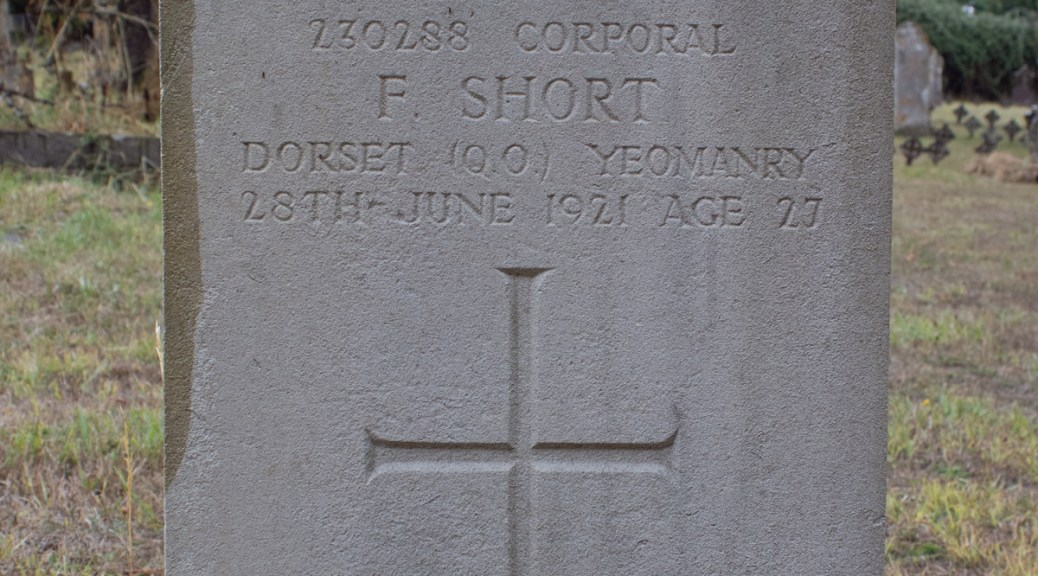
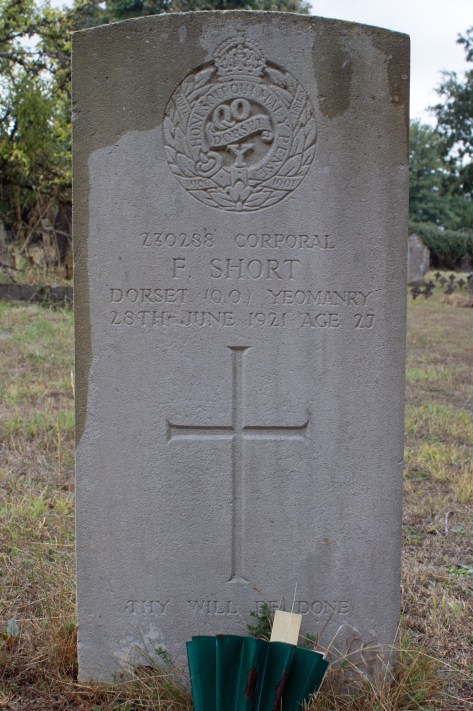
Frederick Short was born in Sturminster Newton, Dorset, in the spring of 1894. The oldest of five children, he was one of three sons to John and Martha Short. John was the caretaker of the village’s cemetery, and the family lived in a cottage on site.
When Frederick completed his schooling, he found work as a groom and, by the time of the 1911 census, he was boarding with John and Clara Binning in the village of Weare, Somerset.
War came to Europe in the summer of 1914, and Frederick was called upon to play his part. Full details of his military service have been lost to time, but it is clear that he enlisted in the Queen’s Own Dorset Yeomanry. By the end of the conflict, he had risen to the rank of Corporal.
Frederick survived the conflict, and returned home. At the start of 1919, he married Mabel Heritage, a soldier’s daughter from Somerton, Somerset. Her father, George, had died by the time of the 1901 census, and Mabel moved with her mother to Milborne Port, on the Somerset-Dorset border. The 1911 census found her working as a leather glove machinist, in a four-roomed cottage on Paddock Walk, to the north of the town centre.
The war had had a negative impact on Frederick’s health. The 1921 census shows him and Mabel visiting his parents in Sturminster: his occupation was given as unfit (formerly a groom). It was only a matter of weeks later that his condition worsened. Frederick passed away from a combination of malaria and heart disease on 28th June 1921: he was 27 years of age.
The body of Frederick Short was laid to rest in Sturminster Newton Cemetery, close to, and under the watchful eye of, his caretaker father, John.
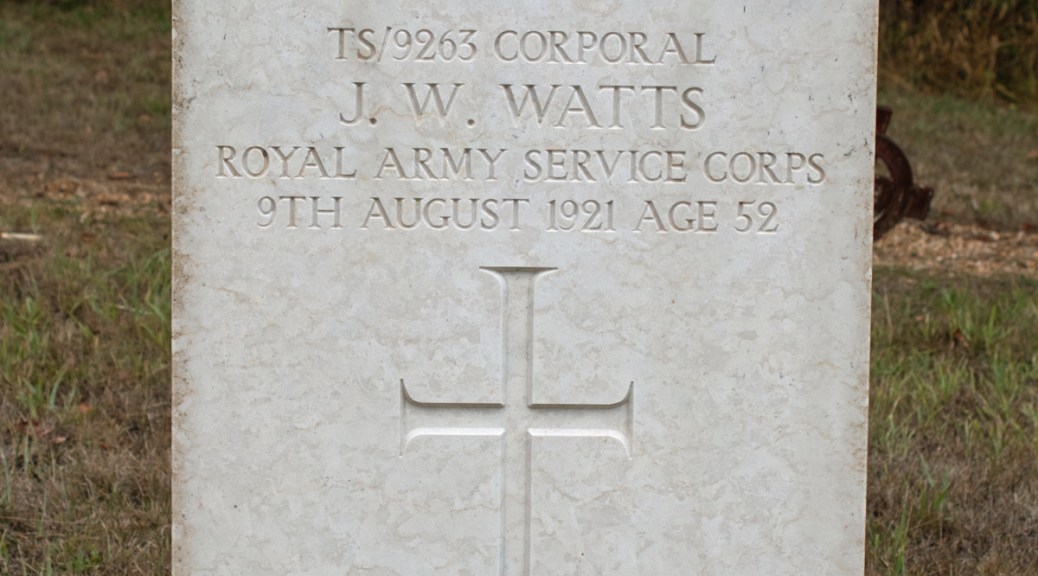
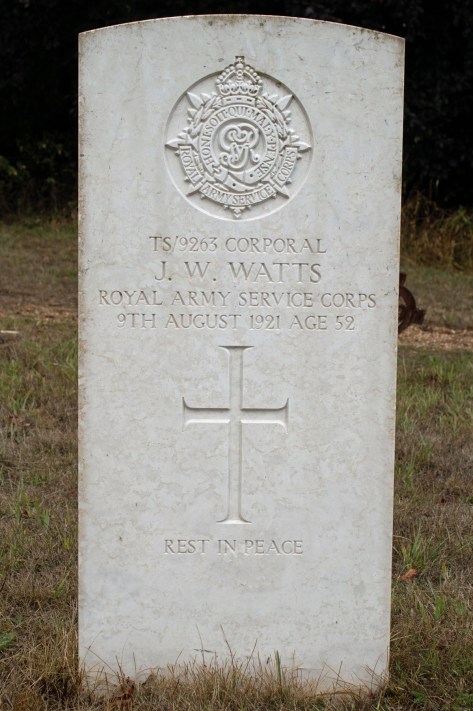
John William Watts was born in the summer of 1869, the youngest of six children to Reuben and Maria Watts. Reuben was a sawyer from Haselbury Brian, Dorset, and it was her that the Watts family were born and raised.
John seemed keen to progress himself, and found employment as a police constable. The 1891 census recorded him as living at the station in Blandford Forum. Three years later, he married Elizabeth Hallett, a shoemaker’s daughter from Lyme Regis. The couple would go on to have eight children before Elizabeth’s untimely death in 1912.
By this point, John’s career had taken a sharp turn: in 1901, when the family were living in Sturminster Newton, he was working as a blacksmith. The next return, taken in 1911, found them at 19 Church Street in the village, where John was employed as a journeyman shoeing smith.
With young children to raise, John took a new wife, marrying widow Rose Yeatman on 3rd August 1914. His oldest daughter, Elsie, and her father, Tom Bleathman, acted as witnesses. John and Rose would go on to have a daughter of their own, Muriel, the following year.
When war broke out, John stepped up to play his part. His service papers have been lost to time, but it is clear that he enlisted in the Royal Army Service Corps, and, presumably because of his age and experience, was assigned the rank of Farrier Corporal There is no indication that he served time outside of Britain, and it seems likely that he would have overseen the preparation of horses and training of blacksmiths for the Western Front.
Farrier Corporal Watts survived the conflict, but was medically discharged with malaria on 16th May 1919. The 1921 census found him living with Rose and five of his children and step-children in their Church Street home. He was employed as a bricklayer’s labourer, and was working for builder and contractor Mr J Silverthorne.
John’s health was suffering now, though, and he would only last until the summer. He passed away at home on 9th August 1921: he was 52 years of age.
The body of John William Watts was laid to rest in Sturminster Newton Cemetery, a short distance from his grieving family’s home.
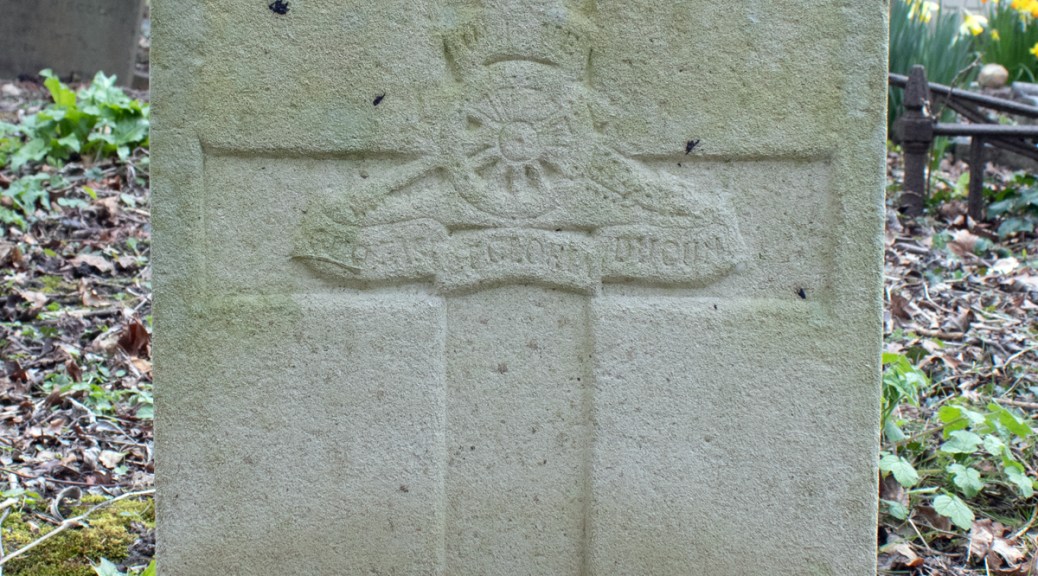
In the depths of Highgate Cemetery, Middlesex, is the weathered grave of Driver EA Lord, of the Royal Horse Artillery, who died on 8th May 1921. Little concrete information is available about him, and a lot of the young man’s life is destined to remain lost to time.
A few military documents shed some light on the man. His name was Ernest Arthur Lord, and he was 26 when he died in Manor House Hospital, Golders Green, Middlesex.
A pension for his widow was refused, because the couple married after he was discharged from the army. There is a marriage certificate for an Ernest Lord and Beatrice Moore on Christmas Day 1920. The couple wed in Charleston Parish Church, Salford, Lancashire: Ernest was noted as being a clerk, and Beatrice a tailoress. However, this is more of an interesting footnote: there is nothing to directly connect this Ernest Lord to the burial in Highgate.
Driver Lord’s entry on the Medal Roll Index confirms that his unit was sent to France on 26th December 1915. Where he served, and for how long, however, is unclear.
Much of Ernest Arthur Lord’s life is sadly untraceable: a life and a history lost to the Great War.
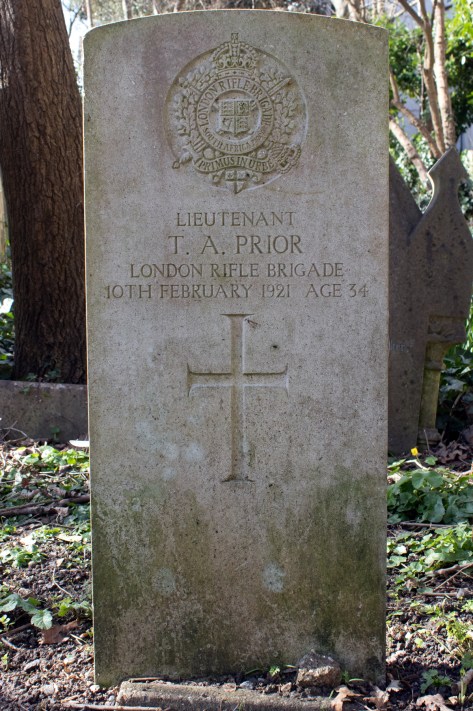
Thomas Ashley Prior was born in Islington, Middlesex, at the start of 1886. The third of seven children, he was the only son to Thomas and Ellen Prior. Thomas Sr was a colonial produce broker agent and, at the time of the 1891 census, the family were living in rooms at 115 Sussex Road.
Over the following years, the family lived together, but moved homes. By 1901 they were living at 1 Blythwood Road, Islington; ten years later they had set up home at 10 Oakfield Road, Stroud Green. By this point Thomas Sr was listed as being a rubber broker. Four of the children were employed in respectable trades: Thomas Jr as a bullion refiner’s clerk, his older sisters as a paper merchant’s clerk and a saleswoman for the court dressmaker. The youngest employed sibling, 22 year old Margaret, was also a clerk, for an estate agent. The family had a live in servant, Alice Charles, supporting them.
War rose its ugly head in 1914, and Thomas Jr stepped up to play his part. He was already a volunteer in army and, as a later military history confirms, he threw himself into a more permanent role:
PRIOR, THOMAS ASHLEY. Enlisted 1909. Served continuously and went to France with 1st Batt. Nov. 1914-May 1915 (wounded). 2nd Lieut. 28/9/15. Served in France again with 1st Batt. March-June 1916 and Nov. 1916-June 1918. Lieut. 1917. Sports. Member of Brighton March and Marathon Teams. Died 1921.
[The History of The London Rifle Brigade 1859-1919]
Thomas’ regiment – the London Rifle Brigade – was actually the 5th Battalion of the London Regiment. Based on his unit’s time abroad, it is likely what Thomas was wounded at Ypres – possibly during the Battle of St Julien. On his return to the front, he would have fought at Arras and Ypres in 1917, and at the Somme (Arras) the following year.
Lieutenant Prior’s return to Britain is not documented. HIs mother, Ellen, had died in 1912, and his father followed in 1918. The London City Directory for 1920 recorded him as living at 8 Oakfield Road, a double-fronted Victorian terrace within sight of Finsbury Park.
Thomas Ashley Prior died on 10th February 1921. Just 34 years of age, the cause of his passing is not clear. He was laid to rest in Highgate Cemetery, not far from his last recorded address.
The funeral took place at the Tiverton Cemetery, on Tuesday afternoon, of George Hunt, 17… a member of the Devon band, who died in Ireland as a result of an illness brought on by exposure. Pte. Hunt visited Tiverton for the last time at Christmas. On the return journey to Ireland he, with several others, were drafted to camp to await the arrival of a steamer. Whilst in camp he contracted a severe chill which he was unable to throw off and his parents recently received a message stating that his condition was giving rise to some anxiety. Mr and Mrs Hunt journeyed to Ireland and satisfied themselves that everything possible was being done to save their son. In spite of all efforts he died on Thursday, June 16th.
[Tiverton Gazette (Mid-Devon Gazette): Tuesday 28th June 1921]
George Cockram Hunt was born on 15th January 1904, and was the youngest of five children to William and Emily Hunt. William was a carpenter and joiner from Tiverton in Devon, and this is where the family were born and raised.
There is little additional available about young George’s life. He had enlisted in the army by the middle of 1920, and, as a Band Boy, was attached to the 1st Battalion of the Devonshire Regiment. Given his age, it is unlikely that he spent any time overseas before the Armistice but, as the report of his funeral suggests, he was stationed in Ireland at the time of his death.
Boy Hunt died in barracks in Queenstown – now Cobh – in the south of Ireland. His body was brought back to Devon for burial.
George Cockram Hunt was laid to rest in Tiverton Cemetery, on the outskirts of the town he had called his home for less that two decades.
Alfred William King was born in the autumn of 1872, the oldest of eight children to Alfred and Caroline King. Alfred Sr was a labourer from Bath, Somerset, and this is where the family were raised.
Times were tough for the King family. The 1891 census recorded most of them living at 89 Avon Street in the city. Alfred Jr, meanwhile, seems to have been an inmate at the Bath Union Workhouse in Lyncombe.
On 24th May 1896, Alfred Jr married Mary Pemberton. She was the daughter of a coachman, in the next street to her in-laws. Both Alfred and his father were, by this point employed as carters, and the new groom was back living in Avon Street. The young couple went on to have two children, Alfred and Dorothy, and made their home in a small terraced house in Avondale Road, Bath.
The 1911 census recorded Alfred as being an army pensioner and night porter. While previous service records no longer exist, his enlistment papers for the First World War suggest he had spent time in both the Somerset Light Infantry and the Royal Garrison Artillery. Certainly, Alfred’s eagerness to serve his country – he joined up on 18th September 1914, at the age of 42 – suggests he had had military service in the past.
Private King’s medical report confirms that he was 5ft 5.5ins (1.66m) tall and weighed 145lbs (65.8kg). He was noted as having grey hair, light brown hair and webbed toes on both feet.
Alfred’s time in the army was to be brief. A later medical report noted that the had a “dilated stomach of old standing. [He was] absolutely unable to retain food unless stomach is washed out twice a week.” He was medically dismissed from the army on 3rd November 1914, after just 45 days.
Alfred’s incapacity for military service may have been what prompted his son, Alfred, to enlist. After time in the Somerset Light Infantry, and a rise to the rank of Lance Corporal, he was to die of wounds in February 1916. His father would live on for just five more years. He passed away on 1st April 1921 at the age of 48 years.
Alfred William King was buried alongside his son in Bath’s majestic Locksbrook Cemetery.
Read about Lance Corporal Alfred Frederick King here.
Henry Ridler was born in Henbury, Gloucestershire, in the summer of 1862. He was the middle of three children to Abraham and Harriet Ridler. Abraham was a farm labourer who moved the family for work to the Weston area of Bath, Somerset, not long after Henry’s younger brother, John, was born.
The oldest Ridler sibling, Joseph, worked as a cabinet maker, and by the time of the 1881 census, both Henry and John were apprenticed to him. Henry married Emma Stone on Christmas Eve 1882, and the couple would go on to have seven children.
The 1891 census found Henry and the family living at 5 Comfortable Place in Bath, one of a row of terraced cottages then, but now sandwiched between the River Avon and the busy A4. Henry and Emma had four children by this point – all daughters – and the house was split between them and mother-and-daughter dressmakers Lucy and Lucy Batt.
By the time of the 1901 census, the family were growing up, and had moved literally just around the corner, to 2 Onega Terrace. Set slightly back from the main road, this terraced house had six rooms, and was better suited to the growing family. Henry was still working as a cabinet maker at this point, while his three oldest daughters – Mabel, Lilian and Maude – were all employed, as a corset fanner, a kitchen maid and a nurse girl respectively.
The next census return, taken in 1911, recorded the Ridler family still living in the same house. Henry and Emma had been married for 28 years by this point, and, while 2 Onega Terrace may have had six rooms, they would have become very cramped by this point. Six of the children – aged between 14 and 27 – were still living at home, with everyone in the household but Emma bringing in a wage of sorts.
War was closing in by this point, and, despite his advancing years, Henry was drawn to serve his King and Country. He enlisted in the Royal Army Service Corps on 20th October 1915, a date that confirms he volunteered for duty, as conscription wasn’t introduced until the following year. Henry’s service records show that he was 5ft 6ins (1.68m) tall, with greying hair and blue eyes.
Private Ridler spent two periods of time overseas. In November 1915, his unit was sent to the Eastern Mediterranean, and he served in Salonika, Greece, for seven months. While there, he was hospitalised following an injury to his right knee. He was medically evacuated to Malta, before being posted back home in Britain to convalesce in Woodcote Park Hospital, Epsom, Surrey.
By the summer of 1916, Henry was deemed fit once more, and was sent abroad again, this time to the Western Front. Details of his time there are sketchy, although he seems to have been transferred tot he Labour Corps at some point. It appears that his previous injury flared up again, and he was eventually discharged from the army on medical grounds on 30th July 1918.
At this point, Henry’s trail goes cold. He returned to Bath, but it is unclear whether or not he was able to resume working. The next confirmed documentation for Henry’s life is that of his passing. While the cause is unclear, he breathed his last on 3rd June 1921: he was 58 years of age.
Henry Ridler was laid to rest in Bath’s sweeping Locksbrook Cemetery, a short walk from the family home in Onega Terrace.
Emma remained in the family home for the next 17 years. When she passed away in 1938, she was also laid to rest in Locksbrook Cemetery, not far from her late husband.
Henry Weakley was born in 1885 in Bath, Somerset. The second of six children, he was the eldest son to James and Fanny. James was a cab driver, and Henry – who was better known as Harry – followed suit, becoming a coachman by the time of the 1901 census.
In 1910, Harry married a woman called Jennie. There is little information available about her, but the following year’s census return found the couple living with his family at 1 Cork Street, Bath, not far from the city’s Royal Crescent. The census had two records for that address, which confirmed the family’s living arrangements. Harry and Jennie had one room, while the rest of the Weakleys – James, Fanny, four of their children and a grandson – took up four rooms.
Harry was still employed as a coachman as this point, but, with war on the horizon, things were to change. Full details of his military service are lost in the mists of time, but it is clear that he enlisted in the Somerset Light Infantry, and that he was assigned to the 3rd (Reserve) Battalion.
Private Weakley’s unit was a territorial battalion and it remained on UK soil throughout the war. Initially based in Devonport, Devon, the 3rd moved to Londonderry, Northern Ireland, in November 1917, and Belfast the following April. Sadly, the little that remain of Harry’s records do not confirm where he served.
Harry was demobbed on 13th May 1919: his pension ledger notes that he had received gun shot wounds to his neck and back, although no further records identify when or how these injuries occurred. He returned home – 5 St George’s Buildings, Upper Bristol Road, Bath – and seems to have settled back into his pre-war life, although his health was still impacted.
Harry passed away at home on 27th March 1921. He was 36 years of age, and had died of heart failure. Despite his wartime injuries, the war office determined that his condition had been contracted after his army service: Jennie was denied a war pension.
Henry “Harry” Weakley was laid to rest in Bath’s sweeping Locksbrook Cemetery, not far from where his widow still lived.
Charles William Morris was born in the summer of 1887, the third of four children – and the only son – to James and Emily Morris. James was a house painter: both he and Emily came from Bath, Somerset, and this is where the Morris family were born and raised.
When he completed his schooling, Charles found work as a clerk: by the time of the 1911 census, he was employed by the Urban Sanitary Authority. Only two of the children were still living at home by this point, and so James and Emily had taken in a boarder, 25-year-old motor engineer Zackarias MacPherson Jackson, to bring a little more money in.
When war was declared, Charles quickly stepped up to play his part. A later newspaper report provides an insight into his service:
The death occurred on Saturday midnight, at 11, Margaret’s Buildings, Hedgmead, of Mr Charles W Morris, at the age of 33. Previous to joining the forces in 1914, he was a member of the Coleford (Somerset) Cricket Club. Joining the North Somerset Yeomanry as a trooper, he went to France, afterwards being transferred to the 5th Dorsets (Cyclist Corps). Eventually he was taken prisoner and was in Germany for two years suffering great hardships. On his return to his native city he joined the St Stephen’s Rugby FC. He was a member of the Walcot Liberal Club, and at the time of his death was employed by his brother-in-law (Mr Z McJackson [sic], motor engineer). Another brother-in-law us Mr W Hollick, headmaster of Coleford schools, and formerly an assistant master at Holy Trinity School, Bath.
The funeral took place at Locksbrook Cemetery on Thursday. The deceased was extremely well known in the neighbourhood in which he resided, and quite a large number of friends attended the cemetery to pay their last respects.
Bath Chronicle and Weekly Gazette: Saturday 4th June 1921
Zackarias had married Charles’ younger sister, Gladys, in 1915, the one time lodger having literally become a member of the family.
Charles William Morris died on 28th May 1921, through causes unknown. He was laid to rest in a peaceful corner of the sprawling Bath cemetery.
Edwin Reginald Barber was born on 26th November 1864 in Martock, Somerset. The oldest of three children, his parents were William and Julia Barber. William was a tailor by trade, but Edwin sought bigger and better things.
On 3rd March 1885, Edwin enlisted in the Border Regiment. Sadly, there are no further details of his military service, although a later report suggests that he spent seven years with the King’s Royal Rifle Corps.
By 1898, Edwin was back in civilian life. He married a woman called Gertrude and, according to the 1901 census, they were living in Wrexham, Denbighshire, where he was employed as a labourer.
Somerset beckoned Edwin home, and he and Gertrude took up residence as landlords of the Stapleton Cross Inn in Martock. They remained there for more than ten years, although the army wasn’t completely done with them as yet.
When war came to Europe, Edwin felt the need to step up and serve once more. Despite approaching his 50th birthday, he joined the Somerset Light Infantry on 15th November 1914, although he soon transferred to a less physical role in the National Defence Corps.
This seemed to have proven to strenuous for Private Barber’s body, however, and he was formally discharged from military service on 2nd October 1916. Edwin returned to Martock, and once again took up his landlord duties.
From here on, Edwin was dogged with poor health. He passed away at home on 18th May 1921, after a long illness. He was 56 years of age.
Edwin Reginald Barber was laid to rest in the graveyard of All Saints’ Church in Martock.





 Death and Service