Tag Archives: accident

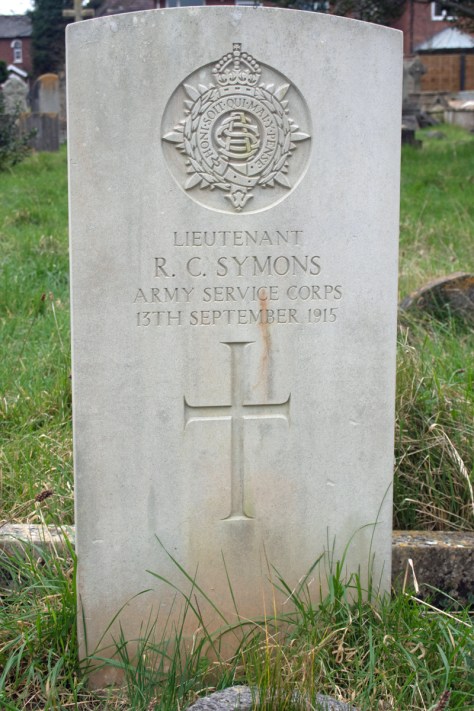
Lieutenant Rudolph Symons

Lieutenant Rudolph Symons

Rudolph Clifford Symons was born in the autumn of 1887, one of ten children to Clifford and Clara Symons. Clifford ran a brick and tile manufacturer’s and later became a town councillor in the family’s home of Bridgwater in Somerset.

By the time of the 1911 census, Rudolph had become the works manager for his father, but war soon beckoned.

Sadly, Rudolph’s full military record has been lost to time, but he enlisted in the Royal Army Service Corps early on in the conflict and was promoted to Lieutenant at the end of September 1914. He was involved in recruiting new soldiers, and it was following one of these meetings that he was involved in an accident.

The local media picked up the story:

On Friday night, while riding through St Jon Street on his motorcycle, to which a side-car was attached, he collided with a horse and light waggon… Lieutenant Symons appears to have been struck by one of the shafts in the region of the heart, and was rendered unconscious. He was at once conveyed to his home, where he was medically attended and was subsequently removed to the nursing home on Friarn Street. On the following day a specialist was called in, and an operation performed, but the injuries were of so severe a character that death ensured on Monday.

Taunton Courier and Western Advertiser: Wednesday 22nd September 1915

The coroner reported that Rudolph had died from an internal haemorrhage and the inquest recorded a verdict of accidental death, and exonerated the waggon driver – a dealer caller Wyatt – from all blame.

Lieutenant Symons was a popular man, a vocalist in the Bridgwater Amateur Operatic Society, and was also heavily involved in the local annual Guy Fawkes celebrations.

He died on 13th September 1915, aged 27 years old, and lies at rest in the Wembdon Road Cemetery in his home town.


Private Bernard Dyke

Private Bernard Dyke

Bernard Dyke was born in 1897, the oldest of three children to Albert and Edith Dyke from Bridgwater, Somerset. Albert worked for a brewery, and the young family lived in a house on the main road west out of the town.

Bernard received a scholarship to attend Dr Morgan’s School, a grammar school in the town, and he was a pupil there from autumn 1910 to spring 1913. He left at the age of 16, and became a merchant’s clerk.

War was on the horizon, however, and Bernard joined up. Full details of his military service are not available, but he enlisted in the Devonshire Regiment. Private Dyke spent some time at the Tregantle Fort, near Plymouth, and it was here that he was caught up in an accident.

It has transpired than a rather remarkable shooting fatality occurred at Tregantle rifle ranges, near Plymouth, on Friday, when Private Bernard Dyke, aged about 24, of the Devon Regiment, received a gunshot would in the left side, and almost immediately expired.

The soldier was acting as an observer for a Lewis gun section when he received the fatal injury, the section being at the time out of action awaiting the appearance of a moving target. On the deceased’s left hand side was a musketry party of nine carrying out an exercise, and when he received his injury only one or two rounds had been discharged by this party.

When the first shot or so had been fired deceased suddenly shouted “Oh! Oh!” and dropped. An officer and NCOs ran to assist him, but found that life was extinct. A military doctor was soon on the spot, and found the bullet had entered the deceased’s left side below the ribs and made its exit at the top of his right arm.

As the musketry party was 80 degrees to the right of the firing party it is strange that a shot could have been fired so wide, but the explanation may be found to be in a ricochet or a soldier’s erratic action.

Western Morning News: Monday 21st January 1918.

Private Bernard Dyke died on 18th January 1918, aged just 20 years old. He lies at rest in the Wembdon Road Cemetery in his home town of Bridgwater, minutes’ walk from his family home.


Bernard Dyke (from ancestry.co.uk)

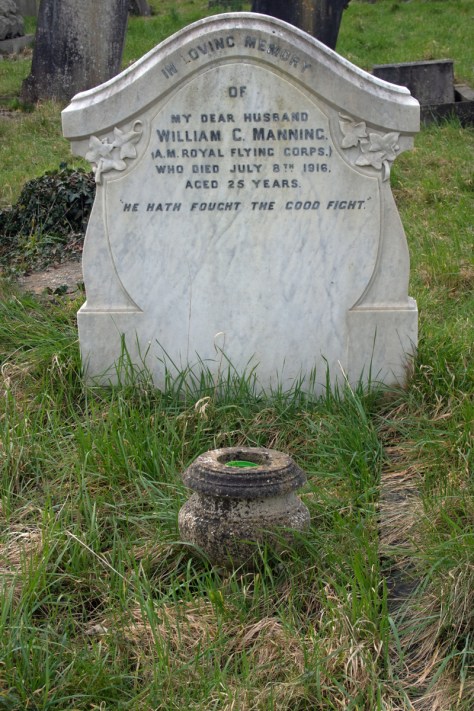
Air Mechanic William Manning

Air Mechanic William Manning

William Charles Manning – known as Willie – was born in Bridgwater in 1890, one of ten children to Samuel and Emily Manning. Samuel was a cabinet maker, and at least of three of his sons, Willie included, went into the family business.

There is little information available on Willie’s life, but he married Nellie Dodden, also from Bridgwater, in November 1915. Sadly, this was around the time that Nellie’s father passed away; tragedy for Nellie was still close by.

Willie’s military records are minimal, although details of his passing can be determined from the subsequent newspaper report.

He had enlisted in the Royal Flying Corps around October 1915, certainly around the time he and Nellie married. He was an air mechanic, something his woodworking skills probably drew him to and was based at Manston Airfield in Kent.

On 8th July 1916, Willie was a passenger in a flight piloted by Lieutenant Bidie. It seems that Bidie was turning the plane while at low altitude, while attempting to land. The plane crashed, and both Bidie and Willie were killed. Air Mechanic Manning was just 25 years old.

William Charles Manning lies at rest in the Wembdon Road Cemetery in his home town of Bridgwater, Somerset.


Able Seaman Percy Strong

Able Seaman Percy Strong

Percy William Strong was born in April 1897, the youngest of five children to Albert Strong and his wife Elizabeth. The family lived in Shepton Mallet, Somerset, where Albert worked as a mason’s labourer.

Percy was keen to make his own way in the world. By the 1911 census, and having left school, he was working as a farm boy on Kingsdown Farm in Shepton, alongside a couple of other paid, and boarding, employees.

He seemed to have been after adventure in his life too; in January 1913, he enlisted in the Royal Navy, getting his training on a number of vessels, even before the start of the Great War. In his six years of service, he was promoted from Boy to Able Seaman, and served on nine ships.

Able Seaman Strong’s final assignment was at HMS Idaho, the naval base in Milford Haven, Pembrokeshire, which he joined in May 1918. It was while he was stationed at HMS Idaho that tragedy would strike.

A boat belonging to a Government Patrol-boat capsized in Milford Haven, when three members of the crew lost their lives. They were Sub-Lieutenant Lever (20), Birkenhead; Leading Seaman Thomas Palmer (30) Shepton Mallet; and AB Percy Strong (21), Shepton Mallet.

The boat, containing six men, had come ashore in a rough sea. It left Milford Haven Naval stage on return to the ship at eleven am. A sharp squall caught the men when well out on their return journey, and this the craft failed to weather, and was capsized. The six occupants were cast into the sea, and despite the efforts of men in boats from other vessels, the three named were drowned, and the others had a narrow escape.

Western Mail: Friday 11th October 1918

Able Seaman Strong has lost his life on 9th October 1918. He was just 21 years old.

Percy William Strong’s body was returned to Shepton Mallet, the town of his birth, and lies at rest in the cemetery there.


Second Lieutenant Frederick Pullen

Second Lieutenant Frederick Pullen

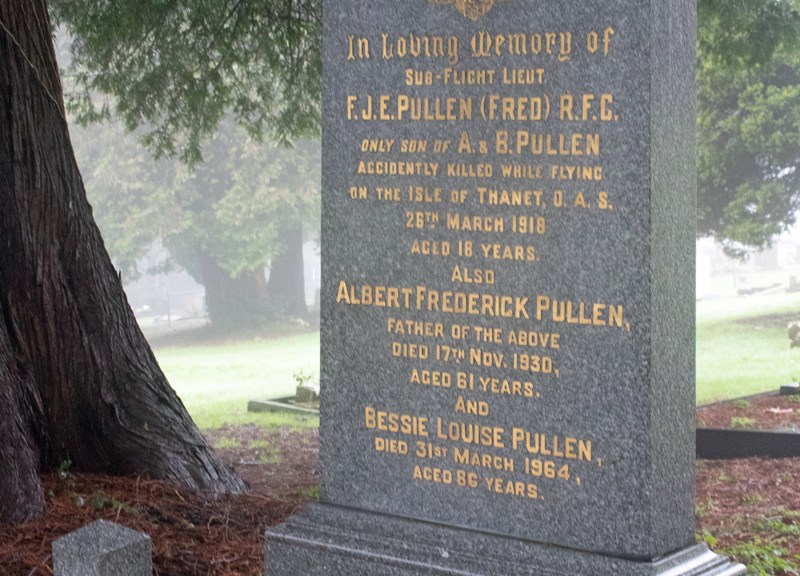
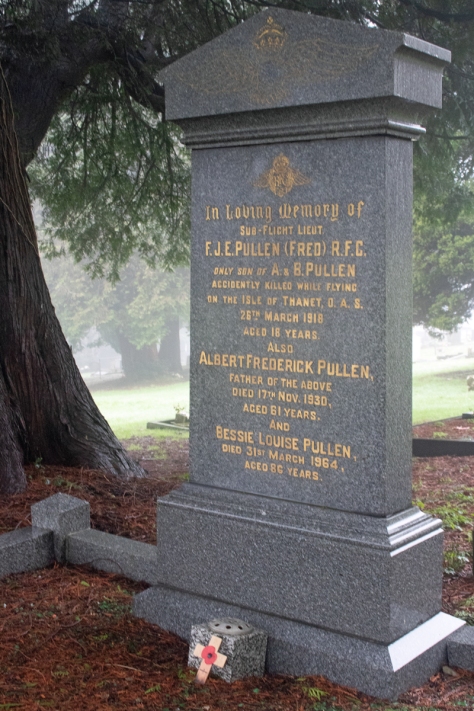
Frederick John Edward Pullen was born in May 1899, the only son to Albert and Bessie Pullen from Shepton Mallet in Somerset. Albert worked at the local prison, acting as clerk, warden and school master to the inmates.

Little else survives to expand on Fred’s military life; his gravestone confirms that he had enlisted in the Royal Flying Corps and, although no date can be attributed to this, it is likely to have been almost as soon as he turned 17.

A report of the young man’s funeral does give a little insight into the young man.


…before entering the service of his country, Lieutenant Pullen was in the Civil Service, and a letter from his late surveyor at Oxford, speaks in high terms of his character and abilities.

He graduated to the rank of Service Pilot in February last, and was gazetted in March. By the Naval authorities he was considered a very good pilot, and was graded as Class A (exemplary).

Shepton Mallet Journal: Friday 5th April 1918

Alongside the Edwardian trait of listing the chief mourners and floral tributes, the newspaper also gives an in-depth report of the cause of Second Lieutenant Pullen’s demise.


The brave young office, who was at a war school [Manston Airfield, Kent], was engaged in ‘stunting’ or trick flying, absolutely necessary in warfare, when from some unknown cause, he fell into a field, and was instantly killed.

A farmer who was ploughing near the spot said he was not conscious of the presence of an aeroplane in the vicinity till this one seemed to drop from the clouds. It nose-dived, but righted on coming near the earth, and seemed to swoop up again, but before going far turned turtle and fell, upside down.

The poor lad was found crushed beneath his gun, and had met instantaneous death. Letters received from witnesses of the accident stated that people living in the neighbourhood hurried to the spot with remedies of all sorts, and were much saddened to find that nothing that they could do was of any avail.

Shepton Mallet Journal: Friday 5th April 1918


Second Lieutenant Pullen met his death in a flying accident on 26th March 1918. He was just 18 years old.

Frederick John Edward Pullen lies at rest in the cemetery of his home town of Shepton Mallet.


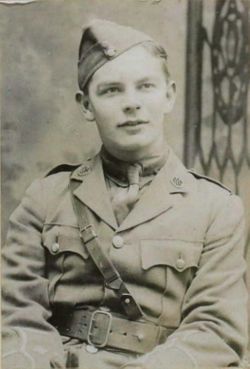
Second Lieutenant Fred Pullen (courtesy of findagrave.com)

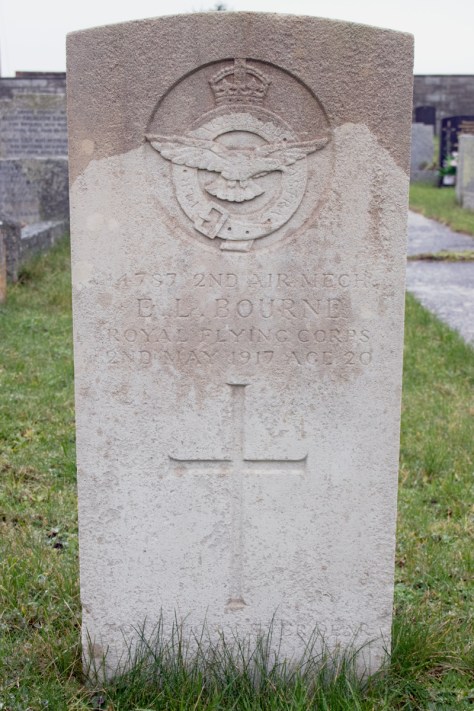
Air Mechanic 2nd Class Eustace Bourne

Air Mechanic Eustace Bourne

Eustace Lionel Bourne was born in 1897, one of six children to Robert and Eve, from Westonzoyland, Somerset. Robert was a wheelwright and carpenter and, after leaving school, Eustace followed in a similar vein, becoming an apprentice to an ironmonger.

When war broke out, Eustace’s interest in engineering led him to join the Royal Flying Corps, where he was appointed as an Air Mechanic. His enlistment papers – dated November 1915 – give his trade or calling as “motor cyclist”, so it is obviously a passion that he had.

Air Mechanic Bourne was assigned to Milton Airfield near Abingdon, Oxfordshire and it was there that he served for nearly eighteen months. He seems to have enjoyed his time off as much as his time working, and boating on the Thames nearby was a hobby. Sadly, it was also to be his undoing.

On 2nd May 1917, he was out on the river at Culham Reach; the local newspaper account picked up the story.

Accidentally drowned was the verdict returned at the inquest last Saturday on Eustace Lionel Bourne, 21 [sic], attached to the mechanical department of the RFC, stationed at Milton.

It appeared that while sculling with a colleague in Culham Reach on May 2nd, he lost a scull. His companion, who had dropped a rudder-line, was turning round at the time. Deceased, in leaning over to pick up the scull, fell into the river and disappeared. It was twilight at the time, and a search was unavailing.

The other man, who could neither swim nor scull, was left in the boat, which was half filled with water.

The body was discovered on Friday morning near Sutton Weirs.

Reading Mercury: Saturday 19th May 1917

Eustace Lionel Bourne was just 20 years old when he drowned. He lies at rest in the cemetery of Westonzoyland, his home village.


Cook’s Mate Harry King

Cook’s Mate Harry King

Harry George King was born in Somerset in December 1894, one of nine children to John and Sarah King. John worked as a cabinet maker in Wells, and Harry followed in a similar vein to his father, becoming an upholsterer.

When war broke out, Harry – who stood at 5’3″ (1.6m) tall – enlisted in the Royal Navy as a Cook’s Mate. He trained on HMS Victory I in Portsmouth, before transferring to the HMV Vernon, a land-based ship, also in Portsmouth.

While on leave in 1917, Harry married Alice Trickey, who had also been born in Wells.

Harry’s first sea-going assignment was on the HMS Hermione, which was a guard ship off the Southampton coast. After two years on board, Cook’s Mate King was transferred to another vessel.

The HMS Glatton was a monitor vessel requisitioned by the Royal Navy from the Norwegian fleet at the outbreak of the First World War. After a lengthy refit, she was finally ready for service in the autumn of 1918, and positioned in Dover in preparation for a future offensive across the Channel.

At 6:15 on the evening of 16 September, there was a small explosion in a 6-inch magazine below decks, which then ignited the cordite stored there. Flames shot through the roof of one of the turrets and started to spread. The fire was not able to be brought under control, and there were concerns that, if the ship’s rear magazine exploded, the presence of the ammunition ship Gransha only 150 yards (140 m) away risked a massive explosion that would devastate Dover itself. The decision was taken to torpedo the Glatton, in the hope that the incoming flood water would quash the fire.

In the event, sixty men aboard the Glatton were killed outright, with another 124 men injured, of whom 19 died later of their injuries. This included Cook’s Mate King.

While the incident wasn’t reported in the media of the time, Harry’s funeral was; it gives a little more insight into the tragedy.

News reached Wells… that 1st Class Cook’s Mate Harry George King… was lying in a hospital at Dover suffering from severe burns caused through an internal explosion on the ship on which he was serving. His wife (…to whom he was married 12 months ago) and his sister at once proceeded to the hospital, where they arrived only a few minutes before he died.

The unfortunate young man had sustained shocking injuries and was conscious for only two hours on Friday. He lost all his belongings in the explosion.

Wells Journal: Friday 27th September 1918.

Harry George King was only 27 years old when he died. He lies at rest in Wells Cemetery, Somerset.


Harry’s widow, Alice, did not remarry; the couple had not had any children, and she passed away in their home town of Wells, in January 1974.


Flight Lieutenant Ronald Knight

Flight Lieutenant Ronald Knight

Ronald Victor Knight was born in March 1894, the youngest of two children – both sons – to John Knight, an Ironmonger from London, and his Swiss wife, Marie.

Ronald was well educated – being taught at Wells and Bedford Grammar Schools in the UK and Neuchatel in Switzerland, not far from where his mother was born. After studying at Bristol University, he went to work at Guys Hospital in London, training as a dental student.

When war broke out, he volunteered at once, being enlisted in the 8th Battalion London Regiment. Lieutenant Knight went with his regiment to France, and was involved in the Battle of Festubert and the fighting at Loos.

Returning home towards the end of 1915, Ronald married Gwendoline Dawkes, in a ceremony overseen by the Bishop of Bath & Wells.

Rather than returning to the front line, Lieutenant Knight accepted a commission to lead a section of the London Cyclist Corps, a position he held for a year or do. While in this service, Ronald and Gwendoline had their one and only child, a little girl they called Beryl.

In 1916, Ronald accepted a further move to the Royal Naval Air Service, becoming involved in flying as a Flight Lieutenant. It was while he was based at RNAS Cranwell that he was involved in the accident that led to his death.

An inquest was held into the incident, and evidence was taken.

Air Mechanic Charles Deboo [said] that the machine had been recently inspected, and that it was alright. He did not see the deceased flying, but saw the machine come down, nose first, in corkscrew fashion. He saw it at a height of 400ft. He went to the machine after it had fallen and found the officer was dead. The machine struck the ground and smashed up, but he could not say how the accident happened.

Charles Barrett, air mechanic, said he saw the accident. The deceased seemed as if he was going to turn towards the wind to land, and, as he turned, he banked, but he never righted himself. He nose-dived and spun round to the earth. He thought he lost control as he was turning, or the wind might have caught him. The machine was smashed, except for the tail.

The jury returned a verdict that deceased accidentally met his death while flying.

Retford and Workshop Herald and North Notts Advertiser: Tuesday 20th March 1917.

Flight Lieutenant Knight died in an aeroplane crash on 12th March 1917. He was 22 years old.

Ronald Victor Knight lies at rest in Wells Cemetery, Somerset.


Sadly, Ronald’s daughter, Beryl, died in the spring of 1923, when she was only 7 years old. She is buried with her father.

Gwendoline went on to marry Henri Booth in months after the death of her daughter. The couple went on to have two children, Elizabeth and William. She requested that her late husband’s war medals be given to his father, John.


Second Lieutenant Victor Bracey

Second Lieutenant Victor Bracey

Victor Charles Edelsten Bracey was born in October 1897, the only child of William and Florence Bracey. William was a physician and surgeon, practicing in Lancashire when Victor was born. The young family soon moved south, however, and by the time of the 1901 census, they were living in Wedmore, Somerset, where William had taken up as the village’s general practitioner.

Military records for Victor are not available, but his life can readily be pieced together from newspaper reports of his death and the de Ruvigny’s Roll of Honour, published after the war.


TWO PILOTS KILLED IN THE NEW FOREST

Two air fatalities have occurred within twenty-four hours of each other in the New Forest. On Saturday [22nd September 1917] Second Lieutenant Ernest Hargrave’s machine nose-dived from the height of 200ft, and crashed to earth.

Second Lieutenant Victor Bracey was flying on Sunday morning at a height of 300ft, when his machine turned and came down in a spinning nose-dive.

At the inquests verdicts of “Death by misadventure” were returned.

Western Gazette: Friday 28th September 1917

BRACEY, VICTOR CHARLES EDELSTEN, 2nd Lieut., RFC, only child of William Edelsten Bracey, LRCP [Licentiate of the Royal College of Physicians], Lieut. (Hon.) RAMC (retired), by his wife, Florence Marion, dau. of the late James Canning Gould.

[Victor was] educated St Peter’s School, Weston-super-Mare, and Blundell’s School, Tiverton, where he was a member of the OTC [Officers’ Training Corps]; passed into the Royal Military Academy in April 1915; joined the Inns of Court OTC in December 1916; was gazetted 2nd Lieut. RFC [Royal Flying Corps] 27 April 1917, obtaining his wings in July, and was killed in an aerial accident at the Beaulieu Aerodrome, Hampshire, 23 September, while testing a new machine.

A brother officer wrote that he was a gallant gentleman and a most skilful pilot.” He was a keen cricketer and footballer, and while at Blundell’s played in the First Cricket XI and the Second Football XV, and was also captain of the First Hockey XI; later played for the Royal Military Academy, Woolwich, and the RFC Rugby Football XV at Oxford.

de Ruvigny’s Roll of Honour, 1914-1919

A note on Second Lieutenant Bracey’s Roll of Honour states that he was ineligible for medals as he saw no overseas service; this seems to have been challenged by Victor’s father in 1921, but nothing confirms whether this anything was subsequently awarded.

Victor Charles Edelsten Bracey lies at rest in the churchyard of St Mary’s in Wedmore, where his father continued to practice. He died, aged just 19 years of age.


William’s prominence in the village played a big part in Victor’s legacy. A Memorial Fund was set up; this helped fund “necessitous cases for medical requirements and for conveying patients to hospitals“. The Victor Bracey Cup was also awarded into the 1940s for sporting achievement in the schools he had attended.


Private James Patch

Private James Patch

James Patch was born in 1882, the third of four children – all boys – to Albert and Jane. Albert was a farm labourer in the village of Meare, Somerset, and this is something that, once leaving school, the Patch boys also went into.

Albert passed away in 1904, so James stepped up and stayed living with his mother. By the time of the 1911 census, they were living near the Grape Vine Pub in Meare, both working as agricultural labourers, and had a John Lee boarding with them.

No firm details remain of James’ military service, although it is evident that he enlisted in the Devonshire Regiment and, from the Army Register of Soldiers’ Effects, this can be narrowed down to the 7th Infantry Works Company.

While Private Patch’s military records are sparse, his name crops up a lot in the newspapers around the time of his death, with headlines like “Mysterious Death of Meare Soldier”.

On the evening of the 25th March 1917, James was found lying across the tram tracks in Horfield, a suburb to the north of Bristol. He was in a semi-conscious state, and was taken to the nearby barracks.

An inquest was held and the story unfolded.

Witness statements confirmed that Private Patch was on a tram and had asked the conductress to let him know when they reached the barracks. The tram halted at the allotted stop, but, when nobody alighted, the driver started up again.

James apparently asked the conductress if that had been the stop for Horfield Barracks and, having confirmed that it was, and that he had wanted to get off there, she pressed the bell for the driver to pull up at the next stop. She then went up to the top deck of the tram, and it appear that James had decided he couldn’t wait for the next stop and jumped off the moving tram.

It seems that James fell from the tram and hit his head when he landed; this was when a passer-by found him.

The morning after his fall, the camp doctor identified the extent of James’ injury and he was moved from the barracks to the Royal Infirmary in Bristol. Private Patch died an hour after being admitted, having suffered an extensive fracture of the skull. He was 35 years of age.

The inquest into his death returned a verdict of “accidental death, due to a fall from a tram-car, caused by stepping from the car while in motion”.

James Patch lies at rest in the ground of the Church of the Blessed Virgin Mary and All Saints in his home village of Meare in Somerset.