William Henry Marsh was born on 6th September 1879 in Whitstable, Kent. An only child, his parents were William and Maria Marsh, and, based on the census records, his early life seemed to have lacked some stability.
The 1881 census recorded William and his mother living on Beach Walk in the town. Marias was recorded as being a mariner’s wife. By 1891, William and his father was living with Maria’s sister and son. Still a mariner, with his son also working as a seaman, William Sr was listed as being a widower.
A decade on, and William Jr’s life had taken a different turn and the 1901 census listed him living on Whitstable High Street. Working as a labourer in the harbour, he is recorded as having a wife, Julia, and a two-year-old son, also William. Sadly, there is no further information about either of them.
The next document for William Jr is his First World War service papers. It shows that he enlisted on 10th March 1915, his previous time at sea making him an ideal candidate for the Royal Naval Reserve. His is noted as being 5ft 7ins (1.7m) tall, with blue eyes and a fresh complexion. He also had a tattoo of clasped hands on his right forearm. The most interesting thing about this document, however, is the fact that William had chosen to go by the surname of Coombes.
Given the rank of Leading Seaman, William would spend the next couple of years serving mainly on shore, at bases in London and Devonport. By the spring of 1918, while attached to the SS Eastville, he was admitted to the Royal Naval Dockyard in Chatham, Kent. Suffering from anaemia and malaria, the conditions would take his life. He died on 19th March 1918, at the age of 38 years old.
The body of William Henry Coombes was laid to rest in the naval section of Woodlands Cemetery, Gillingham, Kent, not far from the dockyard he would have known.
William’s will left £114 (around £8200) to his widow Julia, who was by now living in Leeds, Yorkshire. At his request, however his war pension, however, was given to his aunt, Mrs Rose Rout, of Hull, Yorkshire.
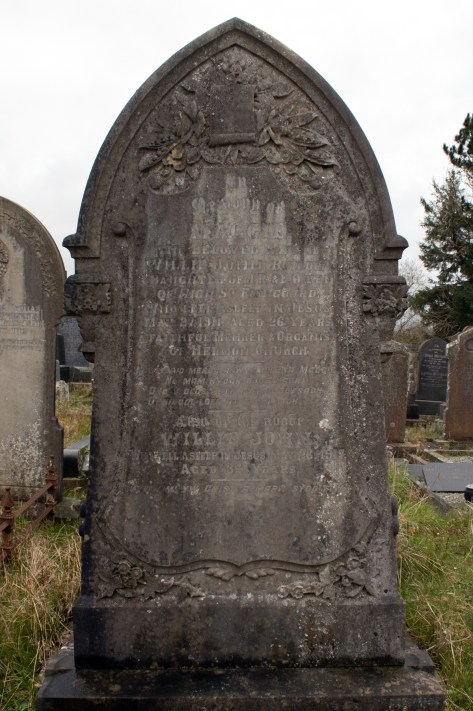
In the Hermon Baptist Burial Ground in Fishguard, Pembrokeshire is a headstone dedicated to Maggie and Willie John. The inscription reads: “In memory of Maggie, the beloved wife of Willie John, builder. Daughter of JR & E Owen of High Street Fishguard, who fell asleep in Jesus May 27, 1911, aged 26 years. A faithful member & organist of Hermon Church… Also of the above Willie John, who fell asleep in Jesus May 26, 1917, age 34 years.”
The early life of Willie – or William – John is a challenge to piece together. He and Maggie – Margaret – married in Hermon Chapel on 30th March 1907, and went on to have a son, Owen, who was born in May 1908.
Willie was employed as a builder and mason, and, after Maggie’s death, sought work wherever he could find it. When war broke out, he was living at 16 Bryn Bedw, Blaengarw, Glamorganshire, although it is unclear whether Owen was with him as well.
Willie’s trade made him an ideal candidate for the Royal Engineers, and he was assigned to the 38th Signal Company when he enlisted on 6th March 1915. Sapper John’s service records show that , he was 5ft 6ins (1.68m) tall, with black hair, dark eyes and a sallow complexion.
Sapper John was sent to Biggleswade, Bedfordshire, for his training, and it was while there that things took a downturn. On 17th September he had a standard inoculation against typhoid, and from there on in felt unwell. Over the following days and weeks he became anaemic and had bouts of giddiness and pains in the back. His medical report notes that he was breathless on waking, and when he walked more than a few hundred yards.
Over the next few months Willie’s condition was monitored, but his condition did not improve. Ultimately he was medically discharged from the army on 10th May 1916, as he was no longer fit enough to serve.
At this point, Willie John’s trail goes cold. He seems to have returned to Pembrokeshire, and it was here, on 26th May 1917, that he passed away. He was reunited with Maggie in the Fishguard burial ground.
Isaac Veal was born on 18th November 1874, the seventh of eight children to Joseph and Frances Veal. When he was born, his parents were the publicans at the Waterloo Arms in Lyndhurst, Hampshire, and this is the town in which they would raise their family.
Frances died in 1890, and by the following year’s census, Joseph had stepped back from being a landlord, he was living with three of his children on a farm to the north of the town centre. Now employed as a domestic gardener, Isaac was working with him.
Isaac sought bigger and better things, however, and, on 21st December 1891, he enlisted in the Royal Navy. Intriguingly, though, he gave his date of birth as 10th July 1875. Below the age to formally sign up, he was given the rank of Boy 2nd Class, and was sent to HMS St Vincent in Devonport, Devon, for training. He remained on board for the next two years, rising to Boy 1st Class in March 1893.
On 26th August 1893, Isaac was promoted to Ordinary Seaman: this would normally mark a boy’s coming of age, but the date doesn’t match Isaac’s given date of birth, or his actual one. It is likely, therefore, that his true age had become known.
Ordinary Seaman Veal’s service documents confirm that he was 5ft 6ins (1.68m) tall, with auburn hair, brown eyes and a fair complexion. He signed up for a period of twelve years and, during that time, he would serve on a total of eleven ships. Isaac travelled the world, returning to HMS Victory, the Royal Naval Dockyard in Portsmouth, Hampshire, in between voyages.
On 11th March 1895, Isaac was promoted to the rank of Able Seaman, and his annual reviews generally marked him of very good character. From April 1901 he was assigned to the battleship HMS Revenge, and she would remain his home for more than four years. During his time assigned to her his contract came to an end and he immediately re-enlisted.
On 18th October 1909, Isaac married Ethel Maud Astridge, a caretaker’s daughter from Basingstoke, Hampshire. When they wed, Ethel – who was better known by her middle name – was working as a housemaid for a miller in North Stoneham. The couple would go on to have three children – Beatrice, Mary and Florence – and while her husband was away at sea, Ethel lived in their cottage on Queen’s Road in Lyndhurst.
Back at sea, Able Seaman Veal would continue to travel the world. During the second term of his contract with the navy, he was assigned to a further dozen ships. In August 1912, Isaac was assigned to HMS Dolphin, the shore base in Gosport, Hampshire, which was the home of the Royal Navy Submarine Service. Over the next five years he would split his time between Dolphin and HMS Maidstone. The submarine depot ship, which operated out of Harwich, Essex, would be his home for the majority of the First World War. Able Seaman Veal’s commitment to the navy was being recognised, as was his ability, which was recorded as superior in each of his annual reviews from 1911 onwards.
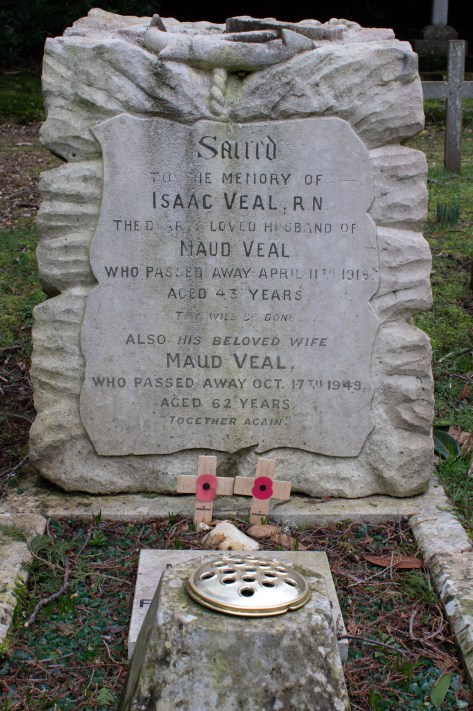
As the conflict entered its closing months, Isaac’s health was becoming impacted. In the spring of 1918, he was admitted to the sick quarters in Shotley – just across the river from Harwich – suffering from pernicious anaemia and rheumyalgia. The combination of conditions would prove fatal: Isaac passed away on 11th April 1918, at the age of 43 years old.
The body of Isaac Veal was taken back to Hampshire for burial. He was laid to rest in Lyndhurst Cemetery, just a few minutes’ walk from his family home. Conveyed to the cemetery in a motor ambulance van, he funeral was supported by a firing party from the local Bombing School Camp, tributes including “a token of respect from the men of the 8th and 9th Submarine Flotillas.” [Hampshire Advertiser – Saturday 20 April 1918]
After the death of her husband, Maud remained living in Myrtle Cottage, the family’s home for the rest of her life. The 1921 census recorded her as being an apartment House Keeper, while the 1939 Register noted that both she and her daughter Florence, were carrying out unpaid domestic duties.
This latter document identifies three boarders to Myrtle Cottage, including Maud’s younger sister Thirza.
Ethel Maud Veal died on 17th October 1949, at the age of 62. She was buried in the family plot in Lyndhurst Cemetery, reunited with her husband Isaac after more than 30 years.
Walter Soper Mitchell was born in the summer of 1878 in Newton Abbot, Devon. The fourth of nine children, his parents were Frederick and Mary. Frederick was a house painter and handyman, and records seem to suggest that he took the family to where the work was. The 1881 census found the family living in Chelsea, West London, and it seems that they stayed in London until 1890.
By the time of the 1891 census, the Mitchells were back in Devon, living at 10 Orchard Terrace in Paignton. Frederick was now working as a plumber, while Walter’s older siblings – brothers Frederick Jr, William and Alfred – were variously employed as a sailor, a painter and a plumber.
Walter, who was 12 years old by this point, was nearing the end of his schooling. When he left, he followed the family trade, and as soon employed as a house painter. The 1901 census found him as the oldest sibling still to be living with Frederick and Mary, although his circumstances were about to change.
In September 1903, Walter married Emily Jeffery. She was a couple of years younger than her new spouse, but, sadly, there is little information about her parents. The 1891 census found her living with her grandparents, while the 1901 return noted her boarding with her aunt and uncle.
Walter and Emily went on to have three children. By the time of the 1911 census, the family were living at 25 Norton Terrace in Paignton, Walter being employed as a house painter by this point.
War came to Europe in the summer of 1914, and Walter was called upon to play his part. Full details of his military service have been lost in the mists of time, but from what remains it is clear that he enlisted in the Royal Army Ordnance Corps at some point after July 1915. He was attached to the 67th Coy., but it is unclear whether he saw any action overseas.
Private Mitchell’s time in the army was not to be a lengthy one. He seems to have been based in Essex, and a later record confirms that he contracted bronchitis and anaemia. This would prove to be his undoing: he passed away in Colchester on 17th February 1916, aged 36 years old.
The body of Walter Soper Mitchell was brought back to Devon for burial. He was laid to rest in what would become the family plot in the sweeping Paignton Cemetery.
Walter Bailey was born on 6th October 1882 in Midsomer Norton, Somerset. He was one of eight children to Wiltshire-born labourer John Bailey and his wife, Emma, who came from the town in which they settled.
When he left school, Walter followed his siblings into the local boot industry and, by the time of the 1901 census, was working as a shoemaker. He was a sporty young man, and played in the local Welton Rovers Football Club.
When war came to Europe, Walter was eager to play his part. He enlisted in the 1/4th Somerset Light Infantry and, on 9th October 1914, was shipped to India. His battalion later moved to Mesopotamia where, on 8th March 1916, he was wounded in the foot in fighting. (Walter’s nephew, Corporal Tom Bailey was in the same regiment and, in the same fighting, he was killed. He is commemorated on the memorial in Basra, Iraq.)
Walter was invalided to India, but returned to his regiment when he recovered. He continued fighting, and was eventually promoted to Company Sergeant Major, while being mentioned in dispatches in 1918.
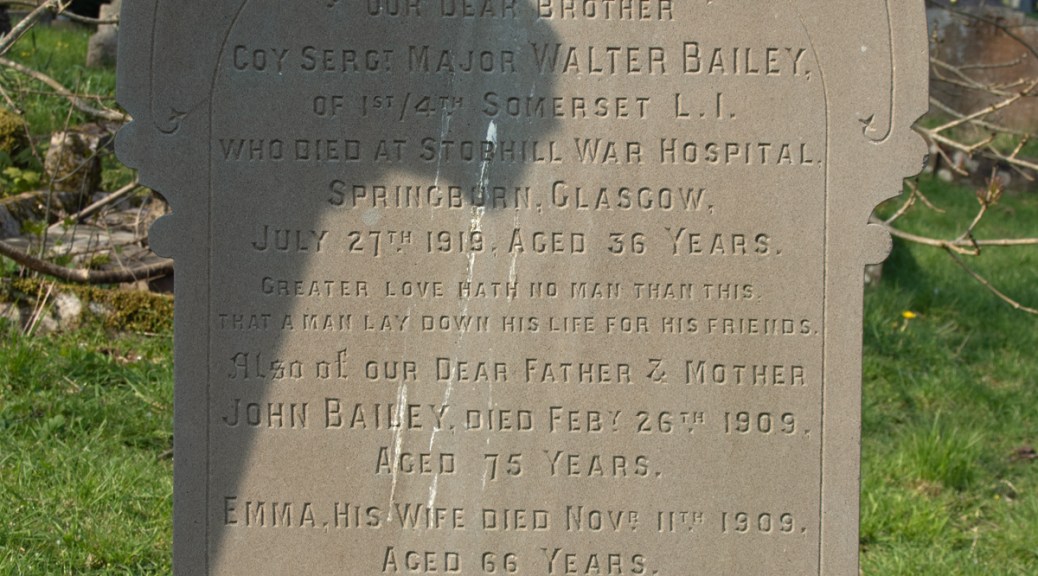
While waiting to return to England when the war ended, Walter fell ill. He was transported back to Southampton on a hospital ship, and from there was taken to a hospital in Glasgow. Sadly, the dysentery and anaemia he was suffering from were to get the better of him: Company Sergeant Major Bailey passed away on 27th July 1919, at the age of just 36 years old.
Walter Bailey’s body was brought back to Somerset for burial. He lies at rest in the family plot in the cemetery of St John the Baptist Church in his home town, Midsomer Norton.
Company Sergeant Major Walter Bailey (from britishnewspaperarchive.com)
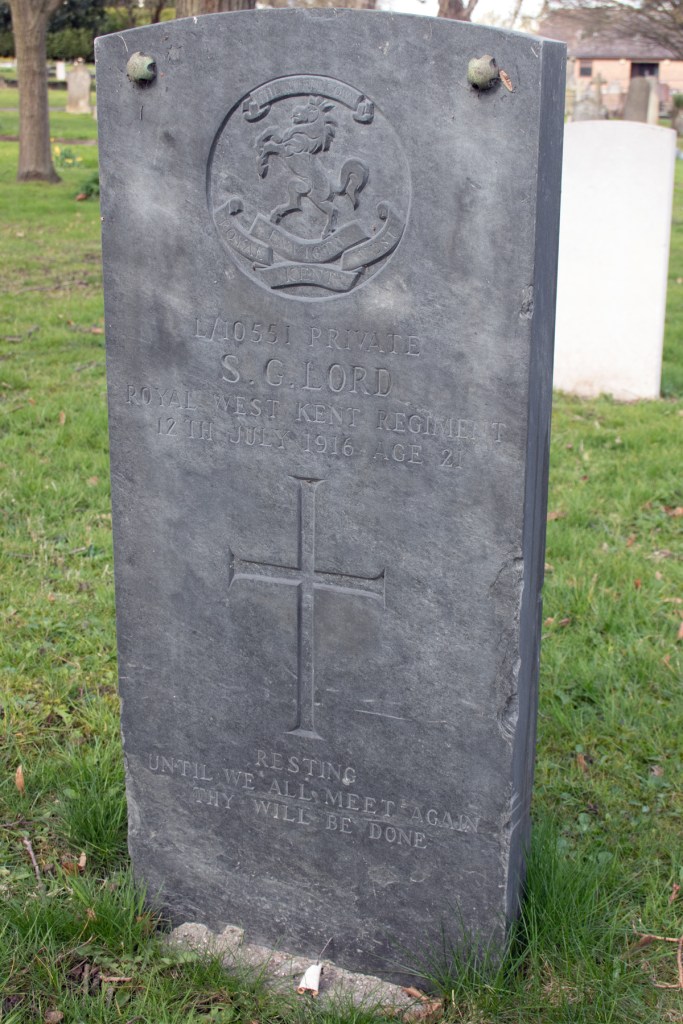
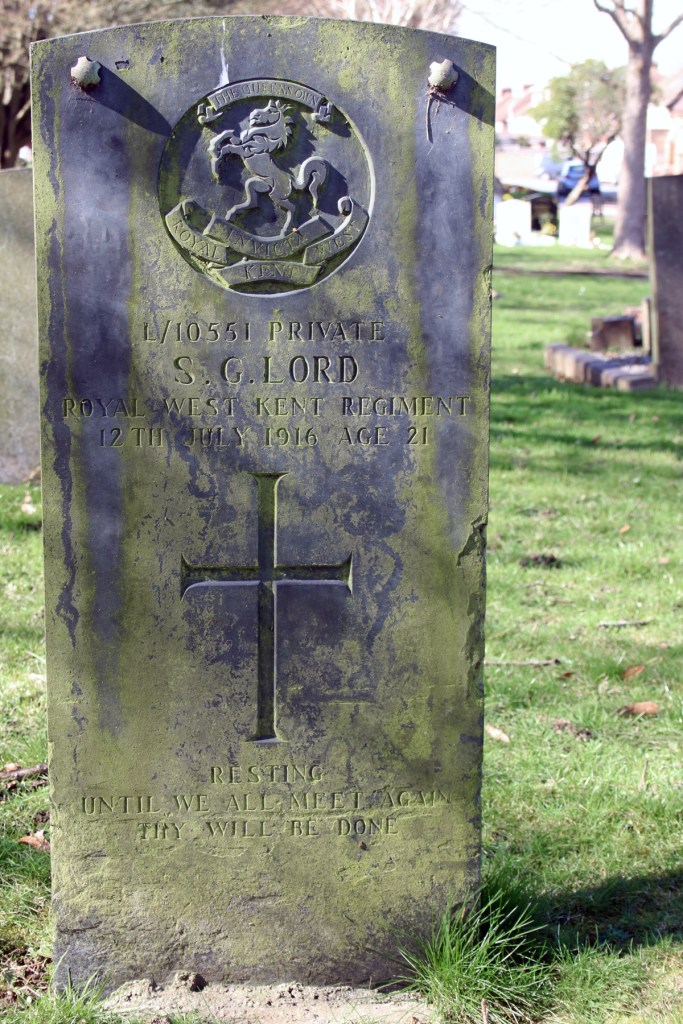
Sidney George Lord was born on 29th March 1895, one of six children to Sidney and Clara Lord. Sidney Sr was a shipwright from Bideford in Devon, and he brought the family to Kent, presumably for work at the Naval Dockyard in Chatham.
Sidney Sr passed away in 1912 and his son left school, finding work as a plumber’s apprentice. War was on the horizon, however and he was keen to do his bit as soon as possible. Sidney Jr enlisted in November 1914, joining the Queen’s Own Royal West Kent Regiment.
After his initial training, Private Lord was sent to the Front on 22nd April 1915, serving in France with his regiment for just over a year. Towards the end of this time he became anaemic, and was shipped back to England for treatment.
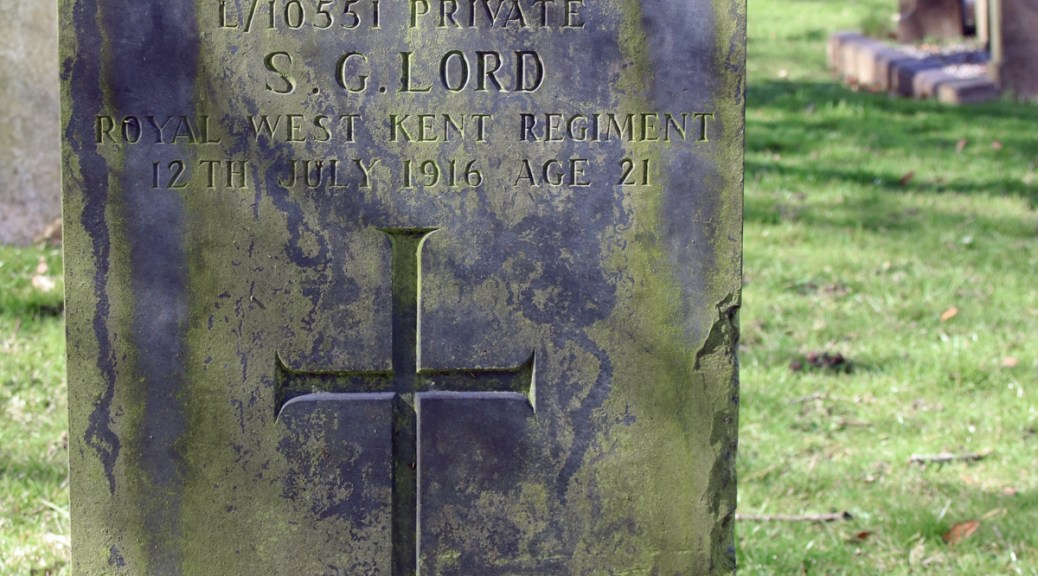
Private Lord was admitted to the Yeatman Hospital in Sherborne, but sadly succumbed to his anaemia a matter of weeks later. He passed away on 12th July 1916, having not lung turned 21 years of age.
Sidney George Lord was laid to rest in the Woodlands Cemetery in Gillingham, Kent, close to where his father was buried.








 Death and Service