Walter James Tottle was born in September 1892, one of fourteen children to Charles and Ellen Tottle from Somerset. Charles was a boatman, and they family lived in Salmon Parade along the riverfront in Bridgwater.
When Walter left school, he became an assistant at a market garden; by the 1911 census, he was living with his parents and eight of his siblings, whose jobs included carpentry and laundering. Walter’s younger brother Henry was listed as a ‘rink boy’, helping with skating at the local ice rink.
Walter’s life beyond this is a bit of a mystery. He enjoyed sports and, before the war had been a regular player for Bridgwater Rugby Football Club. He married a woman called Ruth, although I have been unable to track down who she was or when they couple wed.
When war came, Walter enlisted in the Somerset Light Infantry and, according to contemporary newspaper reports, Corporal Tottle had served on both the Eastern and Western Fronts. He was discharged from the army on 13th February 1919, following a severe attack of influenza, but it appeared to get the better of him. He passed away on 5th May 1919, aged just 26 years old.
Walter James Tottle lies at rest in St John’s Cemetery in his home town of Bridgwater, Somerset.
Walter’s ‘rink boy’ brother Henry also served in the First World War. He had also enrolled in the Somerset Light Infantry and, as a Corporal in the 1/5th Battalion, he was involved in some of the fierce fighting in the Middle East. He was injured, either in Gaza or Jerusalem, but sadly Henry died of his wounds on 22nd November 1917; he was buried in the War Cemetery in Jerusalem.
Wilfred Allen Gillson was born in 1888, the fourth of nine children – and one of eight boys – to George and Emma Gillson. George was a coachbuilder from Cornwall; Emma, whose maiden name was Allen, came from Derbyshire. The family were living in Torquay by the time Wilfred was born.
In 1895, George had moved the family to Bridgwater in Somerset, presumably as railway works had dried up in the coastal Devon town. By this time his oldest son, also called George, was working as a compositor, keying text for a printer. Wilfred was still at school, but his other two older siblings – William and Albert – were both working with their father, working on railway coaches.
Wilfred was also to follow in his father’s employment, and the 1911 census found him living in Bristol, boarding with the Cridland family, earning his keep a a carriage painter.
He joined up within weeks of war breaking out, enlisting in the Worcestershire Regiment on 20th September 1914. Private Gillson readily proved his worth, and was promoted to Lance Corporal after three months, and Corporal within a year of enlisting.
Corporal Gillson’s promotion coincided with his shipment abroad, and he served on the Western Front for eight months. Returning to England in March 1916, he subsequently transferred to the Devonshire Regiment, before being moved to the 4th Reserve Battalion in the spring of 1917.
Things were not right for Wilfred; he was reprimanded for neglecting his post on the night of the 26th May that year, before being medically discharged with neurasthenia in August.
The root of the matter is detailed in his discharge report; he was hospitalised at Neuve Chapelle in February 1916, suffering from shellshock, and it seems that he never really fully recovered.
Sadly, at this point Wilfred’s trail goes cold. He passed away on 10th November 1918, aged 30 years old.
Wilfred Allen Gillson lies at rest in St John’s Cemetery in Bridgwater, Somerset.
There are a couple of additional notes to Wilfred’s life.
During the war, Wilfred’s youngest brother, Thomas, fought with the Oxfordshire & Buckinghamshire Light Infantry. He was involved in the fighting in France, but died from wounds on 10th June 1918. He was just 18 years old, and is buried at Aire-sur-la-Lys, not far from Boulogne.
Given that Wilfred was one of eight brothers, all of whom would have been of fighting age during the war, it is lucky – although still a tragedy – that only he and Thomas died as a result of the conflict.
Sadly, Wilfred’s mother, Emma, passed away in the autumn of 1914, at 57 years of age. It might be a blessing, however, that she was not alive to see two of her sons suffer so.
The early life of Charles Willcox is a bit of a mystery. From fragments of information, we can determine that he was born in 1893 and had a brother called Edmund and a sister called Beatrice. His mother was a Mrs S Willcox, who, by the early 1920s was living in Johannesburg, South Africa.
Piecing together the tiny pieces of information online, it seems likely, therefore, that his parents were Frank and Sarah Willcox. Frank was a cabinet maker and upholsterer, he and Sarah were from Bridgwater in Somerset, and they had eleven children.
By 1895, Frank had moved the family from Somerset to Cardiff; Charles was the last of the siblings to be born in England. The family did eventually move to South Africa – alongside Sarah, both Beatrice and Edmund lived and died there in their later years.
Back to Charles and, once the Great War started, he was quick to enlist. He joined the Somerset Light Infantry in August 1914, and had a narrow escape in October of that year. The Bridgwater Mercury reported that he was in the trenches and had had a near miss when his backpack was hit by a shell.
Corporal Willcox was wounded at Ypres in November, when a piece of shrapnel hit him in the shoulder, went through the lung and had to be cut out of the centre of his back. He was expected to make a full recovery within a year. Charles was also awarded the Distinguished Conduct Medal for his actions in the battle.
In September 1915, Sergeant Willcox received another award; the Russian Cross & Order of St George; the BridgwaterMercury noted that Charles was the first man from the town to be awarded both this and the DCM. The town’s mayor also subsequently presented him with a gold watch and chain on behalf of the town.
Promotion continued for Charles, and, by 1917, he had been elevated to Company Sergeant Major. He was heavily involved in recruitment for the Somerset Light Infantry, and it is likely that, standing at a strapping 6ft 4ins (1.93m) tall and weighing in at 17st (107kg), he would have been the perfect advert for the battalion.
When the war came to a close, things quietened down for him. A keen sportsman – he played rugby for Somerset – he had been a gym instructor in the army, and had taken up boxing around 1912. He entered a novices’ boxing competition in Southampton in December 1919, and found himself up against Seaman Merrilees, from the HMS Hearty.
In the fight, Charles received a body blow and a blow to the jaw, he fell to the floor, landed awkwardly and was knocked out. Attended to by doctors in the sports club, he was sent to Charing Cross Hospital when he did not regain consciousness after a couple of hours.
At the hospital, bruising was reported to Charles’ eye and cheek, but no skull fracture was found. They operated on him, two pieces of bone were removed, and a large clot on the left-hand side of his brain discovered. Sadly, the operation did no good, and Charles died that afternoon, the 4th December 1919. He was just 26 years old.
His death was recorded as concussion and a cerebral haemorrhage, attributed to the fall he had had in the ring. An inquest was held, although one report suggests a verdict of accidental death, while another states excusable homicide by misadventure.
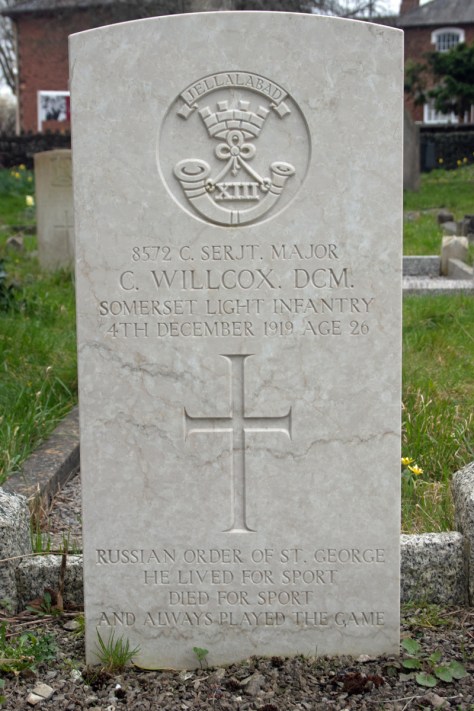
Charles Willcox lies at rest in the Wembdon Road Cemetery in his home town of Bridgwater in Somerset. His gravestone remembers that he lived for sport, died for sport and always played the game.
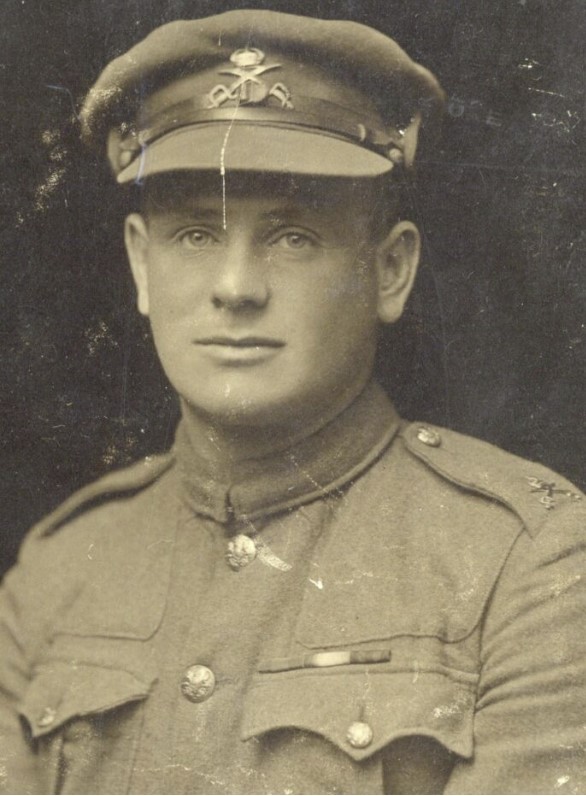
Serjeant Major Charles Willcox (from wembdonroadcemetery.com)
John Milton Welch was born in Yeovil on 19th February 1866, one of five children to William and Anne Welch. William was a chemist by trade, but John’s calling was elsewhere. He became a clerk, initially for a brewery, but by the time of the 1911 census, he was working for a political agency.
In that census, John can be found living with his parents – who were in their 80s by this point – and his two sisters, both school governesses. He is listed as single; although an earlier census suggests he had married a lady from the Isle of Wight called Sarah, I have found nothing to corroborate this, beyond the fact that she had wed a John M Welch, a brewery clerk from Yeovil.
War beckoned and even though he was 48 when the conflict broke out, John enlisted. Private Welch joined the Somerset Light Infantry; his service record no longer exists, but his medal record show that he arrived in France in May 1915, and was subsequently awarded the Victory and British Medals and the 1915 Star. His service obviously warranted promotion, and he was elevated to Corporal.
His troop – the 6th (Service) Battalion – was involved in several of the skirmishes of the Battle of Somme, and it is likely that Corporal Welch was injured during one of these – probably either the Battle of Delville Wood or the Battle of Flers-Courcelette. Wherever it happened, he was shipped back to England, and was treated for his injuries at the Royal Victoria Hospital in Netley, Hampshire
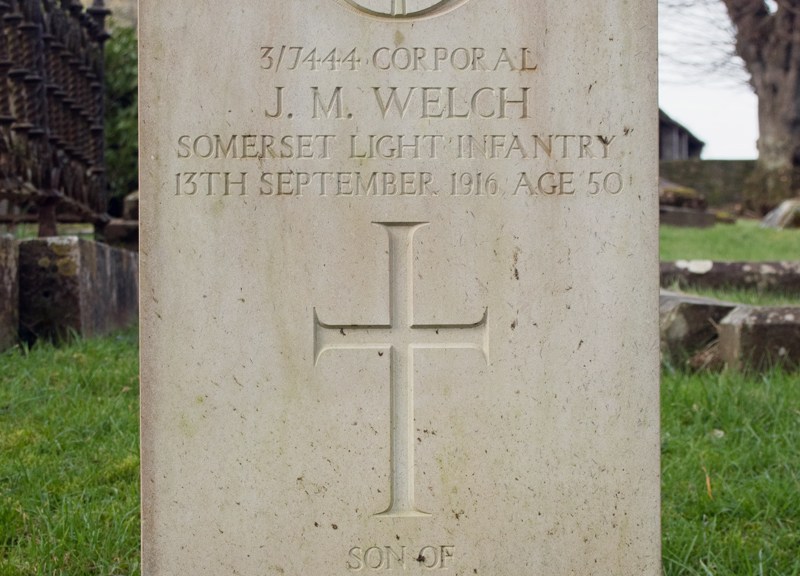
Sadly, Corporal Welch was not to recover; he passed away on 13th September 1916, at the age of 50.
John Milton Welch lies at rest in the graveyard of St James’ Church, in the quiet Somerset village of Milton Clevedon.
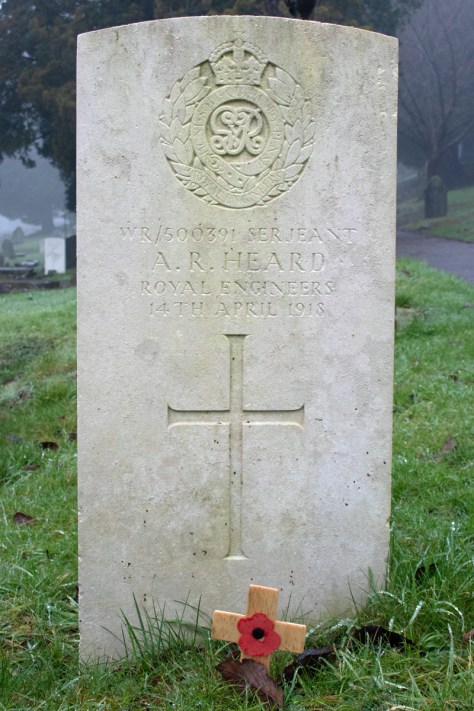
Arthur Reginald Heard was born in 1887, the youngest son to Herbert and Emily. Herbert was a local surveyor and land agent, and the family lived in the middle of Shepton Mallet in Somerset, two doors up from the town’s Baptist Church and within sight of the Magistrate’s Court.
In 1908, aged 21, Arthur made the journey across the Atlantic to Argentina, settling in Buenos Aires and working for the Pacific Railway Company. When war broke out, however, he immediately returned to England, when he enlisted in the army, and was assigned to the Royal Engineers.
Sapper Heard was shipped out to France and was quickly promoted, first to Corporal, then to Serjeant. In November 1917, Arthur was caught up in a shell impact on the front, and was buried. He was quickly dug out, and not severely hurt.
On 25th March 1918, Serjeant Heard was due to return home on leave, but was taken ill. Back in England, he was hospitalised in Birmingham, where meningitis was confirmed. He seemed to recover – even going out for tea with his sister-in-law when she visited him – and was transferred to recuperate in Saltash, Cornwall.
Within days of arriving, he collapsed with a fit, and passed away within half an hour. Subsequent examination confirmed that Arthur had died from a brain tumour. He was just 30 years old.
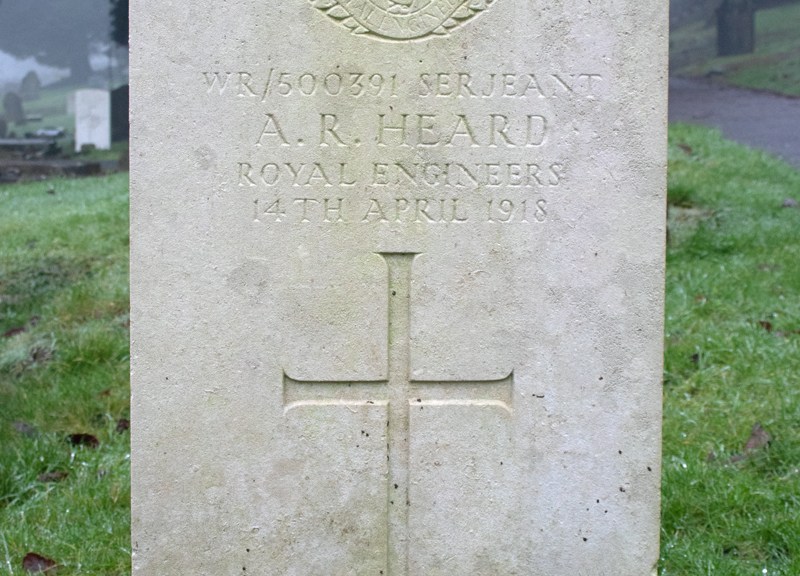
Arthur Reginald Heard lies at rest in the cemetery of his home town, Shepton Mallet.
Ossian Emanuel Richards was born in Westonzoyland, Somerset, in December 1897. He was the youngest of two children and his parents – Emmanuel and Jane – were farmers in the area.
Ossian enlisted later in the war, joining the RAF in June 1918. While little detail of his service is available, he had been a fitter before joining up, so it may well have been on the mechanical side of things that he was involved.
After nine months’ service, Ossian has been promoted to Corporal, and, with the war over, he was transferred to the RAF Reserves in March 1919.
Sadly, as with many young men of his generation, Corporal Richards succumbed to the flu pandemic that followed the war. He died on 15th September 1919, aged just 21 years old.
Ossian Emanuel Richards lies at rest in the cemetery of his home village of Westonzoyland.
William Charles Stevens was born in Wells in 1884. The eldest child of Alfred and Susan, William was one of eleven children. Alfred worked at the local paper mill, while William became a labourer, and found work as a stonemason.
William seemed keen to improve his prospects, however; he enlisted in the army at the start of 1903, serving in the Royal Field Artillery for a period of four years, before being demobbed to the reserves.
On Christmas Day 1907, William married Minnie Bailey; the census four years later gives the young couple as living in their home city. William, by now, was labouring on the railway, and the census shows, they had had a child, who had sadly passed away.
War was looming, and Gunner Stevens was recalled to duty in August 1914. Quickly posted overseas with the 23rd Brigade, he fell ill with myalgia and was shipped home to recover towards the end of the year.
Sent back to the front in 1915, William was promoted to Corporal and transferred to the 51st (Howitzer) Brigade. Sadly, his ‘tremble’ returned and he was sent back to England in October 1915. By this point, Minnie had given birth to their second child, a little girl they called Lilian.
Corporal Stevens’ condition continued, and he was medically discharged in March 1916. No further records exist, but it seems that he finally succumbed to the condition later that year. He passed away on 2nd November 1916, aged 32 years old.
William Charles Stevens lies at peace in the cemetery of his home town, Wells in Somerset.
Henry Leslie Boyce was born on 14th June 1872 in the parish of St Michael, in Barbados, then the British West Indies. His parents were Samuel and Mary Boyce.
Further details of his early life are scant, but Henry appears to have moved to England at some point in the early 1890s. The 1911 census shows him living in Ilford, Essex, and working as an iron and metal merchant. His wife Rosanna, a dressmaker, was born in Wincanton, Somerset, and they married in 1896. The young couple had two children; sadly they both died young.
Henry was quick to do his duty when war broke out, joining up in September 1914. He enlisted in the British West Indies Regiment, and after training on the home front, served in France from April 1917. While there, he was promoted to Acting Corporal, but contracted bronchial pneumonia and was sent back to England to recuperate after only five months.
A medical report from November 1917 states that Acting Corporal Boyce remained unfit for military service, and he was discharged from the army at the end of that year. The same report showed him as a former commercial traveller, living in Forest Gate. It marks him as having a very good military character – “Judging from his records, he is a steady, sober, well-conducted man“.
While no information after that point is available for him, it seems that he succumbed to the disease less than a year later.
Henry Leslie Boyce died on 24th October 1918. He was 46 years old.
He lies at rest in the graveyard of St Leonard’s Church in Butleigh, Somerset; presumably close to his widow’s family.
There is some discrepancy over Henry’s rank. He was discharged with the rank of Acting Corporal, although his headstone cites his previous rank of Private.
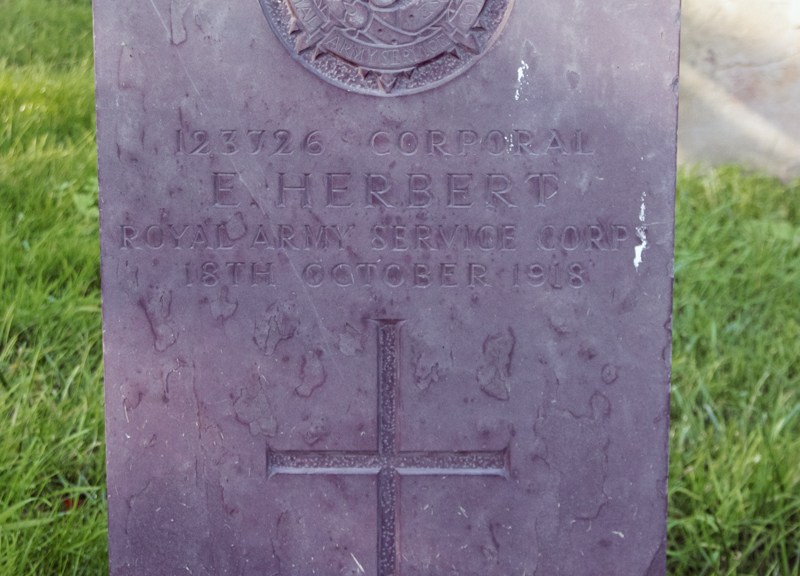
Edwin Herbert was born in 1864, the third of three children to Moses and Melina Herbert of Hove in East Sussex. Moses worked in the cement industry as a labourer, a job that had taken him from his home in Kent to Sussex, and which, by the 1871 census, would return him to his home county.
Edwin married Amelia Charlotte Titus in 1885 and the couple’s first child – a daughter, Nelly – was born a year later.
By the 1891 census, Edwin was also labouring in the North Kent cement industry, something he continued to do for at least the next twenty years, as confirmed in the following two censuses.
The Herberts’ second child, Amelia, was born in 1901, the year after Edwin’s mother passed away. The family were, by then, living in Cuxton, just to the south of Rochester. The cement industry was one of the large employers in the Medway valley, and it is not surprising that the family lived in and around that area for so long.
In 1910, Edwin’s father also died, at the age of 69. After the death of Melina, Moses had moved in with his daughter – Edwin’s older sister – in Rochester, and the family were also still labouring in the cement and brickmaking industry.
Edwin’s military records are sketchy. Piecing the evidence together, he enlisted in the Royal Army Service Corps.
It is likely that he did so on a voluntary basis. The cement industry was not protected by exemption. Kitchener’s initial conscription in March 1916 excluded married men. When this was extended in May 1916, there was still a maximum age limit of 41 (Edwin was 52 year old by this point).
By whichever means he had enlisted, Edwin served as a Corporal (there is nothing to confirm whether he was promoted from Private, or if he went straight into service at that rank). He was discharged on 30th July 1918, and it is likely that this was on a medical basis.
Corporal Herbert’s pension documents record that he passed away on 30th October 1918, as a result of carcinoma of the liver and exhaustion. He was 54 years old.
Edwin Herbert lies at peace in the quiet churchyard of St Helen’s in Cliffe, Kent.
The majority of the the Commonwealth War Graves Commission headstones in the UK are made from Portland stone, although, in face, over 50 different natural stones have been used.
Corporal Cornell’s headstone is one of two in St Helen’s Churchyard that have been fashioned from dark grey slate.
Charles Cornell was born in July 1885, the youngest of six children to Philip and Martha Cornell, from Ashdon in Essex. Philip was an agricultural labourer, and Charles and his older brother Daniel followed their father into the trade.
Charles was keen to further himself, however, and enlisted in the army. The 1911 census records him as a Private soldier at the Salamanca Barracks in Aldershot.
Private Cornell married Elizabeth Fanny Hoare in Strood, Kent, in October 1913. Beyond this there is little information on either Charles or Elizabeth.
Charles was assigned to the 3rd Battalion of the East Yorkshire Regiment and was promoted to Corporal. This reserve battalion was initially based in the town of Beverley, before moving to Hull and then nearby Withernsea. It seems unlikely, therefore, that Corporal Cornell saw active service on the Western Front.
His passing seems to have been sudden; his pension record shows that he had been admitted to the Military Hospital at Wharncliffe with nephritis (inflamed kidneys). He passed away on 27th January 1918, aged 32 years old.
Corporal Charles Cornell is buried in the graveyard of St Helen’s Church in Cliffe, Kent, the village his widow’s family were from. He is also commemorated in his own family’s village of Ashdon in Essex (where the memorial states he had attained the rank of Sergeant).
The majority of the the Commonwealth War Graves Commission headstones in the UK are made from Portland stone, although, in face, over 50 different natural stones have been used.
Corporal Cornell’s headstone is one of two in St Helen’s Churchyard that have been fashioned from dark grey slate.








 Death and Service