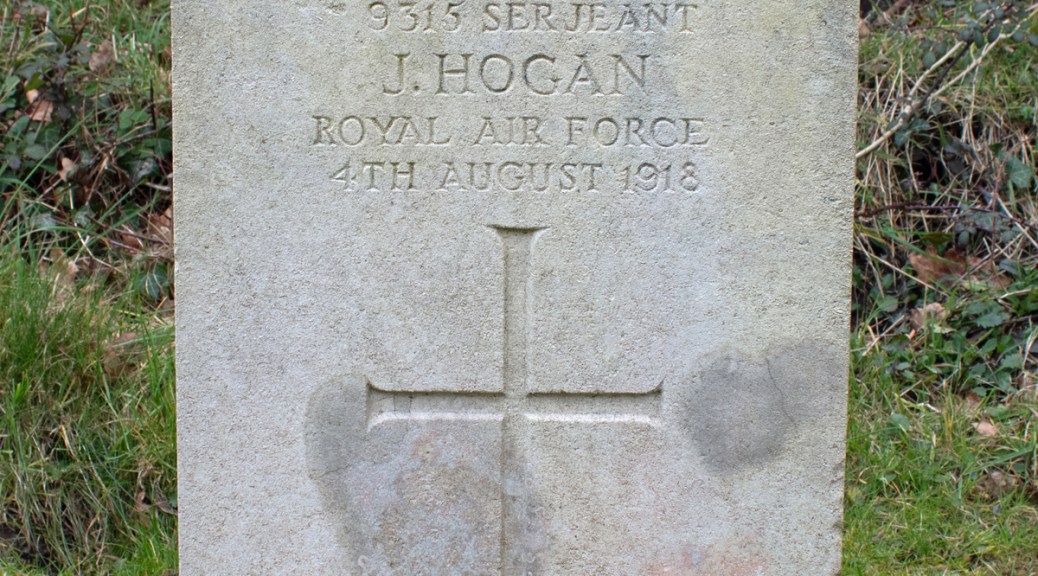
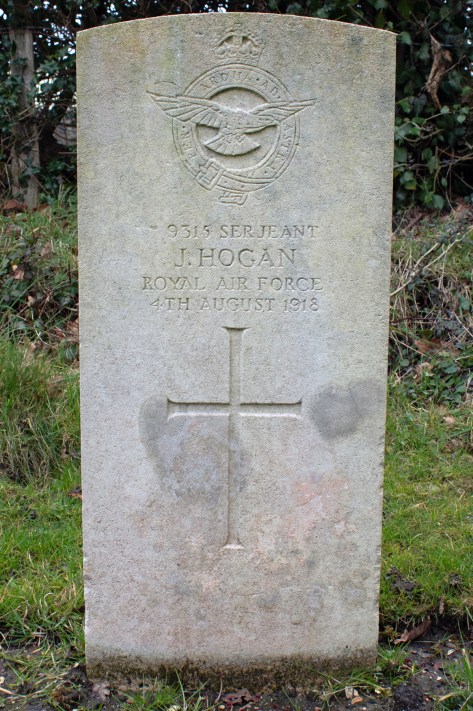
The personal life of Jack Hogan is a challenge to piece together, and much of the information is pulled from his service record. This confirms that he was born in 1890 in Cork, Ireland, and gives his next of kin as his mother, Annie Hogan, who was living in Southsea, Hampshire. He seems to have been born John Hogan, Jack being a common nickname, but there are too many census records with potential matches to narrow down a definite connection.
A Roman Catholic, Jack was 5ft 5.5ins (1.66m) tall. He had dark hair, brown eyes and a fresh complexion. He was also noted as having two small moles on his left cheek. He enlisted in the Royal Flying Corps as an Air Mechanic 2nd Class on 1st October 1915, leaving his job as a motor and cycle fitter to do so.
Jack seemed to have been proficient at what he was doing, and was promoted to Air Mechanic 1st Class less than a year after enlisting. On 5th February 1918 he rose again, taking the role of Acting Sergeant. When the Royal Air Force was formed in April that year, his rank was made permanent.
Sergeant Hogan was attached to the 29th Training Depot Station near East Boldre, Hampshire. On 4th August 1918, he was piloting an Avro 504, when it collided with another aircraft. There is little recorded about the incident, and his RAF Casualty Card does not give details of the other vehicle or its pilot. Jack’s biplane fell to the ground and he was killed. He was 28 years of age.
The body of Jack Hogan was laid to rest in the graveyard of St Paul’s Church in East Boldre, not far from the base that had become his home.
Vernon Monroe Kidd was born in Waco, Missouri, on 6th December 1896. One of nine children, his parents were William and Frances Kidd. William was a blacksmith and, by the time of the 1900 census, he had moved the family to Delaware, Indiana.
Details of Vernon’s life are a challenge to uncover, but a later newspaper report sheds some light on him:
Lieutenant Vernon Kidd, formerly of Yorktown, was killed August 30 in France, the news coming to Yorktown yesterday to his two brothers, J Wesley and William E Kidd. He was serving with the Canadian Aviation Corps and was but 21 years old. Only last April, while visiting Yorktown, Lieutenant Kidd spoke there at the ME Church. He sailed on June 18 for overseas service. He had tried numerous times to enlist in the United States army but was rejected and later went to Canada, enlisting at Toronto. He had another brother now serving in the army against Germany.
[The Star Press: 2nd September 1918]
Vernon’s service papers give a bit more information. He enlisted in Toronto on 12th October 1917, joining the Canadian Royal Flying Corps. He gave his next of kin as his father, who by now, was living in Port Angeles, Washington. Just short of his twentieth birthday, he was noted as being 5ft 9ins (1.75m) tall.
Sent to Britain, Vernon was based at the 29th Training Depot Station in East Boldre, Hampshire. When the Royal Air Force was founded in April 1918, he transferred across, and just a month later, he received his commission.
On the 30th August 1918, Second Lieutenant Kidd was piloting an Avre 504J biplane. It had just taken off, but the engine cut out. He had little choice but to crash land, and was killed in the impact. Vernon was 21 years of age.
Thousands of miles from home, the body of Vernon Monroe Kidd was laid to rest in the graveyard of St Paul’s Church in East Boldre.
Second Lieutenant Vernon Kidd (from findagrave.com)
Arthur Fred Belyea was born in Penetanguishene, Ontario, Canada, on 21st October 1894. The second of five children, he was one of three sons to John and Sarah. John was a farmer, and local to the area, but Sarah, who was sixteen years her husband’s junior, had been born in Pennsylvania, and lived in Kansas for twenty years before moving to Canada.
By the time of the 1911 census, the family had moved to Calgary, where John had taken up work as a horse dealer. Interestingly, the census also recorded the Belyeas’ racial background, which was German, although John and Sarah were at least second generation North American.
Arthur had finished school by this point, and had found employment as a bookkeeper for the Royal Bank of Canada. He was settled in for a career, and, by 1916 had achieved the role of assistant accountant. War was on the horizon, however, and life was to change.
Full details of Arthur’s military service have been lost to time, but it is clear that he enlisted in the Canadian Royal Flying Corps on 3rd December 1917. His service papers show that Air Mechanic 3rd Class Belyea was 5ft 5.5ins (1.66m) tall, with dark brown hair, hazel eyes and a medium complexion.
Arthur was sent to Britain and stationed at East Boldre, Hampshire. When the Royal Air Force was formed on 1st April 1918, he transferred across. He was obviously proficient at what he did, because at the end of May he earned a commission, and rose to the rank of Second Lieutenant.
Mr A C Hallett, Deputy County Coroner, held inquests on Tuesday, of Lieut. Austin Wyard Blackie, RAF, of California, and Second-Lieut. Arthur Fred Belyea, RAF, of Calgary, Canada, who met thwir deaths while flying. The evidence showed that their machines collided at a great height, and that death in each case must have been instantaneous. Verdicts of “Accidental death” were returned.
[Hampshire Advertiser: Saturday 21st September 1918]
The RAF report card on the incident noted that: “The cause of the accident was in our opinion an error of judgement on one pilot (unknown) in flying his machine into the other machine from the rear, causing the left hand frame of Camel C8322 and the right hand frames of Camel C96 to collapse, thus causing each machine to spin to the ground. The one pilot was probably attempting to obtain good photographs of the other machine.”
Arthur Fred Belyea was 23 years of age when he died on 17th September 1918. He was laid to rest alongside Lieutenant Blackie in the graveyard of St Paul’s Church, East Boldre, not far from the airfield at which he served.
You can read about the life of Lieutenant Blackie here.
Second Lieutenant Arthur Belyea (from findagrave.com)
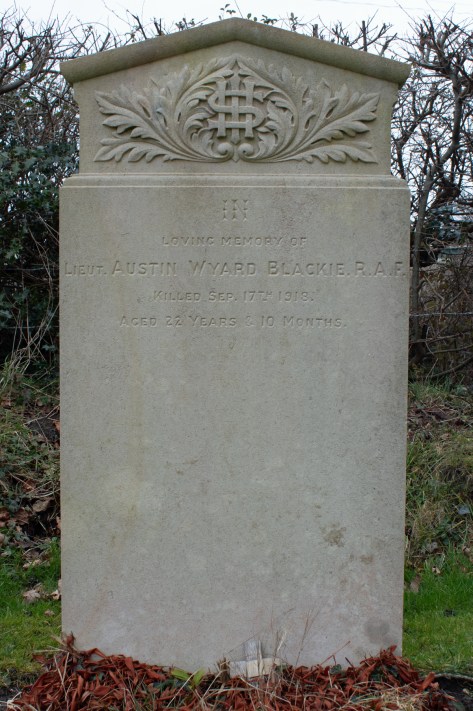
Austin Wyard Blackie was born in Spring Bay on Ontario’s Manitoulin Island on 17th November 1895. The seventh of eight children, his parents were farmers John and Mary Blackie. John took the family to where the work was: by the time of the 1901 census they had relocated to Algoma, 190km (120 miles) to the north west.
Little further information is available about Austin’s early life. When war broke out, he stepped up to play his part. His military records take a bit of unpicking, but he joined the Canadian Expeditionary Force on 10th April 1916, and was assigned to the 227th Battalion as a Sergeant. He was dismissed from service on 15th December 1916, as he was deemed medically unfit.
Undeterred, Austin’s service papers confirm that he re-enlisted on 7th March 1917, and that he was a student at the University of Toronto Officers’ Training Corps at the time. This document also gives his year of birth incorrectly as 1894.
Austin’s medical in 1917 confirmed that, at 22 years of age (based on the incorrect year of birth), he was 5ft 7.5ins (1.71m) tall and weighed 143lbs (64.9kg). He had fair hair, grey eyes and a fair complexion, good hearing and 20/20 vision. He was also recorded as having a number of scars: two either side of his stomach from an operation, and a third on the right side of his left ankle.
Sergeant Blackie’s time in the army was not destined to be a lengthy one, and there is a sense of his determination to better himself. On 5th May 1917, he was discharged from service again, but this time because he mad the transfer to Canadian Royal Flying Corps.
At this point, Austin’s trail goes frustratingly cold. He was shipped out to Britain, and was based at the 29th Training Depot Station in East Boldre, Hampshire. When the Royal Air Force was formed, he transferred across, and, at some point during this time, he was promoted to the rank of Lieutenant.
Mr A C Hallett, Deputy County Coroner, held inquests on Tuesday, of Lieut. Austin Wyard Blackie, RAF, of California, and Second-Lieut. Arthur Fred Belyea, RAF, of Calgary, Canada, who met thwir deaths while flying. The evidence showed that their machines collided at a great height, and that death in each case must have been instantaneous. Verdicts of “Accidental death” were returned.
[Hampshire Advertiser: Saturday 21st September 1918]
The report’s suggestion that Austin was from California is incorrect, although his parents had, by this point, moved there from Canada.
The RAF’s own report gave a little more detail on what happened:
The court considered the evidence, found that the cause of the accident was entirely due to misadventure in that the [Lieutenant Blackie’s] foot became entangled behind the rudder bar, the machine thus being our of control.
It appears that Austin had been offered a different aircraft to the Sopwith Camel in which he he had been killed. “He apparently took his machine up without asking his Flight Commander’s permission or his Instructor’s, contrary to standing orders.”
Second Lieutenant Belyea’s report card adds a stark twist to the crash: “The cause of the accident was in our opinion an error of judgement on one pilot (unknown) in flying his machine into the other machine from the rear, causing the left hand frame of Camel C8322 and the right hand frames of Camel C96 to collapse, thus causing each machine to spin to the ground. The one pilot was probably attempting to obtain good photographs of the other machine.”
Austin Wyard Blackie was just 22 years of age when he died on 17th September 1918. He was laid to rest alongside Second Lieutenant Belyea in the graveyard of St Paul’s Church, East Boldre, not far from the base in which he had served.
You can read about Second Lieutenant Belyea’s life here.
Lieutenant FJ Bravery’s “Great Skill and Fearlessness”
A sad bereavement has just been sustained by Mr & Mrs T Bravery, of 83, Chapel-road, in the death of one of their soldier sons, Lieutenant FJ Bravery, of the Royal Air Force, as the result of a flying accident near Birmingham in the early part of last week.
Together with a young Canadian Officer, Lieutenant Macbeth, of Toronto, and five air mechanics, Lieutenant Bravery was testing a large aeroplane, when, according to a farmer who was an eye-witness of the accident, the machine was seen to come nose down out of a cloud at great height.
The machine then righted itself and went about a mile, when it turned over while flying at a comparatively low altitude, and fell straight to earth, all seven occupants being instantaneously killed.
An inquest was held at a small town in the vicinity of the accident on Thursday afternoon, when evidence was given that both Lieutenant Macbeth (who was in charge of the machine) and Lieutenant Bravery were experienced pilots and accustomed to the type of machine they were flying, and that tests made with the machine before the flight was started were all satisfactory.
The Jury, in returning their verdict of “Accidental death” were unable to state the specific cause of the accident.
Lieutenant Bravery, who was only twenty-two years of age, joined the Army Pay Corps at the end of 1914, bur subsequently transferred to the Royal Flying Corps, where he had been engaged in flying for a little more than a year. A capable and experienced pilot, he had latterly been attached to the Central Dispatch Pool, where his duties mainly consisted of ferrying machines over to France; and his Commanding Officer, in a letter of sympathy to the bereaved parents, wrote that “he had done excellent work by his great skill and fearlessness. He was always popular and loved in his mess; and was absolutely unselfish, and a very brave gentleman.”
The funeral of the other victims of the tragedy took place on Friday near the scene of the accident: but the body of Lieutenant Bravery was brought home to Worthing, and was buried yesterday afternoon, at Broadwater Cemetery, with full Military honours.
[Worthing Gazette: Wednesday 28th August 1918]
Frederick James Bravery was born on 4th January 1896 in Brighton, Sussex. One of seven children, his parents were Thomas and Eugenie Bravery. Thomas was a pork butcher, and the 1901 census found the family lived at 3 Grenville Street in the centre of the town. Frederick and two of his sisters, meanwhile, were staying with their paternal grandparents on New Church Road in Aldrington.
By the time of the 1911 census, the Bravery family had taken a massive step up. They were now living in a 10-roomed Victorian villa at 15 Clermont Terrace in the Preston area of Brighton. Thomas was noted as having no occupation, and while three of Frederick’s older sibling were working – one as a milliner’s assistant, one as a chemist’s cashier and one as a clerk for a piano shop – their salaries would not have been enough to support such a change in status.
There is little that can be added to the newspaper’s account of Frederick’s military service. He seemed keen to enlist, and what remains of his army and air force documentation suggests that he added two years to his age. He was, therefore, just 22 years of age when he died, on 19th August 1918.
The body of Frederick James Bravery was laid to rest in Broadwater Cemetery, Worthing, Sussex, just a short walk from where his parents were now living in Chapel Road (Thomas now listed as being a sauce maker and pork butcher).
The newspaper report only highlighted the deaths of the two Lieutenants killed in the fatal accident. Alongside Lieutenant Bravery, the full list of crew lost were Air Mechanic 3rd Class George Greenland (buried at Tower Hamlets Cemetery Park, London); Air Mechanic 1st Class James May (buried in Basford Cemetery, Nottinghamshire); Air Mechanic 3rd Class Charles Offord (buried in Acton Cemetery, Middlesex); and Aircraftman 2nd Class Horrace Simmonds. Simmonds and Lieutenant Robert Macbeth were both laid to rest in St Michael’s Churchyard, Maxstoke, not far from the site of the crash.
Frank Rice Reid was born on 1st September 1898 in Toronto, Canada. One of four children, his parents were Nova Scotians George and Annie Reid. George was a commercial traveller, and the family had moved back to Nova Scotia by the time of Frank’s youngest sibling’s birth in 1910.
When Frank finished his schooling, he found work as a clerk, but was drawn to the excitement of flight and, soon became an aviation cadet. War was raging across Europe by this point, and, on 9th October 1917, he enlisted in the Royal Flying Corps. At 19 years and one month old, his service papers show that he was 5ft 7ins (1.7m) tall.
By the spring of 1918, Frank was in Britain, and had been a commission to Second Lieutenant. Assigned to the newly-formed Royal Air Force’s No. 1 Training School in Beaulieu, Hampshire, within a matter of months he was working as an instructor, flying Sopwith Camels.
On the morning of the 30th September 1918, Second Lieutenant Reid was flying his aircraft, when it crashed into the ground and he was killed. He had not long turned 20 years of age. The report of the incident noted that “the cause of the accident was an error of judgement on the part of the pilot in doing a half-roll too near the ground and not having enough height to come out of the dive.”
The body of Frank Rice Reid was laid to rest in the graveyard of St Paul’s Church, East Boldre, not far from the base he had called home.
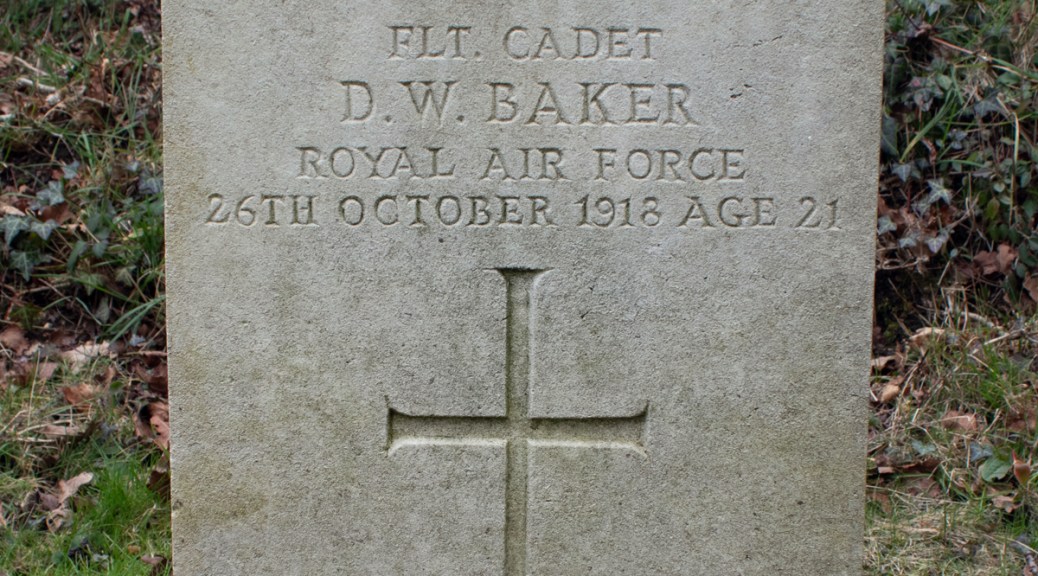
Douglas Walter Baker was born in Newbury, Berkshire, in 1898. One of seven children, his parents were Henry and Rosa Baker. Henry was a commercial traveller for a cornmeal, cake and flour merchants, and the family lived at 91 Crescent Road, Reading at the time of the 1901 census, then at 196 King’s Road, Reading, ten years later.
There is little concrete information about Douglas’ early life. When war broke out, he enlisted in the 4th Battalion of the Royal Berkshire Regiment, later documents seeming to suggest that he had added three years to his age to enable him to do so. His unit served in France from April 1915, but, as his army service records have been lost, it’s unclear when or if Private Baker went with them.
Douglas seemed to want more, though, and, on 18th December 1915, he transferred to the Royal Flying Corps. Given the rank of Air Mechanic 2nd Class, he was attached to No. 1 Aircraft Repair Depot. By March 1917, he had been promoted to Air Mechanic 1st Class. Again, however, he sought more and, just a few months after the Royal Air Force was formed, he started flying lessons.
The now Flight Cadet Baker had transferred to 29 Training Depot Station in Hampshire. Based at an aerodrome near Beaulieu, Douglas was taught in a Sopwith Camel. Two months into his instruction, he was undertaking a routine flight, when his aircraft got into a spin he was unable to get out of. The machine fell to the ground, and Douglas was killed instantly.
A report of the incident noted that: “the cause of the accident was in our opinion due to the machine spinning to the ground from about 500ft. The reason the pilot could not regain control of the machine is unknown.” [Royal Air Force Casualty Card]
Douglas Walter Baker was just 20 years of age when he died on 26th October 1918. His body was taken to the graveyard of St Paul’s Church, East Boldre, not far from the air base at which he had been billeted.
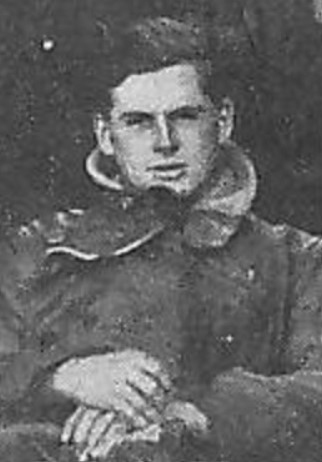
Flight Cadet Douglas Baker (from findagrave.com)
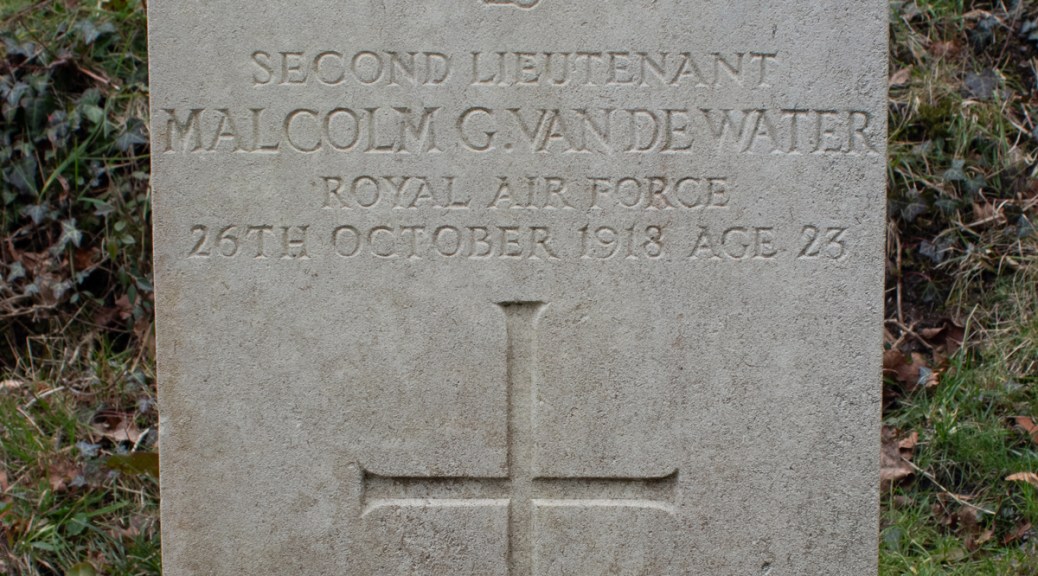
The life of a WW1 pilot was notoriously dangerous. On the same day of Douglas’ death, and at the same airfield, fellow pilot Second Lieutenant Malcolm Vande Water lost his life in a separate incident.
Malcolm Gifford Boggs was born on 14th August 1894 in Brooklyn, New York. The second of four children, his parents were Seth and Anna Boggs. Seth died in 1905, and Anna married again, to widower lawyer Charles Vande Water: her children took his name.
The next record for Malcolm is that of his Royal Flying Corps service records. Interestingly, they note that he enlisted on 10th September 1917, and did so in Toronto, Canada. While the United States had entered the First World War by this point, it may have been easier for him to join via a colonial route.
Malcolm’s papers show that he was 5ft 11ins (1.81cm) tall, and was a student aviator at the time he joined up. He was recorded as being an Air Mechanic 3rd Class, but that came to an end when, on 2nd February 1918, he was accepted for a commission.
Second Lieutenant Vande Water was attached to the 29th Training Depot Station in Hampshire. There is little information about his time there, but a later American newspaper provided details of what happened to him:
Intelligence reaching relatives of Lieutenant Malcolm G Vande Water, of the Royal flying corps, a former Passaic newspaper man, is that he was killed in a fall while testing a new airplane at the British airdrome in Beaulieu, France. Wande Water was the first member of the Pica club to pay the supreme sacrifice. He was on leave in England, after six months’ active service at the front, having operated a machine across the English channel to France on the day before his fatal fall. His machine gun shot off a propellor blade while he was flying 100 feet in the air and the airplane dove to the earth.
[The Morning Call: 17th December 1918]
The accuracy of the information included in the article is variable to say the least. Malcolm may have enlisted in the Royal Flying Corps, but, by the time of the accident on 26th October 1918, that had become the Royal Air Force. The Beaulieu aerodrome mentioned was in Hampshire, not France. The RAF’s records for the incident do confirm, however, that the propellor of his Sopwith Camel was indeed shot through, causing the aircraft to fall to the ground.
Second Lieutenant Vande Water was taken to the Forest Park New Zealand General Hospital in Brockenhurst, Hampshire, for treatment, but his injuries would prove too severe. He died later that day, at the age of 24 years old.
The body of Malcolm Gifford Vande Water was laid to rest in the graveyard of St Paul’s Church in East Boldre, Hampshire, not far from the base he had called home.
The life of a WW1 pilot was notoriously dangerous. On the same day of Malcolm’s death, and at the same airfield, Flight Cadet Douglas Baker was also killed, in a separate incident.
Edward Percival Augustus Topley was born on 6th November 1899 in Woolwich, Kent. He was the third of seven children to Percival and Sarah Topley. Percival was a grocer, and the 1901 census found the family living at 64 Eglinton Road, Plumstead.
Details about Edward’s early life are sketchy. There is a record of him learning to fly at the Cambridge School of Flying, and gaining his wings on 4th November 1917. “…he went through a course at the Royal Naval College, Greenwich. From there he was sent to Beaulieu Aerodrome, Hants…” [Kentish Independent: Friday 15th November 1918]
Edward rose to the rank of Second Lieutenant when the Royal Flying Corps and Royal Naval Air Service merged to become the Royal Air Force on 1st April 1918. Attached to the 29th Depot Training Station, he seems to have built up a fair amount of flying experience.
On 30th October 1918, Second Lieutenant Topley was flying his Sopwith Camel, when the engine stalled, and the aircraft crashed to the ground. Edward was killed instantly. He was a week shy of his nineteenth birthday.
The body of Edward Percival Augustus Topley – “a very promising young officer, and loved by all who knew him” [Kentish Independent: Friday 15th November 1918] – was taken to St Paul’s Church, East Boldre, not far from the base he had begun to call home, and laid to rest.
Second Lieutenant Edward Topley (from britishnewspaperarchive.co.uk)
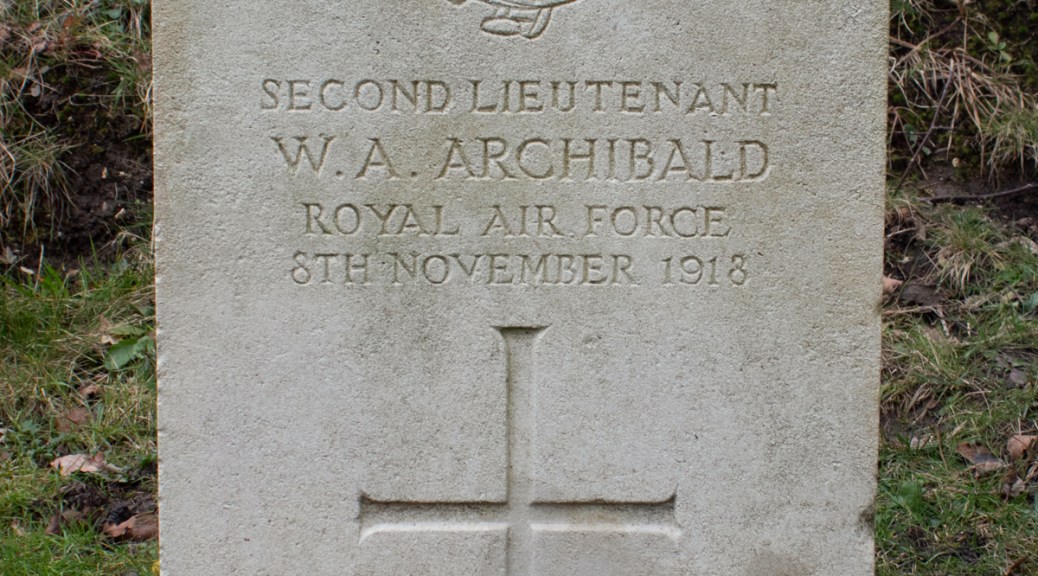
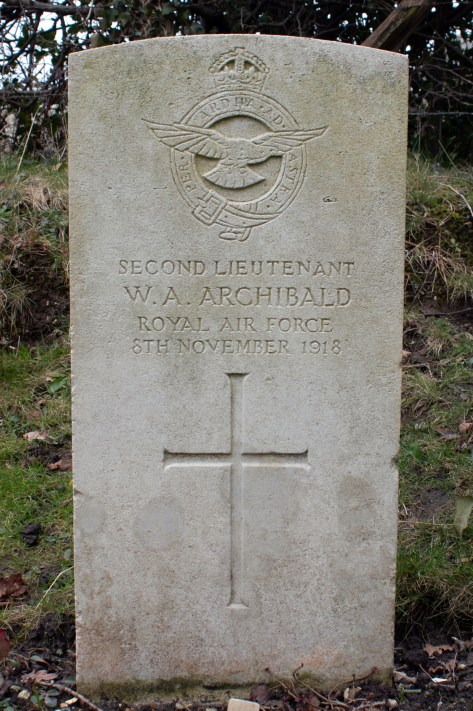
Wesley Alexander Archibald was born in Flatlands, New Brunswick, Canada, on 19th October 1894. The oldest of ten children, his parents were Scottish-born couple James and Jane Archibald. It is unclear what employment James was in, but when he completed his schooling, Wesley found work as a telegraph operator.
When not working, Wesley was an active member of the Irish Fusiliers of Canada, and, by the time was broke out, he had been with the 11th Regiment for a year.
Wesley enlisted in the Canadian Expeditionary Force on 29th November 1915. His service records show that he was 5ft 6.5ins (1.69m) tall, with black hair, brown eyes and a fresh complexion. He was also noted as having a large scar on the outer side of his right thigh.
Private Archibald’s initial training was completed on home soil. His unit – the 121st Battalion – left Halifax on 14th August 1916, and arrived in Liverpool, Lancashire, ten days later. His dedication to the role was clear: his unit moved to Bramshott, Surrey, and he had been promoted to Corporal by the time he arrived there, and Sergeant just two months later.
In January 1917, Wesley was assigned to the 7th Battalion of the Canadian Expeditionary Force and sent to the Front Line. Over the next few months, his unit saw some fierce fighting at Arras, Vimy and Hill 70. On 9th July Sergeant Archibald was awarded the Military Medal for his actions.
By the end of 1917, Wesley was seeking more adventure, and, on 10th December, he transferred to the Royal Flying Corps. Attached to the 29th Training Depot Station, he was based near Beaulieu in Hampshire when the Royal Air Force was created. Over the next year he learnt his new trade and, on 7th November 1918, he was appointed Second Lieutenant.
The following day, Wesley was preparing for a flight in his Sopwith Dolphin. The aircraft took off, but the engine stalled, and the plane crashed. Second Lieutenant Archibald was killed instantly. He was 24 years of age.
The body of William Alexander Archibald was laid to rest in the graveyard of St Paul’s Church in East Boldre, not far for the airfield he had called home.










 Death and Service