Tag Archives: heart

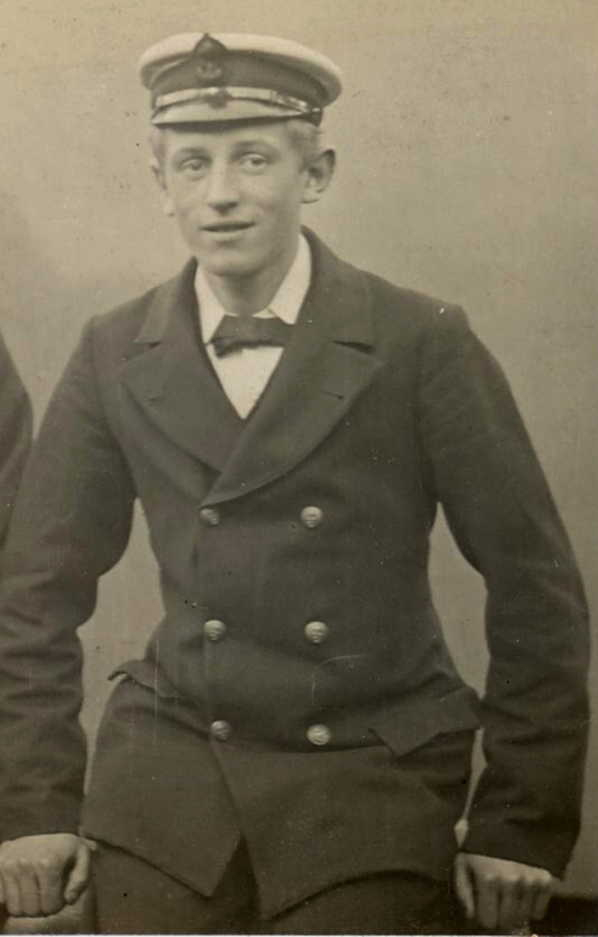
Chief Engine Room Artificer 2nd Class Charles Miller

Artificer Charles Miller

Charles Frederick Caleb Miller was born on 12th December 1887 in Gillingham, Kent. His parents were Charles and Harriet Miller, and he had two younger siblings, Mabel and Harriet.

Tragically, Charles Jr’s mother died when he was only three years old; his father went on to marry again – to his widow’s younger sister, Jane – and the couple had two further children – Jane and Beatrice – who were Charles Jr’s half-sisters.

Charles Sr worked as a ship’s rigger in the Military Dockyard in Chatham, and naval life obviously caught his son’s eye. In 1903, having left school, he enlisted in the Royal Navy, started as a ‘boy artificer’, working in the engine and boiler rooms of ships.

His initial service was for twelve years, and he worked on a number of vessels, as well as being assigned to HMS Pembroke, the shore base in Chatham. He worked his way through the ranks to Engine Room Artificer 2nd Class by 1915.

In June of that year, Charles married Ellen Holden. the daughter of a dairyman from Chelsea. The couple went on to have a daughter, Joan, who was born in 1918. At the time of their wedding, Charles was based on HMS Lance, and his military service was to continue.

His period of service extended until the end of the war, Charles served on a number of other vessels, including HMS Surprise, Blenheim and Prince George and rose to Chief Engine Room Artificer 2nd Class.

It was while he was assigned to HMS Ganges in January 1920 that he became unwell, however. He had contracted bronchial pneumonia, and died of a combination of that and heart failure on 9th February 1920. He was 32 years old.

Charles Frederick Caleb Miller lies at rest in Woodlands Cemetery in his home town of Gillingham, Kent.


Charles Miller (from ancestry.co.uk)

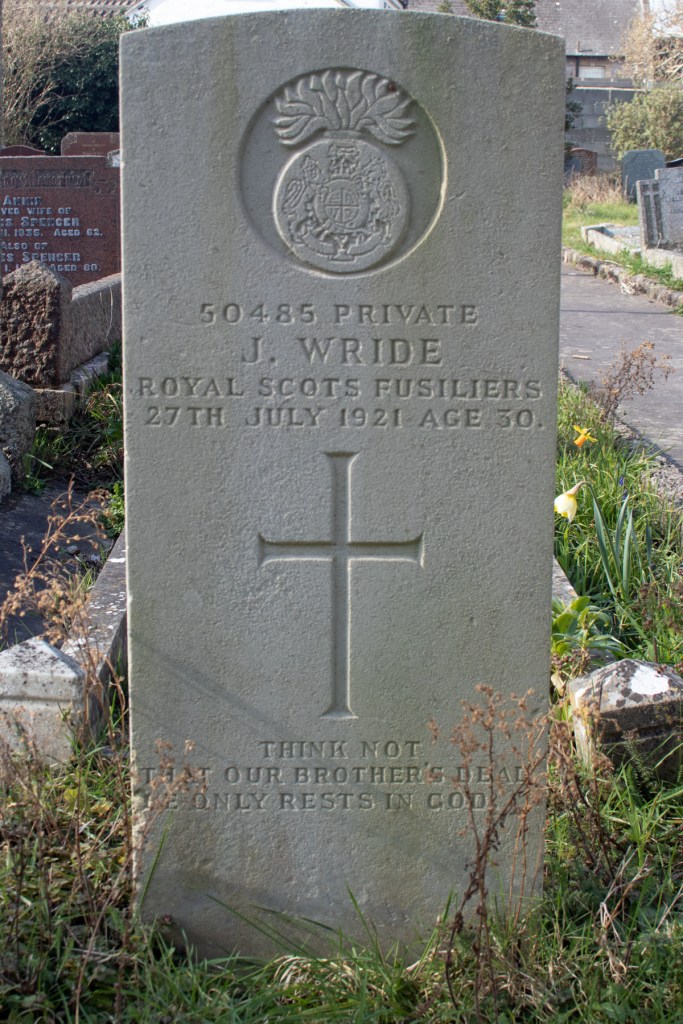
Private John Wride

Private John Wride

John Wride was born in 1891, one of eleven children to William and Kate Wride from Cheddar in Somerset. William stared as an agricultural labourer, but went on to become a market gardener, a trade at least four of his sons, John included, also went into.

Sadly, little of John’s life before the outbreak of war is documented. He enlisted on 12th February 1915, and was assigned to the Royal Scots Fusiliers. There is little information about whether he served abroad, although a number of battalions remained based in the UK.

When he enlisted, Private Wride was noted to have an enlarged thyroid and dental deficiencies. He seems to have suffered with his health during the conflict, and the medical report that accompanied his discharge from the army showed that he suffered from VDH – valvular disease of the heart – although the doctor did not attribute this to his military service.

This decision was appealed, and a subsequent report identified that John’s heart and kidney disease were in fact aggravated by his time in the army. He was medically discharged due to these conditions in February 1919.

By the time of the 1921 census, taken in June that year, John was back home in Cheddar. He was living with his parents and two siblings, and seemed to be working alongside his father in the market garden business. Sadly, however, his heart condition was to prove fatal. He passed away on 27th July 1921, aged 30 years old.

John Wride lies at rest in the Baptist Burial Ground in his home town of Cheddar.


Private Hubert Labdon

Ashcott

Hubert Wilfred Labdon was born in the spring of 1896, to Alfred and Elizabeth Labdon, bakers in Ashcott, Somerset. One of five children, with two older brothers and two older sisters, he lost is mother at a very early age; Elizabeth died in 1901.

Hubert had left home by the time he was fifteen, but had not gone far – the 1911 census found him learning a trade from Edgar and Betsy Vining, farmers in the village.

When war came, Hubert enlisted – he joined up in February 1916, aged 19 years and five months. Private Labdon was initially assigned to the Somerset Light Infantry, but he must have quickly shown aptitude, because he was soon transferred to the Machine Gun Corps. After initial training, he found himself on a ship to France, arriving in Camiers, to the south of Boulonge, on 25th September 1916.

Private Labdon’s military records survive and are quite detailed – after an early mishap, where he was docked two days’ pay for losing part of his kit ‘by neglect’, he also spent time in hospital in June 1917.

By August of that year, he was based permanently at Camiers, where he was acting as a stretcher bearer. This was a role he continued to execute until he was demobbed at the end of the war.

His records show Hubert was granted two periods of leave; it was on the second of these, in November 1918, that he married Eva May Acreman. She was two years his senior, a farmer’s daughter from Ashcott as well, although the couple married in Ealing, London.

By mid-December, Private Labden was back in France, and here he stayed until February 1919, when his unit was finally demobilised. On returning to England, the young couple moved back to Ashcott, to be close to his family.

Sadly, Hubert seems to have succumbed to illness as many of his returning colleagues did. The local newspaper gave details of his passing:

The deceased, who was only 23, was recently married. He had served his country during the late war, part time as stretcher bearer. He had suffered from trench fever, which considerably injured his constitution and left him with a weak heart, which, no doubt, was the cause of death.

He had left his home for a short walk, and having been away rather longer than usual [a] search was made for him, and he was found sitting in an unconscious state. He died in a short time after reaching his home.

Deceased was of a very quiet and inoffensive disposition, and was much respected.

Central Somerset Gazette: Friday 2nd January 1920

While the end result was the same, Private Labdon’s military records adds the cause of death as ‘heart failure following influenza and acute diarrhoea’.

Hubert Wilfred Labdon lies at peace in the graveyard of All Saints’ Church, in his home village of Ashcott in Somerset.


Eva remained in Somerset after her husband’s death. In 1930, she married William Langford, a baker, and the couple went on to have a daughter.