William Gulliford was born on 8th November 1877 in the village of Thurloxton, just to the north of Taunton, Somerset. William’s father – also called William – was an agricultural labourer who, with his wife Charlotte, had nine children in total.
William Jr found work as a labourer for a brewery and, by 1899, had moved to Staffordshire, met and married a local woman called Elsie Sutton. The couple settled down in Burton-on-Trent, and went on to have a daughter, also called Elsie.
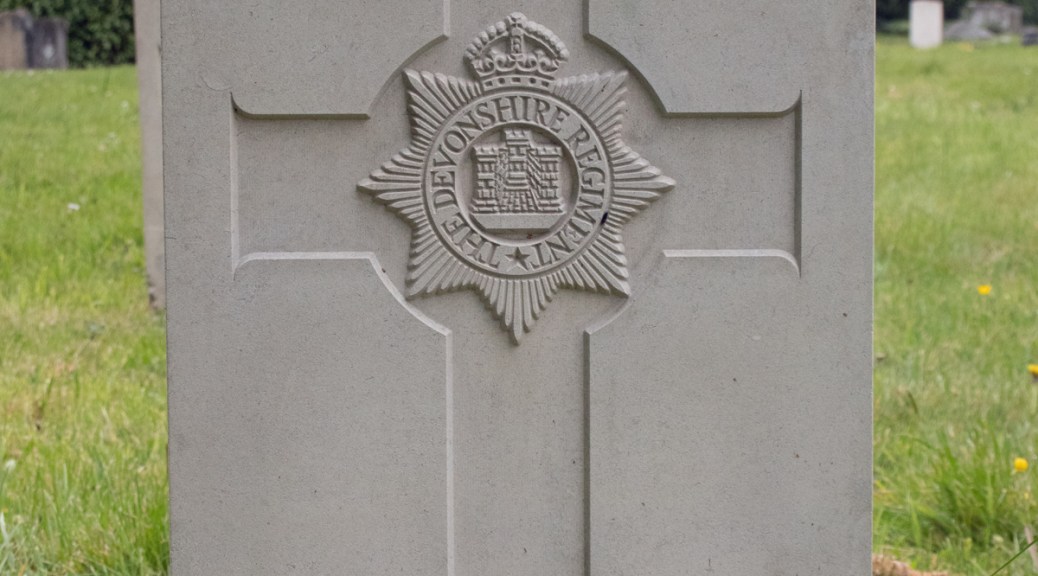
War was coming, however, and, in August 1916, William enlisted. Initially assigned as a Private in the 14th Devonshire Regiment, he was soon moved to the Labour Corps, and within a couple of months was on the Western Front as part of the British Expeditionary Force.
In November 1917, Private Gulliford was shipped back to England, suffering from ill health. He was admitted to the Military Hospital in Taunton with heart failure, and sadly passed away from this a month later. He had just turned 40 years old.
William Gulliford lies at rest in St Mary’s Cemetery in Taunton, Somerset.
Henry Thomas Underhill is one of those people whose lives are lost to time. Details of his early life were difficult to track down, but snippets helped unlock some of the mystery.
In late October 1914, a number of Somerset newspapers gave the following report:
Soldier’s Sudden Death
The West Somerset Coroner held an enquiry at Taunton Barracks on Saturday afternoon relative to the death of Private Henry Thomas Underhill, aged 44, of Street, which took place on Wednesday [14th October 1914].
Deceased was talking to Private TF Davis on a landing in the barracks, when he reeled and, throwing up his arms, fell heavily to the ground, his head striking the floor.
Major Stalkartt, RAMC, was at once summoned, but he found that life was extinct. He afterwards made a post mortem examination, which revealed fatty degeneration of the heart, with a fracture of the bae of the skull. The doctor considered that death was due to heart failure, and that the skull was fractured in falling to the ground.
The deceased was accorded a military funeral at St Mary’s Cemetery the same afternoon. He was an old member of the Somerset Light Infantry, which he recently re-joined on account of the war.
Wells Journal: Friday 23rd October 1914
Private Underhill’s pension record confirms that he was married to a woman called Mary Ann and that the couple had had a daughter, Beatrice Kate Lavinia Underhill, who had been born in December 1906. While searching for Henry directly drew too many variables to provide any certainty, his daughter proved the key to unlock his story.
Henry Thomas Underhill was born in the summer of 1860. One of nine children, his parents were William Underhill and his wife Elizabeth, who was also known as Betsy. William worked as a clerk for a button maker, and the family lived in Birmingham, which, at the time, was in Warwickshire.
When he left school, Henry found work as a ‘brass tube drawer’, making the metal tubes, using a die. He found love too, and, on 13th March 1881, aged just 20, he married Emma Howner. The couple went on to have a son, Ernest, in 1889 although, from the documentation about him, it seems likely that he passed away when only a toddler. Further tragedy was to strike Henry, when Emma also died in 1890, aged just 30 years old.
It may have been around this time that Henry found a focus in military service; he does not appear in the 1891 census and the next set of documentation for him dates from 1900.
It’s at this point that Henry married for a second time. Mary Ann Kelly was seventeen years younger than her new husband, and was the daughter of a carpenter from Solihull. Her father, Michael, had died when she was only a teenager, and she lived with her mother, Lavinia, helping to support her.
Henry’s previous experience with metalwork – and probably his time in the military – found him employment making gun components. The 1901 census finds him and Mary living in Yardley, to the east of Birmingham, with Lavinia and Mary’s younger brother William.
This was obviously a suitable and convenient arrangement; the next census, in 1911, shows the family still living together. By this time, Lavinia was still the head of the household, and shared her home with daughter Mary, Henry and four-year-old Beatrice; son William, his wife Ada and their new-born son, William. Making up the household on Census Day was a visitor, Amy.
War was on the horizon, and this is where we return to the initial news report about Private Underhill. It is likely that Henry had re-enlisted – or at least been called back up – as soon as hostilities broke out. Sadly, his service was not to be a long one, as he suffered the fatal heart attack within a couple of months of the start of the war. Private Underhill was 54 years old at the time of his death.
Henry Thomas Underhill’s body was buried in St Mary’s Cemetery in Taunton, Somerset.
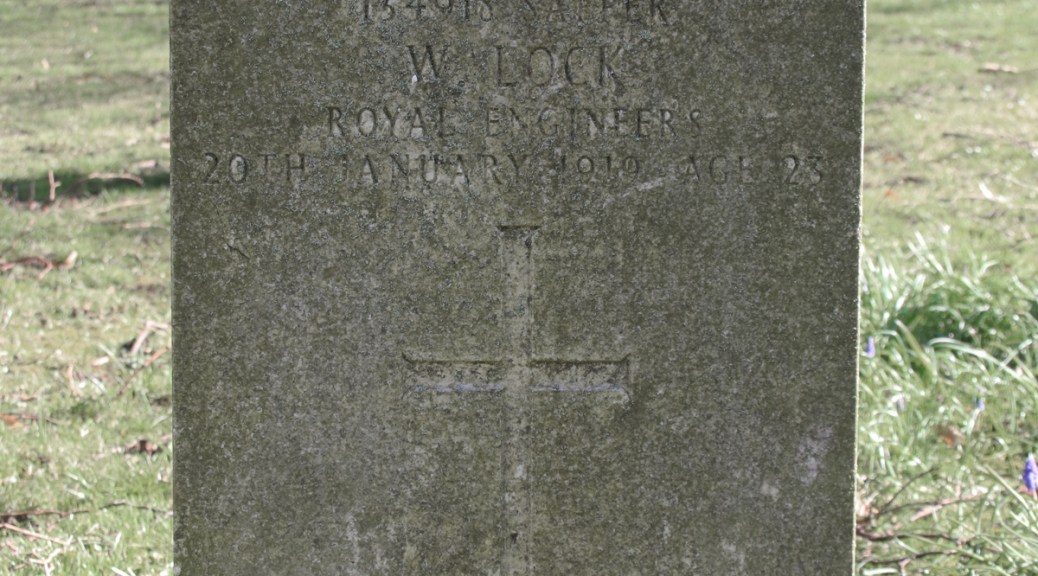
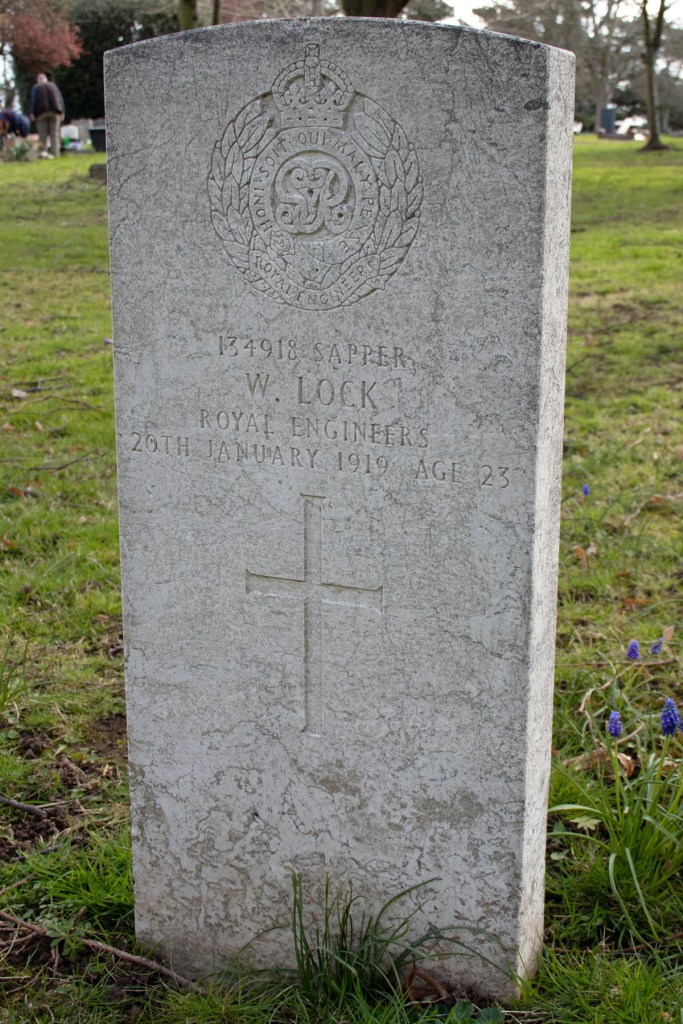
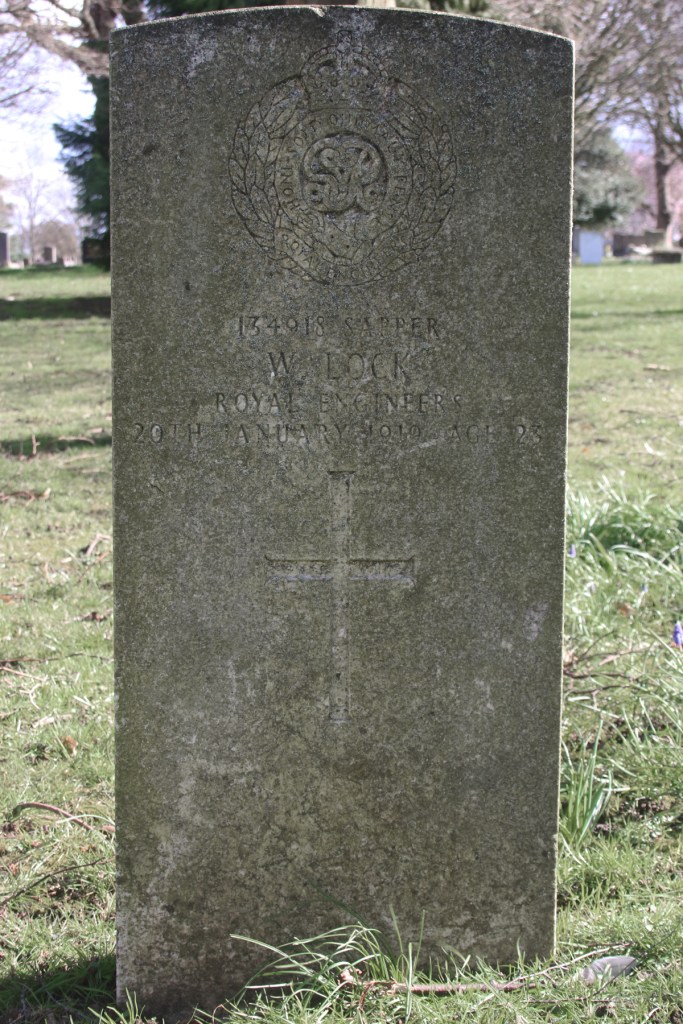
William Lock was born in Devon in 1896, one of three children to Tom and Mary Lock, although sadly only William survived childhood. Tom was a shipwright in on the Devon coast, but brought his young family to Kent, where he found work in the Naval Dockyard in Chatham.
When William left school, he set about finding a trade. By the time of the 1911 census, aged 15, he was listed as “learning house joinery”, presumably a trade for which his father’s work would have stood him in good stead.
War was looming, however, and William enlisted. He joined the Royal Engineers at a time where they were being inundated with volunteers. Sapper Lock was assigned to G Company, a provisional troop that formed part of the Depot Battalion.
Documentation relating to Sapper Lock’s military service are no longer available; he was awarded the Victory and British Medals, which suggests that he saw some kind of service overseas, but there is nothing on file to confirm this.
The next document relating to William is his war pension, which confirms that he died on 20th January 1919 from ulcerated endocarditis, or heart disease. He was just 23 years old.
Tom and Mary had lost the third of their three children.
William Lock was laid to rest in the Woodlands Cemetery in Gillingham, Kent.
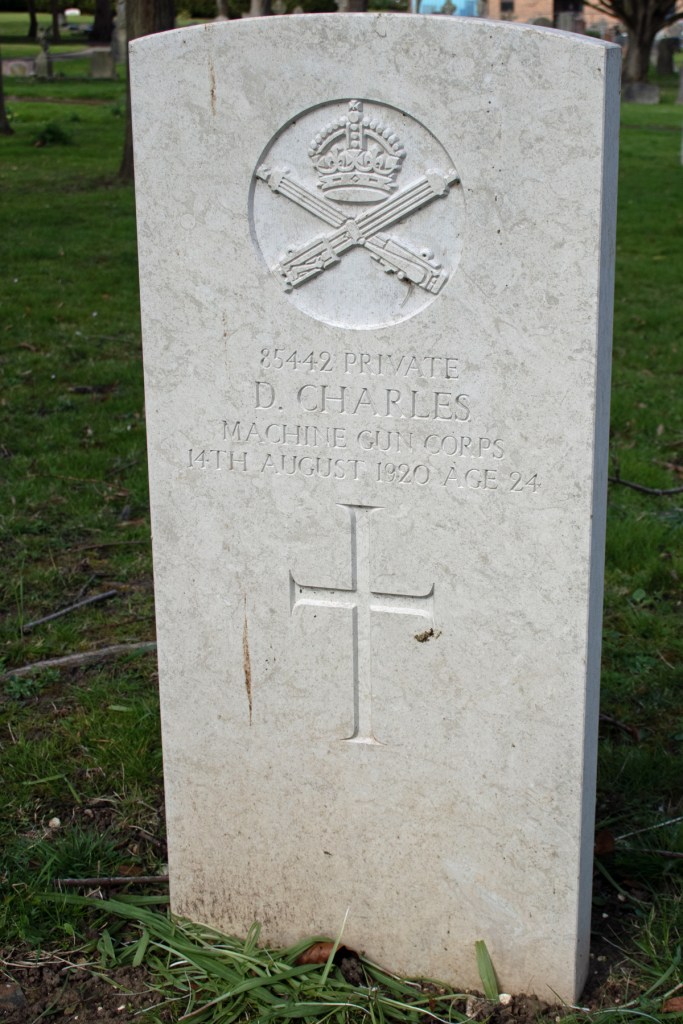
David Charles was born towards the end of 1893 and was one of eight children. His parents – David Sr and Elizabeth Charles – both came from Wales, and moved their young family to Kent in 1891. David Sr worked at a torpedo factory, and the move may have been determined by employment at the Naval Dockyard in Chatham, Kent.
When he left school, David Jr found work at an ironmonger’s, but storm clouds were forming over Europe, and he was soon called up on to do his duty for King and country.
David Jr enlisted in July 1915, joining the 23rd Reserve Battalion. He transferred to the Machine Gun Corps in February 1917 and was posted to the Western Front a month later.
Private Charles was wounded in action on 7th October 1917, although the injury did not prevent him from returning to duty after three weeks’ rest. He was readmitted to hospital on 23rd November, eventually being transferred home on a hospital ship before Christmas.
On 11th January 1918, Private Charles was transferred to No. 5 Battalion in Grantham, where he was promoted to Acting Lance Corporal within a couple of months. Sickness dogged him, however, and he was eventually discharged from military service for medical reasons on 7th August 1920.
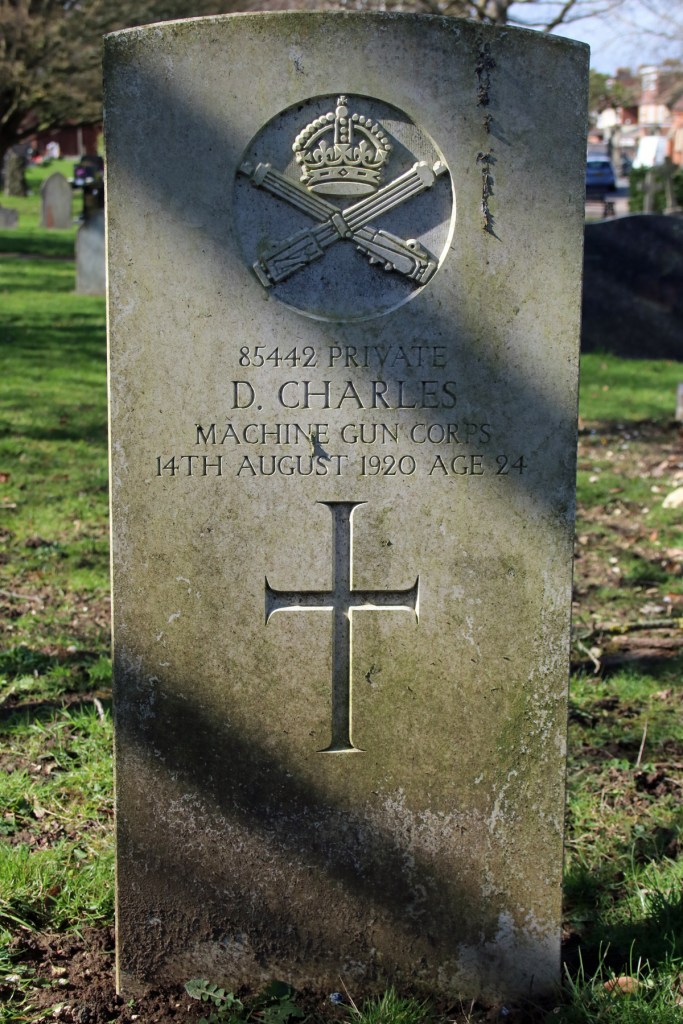
By this time, David had been admitted to Fort Pitt Hospital in Chatham with endocarditis – enlarged heart – and this is where he sadly passed away from the condition just a week after being discharged from the army. He died on 14th August 1920, at the age of 27 years old.
David Charles lies at rest in the Woodlands Cemetery in Gillingham, Kant.
David seems not to have been originally commemorated by the Commonwealth War Graves Commission. I can find no record of why this might have been the case, but this was eventually rectified 10th February 2016, and his name was immediately added to the United Kingdom Book of Remembrance.
The United Kingdom Book of Remembrance commemorates United Kingdom casualties of the two World Wars who were not formerly recorded by the Commonwealth War Graves Commission. The men and women remembered on it are recent additions to the list of war dead and are presently commemorated solely by their database record and register entry.
The register is maintained at the Commonwealth War Graves Commission’s Head Office, Maidenhead, and the names remain recorded there until such time as The Commission has investigated the grave location details.
David’s grave was identified and a headstone now placed in its rightful position.
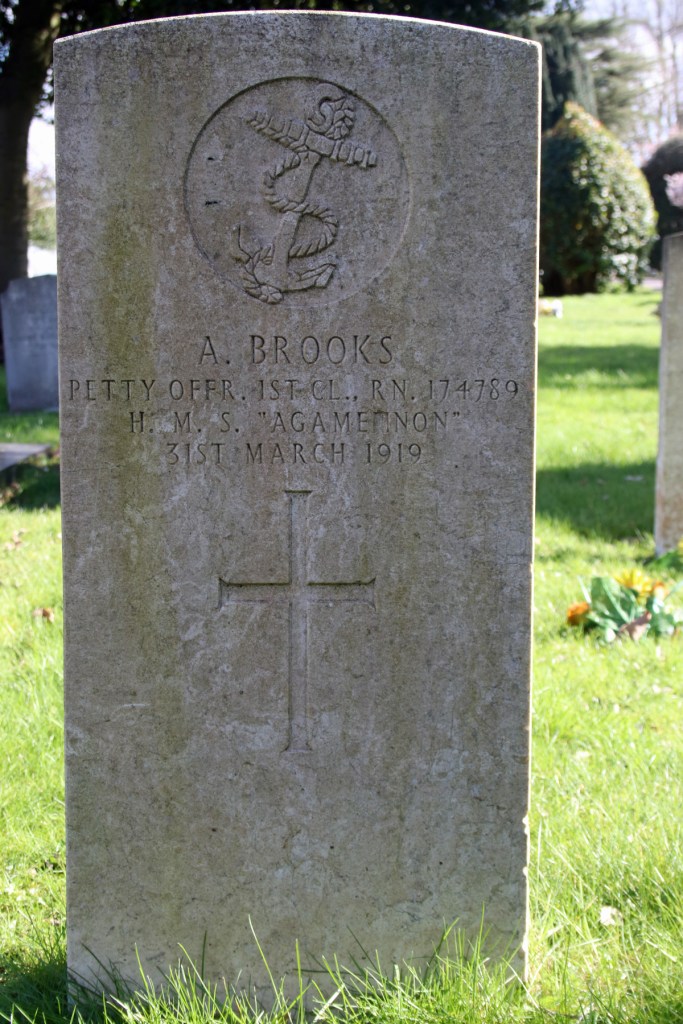
Albert Brooks was born in February 1877 in Cambridge. Sadly, a lot of the documentation for his early life is lost to time, but he enlisted in the Royal Navy in July 1893, at the rank of Boy 2nd Class.
He formally enrolled in naval service in February 1895, initially for a period of twelve years. Beginning as an Ordinary Seaman aboard HMS Thunderer, during his initial time in the navy, he was promoted to Able Seaman and then Petty Officer 2nd Class, while serving on vessels including Hawke, Wildfire, Eclipse and Vernon.
In 1904, Albert married Rosina Wise. A couple of years younger than her new husband, she had been born in Camberwell, South London. The couple had a daughter, Gwendoline, and they set up home in Gillingham, Kent, where Albert was based when not at sea.
War was on the horizon, however, and Petty Officer Brooks’ naval service was extended until the end of the conflict.
Albert was promoted to Petty Officer 1st Class, and continued his service on vessels that included Andromache, London and Hibernia. He transferred to what would be his final ship, HMS Agamemnon, in November 1917.
Petty Officer Brooks served aboard Agamemnon for eighteen months, but it was while stationed at the Naval Dockyard in Chatham that he fell ill. He passed away from aortic disease of the heart – more than likely a heart attack or cardiac arrest – on 31st March 1919. He had just turned 42 years of age.
Albert Brooks lies at rest in the Woodlands Cemetery in Gillingham, Kent.
Ernest George Ware was born in the autumn of 1871 in Marylebone, London. Details of his early life are scant, but records show that he enlisted in the Royal Navy in February 1895, serving as a Stoker for an initial period of twelve years.
During this time, he worked on a number of different vessels – Wildfire, Theseus, Warspite, Amphion, Acheron and Sapphire. He was also based on a number of shore vessels; potentially Southsea in Hampshire and Pembroke in Wales.
In 1905 he married Mary Emery; she was the same age as Ernest, and was born in Hampshire. The young couple had a daughter, Muriel, and, by the time of the 1911 census, the family were living in Pembroke Dock, in South Wales.
War was inching closer, and Stoker Ware’s service was extended for the duration; he served on a number of other vessels – Leander, Blenheim, Blake and Tyne – before being promoted to Chief Stoker on HMS Blonde in 1911. He transferred to HMS St George two years later, before moving on shore to the training vessel HMS Victory II (based in Crystal Palace, South London) in 1915.
Chief Stoker Ware’s health seemed to have been in decline by this point; he was admitted to the Royal Naval Hospital Haslar in Gosport in early 1916, suffering from malignant endocarditis. Sadly, he passed away on 16th February, aged 44 years old.
Ernest George Ware was buried in the Woodlands Cemetery in Gillingham, Kent, close to where his widow was now living.
Charles Frederick Caleb Miller was born on 12th December 1887 in Gillingham, Kent. His parents were Charles and Harriet Miller, and he had two younger siblings, Mabel and Harriet.
Tragically, Charles Jr’s mother died when he was only three years old; his father went on to marry again – to his widow’s younger sister, Jane – and the couple had two further children – Jane and Beatrice – who were Charles Jr’s half-sisters.
Charles Sr worked as a ship’s rigger in the Military Dockyard in Chatham, and naval life obviously caught his son’s eye. In 1903, having left school, he enlisted in the Royal Navy, started as a ‘boy artificer’, working in the engine and boiler rooms of ships.
His initial service was for twelve years, and he worked on a number of vessels, as well as being assigned to HMS Pembroke, the shore base in Chatham. He worked his way through the ranks to Engine Room Artificer 2nd Class by 1915.
In June of that year, Charles married Ellen Holden. the daughter of a dairyman from Chelsea. The couple went on to have a daughter, Joan, who was born in 1918. At the time of their wedding, Charles was based on HMS Lance, and his military service was to continue.
His period of service extended until the end of the war, Charles served on a number of other vessels, including HMS Surprise, Blenheim and Prince George and rose to Chief Engine Room Artificer 2nd Class.
It was while he was assigned to HMS Ganges in January 1920 that he became unwell, however. He had contracted bronchial pneumonia, and died of a combination of that and heart failure on 9th February 1920. He was 32 years old.
Charles Frederick Caleb Miller lies at rest in Woodlands Cemetery in his home town of Gillingham, Kent.
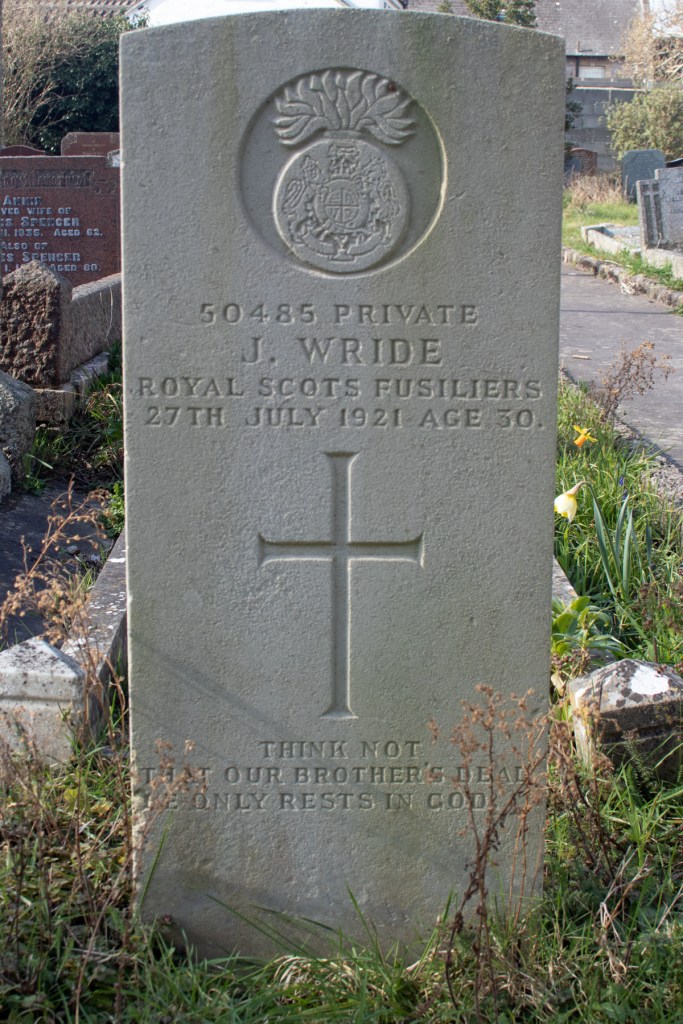
John Wride was born in 1891, one of eleven children to William and Kate Wride from Cheddar in Somerset. William stared as an agricultural labourer, but went on to become a market gardener, a trade at least four of his sons, John included, also went into.
Sadly, little of John’s life before the outbreak of war is documented. He enlisted on 12th February 1915, and was assigned to the Royal Scots Fusiliers. There is little information about whether he served abroad, although a number of battalions remained based in the UK.
When he enlisted, Private Wride was noted to have an enlarged thyroid and dental deficiencies. He seems to have suffered with his health during the conflict, and the medical report that accompanied his discharge from the army showed that he suffered from VDH – valvular disease of the heart – although the doctor did not attribute this to his military service.
This decision was appealed, and a subsequent report identified that John’s heart and kidney disease were in fact aggravated by his time in the army. He was medically discharged due to these conditions in February 1919.
By the time of the 1921 census, taken in June that year, John was back home in Cheddar. He was living with his parents and two siblings, and seemed to be working alongside his father in the market garden business. Sadly, however, his heart condition was to prove fatal. He passed away on 27th July 1921, aged 30 years old.
John Wride lies at rest in the Baptist Burial Ground in his home town of Cheddar.
Hubert Wilfred Labdon was born in the spring of 1896, to Alfred and Elizabeth Labdon, bakers in Ashcott, Somerset. One of five children, with two older brothers and two older sisters, he lost is mother at a very early age; Elizabeth died in 1901.
Hubert had left home by the time he was fifteen, but had not gone far – the 1911 census found him learning a trade from Edgar and Betsy Vining, farmers in the village.
When war came, Hubert enlisted – he joined up in February 1916, aged 19 years and five months. Private Labdon was initially assigned to the Somerset Light Infantry, but he must have quickly shown aptitude, because he was soon transferred to the Machine Gun Corps. After initial training, he found himself on a ship to France, arriving in Camiers, to the south of Boulonge, on 25th September 1916.
Private Labdon’s military records survive and are quite detailed – after an early mishap, where he was docked two days’ pay for losing part of his kit ‘by neglect’, he also spent time in hospital in June 1917.
By August of that year, he was based permanently at Camiers, where he was acting as a stretcher bearer. This was a role he continued to execute until he was demobbed at the end of the war.
His records show Hubert was granted two periods of leave; it was on the second of these, in November 1918, that he married Eva May Acreman. She was two years his senior, a farmer’s daughter from Ashcott as well, although the couple married in Ealing, London.
By mid-December, Private Labden was back in France, and here he stayed until February 1919, when his unit was finally demobilised. On returning to England, the young couple moved back to Ashcott, to be close to his family.
Sadly, Hubert seems to have succumbed to illness as many of his returning colleagues did. The local newspaper gave details of his passing:
The deceased, who was only 23, was recently married. He had served his country during the late war, part time as stretcher bearer. He had suffered from trench fever, which considerably injured his constitution and left him with a weak heart, which, no doubt, was the cause of death.
He had left his home for a short walk, and having been away rather longer than usual [a] search was made for him, and he was found sitting in an unconscious state. He died in a short time after reaching his home.
Deceased was of a very quiet and inoffensive disposition, and was much respected.
Central Somerset Gazette: Friday 2nd January 1920
While the end result was the same, Private Labdon’s military records adds the cause of death as ‘heart failure following influenza and acute diarrhoea’.
Hubert Wilfred Labdon lies at peace in the graveyard of All Saints’ Church, in his home village of Ashcott in Somerset.
Eva remained in Somerset after her husband’s death. In 1930, she married William Langford, a baker, and the couple went on to have a daughter.