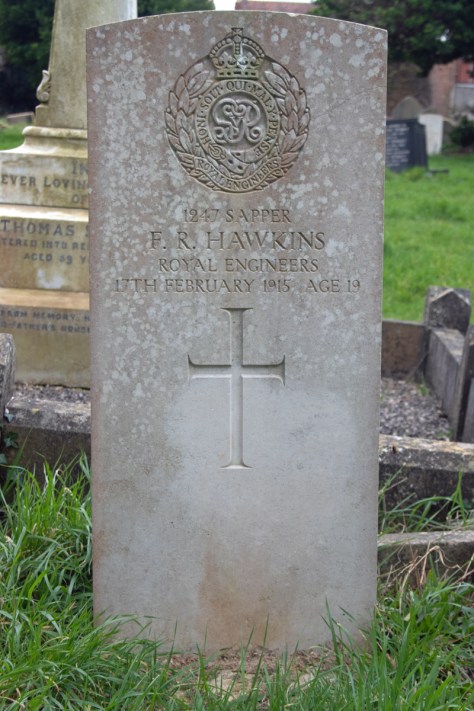
Francis Ralph Hawkins was born in Somerset in March 1895 and was one of twelve children to Charles and Jane Hawkins. Charles was a police sergeant and the family lived in Bishop’s Lydeard, a village to the west of Taunton.
By the time of the 1911 census, Charles had retired from police work, and was operating as a licenced victualler in nearby Bridgwater. While Jane was supporting her husband running the business, Francis was apprenticed to a local clothier.
When war broke out, Francis was quick to enlist – he joined the Royal Engineers, and was appointed a Sapper. He wasn’t with the company for that long, however, as by February he had been admitted to the Red Cross Hospital in Christchurch, Dorset, with a fever.
Sadly, he was not to recover; Sapper Hawkins passed away from spinal meningitis on 17th February 1915. He was just 19 years of age.
Francis Ralph Hawkins lies at rest in the Wembdon Road Cemetery, Bridgwater.
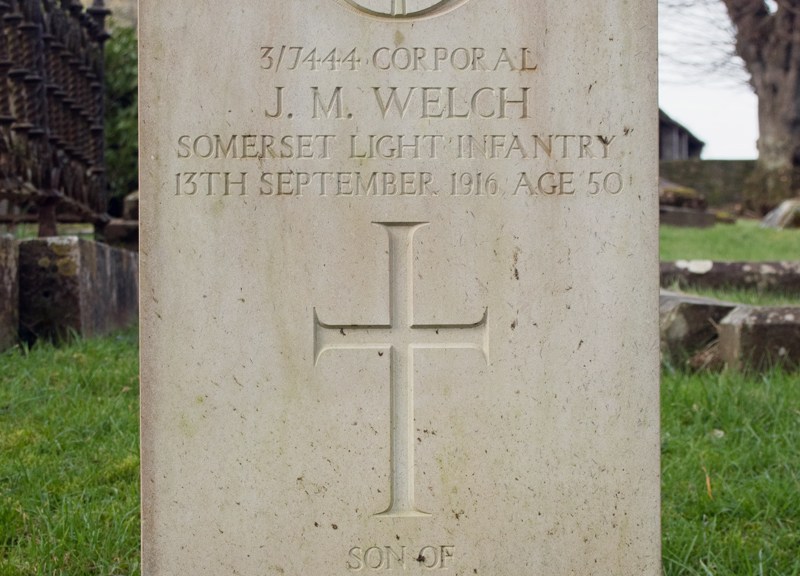
John Milton Welch was born in Yeovil on 19th February 1866, one of five children to William and Anne Welch. William was a chemist by trade, but John’s calling was elsewhere. He became a clerk, initially for a brewery, but by the time of the 1911 census, he was working for a political agency.
In that census, John can be found living with his parents – who were in their 80s by this point – and his two sisters, both school governesses. He is listed as single; although an earlier census suggests he had married a lady from the Isle of Wight called Sarah, I have found nothing to corroborate this, beyond the fact that she had wed a John M Welch, a brewery clerk from Yeovil.
War beckoned and even though he was 48 when the conflict broke out, John enlisted. Private Welch joined the Somerset Light Infantry; his service record no longer exists, but his medal record show that he arrived in France in May 1915, and was subsequently awarded the Victory and British Medals and the 1915 Star. His service obviously warranted promotion, and he was elevated to Corporal.
His troop – the 6th (Service) Battalion – was involved in several of the skirmishes of the Battle of Somme, and it is likely that Corporal Welch was injured during one of these – probably either the Battle of Delville Wood or the Battle of Flers-Courcelette. Wherever it happened, he was shipped back to England, and was treated for his injuries at the Royal Victoria Hospital in Netley, Hampshire
Sadly, Corporal Welch was not to recover; he passed away on 13th September 1916, at the age of 50.
John Milton Welch lies at rest in the graveyard of St James’ Church, in the quiet Somerset village of Milton Clevedon.
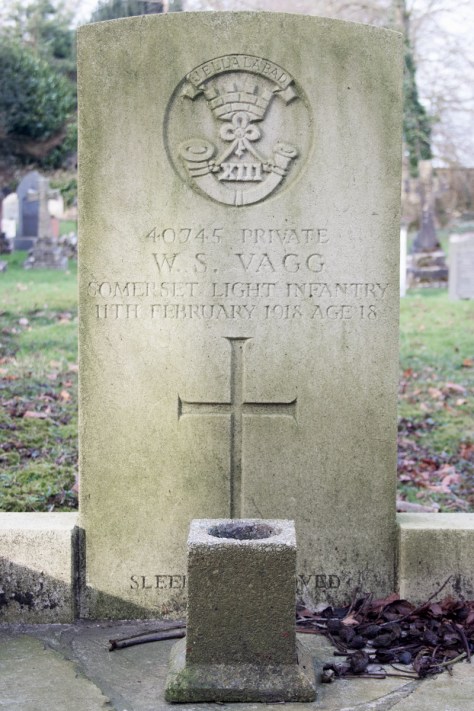
Wilfrid Stanley Vagg was born in 1899 in the Somerset village of Doulting. One of six children, his father Albert was the local blacksmith and innkeeper and he lived with his wife Annie and their family in the Waggon & Horses in the village.
When he left school, Wilfrid was keen to follow in his father’s footsteps; the Oakhill Brewery Company was just up the road from the family pub, and it was here that he found employment as a clerk. When war broke out, however, he must have wanted to do his bet, enlisting in the Somerset Light Infantry when he turned 18.
It may well have been while he was training on Salisbury Plain that Private Vagg became ill. He was treated at the Fargo Military Hospital, situated just to the north of Stonehenge, and was operated on for appendicitis. Sadly, he did not recover, and passed away on 11th February 1918. He was just 18 years of age.
Wilfrid Stanley Vagg lies at rest in the graveyard of St Aldhelm’s Church in his home village of Doulting in Somerset.
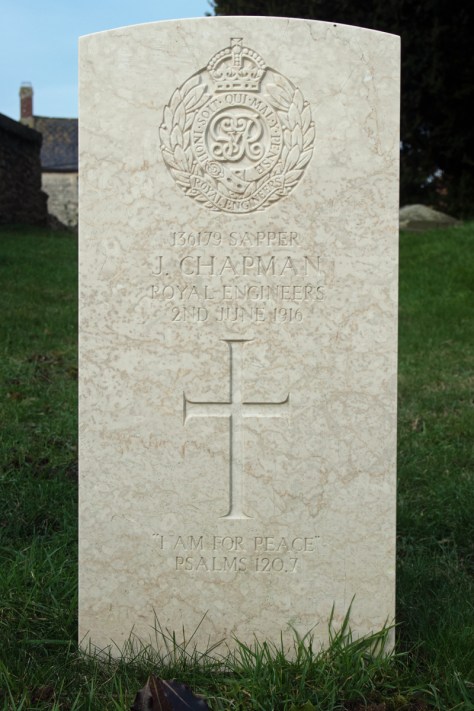
John Chapman was born in October 1892 in the small Somerset village of Ashwick, just to the north of Shepton Mallet. One of five children to Albert and Mary Ann, John followed his father into mining, and, by the time of the 1911 census, he was listed as a coal mining hewer.
In November 1914, he married Louisa Elizabeth Perkins from Shepton Mallet. The war had begun by this point, and before the couple had even been married a year, John had enlisted.
His background made him ideal for the Royal Engineers, and soon Sapper Chapman was bound for France with the British Expeditionary Force. He seems to have been abroad for around six months, and was shipped back to England at the end of April 1916.
John was admitted to a military hospital in Brockenhurst, Hampshire, with bronchial pneumonia, and this is what he succumbed to a matter of weeks later. He died on 2nd June 1916, at the age of 23 years old.
John Chapman is buried in the village of Croscombe, Somerset, where his widow now lived.
An additional tragedy to the loss of this young life is that Louisa was pregnant at this point. The birth of their daughter, Selina, was registered between April and June 1916, and, while I have been unable to pinpoint an exact date of birth for her, it is likely that John never got to see his daughter.
Edward Lionel Gane was born in 1899 and was one of eight children. Known as Lionel, he was the son of Edwin and Joanna Gane, and lived in the quiet Somerset village of Ditcheat. Edwin began life as a pig dealer, but by the time of the 1911 census, had changed direction and become an insurance agent.
Joanna passed away in 1915, and this may have been the impetus Lionel needed to find his way in the world. He enlisted in the Wiltshire Regiment, joining the 3rd (Reserve) Battalion of the Duke of Edinburgh’s brigade.
The battalion – a depot and training unit – were initially based in Devizes, before moving to Dorset and then Kent. While there is no confirmation of when Private Gane enlisted, it would have been by September 1917, which is when the battalion became part of the Thames & Medway Garrison.
The end of the war marked another ending for the Gane family. Edwin passed away on Armistice Day – 11th November – and further tragedy was to follow, as Private Gane contracted influenza and died less than two weeks later.
Edward Lionel Gane died in a military hospital in Malling, Kent, on 24th November 1918. He was just 19 years old. He lies at rest in the graveyard of St Mary’s Church in his home village of Ditcheat.
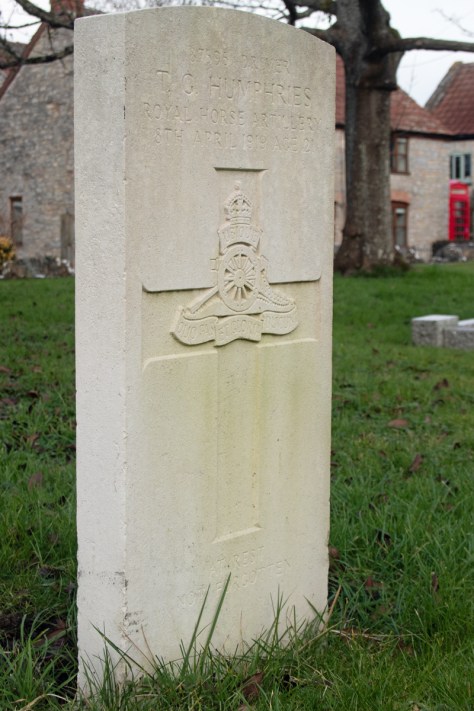
Thomas George Edward Humphries was born in November 1897, one of six children to George and Annie Humphries, from North Wootton in Somerset. George was a farm labourer, and had been married to his wife for 19 years before her untimely death in at the age of 40.
When war came, Thomas was just 16 years old. He enlisted quickly, though, joining the Royal Horse Artillery as early as the summer of 1915. Driver Humphries joined the 120 Brigade of the Royal Field Artillery, which was one of the many Howitzer brigades moving the large long-barrelled field guns along the front line.
Given the high use of horses during the way, and that Thomas was a Driver, it is likely that his role would have been guiding the animals in his care – this may also account for why his gravestone gives his troop as the Royal Horse Artillery.
Little remains of Thomas’ service records; he was awarded the Victory and British Medals and well as the 1915 Star, so would have been in the thick of the fighting and seen action on the Western Front.
When it comes to his passing, again details are scant. His pension records simply state that he died of ‘disease’, and he passed in the military hospital in Southwark, South London. Again, given when he died and the lack of any contemporary media report on his passing, it seems likely that the cause was a lung condition – influenza, pneumonia or tuberculosis – but that is a presumption on my part,
Whatever the cause, Driver Humphries died on 8th April 1919, aged just 21 years old.
Thomas George Edward Humphries lies at rest in the quiet graveyard of St Peter’s Church in his home village of North Wootton.
Ernest Edward Hector was born in 1875, one of six children – all boys – to Thomas and Mary Hector. Thomas was a farm labourer, and this was a trade Ernest and his brothers all followed their father in.
Ernest was keen for a better life, however, and enlisted in the Somerset Light Infantry in May 1896, aged 21. After initial training and service in England, Private Hector was off to the East Indies, arriving there just after Christmas 1897.
Six years abroad followed, after which Ernest returned to England to serve another four years. He completed the 12 years of his military career in May 1908.
By this point, Ernest had married Eliza Humphries, a young lady seven years his junior, who came from his home village of North Wootton in Somerset. The couple went on to have six children and, by the time of the 1911 census, Ernest had settled his family in West Pennard, near Glastonbury, and was working as a farm labourer.
Ernest’s service during the Great War remains tantalisingly hidden. Given that he was 39 when hostilities broke out, it is unlikely that he was called up again straight away; his gravestone confirms that he was assigned to the Machine Gun Corps (Infantry), but research on his service number provides little other detail.
There is nothing in the media of the time reporting on his death or funeral either, so no concrete cause of death can be confirmed. All that is known is that Private Hector died on 9th May 1920, aged 45 years old.
Ernest Edward Hector is buried in the graveyard of St Peter’s Church in North Wootton.
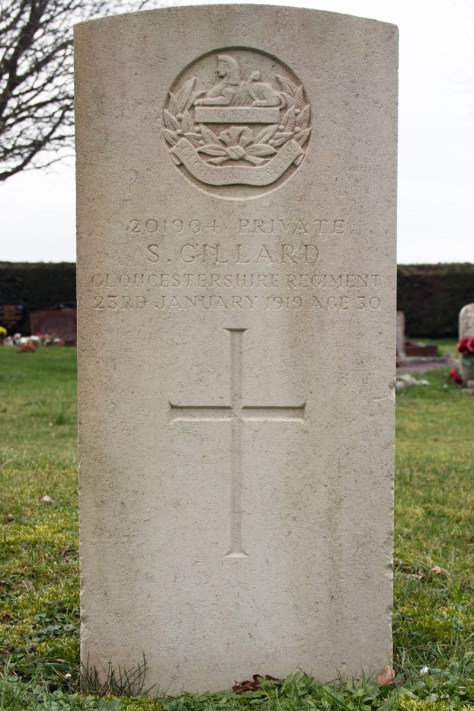
Sydney Gillard was born in October 1888, one of eight children to Charles and Lily. Charles was a stonemason, and this is the trade that Sydney and his older brother Harry also followed.
When war broke out, he enlisted in the Gloucestershire Regiment; Private Gillard’s troop, the 1/4th (City of Bristol) Battalion, were initially based in Swindon, before moving to Maldon in Essex. They were posted to France in March 1915, eventually being shipped to Italy in November 1917.
While Sydney’s military records do not confirm when he enlisted or where he served, that he saw fighting is beyond any doubt because his war pension records confirm that he died from his wounds.
Sydney Gillard passed away on 23rd January 1919, at the age of 31. He lies at rest in the cemetery of his home village of Othery, Somerset.
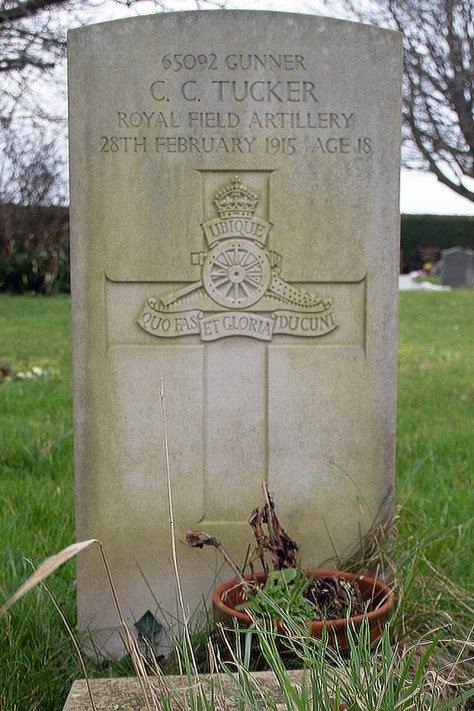
Clifford Charles Tucker was born in 1896, one of five children to John and Ellen Tucker. John was a shoemaker in the Somerset village of Othery, while Clifford became a farm labourer when he left school.
There is little documented of Clifford’s life, and what I have been able to identify about his military career has come from a newspaper article.
Much regret is felt in Othery at the new of the death of Clifford Tucker, one of the young fellows who volunteered for the service of their King and Country. Deceased, who was only 18 years of age… enlisted in the Royal Artillery about six weeks ago and was stationed at Brighton.
He was taken ill with pneumonia and died, his father arriving in time to see him before he breathed his last.
Taunton Courier and Western Advertiser: Wednesday 17th March 1915.
Gunner Tucker passed away on 28th February 1915, aged just 18 years old.
He lies at rest in the cemetery of his home village of Othery.
Walter George Crook was born in 1900, one of thirteen children to William – a gardener – and Elizabeth Crook from Shepton Mallet in Somerset.
When he left school, Walter worked as a printer for the town’s newspaper and, by the time of the 1911 census, he was living with his family in a six-roomed house in the middle of the town.
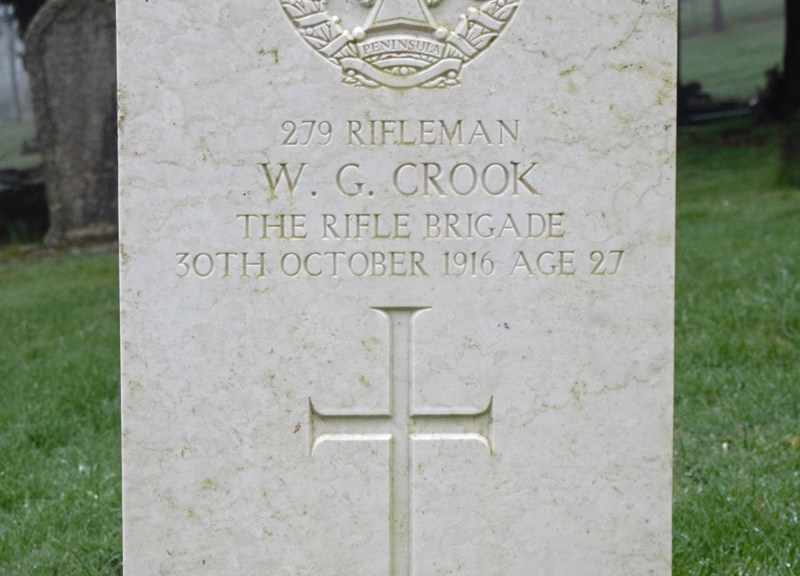
Walter moved on from the Shepton Mallet Journal, and found employment at the Hare and Hounds Hotel in the town. War was coming, however, and he enlisted in the 22nd (Wessex and Welsh) Battalion of the Rifle Brigade.
Rifleman Crook was stationed with his battalion in Salonica, Greece, and it was while he was here that he suffered a cerebral tumour. He was invalided home, and treated in the Royal Victoria Hospital in Netley, Hampshire. Sadly, he lost his fight, passing away on 30th October 1916, aged just 27 years old.
Walter George Crook lies at rest in the cemetery of his home town of Shepton Mallet.
Walter’s brother Gordon is also buried in Shepton Mallet Cemetery – read his story here.
A third brother, Bertie, was also gave his life in the Great War. The local newspaper had given a touching report on his death in April 1916.
Bertie Crook left school at the age of 13, and went into service with Mrs Dickinson at Whitstone, as a stable lad. He was there a year and then, on account of Mrs Dickinson giving up horses and leaving the town, they recommended him to Lord Derby’s stables at Newmarket, under the Hon. G Lambton. Small as he was, Bertie Crook undertook the railway journey alone, with a label in his buttonhole. He served five years apprenticeship, which expired at the beginning of October [1915]. He then tried to join the Royal Field Artillery, but not being tall enough he joined a West country regiment on the 20th October, and left Tidworth Barracks for France in the early part of January. He was in his 21st year, having been born on the 29th July. 1895.
The Hon. George Lambton writes “I was terribly shocked and grieved to hear of the death of your boy… Mrs Lambton and I send our deepest sympathy… I always liked your boy so much when he was in my stable; and I felt sure that with his quiet and courageous character he would make a good soldier. I shall have a plate put up in the stable in memento of his glorious death.”
Shepton Mallet Journal: Friday 21st April 1916
Lance Corporal Bertram Stanley Crook is buried at the 13th London Graveyard in Lavantie, France.










 Death and Service