Tag Archives: history

Private Nelson Pitman

Private Nelson Pitman

Nelson Victor Pitman was born in April 1890, the fourth of eight children to George Pitman and Amy Roles Pitman (née Treasure). George was a butcher’s assistant, and the family lived in their home town of Sherborne in Dorset.

As with a number of the other servicemen I have been researching, Nelson’s military records are sparse, probably lost to time. He is not listed as living with his parents on the 1911 census and, in fact, is nowhere to be found.

On 2nd January 1915, Nelson marries Alice Moores at the parish church (Sherborne Abbey). His profession is listed as soldier, so we know that, but this point in the war, he had enlisted.

While there are no records of Private Pitman’s service, his battalion, the 1st Royal Warwickshire Regiment was involved in a number of the key battles of the war, including the second Ypres, Arras and Passchendaele. The battalion was also involved in the Christmas Truce, so there is a slight chance that Nelson played football with his German counterparts in one of the defining moments of the Great War.

Private Pitman survived the war to end all wars, but was discharged on 22nd February 1919 with a disability. He was suffering from bronchitis, and steadily went downhill.

Private Nelson Pitman passed away eighteen months later, on 21st November 1920. He was 31 years old.

He lies at rest in Sherborne Cemetery.
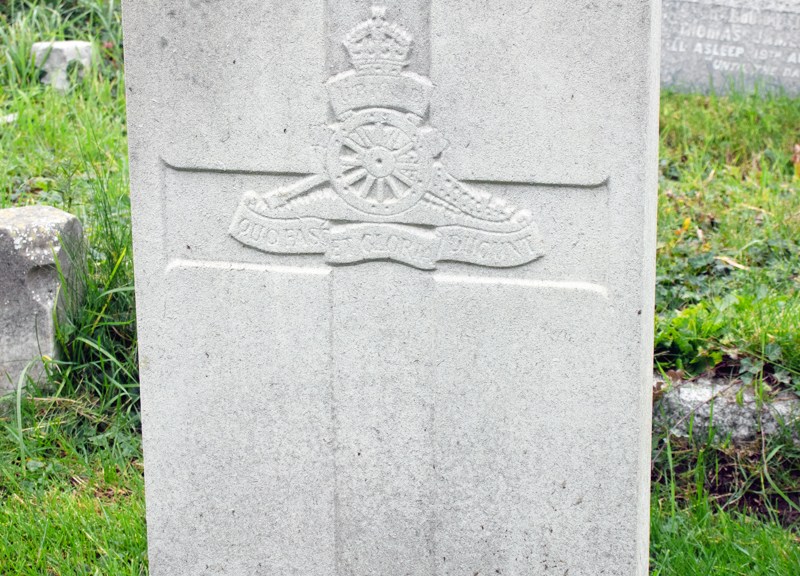
Gunner Thomas Holloway

Gunner Thomas Holloway

Thomas Charles Holloway was born in Chatham, Kent in 1893. The fourth of five children, his parents were Joseph, a domestic coachman, and Caroline Holloway.

By the time of the 1911 census, Thomas had left school and was working in a corn warehouse.

Thomas presented a bit of a challenge when I was researching his history.

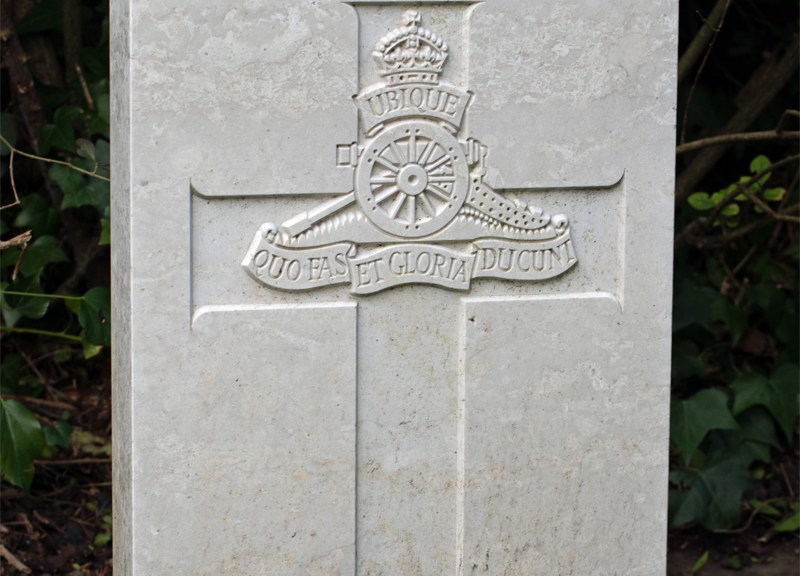
His military records show that he enlisted on 31st December 1914, signing up to the Royal Field Artillery. However, Gunner Holloway’s service records show that he was posted on 9th January 1915, before being discharged as medically unfit just a week later. The records confirm that he served for 16 days.

The medical attestation states that he was discharged because of cardiac dilation and hypertrophy, a systolic murmur and dyspnoea, all heart-related conditions.

Despite only serving for just over a fortnight, he was afforded a Commonwealth War Grave when he died.

Searching the local newspapers of the time, a bigger story was unveiled.

The death of Bombardier Thomas Holloway, aged 24, of the RFA… occurred in a hospital at Cambridge. He was kicked by a horse in the course of his training, nearly two years ago, and had practically been on the sick list ever since. On recovering from the effects of the accident, he was seized with spotted fever at Seal, and ultimately succumbed to paralysis of the brain.

East Kent Gazette: Saturday 21st July 1917

The discrepancies between the original discharge and the newspaper report are intriguing. Either way, this was a young life cut far too short: he was 24 years old.

Gunner Thomas Holloway lies at rest in St Margaret’s Churchyard, in his home town of Rainham in Kent.

Air Mechanic Reuben Hadlow

Air Mechanic Reuben Hadlow

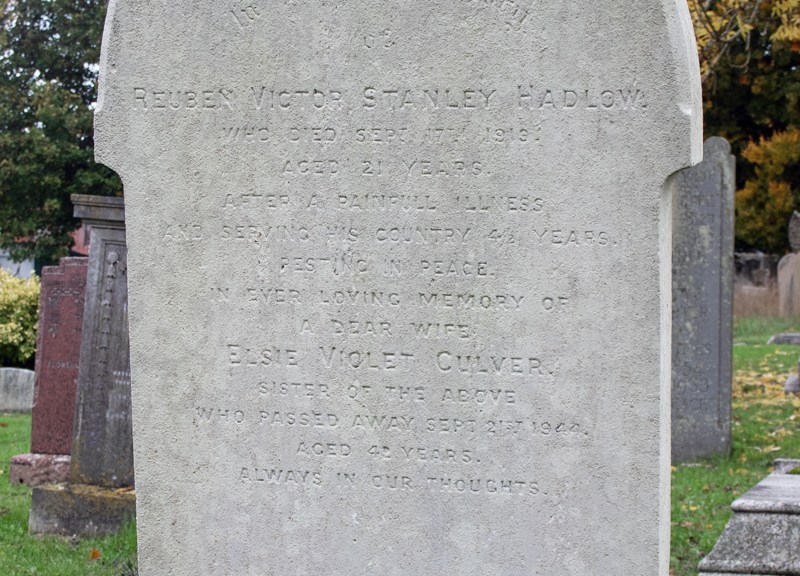
Reuben Victor Stanley Hadlow was born in the spring of 1898. He was one of thirteen children to John Charles Tarpe Hadlow and his wife Gertrude, publicans at the Star pub in Whitstable, Kent.

When war broke out, Reuben was working as a blacksmith; he enlisted in the army in the summer of 1914, serving on the home front.

In February 1916 Private Hadlow transferred to the Royal Flying Corps as a Air Mechanic 2nd Class, and was assigned to the 65 Training Squadron in Croydon. He was promoted to Air Mechanic 1st Class six months later.

When the RFC became the Royal Air Force, Air Mechanic Hadlow moved across to the new institution. He moved to support 156 Squadron in November 1918, then the 35 Training Depot Station shortly after.

Air Mechanic Hadlow contracted phthisis (tuberculosis) towards the end of that year, which led to his being discharged from the RAF on 22nd January 1919.

Reuben’s health did not recover after returning home – his parents were running the King’s Arms pub in Boxley near Maidstone by this point. He passed away on 17th September 1919, aged twenty-one.

He lies at rest in the churchyard of St Mary and All Saints, in his parent’s village.

Poignantly, his gravestone is not a traditional war grave. Instead it states that he died “after a painful illness and serving his country 4 1/2 years”.

Lance Corporal William Larkin

Lance Corporal William Larkin

William Larkin was born in 1863, the eldest son of Alfred and Frances Larkin from Cranbrook in Kent.

He disappears off the radar for a few censuses – there are too many variations on his surname to identify exactly where he was on the 1881 and 1891 documents.

From later documents, however, we can identify that he married Eliza in around 1886; the couple had no children. By the 1901 censes the couple were living to the north of Maidstone; ten years later, they were running the Fox & Goose pub in Weavering, Kent.

Private Larkin’s military service is also lacking in documentation, but some information can be pieced together.

Originally enlisting in the Royal West Kent Regiment, he (was) transferred over to the Royal Defence Corps, and served on home soil.

On Sunday 2nd April 1916, Lance Corporal Larkin was on guard at a gunpowder factory in Faversham, Kent. As the Ministry of Munitions reported at the time:

During the weekend a serious fire broke out in a powder factory in Kent, which led to a series of explosions in the works.

The fire, which was purely accidental, was discovered at midday and the last of the explosions took place shortly after two in the afternoon.

The approximate number of casualties is 200.

Thanet Advertiser: Saturday 8th April 1916.

William was not killed during the Faversham Explosion, but Boxley Parish Council (who covered the Weavering area) carried out research on the names on the village war memorial. According to that research, William “developed cancer after the ‘Faversham Powder Works’ explosion”. He died two months later, on 8th July 1916. He was 53 years of age.

Lance Corporal William Larkin lies at rest in the graveyard of St Mary & All Saints Church in Boxley, Kent.


More details of the Faversham Explosion, along with the servicemen who died there, can be found here.

Gunner Thomas Kelly

Gunner Thomas Kelly

It is often a challenge to find details of the fallen soldiers whose graves pepper the churchyards of the UK.

Sadly, Gunner Thomas Kelly is one of those names lost to time.

Born in 1893, he lived in Alsager, Cheshire and enlisted in the Royal Field Artillery. He served in the Balkans during the war and was wounded. Brought back home to the Yeatman Hospital in Sherborne, Dorset, he died of his wounds on 11th January 1918.

He was buried in the town’s cemetery on 16th January 1918; he was just 25.

Lance Corporal Charles Stubbles

Charles Frederick Stubbles was born in Tottenham in 1892. One of eleven children to Richard and Mary Ann Stubbles, by the time of the 1911 census, the family were living in Edmonton. Charlie and his brother had found employment painting gas stoves, while his father was a building foreman.

Charles enlisted in the army in 1916, aged 25 years and 11 months. His service records show that he stood at 5ft 2ins, weighed in at 69lbs; his health was classified as C2 – Free from serious organic diseases, able to stand service in garrisons at home, able to walk 5 miles, see and hear sufficiently for ordinary purposes.

Joining the Labour Corps of the West Surrey Regiment, Private Stubbles initially served on the home front, before being transferred to France as part of the British Expeditionary Force in March 1917.

Charlie seems to have been a bit of a character and was pulled up a few times during his service. On 10th April, he was charged with “committing a nuisance in the barrack room”, for which he was confined to camp for eight days. On 21st August he went AWOL for nearly a day; he was docked eight days’ pay. On 28th October he appeared unshaven and dirty for the 7:15am parade; he was confined to barracks for seven days.

On 4th January 1918, Charles was admitted to a field hospital with diarrhoea; while there he was diagnosed with tuberculosis; he succumbed to this two days later, dying on 7th January 1918. He was 26 years old.

Lance Corporal Charles Stubbles is buried at the Haringhe Bandaghem Military Cemetery in Poperinge, Belgium.


Charles Frederick Stubbles was my great grandmother Lillian’s younger brother.

Rifleman Harold Shelbrooke

Harold Edward Shelbrooke was born in Poplar, East London, the eldest son of Edward and Jane. One of seven children, Harold lost his father – a labourer in the local gasworks – when he was only eight.

To support his mother – most of his sisters having moved on – he soon found employment as an umbrella maker, and by the 1911 census he had worked his way up to the position of warehouseman.

In July 1915, he married Alice Pulley; six months later their son, George was born. The young family had moved south of the Thames by now, and were living in Greenwich.

Private Shelbrooke’s military records are pretty sparse; he enlisted after marrying Alice – their Banns show him as an umbrella maker – and served in the King’s Royal Rifles.

He saw battle on the Western Front and was involved in the Battle of Menin Road Ridge at Ypres. Harold’s military documents record him as wounded and missing on the day of that battle – 20th September 1917 – and he was officially declared dead on 9th November that year. He was 33-years-old.

Private Shelbrooke had lost his father at the age of eight; his son, George, was not even two years old.

Private Harold Shelbrooke is commemorated at the Tyne Cot memorial in Zonnebeke, Belgium.

Harold Edward Shelbrooke was my first cousin, three times removed.

Private Frank Woods

Frank Ernest Woods was born in 1885, one of seven children to Thomas and Alice. Thomas was a labourer and he raised his family in Worcestershire.

Frank left home early – by the time of the 1901 census, he was living as a gardener for the Cornforth family, who were grain merchants in South Claines, near Worcester.

Frank’s work with the family continued; the 1911 census show that they had relocated to Kensington. The Cornforth family were now running the Eaton Court Hotel, a boarding house with nineteen rooms; the 25-year-old Frank had been elevated to the role of waiter.

Another of the Cornforths’ staff was a housemaid, 20-year-old Ethel Elizabeth James; within a matter of years, the couple were courting, and Frank and Ethel married in November 1915.

The Great War was already being waged across the Channel, and Frank enlisted, joining the Rifle Brigade in June 1916. Within three months, he was fighting on the Western Front.

Private Frank Woods was killed in action in Belgium on 10th October 1918. He was 33 years old. He is remembered on the Tyne Cot Memorial in Zonnebeke.


Frank Ernest Woods was the first husband of my Great Great Great Aunt, Ethel Elizabeth James.

Corporal Sidney Hornby

This image has an empty alt attribute; its file name is photo-01-11-2020-12-01-50-e1605266325697.jpg

Sidney Horace Hornby was born to John and Emily in March 1880. John was a tailor’s assistant from Paddington, and the family – Sidney was the eldest of six siblings – initially lived in the Greenwich.

Sidney enlisted in the army in 1898. He joined the East Kent Regiment for a short service of seven years and was sent to South Africa. In March 1900 he was wounded at the Battle of Driefontein. His service, though, saw him promoted through the ranks from Private to Sergeant.

Something must have happened during his enlistment, however, as on 2nd September 1901 Sergeant Hornby’s military record marks him as having deserted.

Sidney’s records pick him up again on 24th April 1908, when he is put on court martial. Found guilty of desertion, he is reduced to the ranks and sentenced to three years’ penal servitude (later reduced to two years’ hard labour).

His attitude seems to continue, however, as within a matter of months he was discharged due to misconduct and denied any pension for his previous service.

Sidney’s family had moved from Greenwich to Kent at some point before the 1901 census, and his father died three years later. By the 1911 census, he had moved back in with his mother, and worked as a labourer to help look after them.

The Great War called, however, and it seems that Sidney’s previous misdemeanours did not excluding him from fighting again. He joined the Royal West Kent Regiment although his full service for the 1914-18 campaign are not accessible. Again, his service seems to have been good, as he was elevated to the rank of Sergeant for a second time.

Hints of Sergeant Hornby’s rebellious nature remain, however, as he was court marshalled again in February 1916. He was convicted of drunkenness, and reduced to the rank of Corporal.

That was the summer of the Battle of the Somme, and by the autumn Hornby was one of the many who fell during that time. He died on 4th October 1916 and was 36 years old.

Corporal Sidney Hornby is commemorated on the Thiepval Memorial.


Sidney Horace Hornby was my 1st cousin, four times removed.

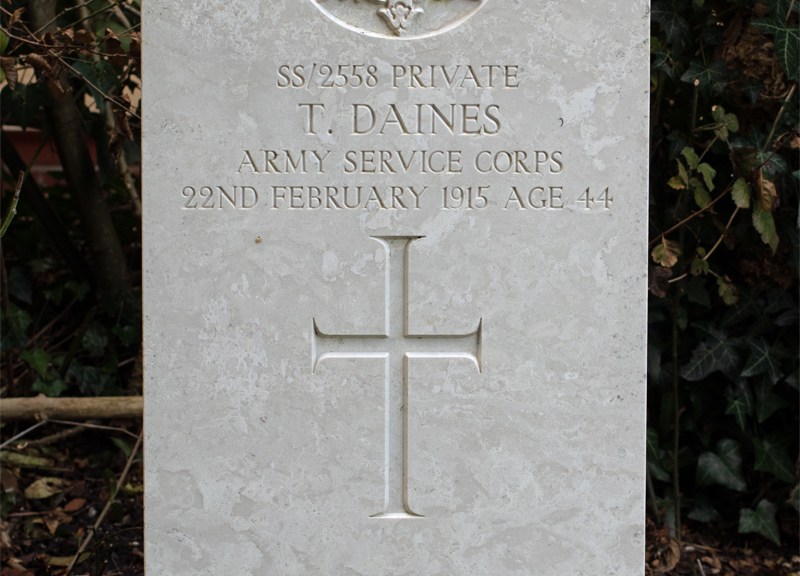
Private Thomas Daines

Private Thomas Daines

Born in 1871, Thomas Daines was one of fourteen children. His parents, Charles and Sarah, worked on a farm a few miles from Halstead in Essex.

After leaving school, Thomas followed in his father’s footsteps and, by the time of the 1891 census was also listed as an agricultural labourer. He married Kate Rawlinson in the spring of 1893, and they had two children – Matilda and Lewis – before relocating to South East London in around 1898.

The reason for the move was, more than like, job opportunities, and Thomas was soon working at the Royal Arsenal in Woolwich.

Settling into their new city life, Thomas and Kate had five further children: Annie, Thomas, Alfred, Charles and Beatrice. Thomas continued as a labourer, before enlisting in the army within three months of war being declared in October 1914.

Sadly, Private Daines’ service was not to be a long one. Having suffered a bout of influenza, Thomas was admitted to a Red Cross Hospital in Sherborne, Dorset. He died of pneumonia on 22nd February 2015.

Private Thomas Daines lies at peace in the Sherborne Cemetery.


As a sad aside to Thomas and Kate’s story, their eldest son, Lewis, enlisted in the 16th Battalion of the Lancashire Fusiliers. He fought on the Western Front, and was killed in action in Pozières on 26th March 1918.

The Great War had claimed both father and son.