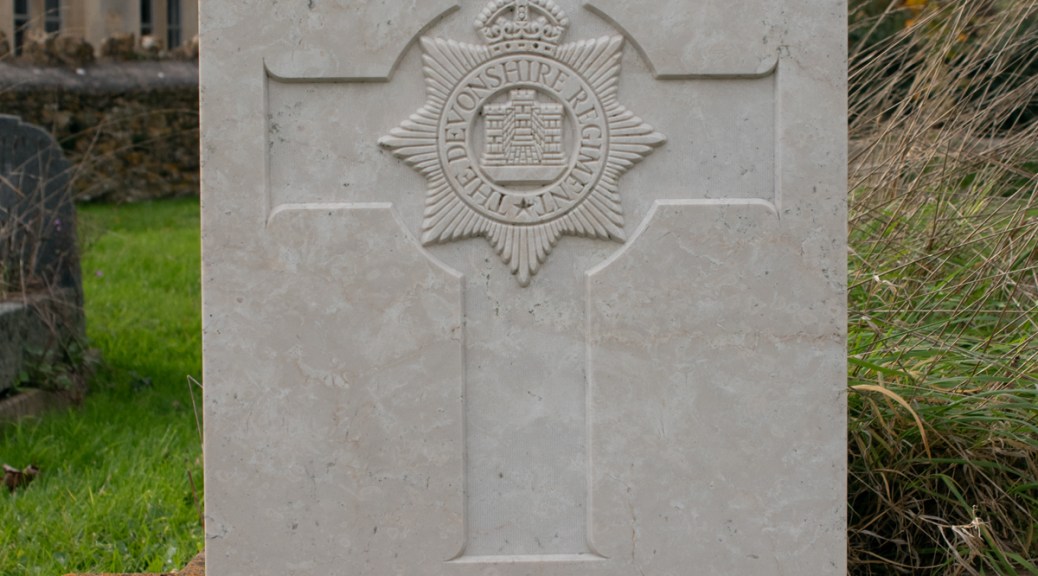
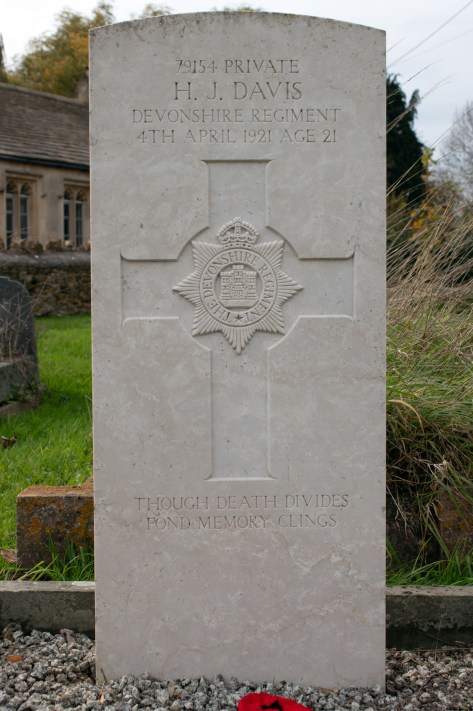
Henry John Davis was born in the village of Broughton Gifford, Wiltshire, in December 1899. The middle of nine children, his parents were John and Annie Davis. John was a cowman, and he worked for the Chalfield estate, not far from the village.
After the 1911 census, Henry’s life is a challenge to piece together. When war broke out, he was too young to serve his country, but it is clear that he enlisted in the Devonshire Regiment at some point. As a Private, he was assigned to the 52nd (Graduated) Battalion, and was based in Norfolk during the second half of the conflict.
By the spring of 1918 Private Davis’ unit was in France, although there is no evidence that Henry was there himself. All that can be confirmed is that he was medically discharged from the army on 26th March 1920, as he was suffering from adenitis, a swelling of the lymph nodes in the abdomen.
Henry John Davis passed away on 4th April 1921, at the age of 21 years old. He seems to have died at home, although the exact cause of his passing is not known. He was laid to rest in Holt Old Cemetery, not far from where his family were living.
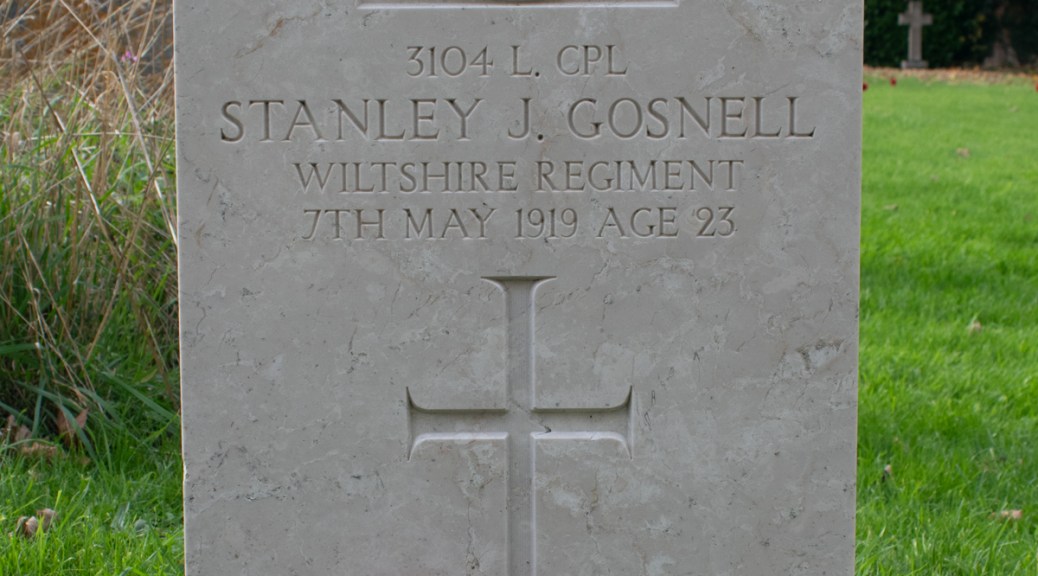
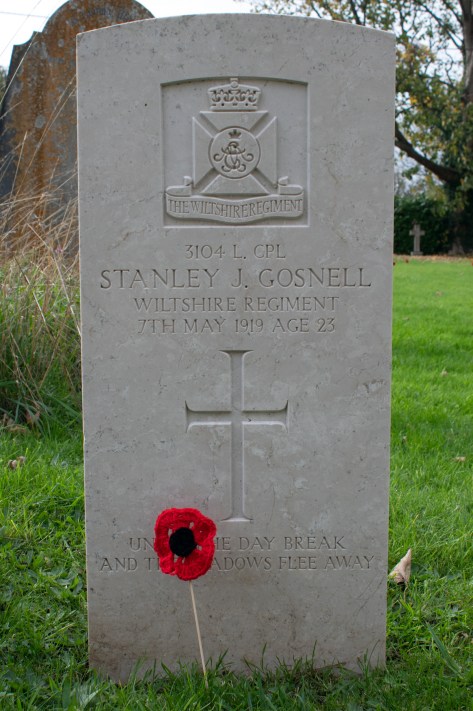
Joseph Roger Stanley Gosnell was born in Birmingham, Warwickshire, in the autumn of 1895. He wad the only child to William and Florence Gosnell. William was a draughtsman, who died when his son was just 4 years old.
Florence was left to raise her son on her own and moved back to Bradford-on-Avon, Wiltshire, where her family lived. On 14th April 1903, she remarried, her new husband being head teacher of Holt Congregational School, John Longstaff. The 1911 census found the family living at Eglington Villa, not far from the school.
When war broke out, Joseph was quick to step up and play his part. Now going by Stanley, he enlisted in the Wiltshire Regiment on 17th September 1914, and was assigned to the 4th Battalion. His service papers show that he was 5ft 11ins (1.8m) tall, with brown hair, blue eyes and a fair complexion. He was noted as having normal vision and good physical development.
Private Gosnell seemed to impress his superiors, and, on 12th December 1914, he was promoted Lance Corporal. The following day his unit was dispatched oversees, and he was sent to India. He would go on to spend the next eight months in Pune, but not in the way he might have hoped.
On 27th February 1915, Stanley was admitted to hospital, suffering from pneumonia. He would remain admitted for nearly three months. Sent back to his unit in mid-May, he was taken back into hospital just three weeks later with tuberculosis. This time, he would only be there for three weeks before being sent back to his unit.
Lance Corporal Gosnell was sent back to Britain in August 1915, and he would remain on home soil for the next year. During this time his health deteriorated, to the point that, no 25th August 1916, he was medically discharged from the army.
At this point, Stanley’s trail goes cold, and it is only a later newspaper report that confirms what happened:
Mrs Longstaff, of Eglington Villa, who a short time since was called upon to mourn the loss of her husband, Mr JC Longstaff, was on Wednesday further bereaved by the death of her only son, Mr Stanley Gosnell. Mr Gosnell’s constitution was never of the most robust kind, and though he volunteered for service and proceeded to India with the Territorials, he was unable to withstand the climate and the work entailed, and was invalided home. His death so soon after reaching manhood’s estate is a heavy blow to his mother and the utmost sympathy will go out to her in her irreparable loss.
[Wiltshire Times and Trowbridge Advertiser: Saturday 10th May 1919]
Details of John’s passing are unclear, but he died just a few months before his stepson. Joseph Roger Stanley Gosnell was just 23 when he died on 7th May 1919. He was laid to rest in Holt Old Cemetery, not far from where his twice-grieving mother lived.
Florence had now been widowed twice, on top of losing her only child. She found some solace in her grief, however, and, in the autumn of 1923, she married for a third time. Her new husband, Joseph Scarisbrick, was a widow thirteen years her senior, and worked as a customs and excise man.
Joseph died in 1938, at the age of 85: Florence had outlived all three of her husbands. She passed away on 4th October 1954, at the age of 88 years old.
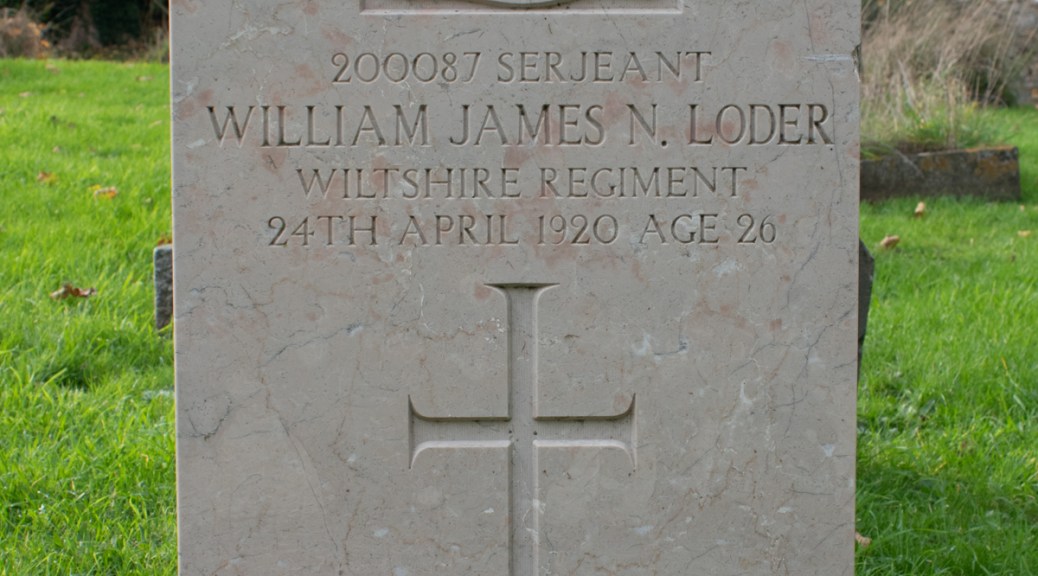
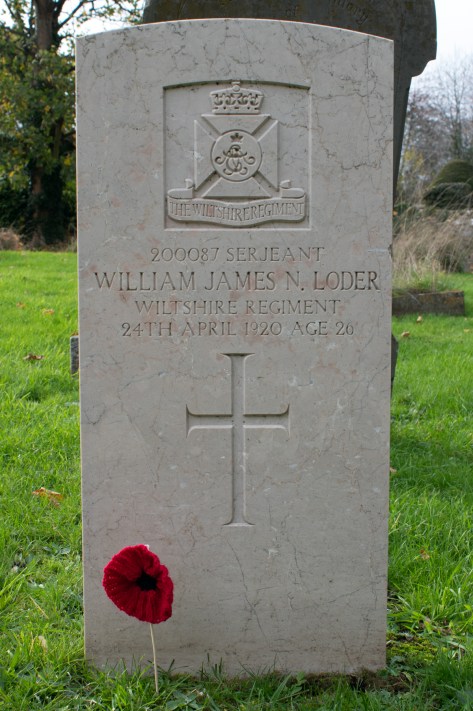
William James Nelson Loder was born in the summer of 1893 in Trowbridge, Wiltshire. The oldest of seven children, his parents were Harry and Rosina. Harry was an engineer at a wool mill, and his son obviously followed in his father’s practical footsteps: the 1911 census found him employed as a coach builder’s apprentice.
The document found the Loder family living at 1 Canal Road, a five-roomed cottage on the outskirts of town. Alongside Harry and his son, William’s younger sister, Ethel was also working as an apprentice dress maker.
Away from work, it seems that William also joined the local militia, with a later document showing that he enlisted in the Wiltshire Regiment on 4th February 1909. When war broke out, he was called upon to play his part. He was assigned to the 4th Battalion, and was sent to India in September 1914. While his service papers have been lost to time, it is clear that he rose to the rank of Serjeant, but by the start of 1917, he was back in Britain.
On 27th January 1917, William married Angelin Gliddon. She was a coachman’s daughter from Holt, Wiltshire, and was working as a draper’s assistant when she and her husband exchanged vows.
William’s health was failing by this point and, on 21st May 1917, he was formally discharged from the army on medical grounds. His trail goes cold as this point, and it is only three years later that documents confirm his passing. He died on 24th April 1920 at the age of 26 years old.
The body of William James Nelson Loder was laid to rest in Holt Old Cemetery, not far from where his grieving wife still lived.
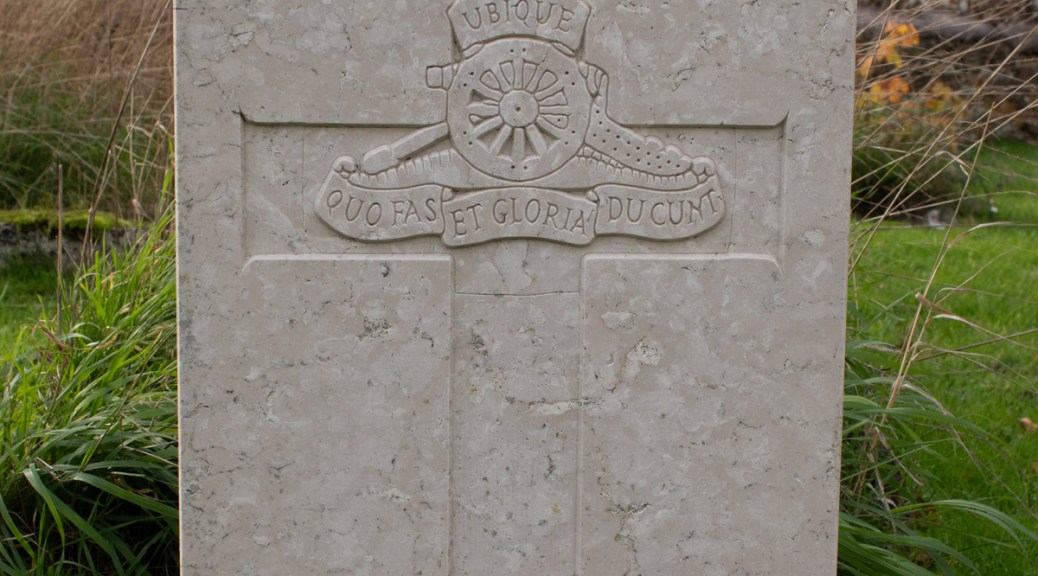
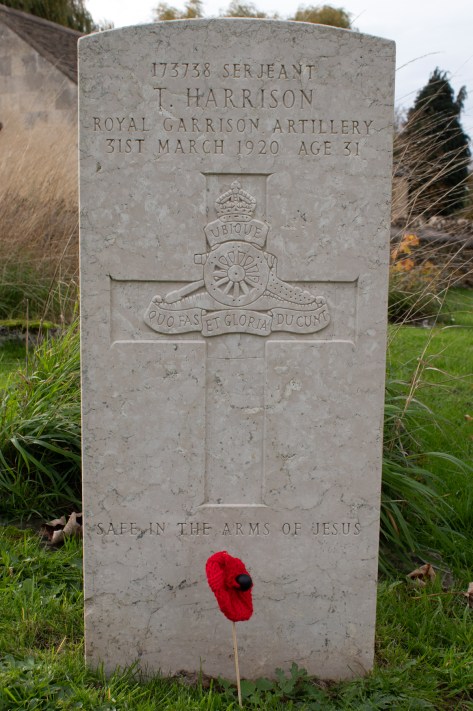
The life of Thomas Harrison, buried in Holt Old Cemetery, Wiltshire, is a challenge to unpick. No service papers remain, but the Commonwealth War Graves Commission note that he was married to Annie Harrison, who lived in Trowbridge, Wiltshire.
The couple do not appear together in the 1911 census, so it is likely that they exchanged vows after this date. There is a Thomas Harrison recorded in the return: he was an Acting Bombardier in the Royal Horse Artillery, billeted in the barracks in Trowbridge. It is likely that he is the gentleman buried in Holt Cemetery, but it cannot be confirmed either way.
Acting Bombardier Harrison was born in Motherwell, Lanarkshire, in around 1889, but his name is not uncommon, so it is not possible to identify his parents or early life.
Thomas served during the First World War, rising to the rank of Serjeant in the Anti-Aircraft Depot of the Royal Garrison Artillery. He and Annie had two children: Vera, who was born in 1912, and Ivy, who was four years younger.
When the Armistice was declared, Serjeant Harrison returned home, but, in the spring of 1920, he suffered a bout of gastritis. The condition was to prove fatal, and he passed away on 31st March 1920. He was 31 years of age.
The body of Thomas Harrison was laid to rest in Holt Old Cemetery, not far from where Annie and the girls lived.
Joseph Arthur Barnes was born in the spring of 1887, and was the youngest of four children to George and Hannah Barnes. George was a farm labourer from Longbridge Deverill, Wiltshire, and this is where he and Hannah – or Anna – raised their family.
When he completed his schooling, Joseph found work as a horseman on the farm, alongside his older brother, George. On 30th July 1913, he married Minnie Ring, a furniture maker’s daughter from the village. The couple exchanged vows in the parish church.
War was on the horizon, and a little over a year after their marriage, Joseph stepped up to play his part. He joined the Wiltshire Regiment and was assigned to the 3rd Battalion. Private Barnes was sent to Dorset for training, but his time in the army would not be a lengthy one.
Joseph contracted pneumonia, and was admitted to hospital in Weymouth. The condition would provide to severe, however, and he passed away on 9th April 1915: he was 27 years of age.
The body of Joseph Arthur Barnes was taken back to Wiltshire for burial: he was laid to rest in the tranquil surrounds of St Peter & St Paul’s Church, Longbridge Deverill.
Joseph’s brother George also served in the First World War. Assigned to the 1st Battalion of the Wiltshire Regiment, he served on the Western Front. Private Barnes was killed in action on 5th August 1917, at the age of 33. He is commemorated on the Menin Gate.
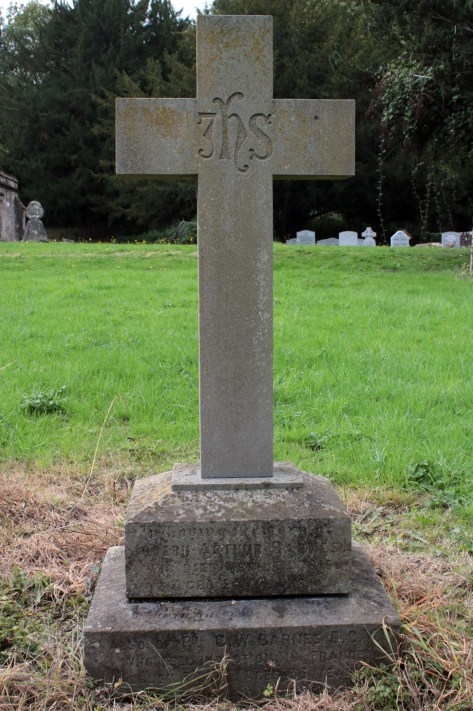
Frederick Cook was born in the Wiltshire village of South Wraxall in the spring of 1866. One of five children to James and Ann Cook, his father died when Frederick was just a toddler. The 1871 census found Ann and her children living in Bradford-on-Avon, where she was working as a farm labourer.
By 1881, Frederick had left school and found work as a cloth weaver. That year’s census found him living on Church Lane, Bradford-on-Avon with his mother and younger brother.
At this point Frederick disappears from the records. The next document relating to him is his wedding certificate, noting that he exchanged vows on 5th August 1895. His new wife was widow Ruth Doel, and the marriage took place in Holy Trinity Church, Heywood, Wiltshire, where she was living. Frederick was noted as being a labourer.
Frederick falls off the radar again and this point. He is noticeable by his absence from the 1901 census, Ruth living in Haywood with her son, Ernest. The next return helps to explain things, however, as, while she is now living alone, her husband is boarding in Pyle, Glamorgan, where he was employed as a limestone quarryman.
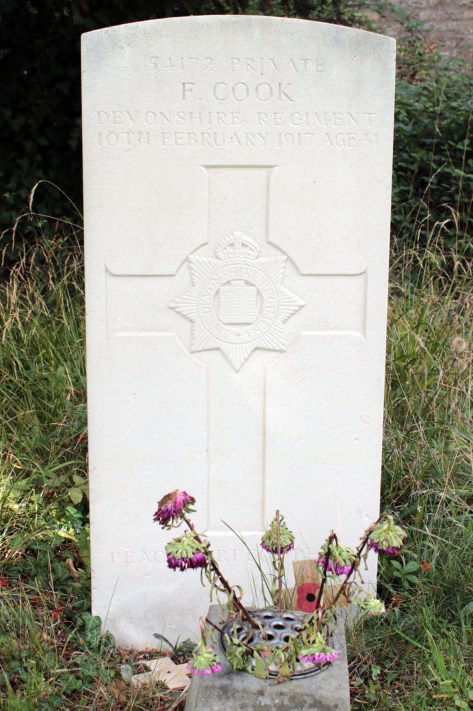
By the time war broke out, Frederick as 48 years old. He still stepped up to play his part, however, and, while his service papers have been lost to time, it is clear that he had joined the Devonshire Regiment by the summer of 1916. Attached to the 13th (Works) Battalion, Private Cook remained on home soil during his time with the army.
The next record for Frederick is that confirming his passing. He died from pneumonia on 10th February 1917, having previously been admitted to hospital. He was 51 years of age.
The body of Frederick Cook was laid to rest in Holy Trinity Churchyard, Heywood, Wiltshire.
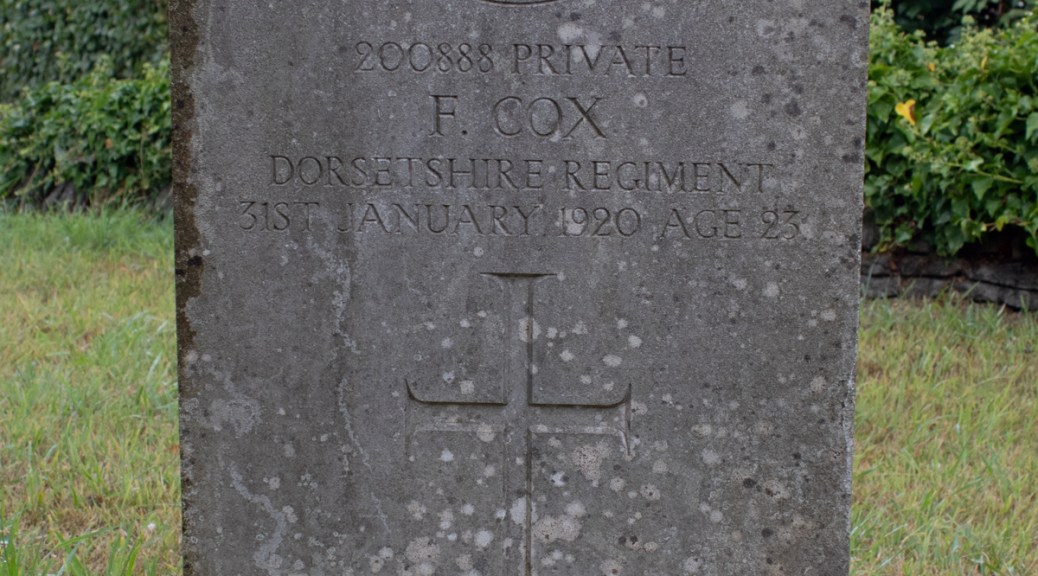
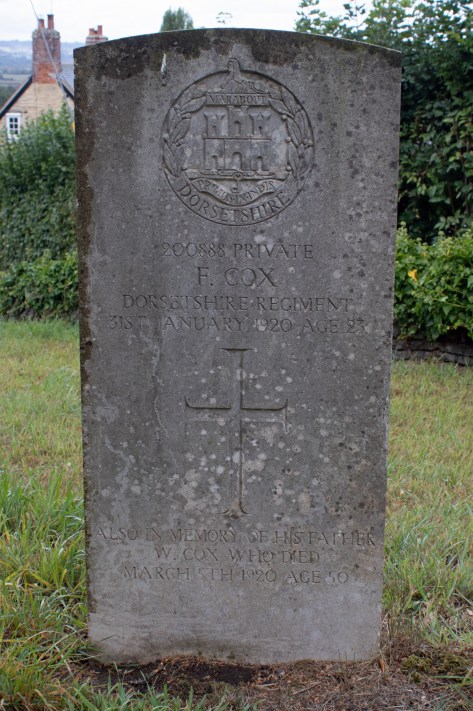
Frederick Charles Cox was born in the Dorset village of Kington Magna in the spring of 1897. One of seven children, his parents were agricultural labourer William Cox and his wife, Kate.
When Frederick completed his schooling, he also found work as a farm labourer. However, when war broke out, he was keen to play his part, possibly having seen his older brother, William Jr, also join up.
Unlike his sibling, Frederick enlisted in the Dorsetshire Regiment. His service papers have been lost to time, but it is clear that he took the role of Private, and that he was assigned to the 1st/4th Battalion. His unit began the war in India, but had moved to Basra in February 1916, remaining in Mesopotamia for the remainder of the conflict.
Private Cox survived the war, and had returned home by the end of 1919. His time in the army would impact his health, however, and during the winter of 1919/20, he came down with malaria, a condition which would prove fatal. Frederick passed away in hospital in Shaftesbury, on 31st January 1920: he was 23 years of age.
The body of Frederick Charles Cox was taken back to Kington Magna for burial. He was laid to rest in All Saints’ Churchyard, close to his brother, who had died a few years before.
Kate had lost two adult sons in a matter of years, and her tragedy was not to end. William Sr passed away less than five weeks after Frederick. He was buried close to his sons.
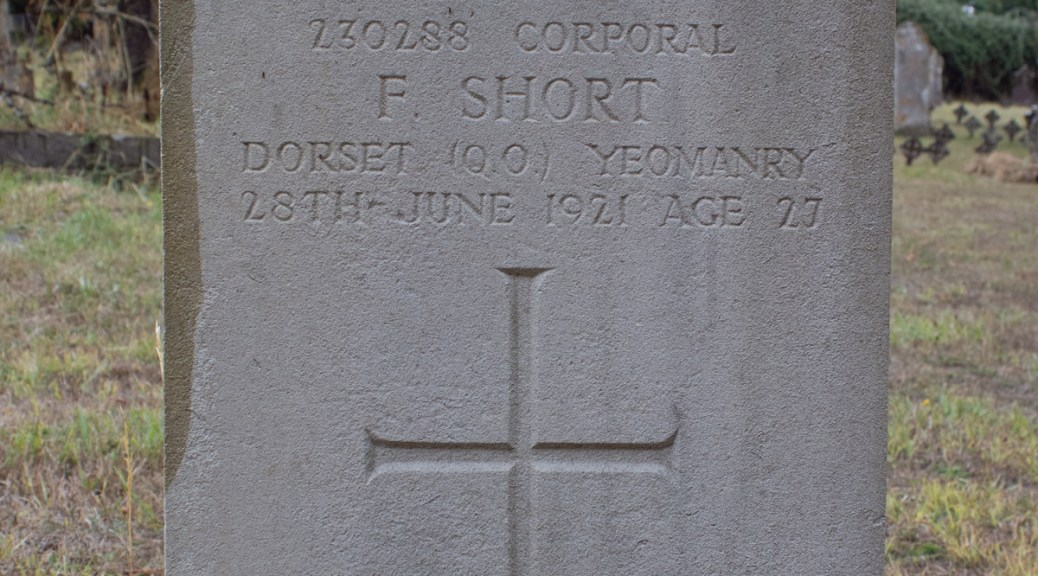
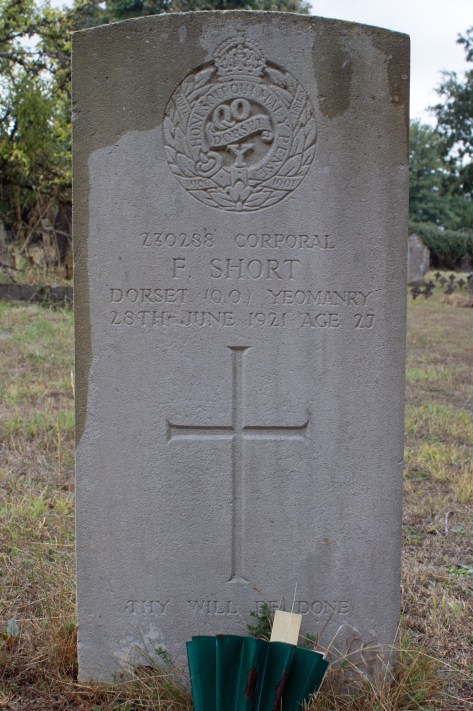
Frederick Short was born in Sturminster Newton, Dorset, in the spring of 1894. The oldest of five children, he was one of three sons to John and Martha Short. John was the caretaker of the village’s cemetery, and the family lived in a cottage on site.
When Frederick completed his schooling, he found work as a groom and, by the time of the 1911 census, he was boarding with John and Clara Binning in the village of Weare, Somerset.
War came to Europe in the summer of 1914, and Frederick was called upon to play his part. Full details of his military service have been lost to time, but it is clear that he enlisted in the Queen’s Own Dorset Yeomanry. By the end of the conflict, he had risen to the rank of Corporal.
Frederick survived the conflict, and returned home. At the start of 1919, he married Mabel Heritage, a soldier’s daughter from Somerton, Somerset. Her father, George, had died by the time of the 1901 census, and Mabel moved with her mother to Milborne Port, on the Somerset-Dorset border. The 1911 census found her working as a leather glove machinist, in a four-roomed cottage on Paddock Walk, to the north of the town centre.
The war had had a negative impact on Frederick’s health. The 1921 census shows him and Mabel visiting his parents in Sturminster: his occupation was given as unfit (formerly a groom). It was only a matter of weeks later that his condition worsened. Frederick passed away from a combination of malaria and heart disease on 28th June 1921: he was 27 years of age.
The body of Frederick Short was laid to rest in Sturminster Newton Cemetery, close to, and under the watchful eye of, his caretaker father, John.
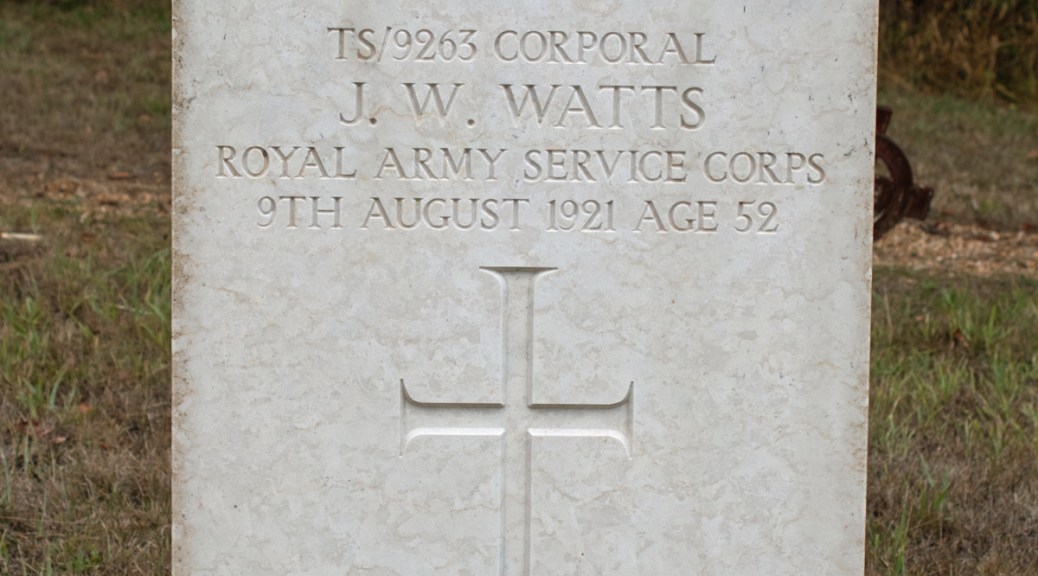
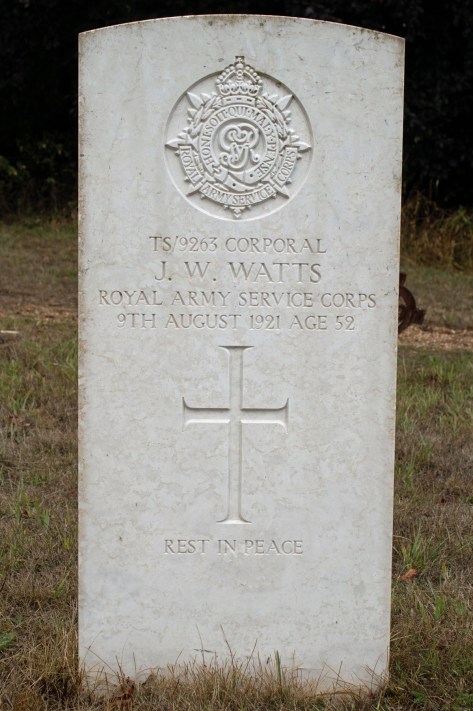
John William Watts was born in the summer of 1869, the youngest of six children to Reuben and Maria Watts. Reuben was a sawyer from Haselbury Brian, Dorset, and it was her that the Watts family were born and raised.
John seemed keen to progress himself, and found employment as a police constable. The 1891 census recorded him as living at the station in Blandford Forum. Three years later, he married Elizabeth Hallett, a shoemaker’s daughter from Lyme Regis. The couple would go on to have eight children before Elizabeth’s untimely death in 1912.
By this point, John’s career had taken a sharp turn: in 1901, when the family were living in Sturminster Newton, he was working as a blacksmith. The next return, taken in 1911, found them at 19 Church Street in the village, where John was employed as a journeyman shoeing smith.
With young children to raise, John took a new wife, marrying widow Rose Yeatman on 3rd August 1914. His oldest daughter, Elsie, and her father, Tom Bleathman, acted as witnesses. John and Rose would go on to have a daughter of their own, Muriel, the following year.
When war broke out, John stepped up to play his part. His service papers have been lost to time, but it is clear that he enlisted in the Royal Army Service Corps, and, presumably because of his age and experience, was assigned the rank of Farrier Corporal There is no indication that he served time outside of Britain, and it seems likely that he would have overseen the preparation of horses and training of blacksmiths for the Western Front.
Farrier Corporal Watts survived the conflict, but was medically discharged with malaria on 16th May 1919. The 1921 census found him living with Rose and five of his children and step-children in their Church Street home. He was employed as a bricklayer’s labourer, and was working for builder and contractor Mr J Silverthorne.
John’s health was suffering now, though, and he would only last until the summer. He passed away at home on 9th August 1921: he was 52 years of age.
The body of John William Watts was laid to rest in Sturminster Newton Cemetery, a short distance from his grieving family’s home.
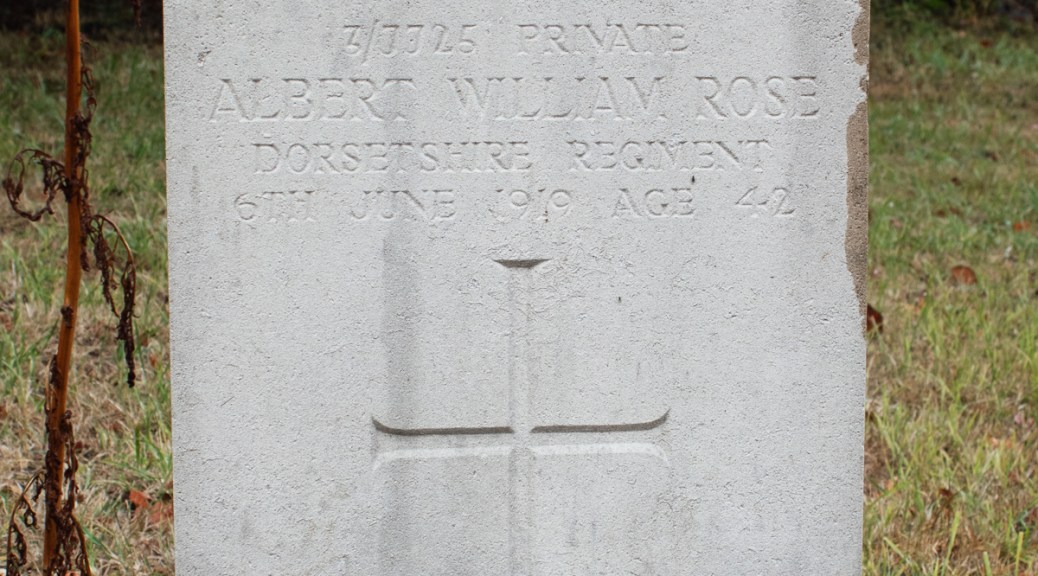
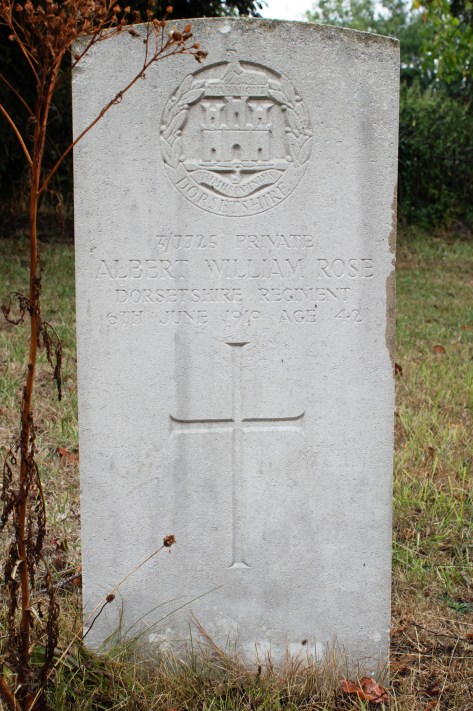
Albert William Rose – who was better known by his middle name – was born in the spring of 1876. One of eight children, his parents were Thomas and Amelia Rose. Thomas was a farm labourer from Sturminster Newton, Dorset, and this is the village in which the Rose family were born and raised.
William followed in his father’s footsteps, and was a farm labourer by the time he turned 14. The 1881, 1891 and 1911 census records all show him living with his parents: in 1901 he was a boarder with the Brown family at The Stables in Bryanstone, Dorset. He was employed as a stable keeper, one of eleven live-in employees at the stud.
Alongside his farm work, William was also an active volunteer in the local militia. When war broke out in the summer of 1914, he was quick to enlist, joining the 3rd Battalion of the Dorsetshire Regiment. His service papers show that he was 5ft 7ins (1.7m) tall and weighed 160lbs (72.6kg). He is recorded as having brown hair and grey eyes.
During the next four months, Private Rose undertook training on home soil. In December 1914, his unit was moved to France, and he would remain on the Western Front through to the Armistice and beyond. His time overseas was not without incident, and his age and health would be against him.
Over the next four years, William would he hospitalised at least a dozen times, for rheumatism, myalgia, a recurring heart condition and, in May 1915, from the effects of a gas attack and subsequent issues with catarrh. In December 1918, he returned to Britain with atherosclerosis, a clogging of the arteries, and was medically discharged from service the following month.
At this point, William’s trail goes cold. It is likely that he returned home, as , when he passed away, his death was registered in Sturminster.
Albert William Rose passed away on 6th June 1919: he was 43 years old. His body was laid to rest in Sturminster Newton Cemetery, not far from his family home.

 Death and Service