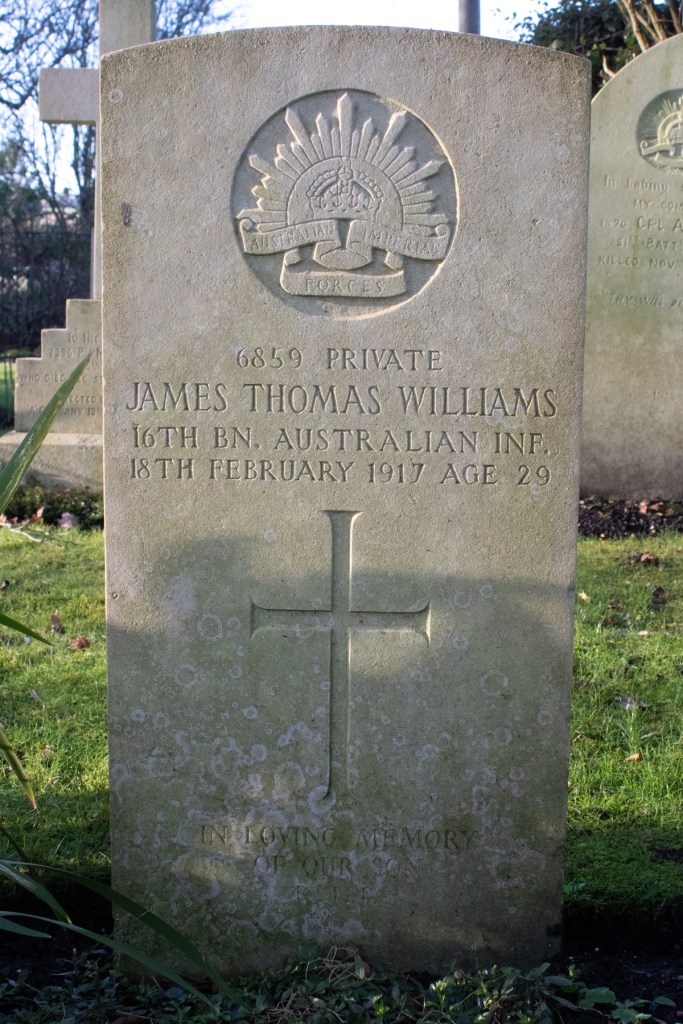
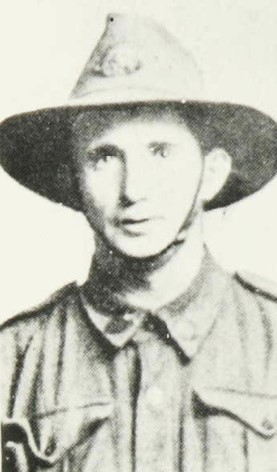
James Thomas Williams was born in Toodyay, Western Australia, in May 1888. The third of eight children, his parents were John and Mary Williams.
When he finished his schooling, James found work farming. Details of his early life are lost to time, but it seems likely that he had followed in his father’s footsteps.
When war engulfed the Empire, James stepped up to serve his King and enlisted in the Australian Imperial Force on 24th August 1916. His service records show that he was 5ft 6ins (1.68m) tall and that he weighed 134lbs (60.8kg). He was noted as having auburn hair, blue eyes and a fresh complexion.
Private Williams’ unit departed Australia from Freemantle on 9th November 1916. He would spend the next two months on board the Argyllshire, and eventually reached British shores on 10th January 1917. Assigned to the 16th Battalion of the Australian Infantry, his unit disembarked at Devonport, Devon, and made straight for base near Codford, Wiltshire.
The ANZAC troops had spent weeks cramped in the bowels of their ships, and space was once again at a premium in their army barracks. This congestion would prove fatal for numerous soldiers, as disease ran rife across the encampments.
Sadly, James would not be immune to poor health. Having contracted influenza, he was initially admitted to the camp infirmary, before being moved to the military hospital in nearby Sutton Veny. The condition was to get the better of him, and Private Williams passed away from a combination of flu and heart failure on 18th February 1917. He was 29 years of age.
The body of James Thomas Williams was laid to rest in the peaceful graveyard of St Mary’s Church in Codford, surrounded by others from his regiment.
Nicholas John Paice was born in the spring of 1867, the second of five children to John and Olive Paice. John was a railway policeman from Aldermaston in Berkshire, but his oldest son, Nicholas, was born in Poole, Dorset where Olive came from.
The Paice family seemed to move to wherever John’s work took him. The 1871 census found them living back in the Berkshire village of Shrivenham, while a decade later they were to be found in Longfleet, to the north of Poole. By this point, John was employed as a groom, and Olive a laundress.
When he completed his schooling, Nicholas found work as a butcher. He had also enlisted in the local militia, joining the 3rd Dorset Regiment. The army life seemed to suit him and, on 12th July 1886, he enlisted in the Rifle Brigade. His service records show that he was 5ft 7ins (1.7m) tall and weighed 148lbs (67.1kg). At 19 years and three months old, he was noted as having a fresh complexion, grey eyes and brown hair. The papers show that he had a scar on his left eyebrow, and tattoos on his forearms and the middle finger of his left hand.
Joining up for a period of twelve years, Private Paice would spend nearly seven of those in India and Burma. His time in the army was not without incident, however. Just three weeks after enlisting he deserted, and remained at loose for nearly a month. When he was captured, he was imprisoned for desertion for four weeks, his term of service extended to reflect the time he was AWOL.
In August 1896, having been back on home soil for just over two years, Nicholas was arrested again. Convicted of ‘begging’, he was confined for a week, before being released back to duty.
On 16th September 1898, Nicholas completed his contract, and was formally discharged from the army.
The next few years are a mystery for Nicholas. He had married Maria Andrews in 1896, and the couple would go on to have eight children, of which five would survive childhood. By the time of the 1911 census – the next document where we can pick him up – Nicholas and the family were living in two rooms at 2 New Corn Street, Bath, Somerset. Nicholas was working as a cattle drover, along with Maria, the household included her daughter Annie, and granddaughter Lily, and John and Maria’s son, Earnest.
When war came to Europe, Nicholas stepped up to play his part. He enlisted in the Somerset Light Infantry on 26th October 1915 but, with his age against him, he was transferred to the 263rd Coy. of the Royal Defence Corps the following April.
It seems that Private Paice’s health was also being impacted and he spend a month in the Red Cross Hospital in Portishead, having contracted influenza. Released to duty on 16th May 1916, just a month later he was re-admitted for three weeks, this time suffering from bronchial catarrh. On 10th September he was admitted to the hospital for a third time. This time it was identified that he had come down with pulmonary tuberculosis, and on 12th October 1916, he was formally discharged on medical grounds.
It is unclear what happened to Nicholas next. His service records suggest that he wasn’t immediately discharged from the Portishead hospital, and it seems likely that he would have returned home to Bath at some point. The next record for him is that of his passing, from tuberculosis, on 20th December 1919. He was 52 years of age.
Nicholas John Paice was laid to rest in the sweeping Locksbrook Cemetery in his adopted home town of Bath, Somerset.
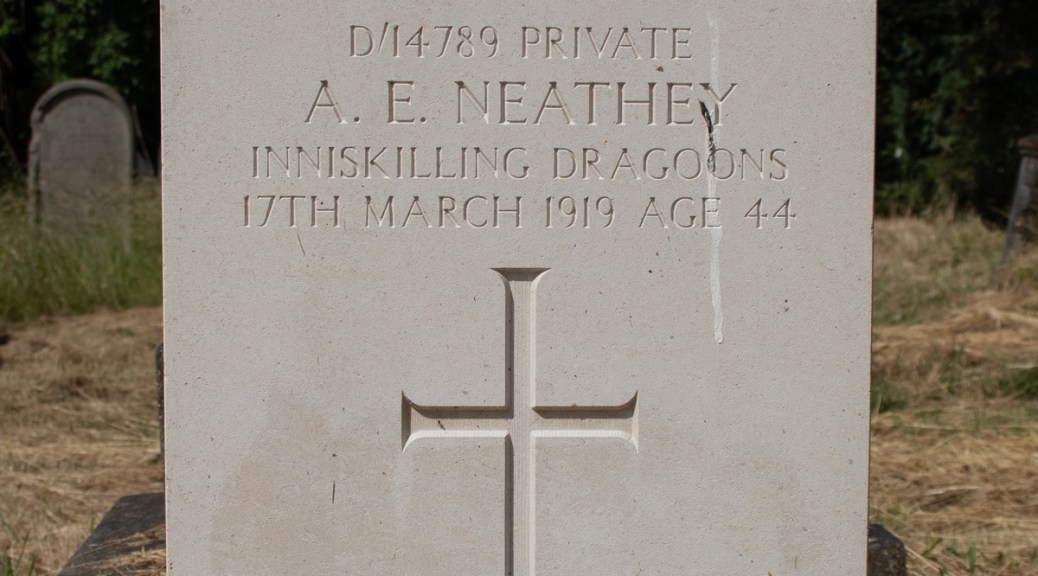
Albert Ernest Neathey was born in Bath, Somerset, early in 1875. The third of six children, his parents were John and Rose Neathey. John was a baker and the family lived at 11 Trinity Square. When John died in 1890, Rose and the four youngest children remained there, and by the time of the following year’s census, three of the Neathey siblings were bringing in a wage.
The 1891 document recorded Rose as living on her own means, while Albert, then 16 years of age, was employed as a telegraph messenger. His older sister, Alice, was a dressmaker’s apprentice, while his younger brother, Sidney, was apprenticed to a hairdresser.
The family are missing from the 1901 census, but the following year Albert got married. His new bride, Mary Louisa Slip, was a mason’s daughter, and the couple exchanged vows in Christ Church, Bath, on 18th September. They would go on to have one child, Doris, born in the summer of 1903, but she would only live for a few months, before passing away on 1st November.
Albert was, by this time, working as a postman, and the 1911 census found him and Doris living at 18 Lansdown Road, to the north of the city. Mary was noted as assisting in the business, although her trade was recorded as being general grocery. The couple were sharing their home with Albert’s ten year old nephew, Norman.
When war broke out, it was inevitable that Albert would be called upon to play his part. Full service details are not available, but a later newspaper report sheds light onto not only his army career, but his personal life:
DEATH OF A WELL-KNOWN BATH POSTMAN
The death occurred at the Bath War Hospital… of Mr Albert Ernest Neathey, of 18 Lansdown Road. Mr Neathey, who was only 44 years old, was the second son of the late Mr John Neathey, of Walcot.
When quite young he entered the service of the Bath Post Office as telegraph boy, and rose to be a postman. Altogether he was a postal servant for nearly 30 years. While thus engages he was a member of the Post Office Band, in which he played cornet.
His military career began with the old 1st Volunteer Battalion of the [Somerset Light Infantry], which whom he served six years. After leaving the infantry he joined the North Somerset Yeomanry. At the outbreak of war he was mobilised with the Yeomanry, and from August 1914, to the November of the same year he was stationed with the regiment in different parts of this country. When the regiment was sent to France, he was sent, much against his will, to the Regimental Depot at the Drill Hall, Lower Bristol Road, and remained there as a member of the staff until his death. While there he was promoted to Corporal. His constant wish was to be with his regiment in France, but his state of health would not have allowed him to stand the rigours of a campaign.
On Tuesday last he was not feeling well, but would not give up his work, and it was not until Saturday that he did so. Then he was sent to the War Hospital, where he was detained, and he passed away at 8:30 on Monday morning. The cause of his death was congestion of the lungs following influenza. For twenty years he was a member of the Foresters (Queen of the West Lodge). He was greatly respected by all who knew him. He leaves a widow, but no children.
Bath Chronicle and Weekly Gazette: Saturday 22nd March 1919
As part of his retention on home soil, Albert was transferred across to the 6th Dragoons (Inniskilling) Reserve Regiment. Nothing on the available documents, however, suggest a promotion during his time in Bath. Albert Ernest Neathey died on 17th March 1919: he was laid to rest in the city’s sweeping Lockbrook Cemetery.
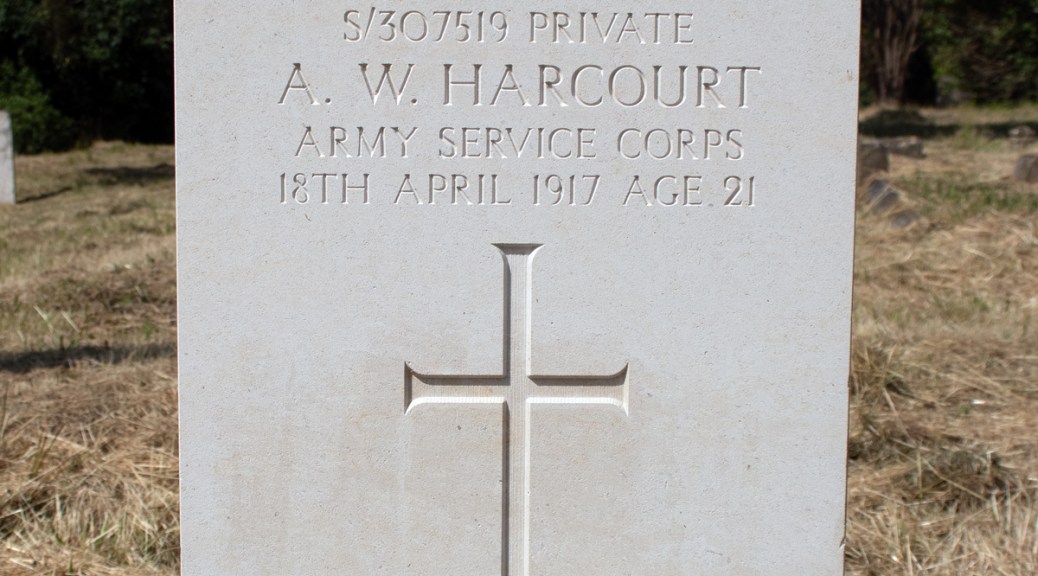
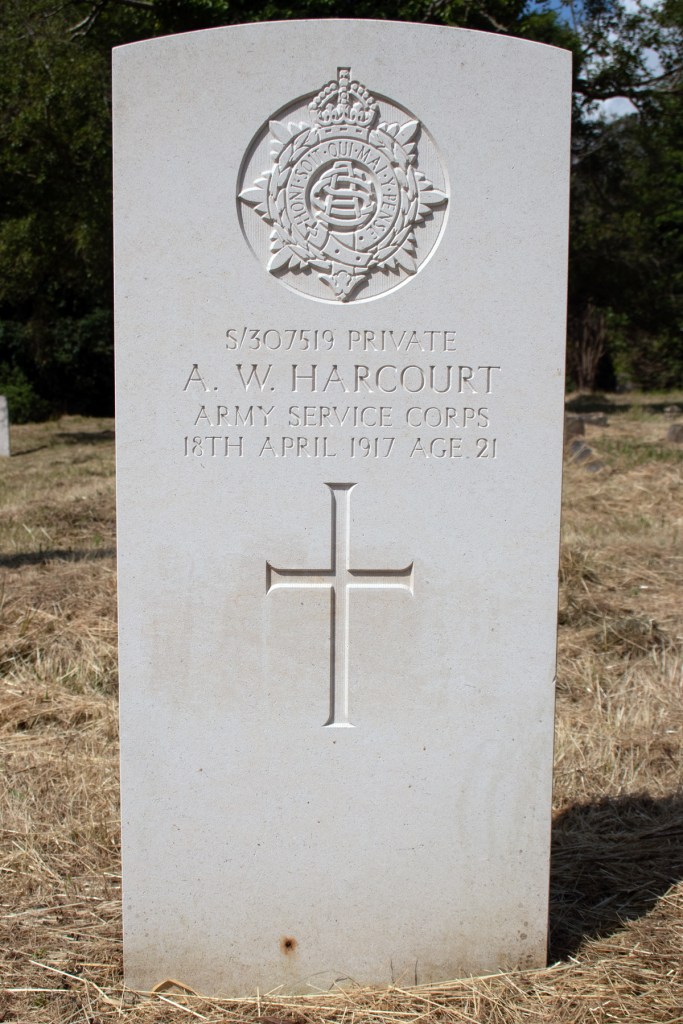
Arthur Wellesley Harcourt was born on 18th June 1895 in Brentford, Middlesex. He was the youngest of five children to Charles and Eliza Harcourt.
The son of a Baptist minister, Charles was a banker’s clerk, but “practically the whole of [his] leisure in a busy life [was] spent in mission work, mainly in Middlesex…” [Middlesex & Surrey Express – Saturday 13 October 1900] When he died in 1900, at the age of 57, Eliza was left to raise her younger children alone.
Arthur’s young life was to be one of travel. The 1901 census, taken just six months after his father’s death, found him living in Walton le Soken (now Walton-on-the-Naze), Essex. Eliza had taken rooms for the family in a lodging house at 9 New Pier Street, yards from the town’s stony beach.
The next record for Arthur is from 1908. Surprisingly, for the grandson of a Baptist minister and the son of a missionary, he seems not to have been baptised when he was born. The document shows that he was christened on 26th April, at St Mary’s Church in the village of Sporle with Palgrave in Norfolk. There is nothing to confirm why he was in Norfolk, or why he chose to be baptised there: the 1911 census found Eliza and his siblings living back in Middlesex.
By this point, Arthur was on the move again. Now fifteen years of age, the same census found him visiting George and Amelia Kerswill at their home in Exeter, Devon. George was a retired nurseryman and florist from Hendon, and it seems likely that the couple were friends of the family.
By the time war broke out, the Harcourts had moved once again, this time setting up home in Reculver, Kent. Arthur was working as a surveyor’s assistant, but felt drawn to play his part. On 8th March 1917, he enlisted, joining the Army Service Corps as a Private. His records show that he was 5ft 4.5ins (1.61m) tall, and weighed 96lbs (43.5kg). He was of fair physical development, but it was noted that he had an understandard chest, but was deemed fit for military service.
Private Harcourt was sent to Somerset for training. Tragically, however, his health was to take a dramatic downturn. Admitted to the Bath War Hospital on 1st April with influenza, this quickly developed into double pneumonia and pleurisy. The strain was to be too much for his young body to bear: Arthur passed away on 18th April 1917, at the age of just 21 years old.
Surprisingly, Eliza, whilst able to live on her own means, did not chose to lay her son to rest close to home. Instead, Arthur Wellesley Harcourt was buried in Locksbrook Cemetery, Bath, not far from the hospital in which he had breathed his last.
Colin Thomas Frazer Rough was born in the autumn of 1896, and was the oldest of seven children to Thomas and Zelia. Thomas was a dairyman from Devon, and the family were initially raised in Charmouth. Thomas took up work as a farmer in 1911, and this meant a move to to Axminster: having finished his schooling, Colin helped his father on the farm.
Colin was still working with his father when war broke out across Europe. He stepped up to play his part, and enlisted in the Royal Garrison Artillery 11th December 1915. His service records show that he was 19 years and three months old, and stood 5ft 8ins (1.72m) tall.
Gunner Rough was not formally mobilised until May 1916. He would spend the next two-and-a-half years on home soil, and was based in Catterick, Yorkshire.
On 31st July 1918, Colin was sent to France with his unit. Full details of his service overseas have been lost to time but it would seem that he was back on home soil by the beginning of 1919.
Gunner Rough had contracted influenza and pneumonia, and returned home to recuperate. The conditions were to prove too severe, however, and he passed away on 8th February 1919, at the age of 22 years old.
Colin Thomas Frazer Rough was laid to rest in the family plot in Axminster Cemetery. Tragically, his younger brother Alan had passed just three weeks earlier: the two were buried alongside each other.
Ralph William Page was born in the autumn of 1889, and was the second of five children to William and Elizabeth. William was a brush maker from London, but the family were initially born and brought up in Ottery St Mary, Devon.
By the time of the 1901 census, the family had upped sticks and relocated to Kilmington, near Axminster. Three of the family – William, Elizabeth and Ralph’s older sister Ethel – were all working in bone brush making, William as a maker, and his wife and daughter as drawers.
Ralph initially followed in the family trade, but this was not to be enough for him. He was already volunteering for the Devonshire Regiment, and he took the opportunity to join full-time. He enlisted on 11th September 1907. His service records show that he was exactly 18 years of age, and that he had black hair, brown eyes and a fresh complexion. Ralph stood 5ft 4ins (1.62m) tall and weighed 10st 9lbs (67.6kg).
Private Page initially enlisted for five years on active service. During that time he remained on home soil and, by the autumn of 1911, he was promoted to Lance Corporal. The following spring, he extended his term of service, in advance of being placed on reserve status later in 1912.
Away from army life, romance had also blossomed. On 2nd September 1912, he married Beatrice White at St Mary’s Church in Axminster. She was the daughter of a carpenter, who had also follower her widowed mother into lacemaking. The couple would go on to have three children: Florence, Ralph and Frederick. A fourth child, Peggy, passed away when she was just a matter of weeks old.
When war was declared in the summer of 1914, Ralph was sent with his unit – the 1st Battalion – to France. He saw action at Mons, Messines and Armentières in the next few months alone. In October, Ralph was promoted to Acting Corporal, and just two months later he was made Acting Serjeant.
In March 1915, things seem to have changed for Ralph. He was transferred to a Depot unit on home soil, and reduced in rank to Private. Nothing in his service records suggests any misdemeanour leading to his transfer.
Private Page remined on home soil until the end of 1916. Attached to the 3rd (Reserve) Battalion, he made his way back up through the ranks again, and was a Corporal by the time he was reassigned to the 2nd Battalion and sent off to France once again that December.
Ralph was to be firmly entrenched on the Western Front over the next five months. It was during the German retreat back to the Hindenburg Line in the spring of 1917 that he received the injury that would remove him from the war. On 23rd April, the now Lance Serjeant Page was shot in the abdomen. He was medically evacuated to Britain for treatment, and did slowly recover. Ralph’s need for an abdominal belt meant that he was no longer fit to serve and he was ultimately discharged from the army on 29th November 1917.
Ralph returned home to Devon, but the war had taken its toll on his health. When pandemic spread around the world as the conflict drew to a close, he was to succumb. He passed away from a combination of the influenza and pneumonia on 5th November 1918, at the age of 29 years old.
Ralph William Page was laid to rest in Axminster Cemetery, Devon, not far from where his widow and children lived.
Alfred Edward Wallis was born on 7th February 1876, the youngest of five children to Charles and Mary. Charles was a carpenter and joined from Bruton in Somerset, but the family were born and raised in the Walcot area of Bath.
By the time of the 1901 census, Alfred was the only one of the Wallis siblings to remain living with his parents. They were living at 14 Belgrave Crescent, to the north of the city, and, at 25 years of age, Alfred had taken on work as a printer’s compositor.
On Christmas Day 1907, Alfred married Caroline Little. She was a farmer’s daughter from Cheltenham, Gloucestershire, and, at the time of their nuptials, the young couple were living at 8 Seymour Road, the next road over from his parents.
Alfred and Caroline would go on to have three children: Harold, Winifred and Lilian. The 1911 census found that they had moved again, and were now settled in a small terrace at 22 Cork Street, in the Weston area of Bath.
War broke out across Europe in the summer of 1914, and, in on 19th December 1915, Alfred enlisted in the Army Service Corps. His records noting that he was 39 years and 10 months old, stood 5ft 5ins (1.65m) tall, and weighed 128lbs (58kg).
Private Wallis was not formally mobilised until the August 1916. Attached to the 19th Company, he was sent for duty to the Queen Mary’s Military Hospital in Whalley, Cheshire. Full details of his duties are unclear, although he would remain in the area for the next couple of years.
As the war progressed, it is likely that Alfred was exposed to the illness with which the patients were being admitted. In October 1918, he became unwell, and was admitted to hospital with a combination of influenza and pneumonia. The hospital he was sent to was the King’s Lancashire Military Convalescent Hospital in Blackpool, Lancashire, so it is likely that he had left Whalley by this point.
Private Wallis’ illness was to prove too much for his body to bear. He passed away while still admitted, on 29th October 1918. He was 42 years of age.
The body of Alfred Edward Wallis was brought back to Somerset for burial. He was laid to rest in the majestic setting of Bath’s Locksbrook Cemetery.
Simeon James Powell was born on 18th October 1882 in Wootton Fitzpaine, Dorset. The oldest of three children, his parents were Francis and Elizabeth Powell. Elizabeth died when Simeon was just 7 years of age, and his father remarried, and went on to have five children with his new wife, Annie.
Francis was a farmer, and Simeon found employment as an estate labourer. The 1911 census found the family living on Dodpin Farm in Monkton Wyld, a village to the north of Lyme Regis: Francis, Annie, Simeon and his three younger siblings.
On 12th June 1913, Simeon married Mary Hodder. There is little information about her, but it seems the couple set up home on the outskirts of Charmouth, Dorset. Mary was six years older than her new husband, and they didn’t go on to have any children.
War was declared in the summer of 1914, and by the following autumn, Simeon had signed up to play his part. His service records confirm that he was 5ft 11ins (1.8m) tall and weighed 188lbs (85.2kg).
Gunner Powell joined the Royal Garrison Artillery, and was formally mobilised on 31st May 1916. By November he was sent to Malta, returning to Britain in September 1917. His new posting was in Sheerness, Kent, and he would remain there for the next nine months.
In May 1918, Simeon fell ill. He had caught influenza, and when this developed into bronchitis, he was admitted to the local war hospital. His health began to deteriorate, and, on 10th June 1918, Gunner Powell passed away from a combination of bronchitis and haemoptysis. He was 35 years of age.
The body of Simeon James Powell was taken back to Devon for burial. He was laid to rest in the graveyard of St John the Baptist Church in Hawkchurch, near the family home just across the border in Dorset.
Edward Victor Davies was born in the Weston area of Bath, Somerset, in the summer of 1897. The second of four children, and the only boy, his parents were Walter and Emily Davies.
Walter was a park keeper who died when Edward was just 9 years old. By the time of the 1911 census, Emily was working as a caretaker for a solicitor’s office, while her sone was a boarding student at the Duke of York’s School in Guston, Kent. This army school had more than 500 students, with a staff of 100 to train them. It is unclear whether Edward went voluntarily, or whether he was sent there by his mother’s employers because he was fatherless.
War came to Europe in the summer of 1914, and Edward stepped up to play his part. Unfortunately, his service records have been lost to time, so it is unclear whether he went straight into the army after finishing his education. However, given that he held the rank of Serjeant by the end of the conflict, it seems likely that his military career began before the start of the First World War.
Edward – who was better known as Ted – joined the Wiltshire Regiment, and was assigned to the 2nd Battalion. His unit spent time on the Western Front, but there is no evidence whether or not he served overseas. He survived the war, but subsequently fell ill, as so many servicemen did:
DAVIES – March 28th, Sergeant Edward Victor (Ted) Davies, 2nd Wiltshire Regiment, at the Royal Military Hospital, of pneumonia, following influenza, aged 22 years.
[Bath Chronicle and Weekly Gazette – Saturday 03 April 1920]
Edward Victor Davies was laid to rest in the sweeping grounds of Bath’s Locksbrook Cemetery, not far from where he had grown up.
Clement Edward Arthur Edwards was born in the summer of 1898, and was the oldest of six children to Clement and Caroline Edwards. Clement Sr was a colonel in the army, and had been born in Dublin, Ireland. His wife hailed from Cheltenham, Gloucestershire, but it is clear that the family travelled as it grew, as each of the Edwards children were born in a different location. Clement Jr was born in Devon, while Caroline had given birth to his younger siblings in locations as distant as Sussex, Hampshire and the West Indies.
By the time of the 1911 census, Clement Sr had retired from duty. The family had settled back in Devon, and were living in the 12-roomed North Grange in the village of North Lew. Clement and Caroline employed five staff, including a cook, a nurse, a housemaid, a kitchen/parlour maid and a stable boy.
It seemed inevitable that Clement Jr would have followed his father into the army. Sadly his service records are lost to time, but a later newspaper report gives an insight into this time in the army:
Colonel and Mrs Edwards of Townsend House, Halberton, have the sympathy of all their friends and neighbours in the loss they have sustained by the death of their eldest son, 2nd-Lieut. Clement Edwards Alexander Edwards, of the Worcestershire Regiment, from pneumonia, following influenza, at the Northern General Hospital, Newcastle-on-Tyne [sic]. Edwards was formerly at Blundell’s School. He joined up at the earliest possible opportunity, obtaining a commission in his father’s regiment. He was a great favourite with all who knew him.
[Tiverton Gazette: Tuesday 10th December 1918]
Clement Edward Alexander Edwards died on 5th December 1918: he was just 20 years of age. His body was taken back to Devon for burial. He was laid to rest in the peaceful graveyard of St Andrew’s Church in Halberton.









 Death and Service