Tag Archives: killed in action

Stoker 1st Class Arthur Charlton

Stoker 1st Class Arthur Charlton

Arthur Charlton was born in St Pancras, London, on 21st November 1891. His parents were Arthur and Bridget Charlton, but little further information on Arthur Jr’s early life remains.

When he left school, he found work as a butcher, but it seems he was after a life of adventure and travel. On 6th November 1913, he enlisted in the Royal Navy, initially for a period of twelve years as a Stoker 2nd Class. Arthur’s service records show that he stood 5ft 6.5ins (1.69m) tall, had brown hair, blue eyes and a fair complexion.

Stoker Charlton was initially posted to HMS Pembroke – the Royal Naval Dockyard in Chatham, Kent – and this is where he did his training. He was then sent to the battleship HMS Vanguard, on board which he served for nearly three-and-a-half years. Arthur was assigned to Vanguard in the summer of 1917, when the vessel was sunk following a series of internal explosions in Scapa Flow, Scotland, with the loss of more than 800 souls. It seems, however, that he was not on board at the time, which likely saved his life.

Brought back to HMS Pembroke that summer, and with the Vanguard destroyed, Arthur found himself in an overly packed dockyard. He was billeted in the Chatham Drill Hall, which was being used as temporary accommodation.

On the 3rd September 1917, the first night air raid carried out by the German Air Force scored a direct hit on the barracks and Drill Hall; Stoker 1st Class Charlton was killed instantly. He was just 25 years old.

Arthur Charlton was laid to rest, alongside the other victims of the Chatham Air Raid, in the Woodlands Cemetery, Gillingham.


Arthur’s pension record gives a Mrs Amelia Ward as his next of kin. No details of a marriage between them are evident, and, as there is no record of his early life, it is not possible to identify whether Amelia was his sister. A mystery left unsolved.


Leading Stoker Percy Moore

Leading Stoker Percy Moore

Percy Edwin Moore was born on 14th April 1889, one of nine children to farrier Charles Moore and his wife, Eliza. Both of Percy’s parents were from West London, and the family was raised on the border between Kensington and Hammersmith.

When Percy left school he found work as a builder’s labourer, but he was drawn to bigger things and, in 1909, he joined the Royal Navy as a Stoker 2nd Class. His service records show that he stood 5ft 6ins (1.68m) tall, had light brown hair, brown eyes and a fresh complexion. He had a scar above his right eye, and a tattoo on each arm.

Percy’s sense of adventure seemed to have been kindled in his earlier years; the tattoo on his right arm was a depiction of Buffalo Bill Cody, the American showman who brought the Wild West to England in the early 1900s. Young Percy’s interest was obviously piqued early on.

Stoker Moore’s first posting was on board HMS Acheron. In the years leading up to the war, he served on six further vessels, returning to HMS Pembroke – the Royal Naval Dockyard in Chatham, Kent – in between voyages. During this time, he was promoted to Stoker 1st Class for his work.

It was during one of these pauses, in August 1913, that he married Annie Eliza Wells, a labourer’s daughter from Kensington. There honeymoon was brief – just five days after they married, Percy was back at sea.

When war was declared, Stoker Moore was assigned to the battleship HMS Triumph. She served in the Mediterranean, seeing action early on in the Gallipoli campaign. After a short spell back in Chatham, he transferred to HMS Tyne, a depot ship, and received a promotion to Acting Leading Stoker.

By the summer of 1917, Percy was back at HMS Pembroke. The base was overly busy that summer, and he was billeted in temporary accommodation in the town’s Drill Hall.

On the 3rd September 1917, the first night air raid carried out by the German Air Force scored a direct hit on the barracks and Drill Hall; Acting Leading Stoker Moore was killed instantly. He was just 28 years old.

Percy Edwin Moore was laid to rest, along with the other victims of the Chatham Air Raid, in the Woodlands Cemetery, Gillingham.


Seaman Francis Crocker

Seaman Francis Crocker

Francis Thomas Crocker was born on 5th February 1895 to Job and Irene Crocker. One of eleven children, the family were born and raised in the small Newfoundland town of Trout River.

Sadly, there is little documentation about Francis’ life. What is clear, however, is that, when war broke out, he volunteered for the Royal Naval Reserve.

By 1917, Seaman Crocker was based at HMS Pembroke, the Royal Naval Dockyard in Chatham, Kent. The base was overly busy that summer, and Frances was billeted in temporary accommodation in the town’s Drill Hall.

On the 3rd September 1917, the first night air raid carried out by the German Air Force scored a direct hit on the barracks and Drill hall; Seaman Crocker was killed instantly. He was just 21 years old.

Francis Thomas Crocker was laid to rest, along with the other victims of the Chatham Air Raid, in the Woodlands Cemetery, Gillingham, some 2500 miles (4000km) from his Canadian home.


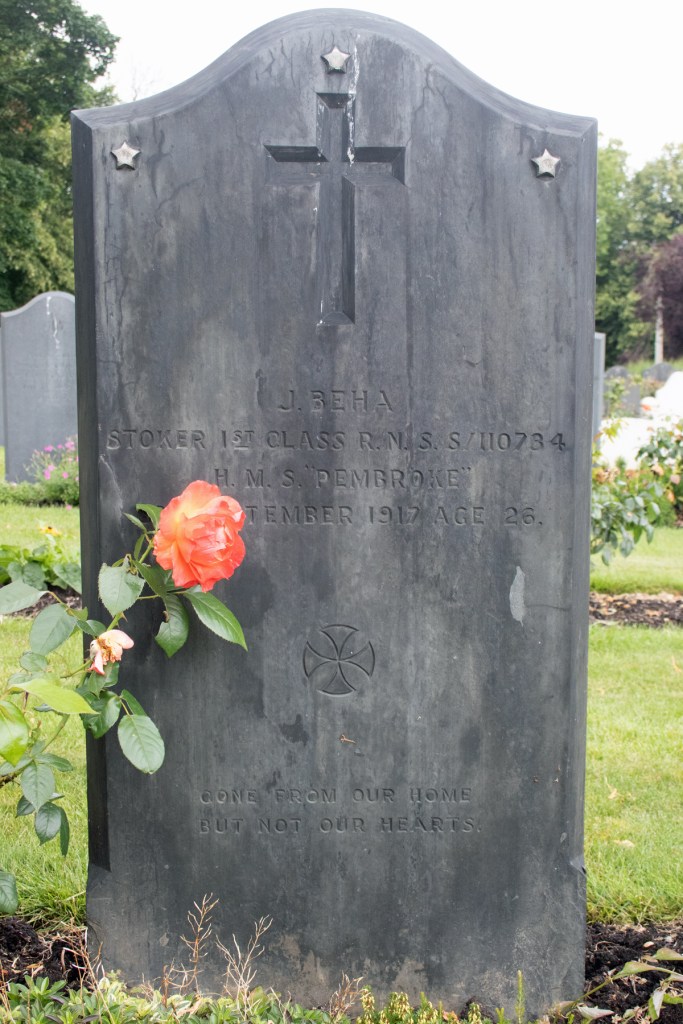
Stoker 1st Class Joseph Beha

Stoker 1st Class Joseph Beha

Joseph Beha was born on 16th June 1891, in the Yorkshire town of Whitby. He was the middle of five children to Joseph and Alice Beha, and had a half-sister, through his mother’s previous relationship.

Joseph Sr was a labourer in the local shipyard, and the family had moved to Hartlepool by the time his son had reached 10 years old. The sea had a definite draw for Joseph Jr, and by his twentieth birthday he had enlisted in the Royal Navy as a Stoker 2nd Class.

The service records show Joseph Jr stood 5ft 3.5ins (1.61m) tall, had brown eyes, dark hair and a fresh complexion. His land base was HMS Pembroke, the alternative name for the Royal Naval Dockyard at Chatham, Kent, and it was here that he received his initial six months’ training.

Stoker Beha’s first sea posting was HMS Falmouth, a light cruiser, on board which he served for more than eighteen months, gaining a promotion to Stoker 1st Class in the process. Over the next few years, he was posted to two further ships and, by the time the First World War broke out, was serving on the armoured cruiser HMS Lancaster.

While his record suggests he was of generally good character, Joseph’s time was totally without blemish. He served time in the cells on three separate occasions – for five days in 1913, fourteen days in 1915 and ten days in 1917 – although no evidence of his misdemeanours remains.

The summer of 1917, found Stoker Beha back on dry land in Chatham. HMS Pembroke was a particularly busy place at that point in the war and temporary accommodation was set up. Joseph found himself billeted at The Drill Hall, away from the main barracks.

On the night of 3rd September 1917, Chatham suddenly found itself in the firing line, as the German Air Force launched a bombing raid. One of the bombs landed squarely on the Drill Hall, and Stoker Beha was killed instantly. He was just 26 years old.

Ninety-eight servicemen perished during the Chatham Air Raid that night. They were buried in a mass funeral at the Woodlands Cemetery in nearby Gillingham. This, too, is where Joseph Beha was laid to rest.


Stoker 1st Class Joseph Brightwell

Stoker 1st Class Joseph Brightwell

Joseph Clarence Henry Brightwell was born in Greenwich, Kent, on 4th August 1894. He was one of eight children to Norfolk-born Charles Brightwell and his wife, Ellen. Charles was originally a builder in the nearby Woolwich Dockyard. The 1911 census, however, shows that he had changed career completely, and was working as a hotel cook.

The same document records that only the three youngest children of the family – Joseph included – remained living in the family home; the youngest, Rosetta, was still at school. Joseph, the next oldest, was employed as a milk boy, while his older brother, Edward, was working as a butcher’s boy.

Joseph was set on a life of adventure. By the next year, he had found work as a kitchen hand – possibly in the same hotel as his father – but, like Charles, a different career beckoned.

On 9th September 1912, Joseph enlisted as a Stoker 2nd Class in the Royal Navy. His service records show that he enlisted for the standard twelve-year term. He stood 5ft 2ins (1.57m) tall, had brown hair, blue eyes and a fair complexion.

Stoker Brightwell was primarily based at HMS Pembroke, the Royal Naval Dockyard in Chatham, Kent. After his initial four-months’ training period, he was assigned to his first ship, the battlecruiser HMS Indomitable. He spent three years aboard, reaching the rank of Stoker 1st Class, before returning to Chatham and transferring to HMS Africa. Joseph spent nine months on board the battleship, which ploughed the waters of the South Atlantic, protecting the convoys.

By the spring of 1917, Stoker Brightwell was back at HMS Pembroke, and it was here that he spent the summer. The base was a particularly busy place at that point in the war and temporary accommodation was set up. Joseph found himself billeted at Chatham Drill Hall, away from the main barracks.

On the night of 3rd September 1917, Chatham suddenly found itself in the firing line, as the German Air Force launched a bombing raid. One of the bombs landed squarely on the Drill Hall, and Stoker Brightwell was killed. He was just 23 years old.

Ninety-eight servicemen perished during the Chatham Air Raid that night. They were buried in a mass funeral at the Woodlands Cemetery in nearby Gillingham. This, too, is where Joseph Clarence Henry Brightwell was laid to rest.

Stoker George Simpson

Stoker George Simpson

George Wilfred Simpson was born early in 1882, the second of seven children to Robert and Mary Simpson. Robert was a shipbuilder from Yorkshire, and the family were raised in Thornaby, on the River Tees near Middlesbrough.

Details of George’s early life are a bit patchy, but when he left school he found work as a warehouseman. He met Florence Unwin, who was born in Stockton-upon-Tees, and they married in the spring of 1906. They young couple set up home in the town and went on to have four children, all boys.

When the war came to Europe, George wanted to do his part. His full service records are not available, but he enlisted in the Royal Naval Reserve as a Stoker at some point during the conflict. By the summer of 1917, he was based at HMS Pembroke, the Royal Naval Dockyard in Chatham, Kent.

The base was a particularly busy place at that point in the war and additional accommodation was desperately needed. Stoker Simpson found himself billeted at Chatham Drill Hall, away from the main barracks.

On the night of 3rd September 1917, Chatham suddenly found itself in the firing line, as the German Air Force launched a bombing raid. One of the bombs landed squarely on the Drill Hall, and Stoker Simpson was killed. He was just 35 years old.

Ninety-eight servicemen perished during the Chatham Air Raid that night. They were buried in a mass funeral at the Woodlands Cemetery in nearby Gillingham. This, too, is where George Wilfred Simpson was laid to rest.

Engineman Thomas Cropley

Engineman Thomas Cropley

Thomas Samuel Cropley was born on 16th November 1882 in the Suffolk village of Mutford. The fifth of eight children, his parents were Robert and Hannah Cropley. Given Mutford’s proximity to the Hundred River Hundred and the coastal town of Lowestoft, it is little surprise that Thomas’ father was a ropemaker. Hannah was also employed, the 1901 census recording her as a monthly nurse – helping women during the month after childbirth.

Thomas’ location to the coast made fishing an ideal choice of work for him, and when he left school he followed his three older brothers into the trade. Indeed, he listed his trade as a deep sea fisherman on his marriage records.

As a young man, he had met bricklayer’s daughter Edith Tuttle, and they tied the knot on 29th May 1906. The couple set up home in Factory Street, Lowestoft, and went on to have seven children.

Sadly, little information on Thomas’ wartime service remains documented. His knowledge of boats and the sea made the navy an obvious option for him, and he enlisted in the Royal Naval Reserve.

Engineman Cropley was assigned to HMS Pembroke – this Royal Naval Dockyard at Chatham in Kent. While it is likely that he served on ships as well, this is certainly the base to which he returned.

Thomas found himself based here in the summer of 1917, which was a particularly busy place at that point in the war. Additional accommodation was desperately needed and he found himself billeted at Chatham Drill Hall, away from the main barracks.

By 1917, the German Air Force had suffered huge losses during the daylight bombing raids it had been undertaking. It was imperative for them to minimise these losses, and so a new tactic – night time raids – was employed.

The first trial of this approach was on the night of 3rd September 1917, and Chatham suddenly found itself in the firing line, startlingly unready and fundamentally unprotected. One of the German bombers landed a direct hit on the Drill Hall, and Engineman Cropley was killed. He was just 34 years old.

Ninety-eight servicemen perished during the Chatham Air Raid that night. They were buried in a mass funeral at the Woodlands Cemetery in nearby Gillingham. This, too, is where Thomas Samuel Cropley was laid to rest.


The lives of Thomas’ family outlines a lot about living conditions in the late nineteenth and early twentieth centuries, with a large number of his relatives dying young.

His father was 68 when he died in 1916; Hannah had passed away fourteen years before, when she was 56 years old. Of his siblings, two did not survive childhood, one died their 20s, one was aged 40, while three reached their late sixties.

Thomas’ widow died in 1921, at the age of 35; their two youngest children died before their first birthdays. Of the other five, one was 31 when he died, while the others lived much longer – one was in their mid-70s, two in their eighties, and the oldest reached her hundredth birthday. A varied legacy indeed.


Ordinary Seaman Robert Smith

Ordinary Seaman Robert Smith

Robert Frederick Sydney Smith was born on 24th July 1889 in Peckham, London. One of seven children, his parents were Robert Smith – a tailor and draper – and his wife Ada.

Little more information is available on Robert Jr’s early life. He married Alice Brookman, a leatherworker’s daughter, on 3rd September 1911, and was, by this time, working as a bank clerk. The couple went on to have three children: Sidney, Eileen and Ronald.

War was on the horizon and, at Robert was soon called up. His service records are dated 31st January 1917, and note that he stood 5ft 5.5ins (1.66m) tall, had brown hair, brown eyes and a medium complexion.

Robert was employed as an Ordinary Seaman, and was initially posted to HMS Pembroke, the shore-based establishment at the Royal Naval Dockyard in Chatham, Kent. After a few weeks, he was posted to HMS Crescent, a cruiser that served in the North Sea.

After six months at sea, Ordinary Seaman Smith landed back in Kent. HMS Pembroke was a busy place at that point in the war, and additional accommodation was desperately needed. Robert found himself billeted at Chatham Drill Hall, away from the main barracks.

At this point in the war, the German Air Force had been suffering huge losses during the daylight bombing raids it had been undertaking. It was imperative for them to minimise these losses, and so a new tactic – night time raids – was employed.

The first trial of this approach was on the night of 3rd September 1917, and Chatham suddenly found itself in the firing line, startlingly unready and fundamentally unprotected. One of the German bombs landed a direct hit on the Drill Hall, and Ordinary Seaman Smith was killed. He was just 28 years old.

Ninety-eight servicemen perished during the Chatham Air Raid that night. They were buried in a mass funeral at the Woodlands Cemetery in nearby Gillingham. This, too, is where Robert Frederick Sydney Smith was laid to rest.


Leading Stoker William Osborne

Leading Stoker William Osborne

William Alfred Osborne was born in Islington, London, on 22nd August 1892. Sadly, this is where any concrete information on his early life – including his family – ends.

The only firm document available is William’s naval service records. This gives the date and location of his birth and also some physical details. He was 5ft 3ins (1.59m) tall, had brown hair, grey eyes (with a scar above his left one) and a fair complexion.

William enlisted in the Royal Navy on 11th May 1911, and was given the rank of Stoker 2nd Class. He was initially stationed at HMS Pembroke – the Royal Naval Dockyard in Chatham, Kent – where he spent a total of five months.

Weeks into his service in Chatham, he was put in the cells for seven days; it is not clear what misdemeanour he had committed, but the punishment this early on into his career seemed to have done the job, as the remainder of his service appears unblemished.

In October 1911, Stoker Osborne was given his first ocean-based posting. He was assigned to the battlecruiser HMS Inflexible on board which he served for nearly six years. During this time, he was given two promotions, to Stoker 1st Class in May 1912, and Leading Stoker four years later.

The Inflexible initially served in the Mediterranean, although during William’s time on board, she was involved in the Battle of the Falklands in the South Atlantic, the Dardanelles Campaign in the Eastern Mediterranean and the Battle of Jutland in the North Sea.

By the summer of 1917, Leading Stoker Osborne was back on home soil, stationed at HMS Pembroke. The Dockyard was a busy place at that point in the war, and additional accommodation was desperately needed. William found himself billeted at Chatham Drill Hall, away from the main barracks.

At this point in the war, the German Air Force had been suffering huge losses during the daylight bombing raids it had been undertaking. It was imperative for them to minimise these losses, and so a new tactic – night time raids – was employed.

The first trial of this approach was on the night of 3rd September 1917, and Chatham suddenly found itself in the firing line, startling unready and fundamentally unprotected. One of the German bombs landed a direct hit on the Drill Hall, and Leading Stoker Osborne was killed. He was just 25 years old.

Ninety-eight servicemen perished during the Chatham Air Raid that night. They were buried in a mass funeral at the Woodlands Cemetery in nearby Gillingham. This, too, is where William Alfred Osborne was laid to rest.


Cook’s Mate Arthur Humphrey

Cook’s Mate Arthur Humphrey

Arthur John Humphrey was born on 22nd December 1880 in the Surrey village of Horne. One of seven children, his parents were agricultural labourer Thomas Humphrey and his wife Eliza.

When he left school, Arthur also found labouring work. By 1899 he had moved to the town of Redhill, where he met tailor’s daughter Kate Wilson. The couple married in St Matthew’s Church that year, and went on to have six children.

With a family to look after, Arthur found additional work to help bring money in, and he became a carter for a local bakery. This seems to have spurred him on, and by the time war broke out, he had become more hands on with the baking side of things.

The hostilities brought new opportunities, and the chance of more permanent, better played employment became available. On 25th May 1916, Arthur enlisted in the Royal Navy as a Cook’s Mate. His service records show that he stood at 5ft 5ins (1.65m) tall, had brown hair, grey eyes and a fresh complexion.

Cook’s Mate Humphrey’s service was wholly at HMS Pembroke, the Royal Naval Dockyard in Chatham, Kent. While he would have been billeted in the barracks themselves, by the summer of 1917, the dockyard was becoming a very crowded place. The Drill Hall was brought in as additional accommodation and, that summer, this is where Arthur was moved to temporarily.

The German Air Force was suffering significant losses during the daylight raids it was carrying out. In an attempt to stem the flow of casualties, they decided to trial night time raids and, on 3rd September 1917, Chatham found itself in the midst of a bombing raid. The Drill Hall that Cook’s Mate Humphrey was sleeping in received a direct hit, and he was killed. He was just 36 years old.

The 98 servicemen who perished during the Chatham Air Raid that night were buried in a mass funeral at the Woodlands Cemetery in nearby Gillingham. This, too, is where Arthur Humphrey was laid to rest.