Tag Archives: Lancashire

Private Charles Bagley

Private Charles Bagley

Charles Sainsbury Bagley was born in the autumn of 1889, one of eleven children to Benjamin and Jane Bagley. The couple’s early life was an intriguing one: they had both been born in Shoreham-by-Sea, West Sussex. The 1891 census recorded the couple living on board the barque Mizpah, with their three oldest children. Benjamin was the vessel’s master and there were ten other members of crew on board.

By the time Charles was born, the family had returned to shore and settled in Minehead, Somerset. By now Benjamin was working as a hairdresser and tobacconist on Park Street near the centre of the town.

Benjamin died in 1910, but left a thriving business to support Jane. At least three of the Bagley siblings went into hairdressing, while Charles’ older brother, Joseph, set up a bakery and confectioner’s in the town with his wife. Charles is absent from the 1911 census, although later records would suggest that he had moved to Lancashire, where he was also working as a hairdresser.

On 3rd July 1915, Charles married Celia Rogers in Lancaster. War was raging across Europe at this point and, in August 1916, he enlisted in the army. His service records confirm that he was 5ft 7.5ins (1.71m) tall and weighed 128lbs (58kg). Private Bagley joined the 5th Battalion of the King’s Own (Royal Lancaster Regiment) and by the end of the year he was on the Western Front, based around the Ypres salient.

The early part of 1917 proved relatively quiet for Private Bagley’s troop. At the end of July, however, he was caught up in the battle of Pilkem Ridge, and was shot in his left leg. Initially treated on site, the wound was severe enough for him to be medically evacuated to Britain for treatment.

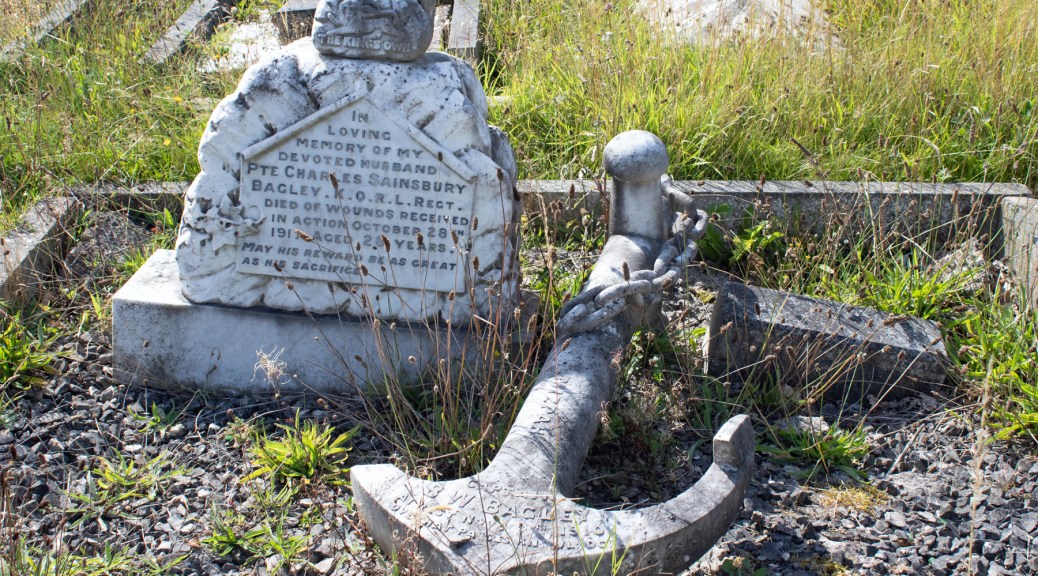
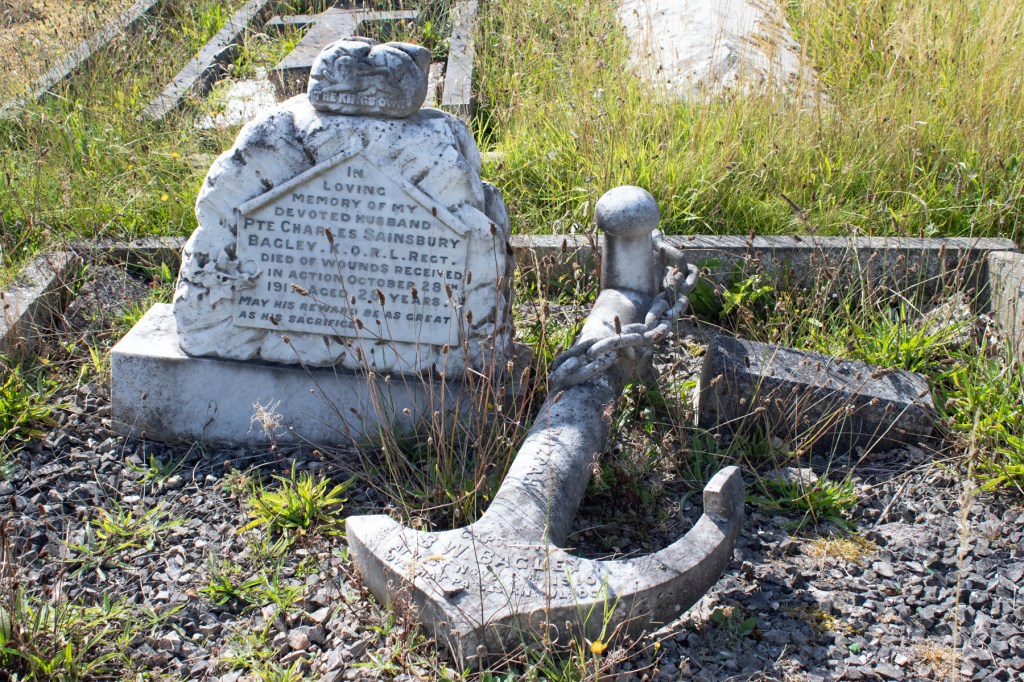
Charles was admitted to the Royal Surrey County Hospital in Guildford, but his wounds were to prove to be too severe. He passed away on 28th October 1917, at the age of 27 years old.

The body of Charles Sainsbury Bagley was taken back to Somerset for burial. He was laid to rest in the family plot in Minehead Cemetery, reunited with his parents, Jane having died at the beginning of 1917. The seafaring headstone paid homage to his father’s maritime service.


Serjeant Thomas Wood

Serjeant Thomas Wood

Thomas Wood was born in Bristol, Gloucestershire, in the summer of 1862. The third of ten children, he was the oldest son to Thomas and Emma Wood. Thomas Sr was a cabinet maker, but his son was not to follow in his father’s footsteps, seeking a life of adventure instead.

Thomas enlisted in the army and, while documents relating to his early life are not readily available, the 1891 census recorded him as being billeted at the Cambridge Barracks in Portsmouth, Hampshire. A member of the Royal Artillery, he seems to have been enlisted for a while, as he had risen to the rank of Corporal.

In 1894, Thomas married Leah Barrett, who was born in Oxfordshire. The army life underscored where the family would settle. They had four children and, according to their ages, the Woods were in Liverpool by 1895, Gosport, Hampshire, in 1896 and Cork in Ireland by 1899. The 1901 census found the family living in Wicklow, with Thomas having now achieved the rank of Company Sergeant Major.

Ten years later, and Thomas had stepped away from the army life. Now 48 years of age, he and Leah had been married for 17 years. The couple had settled in the Worle, on the outskirts of Weston-super-Mare, Somerset, where Thomas had set himself up as a butcher, with Leah assisting him.

War came to Europe in 1914, and it seems that Thomas felt drawn to play his part once more. He joined the Royal Defence Corps as a Serjeant when it was formed in the spring of 1916, and was assigned to the regiment’s 263rd Company.

Little information is available about Serjeant Wood’s army service, but by the autumn he had been admitted to the Shell Shock Hospital (now the Maudsley Hospital) in Denmark Hill, London. His entry to the hospital, however, was actually due to kidney disease, and this was what would claim his life. Thomas died from a combination of nephritis and uraemia on 21st November 1916. He was 54 years of age.

Thomas Wood was brought back to Somerset for burial. He was laid to rest in the graveyard of St Martin’s Church in Worle.


Serjeant Thomas Wood
(from ancestry.co.uk)

Private Charles Blackmore

Private Charles Blackmore

Charles William Blackmore was born in Brompton Regis (or Kingsbrompton), Somerset, on 19th August 1896. He was the twelfth of thirteen children to journeyman carpenter Joshua Blackmore and his wife, Margaret. Charles attended the nearby Upton Primary School until Christmas 1909 at which point he started working with his father.

When war erupted across Europe, however, he stepped up to play his part. He enlisted as a Private in the Somerset Light Infantry on 14th January 1916. Little remains of his service documents, but his medical report confirms that he was 5ft 9ins (1.75m) tall, with light brown hair and grey eyes. Interestingly, the document also gives his date of birth as 14th February 1897, six months later than his school intake record.

The documents that remain for Private Blackmore’s time in the army, do not specify exactly where he served, but his battalion – the 1st – were heavily involved in the Battle of the Somme in 1916, and at Arras the following year.

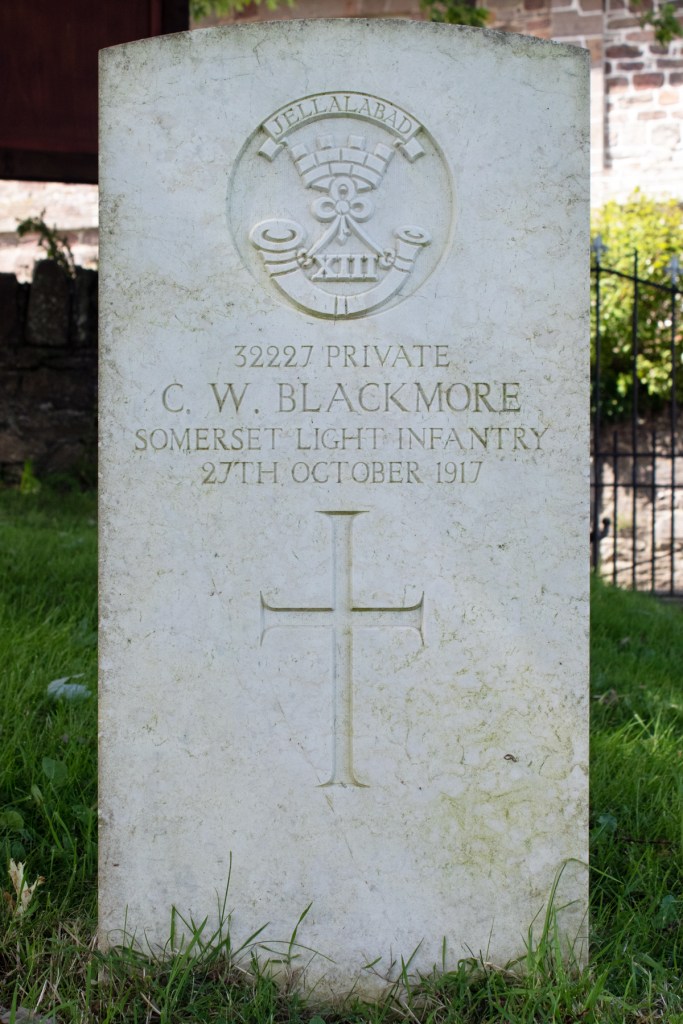
It was during that summer that Charles fell ill, contracting tuberculosis. He was medically evacuated to Britain for treatment, and admitted to the Toxteth Park Auxiliary Military Hospital in Liverpool. The former workhouse was to be where Charles breathed his last: he died on 27th October 1917, at the age of 21 years old.

The body of Charles William Blackmore was brought back to Somerset for burial. He was laid to rest in the peaceful and picturesque graveyard of the Church of the Blessed Virgin Mary in his home village, Brompton Regis.


Private William MacPherson

Private William MacPherson

William George MacPherson was born in the township of Greenway, Huron County, Ontario, on 24th September 1893. The eighth of nine children, his parents were farmer Edmund Macpherson and his wife, Sarah, who was better known by her middle name, Keren (short for Kerenhappuch).

Edmund was the fourth generation of the family to be born in Canada, his maternal great grandfather having emigrated from Scotland to Nova Scotia in the late 1770s. Sarah was the first generation of her family to be born in North America, her parents having moved there in the 1850s.

After he finished his schooling, William followed his father into farming. When war broke out in Europe, the Empire was called upon to serve their King. On 7th January 1916, William enlisted in the Canadian Expeditionary Force. His service records show that he was 5ft 6.5ins (1.69m) tall and weighed 150lbs (68kg). He was noted a having dark hair, brown eyes and a dark complexion.

Private MacPherson set sail from Halifax on 22nd August 1916, and arrived in Liverpool eight days later. His troop was based in Witley, Surrey, and it was here, while attached to the 125 Battalion of the Canadian Infantry, that William spent the winter.

On 23rd May 1917, Private MacPherson was transferred to the 4th Battalion, and set sail for France. He was to spend the summer at Ypres, where he encountered some of the bloodiest fighting of the conflict. William was not to be unscathed, and was wounded in his shoulder and neck on 6th November 1917.

William was initially treated at the No. 2 State Hospital at Abbeville. Dangerously ill, though, he was medically evacuated to Britain, on board the Hospital Ship Essequibo, from Le Havre to Shornescliffe. Private MacPherson was quickly moved to Somerset, and was admitted to the Bath War Hospital. Tetanus set in, and he died of his wounds on 21st December 1917. He was 24 years of age.

With his family thousands of miles away, William George MacPherson was laid to rest in the Locksbrook Cemetery in Bath, not far from the hospital in which he had breathed his last.


Serjeant Andrew Fox

Serjeant Andrew Fox

Andrew Michael Fox was born on 25th May 1871, the oldest of six children, to Michael and Eliza Fox. Michael was a Private in the 40th Regiment of Foot, and was based in Curragh Camp, Kildare, Ireland, when Andrew was born.

The family travelled where Michael’s work took him: Andrew’s oldest siblings were born in Uttar Pradesh, India, and the family were in England by the time of the 1881 census.

Given Michael’s military connections, it is no surprise that Andrew followed him into the army. He enlisted in August 1884, joining the South Lancashire Regiment. His service records give his age as 14 – he was, in fact, just 13 years old – and note his height as 4ft 9ins (1.44cm) and his weight as 73lbs (32.7kg). Andrew was recorded as having hazel eyes, brown hair and a fair complexion: his religion was also confirmed as Roman Catholic.

Andrew’s service records have become damaged over time, and a lot of his details are illegible. Because of his age when he enlisted, he was initially given the rank of Boy. In July 1887, he was formally mobilised, with the rank of Private. He remained on home soil for the next ten years, with the 1891 census listing him as being barracked in Fort Regent, Jersey.

It was in the Channel Islands that Andrew met Kathleen Dooling. The couple married on 7th January 1892, and went on to have ten children. Over the next couple of years, Andrew progressed through the ranks, achieving Lance Corporal in September 1892, Corporal in June 1894 and Lance Serjeant in August 1897.

In 1899, the Second Boer War led to the newly-promoted Serjeant Fox being posted overseas. He remained in South Africa for six months, while the conflict raged on. Andrew returned to Britain in April 1900, and was officially stood down from the army on 31st December that year, as he was deemed no longer fit for military service.

The 1901 census found Andrew and Kathleen still living in family barracks in Aldershot with their three eldest children, Andrew Margaret and Edith. Andrew was recorded as being an officer’s valet, likely now in a civilian role. The family remained in Aldershot until 1910, with five more of their children being born there.

Another change came at that point, however, as the following year’s census found the family living in Brighton Street, Warrington, Lancashire. Andrew was, by this point, working as a salesman for the Singer Sewing Machine Company, and the family were cramped into a four-roomed end-of-terrace house.

War came to Europe in the summer of 1914, and Andrew stepped up to play his part once more. Again, full details have been lost to time, but he took up the rank of Serjeant once more, and was attached to the Somerset Light Infantry. This necessitated another relocation for the family, and they moved to Cannington, near Taunton, Somerset.

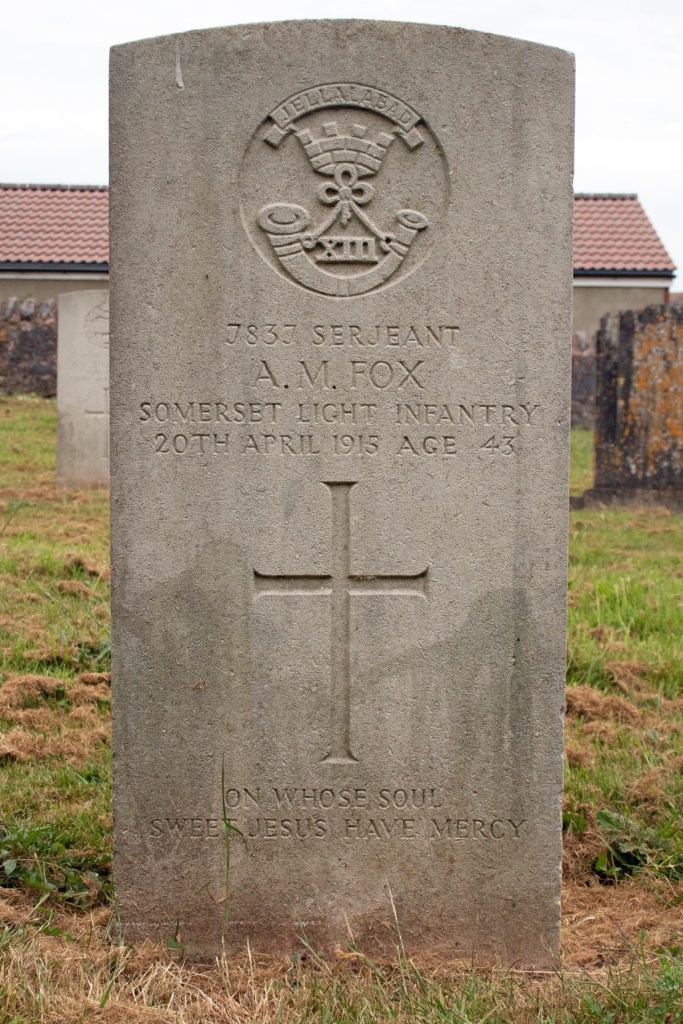
Serjeant Fox was assigned to the 7th (Service) Battalion, but was not to remain in his role for long. He contracted phthisis, or tuberculosis, and passed away from the condition on 20th April 1915, just weeks before his regiment departed for the Western Front. He was 43 years of age.

Andrew Michael Fox was laid to rest in the peaceful Cannington Cemetery, not far from the family home.


Private Andrew M Fox

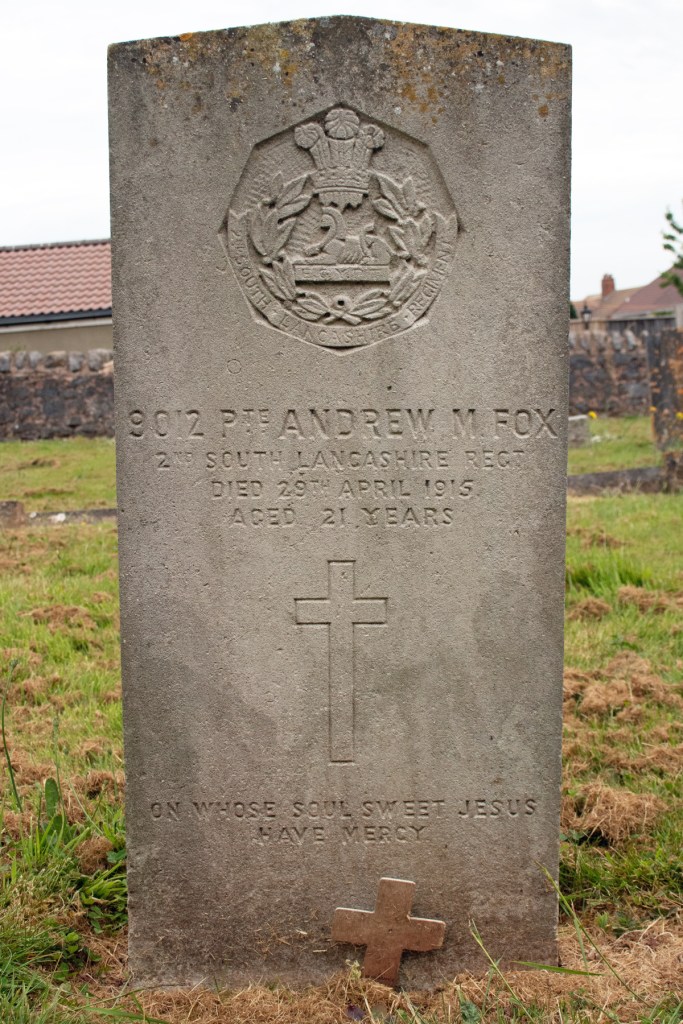
In the plot next to Serjeant Andrew Fox is another, similar headstone. Not quite having the same form as the Commonwealth War Grave Commission headstone that Serjeant Fox has, this is dedicated to a Private Andrew M Fox, of the 2nd South Lancashire Regiment.

Andrew Moyse Fox was the eldest son of Andrew and Kathleen. Born on 31st March 1894 in Ireland, he wanted to follow his father and grandfather into the army.

Andrew Jr enlisted in the South Lancashire Regiment in August 1908. His service records confirmed that he was just 14 years of age, standing 5ft (1.52m) tall, and weighing 5st 2lbs (32.7kg). He was noted as having dark brown hair, hazel eyes and a fresh complexion, and that he has a scar on his right buttock.

As is the case with his father, there is limited information about Andrew Jr’s army career. He spent just under six years serving with the regiment, and was formally mobilised when he came of age in 1912. On 27th March 1914, however, Private Fox was discharged from the army on medical grounds, for reasons unclear. The next record available for him is that of his passing, just nine days after his father. He was 21 years of age.

Andrew Fox Jr was laid to rest next to his father in Cannington Cemetery. The heartbreak for Kathleen, to have lost husband and oldest boy within two weeks, must have been indescribable. While her son’s headstone is similar in design to her husband’s, he was not subsequently entitled to an official Commonwealth War Grave, as he had left the army before the outbreak of war: the Commission’s qualification dates (4th August 1914 to 31st August 1921).


Serjeant Frederick Reid

Serjeant Frederick Reid

Frederick William Reid was born in January 1876 in Liverpool, Lancashire. Little information is available for his early life, and his trail only really becomes traceable when he joined the Royal Irish Regiment at the age of 16 years old.

Frederick’s service records confirm that his mother was called Elizabeth, who lived in Bedminster, near Bristol. He was already volunteering for the regiment when he enlisted, and was working as a musician when he joined up. His papers confirm that he was 5ft 4ins (1.63m) tall, and weighed 112lbs (60.8kg). He had brown hair, hazel eyes and a fresh complexion.

Frederick was given the rank of Drummer when he joined up and was attached to the Royal Irish Regiment’s 3rd Depot. He spent more than seven years on home soil, rising to the rank of Corporal in May 1898. The following January he reverted to the rank of Private at his own request, but his superiors obviously saw something in him, and he was supported in a new role – Lance Corporal – just a month later.

In October 1899, however, Frederick’s life was to take a new turn, when he was sent to India with his troop.

Corporal Reid was based in Lahore, and had found the life that he was seeking. Over the next forty months, he successfully took on a variety of clerical roles. He was promoted to Lance Sergeant in October 1901 and given oversight of the Officers’ Room.

In March 1903, Frederick returned to Britain. With the move came a further promotion, to the rank of full Sergeant, again, overseeing the Officer’s Room. He seems to have been based in Gloucestershire by this point, as, on 18th November 1903, he married Isabella Jane Parke at a Registry Office in Bristol. There is no further record for the young couple, however, so the new Mrs Reid is destined to remain a mystery.

Frederick was destined to return to India, and in January 1905, that is exactly what he did. His regiment returned to Lahore, and he was given the role of Clerk Steward at one of the Lawrence Memorial Asylum. The name is misleading, as the asylums were a series of four military-style boarding schools across India. Sergeant Reid’s records do not confirm which of the four he was attached to, but it would have been Sanawar, Mount Abu, Lovedale or Ghora Gali.

Given his military background, it seems that the role of clerk was something Frederick settled into quite happily. He was recalled back to army service in November 1909, and, within seven months, he requested a discharge from the army. This was granted, as he had, by this point, completed more than eighteen years’ service.

Frederick remained in India, however, and on 28th September 1913, he married Elizabeth Marshall in Lahore. They had two children, Florence, who was born in Quetta on 2nd September 1914, and Lily, who was born on 1st January 1916 in Lahore.

War had come to the world by this point, and in spite of his age – he was 39 by now – Frederick felt it only right to step up and play his part again. On 28th October 1914, he enlisted again, and was assigned to the 1st Battalion of the Duke of Wellington’s (West Riding Regiment). His new medical noted that he was 5ft 7ins (1.7m) tall, and weighed in at 9st (57.2kg). His complexion was recorded as pale, while he had a number of tattoos on his left forearm: the crossed swords, harp and crown of the Royal Irish Regiment, along with the initials VR.

While part of the West Riding Regiment, Sergeant Reid was attached to the 3rd Mule Corps of the Indian Supply & Transport Corps. He was involved in arranging provisions for the various battalions who needed them.

By March 1916, his battalion had been sent to Salonika, and it was here that Frederick contracted tuberculosis. Medically evacuated to Britain, he was admitted to the Southwark Military Hospital. He was confirmed as no longer being medically fit for army service and was discharged on 16th August 1916. His medical report noted that he “is anxious to have sanatorium treatment, but is not an insured man, owing to having been stationed in India.”

On his discharge, Frederick moved to Weston-super-Mare, Somerset, which is where his mother was by now living. His wife and children also came to live in England and, the family settled in Pawlett, near Bridgwater.

After leaving the army, Frederick’s trail goes cold. The next confirmation of his life is that of his passing. He died on 12th October 1919, presumably from his lung condition. He was 43 years of age.

Frederick William Reid, who had been born in Liverpool, who had had two separate careers in the army, and who had lived and married in India, was laid to rest in the peaceful graveyard of St John the Baptist’s Church in Pawlett, Somerset.


Private Stanley Biffen

Private Stanley Biffen

Stanley George Oliver Biffen was born in the autumn of 1894 in the Somerset village of East Huntspill. He was the second child to Oliver and Fanny Biffen, although his older sibling, sister Florence, had passed away at just three months of age.

Oliver was a carter and farm labourer, and the family went where the work was. The 1901 census found them living in Eastover, Bridgwater, Fanny’s widowed father, George, also living there. Ten years later, the four of them had moved to the village of Stawell. Stanley had finished his schooling, and had also taken up farm work.

When war came, Stanley stepped up to play his part. Full details of his service are lost to time, but he had enlisted in the Army by the spring of 1915. He initially joined the 1st Battalion of the Somerset Light Infantry, and by May that year, was in France.

It is not possible to track Private Biffen’s movements during the conflict, but he did transfer across to the Gloucestershire Regiment at some point. Assigned to the 7th (Service) Battalion, his was a troop that served at Gallipoli and in North Africa, although there is no evidence that Stanley fought in there.

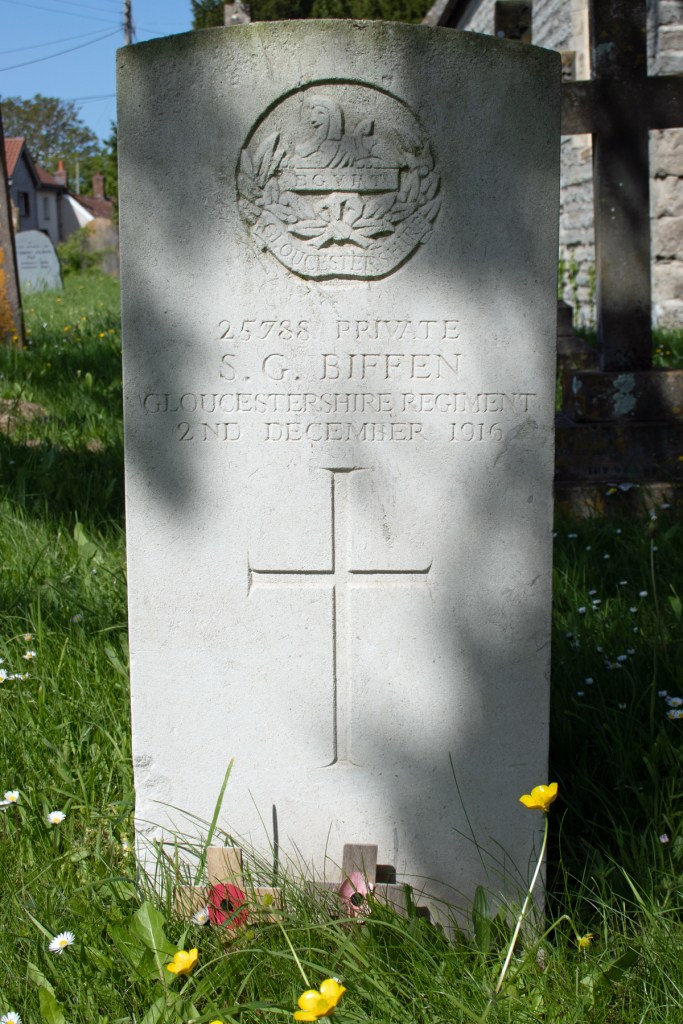
The only other concrete evidence available for Private Biffen relates to his passing. By the autumn of 1916, he had been admitted to the 1st Western General Hospital in Fazakerley, Liverpool. He was suffering from phthitis, or tuberculosis, and this was the condition that was to get the better of him. He passed away on 2nd December 1916, at the age of just 22 years old.

The body of Stanley George Oliver Biffen was brought back to Somerset for burial. He was laid to rest in the quiet graveyard of Stawell Church.


Stanley’s parents had now lost both of their children, and this is likely to have taken a toll on them. Fanny passed away in December 1924, at the age of 64 years old. Oliver died just a year later aged 54 years old.


Gunner Valentine Wilkinson

Gunner Valentine Wilkinson

Valentine Burnett Wilkinson was born early in 1889 in Combe Down, Somerset. One of eight children, his parents were Harry and Eliza Wilkinson, Harry was from nearby Bath and worked as a gardener, and this is the trade into which Valentine also went when he finished school.

In the spring of 1913, Valentine married Florence Moody. She was the daughter of a stone mason and, at the time of the 1911 census, she was employed as a live-in sewing maid at Monkton Combe Junior School.

Gardening seems to have been a footstep to something bigger for Valentine, and he soon found other employment, as a police constable. He and Florence moved to Street, near Glastonbury, and this is where they were living when war broke out.

Keen to play his part, Valentine enlisted in the Royal Garrison Artillery on 11th December 1915. He was placed on reserve, possibly because of his occupation, and was not formally mobilised until the end of June 1917, just six weeks after Florence had given birth to their first and only child, Joan.

Gunner Wilkinson’s service records note that he was 5ft 11ins (1.8m) tall, and had a scar on his right wrist. He spent five months training, split between No. 3 Depot in Plymouth, Devon, 473 Siege Battery and No. 1 Reinforcing Depot in Bexhill-on-Sea, Sussex. On 3rd November 1917, however, he was sent to France, and was attached to the 234th Siege Battery.

Gunner Wilkinson’s time overseas was to be brief, however. He was caught up in a gas attack in December, and evacuated back to Britain for treatment. His health was now impacted and, during the summer of 1918, he was admitted to hospital having contracted pleurisy. After two months in hospital, Valentine was sent to the Military Convalescent Hospital in Ashton-in-Makerfield, near Wigan.

The war was in its closing stages by this point, and in November 1918 Gunner Wilkinson resumed some of his duties, albeit on home soil. His health was still suffering, and he contracted tuberculosis on the lung and throat. He was formally discharged from the army on 27th February 1919, no longer physically fit to serve.

Valentine returned home to Somerset, and it was here, on 1st April 1919, that his body finally succumbed to the lung conditions that had dogged him for nearly eighteen months. He was just 30 years of age.

Valentine Burnett Wilkinson was laid to rest in the quiet graveyard of St Michael’s Church in the parish of his childhood home, Monkton Combe.


Private John Maguire

Private John Maguire

John Maguire was born in Dublin, Ireland, in 1874. There is scant information about his life, and his name is too common to be able to narrow down details of his family.

The only documentation that links to his life is that of his army service. He was working as a labourer when he enlisted in the Royal Army Medical Corps on 27th April 1918. His service records confirm he was 5ft 7ins (1.7m) tall, with blue eyes, grey hair and a sallow complexion. Interestingly, he reported that he did not have any next-of-kin.

Private Maguire seemed to serve on home soil, and was primarily based in Lancashire. It was while here in the January of 1919 that he fell ill with nephritis – kidney disease – and was admitted to the hospital on Adelaide Street, Blackpool.

His condition was such that it led to John’s discharge from military service on medical grounds. On 23rd February he was moved to the 2nd Southern General Hospital in Bristol, and two days later he left army life. John was transferred to the War Hospital in Bath a couple of weeks later, and it was here that he passed away on 16th April 1919. He was 45 years of age.

An addition to John’s initial service records noted that a next-of-kin had been confirmed, and so Mary Prestige, who was living in Bedminster, to the south of Bristol, was informer of her friend’s death.

Respecting the Irishman’s religion, John Maguire was laid to rest in the Roman Catholic Cemetery in Bath, the city in which he died.


John’s friend, Mary Prestige, is also destined to remain a mystery. There are no records of her at the address John’s service records provide – Pipe Cottage, North Street, Bedminster.

There are two census records for Somerset for a Mary Prestige: 1901 records a Durham-born 18 year old Mary working as one of a number of laundry maids at the Marlborough Hill House of Refuge in Bristol.

The 1911 census records the same Mary Prestige visiting a William and Amelia Hockerday in Yatton, Somerset. It is impossible to confirm, however, whether this is the woman John notified the army as his next of kin.


Sergeant Herbert Rendall

Sergeant Herbert Rendall

Herbert Edward Rendall was born in West Coker, Somerset, in the autumn of 1889. He was one of eight children to William and Mary Rendall. William was a foreman at a local twine factory, although by the time of the 1911 census, he had also taken on ownership of a local grocer’s shop. Herbert and his younger brother, Clifford, managed the shop for their father.

In the spring of 1913, Herbert married Thirza Shire. She was the daughter of an agricultural labourer from Yeovil and, by the time of their marriage, she had taken on work as a servant for the vicar of St Leonard’s Church in Misterton, near Crewkerne.

When war was declared, Herbert joined the Somerset Light Infantry. Sadly, little detail of his military service remains. It is clear that he was hard working and well thought of, as he progressed through the ranks to Sergeant, and transferred to the 1st Battalion of the Wiltshire Regiment.

Herbert served on the Western Front, and, as the war entered its final months, he would certainly have been involved in the Battles of the Lys, on the Hindenburg Line and in the closing Battles of the Somme.

By the autumn of 1918, Sergeant Rendall was back on home soil, either for home support, or for medical reasons. He was based in Bury, Manchester, and had fallen ill. While the full details are unclear, whatever condition he had contracted got the better of him, and he passed away on 4th November 1918. He was 29 years of age.

Herbert Edward Rendall was brought back to Somerset for burial. He was laid to rest in the quiet graveyard of St Martin’s Church in West Coker.


Records vary over the date of Herbert’s passing. While his headstone confirms 4th November, military records – and the Commonwealth War Graves Commission website – suggest the following day. Similarly, some documents suggest he was 30 when he died, while his birth and death records confirm he was in his thirtieth year.


Thirza went on to have a full life. She married again in 1923, to a Henry Tregale, and the couple went on to have a daughter. She lived to a ripe age, passing away in the autumn of 1981, at the age of 93.