Tag Archives: Oxfordshire and Buckinghamshire Light Infantry

Private Edward Vale

Private Edward Vale

Edward Charles Vale was born in the spring of 1890, one of ten children to William and Ellen. Born in Cambridgeshire, William was employed by the local railways, becoming a signalman by the time of the 1901 census. The family were raised in Great Shelford, before moving to the Ely area in the early 1900s.

By the time of the 1911 census, Edward was the oldest of three of his siblings to still be living at home. The Vales were living at 12 Granta Terrace, Stapleford, and Edward was employed as a domestic gardener.

When war broke out, Edward volunteered to serve his country. Full service details are lost to time, but he had enlisted in the Royal Fusiliers by the spring of 1915. By June of that year, Private Vale was fighting in the Balkans.

At some point during the conflict, Edward transferred to the Oxfordshire & Buckinghamshire Light Infantry. He remained in the Easter Mediterranean, but was badly wounded in the summer of 1917.

Medically evacuated to Britain, Private Vale was admitted to the Voluntary Aid Detachment hospital that had been set up at Knightshayes Court, Devon. While details are unclear, Edward’s injuries were to prove too severe. He passed away on 9th October 1917, at the age of 27 years old.

Edward Charles Vale was laid to rest in the peaceful graveyard of St Thomas’ Church in Chevithorne, not far from the hospital in which he had passed.


Private Francis Hill

Private Francis Hill

Francis Robert Hill was born in the spring of 1868, the middle of seven children to William and Mary Hill. William was a shoemaker from Wiveliscombe, Somerset, and this is where he and Mary raised their family.

When Francis finished his schooling, he found work as a baker. However, he wanted bigger and better things and, in June 1886, he enlisted in the 1st Battalion of the Oxfordshire Light Infantry. Private Hill would have cut a striking figure: at eighteen years old, he was 5ft 10ins (1.78m) tall and weighed 136lbs (62.6kg). He had light brown hair, grey eyes and a fair complexion.

Francis did not spend any time overseas, instead working in the regiment’s depot in Alverstoke, near Gosport, Hampshire. He spent seven years in the military, and was stood down on 16th June 1893.

By the end of 1895, Francis was back in Somerset as, on Boxing Day that year, he married Florence Ida Giles, a shoemaker’s daughter. The couple were both living in Milverton at the time, and Francis’ profession was noted as storekeeper. On 23rd November 1896, the couple had a son, Harold, and the family were living on Fore Street, the village’s main road.

The 1901 census shows another change in work for Francis, who was now noted as being a house painter. This was a career that seemed to stick with him, as he was still employed in the role by the time of the next census, in 1911. The Hills had moved to Staplegrove, on the outskirts of Taunton, by this point. Florence had taken in work as a glove maker, Harold, now 14 years old, was employed as an office boy, and the family had a boarder, Reginald Cave, who was a nursery foreman.

At this point Francis’ trail goes tantalisingly cold. When war broke out, he enlisted once more, this time joining the Somerset Light Infantry. The only other confirmed document gives a tragic hint as to his death, at the age of 48. His entry in the Pension Ledger reads simply “18.2.16: Accidentally killed by passing train while on military duty.” There are no other records to back this up, and no contemporary newspapers report on his passing.

However it happened, Francis Robert Hill’s body was brought back to Somerset for burial. He was laid to rest in the graveyard of St John’s Church, Staplegrove. His grave is lost to time, but he is commemorated on a special memorial, close to the entrance of the church.


Tragedy was to strike a second time for Francis’ widow, Florence, when, in October 1916, Harold was also to pass away. Read his story here.


Private Arthur French

Private Arthur French

Arthur John French was born on 3rd September 1889 in the Somerset village of Merriott. He was the youngest of three children to John and Annie French. John was a miller and baker in the village, and Arthur’s older brother Edward helped his father with the business. Arthur, however, followed a different path and, with Annie passing away in 1903, he had moved to London for work.

The 1911 census recorded Arthur boarding with his maternal aunt and uncle, who were both schoolteachers. He had found employment as a clerk in the head office of the National Telephone Company and shared the large terraced house with the couple, their son Alfred and their servant, Esther.

When war was declared, Arthur was in the first wave of those enlisting. He joined the Oxford & Bucks Light Infantry and, as a Private, was assigned to the 2nd/4th Battalion. Initially sent to Northampton for training, his troop soon came south again and, by April 1915, was based just outside Chelmsford, Essex.

Tightly-packed barracks, housing men from across the country soon became hotbeds for illness and disease, and Private French was not to be immune. He contracted meningitis, and was admitted to the 3rd London General Hospital in Wandsworth for treatment. Sadly he was to succumb to the condition, and he breathed his last on 16th April 1915, at the age of just 25 years old.

Arthur John French’s body was brought back to Somerset for burial. He was laid to rest in the graveyard of All Saints’ Church in his home village, Merriott.


Corporal George Budgett

Corporal George Budgett

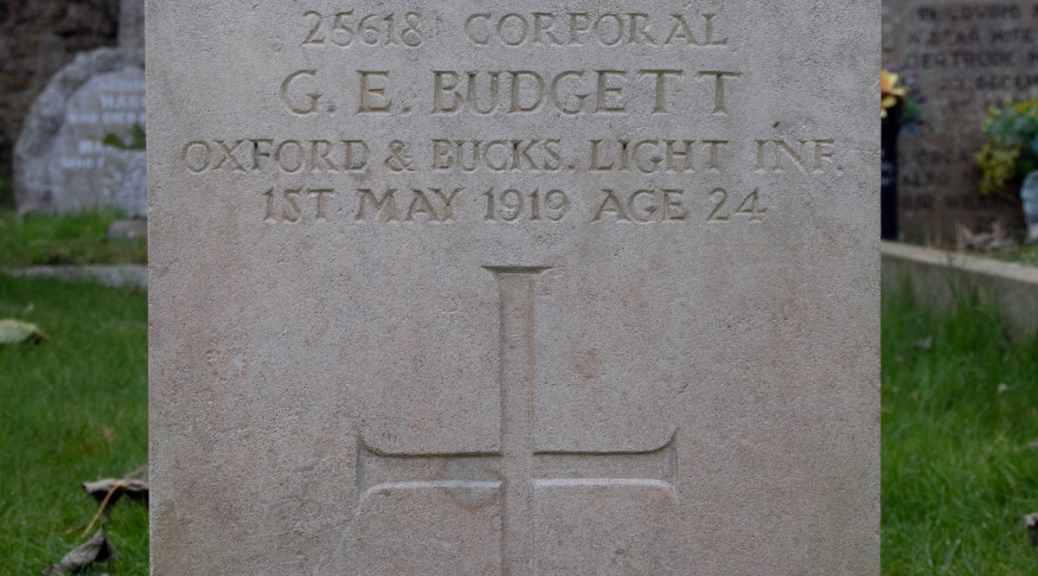
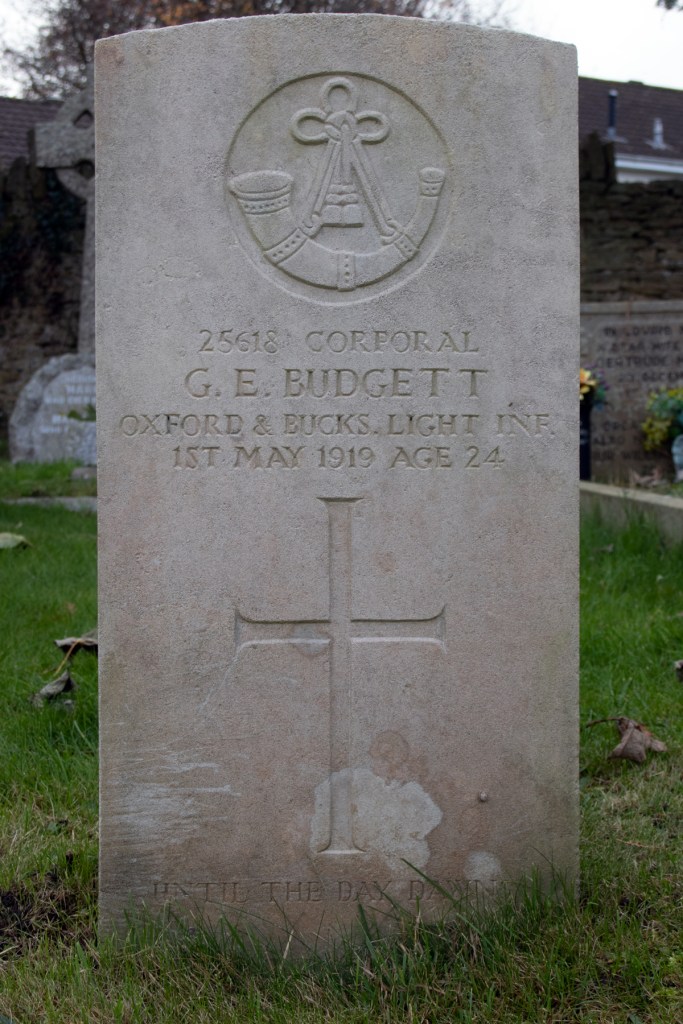
George Edgar Budgett was born in Frome, Somerset in the autumn of 1894, and was one of ten children to Joseph and Annie Budgett. Joseph was a labourer on the roads, but Annie and their eight daughters all went into the town’s silk weaving industry. When they left school, George and his older brother Frederick both found labouring work – Frederick at a bell foundry, George in the silkworks.

Conflict was coming to Europe and, within weeks of the war being declared, George enlisted. He was assigned to the Oxfordshire & Buckinghamshire Light Infantry as a Private and his service records show that he stood 5ft 5ins (1.65m) tall, weighed 114lbs (51.7kg), had dark brown hair and brown eyes.

Private Budgett initially served on home soil, but by May 1915 he was sent to France as part of the British Expeditionary Force, receiving a promotion to Corporal in the process. He had been on the front line for a little over a month when he was wounded at Ypres. He received a shrapnel wound to his left hand and had to have his little finger amputated in the camp hospital. He was then medically evacuated back to England for further treatment and recovery.

George was admitted to the City of London War Hospital in Epsom, and needed a further operation, this time the amputation of the third finger. His health recovered, but the injury to his hand resulted in him being medically discharged from the army on 25th August 1916.

Sadly, at this point Corporal Budgett’s trail goes cold. He passed away at home, through causes unrecorded, on 1st May 1919. He was just 24 years of age.

George Edgar Budgett was laid to rest in the graveyard of Holy Trinity Church in his home town of Frome, Somerset.


George’s brother Frederick – Joseph and Annie’s only other son – also fought in the First World War. He was assigned to the 14th Battalion of the Gloucester Regiment, and was missing in action, presumed dead on 4th April 1918 – possibly during the Battle of the Avre. He was commemorated at the Pozières Memorial in northern France.


Corporal Henry Forrest

Corporal Henry Forrest

Henry Charles Forrest was born in Bromley, Kent, in the summer of 1893. The youngest of eight children to William and Wilhelmina Forrest, Henry’s father was a police sergeant, who retired not long after his youngest son’s birth, moving his family to Worthing in West Sussex.

Henry was obviously a bright lad; the 1911 census records him as a student teacher. The only one of William and Wilhelmina’s children still living at home, he was, by this point, still just 17 years old. His career continued over the next few years, and he taught at the Ham Road Schools in Worthing.

In the spring of 1916, Henry married Constance Robertson. The young couple had a lot in common and seemed like a perfect match. Constance was the daughter of a retired police constable, and was also a student teacher.

War, by this time, had come to Europe. Full details of Henry’s military service are not available, but it seems that he initially joined the Oxfordshire and Buckinghamshire Light Infantry. Private Forrest was promoted to the rank of Corporal, and subsequently transferred to the Army Cycling Corps, serving in France.

As the war moved on, Corporal Forrest was released to resume his teaching back in Worthing but, in the autumn of 1918, he contracted influenza and pneumonia. The conditions got the better of him, and he passed away on 5th December 1918, at the age of just 25 years old.

Henry Charles Forrest was laid to rest in the Broadwater Cemetery in Worthing; sadly, it seems that Constance was unable to attend – she was represented at the ceremony by her mother.


Private Charles Dibble

Private Charles Dibble

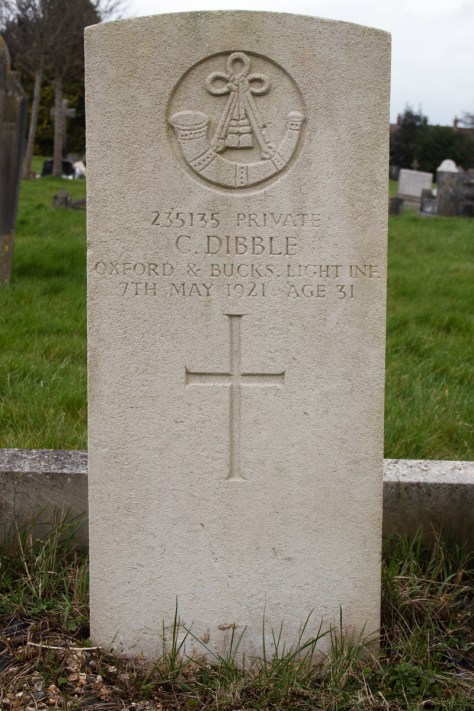
Charles Lang Dibble was born in 1890, one of nine children to Evan and Eliza Dibble from Bridgwater in Somerset. Evan was a labourer in a brickyard, and clay must have been run through the family’s veins, as Charles found employment as a kiln hand in a local tile maker when he left school.

By the 1911 census, Charles was boarding with William Rainey and his family in Bridgwater; whether there was a connection before he moved in or not, I don’t know, but the following year he married one of William’s daughters, Constance. The young couple wed on Christmas Day 1912 and went on to have one child, Charles, who was born in 1915.

Full details of Charles’ military service are not available. However, when he enlisted, he initially joined the Somerset Light Infantry, before transferring to the Devonshire Regiment and finally the Oxfordshire and Buckinghamshire Light Infantry. During his service, he was awarded the Victory and British Medals, but there is little further information about Private Dibble.

Charles survived the war, but his pension records confirm that he passed away on 7th May 1921; the cause of death was noted as exhaustion and sarcoma of the rectum. He was 31 years old.

Charles Lang Dibble lies at rest in St John’s Cemetery in his home town of Bridgwater.