Tag Archives: Palestine

Chief Yeoman of Signals Charles Welling

Chief Yeoman of Signals Charles Welling

Charles James Welling was born on 23rd October 1860, and was the oldest of three children to Charles and Ann Welling. The Wellings were a military family, Charles Sr employed as a Serjeant Instructor of Musquetry in the Parkhurst Barracks on the Isle of Wight when his son was born.

Ann had been born in South Africa while her Irish parents were based out there. She and Charles Sr married in Farnham, Surrey, presumably where the families were based by that point.

Charles Jr’s mother died in 1863, just a month after giving birth to his youngest sibling. His father married again, to Sarah Ash, and by 1871, the Wellings were living in barracks at the School of Musketry in Hythe, Kent.

Being his father’s son, Charles Jr was set to make his own mark on the world and, on 21st January 1876, he joined the Royal Navy. Too young to formally enlist, he was given the rank of Boy 2nd Class, and sent off to HMS Impregnable, the shore base in Devonport, Devon, for his training.

Over the next eighteen months, Boy Welling learnt his trade, spending time at HMS Ganges – another shore base near Ipswich, Suffolk – and the sloop HMS Penguin. It was here that Charles came of age in 1878, and he officially joined the Royal Navy with the rank of Ordinary Seaman. His service papers show that he was just 4ft 10.5ins (1.49m) tall, with light brown hair, blue eyes and a fair complexion.

Ordinary Seaman Welling career was to take a turn in 1880, when he began training as a signaller. His initial contract with the navy was for ten years, and, by the time that came to an end in May 1889, he had served on eight ships in all, rising through the ranks from Signalman 3rd Class, to Signalman 2nd Class in August 1881 and Qualified Signalman seven years later.

When Charles’ term of service came to an end, he immediately renewed it, and with the new contract came a promotion to Leading Signalman. The next decade saw him travel the world, returning to HMS Pembroke, the Royal Naval Dockyard in Chatham, Kent, in between voyages. His commitment to the role paid off: in March 1894 he was promoted to 2nd Class Yeoman of Signals. Just eight months later he took the rank of Yeoman of Signals.

It was around this time that Charles married the love of his life, Harriet Carlaw. Born in London, the couple exchanged vows in St Pancras, Middlesex, on 13th January 1894 and had a son, also called Charles, the following year.

Charles’ naval career continued its upward trajectory, and on 1st March 1898, he was awarded the rank of Chief Yeoman of Signals. By this point HMS Pembroke had become his permanent base and, at the end of his contract in 1899, he was stood down to reserve status.

The 1901 census shows what may have been a downward step for the Wellings: it recorded the family living in rooms at 136 Bayham Street, Camden, Middlesex, where Charles was working as a messenger.

Opportunities come in the most unexpected of places, however, and the following census found them living at Pier House, Sunderland, Tyne and Wear, where Charles was employed as a lighthouse keeper.

By this point, Charles had been invalided out of the navy for medical reasons. The writing on his service papers is unclear, and his dismissal seems to have been as a result of disease of gestes, possibly the neurological disorder dystonia.

When war broke out in 1914, however, anyone with experience was called upon to play their part. Given his age at the time, it seems likely that Charles volunteered for service, reporting to HMS Pembroke on 2nd August 1914. He was given his old rank of Chief Yeoman of Signals, and remained at the naval base for the next two years.

Charles’ health was definitely suffering by this point, and he was admitted to the Royal Naval Hospital in Chatham, in September 1916. Suffering from the heart condition endocarditis, this would take his life. He passed away on 16th September, at the age of 55 years old.

With Harriet still living in Sunderland, Charles’ body was laid to rest in Woodlands Cemetery, Gillingham, Kent, not far from the base he had called home for so long.


Charles and Harriet’s son had also stepped up to play his part when war broke out. Enlisting in the Royal Engineers, Pioneer Welling soon found himself in the Middle East. While serving in Palestine, he contracted malaria, and passed away from the condition on 16th October 1918. Charles was just 23 years of age, and was laid to rest in Haifa War Cemetery.

It is tragic to note that Harriet had lost her husband and her son within two years.

Trooper James Hughes

Trooper James Hughes

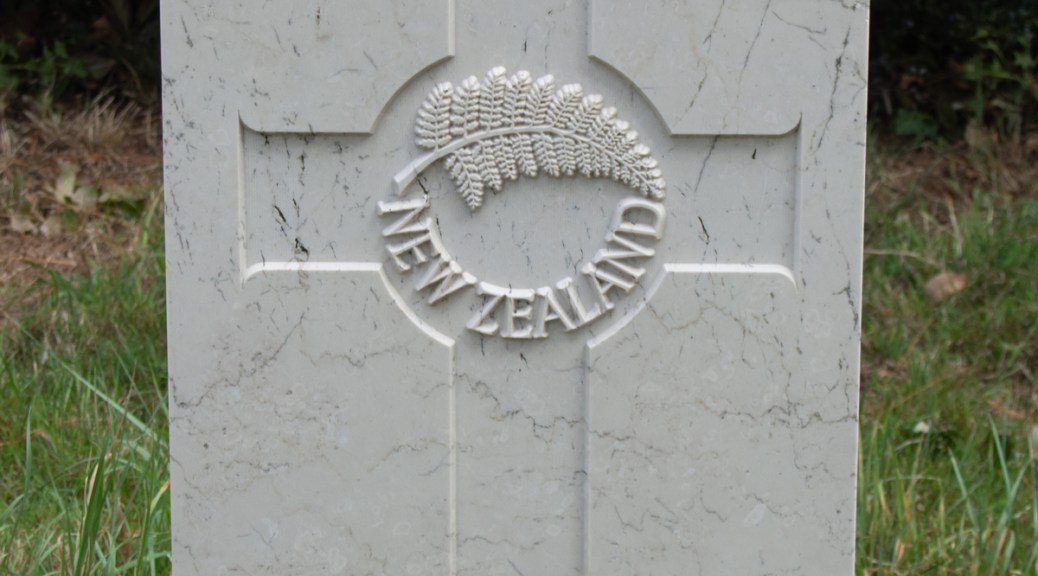
James Hughes was born on 12th November 1884 in the town of Kapuni, New Zealand. One of eleven children, his parents were Daniel and Margaret – or Peggy – Hughes. There is little specific information about James’ early life, but the service records he completed when he enlisted for the army confirms that he was working as a farmer by the summer of 1914.

James enlisted on 18th December 1914. He had had some voluntary experience with the army before the war, and was assigned to the New Zealand Wellington Mounted Rifles as a Trooper. His medical exam confirmed he was 5ft 10ins (1.77m) tall and weighed 174lbs (78.9kgs). He was noted as having brown hair, hazel eyes and a fair complexion.

Trooper Hughes and his unit set sail sailed for the Mediterranean in April 1915, finally arriving in the Dardanelles by the summer. There is little specific confirmation of his movements, but he was reported wounded at Anzac Cove on the Gallipoli peninsula on 27th August. Medically evacuated to Mudros (Moudros) on Greek island of Lemnos. He had received a gun shot wound that fractured his skull, and was shipped back to England for ongoing treatment.

James was admitted to the American Women’s War Hospital in Paighton, Devon. This was based at Oldham House, which had been conscripted for use from Paris Singer, part of the sewing machine manufacturing family.

Trooper Hughes’ wounds would ultimately prove too severe. He died from his injuries on 17th October 1915: he was a month short of his 31st birthday.

Yesterday, at Paignton, the funeral took place of Trooper James Hughes, of the Wellington (New Zealand) Mounted Rifles, who died on Sunday at Oldway Hospital… He was wounded in Gallipoli, the wound being perilously near the brain, and recover was hopeless from the first. However, he lingered for six weeks. Deceased being a Roman Catholic, Father Kirk officiated at the Roman Catholic Church and at the cemetery. Several members of the 7th Devon Territorials, under Captain Hunter, were present, as well as a firing party of the Battalion, and a party of wounded from Oldway and The Larches Hospitals also attended. At the graveside the firing party fired three volleys, and the bugles sounded the Last Post.

[Western Times: Wednesday 20th October 1915]

With his family thousands of miles away, James Hughes was instead laid to rest in Paignton Cemetery, not far from where he had spent his last days.


James’ younger brother Charles also fought in the Great War. Serving in the same regiment as his brother, he was injured in the Middle East, and died of his wounds on 19th April 1917: he was 25 years of age. Trooper Charles Hughes was buried in Gaza Cemetery.


Oldway Mansion, Paignton. It was taken over for war service from Paris Singer, of the sewing machine family, and became the American Women’s War Relief Hospital during the First World War.

Lieutenant Vincent Mellor

Lieutenant Vincent Mellor

Vincent Charles Serocold Mellor was born in Chelsea, Middlesex, in the spring of 1897. The younger of two children, his parents were Chief Solicitor to the Treasury – and later Sir – John Paget Mellor and his Australian-born wife, Mabel. The 1901 census recorded the family living on Chelsea Embankment, with four servants: a cook, a nurse and two housemaids.

For someone with a relatively high standing in Edwardian England, there is surprisingly little documentation relating to Vincent – who was known as Vin. His name does not appear in the 1911 census, although nor does his family.

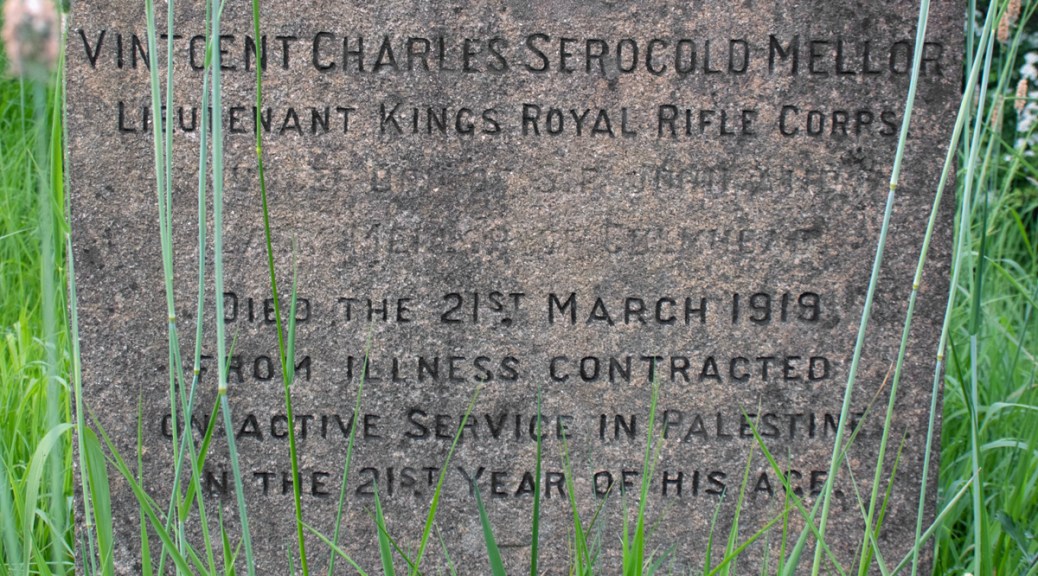
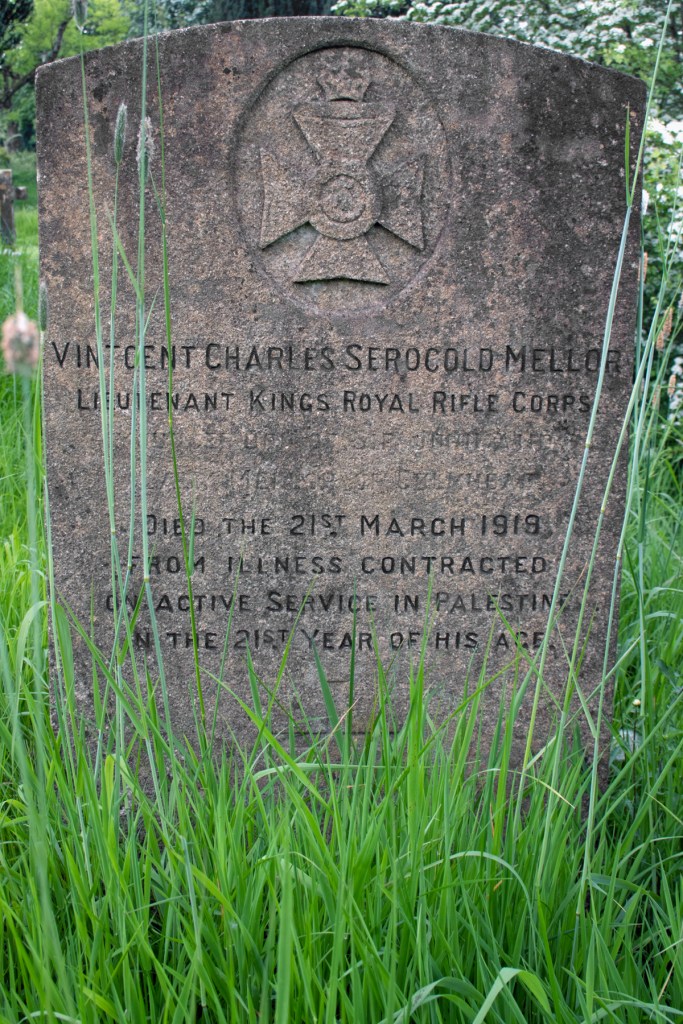
At some point, Vincent was given a commission in the King’s Royal Rifle Corps, but his service records are lost to time, which makes it impossible to find any specific information about his military career. Lieutenant Mellor’s headstone confirms that he served in Palestine, and that he fell ill while in the Middle East.

Vincent returned to Britain for treatment, and was admitted to the Red Cross Hospital for Officers in Portland Place, London. Whatever his condition, he was to succumb to it: he passed away on 21st March 1919, aged just 20 years of age.

Vincent Charles Serocold Mellor was brought back to Somerset for burial. He was laid to rest in the peaceful graveyard of St Paul’s Church in Churchstanton, close to the family’s country home, and the same church in which he had been baptised two decades before.


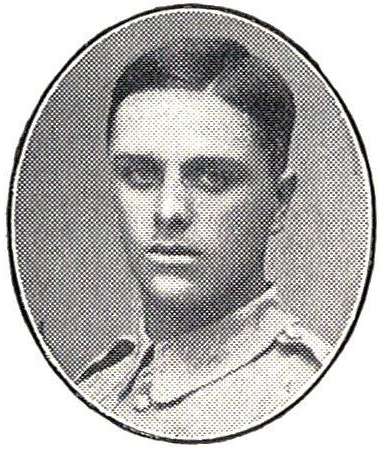
Lieutenant Vincent Mellor
(from findagrave.com)

Private Arthur King

Private Arthur King

Arthur Thomas Rendell King was born early in 1896, the oldest of six children to Thomas and Bessie King. Engine driver Thomas had been born in London, but, after marrying his wife the year before Arthur was born, he settled in Highweek near Newton Abbot, Devon.

When he left school, Arthur followed his father in working for Great Western Railways, working as a carriage cleaner at the town’s depot. War was on the horizon, however, and he enlisted in the Devonshire Regiment shortly after conflict was declared.

Private King was assigned to the 1st/5th Battalion and sailed for India in October 1914, arriving in Karachi a month later. After nearly three years, his regiment moved again, this time to Egypt, in advance of action in the Middle East.

Involved in the Battle of Nebi Samwil in November 1917, Arthur was badly wounded – and initially recorded as missing, presumed dead. However, he was found, and evacuated to England. Tragically, within hours of being admitted to a hospital on home soil on 31st January 1918, Private King died of his injuries. He had just turned 22 years of age.

Arthur Thomas Rendell King’s body was brought back to Devon for burial. He was laid to rest in the family grave in the graveyard of All Saints Church, Highweek.


Private Arthur King
(from findagrave.com)