Much of the life of William Charles Taylor is destined to remain lost to time. His Commonwealth War Grave Commission and military records give his father as Henry Taylor, while another document suggests his mother’s initial was E, but no birth, baptism or census records match the three names given.
The document that can be directly attributed to William is his military service records. They confirm that he enlisted in Bath, Somerset, on 18th February 1916, joining the Somerset Light Infantry. The document notes that he was 21 years and 7 months old when he enlisted, and stood 5ft 7ins (1.7m) tall.
Initially assigned to the 10th Battalion of the Somerset Light Infantry, within a couple of months, Private Taylor was transferred across to the Durham Light Infantry in July 1917. He remained on home soil for the duration of his time in service, and was moved across to the Labour Corps in March 1918.
By May that year, William had become unwell. He was based in Essex at this point, and was admitted to the Warley Military Hospital in Brentwood, suffering from tuberculosis. He spent six weeks in hospital, before finally being discharged from the army as he was no fit for military service.
At this point, William’s trail goes cold once more. He seems to have returned home to Bath, finally succumbing to tuberculosis on 15th September 1918. He was just 24 years of age.
William Charles Taylor was laid to rest in Bath’s Twerton Cemetery.
The youngest of three children to William and Annie, Walter Harold Fry was born in the summer of 1897 in Shepton Mallet, Somerset. William’s job as a railway guard and porter meant the family moved around the area and, by the time of the 1901 census, they had settled in Twerton, to the west of Bath.
Little information is available about Walter’s early life and, indeed, documents from that time seem to record him as both Walter Harold and Harold Walter. When war came to Europe, He was keen to serve his country, presumably because his older brother, William Jr, was already serving overseas in the Somerset Light Infantry.
Walter enlisted in the Gloucestershire Regiment, and, as a Private, was assigned to the 4th (City of Bristol) Battalion. His initial training took place in Wiltshire and Essex, but by March 1915, the battalion had been sent to the Western Front.
Private Fry’s service records no longer exist, by his headstone, in the family plot, suggests that he was injured in France in March 1916. He was medically evacuated back to Britain, although, again, details are sketchy, and admitted to a military hospital in Aldershot, Hampshire.
At this point, Walter’s trail goes cold. The next record for him is that of his passing, while still admitted to the hospital, on 31st December 1916. He was just 19 years of age.
The body of Walter Harold Fry was brought back to Somerset for burial. He was laid to rest in Bath’s Twerton cemetery, a short walk from the family home.
Walter’s brother William had enlisted in the Somerset Light Infantry by 1911. That year’s census recorded him as being billeted at St Andrew’s Barracks in Malta, but by the time war broke out, his troop, the 2nd Battalion, was based in Quetta, India.
He remained based in this far outpost for the duration of the conflict and, while his service records are no longer available, he seemed to have been dedicated to his job as, by October 1918, he had risen to the rank of Sergeant.
William was based in Rawalpindi by that point, and it was here that he died, through causes unknown, on 31st October 1918. He was 26 years of age.
Buried in Rawalpindi Military Cemetery, Sergeant William Fry is also commemorated on the family grave in Twerton.
Thomas Alfred Parsons was born in the summer of 1885 in Twerton, Somerset. One of six children, his parents were railway engine driver William Parsons and his wife, Mary. When Thomas finished his schooling, he found work at a labourer at a mineral water supplier, something he continued doing through to the outbreak of war.
On 27th May 1912, Thomas married Lily Howell, a labourer’s daughter, the couple tying the knot in Twerton parish church. They were living in Charlton Buildings, next to the river and now student accommodation for Bath’s universities. Lily had had a son, in November 1905: young Ronald was either Thomas’, or he was accepted as his own.
When war came to Europe, Thomas stepped up to play his part. He enlisted on 11th December 1915, although he was not formally mobilised until six months later. Private Parsons initially joined the Devonshire Regiment, but by early 1917, he became attached to the 169th Labour Corps.
Sent to France in February that year, Private Parsons only remained overseas for a matter of six months. By early September Thomas had fallen ill, contracting a combination of bronchitis and phthisis (or tuberculosis). Medically evacuated back to Britain, he was admitted to a hospital in Plymouth, Devon, but grew weaker until, on 2nd October 1917, he passed away. He was 32 years of age.
The body of Thomas Alfred Parsons was taken back to Somerset for burial. He was laid to rest in Twerton Cemetery, not far from his widow’s home.
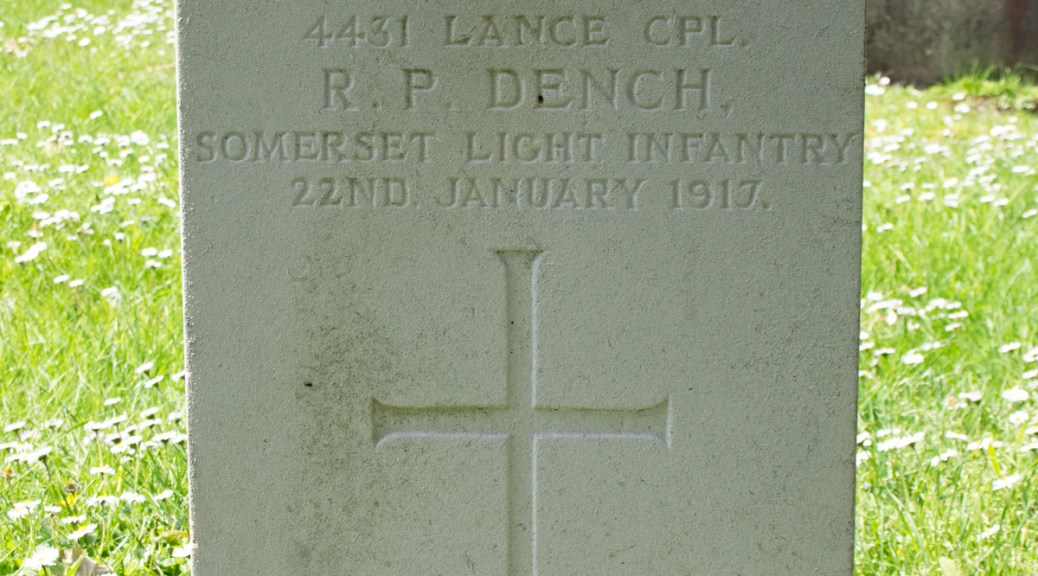
Reginald Percy Dench was born in the spring of 1884 in Twerton, Somerset. He was one of seven children to Henry and Jane – known as Lily – Dench. Henry was a shoe maker turned cloth dyer, but Reginald found work as a stone mason when he finished his schooling.
War came to Europe in 1914, and Reginald stepped up to play his part. His full service details are no longer available, but from what remains it is clear that he had enlisted in the Somerset Light Infantry by the summer of 1916. He was attached to the 5th Battalion, which spent of the conflict in India and Egypt, but there is nothing to confirm that Private Dench served overseas.
Reginald earned a promotion during his military career, and, by the end of 1916 was a Lance Corporal. By this point, however, he had fallen ill, contracting pleurisy. He was, by this point, back in Somerset, and it is likely that he was admitted to the Bath War Hospital. The condition was to get the better of him, and he passed away on 22nd January 1917. He was 32 years of age.
Reginald Percy Dench was laid to rest in Twerton Cemetery, a short walk from the family home in Mill Lane, and close to his two brothers, Edmund and Edward, who had died some twenty years before, while still children.
Tragedy was to strike again for the Dench family when, just six weeks after Reginald’s passing, Henry also died. He was laid in the same cemetery, not far from his sons. When Lily passed away in 1924, she was also buried in Twerton Cemetery, reunited with her family once more.
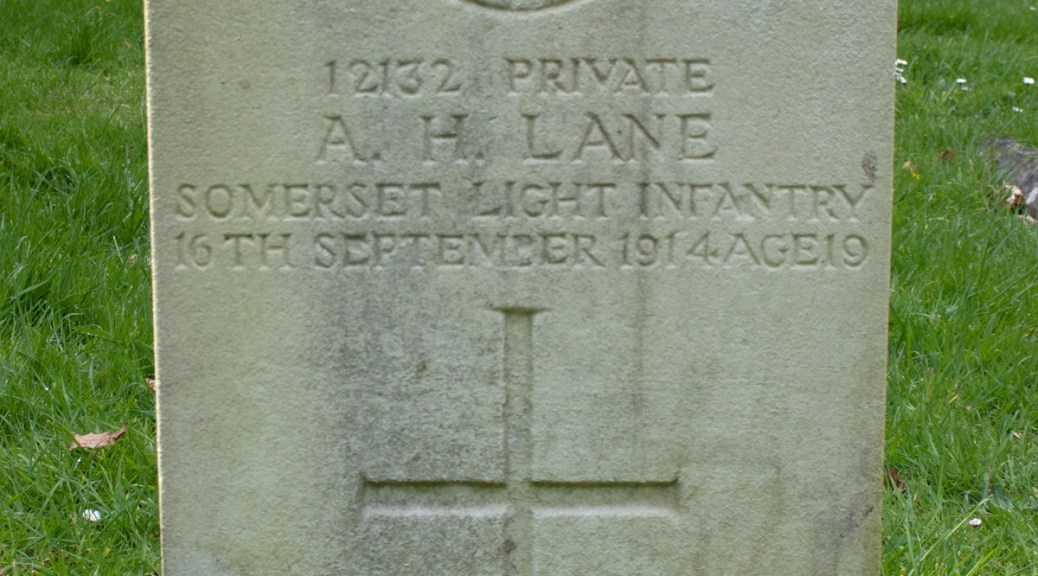
Arthur Henry Lane was born in the summer of 1895, the third of eight children to Henry and Ada Lane. The family were initially born and raised in Templecombe, Somerset, before moving to Bath in the early 1900s.
Henry was employed as an engine driver for Great Western Railways and, after initially finding work as a jobbing gardener, Arthur moved in with relatives in Highbridge in 1911. He found work as an engine cleaner for the Somerset and Dorset Joint Railway Company, and was there for nearly three years.
When war broke out, Arthur was one of the first to enlist. He joined the 3rd Battalion of the Somerset Light Infantry at the barracks in Taunton. Private Lane was then sent to Devon for further training, but he quickly fell ill.
Admitted to Devonport Hospital with appendicitis, he suffered complications following the operation, dying just five days later. He was only 19 years of age, and had been in the army for less than a month.
Arthur Henry Lane’s body was brought back to Somerset for burial. He was laid to rest in Bath’s Twerton Cemetery.
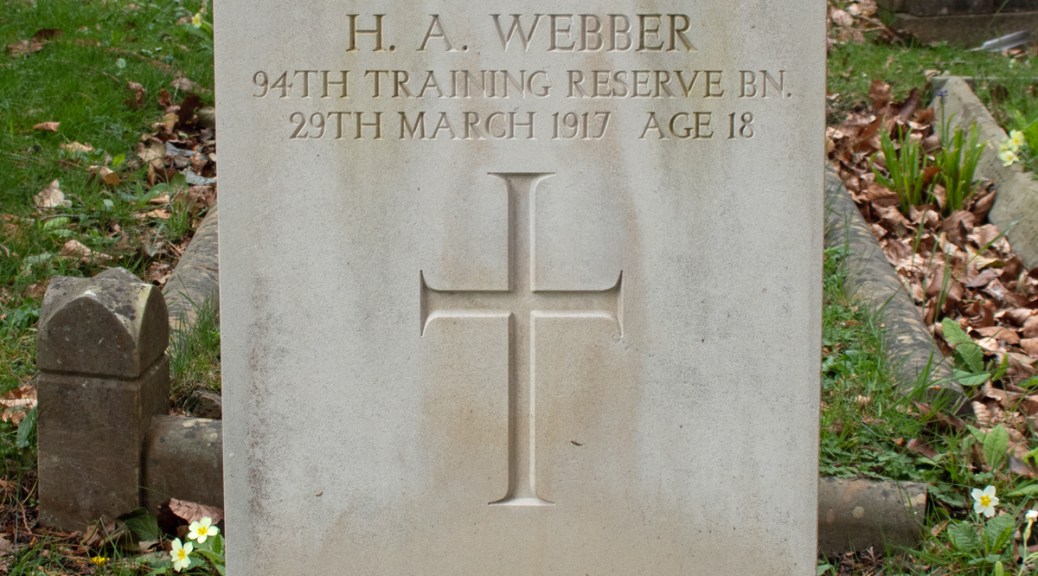
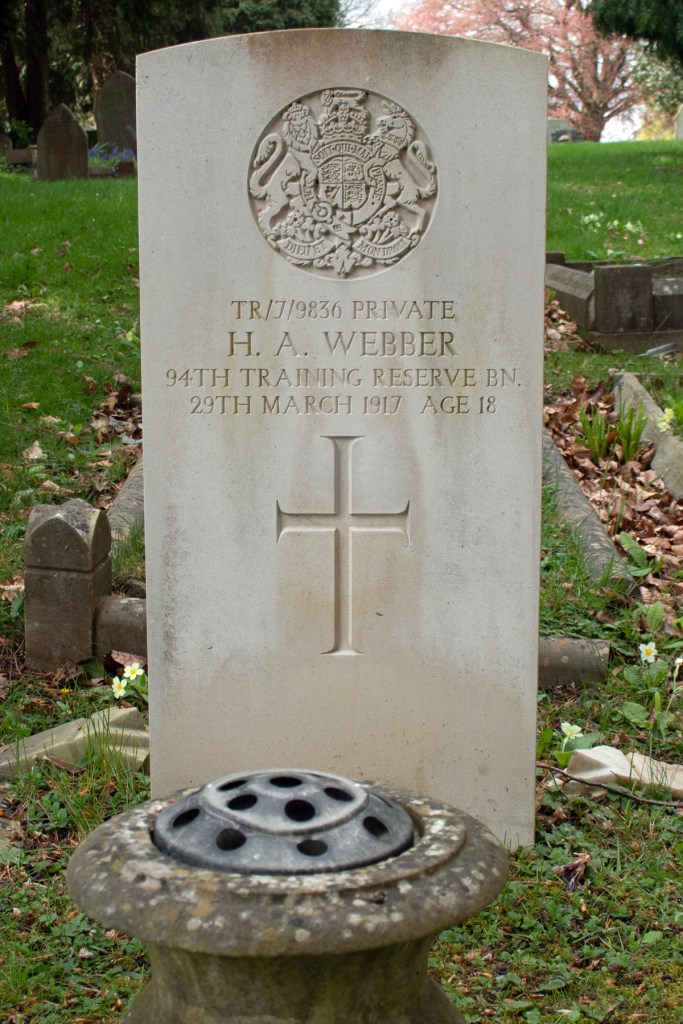
Herbert Alfred Webber was born on 22nd October 1898 in Yatton, Somerset. The younger of two children, his parents were Ernest and Ada. Ernest was a platelayer for the Great Western Railway and, by the time of the 1911 census, the family had moved to Keynsham, near Bristol. With Herbert and his sister still at school, they had taken in two boarders – railway porters Walter Prince and Victor Coombs – to help bring in a little money.
When Herbert left school, he found work at a local chemist, but as soon as he turned 18, he signed up to serve his King an Country. Assigned to the 94th Training Battalion, Private Webber was sent to the Chiseldon Camp in Wiltshire to begin his career.
Tragically, Herbert’s was not to be a long service. Within a month of arriving at camp near Swindon, he fell ill, and was admitted to an Isolation Hospital in the town. While the condition he had contracted is unclear, it was one to which he would succumb. He passed away on 29th March 1917, aged just 18 years old.
Herbert Alfred Webber was brought back to Somerset for burial. With the family having moved to Bath with Ernest’s work, he was laid to rest in the city’s Twerton Cemetery.
Private Herbert Webber (from britishnewspaperarchive.co.uk)
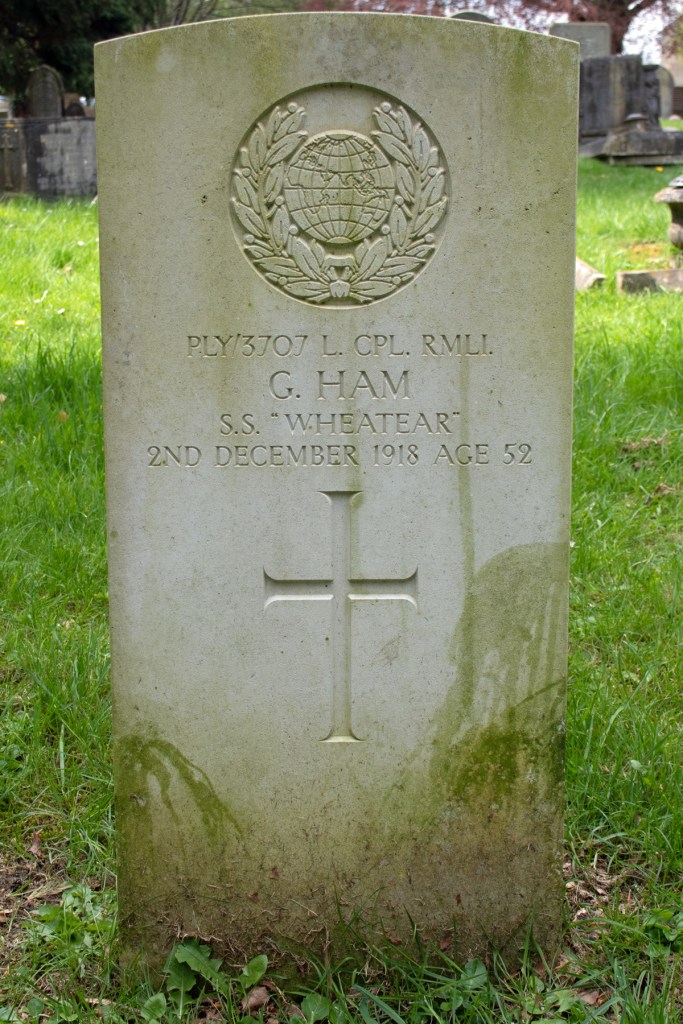
George Ham was born on 19th December 1867 in Twerton, Somerset. His parents were George and Emily Ham, and he was the oldest of their nine children. George Sr was a mason, and initially his first born followed suit, but he was pulled towards something bigger and better and, on 19th January 1886, he enlisted in the Royal Marine Light Infantry.
George’s service records note that he was 5ft 6ins (1.68m) tall, with brown hair, grey eyes and a fresh complexion. He was initially sent to the barracks at Walmer in Kent, and it was from here that Private Ham began a 21 year career in the Royal Marines. Over that time, he served on seven separate ships, and, between voyages, he was based in barracks in Plymouth, Devon. Both his character and ability were consistently noted as being very good.
Private Ham’s career took him around the world and, in 1887, he found himself on the gunboat HMS Banterer, on which he served for three years. His tour of duty included a period of time in Galway, Ireland, and it was here that he met Mary Ann Goode. On 5th July 1889, the couple married in city’s St Nicholas’ Church. The church’s records suggest that the couple went on to have four children – Frederick George; Emily, who died just after her first birthday; Albert; and Katherine.
George’s records from this point become a little disjointed. In October 1890, he returned to his Plymouth base, and the following year’s census recorded him as living in the East Stonehouse Barracks, although his marital status was noted as single.
The next census, in 1901, presents a different picture. George and Mary were, by this time, living in family barracks in East Stonehouse, with two children, (Frederick) George and Albert. Katherine, the couple’s youngest child, was born the following year.
In January 1907, after more than two decades’ service, George was stood down from active service in the Royal Marines. He was placed on reserve status, and took up work as a mason once more. At this point, however, the family seemed to have hit more troubled times, underlined by four separate 1911 census documents.
George, who was 44 by this point, was recorded as being an inmate in the Bath Union Workhouse and Infirmary in Lyncombe, Somerset. Mary and Katherine, meanwhile, were in two rooms in a house in Stonehouse, Devon. Frederick, who was now better known as George, had followed his father into military service, and was a Private in the Royal Marine Light Infantry, serving on HMS Colossus. Albert, who was 13 years old, was one of 946 students boarding at the Royal Hospital School for Sons of Seamen in Greenwich, London.
George spent nine years in the reserves, and, in 1914, was called up again for war service, this time as a Lance Corporal. According to a contemporary newspaper:
[He was] engaged on naval patrol work against submarines off the Canadian coast and elsewhere, and was in charge of a gun on an armed merchant ship. Once the boat he was on was torpedoed, and on another occasion he had a long running fight with a submarine in the Irish Channel. The ship, however, reached Portrush (Ireland), and the inhabitants gave Lance-Corporal Ham a testimonial, and he was also rewarded in other ways, the Cardiff owners of the vessel recognising his skill and gallantry.
Bath Chronicle and Weekly Gazette: Saturday 7th December 1918
Tragedy was to strike in the end, however, and George was to meet a sad end to a distinguished career.
While at Cork [George] fell, either from a boat or the dock, and sustained an injury to the side of his head. It did not appear very serious, and it is understood that he made a trip to Cardiff and back to Londonderry, [where] he became so seriously ill as to necessitate his going to a military hospital in Londonderry. Hemorrhage [sic] of the brain set in, and he died on Monday [2nd December 1918] before his brother, Mr Albert Ham, who had been telegraphed for, could reach him.
Bath Chronicle and Weekly Gazette: Saturday 7th December 1918
Lance Corporal George Ham was days short of his 51st birthday when he died. His body was brought back to Somerset for burial, and he was laid to rest in Twerton Cemetery. The newspaper report give no indication as to whether Mary or their children were in attendance and, in fact, does not mention his wife and family at all.
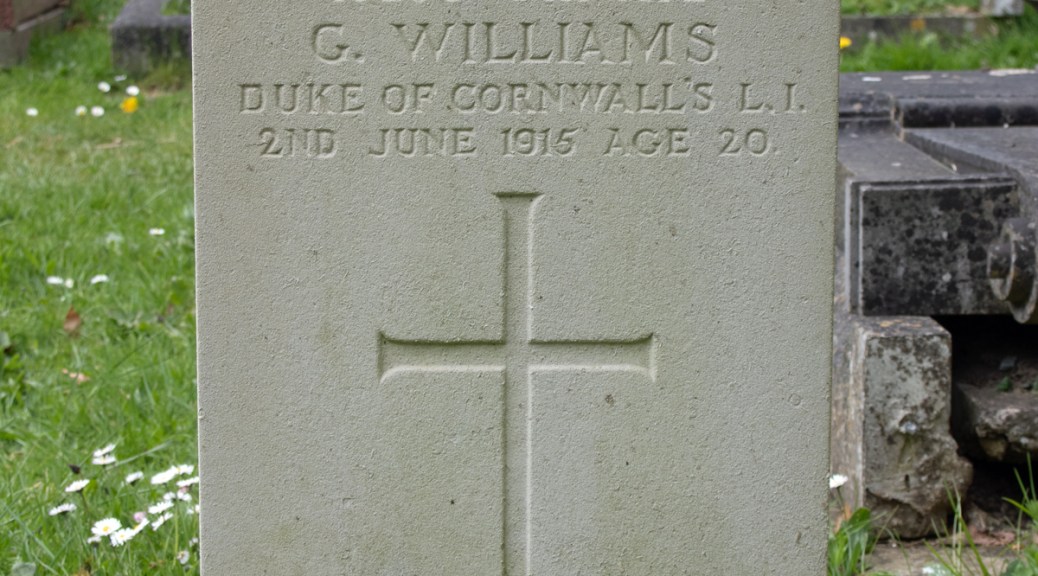
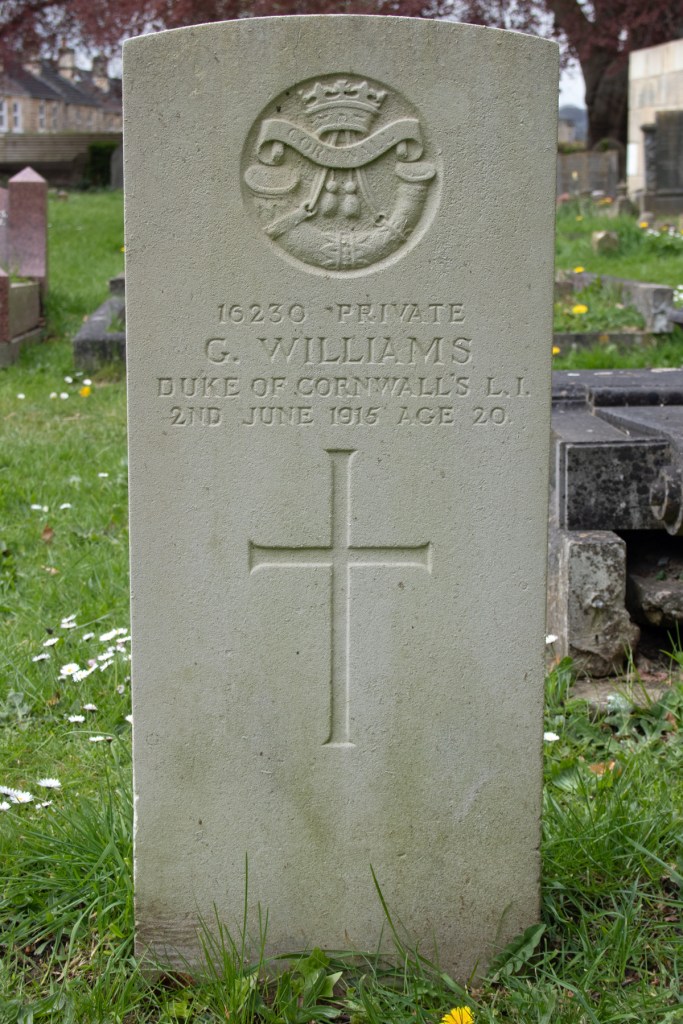
George Williams was born in West Bromwich, Staffordshire, in 1895. One of ten children, his parents were George and Sarah. When George Sr died in 1908, his widow was left to raise the family herself. By the time of the 1911 census, all of the children were still living at home, and four of them, including George Jr, who was working as a labourer, were bringing in a wage.
When conflict broke out, George stepped up to play his part. He enlisted in the Duke of Cornwall’s Light Infantry before the end of 1914 and, as a Private, was assigned to the 8th Battalion.
Little information is available about George’s military life and, indeed, the only other details available for him are that of his passing, based on reports available in a contemporary newspaper.
About half-past eight on Thursday [3rd June 1915] the body of a soldier was found in the river at Bath… The corpse was in a somewhat advanced state of decomposition, its condition suggesting it may have been in the river about three weeks. The man had on his full regimentals, with top coat.
Papers found in the pocket indicate that the deceased is Private George Williams, of the 8th Battalion Duke of Cornwall’s Light Infantry, now encamped at Sutton Veny, Wilts. This regiment was quartered in Bath during the winter, and left the city some weeks ago.
There are.. no marks of violence on the body.
There was found on the body a pass dated 14th May, giving him three days’ leave. The leave expired at 11:55pm on May 17th. The permit allowed him to proceed to Birmingham. There was also found on the deceased a telegram addressed to 22 Green Street, West Bromwich, which said “Leave extended.”
The supposition is that Williams returned as far as Bath, on his way back to camp, by Midland Railway, and when in the city by some means or other fell into the river.
Curiously enough, the Bath police had been advised of the absence without leave from camp at Sutton Veny of a soldier of the same name. But in this case the man belonged to the 10th Devons. They had received no notification regarding Private Williams of the 8th Cornwalls.
Bath Chronicle and Weekly Gazette: Saturday 5th June 1915
The telegram mentioned in the report is likely one sent to George’s family, who was living at 22 Queen Street (possibly an error on the newspaper’s part).
George was just 20 years old when he died: the army report gave the date of his death as 2nd June 1915, although it seems likely that he had passed some weeks before.
Sarah and the family were possibly unable to afford to have George’s body taken back to Staffordshire for burial. Instead, he was laid to rest in the Twerton Cemetery in Bath, with Sarah and two of his brothers, Leonard and William, in attendance. Another member of his battalion, “deceased’s chum” [Bath Chronicle and Weekly Gazette: Saturday 5th June 1915] Private Fred Cotton, was also at the funeral, and sent his own wreath – from “his old pal Fred” [Bath Chronicle and Weekly Gazette: Saturday 5th June 1915].
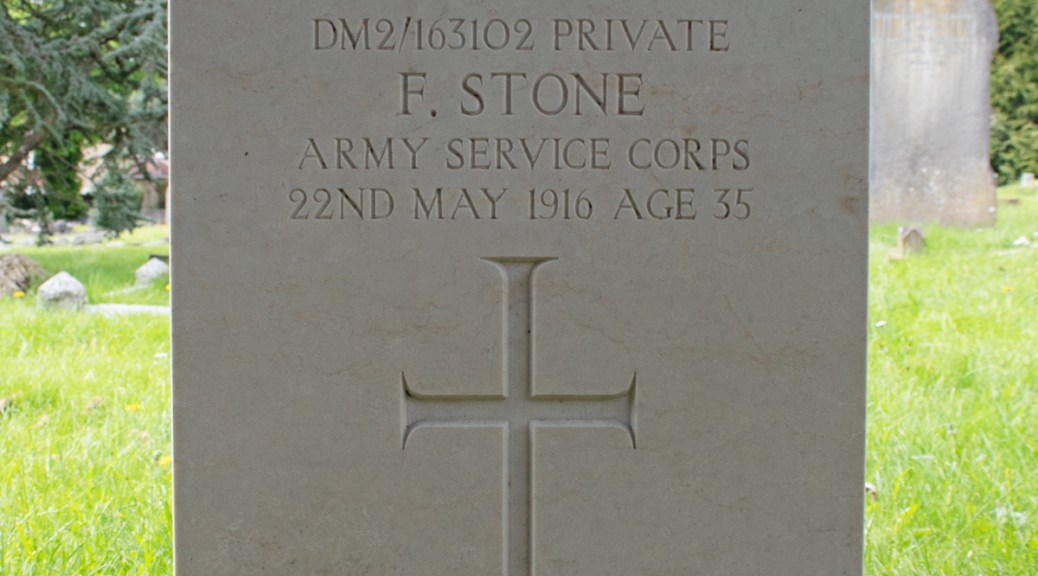
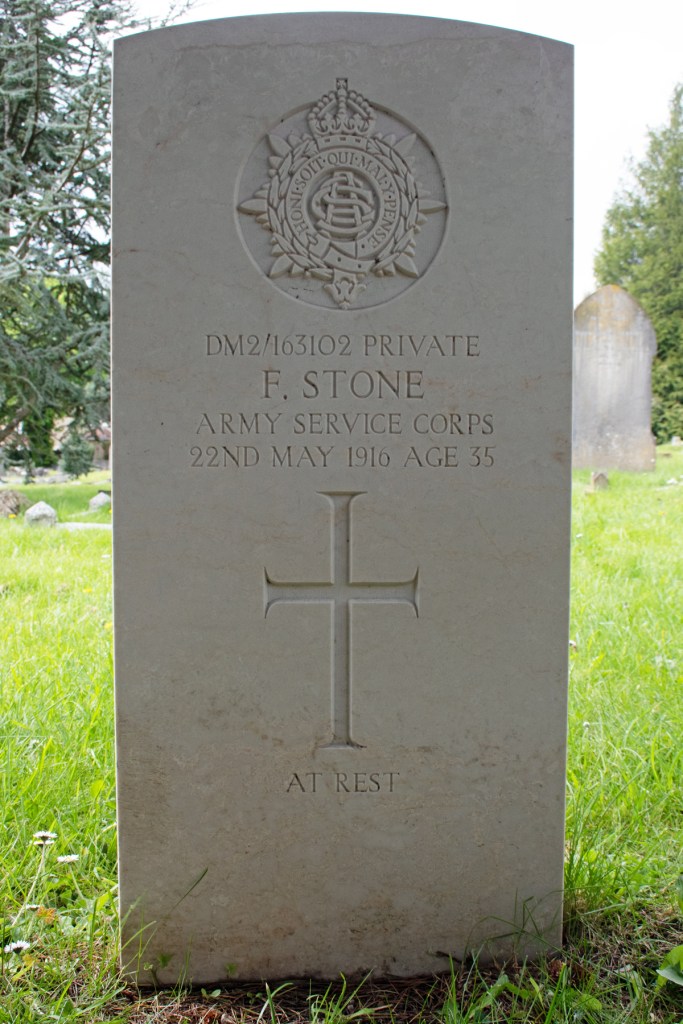
A lot of the life of Frederick Stone is destined to remain shrouded in mystery. His grave lies in the St Michael’s Cemetery, Bath, Somerset. The headstone confirms that he was a Private in the (Royal) Army Service Corps when he passed away on 22nd May 1916, at the age of 35.
The Commonwealth War Graves Commission give a little more information – he was the husband of Millie Stone, who lived at 9 Mount Road, Englishcombe. Private Stone was attached to the 623rd Mechanical Transport Company.
The 1911 census records a Fred and Millie Stone living at 22 Paragon, Bath, a twelve room Georgian terraced house near the centre of the city. Fred is listed as a gas maker for an ice factory, while Millie, who was eight years older than her husband, is noted as being a boarding house keeper. They couple were recorded as having been married for two years, and they had a seven month old daughter, Emily.
There is no marriage record for the couple, nor a baptism record for Emily, so it is not possible to glean any further information. There are four Bath-born Fred/Frederick Stones in the 1901 census, so again confirming which relates to the Private lying in the city’s cemetery is a challenge.
Private Frederick Stone’s death is not reported in the contemporary newspapers and so seems not to have been out of the ordinary. He was laid to rest in St Michael’s Cemetery, at peace.
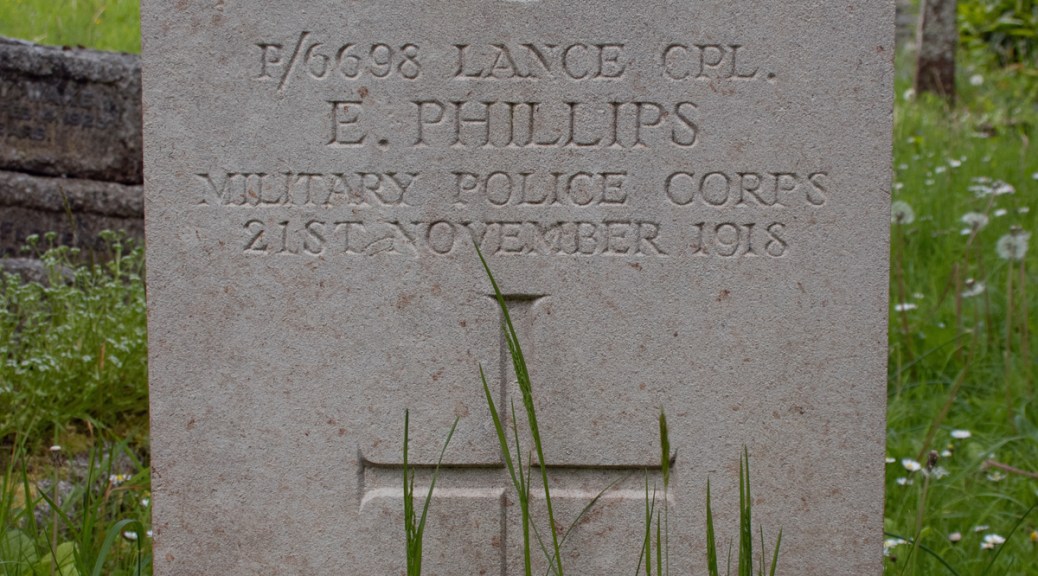
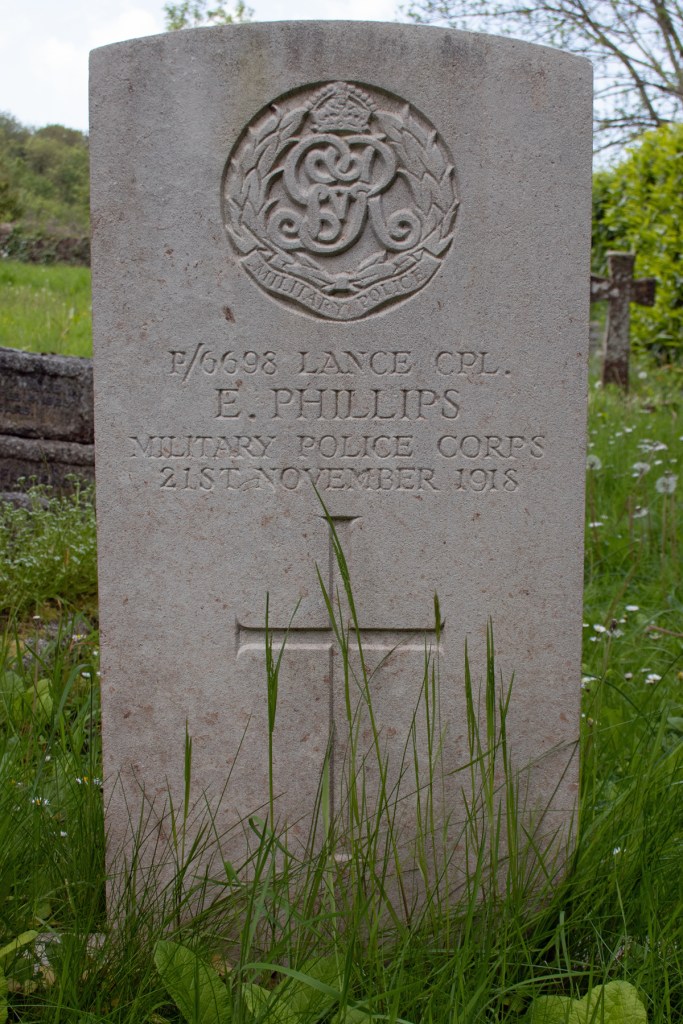
Ernest Algernon Phillips was born at the start of 1879 in the Somerset village of Winscombe. One of nine children, his parents were Arthur and Elizabeth Phillips. Arthur was a gardener, and Ernest followed suit when he finished his schooling.
By the time of the 1911 census, he was boarding with his younger sister Rose and her family – brother-in-law Leonard and nephew Leslie. Just a couple of weeks later, on 11th May 1911, Ernest married Winifred Carey. She was a coachman’s daughter from Winscombe, and the couple set up home in a cottage on the outskirts of the village.
When war broke out, Ernest felt a need to play his part. He enlisted in Bristol on 8th December 1915, but was not formally mobilised until the following June. Initially assigned to the Devonshire Regiment, he was transferred to the Worcestershire Regiment and attached to the 6th Battalion.
Private Phillips’ troop was based on home soil, and he was barracked in the garrison in Harwich, Essex, for the next six months. On 31st January 1917, he was transferred to the Military Police Corps, and given the rank of Acting Lance Corporal. Full details of his service from this point on are lost to time, but it is clear that he remained on home soil until the end of the war.
By November 1918, Ernest had fallen ill. He was admitted to the Queen Alexandra Military Hospital in London on 20th November, suffering from pneumonia. Within a matter of hours, while this seemed to have cleared, his pulse was ‘rapid, irregular and compressible.’ He was medicated, but did not respond to treatment, and passed away the following day. His death was noted as apparently being caused by clots of blood in the heart, but, at the request of his family, no postmortem examination was carried out. He was 39 years of age.
Ernest Algernon Phillips was brought back to Somerset for burial. He was laid to rest in the quiet graveyard of St James the Great Church in Winscombe.