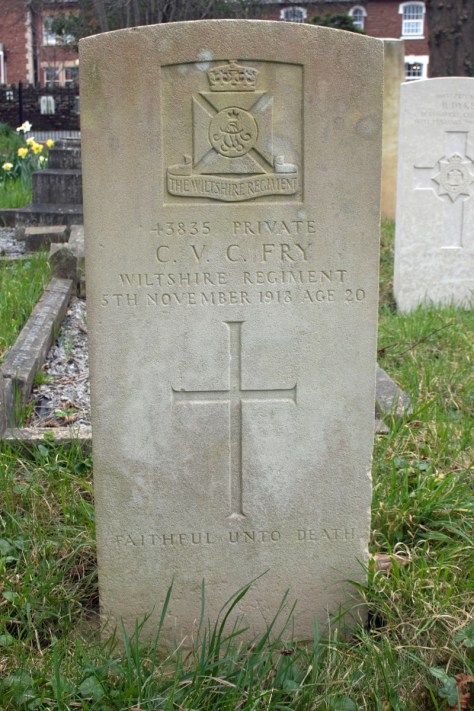
Clarence Vivian Clements Fry was born in November 1898 to William and Rosa Fry. William was a ‘provisions merchant clerk’, who went on to become a ‘cheese and provision dealer’, or grocer. Sadly, Rosa passed away in 1904, at the tender age of 31, leaving Clarence without a mother at just six years old.
William remarried in 1908, and he and new wife Amy had a daughter, also called Amy, a year later. By the 1911 census, the family of four were living in a three storey Victorian Terraced house to the south of Bridgwater town centre.
Sadly, little of Clarence’s military career remains documented. Initially joining the Royal Army Service Corps, Private Fry soon transferred over to the Duke of Edinburgh’s Wiltshire Regiment.
The 1st Battalion found in some of the key battles on the Western Front, including Mons, Ypres, Messines and Vimy Ridge. As his enlistment date isn’t known, it’s impossible to say whether Private Fry was involved in these conflicts or not.
What is likely is that Private Fry was involved in the Battle of the Selle, which took place near the towns of Cambrai and Valenciennes in northern France in October 1918. Clarence was certainly injured at this point, and was evacuated to England for treatment.
Admitted to the Cambridge Military Hospital in Aldershot, it seems that his injuries were too severe and he succumbed to them on 5th November 1918, just a week before the Armistice was signed. Private Fry was just 19 years old.
Clarence Vivian Clements Fry lies at rest in the Wembdon Road Cemetery in his home town of Bridgwater in Somerset.
Walter Ricks Treliving was born in Bridgwater, Somerset, in 1876, the middle of three children to James and Elizabeth Treliving. James was a commercial traveller in the drapery trade, and this is something his son followed him into.
According to the 1891 census, Walter was a pupil at the Commercial Traveller’s School in Pinner, Middlesex, which was, in effect, a boarding school-cum-children’s home for the children of commercial travellers and orphans.
Commerce was obviously engrained into Walter by this point and, after leaving school, he followed his father into the trade of trading. He travelled with his work, frequently boarding with others; in 1901, the census recorded him as living lodging with his maternal aunt Annie Ricks.
Love beckoned, however, and in 1904, Walter married Mabel Broadrick, the daughter of a Unitarian Minister from Worcestershire. The couple set up home in Weston-super-Mare and had a daughter, Beryl, two years later.
Things were not to go smoothly, however, as an article in the Western Daily Press were to show:
In the Divorce Court yesterday, a case was heard in which Mr Walter Treliving, a commercial traveller of Weston-super-Mare, petitioned for a divorce from Mabel Annie Treliving, on the ground of her misconduct with Mr Charles E Rust, an engineer. The case was undefended.
Mr Treliving said he was married on the 13th August 1904 at Bridgwater, and afterwards lived at Weston-super-Mare. There was one child of the marriage. The married life was happy until May 1913, when his wife told him that she cared for someone else.
In July 1913, his wife went away to Manchester on a visit, and when she came back she told him she had stayed with Mr Rust at the Grand Hotel… He forgave her for that, and took her away for a holiday to Lynton. He then discovered that she was still corresponding with the co-respondent, and afterwards that she was meeting him again.
On the 13th September his wife left him, and he heard that she had gone to Khartoum with the co-respondent. He received a letter from her, in which she said:
“Dear Walter. The divorce papers have come. Of course I cannot defend the case, nor he. So you have it all in your power. I hope you will be happy now you are free. If eve I came back to England, may I see Betty [sic]? I cannot marry Mr R. She will not divorce him. I do not know what I shall do now. I hope you will be happy if you marry again, as I hear you will. Oh! if you had only held out one hand to save me, how different it might have been. I am a broken woman. Yesterday, when the petition came, I realised it. You are fully paid back for all your sufferings. Enjoy your victory. Your wife.”
Petitioner said it was not his intention to marry again, as his wife suggested. He had done everything in his power to induce her to remain with him.
Western Daily Press: Thursday 1st April 1915
A decree nisi was granted to Walter and he was awarded costs.
Sadly, it has not been possible to track Walter’s military history. That he enlisted is evident; he joined the Royal Army Service Corps, and rose through the ranks to become Second Lieutenant Treliving. The divorce proceedings did not identify him as serving in the army, so it seems likely that he joined up at some point after April 1915 – his age and his status as a single father seem further proof of this assumption.
Walter returned to Bridgwater in October 1918 to attend his mother’s funeral. Elizabeth had contracted influenza and, sadly, after returning home Walter also caught and succumbed to it. He died on 11th October 1918, at the age of 42.
His probate confirms two beneficiaries; his sister Hilda Treliving, and another woman, Kate Symons, presumably as guardians and trustees for Beryl.
Walter Ricks Treliving lies at rest in the Wembdon Road Cemetery in his home town of Bridgwater, Somerset. He had been buried on the same day as Elizabeth, the mother whose funeral he had returned to attend.
Stanley Hugh Russ was born in 1888, the youngest of five children to Alfred and Elizabeth. The family lived in Wells, Somerset, where Alfred worked as Clerk to the Guardians of the local workhouse. They were doing well for themselves, as they had two domestic servants at the time of the 1891 census.
Stanley seems to have been a studious young man, and by 1911 was boarding in London, where he was a dental student.
Details of Stanley’s military service are scant, but he obviously did well at his job, and rose to the rank of Lieutenant. The local newspaper gave a good overview of his life when reporting on his funeral:
The deceased gentleman was a dentist by profession, and served his apprenticeship with Mr Goddard of Wells. He afterwards went to London, where for some years he had been following his profession at Guy’s Hospital.
At the outbreak of was he joined the Middlesex Yeomanry as a trooper. He was later given a commission in the same regiment… After much service in France, he was, by reason of a physical disability incurred whilst on service, transferred to the Royal Army Service Corps (Mechanical Transport).
He again went to France and was attached to the North Somerset Yeomanry. He was invalided home, but went out a third time, being attached to a Canadian Siege Battery. He took part in the great push around Arras and Vimy Ridge.
He returned to England in October 1918, suffering from heart trouble, severe shell shock, and slight gassing. He was discharged from hospital in January 1919 and demobilised in the following March.
His health gave way, and he was subsequently operated on by a Harley Street specialist. He derived little benefit, and was afterwards removed to a nursing home, where he died.
The deceased gentleman, who was unmarried, was of a very bright and happy disposition, and enjoyed a wide circle of friends.
Wells Journal: Friday 5th November 1920
Stanley Hugh Russ died on 28th October 1920. He was 32 years old. He lies at rest in the cemetery of his home city of Wells.
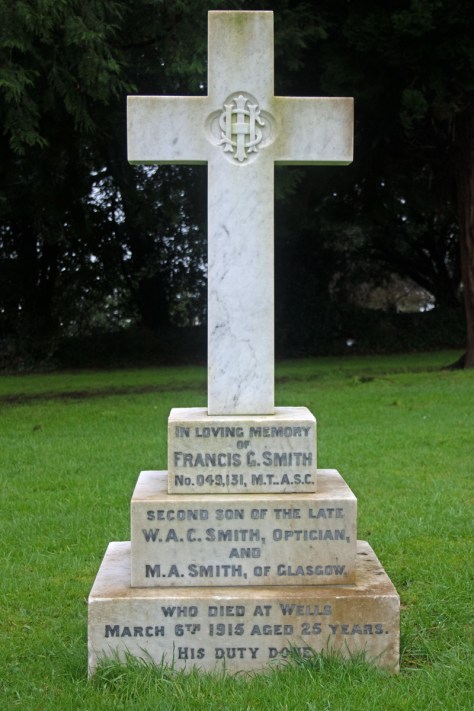
Francis George Smith was born in Glasgow in 1890. Records are scattered, but some of the pieces pull together to give an outline of his life.
The son of William and Mary Smith, Francis was the fourth of six children. His tombstone confirms that William had worked as an optician, but passed away when Francis was a young man.
Francis was an electrical engineer, and had assisted Mary in her business in Glasgow before signing up.
Private Smith enlisted early on in the war, “on February 24th of this year [1915], when he left his native city for London, where he joined the motor transport section of the Army Service Corps” [Wells Journal, Friday 12th March 1915].
Billeted in Wells, he had been assigned to the 133 Mechanical Transport Company. Within weeks of moving there, however, it seems that Francis fell ill. Sadly, his was a life cut too short, and he passed away from pneumonia on 6th March 1915, aged just 25 years old.
Francis George Smith lies at rest in the cemetery in Wells.
William James Waterhouse was born in 1875, the eldest of seven children to Richard and Elizabeth Waterhouse. The family lived in Cumberland, where Richard initially worked a grocer before becoming a music teacher.
William followed his father into food retail, working initially as a butcher’s boy in Barrow-in-Furness, before moving 400 miles to the south coast and settling in Eastbourne. Travel was definitely on William’s mind, however, as, by the 1911 census, he was a butcher’s manager at a hotel in Leicester.
William’s service records are limited; he was 39 when war broke out, and enlisted in the Eastern Mounted Brigade, before transferring Army Service Corps. During his time, he was promoted to Serjeant, and according to a newspaper report of his funeral “was most popular among the men.” [Wells Journal: Friday 9th July 1915]
It seems that, as part of his service, Serjeant Waterhouse had been assisting with haymaking in the Wells area, and it was after this that he fell ill. He developed pneumonia, and passed away on 30th June 1915. He 40 years old.
William James Waterhouse lies at rest in the cemetery of his adopted home town of Wells, in Somerset.
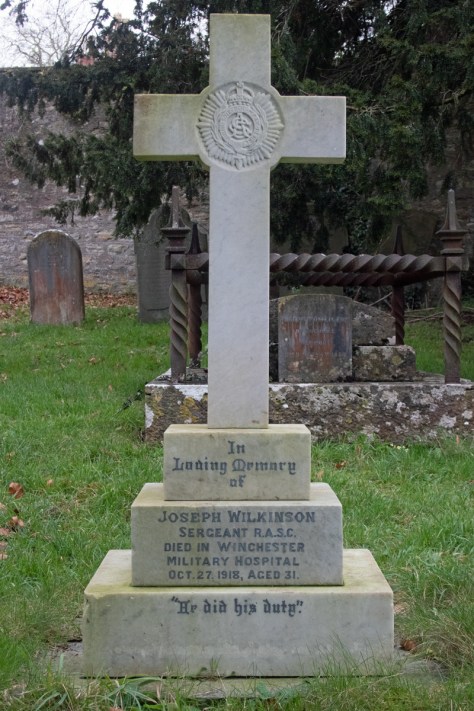
Joseph Wilkinson was born in the village of Greystoke, Cumbria in the summer of 1888. His parents were John and Margaret Wilkinson, and he had two siblings, also called John and Margaret. Joseph’s father worked as a railway signalman, and the industry employed a large number of people in the village.
Joseph’s life was to take a different turn, however, and it was likely the railway that took him there. He next appears on the 1911 census, boarding in a house in the village of Wedmore in Somerset. At 23 years old, he is listed as a Solicitor’s Cashier.
As with so many other fallen men and women, Joseph’s trail goes cold. There is not enough evidence to detail his military career – he joined the Royal Army Service Corps as a Driver and was promoted to Sergeant.
The UK Army Register of Soldiers’ Effects show that he was married to a woman called Ethel, although there are no records of their wedding. The document also confirms that he died at the Union Hospital in Winchester, Hampshire on 17th October 1918, but there is no cause of death given. He was 31 years old.
“He did his duty” says his impressive gravestone, but it is tragic that that duty is lost to time.
Sergeant Joseph Wilkinson lies at rest in the churchyard of St Mary’s in Wedmore, the Somerset village that came to be his home.
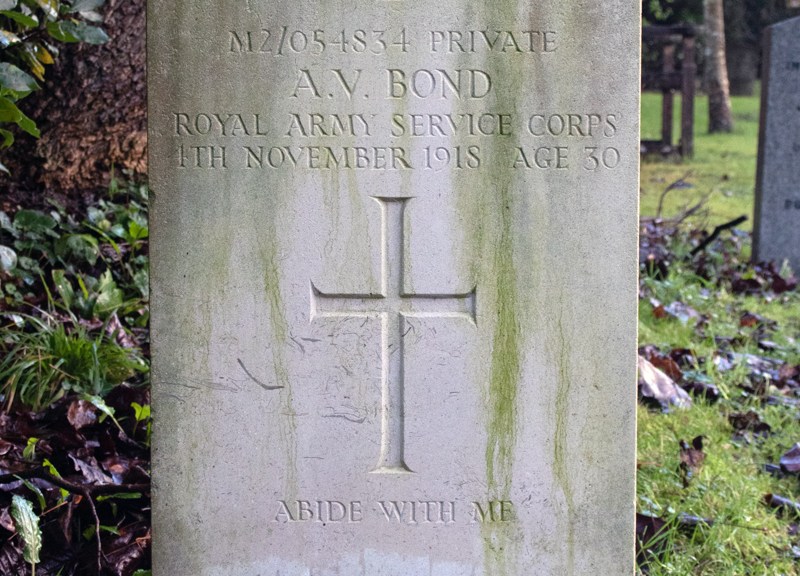
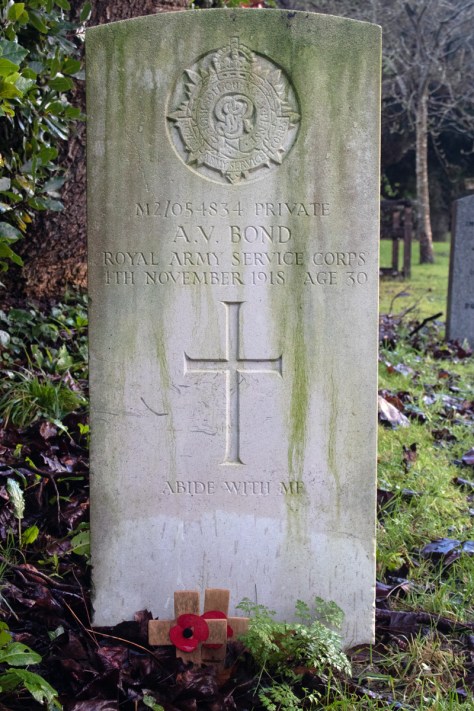
Albert Victor Bond was born in 1887, the only child of John and Sarah Bond. John was an engine driver, with a steam roller, and the family lived in the Somerset village of Butleigh.
Albert started working for the local baker and, by the time of the 1911 census, when his parents were celebrating their 25th Wedding Anniversary, this is the job he was doing.
He enlisted in March 1915, joining the Royal Army Service Corps. While his full service record is not available, Private Bond’s service was relatively short lived. He was discharged as medically unfit in February 1916, having served for just 332 days.
He was discharged with pneumonia, and this seems not to have cleared up and he was eventually admitted to the military hospital in Wool, Dorset. Albert passed away from the disease on 4th November 1918, just a week before the Armistice. He was 30 years old.
Albert Bond lies at rest in the graveyard of St Leonard’s Church in his home village of Butleigh.
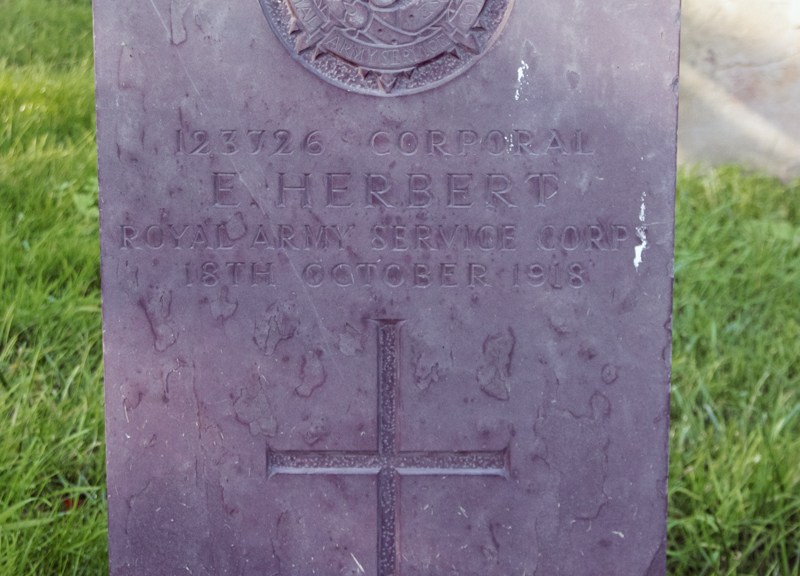
Edwin Herbert was born in 1864, the third of three children to Moses and Melina Herbert of Hove in East Sussex. Moses worked in the cement industry as a labourer, a job that had taken him from his home in Kent to Sussex, and which, by the 1871 census, would return him to his home county.
Edwin married Amelia Charlotte Titus in 1885 and the couple’s first child – a daughter, Nelly – was born a year later.
By the 1891 census, Edwin was also labouring in the North Kent cement industry, something he continued to do for at least the next twenty years, as confirmed in the following two censuses.
The Herberts’ second child, Amelia, was born in 1901, the year after Edwin’s mother passed away. The family were, by then, living in Cuxton, just to the south of Rochester. The cement industry was one of the large employers in the Medway valley, and it is not surprising that the family lived in and around that area for so long.
In 1910, Edwin’s father also died, at the age of 69. After the death of Melina, Moses had moved in with his daughter – Edwin’s older sister – in Rochester, and the family were also still labouring in the cement and brickmaking industry.
Edwin’s military records are sketchy. Piecing the evidence together, he enlisted in the Royal Army Service Corps.
It is likely that he did so on a voluntary basis. The cement industry was not protected by exemption. Kitchener’s initial conscription in March 1916 excluded married men. When this was extended in May 1916, there was still a maximum age limit of 41 (Edwin was 52 year old by this point).
By whichever means he had enlisted, Edwin served as a Corporal (there is nothing to confirm whether he was promoted from Private, or if he went straight into service at that rank). He was discharged on 30th July 1918, and it is likely that this was on a medical basis.
Corporal Herbert’s pension documents record that he passed away on 30th October 1918, as a result of carcinoma of the liver and exhaustion. He was 54 years old.
Edwin Herbert lies at peace in the quiet churchyard of St Helen’s in Cliffe, Kent.
The majority of the the Commonwealth War Graves Commission headstones in the UK are made from Portland stone, although, in face, over 50 different natural stones have been used.
Corporal Cornell’s headstone is one of two in St Helen’s Churchyard that have been fashioned from dark grey slate.
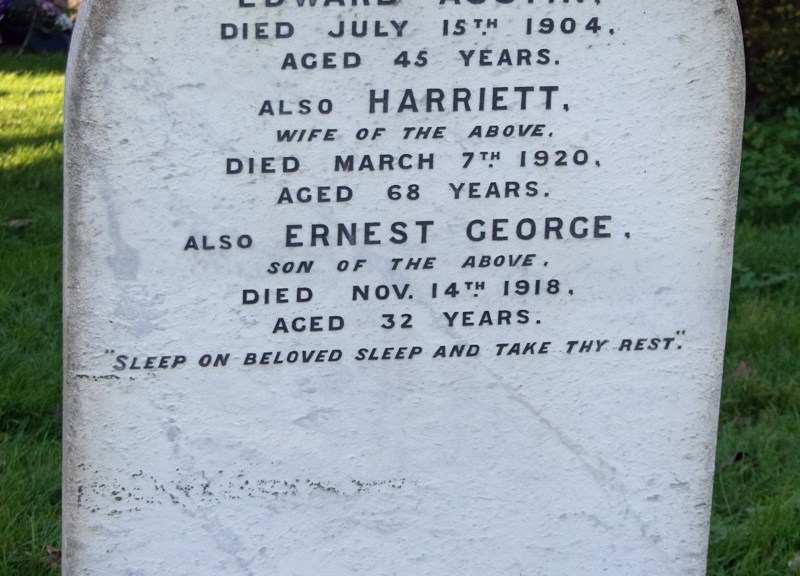
Ernest George Austin was born in early 1888, one of four children – all boys – to Edward Austin and his wife Harriett. The Austin family lived in the village of Cliffe, in the North Kent countryside, where Edward was a carpenter.
Ernest’s older brother Edward worked as a telegram messenger when he left school, and Ernest followed suit, becoming a postman by the time of the 1911 census. The four boys all lived with their now-widowed mother, their father having died seven years earlier.
Duty soon called, however, and Ernest enlisted in July 1916, joining the Army Service Corps. After training in England, he was shipped overseas that autumn.
Private Austin was discharged from the army just over a year later, and the medical report from that time sheds a lot more light onto this young man’s life:
Father [Edward] died of “consumption”.
Has had a chronic cough since a boy. Developed tubercle of lung in 1907. Went to Chile same year, where all symptoms disappeared. Put on weight and lost his cough completely. Returned to England and joined Army July 1916.
Has been in Mesopotamia three months. Cough has returned. Lost weight. Night sweats. Admitted to [military hospital] with sore throat; TB found present.
Admitted to this hospital 14th June 1917 with above symptoms. High temperature, evidence of infection.
In my opinion, the relighting of a latent infection is entirely attributable to active service in Mesopotamia.
Private Ernest Austin’s medical board record, 23rd Jun 1917
Ernest had been hospitalised in the Cumballa War Hospital, Bombay. He was sent home and ultimately discharged from active service on 8th October 1917.
Demobbed, Ernest married Antoinette Gurton at the start of 1918. The marriage was to be short-lived, however, as Ernest appears to have finally succumbed to his illness less than a year later.
Private Ernest Austin passed away on 14th November 1918. He was 31 years old. He lies at rest in the graveyard of St Helen’s Church in his home village of Cliffe, Kent.
Tom Hallett Walter Rawlings was born in 1896, the eldest of six children (and only son) to Walter and Jane Rawlings. Dorset-born Walter had worked as a carpenter and a groom, and Tom had joined him as a stable lad by the time of the 1911 census.
By the time he enlisted in July 1915, Tom’s work with all things equine helped land him a role in the Royal Army Service Corps as a Saddler. His role was backed up as he had previously been apprenticed to Ernest Cottle, a saddler in Blandford, Dorset.
Initially he worked on the Home Front, but he was posted to France as part of the British Expeditionary Force in January 1916, as part of the 1st Company.
Saddler Rawlings’ time overseas was brief; within three months of being shipped overseas he had contracted phthisis (also known as tuberculosis), and he was sent home for treatment on 22nd April 1916.
His health reached the point where he was discharged as being medically unfit on 12th June, and within a matter of weeks, Tom has passed away.
Tom Hallett Walter Rawlings died on 20th June 1916; he was 19 years old. He lies at rest in the cemetery of his home town, Sherborne.
Tom’s father Walter also entered the army as worked in the Royal Army Service Corps. While records of his military career are not immediately evident, it seems that he survived the war, although he may have been discharged in 1919 having fallen ill with malaria.









 Death and Service