Tag Archives: Sergeant

Serjeant Albert West

Serjeant Albert West

Albert Charles West was born in Aldershot, Hampshire, in 1870. The second of nine children, his father Charles was in the army, while his mother Hannah is listed on the 1871 census as a “Soldier’s Wife”.

By the time of the next census, ten years later, Charles had relocated the family to Wells in Somerset – Charles had been born just up the road in Shepton Mallet, so, in effect, he was bringing his family home. By this point, the Wests were a family of seven; Albert had an older sister, Eliza, and three younger siblings, Mary, Joseph and Earnest.

Albert seemed keen to make his own way in the world; by the 1891 census, he had relocated again, this time to South Wales, where he worked as a minor. He boarded with a grocer in the village of Llantwit Fardre. It would have been a bustling house, because Albert was living there with the grocer, his wife and four children and three other lodgers.

The following year, Albert enlisted in the 2nd Battalion Welsh Regiment. Posted to India, he served there for ten of his twelve years’ service.

After completing his enlistment, Albert moved back to Somerset and married Emily Sparrow in Wells. The couple moved back to South Wales for work, however, this time with Albert working in a mine in Llanwonno, ten miles up further up the Taff Valley from Llantwit Fardre.

When war broke out, Albert re-enlisted, this time joining the South Wales Borderers. Sadly, little documentation of his second time in the army remains. He is recorded as having served in the 51st (Graduating) Battalion, which was a training unit based in Suffolk; presumably his experience made him ideal to train others and enabled him to take the rank of Serjeant.

There is nothing to confirm how Serjeant West died. All that is know is that he passed on 9th July 1918. The lack of any media reports around his funeral suggests it is likely to have been illness, rather than injury, that took him. He was 48 years old.

Albert Charles West lies at rest in Wells Cemetery in Somerset.


Charles and Hannah had nine children in total. Two years before Albert passed, their youngest son – Alfred Augustus West – died suddenly and unexpectedly. Records confirm that he was working on the lines at Wells Railway Station, when his foot got caught in the points. Unable to free himself, he was hit by a train and killed.


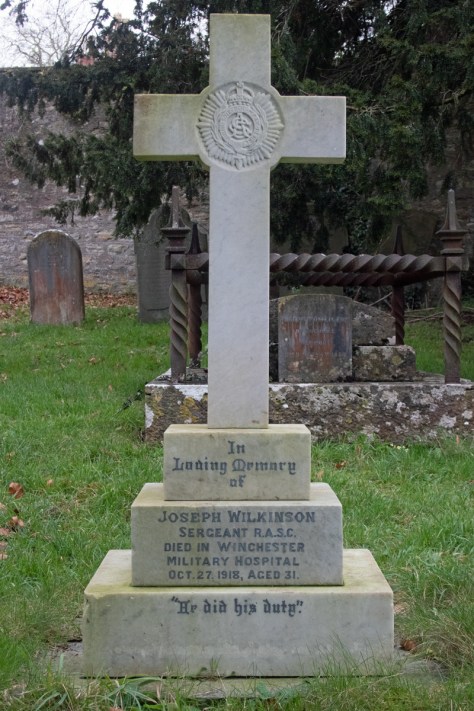
Sergeant Joseph Wilkinson

Sergeant Joseph Wilkinson

Joseph Wilkinson was born in the village of Greystoke, Cumbria in the summer of 1888. His parents were John and Margaret Wilkinson, and he had two siblings, also called John and Margaret. Joseph’s father worked as a railway signalman, and the industry employed a large number of people in the village.

Joseph’s life was to take a different turn, however, and it was likely the railway that took him there. He next appears on the 1911 census, boarding in a house in the village of Wedmore in Somerset. At 23 years old, he is listed as a Solicitor’s Cashier.

As with so many other fallen men and women, Joseph’s trail goes cold. There is not enough evidence to detail his military career – he joined the Royal Army Service Corps as a Driver and was promoted to Sergeant.

The UK Army Register of Soldiers’ Effects show that he was married to a woman called Ethel, although there are no records of their wedding. The document also confirms that he died at the Union Hospital in Winchester, Hampshire on 17th October 1918, but there is no cause of death given. He was 31 years old.

“He did his duty” says his impressive gravestone, but it is tragic that that duty is lost to time.

Sergeant Joseph Wilkinson lies at rest in the churchyard of St Mary’s in Wedmore, the Somerset village that came to be his home.


Private James Fowler

Private James Fowler

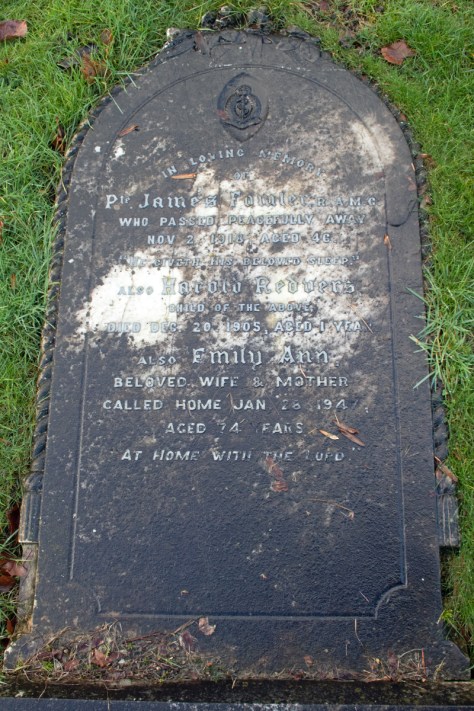
Thomas James Buckley Fowler – known as James – was born in 1872, the eldest of eleven children to Tom and Ellen Fowler.

Much of his early life is lost to time, but we do know that James married Emily Ann Gregory on December 26th 1898, and the couple went on to have four children – Wilfred, Harold, Violet and Ivy.

On his marriage certificate James lists himself as a shoemaker and, given the family were living in the Somerset town of Street, it is likely that he was employed at the Clark’s factory there. By 1911, however, the family had moved to Glamorgan, where he had taken work as a timber man in the coal mine in the village of Nelson.

Private Fowler enlisted when war broke out, joining the 10th Battalion of the Welch Regiment in October 1914. During his time with the regiment, he was promoted, first to Lance Corporal and then to Acting Sergeant.

He transferred to the Royal Army Medical Corps just under a year later. In November 1915, he was admitted to hospital with enteritis, which led to him being shipped back to England for treatment.

Once he had recovered, Private Fowler was enlisted in the Provisional Company of the RAMC, transferring again to the 7th Company in 1916. He then operated on home soil for the next few years.

James was admitted to the Royal Military Hospital in Bristol on 28th October 1918 with influenza and bronchial pneumonia. He sadly passed away a few days later, on 2nd November 1918. He was 46 years old.

James Fowler lies at rest in the cemetery in Street, Somerset.


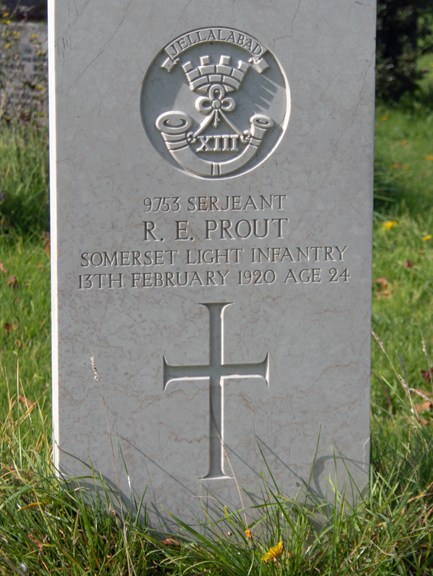
Serjeant Richard Prout

Sergeant Richard Edwin Prout

Richard Edwin Prout was born in 1896, the second son of Frederick and Anna (Hannah) Prout. When his father died in 1908, his mother remarried and by the 1911 census, Richard and his family had moved to Lydeard St Lawrence, where he was a baker’s boy.

He enlisted in June 1914, joining the Somerset Light Infantry and served throughout the war, receiving the Mons Star, Victory Medal and General Service Medals.

After the war, he continued in the army, and was assigned to Taunton Barracks.

His passing was unusual enough for it to be reported on in the local newspaper.

Sergt. Prout, it was stated at the Barracks yesterday, had been on leave for some days prior to his departure for Ireland, and had been spending his furlough at Crowcombe, where his parents live. On the evening of his death, he left home, after taking a hearty meal, to catch the 7.25 train to Taunton. He had to walk a mile to Crowcombe station, most of the way uphill. Early the following morning his dead body was discovered lying face downwards by the roadside, about 50 yards from the station. The body was removed to his home, and Dr. Frossard, of Bishop’s Lydeard, was called in to make a post-mortem examination. The doctor has reported that death was due to asphyxia brought on by over exertion on a full stomach, and syncope, following pressure on the neck by the tightness of the collar of his outside jacket, the doctor adding that he had great difficulty in unfastening the collar.

Western Daily Press – Friday 20th February 1920

A genuine case of someone going before their time. Having visited Lydeard St Lawrence, I recognise the hill he would have had to have climbed to reach the station, and it’s steep enough in a car, let alone walking up it.

Sergeant Prout, the newspaper reported, was generally esteemed by his fellow company, and at his funeral he received full military honours.

Richard Edwin Prout lies peacefully in the churchyard of Lydeard St Lawrence.

Serjeant Nicholas Leadbetter

Serjeant Nicholas Leadbetter

Born in Lancashire in 1877, Nicholas Leadbetter was the eldest of the four children of fisherman and merchant Isaac and his wife Elizabeth. He was quick to follow in his father’s line of work and set up his own fish shop in St Anne’s-on-the-Sea (nowadays known as Lytham St Anne’s).

Nicholas married Alice Griffiths in 1900, and their first child – Isaac – was born that Christmas.

Living near the station in Lytham, the young couple took on boarders to supplement Nicholas’ work. By the time of the 1901 census they had Dionysius Howarth, a chemist’s assistant, and Edgar Charles Randolph Jones, a grocer’s assistant, staying with them.

The Leadbetters don’t appear on the 1911 census, but from later records it is evident that they moved from Lancashire to the South West, where Nicholas ran a fish, game and poultry store in Yeovil. By this time, they were a family of four, as a daughter – Alice – was born in 1906.

Nicholas moved his family across the border to Sherborne, where he continued to ply his trade as a fishmonger and poultry dealer.

War broke out and, at the age of 39, he enlisted in the fledgling Royal Air Force, serving in France for the remainder of the fighting.

Serjeant Nicholas Leadbetter was demobbed in February 1919 and returned home to his family on Valentine’s Day. A local newspaper picks up his story from there.

He was feeling unwell at the time and immediately went to bed. Double pneumonia set in, and, despite the best medical aid, he passed away on Tuesday, leaving a widow, one son, and one daughter to mourn their loss.

Western Gazette: Friday 21st February 1919.

Serjeant Leadbetter’s funeral was a fitting one:

[It] was of military character, members of the Sherborne detachment of the 1st Volunteer Battalion Dorset Regiment being present. The coffin, which was covered with the Union Jack, was borne by members of the detachment, and at the Cemetery a firing party fired three volleys over the grave, and the buglers of the Church Lads’ Brigade sounded the last post.

There were many floral tributes. Mrs Leadbetter wishes to return thanks for the many letters of sympathy received from kind friends, and which she finds it impossible to answer individually.

Western Gazette: Friday 28th February 1919.

Serjeant Nicholas Leadbetter’s records confirm he was 42 years old. He lies at peace in Sherborne Cemetery.

Sergeant Thomas Griffith

This image has an empty alt attribute; its file name is photo-01-11-2020-12-01-50-e1605266325697.jpg

Thomas Griffith was born in Fulham in 1891. He was the eldest of five children to John Griffith and his wife Emma, although John had been married previously (to Eliza, who had died in 1880), and so Thomas had a further six half-siblings.

By the 1911 census, he was 20, working as a printer’s apprentice, while his father was unemployed and his mother worked as a charwoman.

The Great War had been fought for a year when Thomas enlisted in August 1915. He joined the 8th (Service) Battalion of the Bedfordshire Regiment. The regiment fought in most of the battles on the Western Front, and, during his time there, he was promoted to the role of Sergeant.

Beyond this, Sergeant Griffith’s service records give little more information about him. His war pension and the Register of Soldiers’ Effects show that he was killed in action on Monday 17th April 1916. He was 25 years old.

Sergeant Thomas Griffith is commemorated at the Essex Farm Cemetery in West-Vlaanderen, Belgium.


Thomas Griffith was my first cousin three times removed.

Serjeant Leonard Paul

Serjeant Leonard Paul

Leonard Paul was born in Chesham, Hertfordshire. One of six children, he was the second son PC Harry Paul and his wife Mary Martha.

By the time of the 1901 census, Harry had been promoted and had moved his young family – William, Ivy, Leonard and Stuart – to Harmondsworth, where he worked as the Station Sergeant.

It’s clear than Leonard wanted to better himself, as in August 1908 he enlisted in the Royal Field Artillery. After training, he was posted overseas, arriving in India in March 1910. He is listed as a driver in the barracks at Ambala on the 1911 census.

When war broke out, his battalion was moved to the Western Front and he arrived in France in November 1914. Leonard was appointed a Shoeing Smith at the start of 1915, before being promoted to Farrier Serjeant later that year.

Serjeant Paul’s battallion, the 110th Brigade, fought in some of the bloodiest battles of the war – Somme, Pozieres, Third Ypres – and it is almost certain that he was involved in this battles in some respect.

Leonard’s records show that he was admitted hospital in St Omer on 16th March 1917 with Trench Fever, before being invalided back to the UK a few weeks later.

Serjeant Paul was medically discharged from the RFA at the end of April; his release notes show that he was “physically unfit with tubercle of the lung”. His father having retired from the police force, his parents has moved to Kent by this point, and were living in Rainham, where Leonard joined them.

A contemporary newspaper picks up Serjeant Paul’s story from there.

The young man… joined the Army, and had served in France, where he was gassed. This undermined his health, and he fell into a decline, and after lingering for a year at home, died on Saturday [25th May 1918].

East Kent Gazette: Saturday 1st June 1918

A century on, the cause of Leonard’s lung affliction (a gas attack or trench fever) is neither here nor there. Either way, he suffered for a long time before finally succumbing. He was 29 years old.

Serjeant Leonard Paul lies at peace in the St Margaret’s Churchyard, Rainham.